


ASTM C1001-19
(Test Method)Standard Test Method for Radiochemical Determination of Plutonium in Soil by Alpha Spectroscopy
Standard Test Method for Radiochemical Determination of Plutonium in Soil by Alpha Spectroscopy
SIGNIFICANCE AND USE
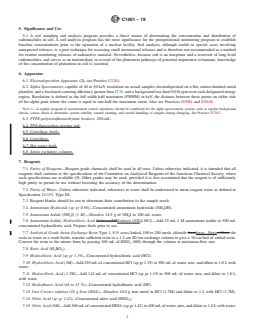
5.1 A soil sampling and analysis program provides a direct means of determining the concentration and distribution of radionuclides in soil. A soil analysis program has the most significance for the preoperational monitoring program to establish baseline concentrations prior to the operation of a nuclear facility. Soil analysis, although useful in special cases involving unexpected releases, is a poor technique for assessing small incremental releases and is therefore not recommended as a method for routine monitoring releases of radioactive material. Nevertheless, because soil is an integrator and a reservoir of long-lived radionuclides, and serves as an intermediary in several of the plutonium pathways of potential importance to humans, knowledge of the concentration of plutonium in soil is essential.
SCOPE
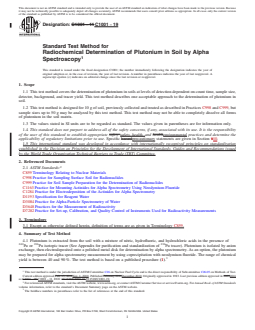
1.1 This test method covers the determination of plutonium in soils at levels of detection dependent on count time, sample size, detector, background, and tracer yield. This test method describes one acceptable approach to the determination of plutonium in soil.
1.2 This test method is designed for 10 g of soil, previously collected and treated as described in Practices C998 and C999, but sample sizes up to 50 g may be analyzed by this test method. This test method may not be able to completely dissolve all forms of plutonium in the soil matrix.
1.3 The values stated in SI units are to be regarded as standard. The values given in parentheses are for information only.
1.4 This standard does not purport to address all of the safety concerns, if any, associated with its use. It is the responsibility of the user of this standard to establish appropriate safety, health, and environmental practices and determine the applicability of regulatory limitations prior to use. Specific precautionary statements are given in Section 10.
1.5 This international standard was developed in accordance with internationally recognized principles on standardization established in the Decision on Principles for the Development of International Standards, Guides and Recommendations issued by the World Trade Organization Technical Barriers to Trade (TBT) Committee.
General Information
- Status
- Published
- Publication Date
- 31-Oct-2019
- Technical Committee
- C26 - Nuclear Fuel Cycle
- Drafting Committee
- C26.05 - Methods of Test
Relations
- Effective Date
- 01-Nov-2019
- Effective Date
- 01-Jan-2024
- Refers
ASTM C1284-18 - Standard Practice for Electrodeposition of the Actinides for Alpha Spectrometry - Effective Date
- 01-Jun-2018
- Refers
ASTM C999-17 - Standard Practice for Soil Sample Preparation for the Determination of Radionuclides - Effective Date
- 01-Jun-2017
- Effective Date
- 01-Jun-2017
- Effective Date
- 15-Jun-2014
- Effective Date
- 15-Jan-2014
- Effective Date
- 01-Jun-2013
- Effective Date
- 01-May-2013
- Effective Date
- 01-Jun-2012
- Effective Date
- 01-Jan-2011
- Effective Date
- 01-Nov-2010
- Effective Date
- 01-Aug-2010
- Refers
ASTM C1284-10 - Standard Practice for Electrodeposition of the Actinides for Alpha Spectrometry - Effective Date
- 01-Jun-2010
- Effective Date
- 01-Jun-2010
Overview
ASTM C1001-19: Standard Test Method for Radiochemical Determination of Plutonium in Soil by Alpha Spectroscopy provides a standardized procedure for analyzing plutonium concentrations in soil samples using alpha spectrometry. Published by ASTM International, this method offers laboratories a reliable approach for assessing baseline and contamination levels of plutonium in environmental soil, which is critical for nuclear facility monitoring, environmental remediation, and radiological impact studies.
The method outlines how to prepare soil samples, extract plutonium, and measure radioactive isotopes with sensitivity determined by sample size, count time, detector capabilities, and background levels. Emphasizing the importance of representative sampling, the standard focuses on accuracy, precision, and the safety precautions necessary for handling radioactive materials.
Key Topics
Soil Sampling and Preparation
- Follows practices outlined in ASTM C998 and C999 for collecting and treating representative soil samples.
- Recommends a minimum sample size of 10 grams for analytical sensitivity, with capacity for up to 50 grams depending on requirements.
Radiochemical Separation and Extraction
- Utilizes a mixture of acids (nitric, hydrofluoric, and hydrochloric) for extracting plutonium from soil.
- Employs anion exchange columns and electrodeposition onto metal disks for sample purification.
Alpha Spectrometry
- Uses alpha spectrometers with specific resolution and efficiency requirements.
- Procedures include calibrating instruments, preparing tracers, and running quality controls per referenced ASTM practices.
Calculation of Results
- Provides formulas for determining plutonium isotope concentrations (e.g., 239Pu, 240Pu) and yield calculations.
- Includes corrections for tracer and isotope interferences.
Laboratory Safety
- Mandates comprehensive safety, health, and environmental controls when working with hazardous chemicals and radioactive materials.
- Highlights the risks of hydrofluoric acid and the need for proper personal protective equipment and laboratory ventilation.
Applications
ASTM C1001-19 is applicable in various practical scenarios, such as:
Preoperational Nuclear Facility Monitoring
- Establishes baseline environmental concentrations of plutonium prior to facility operation.
- Essential for regulatory compliance and environmental stewardship.
Environmental Remediation
- Supports contaminated site assessment, risk evaluation, and cleanup process verification by accurately determining plutonium levels in soil.
Incident Response
- Used in special cases to analyze soil following unexpected or accidental radioactive releases to assess environmental and public health impacts.
Research and Development
- Enables academic and industry laboratories to contribute data on radionuclide migration, behavior, and long-term soil retention.
It is important to note that this method is not recommended for routine monitoring of low-level, incremental plutonium releases but is highly valuable in baseline and episodic assessment contexts.
Related Standards
To ensure a comprehensive radiochemical soil analysis program, the following related ASTM standards are referenced and recommended:
- ASTM C998: Practice for Sampling Surface Soil for Radionuclides
- ASTM C999: Practice for Soil Sample Preparation for Determination of Radionuclides
- ASTM C1284: Practice for Electrodeposition of the Actinides for Alpha Spectrometry
- ASTM C1163: Practice for Mounting Actinides for Alpha Spectrometry Using Neodymium Fluoride
- ASTM D1193: Specification for Reagent Water
- ASTM D3084: Practice for Alpha-Particle Spectrometry of Water
- ASTM D3648: Practices for the Measurement of Radioactivity
- ASTM D7282: Practice for Set-up, Calibration, and Quality Control of Instruments Used for Radioactivity Measurements
Summary
ASTM C1001-19 provides laboratories and environmental professionals with a consistent, credible method for the radiochemical determination of plutonium in soil. By following this standard, users can achieve accurate, reproducible results, essential for environmental monitoring, regulatory compliance, and plutonium contamination assessment. Proper adherence to safety protocols and related ASTM practices ensures the integrity and safety of analytical operations involving radioactive materials.
Buy Documents
ASTM C1001-19 - Standard Test Method for Radiochemical Determination of Plutonium in Soil by Alpha Spectroscopy
REDLINE ASTM C1001-19 - Standard Test Method for Radiochemical Determination of Plutonium in Soil by Alpha Spectroscopy
Get Certified
Connect with accredited certification bodies for this standard

DNV
DNV is an independent assurance and risk management provider.

Lloyd's Register
Lloyd's Register is a global professional services organisation specialising in engineering and technology.
DNV Energy Systems
Energy and renewable energy certification.
Sponsored listings
Frequently Asked Questions
ASTM C1001-19 is a standard published by ASTM International. Its full title is "Standard Test Method for Radiochemical Determination of Plutonium in Soil by Alpha Spectroscopy". This standard covers: SIGNIFICANCE AND USE 5.1 A soil sampling and analysis program provides a direct means of determining the concentration and distribution of radionuclides in soil. A soil analysis program has the most significance for the preoperational monitoring program to establish baseline concentrations prior to the operation of a nuclear facility. Soil analysis, although useful in special cases involving unexpected releases, is a poor technique for assessing small incremental releases and is therefore not recommended as a method for routine monitoring releases of radioactive material. Nevertheless, because soil is an integrator and a reservoir of long-lived radionuclides, and serves as an intermediary in several of the plutonium pathways of potential importance to humans, knowledge of the concentration of plutonium in soil is essential. SCOPE 1.1 This test method covers the determination of plutonium in soils at levels of detection dependent on count time, sample size, detector, background, and tracer yield. This test method describes one acceptable approach to the determination of plutonium in soil. 1.2 This test method is designed for 10 g of soil, previously collected and treated as described in Practices C998 and C999, but sample sizes up to 50 g may be analyzed by this test method. This test method may not be able to completely dissolve all forms of plutonium in the soil matrix. 1.3 The values stated in SI units are to be regarded as standard. The values given in parentheses are for information only. 1.4 This standard does not purport to address all of the safety concerns, if any, associated with its use. It is the responsibility of the user of this standard to establish appropriate safety, health, and environmental practices and determine the applicability of regulatory limitations prior to use. Specific precautionary statements are given in Section 10. 1.5 This international standard was developed in accordance with internationally recognized principles on standardization established in the Decision on Principles for the Development of International Standards, Guides and Recommendations issued by the World Trade Organization Technical Barriers to Trade (TBT) Committee.
SIGNIFICANCE AND USE 5.1 A soil sampling and analysis program provides a direct means of determining the concentration and distribution of radionuclides in soil. A soil analysis program has the most significance for the preoperational monitoring program to establish baseline concentrations prior to the operation of a nuclear facility. Soil analysis, although useful in special cases involving unexpected releases, is a poor technique for assessing small incremental releases and is therefore not recommended as a method for routine monitoring releases of radioactive material. Nevertheless, because soil is an integrator and a reservoir of long-lived radionuclides, and serves as an intermediary in several of the plutonium pathways of potential importance to humans, knowledge of the concentration of plutonium in soil is essential. SCOPE 1.1 This test method covers the determination of plutonium in soils at levels of detection dependent on count time, sample size, detector, background, and tracer yield. This test method describes one acceptable approach to the determination of plutonium in soil. 1.2 This test method is designed for 10 g of soil, previously collected and treated as described in Practices C998 and C999, but sample sizes up to 50 g may be analyzed by this test method. This test method may not be able to completely dissolve all forms of plutonium in the soil matrix. 1.3 The values stated in SI units are to be regarded as standard. The values given in parentheses are for information only. 1.4 This standard does not purport to address all of the safety concerns, if any, associated with its use. It is the responsibility of the user of this standard to establish appropriate safety, health, and environmental practices and determine the applicability of regulatory limitations prior to use. Specific precautionary statements are given in Section 10. 1.5 This international standard was developed in accordance with internationally recognized principles on standardization established in the Decision on Principles for the Development of International Standards, Guides and Recommendations issued by the World Trade Organization Technical Barriers to Trade (TBT) Committee.
ASTM C1001-19 is classified under the following ICS (International Classification for Standards) categories: 27.120.30 - Fissile materials and nuclear fuel technology. The ICS classification helps identify the subject area and facilitates finding related standards.
ASTM C1001-19 has the following relationships with other standards: It is inter standard links to ASTM C1001-11, ASTM C859-24, ASTM C1284-18, ASTM C999-17, ASTM C998-17, ASTM C859-14a, ASTM C859-14, ASTM C859-13a, ASTM C859-13, ASTM D3084-05(2012), ASTM D3648-04(2011), ASTM C859-10b, ASTM C859-10a, ASTM C1284-10, ASTM C999-05(2010)e1. Understanding these relationships helps ensure you are using the most current and applicable version of the standard.
ASTM C1001-19 is available in PDF format for immediate download after purchase. The document can be added to your cart and obtained through the secure checkout process. Digital delivery ensures instant access to the complete standard document.
Standards Content (Sample)
This international standard was developed in accordance with internationally recognized principles on standardization established in the Decision on Principles for the
Development of International Standards, Guides and Recommendations issued by the World Trade Organization Technical Barriers to Trade (TBT) Committee.
Designation: C1001 − 19
Standard Test Method for
Radiochemical Determination of Plutonium in Soil by Alpha
Spectroscopy
This standard is issued under the fixed designation C1001; the number immediately following the designation indicates the year of
original adoption or, in the case of revision, the year of last revision.Anumber in parentheses indicates the year of last reapproval.A
superscript epsilon (´) indicates an editorial change since the last revision or reapproval.
1. Scope C999Practice for Soil Sample Preparation for the Determi-
nation of Radionuclides
1.1 This test method covers the determination of plutonium
C1163PracticeforMountingActinidesforAlphaSpectrom-
in soils at levels of detection dependent on count time, sample
etry Using Neodymium Fluoride
size, detector, background, and tracer yield. This test method
C1284Practice for Electrodeposition of the Actinides for
describes one acceptable approach to the determination of
Alpha Spectrometry
plutonium in soil.
D1193Specification for Reagent Water
1.2 This test method is designed for 10 g of soil, previously
D3084Practice for Alpha-Particle Spectrometry of Water
collectedandtreatedasdescribedinPracticesC998andC999,
D3648Practices for the Measurement of Radioactivity
but sample sizes up to 50 g may be analyzed by this test
D7282Practice for Set-up, Calibration, and Quality Control
method. This test method may not be able to completely
of Instruments Used for Radioactivity Measurements
dissolve all forms of plutonium in the soil matrix.
3. Terminology
1.3 The values stated in SI units are to be regarded as
standard. The values given in parentheses are for information
3.1 Except as otherwise defined herein, definition of terms
only.
are as given in Terminology C859.
1.4 This standard does not purport to address all of the
4. Summary of Test Method
safety concerns, if any, associated with its use. It is the
responsibility of the user of this standard to establish appro- 4.1 Plutonium is extracted from the soil with a mixture of
priate safety, health, and environmental practices and deter- nitric, hydrofluoric, and hydrochloric acids in the presence of
242 236
mine the applicability of regulatory limitations prior to use. Pu or Pu isotopic tracer (See Appendix for purification
Specific precautionary statements are given in Section 10. and standardization of Pu tracer). Plutonium is isolated by
1.5 This international standard was developed in accor- anion exchange, then electrodeposited onto a polished metal
dance with internationally recognized principles on standard- diskfordeterminationbyalphaspectrometry.Asanoption,the
ization established in the Decision on Principles for the plutonium may be prepared for alpha spectrometry measure-
Development of International Standards, Guides and Recom- ment by using coprecipitation with neodymium fluoride. The
mendations issued by the World Trade Organization Technical range of chemical yield is between 40 and 90%. The test
Barriers to Trade (TBT) Committee. method is based on a published procedure (1).
5. Significance and Use
2. Referenced Documents
5.1 Asoil sampling and analysis program provides a direct
2.1 ASTM Standards:
means of determining the concentration and distribution of
C859Terminology Relating to Nuclear Materials
radionuclides in soil. A soil analysis program has the most
C998Practice for Sampling Surface Soil for Radionuclides
significance for the preoperational monitoring program to
establish baseline concentrations prior to the operation of a
nuclear facility. Soil analysis, although useful in special cases
ThistestmethodisunderthejurisdictionofASTMCommitteeC26onNuclear
involving unexpected releases, is a poor technique for assess-
Fuel Cycle and is the direct responsibility of Subcommittee C26.05 on Methods of
Test. ing small incremental releases and is therefore not recom-
Current edition approved Nov. 1, 2019. Published December 2019. Originally
mended as a method for routine monitoring releases of
approved in 1983. Last previous edition approved in 2011 as C1001–11. DOI:
radioactivematerial.Nevertheless,becausesoilisanintegrator
10.1520/C1001-19.
For referenced ASTM standards, visit the ASTM website, www.astm.org, or
contact ASTM Customer Service at service@astm.org. For Annual Book of ASTM
Standards volume information, refer to the standard’s Document Summary page on Theboldfacenumbersinparenthesesrefertothelistofreferencesattheendof
the ASTM website. this standard.
Copyright © ASTM International, 100 Barr Harbor Drive, PO Box C700, West Conshohocken, PA 19428-2959. United States
C1001 − 19
and a reservoir of long-lived radionuclides, and serves as an Convert the resin to the nitrate form by passing 100 mL of
intermediary in several of the plutonium pathways of potential HNO (8M) through the column at maximum flow rate.
importance to humans, knowledge of the concentration of
7.8 Boric Acid (H BO ).
3 3
plutonium in soil is essential.
7.9 Hydrochloric Acid (sp gr 1.19)—Concentrated hydro-
chloric acid (HCl).
6. Apparatus
7.10 HydrochloricAcid (3M)—Add250mLofconcentrated
6.1 Electrodeposition Apparatus (2), see Practice C1284.
HCl (sp gr 1.19) to 500 mL of water, mix, and dilute to 1.0 L
6.2 Alpha Spectrometer, capable of 40 to 50 keV resolution
with water.
on actual samples electrodeposited on a flat, mirror-finished
7.11 Hydrochloric Acid (1.7M)—Add 142 mL of concen-
metal planchet, and a fractional counting efficiency greater
trated HCl (sp gr 1.19) to 500 mL of water, mix, and dilute to
than 17%, and a background less than 0.010 cpm over each
1.0 L with water.
designated energy region. Resolution is defined as the full
width half maximum (FWHM) in keV, the distance between 7.12 Hydrofluoric Acid (48 to 51 %)—Concentrated hydro-
fluoric acid (HF).
thosepointsoneithersideofthealphapeakwherethecountis
equal to one-half the maximum count. Also see Practices
7.13 IronCarriersolution(10gIron(III)/L)—Dissolve10.0
D3084 and D3648.
g iron metal in HCl (1.7M) and dilute to 1 Lwith HCl (1.7M).
NOTE 1—Aregular program of measurement control operations should
7.14 Nitric Acid (sp gr 1.42)—Concentrated nitric acid
be conducted for the alpha spectrometry system, such as regular back-
(HNO ).
ground checks, source check to determine system stability, control
charting, and careful handling of samples during changing. See Practice 7.15 Nitric Acid (8M)—Add 500 mLof concentrated HNO
D7282.
(sp gr 1.42) to 400 mL of water, mix, and dilute to 1.0 L with
water.
6.3 PTFE-polytetrafluoroethylene beakers, 250-mL.
7.16 Nitric Acid (1.8M)—Add 112 mL of concentrated
6.4 TFE-flurocarbon stirring rod.
HNO (sp gr 1.42) to 500 mL of water, mix, and dilute to 1.0
6.5 Centrifuge bottle.
L with water.
6.6 Centrifuge.
7.17 Octyl alcohol.
6.7 Hot water bath.
7.18 Sodium Bisulfite (NaHSO ).
6.8 Anion exchange columns.
7.19 Sodium Hydroxide (50 %)—Dissolve 500 g of NaOH
in 500 mLwater.A50% NaOH solution is available commer-
7. Reagents
cially.
7.1 Purity of Reagents—Reagent grade chemicals shall be
7.20 Sodium Nitrite (NaNO ).
used in all tests. Unless otherwise indicated, it is intended that
7.21 Thymol Blue Indicator, Sodium Salt, 0.02 % Solution.
all reagents shall conform to the specifications of the Commit-
7.22 National Standard Traceable Pu Reagent.
tee onAnalytical Reagents of theAmerican Chemical Society,
where such specifications are available (3). Other grades may
7.23 National Standard Traceable Pu Reagent.
be used, provided it is first ascertained that the reagent is of
8. Sampling
sufficiently high purity to permit its use without lessening the
accuracy of the determination.
8.1 Collect the sample in accordance with Practice C998.
7.2 Purity of Water—Unless otherwise indicated, references
8.2 Prepare the sample for analysis in accordance with
to water shall be understood to mean reagent water as defined
Practice C999.
in Specification D1193, Type III.
8.3 Samples consisting of 10 to 50 g of soil can be readily
7.3 Reagent blanks should be run to determine their contri-
analyzed by the procedure. In order to obtain more represen-
bution to the sample result.
tative samples, as well as lowering the minimum detectable
concentration,theanalysesoflargesoilsamplesisdesirable.In
7.4 Ammonium Hydroxide (sp gr 0.90)—Concentrated am-
general, it is poor practice to use less than 10 g of sample,
monium hydroxide (NH OH).
unless replicate analyses are performed, because of needed
7.5 Ammonium Iodide (NH I) (1 M)—Dissolve 14.5 g of
sensitivity to determine lower levels of activity.
NH I in 100 mL water.
9. Calibration and Standardization
7.6 Ammonium Iodide, Hydrochloric Acid Solution (NH I-
HCl)—Add 25 mL1 M ammonium iodide to 500 mLconcen-
9.1 The fractional counting efficiency of the alpha spec-
trated hydrochloric acid. Prepare fresh prior to use.
trometerisusedtodeterminethechemicalyield.Thefractional
efficiency of the alpha spectrometer is determined as the ratio
7.7 Analytical Grade Anion Exchange Resin Type 1, 8%
of the observed count rate to the known disintegration rate.
cross-linked, 100 to 200 mesh, chloride form—Store the resin
inwaterinawashbottle,transfersufficientresintoa1.3-cmID 9.2 The quantity of the tracer to be used should be in the
ion exchange column to give a 10-cm bed of settled resin. expected range (but not less than 0.17 Bq) of the isotopic
C1001 − 19
activity being determined so that the statistical uncertainty in 11.9 Add 50 mL of water and digest on a hotplate while
the chemical yield determination will not be larger than that of stirring for 10 min to dissolve soluble salts.
the nuclide being determined.
11.10 Cool and transfer approximately equal parts of the
total sample into centrifuge bottles with a minimum of water
10. Precautions
from a wash bottle. If equipment for large volume centrifuga-
tion is not available, the two precipitations in 11.11 – 11.21
10.1 Adequatelaboratoryfacilities,suchasfumehoodsand
controlledventilation,alongwithsafetechniques,mustbeused may be performed in a beaker, allowing the precipitate to
settle, decanting the supernate, and then completing the sepa-
in this procedure. Extreme care should be exercised in using
hydrofluoric and other hot, concentrated acids. Use of proper ration by centrifugation on a smaller scale.
gloves is recommended. Refer to the laboratory’s chemical
11.11 Add 1.0 mL of iron carrier solution (10 mg Fe
hygiene plan and other applicable guidance for handling
(III)/mL) to each centrifuge bottle and mix (Note 4).
chemical and radioactive materials and for the management of
NOTE 4—It may not be necessary to add the iron carrier if a sufficient
radioactive, mixed, and hazardous waste.
amount of iron is present in the soil.
10.2 Hydrofluoric acid is a highly corrosive acid that can
11.12 AddNaOH(50%)withmixingtoeachbottletoapH
severely burn skin, eyes, and mucous membranes. Hydroflu-
ofabout9(usingpHpaper)toprecipitateferrichydroxide.Add
oric acid differs from other acids because the fluoride ion
5 to 10 mL excess NaOH and mix for 1 min.
readily penetrates the skin, causing destruction of deep tissue
layers. Unlike other acids that are rapidly neutralized, hydro- 11.13 Centrifuge for approximately 5 min, decant, and
fluoric acid reactions with tissue may continue for days if left discard the supernate.
untreated.FamiliarizationandcompliancewiththeSafetyData
11.14 Dissolve each precipitate with about 30 mL HNO
Sheet is essential.
(8M) (60 mL total) saturated with boric acid. (Approximately
7 g of boric acid/30 mL HNO (8M).) Digest in a hot water
11. Procedure
bath for 10 min.
11.1 Weigh a 10.0 6 0.1 g soil aliquot into a 250 mLPTFE
11.15 Cool and centrifuge for approximately 5 min. Decant
beaker.
the supernate into the original 250 mLPTFE beaker and save.
11.2 Wet sample with distilled water and add a known
11.16 Wash each residue with approximately 10 to 20 mL
236 242
quantity of Pu or Pu tracer.
(20 to 40 mL total) of HNO (8M) saturated with boric acid.
11.3 Add concentrated HNO (sp gr 1.42) a few drops at a Centrifuge for 5 min and combine the supernates with that in
timeasfastasthefrothingandvigorofthereactionwillpermit 11.15. Discard the undigested soil.
until the entire sample is covered.
11.17 Heat the supernate on a hotplate and evaporate to
11.4 Add 60 mL more of the concentrated HNO (sp gr approximately 5 mL.
1.42)and30mLofconcentratedHF(48to51%)anddigeston
11.18 Add approximately 30 mLwater and heat to dissolve
a hotplate with frequent stirring (TFE-fluorocarbon stirring
the salts. Cool and transfer into a centrifuge tube.
rod) for about1h(Note 2 and Note 3).
11.19 Add concentrated ammonium hydroxide dropwise
NOTE 2—For organic soils, first add the nitric acid only in small
with mixing to a pH of approximately 9 (using pH paper) to
portions while stirring. If the solution threatens to overflow as a result of
precipitate ferric hydroxide.
froth generation, add a few drops of octyl alcohol and stir. Digest on a
hotplate until the evolution of reddish-brown fumes is reduced to a barely
11.20 Centrifuge and discard the supernate.
visible level. Cool to room temperature before carefully adding the
concentrated hydrofluoric acid (48 to 51%) and digesting for an hour. 11.21 Dissolve the precipitate with a volume of concen-
NOTE 3—For larger soil aliquots, larger amounts of the acids (in the
trated nitric acid approximately equal to the volume of the
sameproportions)shouldbeused.Forexample,fora50gsample,use200
precipitate and transfer using nitric acid (8M) into a 250-mL
mL concentrated. HNO and 100 mL HF, etc., with appropriately sized
beaker.Addnitricacid(8M)toatotalvolumeofapproximately
containers.
75 mL. If the volume of the hydroxide precipitate is consider-
11.5 Remove from the hotplate and cool somewhat before
ablygreaterthanshouldbeexpectedfromthe10mgofFe(III)
adding 30 mL concentrated HNO (sp gr 1.42) and 30 mL
added,thefinalvolumeshouldbebroughtuptoapproximately
concentrated HF (48 to 51%). Digest on the hotplate with
100 mL with nitric acid (8M) or, alternatively, the dissolved
intermittent stirring for an additional 1 h.
hydroxidesshouldbeevaporatedtosaltsbeforetheadditionof
...
This document is not an ASTM standard and is intended only to provide the user of an ASTM standard an indication of what changes have been made to the previous version. Because
it may not be technically possible to adequately depict all changes accurately, ASTM recommends that users consult prior editions as appropriate. In all cases only the current version
of the standard as published by ASTM is to be considered the official document.
Designation: C1001 − 11 C1001 − 19
Standard Test Method for
Radiochemical Determination of Plutonium in Soil by Alpha
Spectroscopy
This standard is issued under the fixed designation C1001; the number immediately following the designation indicates the year of
original adoption or, in the case of revision, the year of last revision. A number in parentheses indicates the year of last reapproval. A
superscript epsilon (´) indicates an editorial change since the last revision or reapproval.
1. Scope
1.1 This test method covers the determination of plutonium in soils at levels of detection dependent on count time, sample size,
detector, background, and tracer yield. This test method describes one acceptable approach to the determination of plutonium in
soil.
1.2 This test method is designed for 10 g of soil, previously collected and treated as described in Practices C998 and C999, but
sample sizes up to 50 g may be analyzed by this test method. This test method may not be able to completely dissolve all forms
of plutonium in the soil matrix.
1.3 The values stated in SI units are to be regarded as standard. The values given in parentheses are for information only.
1.4 This standard does not purport to address all of the safety concerns, if any, associated with its use. It is the responsibility
of the user of this standard to establish appropriate safety safety, health, and healthenvironmental practices and determine the
applicability of regulatory limitations prior to use. Specific hazardprecautionary statements are given in Section 910.
1.5 This international standard was developed in accordance with internationally recognized principles on standardization
established in the Decision on Principles for the Development of International Standards, Guides and Recommendations issued
by the World Trade Organization Technical Barriers to Trade (TBT) Committee.
2. Referenced Documents
2.1 ASTM Standards:
C859 Terminology Relating to Nuclear Materials
C998 Practice for Sampling Surface Soil for Radionuclides
C999 Practice for Soil Sample Preparation for the Determination of Radionuclides
C1163 Practice for Mounting Actinides for Alpha Spectrometry Using Neodymium Fluoride
C1284 Practice for Electrodeposition of the Actinides for Alpha Spectrometry
D1193 Specification for Reagent Water
D3084 Practice for Alpha-Particle Spectrometry of Water
D3648 Practices for the Measurement of Radioactivity
D7282 Practice for Set-up, Calibration, and Quality Control of Instruments Used for Radioactivity Measurements
3. Terminology
3.1 Except as otherwise defined herein, definition of terms are as given in Terminology C859.
4. Summary of Test Method
4.1 Plutonium is extracted from the soil with a mixture of nitric, hydrofluoric, and hydrochloric acids in the presence of
242 236 236
Pu or Pu isotopic tracer (See Appendix for purification and standardization of Pu tracer). Plutonium is isolated by anion
exchange, then electrodeposited onto a polished metal disk for determination by alpha spectrometry. As an option, the plutonium
may be prepared for alpha spectrometry measurement by using coprecipitation with neodymium fluoride. The range of chemical
yield is between 40 and 90 %. The test method is based on a published procedure (1).
This test method is under the jurisdiction of ASTM Committee C26 on Nuclear Fuel Cycle and is the direct responsibility of Subcommittee C26.05 on Methods of Test.
Current edition approved Feb. 15, 2011Nov. 1, 2019. Published February 2011December 2019. Originally approved in 1983. Last previous edition approved in 20052011
as C1001 – 05.C1001 – 11. DOI: 10.1520/C1001-11.10.1520/C1001-19.
For referenced ASTM standards, visit the ASTM website, www.astm.org, or contact ASTM Customer Service at service@astm.org. For Annual Book of ASTM Standards
volume information, refer to the standard’s Document Summary page on the ASTM website.
The boldface numbers in parentheses refer to the list of references at the end of this standard.
Copyright © ASTM International, 100 Barr Harbor Drive, PO Box C700, West Conshohocken, PA 19428-2959. United States
C1001 − 19
5. Significance and Use
5.1 A soil sampling and analysis program provides a direct means of determining the concentration and distribution of
radionuclides in soil. A soil analysis program has the most significance for the preoperational monitoring program to establish
baseline concentrations prior to the operation of a nuclear facility. Soil analysis, although useful in special cases involving
unexpected releases, is a poor technique for assessing small incremental releases and is therefore not recommended as a method
for routine monitoring releases of radioactive material. Nevertheless, because soil is an integrator and a reservoir of long-lived
radionuclides, and serves as an intermediary in several of the plutonium pathways of potential importance to humans, knowledge
of the concentration of plutonium in soil is essential.
6. Apparatus
6.1 Electrodeposition Apparatus (2), see Practice C1284.
6.2 Alpha Spectrometer, capable of 40 to 50 keV resolution on actual samples electrodeposited on a flat, mirror-finished metal
planchet, and a fractional counting efficiency greater than 17 %, and a background less than 0.010 cpm over each designated energy
region. Resolution is defined as the full width half maximum (FWHM) in keV, the distance between those points on either side
of the alpha peak where the count is equal to one-half the maximum count. Also see Practices D3084 and D3648.
NOTE 1—A regular program of measurement control operations should be conducted for the alpha spectrometry system, such as regular background
checks, source check to determine system stability, control charting, and careful handling of samples during changing. See Practice D7282.
6.3 PTFE-polytetrafluoroethylene beakers, 250-mL.
6.4 TFE-flurocarbon stirring rod.
6.5 Centrifuge bottle.
6.6 Centrifuge.
6.7 Hot water bath.
6.8 Anion exchange columns.
7. Reagents
7.1 Purity of Reagents—Reagent grade chemicals shall be used in all tests. Unless otherwise indicated, it is intended that all
reagents shall conform to the specifications of the Committee on Analytical Reagents of the American Chemical Society, where
such specifications are available (3). Other grades may be used, provided it is first ascertained that the reagent is of sufficiently
high purity to permit its use without lessening the accuracy of the determination.
7.2 Purity of Water—Unless otherwise indicated, references to water shall be understood to mean reagent water as defined in
Specification D1193, Type III.
7.3 Reagent blanks should be run to determine their contribution to the sample result.
7.4 Ammonium Hydroxide (sp gr 0.90)—Concentrated ammonium hydroxide (NH OH).
7.5 Ammonium Iodide (NH I) (1 M)—Dissolve 14.5 g of NH I in 100 mL water.
4 4
7.6 Ammonium Iodide, Hydrochloric Acid Solution(NHSolution (NH I-HCl)—Add 25 mL 1 M ammonium iodide to 500 mL
concentrated hydrochloric acid. Prepare fresh prior to use.
7.7 Analytical Grade Anion Exchange Resin Type 1, 8 % cross-linked, 100 to 200 mesh, chloride formform—Store—Store the
resin in water in a wash bottle, transfer sufficient resin to a 1.3-cm ID ion exchange column to give a 10-cm bed of settled resin.
Convert the resin to the nitrate form by passing 100 mL of HNO (8M) through the column at maximum flow rate.
7.8 Boric Acid (H BO ).
3 3
7.9 Hydrochloric Acid (sp gr 1.19)—Concentrated hydrochloric acid (HCl).
7.10 Hydrochloric Acid (3M)—Add 250 mL of concentrated HCl (sp gr 1.19) to 500 mL of water, mix, and dilute to 1.0 L with
water.
7.11 Hydrochloric Acid (1.7M)—Add 142 mL of concentrated HCl (sp gr 1.19) to 500 mL of water, mix, and dilute to 1.0 L
with water.
7.12 Hydrofluoric Acid (48 to 51 %)—Concentrated hydrofluoric acid (HF).
7.13 Iron Carrier solution (10 g Iron (III)/L)—Dissolve 10.0 g iron metal in HCl (1.7M) and dilute to 1 L with HCl (1.7M).
7.14 Nitric Acid (sp gr 1.42)—Concentrated nitric acid (HNO ).
7.15 Nitric Acid (8M)—Add 500 mL of concentrated HNO (sp gr 1.42) to 400 mL of water, mix, and dilute to 1.0 L with water.
C1001 − 19
7.16 Nitric Acid (1.8M)—Add 112 mL of concentrated HNO (sp gr 1.42) to 500 mL of water, mix, and dilute to 1.0 L with
water.
7.17 Octyl alcohol.
7.18 Sodium Bisulfite (NaHSO ).
7.19 Sodium Hydroxide (50 %)—Dissolve 500 g of NaOH in 500 mL water. A 50 % NaOH solution is available commercially.
7.20 Sodium Nitrite (NaNO ).
7.21 Thymol Blue Indicator, Sodium Salt, 0.02 % Solution.
7.22 National Standard Traceable Plutonium-236Pu Reagent.
7.23 National Standard Traceable Plutonium-242Pu Reagent.
8. Sampling
8.1 Collect the sample in accordance with Practice C998.
8.2 Prepare the sample for analysis in accordance with Practice C999.
8.3 Samples consisting of 10 to 50 g of soil can be readily analyzed by the procedure. In order to obtain more representative
samples, as well as lowering the minimum detectable concentration, the analyses of large soil samples is desirable. In general, it
is poor practice to use less than 10 g of sample, unless replicate analyses are performed, because of needed sensitivity to determine
lower levels of activity.
9. Calibration and Standardization
9.1 The fractional counting efficiency of the alpha spectrometer is used to determine the chemical yield. The fractional efficiency
of the alpha spectrometer is determined as the ratio of the observed count rate to the known disintegration rate.
9.2 The quantity of the tracer to be used should be in the expected range (but not less than 0.17 Bq) of the isotopic activity being
determined so that the statistical uncertainty in the chemical yield determination will not be larger than that of the nuclide being
determined.
10. Precautions
10.1 Adequate laboratory facilities, such as fume hoods and controlled ventilation, along with safe techniques, must be used in
this procedure. Extreme care should be exercised in using hydrofluoric and other hot, concentrated acids. Use of proper gloves is
recommended. Refer to the laboratory’s chemical hygiene plan and other applicable guidance for handling chemical and
radioactive materials and for the management of radioactive, mixed, and hazardous waste.
10.2 Hydrofluoric acid is a highly corrosive acid that can severely burn skin, eyes, and mucous membranes. Hydrofluoric acid
is similar to other acids in that the initial extent of a burn depends on the concentration, the temperature, and the duration of contact
with the acid. Hydrofluoric acid differs from other acids because the fluoride ion readily penetrates the skin, causing destruction
of deep tissue layers. Unlike other acids that are rapidly neutralized, hydrofluoric acid reactions with tissue may continue for days
if left unattended. Due to the serious consequences of hydrofluoric acid burns, prevention of exposure or injury of personnel is the
primary goal. Utilization of appropriate laboratory controls (hoods) and wearing adequate personal protective equipment to protect
from skin and eye contact untreated. Familiarization and compliance with the Safety Data Sheet is essential.
11. Procedure
11.1 Weigh a 10.0 6 0.1 g soil aliquot into a 250 mL PTFE beaker.
236 242
11.2 Wet sample with distilled water and add a known quantity of Pu or Pu tracer.
11.3 Add concentrated HNO (sp gr 1.42) a few drops at a time as fast as the frothing and vigor of the reaction will permit until
the entire sample is covered.
11.4 Add 60 mL more of the concentrated HNO (sp gr 1.42) and 30 mL of concentrated HF (48 to 51 %) and digest on a
hotplate with frequent stirring (TFE fluorocarbon (TFE-fluorocarbon stirring rod) for about 1 h (Note 2 and Note 3).
NOTE 2—For organic soils, first add the nitric acid only in small portions while stirring. If the solution threatens to overflow as a result of froth
generation, add a few drops of octyl alcohol and stir. Digest on a hotplate until the evolution of reddish-brown fumes is reduced to a barely visible level.
Cool to room temperature before carefully adding the concentrated hydrofluoric acid (48 to 51 %) and digesting for an hour.
NOTE 3—For larger soil aliquots, larger amounts of the acids (in the same proportions) should be used. For example, for a 50 g sample, use 200 mL
concentrated. HNO and 100 mL HF, etc., with appropriately sized containers.
11.5 Remove from the hotplate and cool somewhat before adding 30 mL concentrated HNO (sp gr 1.42) and 30 mL
concentrated HF (48 to 51 %). Digest on the hotplate with intermittent stirring for an additional 1 h.
11.6 Remove from the hotplate and cool. Carefully add 20 mL concentrated HCl (sp gr 1.19) and stir. Heat on hotplate for 45
min with occasional stirring.
C1001 − 19
11.7 Add about 5 g of powdered boric acid and digest for an additional 15 min with occasional stirring.
11.8 Add approximately 200 mg of sodium bisulfite and continue heating until the solution has evaporated to a liquid volume
of approximately 20 mL.
11.9 Add 50 mL of water and digest on a hotplate while stirring for 10 min to dissolve soluble salts.
11.10 Cool and transfer approximately equal parts of the total sample into centrifuge bottles with a minimum of water from a
wash bottle. If equipment for large volume centrifugation is not available, the two precipitations in 10.1111.11 – 10.2111.21 may
be performed in a beaker, allowing the precipitate to settle, decanting the supernate, and then completing the separation by
centrifugation on a smaller scale.
11.11 Add 1.0 mL of iron carrier solution (10 mg Fe (III)/mL) to each centrifuge bottle and mix (Note 4).
NOTE 4—It may not be necessary to add the iron carrier if a sufficient amount of iron is present in the soil.
11.12 Add NaOH (50 %) with mixing to each bottle to a pH of about 9 (using pH paper) to precipitate ferric hydroxide. Add
5 to 10 mL excess NaOH and mix for 1 min.
11.13 Centrifuge for approximately 5 min, decant, and discard the supernate.
11.14 Dissolve each precipitate with about 30 mL HNO (8M) (60 mL total) saturated with boric acid. (Approximately 7 g of
boric acid/30 mL HNO (8M).) Digest in a hot water bath for 10 min.
11.15 Cool and centrifuge for approximately 5 min. Decant the supernate into the original 250 mL PTFE beaker and save.
11.16 Wash each residue with approximately 10 to 20 mL (20 to 40 mL total) of HNO (8M) saturated with boric acid.
Centrifuge for 5 min and combine the supernates with that in 10.1511.15. Discard the undigested soil.
11.17 Heat the supernate on a hotplate and evaporate to approximately 5 mL.
11.18 Add approximately 30 mL water and heat to dissolve the salts. Cool and transfer into a centrifuge tube.
11.19 Add concentrated ammonium hydroxide dropwise with mixing to a pH of approximately 9 (using pH paper) to precipitate
ferric hydroxide.
11.20 Centrifuge and discard the supernate.
11.21 Dissolve the precipitate with a volume of concentrated nitric acid approximately equal to the volume of the precipitate
and transfer using nitric acid (8M) into a 250-mL beaker. Add nitric acid (8M) to a total volume of approximat
...
Questions, Comments and Discussion
Ask us and Technical Secretary will try to provide an answer. You can facilitate discussion about the standard in here.
Loading comments...