


ASTM D1125-23
(Test Method)Standard Test Methods for Electrical Conductivity and Resistivity of Water
Standard Test Methods for Electrical Conductivity and Resistivity of Water
SIGNIFICANCE AND USE
4.1 These test methods are applicable for such purposes as impurity detection and, in some cases, the quantitative measurement of ionic constituents dissolved in waters. These include dissolved electrolytes in natural and treated waters, such as boiler water, boiler feedwater, cooling water, and saline and brackish water.
4.1.1 Their concentration may range from trace levels in pure waters (2)4 to significant levels in condensed steam (see Test Methods D2186 and D4519, and Ref (3)), or pure salt solutions.
4.1.2 Where the principal interest in the use of conductivity methods is to determine steam purity, see Ref (4). These test methods may also be used for checking the correctness of water analyses (5).
SCOPE
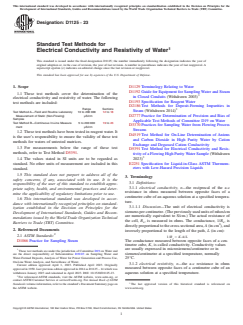
1.1 These test methods cover the determination of the electrical conductivity and resistivity of water. The following test methods are included:
Range
Sections
Test Method A—Field and Routine Laboratory
10 to 200 000
12 to 18
Measurement of Static (Non-Flowing) Samples
μS/cm
Test Method B—Continuous In-Line Measure
5 to 200 000
19 to 23
ment
μS/cm
1.2 These test methods have been tested in reagent water. It is the user's responsibility to ensure the validity of these test methods for waters of untested matrices.
1.3 For measurements below the range of these test methods, refer to Test Method D5391.
1.4 The values stated in SI units are to be regarded as standard. No other units of measurement are included in this standard.
1.5 This standard does not purport to address all of the safety concerns, if any, associated with its use. It is the responsibility of the user of this standard to establish appropriate safety, health, and environmental practices and determine the applicability of regulatory limitations prior to use.
1.6 This international standard was developed in accordance with internationally recognized principles on standardization established in the Decision on Principles for the Development of International Standards, Guides and Recommendations issued by the World Trade Organization Technical Barriers to Trade (TBT) Committee.
General Information
- Status
- Published
- Publication Date
- 31-Mar-2023
- Technical Committee
- D19 - Water
Relations
- Effective Date
- 01-May-2020
- Effective Date
- 01-Aug-2018
- Effective Date
- 01-Aug-2018
- Effective Date
- 01-Jun-2016
- Effective Date
- 15-Jun-2012
- Effective Date
- 15-Jun-2011
- Effective Date
- 01-May-2011
- Effective Date
- 01-Dec-2010
- Effective Date
- 01-Nov-2010
- Effective Date
- 01-Mar-2010
- Effective Date
- 01-Oct-2008
- Effective Date
- 15-Jan-2008
- Effective Date
- 01-Dec-2007
- Effective Date
- 01-Nov-2007
- Effective Date
- 15-Dec-2006
Overview
ASTM D1125-23: Standard Test Methods for Electrical Conductivity and Resistivity of Water is a key international standard developed by ASTM International. This standard specifies procedures for determining the electrical conductivity and resistivity of water, fundamental indicators of ionic content and water purity. The test methods are widely used for quality control, process monitoring, and contamination detection in various water types, including natural, treated, industrial, boiler, cooling, brackish, and saline waters. Adherence to this standard ensures consistency and accuracy in water quality measurements across diverse industries and laboratories.
Key Topics
- Electrical Conductivity of Water: Measures the ability of water to conduct electricity, reflecting the concentration of dissolved ions.
- Electrical Resistivity of Water: The inverse of conductivity, indicating the resistance of water to the flow of electric current.
- Test Method A: For field and routine laboratory measurement of static (non-flowing) samples within a range of 10 to 200,000 μS/cm.
- Test Method B: For continuous, in-line measurement in process streams, covering a range of 5 to 200,000 μS/cm.
- Significance and Use:
- Detecting impurities and quantifying ionic constituents in water.
- Monitoring steam and condensate purity in power generation.
- Validating water analysis results.
- Sampling and Calibration: Emphasizes correct sample handling, instrument calibration, and temperature control to ensure accuracy-critical for both high-purity and contaminated water.
- Limitations and Interferences:
- Atmospheric contamination, particularly for pure waters.
- Electrode fouling and maintenance requirements.
- Temperature effects on measurements, requiring compensation or control.
Applications
ASTM D1125-23 is versatile and applicable across multiple sectors where water quality is crucial:
- Power Generation: Checking the purity of boiler water, feedwater, and steam condensate to prevent scaling and corrosion.
- Industrial Water Treatment: Monitoring process water, cooling water, and effluent streams for compliance and operational efficiency.
- Environmental Testing: Measuring electrical conductivity in lakes, rivers, and groundwater to assess pollution and salt intrusion.
- Laboratory Analysis: Ensuring the reliability of chemical analyses that depend on accurate water quality data.
- Pharmaceutical and Microelectronics Manufacturing: Verifying the purity of high-quality water used in production and rinsing processes.
- Desalination and Water Purification: Assessing treatment effectiveness and water potability.
By providing standardized procedures, ASTM D1125-23 promotes consistency in water quality testing and helps facilities meet regulatory and operational standards.
Related Standards
ASTM D1125-23 interfaces with several other ASTM and international water quality standards, enhancing its practical value:
- ASTM D1129 – Terminology Relating to Water
- ASTM D1192 – Guide for Equipment for Sampling Water and Steam
- ASTM D1193 – Specification for Reagent Water
- ASTM D2186 – Deposit-Forming Impurities in Steam (Withdrawn)
- ASTM D2777 – Practice for Determination of Precision and Bias of Applicable Test Methods of Committee D19 on Water
- ASTM D3370 – Practices for Sampling Water from Flowing Process Streams
- ASTM D4519 – On-Line Determination of Anions and Carbon Dioxide in High Purity Water
- ASTM D5391 – Test Method for Electrical Conductivity and Resistivity of Flowing High Purity Water Sample (for low-range measurements)
- ASTM E2251 – Specification for Low-Hazard Liquid-in-Glass Thermometers
Each referenced document contributes to a comprehensive approach in water testing, sampling, and quality assurance, enabling users to maintain high standards and regulatory compliance in water analysis.
Keywords: ASTM D1125, electrical conductivity of water, electrical resistivity of water, water quality testing, water analysis, power plant water, laboratory water testing, in-line water measurement, impurity detection in water, industrial water standards, standard test methods for water
Get Certified
Connect with accredited certification bodies for this standard

NSF International
Global independent organization facilitating standards development and certification.

CIS Institut d.o.o.
Personal Protective Equipment (PPE) certification body. Notified Body NB-2890 for EU Regulation 2016/425 PPE.

Kiwa BDA Testing
Building and construction product certification.
Sponsored listings
Frequently Asked Questions
ASTM D1125-23 is a standard published by ASTM International. Its full title is "Standard Test Methods for Electrical Conductivity and Resistivity of Water". This standard covers: SIGNIFICANCE AND USE 4.1 These test methods are applicable for such purposes as impurity detection and, in some cases, the quantitative measurement of ionic constituents dissolved in waters. These include dissolved electrolytes in natural and treated waters, such as boiler water, boiler feedwater, cooling water, and saline and brackish water. 4.1.1 Their concentration may range from trace levels in pure waters (2)4 to significant levels in condensed steam (see Test Methods D2186 and D4519, and Ref (3)), or pure salt solutions. 4.1.2 Where the principal interest in the use of conductivity methods is to determine steam purity, see Ref (4). These test methods may also be used for checking the correctness of water analyses (5). SCOPE 1.1 These test methods cover the determination of the electrical conductivity and resistivity of water. The following test methods are included: Range Sections Test Method A—Field and Routine Laboratory 10 to 200 000 12 to 18 Measurement of Static (Non-Flowing) Samples μS/cm Test Method B—Continuous In-Line Measure 5 to 200 000 19 to 23 ment μS/cm 1.2 These test methods have been tested in reagent water. It is the user's responsibility to ensure the validity of these test methods for waters of untested matrices. 1.3 For measurements below the range of these test methods, refer to Test Method D5391. 1.4 The values stated in SI units are to be regarded as standard. No other units of measurement are included in this standard. 1.5 This standard does not purport to address all of the safety concerns, if any, associated with its use. It is the responsibility of the user of this standard to establish appropriate safety, health, and environmental practices and determine the applicability of regulatory limitations prior to use. 1.6 This international standard was developed in accordance with internationally recognized principles on standardization established in the Decision on Principles for the Development of International Standards, Guides and Recommendations issued by the World Trade Organization Technical Barriers to Trade (TBT) Committee.
SIGNIFICANCE AND USE 4.1 These test methods are applicable for such purposes as impurity detection and, in some cases, the quantitative measurement of ionic constituents dissolved in waters. These include dissolved electrolytes in natural and treated waters, such as boiler water, boiler feedwater, cooling water, and saline and brackish water. 4.1.1 Their concentration may range from trace levels in pure waters (2)4 to significant levels in condensed steam (see Test Methods D2186 and D4519, and Ref (3)), or pure salt solutions. 4.1.2 Where the principal interest in the use of conductivity methods is to determine steam purity, see Ref (4). These test methods may also be used for checking the correctness of water analyses (5). SCOPE 1.1 These test methods cover the determination of the electrical conductivity and resistivity of water. The following test methods are included: Range Sections Test Method A—Field and Routine Laboratory 10 to 200 000 12 to 18 Measurement of Static (Non-Flowing) Samples μS/cm Test Method B—Continuous In-Line Measure 5 to 200 000 19 to 23 ment μS/cm 1.2 These test methods have been tested in reagent water. It is the user's responsibility to ensure the validity of these test methods for waters of untested matrices. 1.3 For measurements below the range of these test methods, refer to Test Method D5391. 1.4 The values stated in SI units are to be regarded as standard. No other units of measurement are included in this standard. 1.5 This standard does not purport to address all of the safety concerns, if any, associated with its use. It is the responsibility of the user of this standard to establish appropriate safety, health, and environmental practices and determine the applicability of regulatory limitations prior to use. 1.6 This international standard was developed in accordance with internationally recognized principles on standardization established in the Decision on Principles for the Development of International Standards, Guides and Recommendations issued by the World Trade Organization Technical Barriers to Trade (TBT) Committee.
ASTM D1125-23 is classified under the following ICS (International Classification for Standards) categories: 13.060.60 - Examination of physical properties of water. The ICS classification helps identify the subject area and facilitates finding related standards.
ASTM D1125-23 has the following relationships with other standards: It is inter standard links to ASTM D1129-13(2020)e2, ASTM D1066-18, ASTM D1066-18e1, ASTM D4519-16, ASTM D2777-12, ASTM D1066-11, ASTM E2251-11, ASTM D3370-10, ASTM E2251-10, ASTM D1129-10, ASTM D3370-08, ASTM D2777-08, ASTM D3370-07, ASTM E2251-07, ASTM D1066-06. Understanding these relationships helps ensure you are using the most current and applicable version of the standard.
ASTM D1125-23 is available in PDF format for immediate download after purchase. The document can be added to your cart and obtained through the secure checkout process. Digital delivery ensures instant access to the complete standard document.
Standards Content (Sample)
This international standard was developed in accordance with internationally recognized principles on standardization established in the Decision on Principles for the
Development of International Standards, Guides and Recommendations issued by the World Trade Organization Technical Barriers to Trade (TBT) Committee.
Designation: D1125 − 23
Standard Test Methods for
Electrical Conductivity and Resistivity of Water
This standard is issued under the fixed designation D1125; the number immediately following the designation indicates the year of
original adoption or, in the case of revision, the year of last revision. A number in parentheses indicates the year of last reapproval. A
superscript epsilon (´) indicates an editorial change since the last revision or reapproval.
This standard has been approved for use by agencies of the U.S. Department of Defense.
1. Scope D1129 Terminology Relating to Water
D1192 Guide for Equipment for Sampling Water and Steam
1.1 These test methods cover the determination of the
in Closed Conduits (Withdrawn 2003)
electrical conductivity and resistivity of water. The following
D1193 Specification for Reagent Water
test methods are included:
D2186 Test Methods for Deposit-Forming Impurities in
Range Sections
Steam (Withdrawn 2014)
Test Method A—Field and Routine Laboratory 10 to 200 000 12 to 18
Measurement of Static (Non-Flowing) μS/cm D2777 Practice for Determination of Precision and Bias of
Samples
Applicable Test Methods of Committee D19 on Water
Test Method B—Continuous In-Line Measure 5 to 200 000 19 to 23
D3370 Practices for Sampling Water from Flowing Process
ment μS/cm
Streams
1.2 These test methods have been tested in reagent water. It
D4519 Test Method for On-Line Determination of Anions
is the user’s responsibility to ensure the validity of these test
and Carbon Dioxide in High Purity Water by Cation
methods for waters of untested matrices.
Exchange and Degassed Cation Conductivity
1.3 For measurements below the range of these test
D5391 Test Method for Electrical Conductivity and Resis-
methods, refer to Test Method D5391.
tivity of a Flowing High Purity Water Sample (Withdrawn
2023)
1.4 The values stated in SI units are to be regarded as
E2251 Specification for Liquid-in-Glass ASTM Thermom-
standard. No other units of measurement are included in this
eters with Low-Hazard Precision Liquids
standard.
1.5 This standard does not purport to address all of the
3. Terminology
safety concerns, if any, associated with its use. It is the
3.1 Definitions:
responsibility of the user of this standard to establish appro-
3.1.1 electrical conductivity, n—the reciprocal of the a-c
priate safety, health, and environmental practices and deter-
resistance in ohms measured between opposite faces of a
mine the applicability of regulatory limitations prior to use.
centimetre cube of an aqueous solution at a specified tempera-
1.6 This international standard was developed in accor-
ture.
dance with internationally recognized principles on standard-
3.1.1.1 Discussion—The unit of electrical conductivity is
ization established in the Decision on Principles for the
siemens per centimetre. (The previously used units of mhos/cm
Development of International Standards, Guides and Recom-
are numerically equivalent to S/cm.) The actual resistance of
mendations issued by the World Trade Organization Technical
the cell, R , is measured in ohms. The conductance, 1/R , is
x x
Barriers to Trade (TBT) Committee.
directly proportional to the cross-sectional area, A (in cm ), and
2. Referenced Documents
inversely proportional to the length of the path, L (in cm):
2.1 ASTM Standards:
1/R 5 K·A/L
x
D1066 Practice for Sampling Steam
The conductance measured between opposite faces of a cen-
timetre cube, K, is called conductivity. Conductivity values
1 are usually expressed in microsiemens/centimetre or in
These test methods are under the jurisdiction of Committee D19 on Water and
siemens/centimetre at a specified temperature, normally
are the direct responsibility of Subcommittee D19.03 on Sampling Water and
Water-Formed Deposits, Analysis of Water for Power Generation and Process Use, 25°C.
On-Line Water Analysis, and Surveillance of Water.
3.1.2 electrical resistivity, n—the a-c resistance in ohms
Current edition approved April 1, 2023. Published April 2023. Originally
measured between opposite faces of a centimetre cube of an
approved in 1950. Last previous edition approved in 2014 as D1125 – 14 which was
withdrawn January 2023 and reinstated in April 2023. DOI: 10.1520/D1125-23.
aqueous solution at a specified temperature.
For referenced ASTM standards, visit the ASTM website, www.astm.org, or
contact ASTM Customer Service at service@astm.org. For Annual Book of ASTM
Standards volume information, refer to the standard’s Document Summary page on The last approved version of this historical standard is referenced on
the ASTM website. www.astm.org.
Copyright © ASTM International, 100 Barr Harbor Drive, PO Box C700, West Conshohocken, PA 19428-2959. United States
D1125 − 23
A
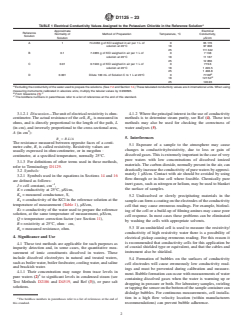
TABLE 1 Electrical Conductivity Values Assigned to the Potassium Chloride in the Reference Solution
Approximate Electrical
Reference
Normality of Method of Preparation Temperature, °C Conductivity,
Solution
Solution μS/cm
A 1 74.2460 g of KCl weighed in air per 1 L of 0 65 176
solution at 20°C 18 97 838
25 111 342
B 0.1 7.4365 g of KCl weighed in air per 1 L of 0 7 138
solution at 20°C 18 11 167
25 12 856
C 0.01 0.7440 g of KCl weighed in air per 1 L of 0 773.6
solution at 20°C 18 1 220.5
25 1 408.8
B
D 0.001 Dilute 100 mL of Solution C to 1 L at 20°C 0 77.69
B
18 127.54
25 146.93
A
Excluding the conductivity of the water used to prepare the solutions. (See 7.2 and Section 14.) These tabulated conductivity values are in international units. When using
measuring instruments calibrated in absolute units, multiply the tabular values by 0.999505.
B C
From Glasstone (1).
C
The boldface numbers in parentheses refer to a list of references at the end of this standard.
3.1.2.1 Discussion—The unit of electrical resistivity is ohm- 4.1.2 Where the principal interest in the use of conductivity
centimetre. The actual resistance of the cell, R , is measured in methods is to determine steam purity, see Ref (4). These test
x
ohms, and is directly proportional to the length of the path, L methods may also be used for checking the correctness of
(in cm), and inversely proportional to the cross-sectional area, water analyses (5).
A (in cm ):
5. Interferences
R 5 R·L/A
x
The resistance measured between opposite faces of a centi-
5.1 Exposure of a sample to the atmosphere may cause
metre cube, R, is called resistivity. Resistivity values are
changes in conductivity/resistivity, due to loss or gain of
usually expressed in ohm·centimetre, or in megohm ·
dissolved gases. This is extremely important in the case of very
centimetre, at a specified temperature, normally 25°C.
pure waters with low concentrations of dissolved ionized
3.1.3 For definitions of other terms used in these methods,
materials. The carbon dioxide, normally present in the air, can
refer to Terminology D1129.
drastically increase the conductivity of pure waters by approxi-
3.2 Symbols:
mately 1 μS/cm. Contact with air should be avoided by using
3.2.1 Symbols used in the equations in Sections 14 and 16
flow-through or in-line cell where feasible. Chemically pure
are defined as follows:
−1
inert gases, such as nitrogen or helium, may be used to blanket
J = cell constant, cm ,
the surface of samples.
K = conductivity at 25°C, μS/cm,
K = measured conductance, S,
x 5.2 Undissolved or slowly precipitating materials in the
K = conductivity of the KCl in the reference solution at the
sample can form a coating on the electrodes of the conductivity
temperature of measurement (Table 1), μS/cm,
cell that may cause erroneous readings. For example, biofoul-
K = conductivity of the water used to prepare the reference
ing of the cell or a build-up of filming amines may cause poor
solution, at the same temperature of measurement, μS/cm,
cell response. In most cases these problems can be eliminated
Q = temperature correction factor (see Section 11),
by washing the cells with appropriate solvents.
R = resistivity at 25°C, ohm · cm,
5.3 If an unshielded cell is used to measure the resistivity/
R = measured resistance, ohm.
x
conductivity of high resistivity water there is a possibility of
4. Significance and Use
electrical pickup causing erroneous reading. For this reason it
is recommended that conductivity cells for this application be
4.1 These test methods are applicable for such purposes as
of coaxial shielded type or equivalent, and that the cables and
impurity detection and, in some cases, the quantitative mea-
instrument also be shielded.
surement of ionic constituents dissolved in waters. These
include dissolved electrolytes in natural and treated waters,
5.4 Formation of bubbles on the surfaces of conductivity
such as boiler water, boiler feedwater, cooling water, and saline
cell electrodes will cause erroneously low conductivity read-
and brackish water.
ings and must be prevented during calibration and measure-
4.1.1 Their concentration may range from trace levels in
ment. Bubble formation can occur with measurements of water
pure waters (2) to significant levels in condensed steam (see
containing dissolved gases when the water is warming up or
Test Methods D2186 and D4519, and Ref (3)), or pure salt
dropping in pressure or both. For laboratory samples, swirling
solutions.
or tapping the sensor on the bottom of the sample container can
dislodge bubbles. For continuous measurements, cell installa-
tion in a high flow velocity location (within manufacturers
The boldface numbers in parentheses refer to a list of references at the end of
this standard. recommendations) can prevent bubble adherence.
D1125 − 23
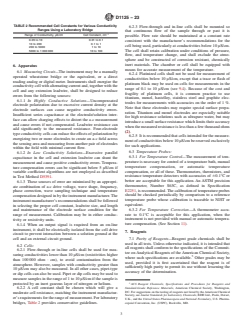
TABLE 2 Recommended Cell Constants for Various Conductivity
6.2.3 Flow-through and in-line cells shall be mounted so
Ranges Using a Laboratory Bridge
that continuous flow of the sample through or past it is
−1
Range of Conductivity, μS/cm Cell Constant, cm
possible. Flow rate should be maintained at a constant rate
0.05 to 10 0.01 to 0.1
consistent with the manufacturer’s recommendations for the
10 to 200 0.1 to 1
cell being used, particularly at conductivities below 10 μS/cm.
200 to 5000 1 to 10
The cell shall retain calibration under conditions of pressure,
5000 to 1 000 000 10 to 100
flow, and temperature change, and shall exclude the atmo-
sphere and be constructed of corrosion resistant, chemically
inert materials. The chamber or cell shall be equipped with
6. Apparatus
means for accurate measurement of the temperature.
6.1 Measuring Circuit—The instrument may be a manually
6.2.4 Platinized cells shall not be used for measurement of
operated wheatstone bridge or the equivalent, or a direct
conductivities below 10 μS/cm, except that a trace or flash of
reading analog or digital meter. Instruments shall energize the
platinum black may be used on cells for measurements in the
conductivity cell with alternating current and, together with the
range of 0.1 to 10 μS/cm (see 9.4). Because of the cost and
cell and any extension leadwire, shall be designed to reduce
fragility of platinum cells, it is common practice to use
errors from the following sources:
titanium, monel, hastelloy, stainless steel and graphite elec-
6.1.1 In Highly Conductive Solutions—Uncompensated
trodes for measurements with accuracies on the order of 1 %.
electrode polarization due to excessive current density at the
Note that these electrodes may require special surface prepa-
electrode surfaces can cause negative conductivity errors.
ration. Titanium and monel electrodes are especially suitable
Insufficient series capacitance at the electrode/solution inter-
for high resistance solutions such as ultrapure water, but may
face can allow charging effects to distort the a-c measurement
introduce a small surface resistance which limits their accuracy
and cause errors if not compensated. Leadwire resistance can
when the measured resistance is less than a few thousand ohms
add significantly to the measured resistance. Four-electrode
(2).
type conductivity cells can reduce the effects of polarization by
6.2.5 It is recommended that cells intended for the measure-
energizing two or more electrodes to create an a-c field across
ment of conductivities below 10 μS/cm be reserved exclusively
the sensing area and measuring from another pair of electrodes
for such applications.
within the field with minimal current flow.
6.3 Temperature Probes:
6.1.2 In Low Conductivity Solutions—Excessive parallel
6.3.1 For Temperature Control—The measurement of tem-
capacitance in the cell and extension leadwire can shunt the
perature is necessary for control of a temperature bath, manual
measurement and cause positive conductivity errors. Tempera-
temperature compensation, or automatic temperature
ture compensation errors can be significant below 5 μS/cm if
compensation, or all of these. Thermometers, thermistors, and
variable coefficient algorithms are not employed as described
resistance temperature detectors with accuracies of 60.1°C or
in Test Method D5391.
better are acceptable for this application. An ASTM precision
6.1.3 These sources of error are minimized by an appropri-
thermometer, Number S63C, as defined in Specification
ate combination of a-c drive voltage, wave shape, frequency,
E2251, is recommended. The calibration of temperature probes
phase correction, wave sampling technique and temperature
should be checked periodically by comparison to a reference
compensation designed in by the instrument manufacturer. The
temperature probe whose calibration is traceable to NIST or
instrument manufacturer’s recommendations shall be followed
equivalent.
in selecting the proper cell constant, leadwire size, and length
6.3.2 For Temperature Correction—A thermometer accu-
and maintenance of the electrode surface condition for the
rate to 0.1°C is acceptable for this application, when the
range of measurement. Calibration may be in either conduc-
instrument is not provided with manual or automatic tempera-
tivity or resistivity units.
ture compensation. (See Section 11).
6.1.4 When an output signal is required from an on-line
instrument, it shall be electrically isolated from the cell drive
7. Reagents
circuit to prevent interaction between a solution ground at the
7.1 Purity of Reagents—Reagent grade chemicals shall be
cell and an external circuit ground.
used in all tests. Unless otherwise indicated, it is intended that
6.2 Cells:
all reagents shall conform to the specifications of the Commit-
6.2.1 Flow-through or in-line cells shall be used for mea-
tee on Analytical Reagents of the American Chemical Society,
suring conductivities lower than 10 μS/cm (resistivities higher
where such specifications are available. Other grades may be
than 100 000 ohm · cm), to avoid contamination from the
used, provided it is first ascertained that the reagent is of
atmosphere. However, samples with conductivity greater than
sufficiently high purity to permit its use without lessening the
10 μS/cm may also be measured. In all other cases, pipet-type
accuracy of the determination.
or dip cells can also be used. Pipet or dip cells may be used to
measure samples in the range of 1 to 10 μS/cm if the sample is
protected by an inert gaseous layer of nitrogen or helium.
ACS Reagent Chemicals, Specifications and Procedures for Reagents and
Standard-Grade Reference Materials, American Chemical Society, Washington,
6.2.2 A cell constant shall be chosen which will give a
DC. For suggestions on the testing of reagents not listed by the American Chemical
moderate cell resistance, matching the instrument manufactur-
Society, see Analar Standards for Laboratory Chemicals, BDH Ltd., Poole, Dorset,
er’s requirements for the range of measurement. For laboratory
U.K., and the United States Pharmacopeia and National Formulary, U.S. Pharma-
bridges, Table 2 provides conservative guidelines. copeial Convention, Inc. (USPC), Rockville, MD.
D1125 − 23
7.2 Purity of Water—Unless otherwise indicated, references 8. Sampling
to water shall be understood to mean reagent water conforming
8.1 Samples shall be collected in accordance with Practice
to the quantitative specifications of D1193, Type I. In making
D1066, Specification D1192, and Practices D3370, as appli-
up the potassium chloride solutions for cell constant
cable.
determinations, use water of conductivity not greater than 1.5
8.2 Avoid exposure of the sample to atmospheres containing
μS/cm. If necessary, stabilize to the laboratory atmosphere by
ammonia or acidic gases. Protect the sample to avoid gain or
aspirating air through the water from a fritted glass or stainless
loss of dissolved gases, particularly if there is some delay
steel gas dispersion tube. The equilibrium point is reached
before the conductivity measurements are made. Preferably,
when the conductivity remains constant but not greater than 1.5
use a flow-type cell for sampling and measuring condensed
μS/cm. The equilibrium conductivity must be added to Table 1.
steam or water having a conductivity of less than 10 μS/cm.
7.3 Alcohol—95 % ethyl alcohol. Alternatively, use isopro-
For waters in the range of 5 to 10 μS/cm, a dip-type cell may
pyl alcohol or methyl alcohol.
be used if a layer of chemically pure nitrogen or helium is
maintained over the surface.
7.4 Aqua Regia (3 + 1)—Mix 3 volumes of concentrated
hydrochloric acid (HCl, sp gr 1.19) with 1 volume of concen-
9. Preparation of Electrodes
trated nitric acid (HNO , sp gr 1.42). This reagent should be
used immediately after its preparation. 9.1 If the cell constant as checked does not fall within
reasonable limits of its nominal value, it is necessary to clean
7.5 Ethyl Ether.
or replatinize the electrodes or replace the cell. In general, no
7.6 Hydrochloric Acid (sp gr 1.19)—Concentrated HCl.
mechanical cleaning should be attempted with platinum or
graphite electrodes. In high purity water measurements, where
7.7 Hydrochloric Acid (1 + 1)—Mix 1 volume of concen-
the presence of finely divided platinum is undesirable due to its
trated HCl (sp gr 1.19) with 1 volume of water.
long retention of impurities, platinization of electrodes should
7.8 Platinizing Solution—Dissolve 1.5 g of chloroplatinic
be omitted, especially for testing of water having a conductiv-
acid (H PtCl · 6H O) in 50 mL of water containing 0.0125 g of
2 6 2
ity below 10 μS/cm (see 9.4). On the other hand, clean and
lead acetate (Pb(C H O ) ).
2 3 2 2
well-platinized electrodes are increasingly important in testing
water of higher conductivities, particularly above 1000 μS/cm.
7.9 Potassium Chloride (KCl)—The assay of the potassium
chloride must be 100.0 6 0.1 %. This standardization grade of
9.2 The cell manufacturer’s instructions may be followed
KCl is available from NIST and from commercial sources. Dry
for cleaning the electrodes as well as other parts of the cell. A
at 150°C for 2 h or until weight loss is less than 0.02 %; store
suitable cleaning solution consists of a mixture of 1 part by
in desiccator.
volume of isopropyl alcohol, 1 part of ethyl ether, (with
polymer cells, check compatibility) and 1 part of HCl (1 + 1).
7.10 Potassium Chloride Reference Solution A—Dissolve
After cleaning, thoroughly flush the cell with water. If the old
74.2460 g of KCl (weighed in air) in water and dilute to 1 L at
platinum black coating is to be removed, judicious application
20 6 2°C in a Class A volumetric flask.
of aqua regia to the electrodes, or electrolysis in HCl (sp gr
7.11 Potassium Chloride Reference Solution B—Dissolve
1.19) is frequently successful.
7.4365 g of KCl (weighed in air) in water and dilute to 1 L at
9.3 Platinize the electrodes of the cell with H PtCl solu-
2 6
20 6 2°C in a Class A volumetric flask.
tion. A suitable plating apparatus consists of a 6 volt a-c supply,
7.12 Potassium Chloride Reference Solution C—Dissolve
a variable resistor, milliammeter, and an electrode. The deposit
0.7440 g of KCl (weighed in air) in water and to dilute 1 L at
should present a black, velvety appearance and should adhere
20 6 2°C in a Class A volumetric flask.
well to the electrode surface. The procedure for platinizing is
not critical. Follow the manufacturer’s instructions or the
7.13 Potassium Chloride Reference Solution D—Dilute 100
following guidelines. Good platinized coatings are obtained
mL of reference solution C to 1 L with water at 20 6 2°C in
using from 1.5 to 3 coulombs/cm of electrode area. For
a Class A volumetric flask shortly before using. Store the
example, for an electrode having a total area (both sides) of 10
solution in a glass-stoppered bottle of chemically resistant
cm , the plating time at a current of 20 mA would be from 12 ⁄2
glass which has only been used for storage of this solution.
to 25 min. The current density may be from 1 to 4 mA/cm of
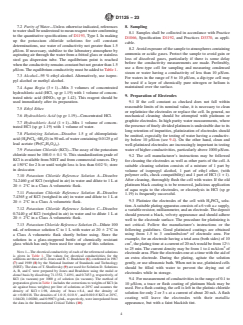
NOTE 1—The electrical conductivity of each of the referenced solutions
electrode area. Plate the electrodes one at a time with the aid of
is given in Table 1. The values for electrical conductivities for the
an extra electrode. During the plating, agitate the solution
solutions are those of G. Jones and B. C. Bradshaw (6), confirmed in 1987
gently, or use ultrasonic bath. When not in use, platinized cells
(7) and 1989 (8) by the National Institute of Standards and Technology
(NIST). The data of T. Shedlovsky (9) are used for Solution D. Solutions
should be filled with water to prevent the drying out of
A, B, and C were prepared by Jones and Bradshaw using the molal or
electrodes while in storage.
demal basis by dissolving 71.1352, 7.4191, and 0.7453 g, respectively, of
KCl (in vacuum) per 1000 g of solution (in vacuum). The method of 9.4 For measurement of conductivities in the range of 0.1 to
preparation given in Table 1 includes the corrections to weights of KCl (in
10 μS/cm, a trace or flash coating of platinum black may be
air against brass weights) per litre of solutions at 20°C and assumes the
used. For a flash coating, the cell is left in the platinic
...
Questions, Comments and Discussion
Ask us and Technical Secretary will try to provide an answer. You can facilitate discussion about the standard in here.
Loading comments...