


ASTM D2867-09(2014)
(Test Method)Standard Test Methods for Moisture in Activated Carbon
Standard Test Methods for Moisture in Activated Carbon
SIGNIFICANCE AND USE
4.1 The moisture content of activated carbon is often required to define and express its properties in relation to the net weight of the carbon.
4.2 The moisture content of activated carbon packed in typical shipping containers will usually increase during transportation and storage. Users of activated carbon in applications where low moisture content is important should be aware of this effect.
SCOPE
1.1 These test methods provide three procedures for the determination of the moisture content of activated carbon. The procedures may also be used to dry samples required for other tests. The oven-drying and moisture balance methods are used when water is the only volatile material present and is in significant quantities, and the activated carbon is not heat-sensitive (some activated carbons can ignite spontaneously at temperatures as low as 150°C). The xylene-extraction method is used when a carbon is known or suspected to be heat sensitive or to contain nonwater-miscible organic compounds instead of or in addition to water. The oven-drying method described in these test methods may be used as the reference for development of instrumental techniques for moisture determination in activated carbon.
1.2 The values stated in SI units are to be regarded as standard. No other units of measurement are included in this standard.
1.3 This standard does not purport to address all of the safety concerns, if any, associated with its use. It is the responsibility of the user of this standard to establish appropriate safety and health practices and determine the applicability of regulatory limitations prior to use.
General Information
Buy Standard
Standards Content (Sample)
NOTICE: This standard has either been superseded and replaced by a new version or withdrawn.
Contact ASTM International (www.astm.org) for the latest information
Designation: D2867 − 09 (Reapproved 2014)
Standard Test Methods for
Moisture in Activated Carbon
This standard is issued under the fixed designation D2867; the number immediately following the designation indicates the year of
original adoption or, in the case of revision, the year of last revision. A number in parentheses indicates the year of last reapproval. A
superscript epsilon (´) indicates an editorial change since the last revision or reapproval.
This standard has been approved for use by agencies of the U.S. Department of Defense.
1. Scope 3. Summary of Test Methods
3.1 Oven-Drying Test Method—A sample of carbon is put
1.1 These test methods provide three procedures for the
into a dry, closed capsule (of known weight) and weighed
determination of the moisture content of activated carbon. The
accurately. The capsule is opened and placed with the lid in a
procedures may also be used to dry samples required for other
preheated oven. The sample is dried to constant weight then
tests. The oven-drying and moisture balance methods are used
removed from the oven and with the capsule closed, cooled to
when water is the only volatile material present and is in
ambient temperature. The closed capsule is weighed again
significant quantities, and the activated carbon is not heat-
accurately. The weight loss is expressed as a percentage of the
sensitive (some activated carbons can ignite spontaneously at
weight of the original sample.
temperatures as low as 150°C). The xylene-extraction method
3.2 Xylene-Extraction Test Method— A known, accurate
is used when a carbon is known or suspected to be heat
weightofcarbonisputintoaboilingflask.Aknownvolumeof
sensitive or to contain nonwater-miscible organic compounds
xylene is added to the flask and the flask then connected to a
instead of or in addition to water. The oven-drying method
water trap. A hot plate is used to heat the xylene until boiling.
described in these test methods may be used as the reference
The temperature is controlled to allow steady reflux. Reflux
for development of instrumental techniques for moisture de-
continues until no further water can be collected in the trap.
termination in activated carbon.
The weight of water collected is expressed as a percentage of
1.2 The values stated in SI units are to be regarded as
the weight of the original sample.
standard. No other units of measurement are included in this
3.3 Moisture Balance Test Method—A sample of activated
standard.
carbonisplacedinamoisturebalanceandtheweightmeasured
1.3 This standard does not purport to address all of the
accurately. The sample is dried to constant weight. The weight
safety concerns, if any, associated with its use. It is the
loss is expressed as a percentage of the weight of the original
responsibility of the user of this standard to establish appro-
sample.
priate safety and health practices and determine the applica-
bility of regulatory limitations prior to use. 4. Significance and Use
4.1 The moisture content of activated carbon is often
2. Referenced Documents
required to define and express its properties in relation to the
net weight of the carbon.
2.1 ASTM Standards:
E177 Practice for Use of the Terms Precision and Bias in
4.2 The moisture content of activated carbon packed in
ASTM Test Methods
typical shipping containers will usually increase during trans-
E691 Practice for Conducting an Interlaboratory Study to
portation and storage. Users of activated carbon in applications
Determine the Precision of a Test Method where low moisture content is important should be aware of
this effect.
OVEN-DRYING METHOD
These test methods are under the jurisdiction of ASTM Committee D28 on
Activated Carbon and are the direct responsibility of Subcommittee D28.04 on Gas
5. Apparatus
Phase Evaluation Tests.
Current edition approved July 1, 2014. Published September 2014. Originally
5.1 Moisture Oven—Most commercial, electrically heated,
approved in 1970. Last previous edition approved in 2009 as D2867 – 09. DOI:
forced-circulation drying ovens capable of temperature regu-
10.1520/D2867-09R14.
For referenced ASTM standards, visit the ASTM website, www.astm.org, or lation between 145 and 155°C may be used.
contact ASTM Customer Service at service@astm.org. For Annual Book of ASTM
5.2 Capsules with Covers—Low-form glass weighing
Standards volume information, refer to the standard’s Document Summary page on
the ASTM website. bottles with ground-glass stoppers or seamless metal boxes
Copyright © ASTM International, 100 Barr Harbor Drive, PO Box C700, West Conshohocken, PA 19428-2959. United States
D2867 − 09 (2014)
with covers may be used. They should be as shallow as 11. Reagent
possible, consistent with convenient handling.
11.1 Xylene—Reagent grade in accordance with the speci-
5.3 Desiccator. fications of the Committee on Analytical Reagents of the
American Chemical Society.
6. Materials
12. Hazards
6.1 Desiccant—Anhydrous calcium chloride or other suit-
12.1 The use of hot xylene presents a continual fire hazard
able desiccant.
and suitable fire extinguishing equipment should be available.
7. Procedure for Activated Carbon Passing A No. 50
13. Preparation of Apparatus
Sieve
13.1 Clean the condenser, flask, and trap and carefully dry
7.1 Dip out with a spoon or spatula from the sample bottle
to ensure that it is free of water. Assemble the condenser and
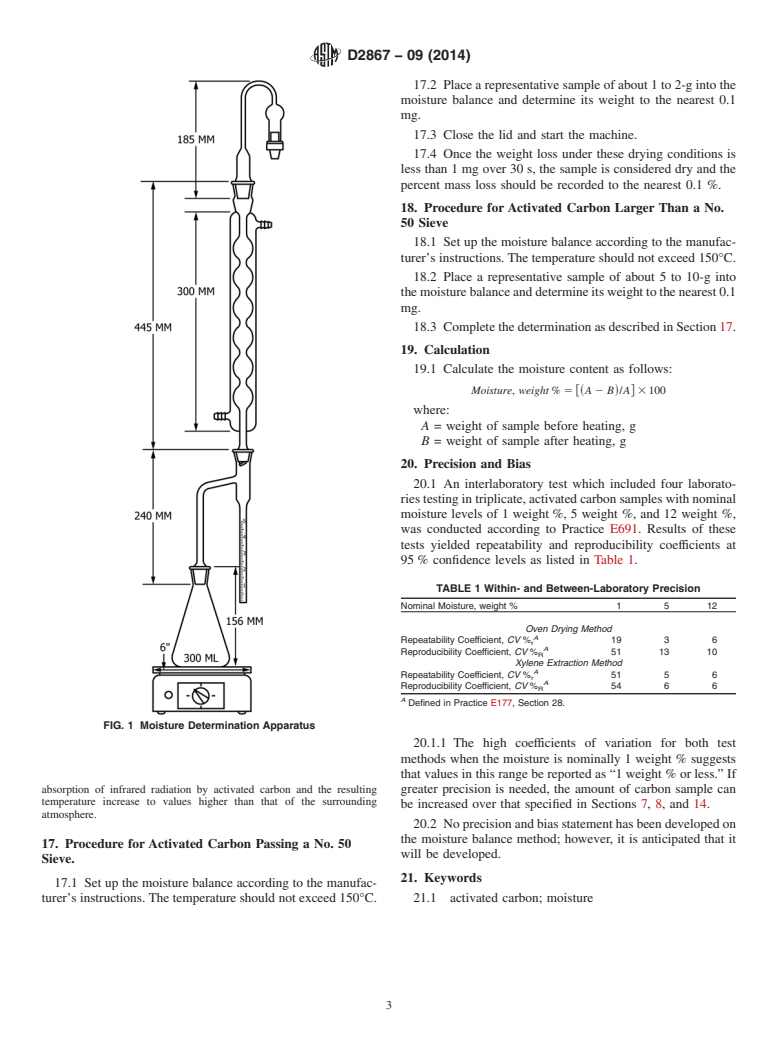
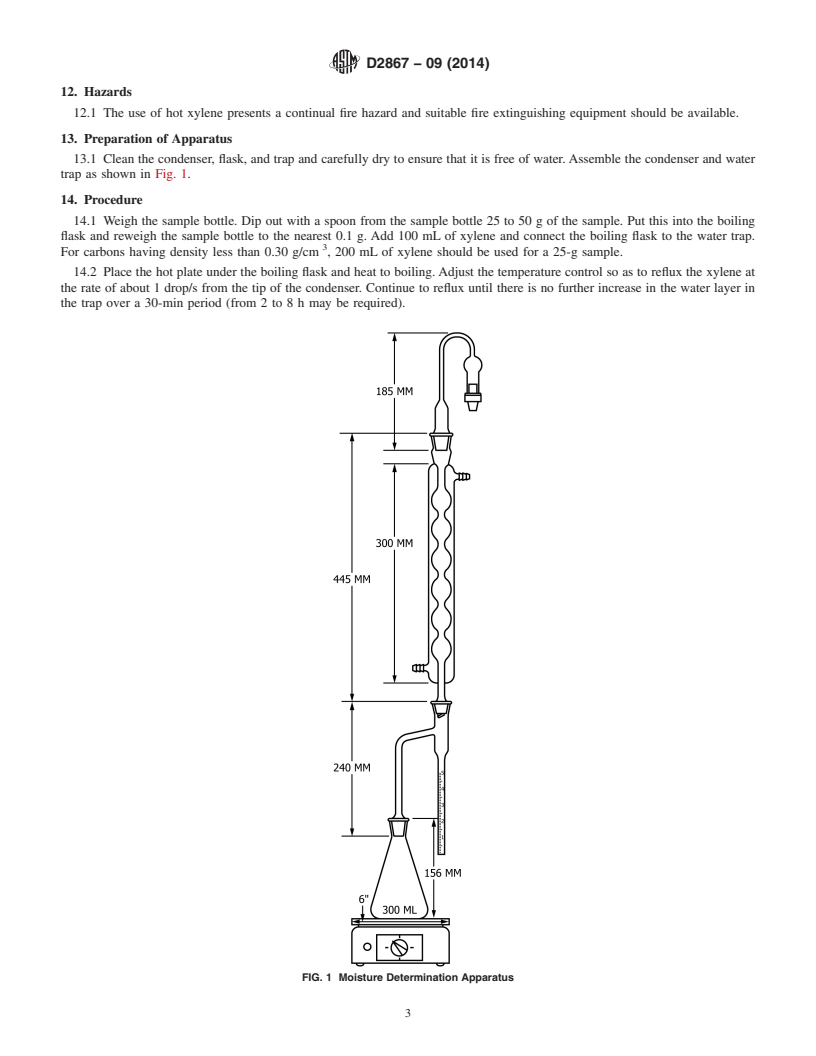
a 1 to 2-g representative sample. Put this into a predried tared
water trap as shown in Fig. 1.
capsule with lid, close and weigh at once to the nearest 0.5 mg.
The depth of the carbon in the capsule must not exceed 1.25
14. Procedure
cm.
14.1 Weighthesamplebottle.Dipoutwithaspoonfromthe
7.2 Remove the cover and place the capsule and cover in a
sample bottle 25 to 50 g of the sample. Put this into the boiling
preheated forced circulation oven (at 145 to 155°C). Close the
flask and reweigh the sample bottle to the nearest 0.1 g. Add
ovenanddrytoconstantweight(3hnormallysufficient).Open
100 mL of xylene and connect the boiling flask to the water
theovenandcoverthecapsulesquickly.Coolinadesiccatorto 3
trap. For carbons having density less than 0.30 g/cm , 200 mL
ambient temperature and weigh.
of xylene should be used for a 25-g sample.
14.2 Place the hot plate under the boiling flask and heat to
8. Procedure for Activated Carbon Larger Than A No.
boiling. Adjust the temperature control so as to reflux the
50 Sieve
xylene at the rate of about 1 drop/s
...
This document is not an ASTM standard and is intended only to provide the user of an ASTM standard an indication of what changes have been made to the previous version. Because
it may not be technically possible to adequately depict all changes accurately, ASTM recommends that users consult prior editions as appropriate. In all cases only the current version
of the standard as published by ASTM is to be considered the official document.
Designation: D2867 − 09 D2867 − 09 (Reapproved 2014)
Standard Test Methods for
Moisture in Activated Carbon
This standard is issued under the fixed designation D2867; the number immediately following the designation indicates the year of
original adoption or, in the case of revision, the year of last revision. A number in parentheses indicates the year of last reapproval. A
superscript epsilon (´) indicates an editorial change since the last revision or reapproval.
This standard has been approved for use by agencies of the U.S. Department of Defense.
1. Scope
1.1 These test methods provide three procedures for the determination of the moisture content of activated carbon. The
procedures may also be used to dry samples required for other tests. The oven-drying and moisture balance methods are used when
water is the only volatile material present and is in significant quantities, and the activated carbon is not heat-sensitive (some
activated carbons can ignite spontaneously at temperatures as low as 150°C). The xylene-extraction method is used when a carbon
is known or suspected to be heat sensitive or to contain nonwater-miscible organic compounds instead of or in addition to water.
The oven-drying method described in these test methods may be used as the reference for development of instrumental techniques
for moisture determination in activated carbon.
1.2 The values stated in SI units are to be regarded as standard. No other units of measurement are included in this standard.
1.3 This standard does not purport to address all of the safety concerns, if any, associated with its use. It is the responsibility
of the user of this standard to establish appropriate safety and health practices and determine the applicability of regulatory
limitations prior to use.
2. Referenced Documents
2.1 ASTM Standards:
E177 Practice for Use of the Terms Precision and Bias in ASTM Test Methods
E691 Practice for Conducting an Interlaboratory Study to Determine the Precision of a Test Method
3. Summary of Test Methods
3.1 Oven-Drying Test Method—A sample of carbon is put into a dry, closed capsule (of known weight) and weighed accurately.
The capsule is opened and placed with the lid in a preheated oven. The sample is dried to constant weight then removed from the
oven and with the capsule closed, cooled to ambient temperature. The closed capsule is weighed again accurately. The weight loss
is expressed as a percentage of the weight of the original sample.
3.2 Xylene-Extraction Test Method— A known, accurate weight of carbon is put into a boiling flask. A known volume of xylene
is added to the flask and the flask then connected to a water trap. A hot plate is used to heat the xylene until boiling. The temperature
is controlled to allow steady reflux. Reflux continues until no further water can be collected in the trap. The weight of water
collected is expressed as a percentage of the weight of the original sample.
3.3 Moisture Balance Test Method—A sample of activated carbon is placed in a moisture balance and the weight measured
accurately. The sample is dried to constant weight. The weight loss is expressed as a percentage of the weight of the original
sample.
4. Significance and Use
4.1 The moisture content of activated carbon is often required to define and express its properties in relation to the net weight
of the carbon.
These test methods are under the jurisdiction of ASTM Committee D28 on Activated Carbon and are the direct responsibility of Subcommittee D28.04 on Gas Phase
Evaluation Tests.
Current edition approved Nov. 1, 2009July 1, 2014. Published December 2009September 2014. Originally approved in 1970. Last previous edition approved in 20042009
as D2867 – 04.D2867 – 09. DOI: 10.1520/D2867-09.10.1520/D2867-09R14.
For referenced ASTM standards, visit the ASTM website, www.astm.org, or contact ASTM Customer Service at service@astm.org. For Annual Book of ASTM Standards
volume information, refer to the standard’s Document Summary page on the ASTM website.
Copyright © ASTM International, 100 Barr Harbor Drive, PO Box C700, West Conshohocken, PA 19428-2959. United States
D2867 − 09 (2014)
4.2 The moisture content of activated carbon packed in typical shipping containers will usually increase during transportation
and storage. Users of activated carbon in applications where low moisture content is important should be aware of this effect.
OVEN-DRYING METHOD
5. Apparatus
5.1 Moisture Oven—Most commercial, electrically heated,
forced-circulation drying ovens capable of temperature regulation between 145 and 155°C may be used.
5.2 Capsules with Covers—Low-form glass weighing bottles with ground-glass stoppers or seamless metal boxes with covers
may be used. They should be as shallow as possible, consistent with convenient handling.
5.3 Desiccator.
6. Materials
6.1 Desiccant—Anhydrous calcium chloride or other suitable desiccant.
7. Procedure for Activated Carbon Passing A No. 50 Sieve
7.1 Dip out with a spoon or spatula from the sample bottle a 1 to 2-g representative sample. Put this into a predried tared capsule
with lid, close and weigh at once to the nearest 0.5 mg. The depth of the carbon in the capsule must not exceed 1.25 cm.
7.2 Remove the cover and place the capsule and cover in a preheated forced circulation oven (at 145 to 155°C). Close the oven
and dry to constant weight (3 h normally sufficient). Open the oven and cover the capsules quickly. Cool in a desiccator to ambient
temperature and weigh.
8. Procedure for Activated Carbon Larger Than A No. 50 Sieve
8.1 Use a 5 to 10-g representative sample and weigh to the nearest 2 mg. Complete the determination as described in Section
7.
9. Calculation
9.1 Calculate the moisture content as follows:
Moisture, weight %5 C 2 D / C 2 B 3100
@~ ! ~ !#
where:
B = weight of capsule with cover, g,
C = weight of capsule with cover plus original sample, g, and
D = weight of capsule with cover plus dried sample, g.
XYLENE–EXTRACTION METHOD
10. Apparatus
10.1 Boiling Flask—A 300-mL flat-bottom Erlenmeyer flask with ground-glass joints.
10.2 Condenser—A 300-mm water-cooled condenser of the Allihn type with ground-glass joints.
10.3 Drying Tube, containing a suitable desiccant with fiber-glass filter.
10.4 Water Trap—A Bidwell and Sterling 10-mL or a Dean and Stark receiver with ground-glass joints. The water trap should
be clean so that the shape of the meniscus at the end of the test is the same as at th
...
Questions, Comments and Discussion
Ask us and Technical Secretary will try to provide an answer. You can facilitate discussion about the standard in here.