


ASTM D2619-09(2014)
(Test Method)Standard Test Method for Hydrolytic Stability of Hydraulic Fluids (Beverage Bottle Method)
Standard Test Method for Hydrolytic Stability of Hydraulic Fluids (Beverage Bottle Method)
SIGNIFICANCE AND USE
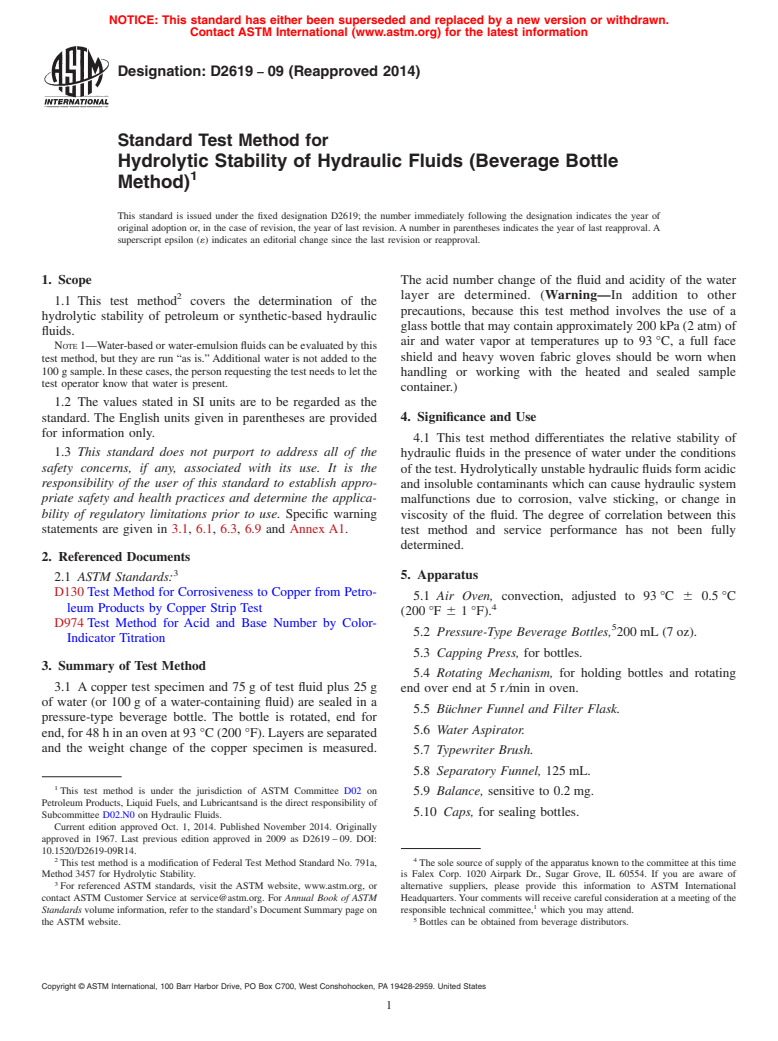
4.1 This test method differentiates the relative stability of hydraulic fluids in the presence of water under the conditions of the test. Hydrolytically unstable hydraulic fluids form acidic and insoluble contaminants which can cause hydraulic system malfunctions due to corrosion, valve sticking, or change in viscosity of the fluid. The degree of correlation between this test method and service performance has not been fully determined.
SCOPE
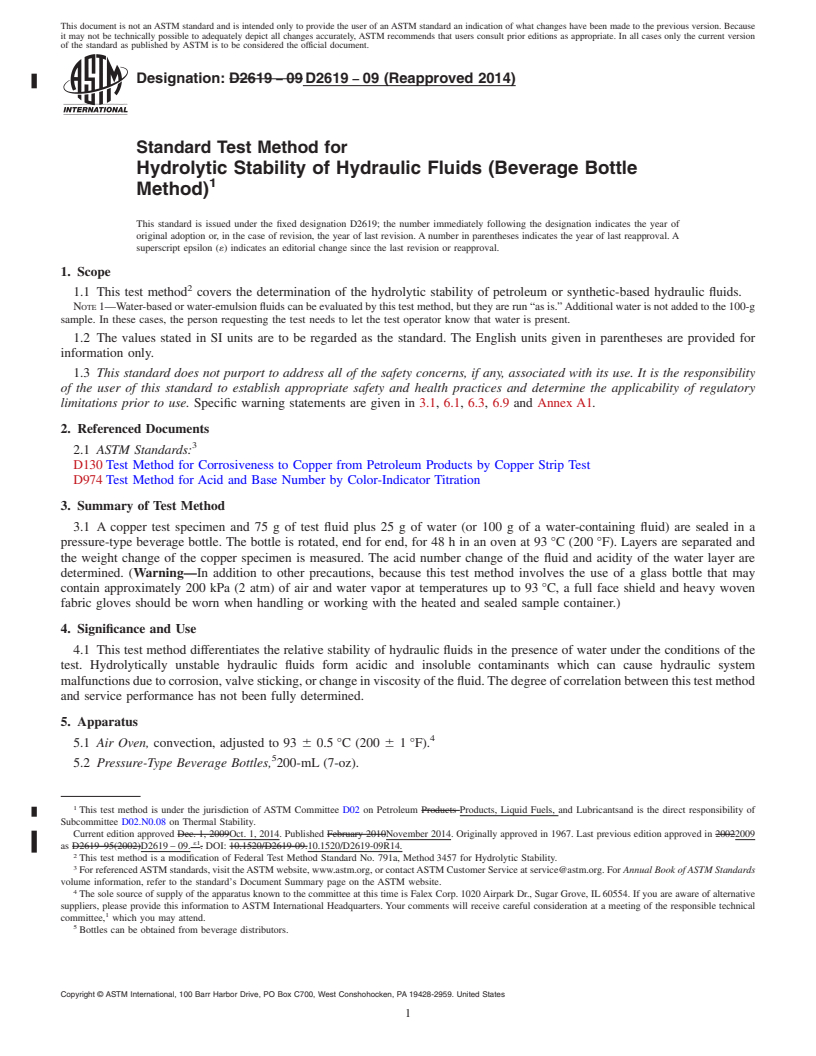
1.1 This test method2 covers the determination of the hydrolytic stability of petroleum or synthetic-based hydraulic fluids.
Note 1: Water-based or water-emulsion fluids can be evaluated by this test method, but they are run “as is.” Additional water is not added to the 100-g sample. In these cases, the person requesting the test needs to let the test operator know that water is present.
1.2 The values stated in SI units are to be regarded as the standard. The English units given in parentheses are provided for information only.
1.3 This standard does not purport to address all of the safety concerns, if any, associated with its use. It is the responsibility of the user of this standard to establish appropriate safety and health practices and determine the applicability of regulatory limitations prior to use. Specific warning statements are given in 3.1, 6.1, 6.3, 6.9 and Annex A1.
General Information
Buy Standard
Standards Content (Sample)
NOTICE: This standard has either been superseded and replaced by a new version or withdrawn.
Contact ASTM International (www.astm.org) for the latest information
Designation: D2619 − 09 (Reapproved 2014)
Standard Test Method for
Hydrolytic Stability of Hydraulic Fluids (Beverage Bottle
Method)
This standard is issued under the fixed designation D2619; the number immediately following the designation indicates the year of
original adoption or, in the case of revision, the year of last revision. A number in parentheses indicates the year of last reapproval. A
superscript epsilon (´) indicates an editorial change since the last revision or reapproval.
1. Scope The acid number change of the fluid and acidity of the water
2 layer are determined. (Warning—In addition to other
1.1 This test method covers the determination of the
precautions, because this test method involves the use of a
hydrolytic stability of petroleum or synthetic-based hydraulic
glass bottle that may contain approximately 200 kPa (2 atm) of
fluids.
air and water vapor at temperatures up to 93 °C, a full face
NOTE 1—Water-based or water-emulsion fluids can be evaluated by this
shield and heavy woven fabric gloves should be worn when
test method, but they are run “as is.”Additional water is not added to the
100 g sample. In these cases, the person requesting the test needs to let the
handling or working with the heated and sealed sample
test operator know that water is present.
container.)
1.2 The values stated in SI units are to be regarded as the
standard. The English units given in parentheses are provided 4. Significance and Use
for information only.
4.1 This test method differentiates the relative stability of
1.3 This standard does not purport to address all of the
hydraulic fluids in the presence of water under the conditions
safety concerns, if any, associated with its use. It is the of the test. Hydrolytically unstable hydraulic fluids form acidic
responsibility of the user of this standard to establish appro-
and insoluble contaminants which can cause hydraulic system
priate safety and health practices and determine the applica- malfunctions due to corrosion, valve sticking, or change in
bility of regulatory limitations prior to use. Specific warning
viscosity of the fluid. The degree of correlation between this
statements are given in 3.1, 6.1, 6.3, 6.9 and Annex A1. test method and service performance has not been fully
determined.
2. Referenced Documents
5. Apparatus
2.1 ASTM Standards:
D130 Test Method for Corrosiveness to Copper from Petro-
5.1 Air Oven, convection, adjusted to 93 °C 6 0.5 °C
leum Products by Copper Strip Test
(200 °F 6 1 °F).
D974 Test Method for Acid and Base Number by Color-
5.2 Pressure-Type Beverage Bottles, 200 mL (7 oz).
Indicator Titration
5.3 Capping Press, for bottles.
3. Summary of Test Method
5.4 Rotating Mechanism, for holding bottles and rotating
3.1 A copper test specimen and 75 g of test fluid plus 25 g
end over end at 5 r⁄min in oven.
of water (or 100 g of a water-containing fluid) are sealed in a
5.5 Büchner Funnel and Filter Flask.
pressure-type beverage bottle. The bottle is rotated, end for
5.6 Water Aspirator.
end,for48 hinanovenat93 °C(200 °F).Layersareseparated
and the weight change of the copper specimen is measured.
5.7 Typewriter Brush.
5.8 Separatory Funnel, 125 mL.
This test method is under the jurisdiction of ASTM Committee D02 on
5.9 Balance, sensitive to 0.2 mg.
Petroleum Products, Liquid Fuels, and Lubricantsand is the direct responsibility of
5.10 Caps, for sealing bottles.
Subcommittee D02.N0 on Hydraulic Fluids.
Current edition approved Oct. 1, 2014. Published November 2014. Originally
approved in 1967. Last previous edition approved in 2009 as D2619 – 09. DOI:
10.1520/D2619-09R14.
2 4
This test method is a modification of Federal Test Method Standard No. 791a, The sole source of supply of the apparatus known to the committee at this time
Method 3457 for Hydrolytic Stability. is Falex Corp. 1020 Airpark Dr., Sugar Grove, IL 60554. If you are aware of
For referenced ASTM standards, visit the ASTM website, www.astm.org, or alternative suppliers, please provide this information to ASTM International
contact ASTM Customer Service at service@astm.org. For Annual Book of ASTM Headquarters.Your comments will receive careful consideration at a meeting of the
Standards volume information, refer to the standard’s Document Summary page on responsible technical committee, which you may attend.
the ASTM website. Bottles can be obtained from beverage distributors.
Copyright © ASTM International, 100 Barr Harbor Drive, PO Box C700, West Conshohocken, PA 19428-2959. United States
D2619 − 09 (2014)
so this step should be bypassed. Certain other fluids may emulsify with
5.11 Inert Seal, for cap gasket, 0.127 mm (0.005 in.) thick
water and not separate during this step. In either of these cases, no
fluorocarbon seal.
determination of water acidity will be conducted and a remark should be
insertedintothetestreporttothiseffect.Ifthefluidsampleisheavierthan
6. Reagents and Materials
water, drain the fluid from the separatory funnel, remove the water wash,
and return the fluid to the separatory funnel for repeated water washes.
6.1 n-Heptane.(Warning—Flammable,harmfulifinhaled,
NOTE 3—Mechanical stirring for 1 h with the anhydrous sodium sulfate
skin irritant on repeated contact, aspiration hazard; see A1.1.)
dries the fluid efficiently.Add sufficient sodium sulfate with swirling until
it no longer forms clumps in the fluid.
6.2 Phenolphthalein, 1 % alcoholic solution.
7.9 Determine the total acid number of the filtered fluid in
6.3 Potassium Hydroxide (KOH), 0.1N aqueous solution
accordance with Test Method D974. The acid number of the
standardized to within 0.0005N.(Warning—Caustic.)
filtered fluid is compared to that of the original fluid (deter-
6.4 Copper Strip (QQ-C-576A), 16-22 B and S gage,
mined in 7.2) and the change recorded.
13 mm by 51 mm.
7.10 Rinse the copper test specimen and beverage bottle
6.5 Steel Wool, grade 1-medium fine.
with distilled water and n-heptane into the combined water
6.6 Litmus Paper.
washes and then return to the separatory funnel. Separate the
layers and wash the aqueous phase with one 50 mL portion of
6.7 Filter Paper, Whatman No. 41.
n-heptane.
6.8 Anhydrous Sodium Sulfate (Na SO ).
2 4
7.11 Transfer the water layer to an Ehrlenmeyer flask.
6.9 1,1,1-Trichloroethane (optional–for use when the test
Determine total acidity by adding 1.0 mL of phenolphthalein
fluid is a phosphate ester). (Warning—Harmful if inhaled,
solution and titrating rapidly with 0.1N KOH solution to the
high concentrations may cause unconsciousness or death;
appearance of a pink phenolphthalein end point which persists
contact may cause skin irritations and dermatitis, may produce
for 15 s. Calculate the water layer acidity as follows:
toxic vapors if burned, eye irritant; see A1.2.)
Total Acidity, mg KOH 5 @~A 2 B!N# 356,100 mg/Eq~1 L/1000 mL!
7. Procedure
(1)
7.1 Fill the pressure beverage bottle with distilled water and
where:
allow to stand overnight. Drain and rinse with fresh distilled
A = KOH solution required for titration of the sample, mL,
water, but do not dry.
B = KOH solution required for titration of the blank, mL,
7.2 Determine the total acid number of the test fluid in and
N = normality of KOH solution.
accordance with Test Method D974.
7.3 Weigh 75 g of test fluid and 25 g of distilled water (or in
7.12 Wash the copper specimen with warm n-heptane,
the case of water-containing fluids, 100 g of the test fluid) to followed by warm 1,1,1-trichloroethane (if using).
0.5 g into the beverage bottle.
(Warning—see 6.9.) Brush with a short bristled typewriter-
type brush while washing. Dry and weigh. Report weight
7.4 Polish the copper test specimen to a clean surface with
change in milligrams per square centimetre and appearance as
the steel wool and wash with n-heptane. (Warning—see 6.1.)
determined using theASTM Copper Strip Corrosion Standard,
Dry and weigh to 0.2 mg. Immediately immerse the copper
following the interpretation guidelines in Test Method D130,
specimen in the fluid in the beverage bottle. Avoid specimen
Section 11.
contact by handling the cleaned copper test strip with cotton
gloves or filter paper. F 5 C 2 D /E (2)
~ !
7.5 Prepare a disk of the inert seal and place in a new bottle
where:
cap. Seal the bottle using the cap with the gasket.
C = final weight of copper specimen, mg,
D = initial weight of copper specimen, mg,
7.6 Place the bottle in the rotating mechanism in the oven
E = surface area of copper specimen, cm , and
adjusted to 93 °C 6 0.5 °C (200 °F 6 1 °F). Allow to rotate,
F = weight change, mg/cm .
end for end, at 5 r⁄min for 48 h.
7.7 Remove the bottle and place on an insulated surface
8. Report
until cool.
8.1 The report shall include the following:
7.8 Open the bottle and decant the contents (except for the
8.1.1 Acid number change of fluid in milligrams of KOH
copper specimen) into a 125 mL separatory funnel. Allow the
per gram,
layerstoseparateandremovetheaqueouslayer(Note2).Wash
8.1.2 Total acidity of water in milligrams of KOH, or if this
the oil layer with 25 mL portions of distilled water, repeating
could not be determined because no separation occurred, a
until the washings are neutral to litmus paper. Save the
remark to this effect.
combined water washings. Dry the washed fluid with anhy-
8.1.3 Weight change of copper strip in milligrams per
drous sodium sulfate or by vacuum dehydration (Note 3), or
square centimetre,
...
This document is not an ASTM standard and is intended only to provide the user of an ASTM standard an indication of what changes have been made to the previous version. Because
it may not be technically possible to adequately depict all changes accurately, ASTM recommends that users consult prior editions as appropriate. In all cases only the current version
of the standard as published by ASTM is to be considered the official document.
Designation: D2619 − 09 D2619 − 09 (Reapproved 2014)
Standard Test Method for
Hydrolytic Stability of Hydraulic Fluids (Beverage Bottle
Method)
This standard is issued under the fixed designation D2619; the number immediately following the designation indicates the year of
original adoption or, in the case of revision, the year of last revision. A number in parentheses indicates the year of last reapproval. A
superscript epsilon (´) indicates an editorial change since the last revision or reapproval.
1. Scope
1.1 This test method covers the determination of the hydrolytic stability of petroleum or synthetic-based hydraulic fluids.
NOTE 1—Water-based or water-emulsion fluids can be evaluated by this test method, but they are run “as is.” Additional water is not added to the 100-g
sample. In these cases, the person requesting the test needs to let the test operator know that water is present.
1.2 The values stated in SI units are to be regarded as the standard. The English units given in parentheses are provided for
information only.
1.3 This standard does not purport to address all of the safety concerns, if any, associated with its use. It is the responsibility
of the user of this standard to establish appropriate safety and health practices and determine the applicability of regulatory
limitations prior to use. Specific warning statements are given in 3.1, 6.1, 6.3, 6.9 and Annex A1.
2. Referenced Documents
2.1 ASTM Standards:
D130 Test Method for Corrosiveness to Copper from Petroleum Products by Copper Strip Test
D974 Test Method for Acid and Base Number by Color-Indicator Titration
3. Summary of Test Method
3.1 A copper test specimen and 75 g of test fluid plus 25 g of water (or 100 g of a water-containing fluid) are sealed in a
pressure-type beverage bottle. The bottle is rotated, end for end, for 48 h in an oven at 93 °C (200 °F). Layers are separated and
the weight change of the copper specimen is measured. The acid number change of the fluid and acidity of the water layer are
determined. (Warning—In addition to other precautions, because this test method involves the use of a glass bottle that may
contain approximately 200 kPa (2 atm) of air and water vapor at temperatures up to 93 °C, a full face shield and heavy woven
fabric gloves should be worn when handling or working with the heated and sealed sample container.)
4. Significance and Use
4.1 This test method differentiates the relative stability of hydraulic fluids in the presence of water under the conditions of the
test. Hydrolytically unstable hydraulic fluids form acidic and insoluble contaminants which can cause hydraulic system
malfunctions due to corrosion, valve sticking, or change in viscosity of the fluid. The degree of correlation between this test method
and service performance has not been fully determined.
5. Apparatus
5.1 Air Oven, convection, adjusted to 93 6 0.5 °C (200 6 1 °F).
5.2 Pressure-Type Beverage Bottles, 200-mL (7-oz).
This test method is under the jurisdiction of ASTM Committee D02 on Petroleum Products Products, Liquid Fuels, and Lubricantsand is the direct responsibility of
Subcommittee D02.N0.08 on Thermal Stability.
Current edition approved Dec. 1, 2009Oct. 1, 2014. Published February 2010November 2014. Originally approved in 1967. Last previous edition approved in 20022009
ε1
as D2619–95(2002)D2619 – 09. . DOI: 10.1520/D2619-09.10.1520/D2619-09R14.
This test method is a modification of Federal Test Method Standard No. 791a, Method 3457 for Hydrolytic Stability.
For referenced ASTM standards, visit the ASTM website, www.astm.org, or contact ASTM Customer Service at service@astm.org. For Annual Book of ASTM Standards
volume information, refer to the standard’s Document Summary page on the ASTM website.
The sole source of supply of the apparatus known to the committee at this time is Falex Corp. 1020 Airpark Dr., Sugar Grove, IL 60554. If you are aware of alternative
suppliers, please provide this information to ASTM International Headquarters. Your comments will receive careful consideration at a meeting of the responsible technical
committee, which you may attend.
Bottles can be obtained from beverage distributors.
Copyright © ASTM International, 100 Barr Harbor Drive, PO Box C700, West Conshohocken, PA 19428-2959. United States
D2619 − 09 (2014)
5.3 Capping Press, for bottles.
5.4 Rotating Mechanism, for holding bottles and rotating end over end at 5 r/min in oven.
5.5 Büchner Funnel and Filter Flask.
5.6 Water Aspirator.
5.7 Typewriter Brush.
5.8 Separatory Funnel, 125-mL.
5.9 Balance, sensitive to 0.2 mg.
5.10 Caps, for sealing bottles.
5.11 Inert Seal, for cap gasket, 0.127-mm (0.005-in.) thick fluorocarbon seal.
6. Reagents and Materials
6.1 n-Heptane. (Warning— Flammable, harmful if inhaled, skin irritant on repeated contact, aspiration hazard; see A1.1.)
6.2 Phenolphthalein, 1 % alcoholic solution.
6.3 Potassium Hydroxide (KOH), 0.1 N aqueous solution standardized to within 0.0005 N. (Warning—Caustic.)
6.4 Copper Strip (QQ-C-576A), 16-22 B and S gage, 13 by 51 mm.
6.5 Steel Wool, grade 1-medium fine.
6.6 Litmus Paper.
6.7 Filter Paper, Whatman No. 41.
6.8 Anhydrous Sodium Sulfate (Na SO ).
2 4
6.9 1,1,1-Trichloroethane (optional–for use when the test fluid is a phosphate ester). (Warning—Harmful if inhaled, high
concentrations may cause unconsciousness or death; contact may cause skin irritations and dermatitis, may produce toxic vapors
if burned, eye irritant; see A1.2.)
7. Procedure
7.1 Fill the pressure beverage bottle with distilled water and allow to stand overnight. Drain and rinse with fresh distilled water,
but do not dry.
7.2 Determine the total acid number of the test fluid in accordance with Test Method D974.
7.3 Weigh 75 g of test fluid and 25 g of distilled water (or in the case of water-containing fluids, 100 g of the test fluid) to 0.5
g into the beverage bottle.
7.4 Polish the copper test specimen to a clean surface with the steel wool and wash with n-heptane. (Warning—see 6.1.) Dry
and weigh to 0.2 mg. Immediately immerse the copper specimen in the fluid in the beverage bottle. Avoid specimen contact by
handling the cleaned copper test strip with cotton gloves or filter paper.
7.5 Prepare a disk of the inert seal and place in a new bottle cap. Seal the bottle using the cap with the gasket.
7.6 Place the bottle in the rotating mechanism in the oven adjusted to 93 6 0.5 °C (200 6 1 °F). Allow to rotate, end for end,
at 5 r/min for 48 h.
7.7 Remove the bottle and place on an insulated surface until cool.
7.8 Open the bottle and decant the contents (except for the copper specimen) into a 125 mL separatory funnel. Allow the layers
to separate and remove the aqueous layer (Note 2). Wash the oil layer with 25 mL portions of distilled water, repeating until the
washings are neutral to litmus paper. Save the combined water washings. Dry the washed fluid with anhydrous sodium sulfate or
by vacuum dehydration (Note 3), or both. Filter the fluid through filter paper to remove the sodium sulfate solids.
NOTE 2—For water-containing fluids, there will be no separation, and so this step should be bypassed. Certain other fluids may emulsify with water
and not separate during this step. In either of these cases, no determination of water acidity will be conducted and a remark should be inserted into the
test report to this effect. If the fluid sample is heavier than water, drain the fluid from the separatory funnel, remove the water wash, and return the fluid
to the separatory funnel for repeated water washes.
NOTE 3—Mechanical stirring for 1 h with the anhydrous sodium sulfate dries the fluid efficiently. Add sufficient sodium sulfate with swirling until it
no longer forms clumps in the fluid.
7.9 Determine the total acid number of the filtered fluid in accordance with Test Method D974. The acid number of the filtered
fluid is compared to that of the original fluid (determined in 7.2) and the change recorded.
7.10 Rinse the copper test specimen and beverage bottle with distilled water and n-heptane into the combined water washes and
then return to the separatory funnel. Separate the layers and wash the aqueous phase with one 50 mL portion of n-heptane.
D2619 − 09 (2014)
7.11 Transfer the water layer to an Ehrlenmeyer flask. Determine total acidity by adding 1.0 mL of phenolphthalein solution and
titrating rapidly with 0.1 N KOH solution to the appearance of a pink phenolphthalein end point which persists for 15 s. Calculate
the water layer acidity as follows:
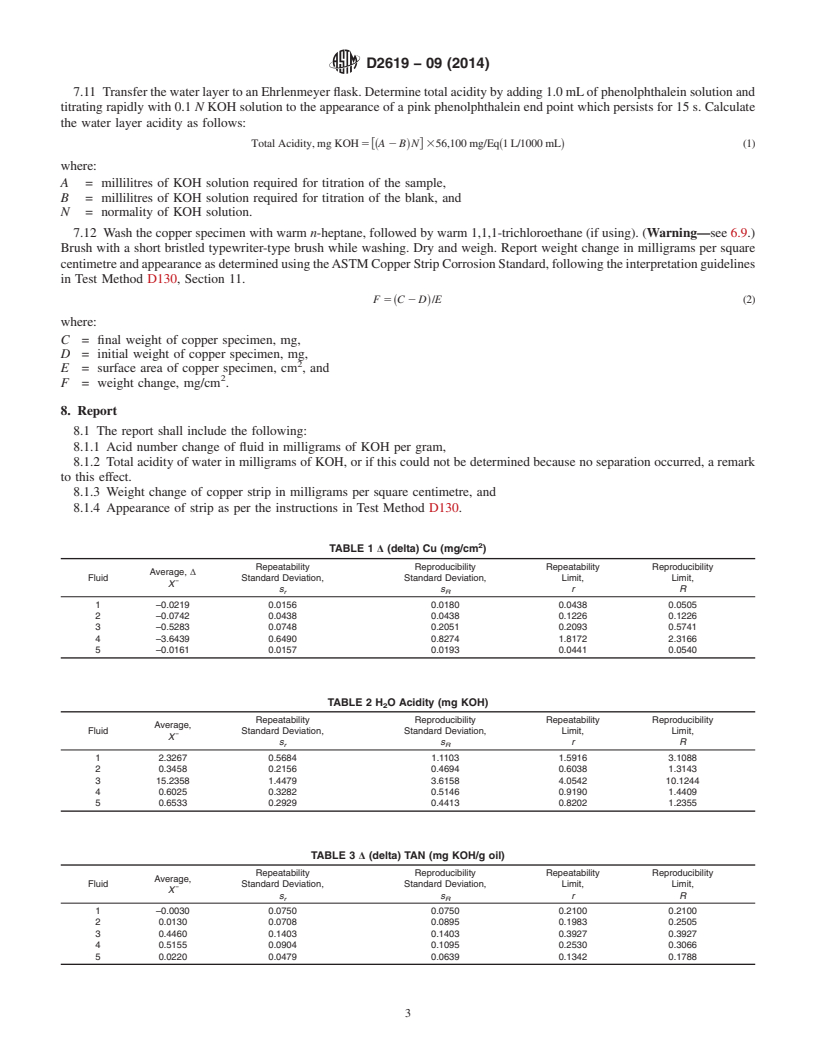
Total Acidity, mg KOH 5 @~A 2 B!N# 356,100 mg/Eq~1 L/1000 mL! (1)
where:
A = millilitres of KOH solution required for titration of the sample,
B = millilitres of KOH solution required for titration of the blank, and
N = normality of KOH solution.
7.12 Wash the copper specimen with warm n-heptane, followed by warm 1,1,1-trichloroethane (if using). (Warning—see 6.9.)
Brush with a short bristled typewriter-type brush while washing. Dry and weigh. Report weight change in milligrams per square
centimetre and appearance as determined using the ASTM Copper Strip Corrosion Standard, following the interpretation guidelines
in Test Method D130, Section 11.
F 5 ~C 2 D!/E (2)
where:
C = final weight of copper specimen, mg,
D = initial weight of copper specimen, mg,
E = surface
...
Questions, Comments and Discussion
Ask us and Technical Secretary will try to provide an answer. You can facilitate discussion about the standard in here.