

ASTM F3287-17e1
(Test Method)Standard Test Method for Nondestructive Detection of Leaks in Packages by Mass Extraction Method
General Information
- Abstract
SIGNIFICANCE AND USE
5.1 Leaks in medical, pharmaceutical, or food product packages can affect product quality and consumer safety. Such leaks can arise from imperfections in package material or between mated components designed to seal the package. Defects can allow unwanted gas (e.g. oxygen or water vapor), particulates, liquids, or microbiological contaminants into or out of the package. Package defect detection can be a critical part of ensuring product quality and consumer safety. Use of a physical CCI test method for sterile products can be used to assure the stability of the package sterility property during transportation and product shelf life.
5.2 Mass extraction is a useful non-destructive test method for testing a wide variety of packages. Package shape and dimensions that can be tested using mass extraction are essentially unlimited, as long as a vacuum test chamber can be designed and manufactured to accommodate the package.
5.3 This method produces quantitative flow measurement results that are useful in comparing package sealing properties, different batches of product, material properties, and combinations of process parameters.
5.4 Applications for mass extraction range from manually loaded and operated machines to automatic unattended work cells. This method can be applied for audit testing or 100% in-line testing.
Note 2: Leak test methods that rely on gas or vapor transport, such as mass extraction, are not able to detect defects if they become plugged by solid or nonvolatile matter. Plugging is possible by exposure to environmental contaminants. In some cases, the packaged product itself can clog defects. For example, leak paths may become blocked by suspended solids, gelatinous matter or dried-out solutions. Product clogging propensity is a function of the product formulation, defect size and geometry, and may be linked to product storage and handling conditions as well as the time allotted to defect exposure. An investigation into the impact of repeate...
SCOPE
1.1 This method provides a nondestructive means to detect holes (leaks) in a variety of non-porous rigid and semi-rigid packages.
1.2 This test method detects package leaks by measuring the mass flow extracted from a package while the package is enclosed inside an evacuated test chamber. The test system is a closed system during the leakage measurement portion of the test cycle. The closed system includes a vacuum reservoir, Intelligent Molecular Flow Sensor (IMFS), and vacuum test chamber. Mass extracted from the test package into the vacuum test chamber flows to the vacuum reservoir through the IMFS to equalize the system. Mass flow rate from the vacuum chamber to the vacuum reservoir is measured by the IMFS. Based on the conservation of mass law, mass flow into the closed system is equal to the mass loss from the test package. The test system is capable of producing quantitative (variable data) or qualitative (pass/fail) results depending on the requirements.
1.2.1 Headspace gas leakage defects equivalent to a 1µm diameter glass micropipette (sharp edge defect) can be detected at a 95% confidence level.
1.2.2 Liquid leakage defects equivalent to a 1µm diameter glass micropipette can be detected at a 95% confidence level for glass vials and LDPE bottles. Liquid leakage defects equivalent to a 2 µm diameter glass micropipette can be detected for glass syringes.
1.3 Units—The values stated in SI units are to be regarded as standard. Pressure units are expressed as Pa, mbar, or Torr.
1.4 This standard does not purport to address all of the safety concerns, if any, associated with its use. It is the responsibility of the user of this standard to establish appropriate safety, health, and environmental practices and determine the applicability of regulatory limitations prior to use.
1.5 This international standard was developed in accordance with internationally recognized principles on standardization esta...
- Status
- Published
- Publication Date
- 31-Oct-2017
- Technical Committee
- F02 - Primary Barrier Packaging
- Drafting Committee
- F02.40 - Package Integrity
Overview
ASTM F3287-17e1: Standard Test Method for Nondestructive Detection of Leaks in Packages by Mass Extraction Method specifies a nondestructive approach to identify leaks in rigid and semi-rigid, non-porous product packaging. This test method, developed by ASTM International, is particularly valuable in industries where package integrity directly impacts product quality and consumer safety, such as medical, pharmaceutical, and food packaging sectors. The mass extraction method is recognized for its ability to both quantitatively and qualitatively assess leaks, supporting broader efforts to ensure container closure integrity (CCI) over the product's shelf life and during transportation.
Key Topics
Nondestructive Leak Detection:
The standard describes a method for detecting holes or leaks in packages by measuring mass flow extracted from a package enclosed within an evacuated test chamber. This process does not damage the packaging or its contents, making it suitable for both batch and in-line quality assurance.Mass Extraction Principle:
By using a vacuum chamber, vacuum reservoir, and an Intelligent Molecular Flow Sensor (IMFS), the system measures the flow of gas or vapor escaping from the package. Based on the law of conservation of mass, any detected flow from the package indicates a leak.Sensitivity and Detection Limits:
The test method can detect very small defects, such as headspace gas or liquid leakage equivalent to a 1µm diameter micropipette, at a 95% confidence level for certain package types (e.g., glass vials and LDPE bottles).Quantitative and Qualitative Results:
Depending on requirements, results can indicate either pass/fail (qualitative) or provide specific mass flow rates (quantitative), allowing for detailed comparisons of package sealing and process parameters.Wide Package Compatibility:
The method is applicable to virtually any shape and size of rigid or semi-rigid, non-porous package, provided a suitable test chamber can be designed.
Applications
Medical and Pharmaceutical Packaging:
This standard supports critical quality control for sterile barrier packaging such as vials, syringes, and ampoules, helping ensure sterility and preventing contamination by gases, particulates, or microorganisms.Food Packaging:
Prevents loss of package integrity that could result in spoilage due to ingress of oxygen or moisture, thus protecting food safety and shelf life.In-Process and In-Line Testing:
Mass extraction systems can be integrated into manufacturing for automated, unattended leak testing, making it possible to audit batches or conduct 100% in-line quality checks.Comparative Analysis:
Quantitative leak rate measurements allow manufacturers to compare sealing properties across material batches, process changes, and package designs.
Related Standards
- ASTM E177: Practice for Use of the Terms Precision and Bias in ASTM Test Methods
- ASTM E691: Practice for Conducting an Interlaboratory Study to Determine the Precision of a Test Method
- ASTM F17: Terminology Relating to Primary Barrier Packaging
- ISO/IEC 17025: General requirements for the competence of testing and calibration laboratories
These referenced standards provide guidance on test method precision, terminology, and laboratory competency, ensuring that mass extraction leak detection is performed with rigor and reliability.
Keywords:
mass extraction, nondestructive leak detection, package integrity, container closure integrity (CCI), medical packaging, pharmaceutical packaging, food packaging, vacuum leak test, Intelligent Molecular Flow Sensor (IMFS), ASTM F3287-17e1, sterile barrier, quality control, in-line testing, leak testing.
Practical Value:
Implementing ASTM F3287-17e1 helps manufacturers in regulated industries meet stringent package integrity and sterility requirements, improve quality assurance programs, reduce the risk of recalls, and enhance consumer protection through reliable, repeatable nondestructive testing.
Relations
- Effective Date
- 01-Nov-2017
- Effective Date
- 01-May-2020
- Effective Date
- 01-Oct-2018
- Effective Date
- 15-Aug-2018
- Effective Date
- 01-Jun-2017
- Effective Date
- 01-May-2014
- Effective Date
- 01-Aug-2013
- Effective Date
- 01-May-2013
- Effective Date
- 01-May-2013
- Effective Date
- 15-Apr-2013
- Effective Date
- 01-Nov-2012
- Effective Date
- 01-Nov-2011
- Effective Date
- 01-Oct-2010
- Effective Date
- 01-Oct-2008
- Effective Date
- 01-Oct-2008
Get Certified
Connect with accredited certification bodies for this standard

BRCGS (Brand Reputation Compliance Global Standards)
Global food safety and quality standards owner.
Sponsored listings
Frequently Asked Questions
ASTM F3287-17e1 is a standard published by ASTM International. Its full title is "Standard Test Method for Nondestructive Detection of Leaks in Packages by Mass Extraction Method". This standard covers: SIGNIFICANCE AND USE 5.1 Leaks in medical, pharmaceutical, or food product packages can affect product quality and consumer safety. Such leaks can arise from imperfections in package material or between mated components designed to seal the package. Defects can allow unwanted gas (e.g. oxygen or water vapor), particulates, liquids, or microbiological contaminants into or out of the package. Package defect detection can be a critical part of ensuring product quality and consumer safety. Use of a physical CCI test method for sterile products can be used to assure the stability of the package sterility property during transportation and product shelf life. 5.2 Mass extraction is a useful non-destructive test method for testing a wide variety of packages. Package shape and dimensions that can be tested using mass extraction are essentially unlimited, as long as a vacuum test chamber can be designed and manufactured to accommodate the package. 5.3 This method produces quantitative flow measurement results that are useful in comparing package sealing properties, different batches of product, material properties, and combinations of process parameters. 5.4 Applications for mass extraction range from manually loaded and operated machines to automatic unattended work cells. This method can be applied for audit testing or 100% in-line testing. Note 2: Leak test methods that rely on gas or vapor transport, such as mass extraction, are not able to detect defects if they become plugged by solid or nonvolatile matter. Plugging is possible by exposure to environmental contaminants. In some cases, the packaged product itself can clog defects. For example, leak paths may become blocked by suspended solids, gelatinous matter or dried-out solutions. Product clogging propensity is a function of the product formulation, defect size and geometry, and may be linked to product storage and handling conditions as well as the time allotted to defect exposure. An investigation into the impact of repeate... SCOPE 1.1 This method provides a nondestructive means to detect holes (leaks) in a variety of non-porous rigid and semi-rigid packages. 1.2 This test method detects package leaks by measuring the mass flow extracted from a package while the package is enclosed inside an evacuated test chamber. The test system is a closed system during the leakage measurement portion of the test cycle. The closed system includes a vacuum reservoir, Intelligent Molecular Flow Sensor (IMFS), and vacuum test chamber. Mass extracted from the test package into the vacuum test chamber flows to the vacuum reservoir through the IMFS to equalize the system. Mass flow rate from the vacuum chamber to the vacuum reservoir is measured by the IMFS. Based on the conservation of mass law, mass flow into the closed system is equal to the mass loss from the test package. The test system is capable of producing quantitative (variable data) or qualitative (pass/fail) results depending on the requirements. 1.2.1 Headspace gas leakage defects equivalent to a 1µm diameter glass micropipette (sharp edge defect) can be detected at a 95% confidence level. 1.2.2 Liquid leakage defects equivalent to a 1µm diameter glass micropipette can be detected at a 95% confidence level for glass vials and LDPE bottles. Liquid leakage defects equivalent to a 2 µm diameter glass micropipette can be detected for glass syringes. 1.3 Units—The values stated in SI units are to be regarded as standard. Pressure units are expressed as Pa, mbar, or Torr. 1.4 This standard does not purport to address all of the safety concerns, if any, associated with its use. It is the responsibility of the user of this standard to establish appropriate safety, health, and environmental practices and determine the applicability of regulatory limitations prior to use. 1.5 This international standard was developed in accordance with internationally recognized principles on standardization esta...
SIGNIFICANCE AND USE 5.1 Leaks in medical, pharmaceutical, or food product packages can affect product quality and consumer safety. Such leaks can arise from imperfections in package material or between mated components designed to seal the package. Defects can allow unwanted gas (e.g. oxygen or water vapor), particulates, liquids, or microbiological contaminants into or out of the package. Package defect detection can be a critical part of ensuring product quality and consumer safety. Use of a physical CCI test method for sterile products can be used to assure the stability of the package sterility property during transportation and product shelf life. 5.2 Mass extraction is a useful non-destructive test method for testing a wide variety of packages. Package shape and dimensions that can be tested using mass extraction are essentially unlimited, as long as a vacuum test chamber can be designed and manufactured to accommodate the package. 5.3 This method produces quantitative flow measurement results that are useful in comparing package sealing properties, different batches of product, material properties, and combinations of process parameters. 5.4 Applications for mass extraction range from manually loaded and operated machines to automatic unattended work cells. This method can be applied for audit testing or 100% in-line testing. Note 2: Leak test methods that rely on gas or vapor transport, such as mass extraction, are not able to detect defects if they become plugged by solid or nonvolatile matter. Plugging is possible by exposure to environmental contaminants. In some cases, the packaged product itself can clog defects. For example, leak paths may become blocked by suspended solids, gelatinous matter or dried-out solutions. Product clogging propensity is a function of the product formulation, defect size and geometry, and may be linked to product storage and handling conditions as well as the time allotted to defect exposure. An investigation into the impact of repeate... SCOPE 1.1 This method provides a nondestructive means to detect holes (leaks) in a variety of non-porous rigid and semi-rigid packages. 1.2 This test method detects package leaks by measuring the mass flow extracted from a package while the package is enclosed inside an evacuated test chamber. The test system is a closed system during the leakage measurement portion of the test cycle. The closed system includes a vacuum reservoir, Intelligent Molecular Flow Sensor (IMFS), and vacuum test chamber. Mass extracted from the test package into the vacuum test chamber flows to the vacuum reservoir through the IMFS to equalize the system. Mass flow rate from the vacuum chamber to the vacuum reservoir is measured by the IMFS. Based on the conservation of mass law, mass flow into the closed system is equal to the mass loss from the test package. The test system is capable of producing quantitative (variable data) or qualitative (pass/fail) results depending on the requirements. 1.2.1 Headspace gas leakage defects equivalent to a 1µm diameter glass micropipette (sharp edge defect) can be detected at a 95% confidence level. 1.2.2 Liquid leakage defects equivalent to a 1µm diameter glass micropipette can be detected at a 95% confidence level for glass vials and LDPE bottles. Liquid leakage defects equivalent to a 2 µm diameter glass micropipette can be detected for glass syringes. 1.3 Units—The values stated in SI units are to be regarded as standard. Pressure units are expressed as Pa, mbar, or Torr. 1.4 This standard does not purport to address all of the safety concerns, if any, associated with its use. It is the responsibility of the user of this standard to establish appropriate safety, health, and environmental practices and determine the applicability of regulatory limitations prior to use. 1.5 This international standard was developed in accordance with internationally recognized principles on standardization esta...
ASTM F3287-17e1 is classified under the following ICS (International Classification for Standards) categories: 55.040 - Packaging materials and accessories. The ICS classification helps identify the subject area and facilitates finding related standards.
ASTM F3287-17e1 has the following relationships with other standards: It is inter standard links to ASTM F3287-17, ASTM F17-20, ASTM F17-18a, ASTM F17-18, ASTM F17-17, ASTM E177-14, ASTM F17-13a, ASTM E691-13, ASTM E177-13, ASTM F17-13, ASTM F17-12, ASTM E691-11, ASTM E177-10, ASTM E177-08, ASTM E691-08. Understanding these relationships helps ensure you are using the most current and applicable version of the standard.
ASTM F3287-17e1 is available in PDF format for immediate download after purchase. The document can be added to your cart and obtained through the secure checkout process. Digital delivery ensures instant access to the complete standard document.
Standards Content (Sample)
This international standard was developed in accordance with internationally recognized principles on standardization established in the Decision on Principles for the
Development of International Standards, Guides and Recommendations issued by the World Trade Organization Technical Barriers to Trade (TBT) Committee.
´1
Designation: F3287 − 17
Standard Test Method for
Nondestructive Detection of Leaks in Packages by Mass
1,2
Extraction Method
This standard is issued under the fixed designation F3287; the number immediately following the designation indicates the year of
original adoption or, in the case of revision, the year of last revision.Anumber in parentheses indicates the year of last reapproval.A
superscript epsilon (´) indicates an editorial change since the last revision or reapproval.
ε NOTE—Editorial corrections were made in May 2018.
1. Scope 1.4 This standard does not purport to address all of the
safety concerns, if any, associated with its use. It is the
1.1 This method provides a nondestructive means to detect
responsibility of the user of this standard to establish appro-
holes (leaks) in a variety of non-porous rigid and semi-rigid
priate safety, health, and environmental practices and deter-
packages.
mine the applicability of regulatory limitations prior to use.
1.2 Thistestmethoddetectspackageleaksbymeasuringthe 1.5 This international standard was developed in accor-
mass flow extracted from a package while the package is dance with internationally recognized principles on standard-
enclosed inside an evacuated test chamber. The test system is ization established in the Decision on Principles for the
aclosedsystemduringtheleakagemeasurementportionofthe
Development of International Standards, Guides and Recom-
test cycle. The closed system includes a vacuum reservoir, mendations issued by the World Trade Organization Technical
Intelligent Molecular Flow Sensor (IMFS), and vacuum test
Barriers to Trade (TBT) Committee.
chamber.Massextractedfromthetestpackageintothevacuum
2. Referenced Documents
test chamber flows to the vacuum reservoir through the IMFS
to equalize the system. Mass flow rate from the vacuum
2.1 ASTM Standards:
chamber to the vacuum reservoir is measured by the IMFS.
E177Practice for Use of the Terms Precision and Bias in
Based on the conservation of mass law, mass flow into the
ASTM Test Methods
closed system is equal to the mass loss from the test package.
E691Practice for Conducting an Interlaboratory Study to
The test system is capable of producing quantitative (variable
Determine the Precision of a Test Method
data)orqualitative(pass/fail)resultsdependingontherequire-
F17Terminology Relating to Primary Barrier Packaging
ments.
2.2 ISO Standard:
1.2.1 Headspace gas leakage defects equivalent to a 1µm ISO/IEC 17025General requirements for the competence of
diameterglassmicropipette(sharpedgedefect)canbedetected testing and calibration laboratories
at a 95% confidence level.
3. Terminology
1.2.2 Liquid leakage defects equivalent to a 1µm diameter
glass micropipette can be detected at a 95% confidence level 3.1 For terminology related to primary barrier packaging,
see Terminology F17.
for glass vials and LDPE bottles. Liquid leakage defects
equivalent toa2µm diameter glass micropipette can be
3.2 Definitions of Terms Specific to This Standard:
detected for glass syringes.
3.2.1 baseline flow measurement, n—measuredflowratefor
a negative control test package. Measured flow is largely
1.3 Units—The values stated in SI units are to be regarded
attributed to characteristics of the package (material type,
as standard. Pressure units are expressed as Pa, mbar, or Torr.
labels, etc.).
3.2.2 blank master part, n—a piece of metal tooling with
similar volume and shape as the actual test package. This is
ThistestmethodisunderthejurisdictionofASTMCommitteeF02onPrimary
used to represent a leak free package.
Barrier Packaging and is the direct responsibility of Subcommittee F02.40 on
Package Integrity.
Current edition approved Nov. 1, 2017. Published November 2017. DOI:
10.1520/F3287-17. For referenced ASTM standards, visit the ASTM website, www.astm.org, or
Mass Extraction is covered by patents (1, 2). If you are aware of an contact ASTM Customer Service at service@astm.org. For Annual Book of ASTM
alternative(s) to the patented item, please attach to your ballot return a description Standards volume information, refer to the standard’s Document Summary page on
of the alternatives. All suggestions will be considered by the committee. If the ASTM website.
alternatives are identified, the committee shall reconsider whether the patented item Available fromAmerican National Standards Institute (ANSI), 25 W. 43rd St.,
is necessary. The committee, in making its decision, shall follow Regulation 15. 4th Floor, New York, NY 10036, http://www.ansi.org.
Copyright © ASTM International, 100 Barr Harbor Drive, PO Box C700, West Conshohocken, PA 19428-2959. United States
´1
F3287 − 17
3.2.3 chamber base, n—lower portion of a vacuum test and typically irregular shaped with given throat area (smallest
chamber that is connected to the mass extraction test instru- cross section area) and length.
ment. Chamber base commonly includes an o-ring to seal the
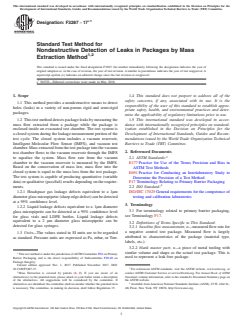
3.2.11 leak artifact, n—a test package that includes a
chamber lid onto the base. The chamber base also contains a
manufactured defect. For this method, leak artifacts are pack-
nest to contain the test package. Nest configuration is depen-
ages that include a glass micropipette to simulate a package
dent on test package features.
leak with a similar cross sectional area as real life leaks. The
3.2.4 chamber lid, n—upper portion of a vacuum test
glass micropipette is encapsulated inside a syringe needle and
chamber. The chamber lid commonly conforms to the portion inserted into the needle so its tip is near the needle sharp point
of the test package that extends above the chamber base.
as shown in Fig. 1. The metal needle provides mechanical
protection to the fragile micropipette. Leak artifact flow rates
3.2.5 container closure integrity test (CCIT), n—a method
were verified using airflow NIST traceable standards in com-
to determine if a package is sealed to a specified level.
pliance with the requirements of ISO 17025 to assure their
3.2.6 glass micropipette, n—athinglasstubethatincludesa
integrity and size.
specificdiameterwithin 620%ofspecificationatthetipofthe
3.2.12 leak test signature, n—flow curve that displays the
capillary tube. Micropipettes are independently qualified by
flow rate for the test package through the test cycle.
supplier.Flowpathsofthisnaturearecommonlydesignatedas
sharp edge (SE) holes. This can be used to represent a hole of
3.2.13 mass extraction instrument, n—complete instrument
a specific diameter when inserted into a package.
with automated test circuit, IMFS sensor, and controls to
complete mass extraction testing (3).
3.2.7 gross leak (GL) check, n—preliminary step in the leak
detection process where chamber pressure is measured before
3.2.14 negative control, n—intact (known good) test pack-
the chamber is fully evacuated. This step is intended to detect
age.
major issues (e.g. missing cap, chamber lid not installed,
3.2.15 rigid packages, n—test packages that maintain their
missing part, etc.).
shape with very minimal deflection under vacuum.
3.2.8 intelligent molecular flow sensor (IMFS), n—mass
3.2.16 semi-rigid packages, n—test packages that deform
flow measurement sensor that is capable of operating in the
under vacuum but return to original shape once vacuum is
transitional and molecular flow regimes measuring mass flow,
removed.
pressure (vacuum) and temperature (3). The IMFS is indepen-
3.2.17 verification orifice, n—calibrated leak device built
dently calibrated against traceable standards per the require-
into the mass extraction instrument includes a small calibrated
ments of ISO 17025.
leak used for periodic test system challenges.
3.2.9 large leak check (LLC), n—preliminary step in the
3.2.18 water for injection (WFI), n—water purified by
leak detection process where the mass exiting the chamber is
distillation or a purification process that is equivalent or
measured before the chamber is fully evacuated. This step is
superior to distillation in the removal of chemicals and
intended to detect leaks large enough to allow the test package
microorganisms.
to be evacuated as the vacuum test chamber is evacuated in
preparation for the fine leak test. This step is also intended to
4. Summary of Test Method
detect liquid leakage or spillage early in the process to
minimize system drying (moisture removal) requirements.
4.1 Thetestpackageisplacedinsideavacuumtestchamber
Refer to Section 10for additional details regarding the drying
and the vacuum test chamber evacuated. The test system
process. The size of defect that would be detected in this test
includes a vacuum reservoir, IMFS, and vacuum test chamber.
step is largely dependent on target fine leak detection level.
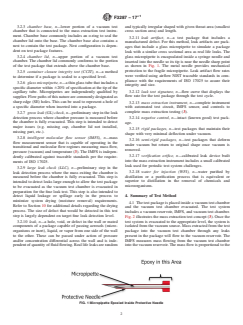
Fig. 2 illustrates the mass extraction test concept (3). Once the
3.2.10 leak, n—a hole, void, or defect in the wall or mated test system is evacuated to the appropriate level, the system is
components of a package capable of passing aerosols (micro- isolated from the vacuum source. Mass extracted from the test
organisms or inert), liquid, or vapor from one side of the wall package into the vacuum test chamber through any leaks
to the other. These can be passed under action of pressure present in the package will flow to the vacuum reservoir. The
and/or concentration differential across the wall and is inde- IMFS measures mass flowing from the vacuum test chamber
pendentofquantityoffluidflowing.Reallifeleaksarerandom intothevacuumreservoir.Themassflowisproportionaltothe
FIG. 1 Micropipette Epoxied Inside Protective Needle
´1
F3287 − 17
physical CCI test method for sterile products can be used to
assure the stability of the package sterility property during
transportation and product shelf life.
5.2 Mass extraction is a useful non-destructive test method
for testing a wide variety of packages. Package shape and
dimensions that can be tested using mass extraction are
FIG. 2 Mass Extraction Test System Overview
essentially unlimited, as long as a vacuum test chamber can be
designed and manufactured to accommodate the package.
defect geometry at the given differential pressure. The mea- 5.3 This method produces quantitative flow measurement
suredgasflowresultsfromleaksfromtheheadspacevolumeor
resultsthatareusefulincomparingpackagesealingproperties,
liquid (e,g, water) leaks exposed to the vacuum inside the different batches of product, material properties, and combina-
chamber. Since the vacuum pressure is lower than the boiling
tions of process parameters.
point of water at 20 6 5 ºC, the liquid will boil resulting in
5.4 Applications for mass extraction range from manually
liquid vapor and air gas flow mixture.
loaded and operated machines to automatic unattended work
4.2 Test system sensitivity is dependent on IMFS full scale
cells. This method can be applied for audit testing or 100%
range,vacuumtestchamberdesign,packagematerialtype,and
in-line testing.
test system set-up parameters. Test system set-up parameters
NOTE 2—Leak test methods that rely on gas or vapor transport, such as
can vary significantly based on required sensitivity, test pack- mass extraction, are not able to detect defects if they become plugged by
solid or nonvolatile matter. Plugging is possible by exposure to environ-
age material type, test package volume (size), and amount of
mental contaminants. In some cases, the packaged product itself can clog
package deflection that occurs when vacuum is applied. Ma-
defects. For example, leak paths may become blocked by suspended
terials can release mass into the vacuum test chamber due to
solids, gelatinous matter or dried-out solutions. Product clogging propen-
outgassing. The effects of outgassing on final mass flow rate
sityisafunctionoftheproductformulation,defectsizeandgeometry,and
can be minimized by lengthening the evacuation time before may be linked to product storage and handling conditions as well as the
time allotted to defect exposure. An investigation into the impact of
thefinalmassflowrateismeasuredorraisingthevacuumlevel
repeated test condition exposure on defect plugging is recommended if
to a higher absolute pressure. In special cases (e.g. large
product-package units are to be subject to repeated leak testing. Clogging
volume flexible packaging or some label materials) test pack-
is a complex phenomenon that is not well characterized or understood.
agepreparationmayberequiredtominimizepackagevolatiles.
Care must be taken to ensure that any CCI test method based on gas or
vapor transport through the leak path is appropriate for the intended
Incaseswhereacomponentcanmovewhenvacuumisapplied
product.
(e.g. Syringe or Cartridge stoppers), it is important to design
the vacuum test chamber to limit movement. Outward move-
6. Apparatus
ment of components during the test cycle will change the
volume inside the vacuum test chamber and can cause flow to
6.1 Mass Extraction Leak Detection Apparatus—Mass ex-
move to the reservoir which could simulate a leaking package
traction apparatus includes a vacuum test chamber connected
or false positive.
to a test instrument that includes an IMFS. The system also
requires a vacuum reservoir, vacuum generation package
4.3 Test chamber and test parameters must be designed to
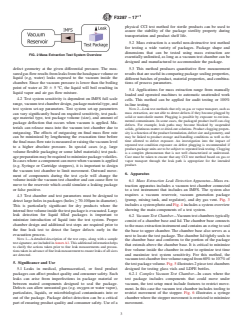
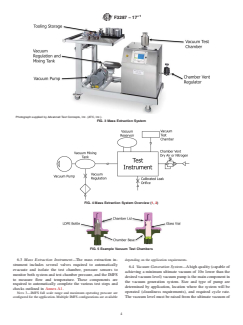
(pump, mixing tank, and regulator), and dry gas vent. Fig. 3
detectlargeholesinpackages(holes ≥70-100µmindiameter).
includesasystemphotoandFig.4includesasystemoverview
This is particularly significant for dry products where the
showing the main components of a test system.
internalfreevolumeinsidethetestpackageisevacuated.Large
leak detection for liquid filled packages is important to
6.2 Vacuum Test Chamber—Vacuumtestchamberstypically
minimize introduction of liquid into the test system. Proper
consist of a chamber base and lid. The chamber base connects
chamber design and additional test steps are required prior to
tothemassextractioninstrumentandcontainsano-ringtoseal
the fine leak test to detect the larger defects early in the
the base to upper chamber. The chamber base also serves as a
evacuation process.
nest to locate the test package.The chamber lid tightly seals to
NOTE 1—A detailed description of the test steps, along with a sample
the chamber base and conforms to the portion of the package
testsignature,areincludedinAnnexA1.Thisadditionalinformationhelps
that extends above the chamber base. It is critical to minimize
to clarify the actions taken prior to fine leak measurements and precau-
free volume inside the chamber in order to optimize test time
tionstakeninadvanceoffineleakmeasurementtoensureleaksofallsizes
are detected. and maximize test system sensitivity. For this method, the
vacuumtestchamberfreevolumerangedfrom60%to107%of
5. Significance and Use
thetestpackagevolume.Fig.5illustrates2piecetestchambers
designed for testing glass vials and LDPE bottles.
5.1 Leaks in medical, pharmaceutical, or food product
packages can affect product quality and consumer safety. Such 6.2.1 Complex Vacuum Test Chamber—In cases where the
leaks can arise from imperfections in package material or test package includes components that could move under
between mated components designed to seal the package. vacuum, the test setup must include features to restrict move-
Defects can allow unwanted gas (e.g. oxygen or water vapor), ment. In this case the vacuum test chamber includes tooling to
particulates, liquids, or microbiological contaminants into or restrict movement of the stopper. Fig. 6 illustrates a syringe
out of the package. Package defect detection can be a critical chamberwherethestoppermovementisrestrictedtominimize
part of ensuring product quality and consumer safety. Use of a movement.
´1
F3287 − 17
Photograph supplied by Advanced Test Concepts, Inc. (ATC, Inc.).
FIG. 3 Mass Extraction System
FIG. 4 Mass Extraction System Overview (1, 2)
FIG. 5 Example Vacuum Test Chambers
depending on the application requirements.
6.3 Mass Extraction Instrument—The mass extraction in-
strument includes several valves required to automatically
6.4 Vacuum Generation System—Ahigh quality (capable of
evacuate and isolate the test chamber, pressure sensors to
achieving a minimum ultimate vacuum of 10× lower than the
monitor both system and test chamber pressure, and the IMFS
desiredvacuumlevel)vacuumpumpisthemaincomponentin
to measure flow and temperature. These components are
the vacuum generation system. Size and type of pump are
required to automatically complete the various test steps and
determined by application, location where the system will be
checks outlined in Annex A1.
operated (cleanliness requirements), and required cycle rate.
NOTE 3—IMFS full scale range and maximum operating pressure are
The vacuum level must be raised from the ultimate vacuum of
configuredfortheapplication.MultipleIMFSconfigurationsareavailable
´1
F3287 − 17
9.2 The systems baseline leak tightness verification using
the master blank part prior to use is recommended by the
manufacturer,butisnotrequired.Thisensuresthatthereareno
significant system leaks and that the tooling has not been
damaged since last use. Frequency of baseline verification
checks should be defined by the user.The blank master part or
master intact packages can be used to verify system perfor-
mance after a failed test result.
9.3 Test parameters must be established and qualified for
each package type along with corresponding vacuum test
chamberpriortouse.Themasterblankpartornegativecontrol
packages can be used for development of test parameters. Test
parameters are defined during the development process to
achieve adequate differentiation (separation) between the mas-
ter blank and known leak. The known leak is commonly
achieved using the built in verification orifice or manufactured
leak artifact.
9.4 The system includes a calibrated NIST traceable verifi-
cation orifice that can be used in conjunction with the blank or
negative control packages to simulate a gas leak. Gas flow
FIG. 6 Syringe Vacuum Test Chamber
detection sensitivity can be determined using the calibrated
leak orifice. This built in verification orifice can be used to
the pump to the desired test pressure. This vacuum level is
periodically challenge the system by completing a test cycle
established by bleeding air into the system using a vacuum
with the verification orifice included in the test circuit. This
regulation device. Common tolerance for the vacuum level is
verification orifice typically represents the leak tightness re-
666 Pa. However, vacuum level tolerance can vary signifi-
quired for the package being tested. The test cycle should fail
cantly depending on application.
when the verification orifice is included in the circuit.
6.5 Chamber Vent—Venting the vacuum test chamber with
9.5 System verification should be completed on a regular
clean dry gas is important for consistent long term operation.
basis. Verification includes manually (or remotely through
Venting the chamber with atmospheric air can introduce test
digital I/O) opening the calibrated leak orifice into the circuit,
result variation due to varying moisture content of the atmo-
loadingtheblankmasterpartornegativecontrolpackages,and
spheric air along with particulates. If the atmosphere around
performinganormalleaktestcycle.Thecalibratedleakorifice
the system is well controlled, clean, and dry, it is possible to
should be turned off and test cycle run a second time. Results
use atmospheric air to vent the vacuum test chamber.
of these tests can be used to determine if the system is
operating per manufacturer’s specifications.
7. Hazards
7.1 Manualoperationofthisequipmentpresentsnohazards. 10. Procedure
In cases where mass extraction is integrated into an automated
10.1 Initial Package Set-up:
work cell and vacuum test chambers are opened and closed
10.1.1 Prior to initiating leak test cycles, it is suggested that
automatically,caremustbetakentoensurethatallpinchpoints
theinstrumentcalibrationdateshouldbeverifiedtoensurethat
are appropriately guarded.
the instruments calibration is valid.
10.1.2 Load appropriate test parameters for the desired test
8. Preparation of Apparatus
set-ups into the test instrument (see section 9.3).Verify that all
8.1 The apparatus must be started and made ready per the
parameters were properly programmed into the instrument.
manufacturer’s specifications. Utilities required for the instru-
10.1.3 Verifyvacuumgenerationsystemoperationtoensure
ments operation include 120/220VAC power and dry com-
vacuum level was within specified range as determined during
pressed air or gas at 551 kPa (80 psig) minimum.
parameter qualification.
8.2 A vacuum test chamber and/or volume fillers designed
10.1.4 Cycle the test instrument multiple times, typically
and manufact
...