

ASTM D6473/D6473M-24
(Test Method)Standard Test Method for Specific Gravity and Absorption of Rock for Erosion Control
General Information
- Abstract
SIGNIFICANCE AND USE
5.1 Rock for erosion control is composed of pieces of natural rock that are placed on construction projects, shorelines, streambeds, bridge abutments, pilings, and other structures to minimize the effects of erosion. The ability of rock to withstand deterioration from weathering affects both the effectiveness of the project and its cost. The specific gravity and absorption of rock provide useful information that can be used in evaluating the durability of the rock as well as its resistance to movement by water.
5.2 The absorption of water into rock may affect its durability under freezing conditions and salt crystallization conditions. In addition, the absorption test has been used as an index test in determining whether additional tests are needed to evaluate the durability of a rock.
5.3 Test specimens equal in size to the proposed design size would provide the best correlations between laboratory tests and actual field performance, however this is usually neither practical nor economically feasible.
5.4 The results of these tests are not to be used as the sole basis for determination of rock durability, and shall be used in conjunction with the results of other tests.
5.5 These test methods have been used to evaluate different types of rocks. There have been rare occasions when test results have provided data that have not agreed with the durability of rock under actual field conditions. For example, some rocks with low absorption values have fragmented in actual usage and some with high absorption values have proven to be durable.
Note 2: The quality of the result produced by this standard is dependent on the competence of the personnel performing it, and the suitability of the equipment and facilities used. Agencies which meet the criteria of Practice D3740 are generally considered capable of competent and objective testing/sampling/inspection/etc. Users of this standard are cautioned that compliance with Practice D3740 does not in itself assure r...
SCOPE
1.1 This test method covers the determination of specific gravity and absorption of rock for erosion control. The specific gravity may be expressed as bulk specific gravity or apparent specific gravity. Bulk specific gravity and absorption are based on a 24 ± 4-h soaking time for the rock specimens tested. This test is appropriate for breakwater stone, armor stone, riprap, and gabion sized rock materials, or similar.
1.2 The use of reclaimed concrete and other materials is beyond the scope of this test method.
1.3 Units—The values stated in either SI units or inch-pound units are to be regarded separately as standard. The values stated in each system may not be exact equivalents; therefore, each system shall be used independently of the other. Combining values from the two systems may result in nonconformance with the standard.
1.3.1 The gravitational system of inch-pound units is used when dealing with inch-pound units. In the system, the pound (lbf) represents a unit of force (weight), while the units for mass is slugs. The slug unit is not given, unless dynamic (F = ma) calculations are involved.
1.3.2 It is common practice in the engineering/construction profession to concurrently use pounds to represent both a unit of mass (lbm) and of force (lbf). This practice implicitly combines two separate systems of units; the absolute and the gravitational systems. It is scientifically undesirable to combine the use of two separate sets of inch-pound units within a single standard. As stated, this standard includes the gravitational system of inch-pound units and does not use/present the slug unit of mass. However, the use of balances and scales recording pounds of mass (lbm) shall not be regarded as nonconformance with this standard.
1.4 All observed and calculated values shall conform to the guidelines for significant digits and rounding established in Practice D6026, unless superseded by this standard.
1...
- Status
- Published
- Publication Date
- 14-Jan-2024
- Technical Committee
- D18 - Soil and Rock
- Drafting Committee
- D18.17 - Rock for Erosion Control
Buy Documents
ASTM D6473/D6473M-24 - Standard Test Method for Specific Gravity and Absorption of Rock for Erosion Control
REDLINE ASTM D6473/D6473M-24 - Standard Test Method for Specific Gravity and Absorption of Rock for Erosion Control
Overview
ASTM D6473/D6473M-24: Standard Test Method for Specific Gravity and Absorption of Rock for Erosion Control provides a standardized procedure for determining the specific gravity and water absorption of natural rock materials used in erosion control applications. Developed by ASTM International, this standard is crucial for ensuring the durability, stability, and suitability of large stone materials such as riprap, armor stone, breakwater stone, and gabion fill stone used in construction and environmental protection.
By assessing properties such as bulk and apparent specific gravity and percent absorption, engineers can better predict rock performance, select appropriate materials for erosion control, and safeguard long-term project success. The test method applies to rock sourced directly from quarries, outcrops, or drill core and does not cover materials like reclaimed concrete.
Key Topics
Specific Gravity Determination: The standard details methods for measuring bulk specific gravity (including saturated surface-dry, or SSD, and apparent) using a laboratory soaking and weighing procedure. Results should be provided both at test temperature and normalized to 20°C.
Absorption Testing: Water absorption is essential for understanding how rock might deteriorate, especially under freeze-thaw or salt crystallization conditions. The standard defines absorption as the percentage increase in mass after soaking, indicating the volume of permeable pores in the rock.
Sampling and Specimens: Guidelines are provided for sample collection, emphasizing representative sampling from both uniform and heterogeneous sources. Minimum specimen mass is typically 1 kg (2.2 lbs), and various sample types-field fragments, slabs, core-can be used.
Reporting Requirements: The standard mandates clear, detailed reporting, including source information, type of rock, specimen identification, specific test values, and averages. Adherence to significant digits and rounding practices is required per ASTM D6026.
Applicability: Suitable for large-sized rocks intended for erosion protection in infrastructure and environmental applications. Not applicable to alternate materials like concrete blocks.
Applications
The ASTM D6473/D6473M-24 standard is widely used in civil engineering, geotechnical, and environmental projects where erosion control is critical:
- Shoreline and Riverbank Protection: Ensures the durability of riprap and armor stone used to shield shores and streambanks from erosive forces.
- Infrastructure Foundations: Supports selection of rock for bridge abutments, pilings, and culvert outfalls.
- Coastal and Breakwater Structures: Assists in the evaluation of breakwater and revetment stone to prevent wave-induced erosion.
- Slope Stability: Helps determine the suitability of gabion fill and riprap for stabilizing embankments and slopes.
- Flood and Hydraulic Engineering: Supports material selection for temporary or permanent flood defenses and drainage channels.
Proper assessment of specific gravity and absorption using this ASTM standard is vital to select stone materials that remain effective and durable under site conditions, minimizing maintenance costs and project failures.
Related Standards
For comprehensive rock and aggregate testing, ASTM D6473/D6473M-24 is used in conjunction with other key standards, including:
- ASTM D653: Terminology Relating to Soil, Rock, and Contained Fluids
- ASTM D3740: Practice for Minimum Requirements for Agencies Engaged in Testing and/or Inspection of Soil and Rock
- ASTM D4753: Guide for Evaluating, Selecting, and Specifying Balances and Standard Masses
- ASTM D4992: Practice for Evaluation of Rock to be Used for Erosion Control
- ASTM D5121, D5312/D5312M, D5313/D5313M: Durability and preparation test methods for rock used in erosion control
- ASTM D6026: Practice for Using Significant Digits and Data Records in Geotechnical Data
Using ASTM D6473/D6473M-24 as part of an integrated testing program ensures reliable selection and performance of erosion control rock, supporting the longevity and success of infrastructure and environmental works.
Relations
- Replaces
ASTM D6473-15 - Standard Test Method For Specific Gravity And Absorption of Rock For Erosion Control - Effective Date
- 15-Jan-2024
Buy Documents
ASTM D6473/D6473M-24 - Standard Test Method for Specific Gravity and Absorption of Rock for Erosion Control
REDLINE ASTM D6473/D6473M-24 - Standard Test Method for Specific Gravity and Absorption of Rock for Erosion Control
Get Certified
Connect with accredited certification bodies for this standard

CIS Institut d.o.o.
Personal Protective Equipment (PPE) certification body. Notified Body NB-2890 for EU Regulation 2016/425 PPE.

Kiwa BDA Testing
Building and construction product certification.
Kmetijski inštitut Slovenije
Agricultural Institute of Slovenia. Soil testing, plant health, agricultural product analysis.
Sponsored listings
Frequently Asked Questions
ASTM D6473/D6473M-24 is a standard published by ASTM International. Its full title is "Standard Test Method for Specific Gravity and Absorption of Rock for Erosion Control". This standard covers: SIGNIFICANCE AND USE 5.1 Rock for erosion control is composed of pieces of natural rock that are placed on construction projects, shorelines, streambeds, bridge abutments, pilings, and other structures to minimize the effects of erosion. The ability of rock to withstand deterioration from weathering affects both the effectiveness of the project and its cost. The specific gravity and absorption of rock provide useful information that can be used in evaluating the durability of the rock as well as its resistance to movement by water. 5.2 The absorption of water into rock may affect its durability under freezing conditions and salt crystallization conditions. In addition, the absorption test has been used as an index test in determining whether additional tests are needed to evaluate the durability of a rock. 5.3 Test specimens equal in size to the proposed design size would provide the best correlations between laboratory tests and actual field performance, however this is usually neither practical nor economically feasible. 5.4 The results of these tests are not to be used as the sole basis for determination of rock durability, and shall be used in conjunction with the results of other tests. 5.5 These test methods have been used to evaluate different types of rocks. There have been rare occasions when test results have provided data that have not agreed with the durability of rock under actual field conditions. For example, some rocks with low absorption values have fragmented in actual usage and some with high absorption values have proven to be durable. Note 2: The quality of the result produced by this standard is dependent on the competence of the personnel performing it, and the suitability of the equipment and facilities used. Agencies which meet the criteria of Practice D3740 are generally considered capable of competent and objective testing/sampling/inspection/etc. Users of this standard are cautioned that compliance with Practice D3740 does not in itself assure r... SCOPE 1.1 This test method covers the determination of specific gravity and absorption of rock for erosion control. The specific gravity may be expressed as bulk specific gravity or apparent specific gravity. Bulk specific gravity and absorption are based on a 24 ± 4-h soaking time for the rock specimens tested. This test is appropriate for breakwater stone, armor stone, riprap, and gabion sized rock materials, or similar. 1.2 The use of reclaimed concrete and other materials is beyond the scope of this test method. 1.3 Units—The values stated in either SI units or inch-pound units are to be regarded separately as standard. The values stated in each system may not be exact equivalents; therefore, each system shall be used independently of the other. Combining values from the two systems may result in nonconformance with the standard. 1.3.1 The gravitational system of inch-pound units is used when dealing with inch-pound units. In the system, the pound (lbf) represents a unit of force (weight), while the units for mass is slugs. The slug unit is not given, unless dynamic (F = ma) calculations are involved. 1.3.2 It is common practice in the engineering/construction profession to concurrently use pounds to represent both a unit of mass (lbm) and of force (lbf). This practice implicitly combines two separate systems of units; the absolute and the gravitational systems. It is scientifically undesirable to combine the use of two separate sets of inch-pound units within a single standard. As stated, this standard includes the gravitational system of inch-pound units and does not use/present the slug unit of mass. However, the use of balances and scales recording pounds of mass (lbm) shall not be regarded as nonconformance with this standard. 1.4 All observed and calculated values shall conform to the guidelines for significant digits and rounding established in Practice D6026, unless superseded by this standard. 1...
SIGNIFICANCE AND USE 5.1 Rock for erosion control is composed of pieces of natural rock that are placed on construction projects, shorelines, streambeds, bridge abutments, pilings, and other structures to minimize the effects of erosion. The ability of rock to withstand deterioration from weathering affects both the effectiveness of the project and its cost. The specific gravity and absorption of rock provide useful information that can be used in evaluating the durability of the rock as well as its resistance to movement by water. 5.2 The absorption of water into rock may affect its durability under freezing conditions and salt crystallization conditions. In addition, the absorption test has been used as an index test in determining whether additional tests are needed to evaluate the durability of a rock. 5.3 Test specimens equal in size to the proposed design size would provide the best correlations between laboratory tests and actual field performance, however this is usually neither practical nor economically feasible. 5.4 The results of these tests are not to be used as the sole basis for determination of rock durability, and shall be used in conjunction with the results of other tests. 5.5 These test methods have been used to evaluate different types of rocks. There have been rare occasions when test results have provided data that have not agreed with the durability of rock under actual field conditions. For example, some rocks with low absorption values have fragmented in actual usage and some with high absorption values have proven to be durable. Note 2: The quality of the result produced by this standard is dependent on the competence of the personnel performing it, and the suitability of the equipment and facilities used. Agencies which meet the criteria of Practice D3740 are generally considered capable of competent and objective testing/sampling/inspection/etc. Users of this standard are cautioned that compliance with Practice D3740 does not in itself assure r... SCOPE 1.1 This test method covers the determination of specific gravity and absorption of rock for erosion control. The specific gravity may be expressed as bulk specific gravity or apparent specific gravity. Bulk specific gravity and absorption are based on a 24 ± 4-h soaking time for the rock specimens tested. This test is appropriate for breakwater stone, armor stone, riprap, and gabion sized rock materials, or similar. 1.2 The use of reclaimed concrete and other materials is beyond the scope of this test method. 1.3 Units—The values stated in either SI units or inch-pound units are to be regarded separately as standard. The values stated in each system may not be exact equivalents; therefore, each system shall be used independently of the other. Combining values from the two systems may result in nonconformance with the standard. 1.3.1 The gravitational system of inch-pound units is used when dealing with inch-pound units. In the system, the pound (lbf) represents a unit of force (weight), while the units for mass is slugs. The slug unit is not given, unless dynamic (F = ma) calculations are involved. 1.3.2 It is common practice in the engineering/construction profession to concurrently use pounds to represent both a unit of mass (lbm) and of force (lbf). This practice implicitly combines two separate systems of units; the absolute and the gravitational systems. It is scientifically undesirable to combine the use of two separate sets of inch-pound units within a single standard. As stated, this standard includes the gravitational system of inch-pound units and does not use/present the slug unit of mass. However, the use of balances and scales recording pounds of mass (lbm) shall not be regarded as nonconformance with this standard. 1.4 All observed and calculated values shall conform to the guidelines for significant digits and rounding established in Practice D6026, unless superseded by this standard. 1...
ASTM D6473/D6473M-24 is classified under the following ICS (International Classification for Standards) categories: 13.080.01 - Soil quality and pedology in general. The ICS classification helps identify the subject area and facilitates finding related standards.
ASTM D6473/D6473M-24 has the following relationships with other standards: It is inter standard links to ASTM D6473-15. Understanding these relationships helps ensure you are using the most current and applicable version of the standard.
ASTM D6473/D6473M-24 is available in PDF format for immediate download after purchase. The document can be added to your cart and obtained through the secure checkout process. Digital delivery ensures instant access to the complete standard document.
Standards Content (Sample)
This international standard was developed in accordance with internationally recognized principles on standardization established in the Decision on Principles for the
Development of International Standards, Guides and Recommendations issued by the World Trade Organization Technical Barriers to Trade (TBT) Committee.
Designation: D6473/D6473M − 24
Standard Test Method for
Specific Gravity and Absorption of Rock for Erosion
Control
This standard is issued under the fixed designation D6473/D6473M; the number immediately following the designation indicates the
year of original adoption or, in the case of revision, the year of last revision. A number in parentheses indicates the year of last
reapproval. A superscript epsilon (´) indicates an editorial change since the last revision or reapproval.
1. Scope* 1.4.1 For purposes of comparing measured or calculated
value(s) with specified limits, the measured or calculated
1.1 This test method covers the determination of specific
value(s) shall be rounded to the nearest decimal or significant
gravity and absorption of rock for erosion control. The specific
digits in the specified limits.
gravity may be expressed as bulk specific gravity or apparent
1.4.2 The procedures used to specify how data are collected/
specific gravity. Bulk specific gravity and absorption are based
recorded or calculated, in this standard are regarded as the
on a 24 6 4-h soaking time for the rock specimens tested. This
industry standard. In addition, they are representative of the
test is appropriate for breakwater stone, armor stone, riprap,
significant digits that generally should be retained. The proce-
and gabion sized rock materials, or similar.
dures used do not consider material variation, purpose for
1.2 The use of reclaimed concrete and other materials is
obtaining the data, special purpose studies, or any consider-
beyond the scope of this test method.
ations for the user’s objectives; and it is common practice to
increase or reduce significant digits of reported data to be
1.3 Units—The values stated in either SI units or inch-
pound units are to be regarded separately as standard. The commensurate with these considerations. It is beyond the scope
of this standard to consider significant digits used in analytical
values stated in each system may not be exact equivalents;
therefore, each system shall be used independently of the other. methods for engineering design.
Combining values from the two systems may result in noncon-
1.5 This standard does not purport to address all of the
formance with the standard.
safety concerns, if any, associated with its use. It is the
1.3.1 The gravitational system of inch-pound units is used
responsibility of the user of this standard to establish appro-
when dealing with inch-pound units. In the system, the pound
priate safety, health, and environmental practices and deter-
(lbf) represents a unit of force (weight), while the units for
mine the applicability of regulatory limitations prior to use.
mass is slugs. The slug unit is not given, unless dynamic (F =
1.6 This international standard was developed in accor-
ma) calculations are involved.
dance with internationally recognized principles on standard-
1.3.2 It is common practice in the engineering/construction
ization established in the Decision on Principles for the
profession to concurrently use pounds to represent both a unit
Development of International Standards, Guides and Recom-
of mass (lbm) and of force (lbf). This practice implicitly
mendations issued by the World Trade Organization Technical
combines two separate systems of units; the absolute and the
Barriers to Trade (TBT) Committee.
gravitational systems. It is scientifically undesirable to com-
bine the use of two separate sets of inch-pound units within a 2. Referenced Documents
single standard. As stated, this standard includes the gravita- 2
2.1 ASTM Standards:
tional system of inch-pound units and does not use/present the
C127 Test Method for Relative Density (Specific Gravity)
slug unit of mass. However, the use of balances and scales
and Absorption of Coarse Aggregate (Withdrawn 2024)
recording pounds of mass (lbm) shall not be regarded as
D653 Terminology Relating to Soil, Rock, and Contained
nonconformance with this standard.
Fluids
1.4 All observed and calculated values shall conform to the D3740 Practice for Minimum Requirements for Agencies
guidelines for significant digits and rounding established in Engaged in Testing and/or Inspection of Soil and Rock as
Practice D6026, unless superseded by this standard. Used in Engineering Design and Construction
1 2
This test method is under the jurisdiction of ASTM Committee D18 on Soil and For referenced ASTM standards, visit the ASTM website, www.astm.org, or
Rock and is the direct responsibility of Subcommittee D18.17 on Rock for Erosion contact ASTM Customer Service at service@astm.org. For Annual Book of ASTM
Control. Standards volume information, refer to the standard’s Document Summary page on
Current edition approved Jan. 15, 2024. Published March 2024. Originally the ASTM website.
approved in 1999. Last previous edition approved in 2015 as D6473 - 15. DOI: The last approved version of this historical standard is referenced on
10.1520/D6473_D6473M-24. www.astm.org.
*A Summary of Changes section appears at the end of this standard
Copyright © ASTM International, 100 Barr Harbor Drive, PO Box C700, West Conshohocken, PA 19428-2959. United States
D6473/D6473M − 24
D4753 Guide for Evaluating, Selecting, and Specifying Bal- used in evaluating the durability of the rock as well as its
ances and Standard Masses for Use in Soil, Rock, and resistance to movement by water.
Construction Materials Testing
5.2 The absorption of water into rock may affect its dura-
D4992 Practice for Evaluation of Rock to be Used for
bility under freezing conditions and salt crystallization condi-
Erosion Control
tions. In addition, the absorption test has been used as an index
D5121 Practice for Preparation of Rock Slabs for Durability
test in determining whether additional tests are needed to
Testing
evaluate the durability of a rock.
D5312/D5312M Test Method for Evaluation of Durability of
5.3 Test specimens equal in size to the proposed design size
Rock for Erosion Control Under Freezing and Thawing
would provide the best correlations between laboratory tests
Conditions
and actual field performance, however this is usually neither
D5313/D5313M Test Method for Evaluation of Durability of
practical nor economically feasible.
Rock for Erosion Control Under Wetting and Drying
Conditions
5.4 The results of these tests are not to be used as the sole
D6026 Practice for Using Significant Digits and Data Re-
basis for determination of rock durability, and shall be used in
cords in Geotechnical Data
conjunction with the results of other tests.
5.5 These test methods have been used to evaluate different
3. Terminology
types of rocks. There have been rare occasions when test
3.1 Definitions—For definitions of common technical terms
results have provided data that have not agreed with the
used in this standard, refer to Terminology D653.
durability of rock under actual field conditions. For example,
3.1.1 gabion fill stone, n—in rock, stone generally less than
some rocks with low absorption values have fragmented in
22 kg [50 lb] and placed in baskets of wire or other suitable
actual usage and some with high absorption values have proven
material that is tied together to form an integral structure
to be durable.
designed to resist erosion along stream banks and around
bridge piers as well as stabilize shorelines, stream banks or NOTE 2—The quality of the result produced by this standard is
dependent on the competence of the personnel performing it, and the
slopes as well as retaining walls, noise barriers, temporary
suitability of the equipment and facilities used. Agencies which meet the
flood walls, silt filtration from runoff, for small or temporary/
criteria of Practice D3740 are generally considered capable of competent
permanent dams, or channel lining. D5121, D5312/D5312M,
and objective testing/sampling/inspection/etc. Users of this standard are
D5312/D5312M
cautioned that compliance with Practice D3740 does not in itself assure
reliable results. Reliable results depends on many factors; Practice D3740
3.2 Definitions of Terms Specific to This Standard:
provides a means of evaluating some of those factors.
3.2.1 absorption, n—in rock, the increase in the mass of
rock due to water in the pores of the material, but not including
6. Apparatus
water adhering to the outside surface of the particles; expressed
6.1 Balance—A balance or scale conforming to the require-
as a percentage of the dry mass.
ments of Guide D4753 and readable (with no estimation) and
accurate to the nearest 5 g [0.01 lbm] or to 0.1 % or better of
4. Summary of Test Method
the mass of the test specimen. The balance shall be equipped
4.1 An air-dried specimen (block, chunk, or slab) of rock is
with suitable apparatus for suspending the sample container in
submerged in water for 24 6 4 h after which its buoyant mass
water from the center of the platform or pan of the balance.
is determined while still submerged. It is then removed from
the water, dried to a surface dry condition, and its mass in air 6.2 Specimen Container—A wire basket capable of holding
the submerged rock specimen being tested. The container shall
is determined. Finally, it is dried in an oven to a constant mass.
The oven-dry mass and saturated surface dry masses in air and be constructed so as to prevent trapping air when the container
is submerged.
when submerged in water are used to determine the specimen’s
specific gravity and percentage of water absorbed.
6.3 Water Tank—A watertight tank capable of holding the
NOTE 1—Immersion durations other than the 24-h period have been
fully immersed rock and specimen container while suspended
used. Specimens in those tests have been immersed in increments over a
below the balance.
four-day period. Test results indicate a higher percentage of water
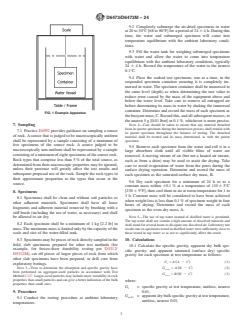
absorption than the 24 h test. Negligible differences in bulk specific 6.4 An example of the assembled test apparatus is shown in
gravity were measured after one-day soaking and four-day incremental
Fig. 1.
soakings.
6.5 Drying Oven—Vented, thermostatically-controlled,
preferably of the forced-draft type and capable of maintaining
5. Significance and Use
a uniform temperature of 110 6 5°C [230 6 9°F] throughout
5.1 Rock for erosion control is composed of pieces of
the drying chamber. These requirements typically require the
natural rock that are placed on construction projects,
use of a forced-draft oven.
shorelines, streambeds, bridge abutments, pilings, and other
structures to minimize the effects of erosion. The ability of rock 6.6 Thermometric Device—A thermometric device capable
to withstand deterioration from weathering affects both the of measuring the temperature of the water in the Water Tank
effectiveness of the project and its cost. The specific gravity within which the test is being performed readable to 0.1°C or
and absorption of rock provide useful information that can be better and having an
...
This document is not an ASTM standard and is intended only to provide the user of an ASTM standard an indication of what changes have been made to the previous version. Because
it may not be technically possible to adequately depict all changes accurately, ASTM recommends that users consult prior editions as appropriate. In all cases only the current version
of the standard as published by ASTM is to be considered the official document.
Designation: D6473 − 15 D6473/D6473M − 24
Standard Test Method for
Specific Gravity and Absorption of Rock for Erosion
Control
This standard is issued under the fixed designation D6473;D6473/D6473M; the number immediately following the designation indicates
the year of original adoption or, in the case of revision, the year of last revision. A number in parentheses indicates the year of last
reapproval. A superscript epsilon (´) indicates an editorial change since the last revision or reapproval.
1. Scope*
1.1 This test method covers the determination of specific gravity and absorption of rock for erosion control, commonly referred
to as riprap or armor stone. control. The specific gravity may be expressed as bulk specific gravity or apparent specific gravity. Bulk
specific gravity and absorption are based on a 24 6 4-h soaking time for the rock specimens tested. This test is appropriate for
breakwater stone, armor stone, riprap, and gabion sized rock materials.materials, or similar.
1.2 The use of reclaimed concrete and other materials is beyond the scope of this test method.
1.3 Units—The values stated in either SI units or inch-pound units are to be regarded separately as the standard. The values given
in parentheses are mathematical conversions to inch-pound units that are provided for information only and are not considered
standard. stated in each system may not be exact equivalents; therefore, each system shall be used independently of the other.
Combining values from the two systems may result in nonconformance with the standard.
1.3.1 The gravitational system of inch-pound units is used when dealing with inch-pound units. In the system, the pound (lbf)
represents a unit of force (weight), while the units for mass is slugs. The slug unit is not given, unless dynamic (F = ma)
calculations are involved.
1.3.2 It is common practice in the engineering/construction profession to concurrently use pounds to represent both a unit of mass
(lbm) and of force (lbf). This practice implicitly combines two separate systems of units; the absolute and the gravitational systems.
It is scientifically undesirable to combine the use of two separate sets of inch-pound units within a single standard. As stated, this
standard includes the gravitational system of inch-pound units and does not use/present the slug unit of mass. However, the use
of balances and scales recording pounds of mass (lbm) shall not be regarded as nonconformance with this standard.
1.4 All observed and calculated values shall conform to the guidelines for significant digits and rounding established in Practice
D6026, unless superseded by this standard.
1.4.1 For purposes of comparing measured or calculated value(s) with specified limits, the measured or calculated value(s) shall
be rounded to the nearest decimal or significant digits in the specified limits.
1.4.2 The procedures used to specify how data are collected/recorded or calculated, in this standard are regarded as the industry
standard. In addition, they are representative of the significant digits that generally should be retained. The procedures used do not
consider material variation, purpose for obtaining the data, special purpose studies, or any considerations for the user’s objectives;
This test method is under the jurisdiction of ASTM Committee D18 on Soil and Rock and is the direct responsibility of Subcommittee D18.17 on Rock for Erosion
Control.
Current edition approved July 1, 2015Jan. 15, 2024. Published July 2015March 2024. Originally approved in 1999. Last previous edition approved in 20102015 as
D6473 - 10.D6473 - 15. DOI: 10.1520/D6473-15.10.1520/D6473_D6473M-24.
*A Summary of Changes section appears at the end of this standard
Copyright © ASTM International, 100 Barr Harbor Drive, PO Box C700, West Conshohocken, PA 19428-2959. United States
D6473/D6473M − 24
and it is common practice to increase or reduce significant digits of reported data to be commensurate with these considerations.
It is beyond the scope of this standard to consider significant digits used in analytical methods for engineering design.
1.5 This standard does not purport to address all of the safety concerns, if any, associated with its use. It is the responsibility
of the user of this standard to establish appropriate safety, health, and environmental practices and determine the applicability of
regulatory limitations prior to use.
1.6 This international standard was developed in accordance with internationally recognized principles on standardization
established in the Decision on Principles for the Development of International Standards, Guides and Recommendations issued
by the World Trade Organization Technical Barriers to Trade (TBT) Committee.
2. Referenced Documents
2.1 ASTM Standards:
C127 Test Method for Relative Density (Specific Gravity) and Absorption of Coarse Aggregate (Withdrawn 2024)
D653 Terminology Relating to Soil, Rock, and Contained Fluids
D3740 Practice for Minimum Requirements for Agencies Engaged in Testing and/or Inspection of Soil and Rock as Used in
Engineering Design and Construction
D4753 Guide for Evaluating, Selecting, and Specifying Balances and Standard Masses for Use in Soil, Rock, and Construction
Materials Testing
D4992 Practice for Evaluation of Rock to be Used for Erosion Control
D5121 Practice for Preparation of Rock Slabs for Durability Testing
D5312/D5312M Test Method for Evaluation of Durability of Rock for Erosion Control Under Freezing and Thawing Conditions
D5313/D5313M Test Method for Evaluation of Durability of Rock for Erosion Control Under Wetting and Drying Conditions
D6026 Practice for Using Significant Digits and Data Records in Geotechnical Data
3. Terminology
3.1 Definitions—For definitions of common technical terms used in this standard, refer to Terminology D653.
3.1 Definitions of Terms Specific to This Standard:Definitions—
3.2.1 absorption—the increase in the mass of rock due to water in the pores of the material, but not including water adhering to
the outside surface of the particles. Absorption is expressed as a percentage of the dry mass.For
3.2.2 apparent specific gravity—the ratio of the mass in air of a given volume of the impermeable portion of a permeable material
(that is, the solid matter including its impermeable pores or voids) at a stated temperature to the mass of an equal volume of
distilled water at the same stated temperature. The value is dimensionless.
3.2.3 bulk specific gravity—the ratio of the mass in air of a given volume of a permeable solid (including both permeable and
impermeable voids within the material) at a stated temperature, to the mass in air of an equal volume of distilled water at the same
stated temperature. The value is dimensionless.definitions
3.2.4 bulk specific gravity (saturated surface-dry) (SSD)—the ratio of the mass of a given volume of permeable solid, (including
the mass of water within the saturated permeable voids) filled to the extent achieved by submerging in water for approximately
24 h at the stated temperature to the mass of an equal volume of water at the same stated temperature. The value is dimensionless.
of common technical terms used in this standard, refer to Terminology D653.
3.1.1 gabion-fill stone—gabion fill stone, n—in rock, stone generally less than 25 kg (50 lb)22 kg [50 lb] and placed in baskets
of wire or other suitable material. These baskets are then material that is tied together to form an integral structure designed to resist
erosion along stream banks and around bridge piers.piers as well as stabilize shorelines, stream banks or slopes as well as retaining
walls, noise barriers, temporary flood walls, silt filtration from runoff, for small or temporary/ permanent dams, or channel lining.
D5121, D5312/D5312M, D5312/D5312M
3.2.6 specific gravity—the ratio of the mass in air of a given volume of solid at a stated temperature to the mass of an equal volume
of distilled water at the same stated temperature. The value is dimensionless.
For referenced ASTM standards, visit the ASTM website, www.astm.org, or contact ASTM Customer Service at service@astm.org. For Annual Book of ASTM Standards
volume information, refer to the standard’s Document Summary page on the ASTM website.
The last approved version of this historical standard is referenced on www.astm.org.
D6473/D6473M − 24
3.2 Definitions of Terms Specific to This Standard:
3.2.1 absorption, n—in rock, the increase in the mass of rock due to water in the pores of the material, but not including water
adhering to the outside surface of the particles; expressed as a percentage of the dry mass.
4. Summary of Test Method
4.1 An air-dried specimen (block, chunk, or slab) of rock is submerged in water for 24 6 4 h after which its buoyant mass is
determined while still submerged. It is then removed from the water, dried to a surface dry condition, and its mass re-determined.
in air is determined. Finally, it is dried in an oven to a constant mass. The initialoven-dry mass and increase in mass saturated
surface dry masses in air and when submerged in water are used to determine the specimen’s specific gravity and percentage of
water absorbed.
NOTE 1—Immersion durations other than the 24-h period have been used. Specimens in those tests have been immersed in increments over a four-day
period. Test results indicate a higher percentage of water absorption than the 24 h test. Negligible differences in bulk specific gravity were measured after
one-day soaking and four-day incremental soakings.
5. Significance and Use
5.1 Rock riprap and armor stone are for erosion control is composed of pieces of natural rock that are placed on construction
projects, shorelines, streambeds, bridge abutments, pilings, and other structures to minimize the effects of erosion. The ability of
rock to withstand deterioration from weathering affects both the effectiveness of the project and its cost. The specific gravity and
absorption of rock provide useful information that can be used in evaluating possible deterioration of rock.the durability of the rock
as well as its resistance to movement by water.
5.2 Bulk specific gravity and bulk specific gravity SSD may reflect the quality of rock and is important in that it may provide one
indicator to the resistance of a rock to movement by water.
5.2 The absorption of water into rock may affect its durability under freezing conditions and salt crystallization conditions. In
addition, the absorption test has been used as an index test in determining whether additional tests are needed to evaluate the
durability of a rock.
5.3 Test specimens equal in size to the proposed design size would provide the best correlations between laboratory tests and
actual field performance, however this is usually neither practical nor economically feasible.
5.4 The results of these tests are not to be used as the sole basis for determination of rock durability, but shouldand shall be used
in conjunction with the results of other tests.
5.5 These test methods have been used to evaluate different types of rocks. There have been rare occasions when test results have
provided data that have not agreed with the durability of rock under actual field conditions. For example, some rocks with low
absorption values have fragmented in actual usage and some with high absorption values have proven to be durable.
NOTE 2—The quality of the result produced by this standard is dependent on the competence of the personnel performing it, and the suitability of the
equipment and facilities used. Agencies which meet the criteria of Practice D3740 are generally considered capable of competent and objective
testing/sampling/inspection/etc. Users of this standard are cautioned that compliance with Practice D3740 does not in itself assure reliable results. Reliable
results depends on many factors; Practice D3740 provides a means of evaluating some of those factors.
6. Apparatus
6.1 Balance—A balance or scale conforming to the requirements of SpecificationGuide D4753 and readable (with no estimation)
and accurate to the nearest 5 g [0.01 lbm] or to 0.1 % or better of the mass of the test specimen. The balance shall be equipped
with suitable apparatus for suspending the sample container in water from the center of the platform or pan of the balance.
6.2 Specimen Container—A wire basket capable of holding the submerged rock specimen being tested. The container shall be
constructed so as to prevent trapping air when the container is submerged.
D6473/D6473M − 24
6.3 Water Tank—A watertight tank capable of holding the fully immersed rock and specimen container while suspended below
the balance.
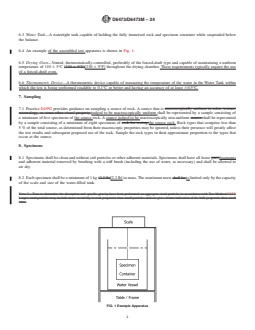
6.4 An example of the assembled test apparatus is shown in Fig. 1.
6.5 Drying Oven—Vented, thermostatically-controlled, preferably of the forced-draft type and capable of maintaining a uniform
temperature of 110 6 5°C (230 6 9°F)[230 6 9°F] throughout the drying chamber. These requirements typically require the use
of a forced-draft oven.
6.6 Thermometric Device—A thermometric device capable of measuring the temperature of the water in the Water Tank within
which the test is being performed readable to 0.1°C or better and having an accuracy of at least 60.5°C.
7. Sampling
7.1 Practice D4992 provides guidance on sampling a source of rock. A source that is macroscopically uniform in color, texture,
mineralogy, or some other visual property judged to be macroscopically uniform shall be represented by a sample consisting of
a minimum of five specimens of the source rock. A source judged to be macroscopically non-uniform source shall be represented
by a sample consisting of a minimum of eight specimens of rock for testing.
...