

ASTM D8297/D8297M-23
(Test Method)Standard Test Method for Determination of Erosion Control Products (ECP) Performance in Protecting Slopes from Sequential Rainfall-Induced Erosion Using a Tilted Bed Slope
General Information
- Abstract
SIGNIFICANCE AND USE
5.1 This test method utilizes large-scale testing equipment and procedures established at a variety of testing laboratories over the last 30 years.
5.2 This method is useful in evaluating ECPs and their installation to reduce soil loss and sediment concentrations when exposed to defined rainfall conditions and improving water quality exiting the area disturbed by earthwork activity by reducing suspended solids and turbidity.
5.3 This test method is a performance test, but can also be used for acceptance testing to determine product conformance to project specifications. For project-specific conformance, unique project-specific conditions should be considered. Caution is advised since information regarding laboratory specific precision is incomplete at this time, and differences in soil and other environmental and geotechnical conditions may affect ECP performance.
5.4 This standard can also be used as a comparative tool for evaluating the erosion control characteristics of different ECPs and can also be used to gain agency approvals.
Note 1: The quality of the result produced by this standard is dependent on the competence of the personnel performing it, and the suitability of the equipment and facilities used. Agencies that meet the criteria of Practice D3740 are generally considered capable of competent and objective testing/sampling/inspection/etc. Users of this standard are cautioned that compliance with Practice D3740 does not in itself assure reliable results. Reliable results depend on many factors; Practice D3740 provides a means of evaluating some of those factors.
SCOPE
1.1 This test method is used to evaluate the ability of erosion control products (ECP) to protect slopes from rainfall-induced erosion using an adjustable tilting bed slope. The standard slopes range from 2:1 to 4:1 (H:V) having a target rainfall intensity of 3.5 in./h [90 mm/h].
1.2 There are three main elements the ECPs must have the ability to perform: 1. Absorb the impact force of raindrops, thereby reducing soil particle loosening and detachment through “splash” mechanisms; 2. Slow runoff and encourage infiltration, thereby reducing soil particle displacement and transport through “overland flow” mechanisms; and 3. Trap soil particles beneath the ECP. When comparing data from different ECPs under consideration, it is important to keep the test conditions the same for the ECPs being evaluated, for example, the rainfall intensity rate and the slope.
1.3 The results of this test method can be used to evaluate performance and acceptability, and can be used to compare the effectiveness of different ECPs. This method provides a comparative evaluation of an ECP to baseline bare soil conditions under controlled and documented conditions. This test method can provide information about a product that is under consideration for a specific application where no performance information currently exists.
1.4 This test method covers the use of three different soil types, ECP installation: sprayed, rolled, or dry applied, and a runoff collection procedure. This test is typically performed indoors, but may be performed outside as long as certain requirements are met. Partially enclosed facilities are acceptable providing the environmental conditions are met.
1.5 Units—The values stated in either inch-pound units or SI units are to be regarded separately as standard. The values stated in each system may not be exact equivalents; therefore, each system shall be used independently of the other. Combining values from the two systems may result in nonconformance with the standard. Reporting of test results in units other than inch-pound shall not be regarded as nonconformance with this standard.
1.5.1 The gravitational system of inch-pound units is used when dealing with inch-pound units. In the system, the pound (lbf) represents a unit of force (weight), while the units for mass is slugs. The slug unit is n...
- Status
- Published
- Publication Date
- 31-Oct-2023
- Technical Committee
- D18 - Soil and Rock
- Drafting Committee
- D18.25 - Erosion and Sediment Control Technology
Buy Documents
ASTM D8297/D8297M-23 - Standard Test Method for Determination of Erosion Control Products (ECP) Performance in Protecting Slopes from Sequential Rainfall-Induced Erosion Using a Tilted Bed Slope
REDLINE ASTM D8297/D8297M-23 - Standard Test Method for Determination of Erosion Control Products (ECP) Performance in Protecting Slopes from Sequential Rainfall-Induced Erosion Using a Tilted Bed Slope
Overview
ASTM D8297/D8297M-23 is the standard test method developed by ASTM International for the performance evaluation of Erosion Control Products (ECPs) in protecting slopes from erosion triggered by sequential rainfall events. Using a tilted bed slope to simulate real-world conditions, this method provides a standardized and comparative approach to assess how effective different ECPs are at reducing soil loss, minimizing sediment concentration, and maintaining water quality in disturbed areas, particularly those affected by earthmoving or construction activities.
Key Topics
- Performance Testing of ECPs: The method determines if ECPs can mitigate rainfall-induced surface erosion and prevent sediment runoff on slopes with gradient ratios from 2:1 to 4:1 (horizontal:vertical).
- Simulated Rainfall and Runoff Collection: ECPs are tested under controlled rainfall events using specialized tilting bed slopes, allowing for consistent, repeatable results. Standard rainfall intensity for evaluation is set at 3.5 in./h [90 mm/h].
- Soil and ECP Installation Variability: The standard allows testing on three soil types (sand, loam, and clay) and accounts for different ECP installation methods-sprayed, rolled, or dry applied.
- Critical ECP Functions:
- Absorb raindrop impact forces, reducing soil surface disturbance.
- Slow surface runoff and enhance water infiltration, thereby decreasing soil particle transport.
- Physically trap soil particles beneath the protective layer of the ECP.
- Comparative and Acceptance Testing: Enables side-by-side comparison of different ECPs, helping agencies, engineers, and contractors select the best product for specific site conditions. The standard also supports product acceptance for project specification conformance.
Applications
ASTM D8297/D8297M-23 has broad value in the construction, geotechnical, and environmental engineering sectors, as well as regulatory contexts:
- Infrastructure and Construction Sites: Critical for preventing erosion on temporary and permanent slopes subjected to earthmoving. Ensures regulatory compliance and environmental stewardship during highway, pipeline, or other large excavation projects.
- Product Development and Quality Assurance: Manufacturers use this test method during R&D and quality control to optimize ECP performance for specific soil and environmental conditions.
- Regulatory Approval: Results from this standardized test can be presented to regulatory agencies to validate a product’s effectiveness before approval for public or private sector use.
- Environmental Impact Mitigation: By providing data on how ECPs reduce turbidity and suspended solids, the method supports efforts to maintain downstream water quality.
- Contract Administration: Allows agencies and project owners to specify minimum ECP performance criteria, confirming products meet or exceed those requirements under standardized testing.
Related Standards
- ASTM D653: Terminology relating to soil, rock, and contained fluids, ensuring consistent language across geotechnical documentation.
- ASTM D698: Methods for soil compaction characteristics, supporting the preparation of test plots.
- ASTM D2487: Soil classification for appropriate test material selection.
- ASTM D3740: Agency requirements for soil and rock testing, supporting laboratory accreditation and reliability of test results.
- ASTM D7937: Turbidity measurement in surface water, relevant to assessing runoff water quality.
- ASTM D4318, D6913/D6913M, D7928: Soil property testing (Atterberg limits, gradation) involved in test plot preparation.
These referenced standards contribute to the rigor, repeatability, and acceptance of ASTM D8297/D8297M-23 test results.
Conclusion
ASTM D8297/D8297M-23 is a vital standard for anyone concerned with effective slope protection and erosion control product performance. By using controlled, repeatable testing parameters, it ensures that ECPs can be reliably evaluated and selected to minimize environmental impact and safeguard project success. For manufacturers, engineers, regulatory agencies, and environmental professionals, this standard delivers significant practical value in reducing soil loss, managing stormwater runoff, and upholding water quality on construction and infrastructure projects.
Relations
- Effective Date
- 01-Nov-2023
- Effective Date
- 01-Feb-2024
- Effective Date
- 01-Nov-2023
- Effective Date
- 01-Nov-2023
- Effective Date
- 01-Oct-2019
- Effective Date
- 01-Jun-2018
- Effective Date
- 01-May-2015
- Effective Date
- 01-Nov-2023
Buy Documents
ASTM D8297/D8297M-23 - Standard Test Method for Determination of Erosion Control Products (ECP) Performance in Protecting Slopes from Sequential Rainfall-Induced Erosion Using a Tilted Bed Slope
REDLINE ASTM D8297/D8297M-23 - Standard Test Method for Determination of Erosion Control Products (ECP) Performance in Protecting Slopes from Sequential Rainfall-Induced Erosion Using a Tilted Bed Slope
Get Certified
Connect with accredited certification bodies for this standard

BSI Group
BSI (British Standards Institution) is the business standards company that helps organizations make excellence a habit.

Bureau Veritas
Bureau Veritas is a world leader in laboratory testing, inspection and certification services.

DNV
DNV is an independent assurance and risk management provider.
Sponsored listings
Frequently Asked Questions
ASTM D8297/D8297M-23 is a standard published by ASTM International. Its full title is "Standard Test Method for Determination of Erosion Control Products (ECP) Performance in Protecting Slopes from Sequential Rainfall-Induced Erosion Using a Tilted Bed Slope". This standard covers: SIGNIFICANCE AND USE 5.1 This test method utilizes large-scale testing equipment and procedures established at a variety of testing laboratories over the last 30 years. 5.2 This method is useful in evaluating ECPs and their installation to reduce soil loss and sediment concentrations when exposed to defined rainfall conditions and improving water quality exiting the area disturbed by earthwork activity by reducing suspended solids and turbidity. 5.3 This test method is a performance test, but can also be used for acceptance testing to determine product conformance to project specifications. For project-specific conformance, unique project-specific conditions should be considered. Caution is advised since information regarding laboratory specific precision is incomplete at this time, and differences in soil and other environmental and geotechnical conditions may affect ECP performance. 5.4 This standard can also be used as a comparative tool for evaluating the erosion control characteristics of different ECPs and can also be used to gain agency approvals. Note 1: The quality of the result produced by this standard is dependent on the competence of the personnel performing it, and the suitability of the equipment and facilities used. Agencies that meet the criteria of Practice D3740 are generally considered capable of competent and objective testing/sampling/inspection/etc. Users of this standard are cautioned that compliance with Practice D3740 does not in itself assure reliable results. Reliable results depend on many factors; Practice D3740 provides a means of evaluating some of those factors. SCOPE 1.1 This test method is used to evaluate the ability of erosion control products (ECP) to protect slopes from rainfall-induced erosion using an adjustable tilting bed slope. The standard slopes range from 2:1 to 4:1 (H:V) having a target rainfall intensity of 3.5 in./h [90 mm/h]. 1.2 There are three main elements the ECPs must have the ability to perform: 1. Absorb the impact force of raindrops, thereby reducing soil particle loosening and detachment through “splash” mechanisms; 2. Slow runoff and encourage infiltration, thereby reducing soil particle displacement and transport through “overland flow” mechanisms; and 3. Trap soil particles beneath the ECP. When comparing data from different ECPs under consideration, it is important to keep the test conditions the same for the ECPs being evaluated, for example, the rainfall intensity rate and the slope. 1.3 The results of this test method can be used to evaluate performance and acceptability, and can be used to compare the effectiveness of different ECPs. This method provides a comparative evaluation of an ECP to baseline bare soil conditions under controlled and documented conditions. This test method can provide information about a product that is under consideration for a specific application where no performance information currently exists. 1.4 This test method covers the use of three different soil types, ECP installation: sprayed, rolled, or dry applied, and a runoff collection procedure. This test is typically performed indoors, but may be performed outside as long as certain requirements are met. Partially enclosed facilities are acceptable providing the environmental conditions are met. 1.5 Units—The values stated in either inch-pound units or SI units are to be regarded separately as standard. The values stated in each system may not be exact equivalents; therefore, each system shall be used independently of the other. Combining values from the two systems may result in nonconformance with the standard. Reporting of test results in units other than inch-pound shall not be regarded as nonconformance with this standard. 1.5.1 The gravitational system of inch-pound units is used when dealing with inch-pound units. In the system, the pound (lbf) represents a unit of force (weight), while the units for mass is slugs. The slug unit is n...
SIGNIFICANCE AND USE 5.1 This test method utilizes large-scale testing equipment and procedures established at a variety of testing laboratories over the last 30 years. 5.2 This method is useful in evaluating ECPs and their installation to reduce soil loss and sediment concentrations when exposed to defined rainfall conditions and improving water quality exiting the area disturbed by earthwork activity by reducing suspended solids and turbidity. 5.3 This test method is a performance test, but can also be used for acceptance testing to determine product conformance to project specifications. For project-specific conformance, unique project-specific conditions should be considered. Caution is advised since information regarding laboratory specific precision is incomplete at this time, and differences in soil and other environmental and geotechnical conditions may affect ECP performance. 5.4 This standard can also be used as a comparative tool for evaluating the erosion control characteristics of different ECPs and can also be used to gain agency approvals. Note 1: The quality of the result produced by this standard is dependent on the competence of the personnel performing it, and the suitability of the equipment and facilities used. Agencies that meet the criteria of Practice D3740 are generally considered capable of competent and objective testing/sampling/inspection/etc. Users of this standard are cautioned that compliance with Practice D3740 does not in itself assure reliable results. Reliable results depend on many factors; Practice D3740 provides a means of evaluating some of those factors. SCOPE 1.1 This test method is used to evaluate the ability of erosion control products (ECP) to protect slopes from rainfall-induced erosion using an adjustable tilting bed slope. The standard slopes range from 2:1 to 4:1 (H:V) having a target rainfall intensity of 3.5 in./h [90 mm/h]. 1.2 There are three main elements the ECPs must have the ability to perform: 1. Absorb the impact force of raindrops, thereby reducing soil particle loosening and detachment through “splash” mechanisms; 2. Slow runoff and encourage infiltration, thereby reducing soil particle displacement and transport through “overland flow” mechanisms; and 3. Trap soil particles beneath the ECP. When comparing data from different ECPs under consideration, it is important to keep the test conditions the same for the ECPs being evaluated, for example, the rainfall intensity rate and the slope. 1.3 The results of this test method can be used to evaluate performance and acceptability, and can be used to compare the effectiveness of different ECPs. This method provides a comparative evaluation of an ECP to baseline bare soil conditions under controlled and documented conditions. This test method can provide information about a product that is under consideration for a specific application where no performance information currently exists. 1.4 This test method covers the use of three different soil types, ECP installation: sprayed, rolled, or dry applied, and a runoff collection procedure. This test is typically performed indoors, but may be performed outside as long as certain requirements are met. Partially enclosed facilities are acceptable providing the environmental conditions are met. 1.5 Units—The values stated in either inch-pound units or SI units are to be regarded separately as standard. The values stated in each system may not be exact equivalents; therefore, each system shall be used independently of the other. Combining values from the two systems may result in nonconformance with the standard. Reporting of test results in units other than inch-pound shall not be regarded as nonconformance with this standard. 1.5.1 The gravitational system of inch-pound units is used when dealing with inch-pound units. In the system, the pound (lbf) represents a unit of force (weight), while the units for mass is slugs. The slug unit is n...
ASTM D8297/D8297M-23 is classified under the following ICS (International Classification for Standards) categories: 13.020.01 - Environment and environmental protection in general; 13.080.01 - Soil quality and pedology in general. The ICS classification helps identify the subject area and facilitates finding related standards.
ASTM D8297/D8297M-23 has the following relationships with other standards: It is inter standard links to ASTM D8297/D8297M-22, ASTM D4753-24, ASTM D6567-23, ASTM D3740-23, ASTM D3740-19, ASTM D6567-18, ASTM D4753-15, ASTM D653-22. Understanding these relationships helps ensure you are using the most current and applicable version of the standard.
ASTM D8297/D8297M-23 is available in PDF format for immediate download after purchase. The document can be added to your cart and obtained through the secure checkout process. Digital delivery ensures instant access to the complete standard document.
Standards Content (Sample)
This international standard was developed in accordance with internationally recognized principles on standardization established in the Decision on Principles for the
Development of International Standards, Guides and Recommendations issued by the World Trade Organization Technical Barriers to Trade (TBT) Committee.
Designation: D8297/D8297M − 23
Standard Test Method for
Determination of Erosion Control Products (ECP)
Performance in Protecting Slopes from Sequential Rainfall-
Induced Erosion Using a Tilted Bed Slope
This standard is issued under the fixed designation D8297/D8297M; the number immediately following the designation indicates the
year of original adoption or, in the case of revision, the year of last revision. A number in parentheses indicates the year of last
reapproval. A superscript epsilon (´) indicates an editorial change since the last revision or reapproval.
1. Scope* each system shall be used independently of the other. Combin-
ing values from the two systems may result in nonconformance
1.1 This test method is used to evaluate the ability of
with the standard. Reporting of test results in units other than
erosion control products (ECP) to protect slopes from rainfall-
inch-pound shall not be regarded as nonconformance with this
induced erosion using an adjustable tilting bed slope. The
standard.
standard slopes range from 2:1 to 4:1 (H:V) having a target
1.5.1 The gravitational system of inch-pound units is used
rainfall intensity of 3.5 in./h [90 mm/h].
when dealing with inch-pound units. In the system, the pound
1.2 There are three main elements the ECPs must have the
(lbf) represents a unit of force (weight), while the units for
ability to perform: 1. Absorb the impact force of raindrops,
mass is slugs. The slug unit is not given, unless dynamic (F =
thereby reducing soil particle loosening and detachment
ma) calculations are involved.
through “splash” mechanisms; 2. Slow runoff and encourage
1.5.2 It is common practice in the engineering/construction
infiltration, thereby reducing soil particle displacement and
profession to concurrently use pounds to represent both a unit
transport through “overland flow” mechanisms; and 3. Trap
of mass (lbm) and of force (lbf). This practice implicitly
soil particles beneath the ECP. When comparing data from
combines two separate systems of units; the absolute and the
different ECPs under consideration, it is important to keep the
gravitational systems. It is scientifically undesirable to com-
test conditions the same for the ECPs being evaluated, for
bine the use of two separate sets of inch-pound units within a
example, the rainfall intensity rate and the slope.
single standard. As stated, this standard includes the gravita-
1.3 The results of this test method can be used to evaluate
tional system of inch-pound units and does not use/present the
performance and acceptability, and can be used to compare the
slug unit of mass. However, the use of balances and scales
effectiveness of different ECPs. This method provides a com-
recording pounds of mass (lbm) or recording density in lbm/ft
parative evaluation of an ECP to baseline bare soil conditions
shall not be regarded as nonconformance with this standard.
under controlled and documented conditions. This test method
1.5.3 Calculations are done using only one set of units;
can provide information about a product that is under consid-
either gravitational inch-pound or SI. Other units are permis-
eration for a specific application where no performance infor-
sible provided appropriate conversion factors are used to
mation currently exists.
maintain consistency of units throughout the calculations, and
1.4 This test method covers the use of three different soil
similar significant digits or resolution, or both are maintained.
types, ECP installation: sprayed, rolled, or dry applied, and a
1.6 All observed and calculated values shall conform to the
runoff collection procedure. This test is typically performed
guidelines for significant digits and rounding established in
indoors, but may be performed outside as long as certain
Practice D6026, unless superseded by this test method.
requirements are met. Partially enclosed facilities are accept-
able providing the environmental conditions are met.
1.6.1 The procedures used to specify how data are collected/
recorded and calculated in the standard are regarded as the
1.5 Units—The values stated in either inch-pound units or
industry standard. In addition, they are representative of the
SI units are to be regarded separately as standard. The values
significant digits that generally should be retained. The proce-
stated in each system may not be exact equivalents; therefore,
dures used do not consider material variation, purpose for
obtaining the data, special purpose studies, or any consider-
ations for the user’s objectives; and it is common practice to
This test method is under the jurisdiction of ASTM Committee D18 on Soil and
Rock and is the direct responsibility of Subcommittee D18.25 on Erosion and
increase or reduce significant digits of reported data to be
Sediment Control Technology.
commensurate with these considerations. It is beyond the scope
Current edition approved Nov. 1, 2023. Published November 2023. Originally
of these test methods to consider significant digits used in
approved in 2020. Last previous edition approved in 2022 as D8297/D8297M – 22.
DOI: 10.1520/D8297_D8297M-23. analysis methods for engineering data.
*A Summary of Changes section appears at the end of this standard
Copyright © ASTM International, 100 Barr Harbor Drive, PO Box C700, West Conshohocken, PA 19428-2959. United States
D8297/D8297M − 23
1.7 This standard does not purport to address all of the D7367 Test Method for Determining Water Holding Capac-
safety concerns, if any, associated with its use. It is the ity of Fiber Mulches for Hydraulic Planting
responsibility of the user of this standard to establish appro- D7928 Test Method for Particle-Size Distribution (Grada-
priate safety, health, and environmental practices and deter- tion) of Fine-Grained Soils Using the Sedimentation
mine the applicability of regulatory limitations prior to use. (Hydrometer) Analysis
1.8 This international standard was developed in accor- D7937 Test Method for In-situ Determination of Turbidity
dance with internationally recognized principles on standard- Above 1 Turbidity Unit (TU) in Surface Water
ization established in the Decision on Principles for the D8199 Test Method for Determining the Specific Strength of
Development of International Standards, Guides and Recom- Hydraulically Applied Fiber Matrix Products for Erosion
mendations issued by the World Trade Organization Technical Control
Barriers to Trade (TBT) Committee. E11 Specification for Woven Wire Test Sieve Cloth and Test
Sieves
2. Referenced Documents
2.2 Other Standards:
2.1 ASTM Standards: Soil Science Division Staff, 2017. Soil Survey Manual. C.
Ditzler, K. Scheffe, and H.C. Monger (eds.). USDA
D653 Terminology Relating to Soil, Rock, and Contained
Fluids Handbook 18. Government Printing Office, Washington,
DC
D698 Test Methods for Laboratory Compaction Character-
istics of Soil Using Standard Effort (12,400 ft-lbf/ft (600
3. Terminology
kN-m/m ))
D2216 Test Methods for Laboratory Determination of Water
3.1 Definitions:
(Moisture) Content of Soil and Rock by Mass
3.1.1 For definitions of common technical terms used in this
D2434 Test Methods for Measurement of Hydraulic Con-
standard, refer to Terminology D653.
ductivity of Coarse-Grained Soils
3.1.2 erosion control product (ECP), n—in erosion control,
D2487 Practice for Classification of Soils for Engineering
a temporary degradable or long term, non-degradable material
Purposes (Unified Soil Classification System)
designed to reduce soil erosion and assist in the growth,
D3740 Practice for Minimum Requirements for Agencies
establishment, and protection of vegetation.
Engaged in Testing and/or Inspection of Soil and Rock as
3.2 Definitions of Terms Specific to This Standard:
Used in Engineering Design and Construction
3.2.1 runoff, n—in erosion control, sediment and water
D4318 Test Methods for Liquid Limit, Plastic Limit, and
collected from the ECP covered test plots during testing.
Plasticity Index of Soils
D4753 Guide for Evaluating, Selecting, and Specifying Bal-
4. Summary of Test Method
ances and Standard Masses for Use in Soil, Rock, and
4.1 Before testing, the rainfall simulator system is calibrated
Construction Materials Testing
for each type of rainfall intensity/slope combination intended
D5084 Test Methods for Measurement of Hydraulic Con-
for use. Once the rainfall simulator is calibrated, bare soil slope
ductivity of Saturated Porous Materials Using a Flexible
tests are conducted on test plots to determine the baseline soil
Wall Permeameter
loss, turbidity and sediment values. Three test plots are
D6026 Practice for Using Significant Digits and Data Re-
prepared and the ECP is applied by spraying, rolling, or dry
cords in Geotechnical Data
application according to the manufacturer’s recommended rate
D6475 Test Method for Measuring Mass per Unit Area of
of application corresponding to the slope of the prepared test
Erosion Control Blankets
plots. After the ECP has been installed and cured (if needed)
D6525/D6525M Test Method for Measuring Nominal
the rainfall simulator is started and runs for 30 minutes per day
Thickness of Rolled Erosion Control Products (With-
3 for a total of 3 days with a total time of 90 minutes. The total
drawn 2014)
amount of runoff is collected at the end of each 30 minute
D6567 Test Method for Measuring the Light Penetration of
period and a turbidity sample is taken every 15 minutes during
a Rolled Erosion Control Product (RECP)
testing using the collection procedure. Specimens are taken
D6818 Test Method for Tensile Properties of Rolled Erosion
from the collected runoff and are analyzed for soil loss,
Control Products
turbidity and sediment concentrations.
D6913/D6913M Test Methods for Particle-Size Distribution
(Gradation) of Soils Using Sieve Analysis
5. Significance and Use
D6938 Test Methods for In-Place Density and Water Content
5.1 This test method utilizes large-scale testing equipment
of Soil and Soil-Aggregate by Nuclear Methods (Shallow
and procedures established at a variety of testing laboratories
Depth)
over the last 30 years.
5.2 This method is useful in evaluating ECPs and their
For referenced ASTM standards, visit the ASTM website, www.astm.org, or
installation to reduce soil loss and sediment concentrations
contact ASTM Customer Service at service@astm.org. For Annual Book of ASTM
Standards volume information, refer to the standard’s Document Summary page on
the ASTM website.
3 4
The last approved version of this historical standard is referenced on The referenced Soil Survey Manual can be found by visiting the USDA
www.astm.org. website, www.nrcs.usda.gov, or call NRCS Customer Service at 888- 526-3227.
D8297/D8297M − 23
when exposed to defined rainfall conditions and improving Test Method D7937. Tap water is commonly acceptable for use
water quality exiting the area disturbed by earthwork activity as the water source for the simulators.
by reducing suspended solids and turbidity.
7.1.1 Sprinkler—Irrigation equipment that distributes water
droplets into the air which fall on the test plot.
5.3 This test method is a performance test, but can also be
7.1.2 Nozzle—Irrigation equipment from which water is
used for acceptance testing to determine product conformance
forced at a velocity by pressure downward toward the test plot.
to project specifications. For project-specific conformance,
7.1.3 Drop Emitters—Irrigation equipment where drops
unique project-specific conditions should be considered. Cau-
form and fall from a tip starting at essentially zero velocity.
tion is advised since information regarding laboratory specific
precision is incomplete at this time, and differences in soil and
7.2 Runoff Collection System—This system should include
other environmental and geotechnical conditions may affect
flashing, collection apparatus, and a holding tank. Flashing
ECP performance.
shall be fabricated to direct runoff from the test plots into the
5.4 This standard can also be used as a comparative tool for collection apparatus and shall be continuous across the entire
evaluating the erosion control characteristics of different ECPs bottom edge of the test plot. It may be desirable to divert the
and can also be used to gain agency approvals.
runoff to a single collection point. The holding tank(s) con-
nected to the collection apparatus shall be capable of tempo-
NOTE 1—The quality of the result produced by this standard is
rarily containing all the runoff. Bins (with or without metal
dependent on the competence of the personnel performing it, and the
reinforcement), tubs, buckets, and similar containers are
suitability of the equipment and facilities used. Agencies that meet the
criteria of Practice D3740 are generally considered capable of competent
needed to capture the runoff from the collection system. Bulk
and objective testing/sampling/inspection/etc. Users of this standard are
bags used should be made of material that will retain sediment
cautioned that compliance with Practice D3740 does not in itself assure
while allowing water to drain from the bag.
reliable results. Reliable results depend on many factors; Practice D3740
provides a means of evaluating some of those factors.
7.3 Test Plots—A metal tray fabricated to contain a mini-
mum of 9.0 in. [0.2 m] depth of soil with a perforated bottom
6. Interferences
sheet covered with a geotextile fabric that has a water flow rate
6.1 Raindrop distribution must be uniform when performing 2 2
greater than or equal to 4 gal/min/ft [163 L/min/m ]. The
this test. Usually, indoor facilities provide environmental
necessary length to width ratio is 5 to 1 with the minimum test
control such that wind velocity is below 1.0 mph [1.5 kph];
plot size of 30 by 6 ft [9.0 by 2.0 m].
however, for locations using plastic sheeting for wind
7.3.1 Test Plot Water Barriers—The top edge and sides of
protection, partially outdoor, and outdoor locations the wind
the test plot must be isolated by a water barrier if individual
velocity can interfere with uniform raindrop distribution.
testing trays are not used. The barrier shall be continuous such
Therefore, do not conduct testing and verification in a non-
that joints do not allow outside flow to enter the test plot.
enclosed or partially enclosed facility when the wind velocity
Commercially available lawn edging or lumber are both
exceeds 1.0 mph [1.5 kph]. Facilities sometimes use plastic
suitable for use as barriers. In the case of individual test trays,
sheeting or tarps as wind barriers and are therefore subject to
side edging and test plot separation are not necessary.
the wind velocity requirements.
7.4 Hydroseeding/Mulching Apparatus—This device shall
6.2 Sediment concentrations may be small, thus it is impor-
be used when the ECP is installed by spraying and must be
tant to follow the standard carefully.
capable of uniformly applying it. One of the following devices
6.3 ECPs shall be free of extraneous foreign material, such
should be used: 80 gal [300 L] mechanically agitated hydro-
as, metals or non-standard plastics, as they can interfere (for
seeder; 300 gal [1200 L] mechanically agitated hydroseeder;
example, clogging a hose) with product application, see 8.2 for
500 gal [1900 L] mechanically agitated hydroseeder (Note 2).
further details on how to check for foreign materials.
The 300 gal [1200 L] and 500 gal [1900 L] hydroseeder tanks
shall be calibrated using a flowmeter and have permanent
7. Apparatus
graduations marked on it. Any hydroseeder with a capacity
7.1 Rainfall Simulators—One of the following rainfall
between 80 gal [300 L] and 1100 gal [4160] must also be
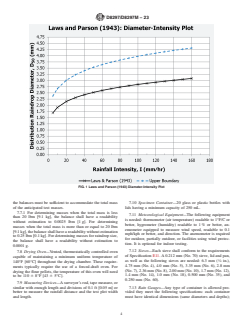
simulators shall be selected and setup with a fall height of no
calibrated, marked, and meet the requirements of this standard.
less than 8.0 ft [2.5 m] at the lowest point and must be able to
5 NOTE 2—Historically, these three hydroseeders are the most commonly
produce a data point based on the Laws and Parson (1943)
used for this type of testing. Other capacity hydroseeders up to 1100 gal
raindrop size-intensity curve (Fig. 1) for the minimum distri-
[4160 L] can be used providing they meet the requirements set forth in this
bution raindrop sizes corresponding to the appropriate target
standard. This standard does not go into detail regarding the slurry levels
or the use of other capacity hydroseeders.
intensity as presented in Fig. 1. Points on or above the Laws &
Parson curve and below the upper boundary curve are allowed,
7.5 Turbidimeter—A handheld or benchtop device capable
while points below the Laws & Parson curve are not allowed.
of measuring values up to 4000 TU. The specifications for the
The water used in the simulators must not contain deleterious
turbidimeter are given in Test Method D7937.
material that could impair the simulators operation and as such
7.6 Timing Device—A clock, stopwatch, digital timer, or
should have a turbidity value of 10 or less as determined by
comparable device readable to 1 second or better.
7.7 Balance—Balances shall conform to the requirements of
Laws, J.O., and Parsons, D.A., “The Relation of Raindrop-Size to Intensity.”
Transactions, American Geophysical Union., Vol. 24, Part 2, 1943, p. 452-460. Guide D4753 and shall be verified annually. The capacity of
D8297/D8297M − 23
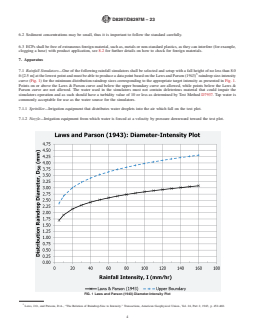
FIG. 1 Laws and Parson (1943) Diameter-Intensity Plot
the balances must be sufficient to accommodate the total mass 7.10 Specimen Container—20 glass or plastic bottles with
of the anticipated test masses. lids having a minimum capacity of 250 mL.
7.7.1 For determining masses when the total mass is less
7.11 Meteorological Equipment—The following equipment
than 20 lbm [9.1 kg], the balance shall have a readability
is needed: thermometer (air temperature) readable to 1°F/C or
without estimation to 0.0025 lbm [1 g]. For determining
better, hygrometer (humidity) readable to 1 % or better, an-
masses when the total mass is more than or equal to 20 lbm
emometer equipped to measure wind speed, readable to 0.1
[9.1 kg], the balance shall have a readability without estimation
mph/kph or better, and direction. The anemometer is required
to 0.25 lbm [0.1 kg]. For determining masses for raindrop size,
for outdoor, partially outdoor, or facilities using wind protec-
the balance shall have a readability without estimation to
tion. It is optional for indoor testing.
0.0001 g.
7.12 Sieves—Each sieve shall conform to the requirements
7.8 Drying Oven—Vented, thermostatically controlled oven
of Specification E11. A 0.212 mm (No. 70) sieve, lid and pan,
capable of maintaining a minimum uniform temperature of
as well as the following sieves are needed: 6.3 mm ( ⁄4 in.),
140°F [60°C] throughout the drying chamber. These require-
4.75 mm (No. 4), 4.0 mm (No. 5), 3.35 mm (No. 6), 2.8 mm
ments typically require the use of a forced-draft oven. For
(No. 7), 2.36 mm (No. 8), 2.00 mm (No. 10), 1.7 mm (No. 12),
drying the flour pellets, the temperature of this oven will need
1.4 mm (No. 14), 1.0 mm (No. 18), 0.500 mm (No. 35), and
to be 110 6 8°F [43 6 5°C].
0.250 mm (No. 60).
7.9 Measuring Devices—A surveyor’s rod, tape measure, or
similar with enough length and divisions of 0.1 ft [0.05 m] or 7.13 Rain Gauges—Any type of container is allowed pro-
better to measure the rainfall distance and the test plot width vided they meet the following specifications: each container
and length. must have identical dimensions (same diameters and depths);
D8297/D8297M − 23
each container must be calibrated such that the marked 9. Hazards
graduation lines accurately measure the amount of rainfall
9.1 It is recommended that appropriate personal protection
within 60.2 in. [5 mm]; and lines shall be marked every 0.2 in.
equipment be used by laboratory personnel when handling any
[5 mm]. Clear plastic or glass containers are recommended. A
ECP based upon recommendations outlined in the product’s
holder or platform/rack is also needed to keep the rain gauge
Safety Data Sheet (SDS).
vertical during use.
7.14 Miscellaneous Items—The following items are also
10. Preparation of Test Plots
needed: flowmeter, waterproof barrier (plastic sheeting, lids), 9
10.1 Three test plots consisting of identically prepared and
in. [230 mm] wide by 1 in. [25 mm] deep cake pans, flour
installed soil and ECP are required. Select the soil to be used
sifter, Pillsbury Best all-purpose flour, ruler/straightedge,
for testing as given in Section 8.
evaporating dishes, desiccator (optional), sieve shaker
10.2 Test Plot Construction—Construct the test plot having
(optional), heat resistant pans, digital camera, digital video
recorder, lath board, and shovel or rototiller. the minimum dimensions given in 7.3. Determine and record
the width (cross slope), length (downslope), and depth of the
8. Materials
test plots to the nearest 0.1 ft [0.1 m]. Determine and record the
2 2
area of the test plot to the nearest 0.1 ft [0.1 m ]. It is
8.1 Soil Types—The soil type to be used in the test plots
recommended to use individual trays for the test plots.
shall be one of the three types listed in Table 1. The soil types
10.2.1 If not using individual trays, install water barriers as
are based on USCS classification or the USDA textural triangle
follows. Compact the soil as discussed in 10.3, then isolate the
and have properties as shown in Table 1. The following soil
top edge and sides of each test plot by burying the bottom edge
testing is needed for every test according to the listed proce-
of the barrier approximately 4 in. [100 mm] to divert surface
dure. Record the results of the testing in accordance with the
flow such that no intrusion of outside surface water (“run-on”)
requirements of each individual standard.
onto the test plot occurs. The water barrier forms the bound-
8.1.1 Soil classification based on Practice D2487 (USCS) or
aries of the test plots. Make sure to separate the test plots with
the USDA textural triangle classification system from the
dividers such that overspray from the rainfall simulators does
USDA Soil Survey Manual.
not impact adjacent test plots. The use of individual trays does
8.1.2 Optimum water content and maximum dry unit weight
not require side edging and plot separation.
as determined by Test Methods D698. In addition, determine
and record the value corresponding to 85 % of the maximum
10.3 Soil Compaction—Roll or plate compact the surface of
dry unit weight when using sand; 75 % when using loam; and
the test plot in 3 to 4 in. [75 - 100 mm] lifts to achieve a
65 % when using clay soil types.
minimum total depth of 9 in. [230 mm]. This compaction is
8.1.3 Atterberg limits as determined by Test Methods
typically done horizontally with the trays placed on a level
D4318.
surface/ground. Table 2 lists the compaction maximum dry unit
8.1.4 Particle-size distribution as determined by Test Meth-
weight targets for the soil types as described in Section 8.
ods D6913/D6913M and D7928.
Verify the compaction and water content targets were achieved
8.1.5 Constant or falling head permeability as determined
using Test Method D6938, Procedure B along the center of
by Test Method D2434 or D5084, respectively.
each test plot at the top, middle, and bottom at the soil surface
immediately after completing compaction. Record the compac-
8.2 ECP—All packages or rolls, or both of ECPs to be used
3 3
tion values to the nearest 1 % or 0.1 lbf/ft [0.02 kN/m ] and
in testing shall be checked for visible damage, such as tears,
the water content to the nearest 1 %. If the target compaction/
rips, and holes, prior to use. If the packaging is damaged, do
water content was not achieved, remove the soil making sure to
not use it for testing. All ECPs shall be free of extraneous
thoroughly break up the soil aggregations, make adjustments,
foreign materials, such as, metals or non standard plastics that
and repeat the process. If the test plots are not being used
could interfere with production application. The ECP shall be
within 1 hour after compaction, cover to prevent moisture
applied to the soil surface in accordance with the manufactur-
changes.
er’s recommended application methods. For sprayed ECP
installation, installers shall visually check the ECP as it is being 10.3.1 If the test plot was prepared but not used within 1
fed into the mulching apparatus for extraneous foreign mate- hour after compaction, verify the water content has not
rials. A letter from the manufacturer shall be provided certify- changed by repeating the applicable sections of Test Method
D6938. Perform this verification within 1 hour prior to any
ing the labeled ingredients and corresponding percentages, by
mass, of the total product. testing. The water content shall be within 62 % of the
TABLE 1 Soil Properties
Property Sand Loam Clay
D (mm) 25 > D > 3.0 10 > D > 0.3 3.0 > D > 0.02
100 100 100 100
D (mm) 4.0 > D > 0.8 0.8 > D > 0.08 0.08 > D > 0.003
85 85 85 85
D (mm) 0.9 > D > 0.2 0.15 > D > 0.015 0.015 > D > 0.0008
50 50 50 50
D (mm) 0.3 > D > 0.01 0.03 > D > 0.001 D < 0.002
15 15 15 15
Plasticity Index Nonplastic 2 < PI < 8 10 < PI
D8297/D8297M − 23
TABLE 2 Compaction Target Values by Soil Type
seeder’s agitator, mix the ECP and water together for 5 minutes
Maximum Dry Unit Weight SAND LOAM CLAY or as recommended by the manufacturer.
within ±2 % of Optimum 85 % ± 3 % 75 % ± 3 % 65 % ± 3 %
11.2.1.4 While under agitation, discharge the hydroseeder
Water Content
away from the test plots to fill the hose with slurry. Bring the
slurry level down by 5 gal [19 L] to make sure the hose is
properly filled.
11.2.1.5 Once the hose is full, begin installation of the ECP
specified optimum water content. Determine and record the
to the test plots. Make sure to continue to agitate the slurry
water content of the test plot to the nearest 1 %.
during installation. During installation, stop frequently to
10.3.2 After verifying the compaction and water content
monitor the slurry level to make sure the target rate of slurry is
targets have been achieved, repair depressions, voids, soft, or
applied to the test plot and to make sure uniform distribution
uncompacted areas. Free the test plot from obstructions or
across the test plot is achieved (Note 3). Design your rate per
protrusions, such as roots, large stones, or other foreign
acre [m or hectare] to accommodate approximately 5 %
material.
overspray of the test plot. Record the calculations that were
10.4 Reuse of Test Plots—If reusing test plots the following
used to determine the volumes along with the initial and final
steps must be taken prior to the next use. Break up the top 8 in.
volume measurements to the nearest 0.1 gal [0.1 L].
[200 mm] with a shovel or rototiller, then discard the top 3-4
11.2.1.6 Leave approximately 1 gal [4 L] of slurry to use for
in. [75-100 mm] of soil. Using new soil to replace the
touch up installation and for coverage of areas of light
discarded soil, follow the guidance given in 10.3 to compact
application. Allow the sprayed ECP to cure based on the
the new soil into the test plots. When test plots have been used
manufacturer’s recommending wait time. Record the actual
with an ECP containing chemicals or other additives, the soil
cure time and the manufacturers recommended cure time for
must not be reused and must be replaced.
testing to the nearest 1 min.
NOTE 3—It is desirable for the machine operator and application
11. ECP Installation on Test Plots
operator to coordinate signals to indicate the amount of application, such
11.1 There are three ways ECP can be installed on the test 1 3
as ⁄2, ⁄4, and stop application.
plots: sprayed (11.2), rolled (11.3), or applied dry (11.4).
11.2.2 300 gal [1200 L] or 500 gal [1900 L] Capacity
Document the ECP installation on the test plots by taking
Hydroseeder/Mulching Apparatus by Mass:
photos after initial application of the ECP and after curing, if
11.2.2.1 Make sure the hydroseeder tank is calibrated using
applicable. ECP that is sprayed on can be installed using a
a flowmeter with permanent graduations marked by hand on
hydroseeder. Typically one of the following capacity machines
the tank such that, the total volume can be monitored closely
is used: 80 gal [300 L], 300 gal [1200 L], and 500 gal [1900 L]
during mixing and spraying of the slurry before initial use.
(Note 2).
Then, assemble the hydroseeder on the verified balance.
11.2 Sprayed Installation—The rate of application of a
11.2.2.2 Follow the steps in 11.2.1.2 and 11.2.1.3. Then,
sprayed ECP to a soil surface has a significant impact on its
discharge the hydroseeder away from the test plots to fill the
performance. Sprayed ECPs should be installed at the manu-
hose with slurry.
facturer’s recommended rate corresponding to the slope of the
11.2.2.3 Calculate the amount by mass of slurry needed for
prepared soil test plots. Identify and record the rate of
each test plot plus 25 % for overspray. Then, zero the balance
application. If a product is applied and tested at a rate different
and add this calculated amount of mass to be placed into the
than what the manufacturer recommends, record the use of a
hydroseeder. Measure and record the amount by mass of slurry
differing rate. To check the application rate is achieved, place
using the appropriate balance (7.7.1). Record the mass to the
three 12 by 12 in. [0.3 by 0.3 m] lath board(s) between the test
nearest 0.0025 or 0.25 lbm [1 g or 0.1 kg] depending on the
plots, or adjacent to the test plots, and spray the boards during
balance used and the anticipated mass of the slurry.
application. Then, remove the ECP from the lath board and
11.2.2.4 Once the hose is full, begin installation of the ECP
determine and record the mass and area of the sprayed ECP to
to the test plots. Apply the calculated amount of slurry to each
calculate and check the application rate. Install the sprayed
test plot. During installation, stop frequently to monitor the
ECP using one of the following machines (Note 2).
slurry mass to make sure the target amount of slurry is applied
11.2.1 80 gal [300 L] Capacity Hydroseeder/Mulching
to the test plot and to make sure uniform distribution across the
Apparatus:
test plot is achieved (Note 3). Record the calculations that were
11.2.1.1 Pre-wet the application hose by allowing water to
used to determine the masses along with the initial and final
flow through the hose.
mass measurements to the nearest 0.0025 or 0.25 lbm [1 g or
11.2.1.2 Determine and remove the appropriate amount of
0.1 kg] depending on the total masses and balance used.
ECP from the prepackaged bag or obtain appropriate lots of
ECP and appropriate quantity of additives from the manufac- 11.2.2.5 Leave approximately 9 lbm [4 kg] of slurry to use
turer if mixing onsite. Record the mixture quantities of ECP for touch up installation and for coverage of areas of light
and chemical/additives if not using a prepackaged ECP. application. Allow the sprayed ECP to cure based on the
11.2.1.3 Load and record the amount of ECP and chemical/ manufacturer’s recommending wait time. Record the actual
additives, if any, and water to the tank corresponding to the cure time and the manufacturers recommended cure time for
required application rate and mixing ratio. Using the hydro- testing to the nearest 1 min.
D8297/D8297M − 23
11.2.3 300 gal [1200 L] or 500 gal [1900 L] Capacity 11.3 Rolled Installation—Install rolled ECP according to the
Hydroseeder/Mulching Apparatus by Volume: manufacturer’s instructions. Place rolled ECP so that no gaps
11.2.3.1 The amount of ECP applied is calculated based on are present along the perimeter barrier and make sure the ECP
volumes instead of by mass. When using the hydroseeder by is cut to fit as necessary to cover the test plot. Record the
volume, the installation instructions and application rate of the installation methodology including the orientation applied to
ECP provided by the manufacturer must be followed precisely. slope (longitudinal or lateral), placement (which side faces up),
The exact amount of ECP and water is calculated based on the termination details, joint details, and anchor type and installa-
exact area of each test plot. An additional 25% is added to the tion pattern as well as staple frequency.
batch to account for overspray and loss while hydroseeding.
11.4 Dry Application Installation—The rate of application
See Table 3 for an example calculation.
of a dry applied ECP to a soil surface has a significant impact
11.2.3.2 To make sure the total volume required is applied,
on its performance. Dry applied ECPs should be installed at the
the hydroseeder tank is calibrated using a flowmeter with
manufacturer’s recommended rate corresponding to the slope
permanent graduations marked by hand on the tank such that,
of the prepared soil test plots. Identify and record the rate of
the total volume can be monitored closely during mixing and
application. If a product is applied and tested at a rate different
spraying of the slurry. The volume of water placed in the
than what the manufacturer recommends, record the use of a
hydroseeder for every batch is also monitored with a flowmeter
differing rate.
which provides secondary quality assurance to make sure the
11.4.1 Install the dry applied ECP according to manufactur-
total flow matches the volume shown by the gradations on the
er’s instructions. Record the installation methodology includ-
tank.
ing the total amount of material applied per slope in lbm [kg],
11.2.3.3 After calculating the mass of ECP and volume of
the application rate, and the method used for application (hand
water needed per test plot, use the verified balance to determine
or spreader).
the mass of the ECP. Record the mass to the nearest 0.0025 or
0.25 lbm [1 g or 0.1 kg] depending on the anticipated total
12. Verification of Rainfall Simulators and Average Soil
mass. Record the volume of water to the nearest 0.1 gal [0.1 L].
Loss
Fill the hydroseeder with the required volume of water and
12.1 Verification of the rainfall simulators is made by
then add the ECP to the water.
operating the simulators in a controlled and documented
11.2.3.4 Using the hydroseeder’s agitator, mix the ECP and
environment while measuring and determining the average
water together for at least 5 min or as recommended by the
drop height of the raindrops, the rainfall intensity and
manufacturer. Once mixed, stop the agitation, then determine
distribution, and raindrop size. Most rainfall simulators are
and record the total volume of the mixed slurry to the nearest
located indoors, however, outdoor or partially outdoor loca-
0.1 gal [0.1 L]. This volume is the amount in gal [L] that is
tions and facilities using wind protection locations are permis-
sprayed on each test plot. Once this value is recorded, if
sible. Do not conduct the verification in a non-enclosed facility
desired, double the volume and record the doubled volume.
when the wind velocity exceeds 1.0 mph [1.5 kph]. Once the
11.2.3.5 In order to aid in priming the hydroseeder lines,
simulator parameters have been calibrated, identically prepared
pumps, and hoses it is common practice to double the volume.
test plots using bare soil without an ECP are used to determine
Even though double the volume is made, the calculated total
the average soil loss for bare soil. See Section 10 for test plot
volume amount per test plot is what is actually applied. The
preparation, except do not apply an ECP to the test plots.
extra volume is discarded.
12.2 Verification for each rainfall intensity, slope, and du-
11.2.3.6 Prime the hydroseeder by discharging the hydro-
ration combination listed in Table 4 is then performed on bare
seeder away from the test plots to fill the hose with slurry.
soil. The data obtained from these bare soil tests provides
11.2.3.7 Apply the mixed slurry to the test plots using a
information needed to calculate average soil loss for the bare
standard fan nozzle as uniformly and evenly as possible. To
soil tests (ASL ). This calculation is then used as part of the
prevent shadowing and to provide uniform test plot coverage,
BSOIL
event cover factor determination.
apply the slurry from multiple directions and angles (Note 3).
11.2.3.8 Allow the sprayed ECP to cure based on the
12.3 Verification Interval—Perform a minimum of 3 bare
manufacturer’s recommending wait time (Note 4). Record the
soil slope tests for each rainfall intensity, slope, and duration
actual cure time and the manufacturers recommended cure time
combination listed in Table 4 that is expected for use. Annually
for testing to the nearest 1 min.
thereafter, a minimum of 1 additional bare soil slope test shall
be performed with additional data points as necessary follow-
NOTE 4—It may be desirable to test sprayed ECP products in both a
cured and uncured condition based on project requirements. ing equipment maintenance work or change in any of the key
TABLE 3 Example Calculation
Manufacturer’s specified rate 4000 lbm/acre 3900 kg/hectare
Water to ECP ratio 100 gal per 50.0 lbm of ECP 380 L per 22.7 kg of ECP
2 2
Test Plot Area 30.0 ft by 6.0 ft (30.0 × 6.0 =180 ft (0.0041 acre)) 9.1 m by 1.8 m (9.1 × 1.8 = 16.38 m (0.0016 hectare))
Amount of ECP needed per test plot 4000 lbm × 0.0041 acre = 16.4 lbm 3900 kg × 0.0016 hectare = 6.24 kg
16.4*0.25 = 4.1 lbm → 16.4 + 4.1 = 20.5 lbm 6.24*0.25 = 1.56 kg → 6.24 kg + 1.56 kg = 7.8 kg
Water rate per kg 100 gal/50.0 lbm = 2.0 gal/lbm of ECP 380 L/22.7 kg = 16.7 L/kg of ECP
Amount of water needed per test plot 20.5 lbm × 2.0 gal/lbm = 41 gal 7.8 kg × 16.7 L ⁄kg = 130.3 L
D8297/D8297M − 23
TABLE 4 Rainfall Intensity, Slope, and Duration Combinations
12.5.2.3 After each 1 min period, remove each bin out from
Type Rainfall Intensity Slope (H:V) Duration (min) under the collection apparatus of the test plot and determine
in./h [mm/h]
and record the mass of each bin plus water, M , to the nearest
bw
1 3.5 [90] 2:1 One 30 min period 24 ± 2 h apart
0.0025 or 0.25 lbm [1 g or 0.1 kg]. Then subtract the mass of
for 3 days (90 min total)
2 3.5 [90] 3:1 One 30 min period 24 ± 2 h apart the bin from the mass of bin plus water to determine the mass
for 3 days (90 min total)
of the water, M , collected from each test plot. Record the mass
w
3 3.5 [90] 4:1 One 30 min period 24 ± 2 h apart
of water to the nearest 0.0025 or 0.25 lbm [1 g or 0.1 kg].
for 3 days (90 min total)
12.5.2.4 Use the following equation to determine and record
the rainfall intensity, I, in in./h for the test plot.
M × 720
w
I 5 (1)
A × ρ
p w
parameters as discussed in 12.5. The annual bare soil slope
where:
data, as well as any additional data obtained is added to the
overall bare soil data set to be used for analysis. All data I = rainfall intensity, nearest 0.1 in./h.
M = mass of water, lbm (M – M = M ); nearest 0.0025
obtained from this verification process shall be kept on file by
w bw b w
or 0.25 lbm,
the rainfall testing facility and can be used to supplement any
A = area of the test plot, nearest 0.1 ft ,
ECP testing data reports. p
ρ = conversion factor, 62.4 lbf/ft , and
w
12.4 Environmental Conditions—Determine and record the
12.5.2.5 Use the following equation to determine and record
following environmental conditions before each data point: air
the rainfall intensity, I, in mm/h for the test plot.
temperature to the nearest 1°F/C, humidity to the nearest 1 %,
wind speed to the nearest 0.1 mph/kph, and the direction of the
M × 60
w
5 I (2)
wind relative to the test plots. Wind speed and direction are not
A
p
required to be measured when testing is located indoors.
where:
12.5 Rainfall Simulator System Verification—The following
I = rainfall intensity, nearest 0.1 mm/h.
4 key parameters shall be included in the verification of the
M = mass of water, kg (M – M = M ); converted to
w bw b w
rainfall simulator system: Average drop height of raindrops,
3 3
volume, m (nearest 1 m ),
rainfall intensity, rainfall distribution, and raindrop size. Re-
A = area of the test plot, m , and
p
cord the type of simulator used: sprinkler, nozzle, or drop
NOTE 5—Converting from kg to m divides the mass of water by 1000.
emitters. 2
Converting from m to mm then multiplies the mass of water by 1000.
12.5.1 Average Drop Height of Raindrops:
These conversions are not shown.
12.5.1.1 Prepare the test plots in accordance with Section
12.5.2.6 Compare the rainfall intensity for each test plot to
10. Record the soil type used for each test plot as defined in
the desired or target intensity listed in Table 4. If necessary,
Section 8. Do not reuse soil that has eroded off the test plot(s).
adjust the rainfall simulator and repeat the above steps to make
Determine and record the width (cross slope), length
sure the correct intensity value is obtained prior to bare soil
(downslope), and depth of each test plot to the nearest 0.1 ft
testing.
[0.05 m] using a tape measure.
12.5.3 Raindrop Distribution:
12.5.1.2 The minimum drop height for the raindrops can be
12.5.3.1 Divide the test plot into 20 equal sections when
no less than 8.0 ft [2.5 m] at the lowest point of the simulator.
using the minimum test plot area as shown in Fig. 2. When the
Determine and record the drop height of the raindrops at the
test plot is larger than the minimum, more equal sections must
top, middle, and bottom of each test plot to the nearest 0.1 ft
be used. It is desirable to have more equal sections than exactly
[0.05 m] using a surveyor’s rod or tape measure.
20 sections of unequal dimensions.
12.5.2 Rainfall Intensity:
12.5.3.2 Place a rain gauge in the center of each section.
12.5.2.1 Place the desired number of test plots under the
Make sure the rain gauge is, and remains, vertical for the
simulator at the slope to be tested (Table 4). Obtain and use 1
duration of the verification. The use of a holder or platform is
bin per test plot. Determine and record the mass of the bin, M ,
b
recommended to keep the rain gauge vertical as long as the
to the nearest 0.0025 or 0.25 lbm [1 g or 0.1 kg] depending on
device allows for the free collection of the rainfall. Cover each
the anticipated total mass of the bin plus runoff and the
rain gauge with a waterproof barrier to prevent the initial
balanced used.
collection of rainfall.
12.5.2.2 Cover all the test plots with plastic sheeting. Make
sure the plastic sheeting does not have any rips, tears, or holes 12.5.3.3 Set the target intensity and slope, then turn on the
that would allow water to penetrate through to the test plot. simulator and allow it to reach equilibrium. Once equilibrium
Turn on the water source and allow the rainfall system to come is reached, allow the simulator to run for 3 min at the target
to equilibrium. Once equilibrium has been reached, place the condition. Remove the waterproof barrier from each rain
bin(s) under the test plot(s). Then allow the runoff collection gauge. Start the timer after the first rain gauge is uncovered.
system to capture the water in a bin for a period of 1 minute. Record the start time. Remove the waterproof barriers from the
The bin must have enough capacity to hold the runoff that has remaining rain gauges in a set order. If using one large piece of
collected over a 1 minute period. Record the start and end time plastic sheeting to cover all the rain gauges, remove the plastic
of each 1 min period. sheeting in one single motion in one direction.
D8297/D8297M − 23
12.5.3.7 If C is less than 90 %, adjust the rainfall simulator
u
to increase the consistency and repeat the rainfall distribution
verification. Do not proceed until the C is greater than or equal
u
to 90%.
12.5.4 Raindrop Size:
12.5.4.1 Completely fill three 9 in. [230 mm] labeled cake
pans with sifted Pillsbury Best all purpose flour (Note 6).
Record the identification number of the cake pans. Use a
ruler/straightedge to strike off the surface of the flour to
produce a smooth, uncompacted surface. The flour should be a
minimum of 1 in. [25 mm] deep. Divide the test plot into 6
sections: 1 vertical (width) and 3 horizontal (length) (Fig. 3).
Place 1 filled cake pan in the center of each section and cover
with a waterproof barrier. The cake pan must be held horizon-
tally 12 to 18 in. [300 to 450 mm] above the surface of the test
plot. Resift the flour if the pans will sit for
...
This document is not an ASTM standard and is intended only to provide the user of an ASTM standard an indication of what changes have been made to the previous version. Because
it may not be technically possible to adequately depict all changes accurately, ASTM recommends that users consult prior editions as appropriate. In all cases only the current version
of the standard as published by ASTM is to be considered the official document.
Designation: D8297/D8297M − 22 D8297/D8297M − 23
Standard Test Method for
Determination of Erosion Control Products (ECP)
Performance in Protecting Slopes from Sequential Rainfall-
Induced Erosion Using a Tilted Bed Slope
This standard is issued under the fixed designation D8297/D8297M; the number immediately following the designation indicates the
year of original adoption or, in the case of revision, the year of last revision. A number in parentheses indicates the year of last
reapproval. A superscript epsilon (´) indicates an editorial change since the last revision or reapproval.
1. Scope*
1.1 This test method is used to evaluate the ability of erosion control products (ECP) to protect slopes from rainfall-induced
erosion using an adjustable tilting bed slope. The standard slopes range from 2:1 to 4:1 (H:V) having a target rainfall intensity of
3.5 in./h [90 mm/h].
1.2 There are three main elements the ECPs must have the ability to perform: 1. Absorb the impact force of raindrops, thereby
reducing soil particle loosening and detachment through “splash” mechanisms; 2. Slow runoff and encourage infiltration, thereby
reducing soil particle displacement and transport through “overland flow” mechanisms; and 3. Trap soil particles beneath the ECP.
When comparing data from different ECPs under consideration, it is important to keep the test conditions the same for the ECPs
being evaluated, for example, the rainfall intensity rate and the slope.
1.3 The results of this test method can be used to evaluate performance and acceptability, and can be used to compare the
effectiveness of different ECPs. This method provides a comparative evaluation of an ECP to baseline bare soil conditions under
controlled and documented conditions. This test method can provide information about a product that is under consideration for
a specific application where no performance information currently exists.
1.4 This test method covers the use of three different soil types, ECP installation: sprayed, rolled, or dry applied, and a runoff
collection procedure. This test is typically performed indoors, but may be performed outside as long as certain requirements are
met. Partially enclosed facilities are acceptable providing the environmental conditions are met.
1.5 Units—The values stated in either inch-pound units or SI units are to be regarded separately as standard. The values stated in
each system may not be exact equivalents; therefore, each system shall be used independently of the other. Combining values from
the two systems may result in nonconformance with the standard. Reporting of test results in units other than inch-pound shall not
be regarded as nonconformance with this standard.
1.5.1 The gravitational system of inch-pound units is used when dealing with inch-pound units. In the system, the pound (lbf)
represents a unit of force (weight), while the units for mass is slugs. The slug unit is not given, unless dynamic (F = ma)
calculations are involved.
1.5.2 It is common practice in the engineering/construction profession to concurrently use pounds to represent both a unit of mass
This test method is under the jurisdiction of ASTM Committee D18 on Soil and Rock and is the direct responsibility of Subcommittee D18.25 on Erosion and Sediment
Control Technology.
Current edition approved June 1, 2022Nov. 1, 2023. Published June 2022November 2023. Originally approved in 2020. Last previous edition approved in 20202022 as
D8297/D8297M – 20.D8297/D8297M – 22. DOI: 10.1520/D8297_D8297M-22.10.1520/D8297_D8297M-23.
*A Summary of Changes section appears at the end of this standard
Copyright © ASTM International, 100 Barr Harbor Drive, PO Box C700, West Conshohocken, PA 19428-2959. United States
D8297/D8297M − 23
(lbm) and of force (lbf). This practice implicitly combines two separate systems of units; the absolute and the gravitational systems.
It is scientifically undesirable to combine the use of two separate sets of inch-pound units within a single standard. As stated, this
standard includes the gravitational system of inch-pound units and does not use/present the slug unit of mass. However, the use
of balances and scales recording pounds of mass (lbm) or recording density in lbm/ft shall not be regarded as nonconformance
with this standard.
1.5.3 Calculations are done using only one set of units; either gravitational inch-pound or SI. Other units are permissible provided
appropriate conversion factors are used to maintain consistency of units throughout the calculations, and similar significant digits
or resolution, or both are maintained.
1.6 All observed and calculated values shall conform to the guidelines for significant digits and rounding established in Practice
D6026, unless superseded by this test method.
1.6.1 The procedures used to specify how data are collected/recorded and calculated in the standard are regarded as the industry
standard. In addition, they are representative of the significant digits that generally should be retained. The procedures used do not
consider material variation, purpose for obtaining the data, special purpose studies, or any considerations for the user’s objectives;
and it is common practice to increase or reduce significant digits of reported data to be commensurate with these considerations.
It is beyond the scope of these test methods to consider significant digits used in analysis methods for engineering data.
1.7 This standard does not purport to address all of the safety concerns, if any, associated with its use. It is the responsibility
of the user of this standard to establish appropriate safety, health, and environmental practices and determine the applicability of
regulatory limitations prior to use.
1.8 This international standard was developed in accordance with internationally recognized principles on standardization
established in the Decision on Principles for the Development of International Standards, Guides and Recommendations issued
by the World Trade Organization Technical Barriers to Trade (TBT) Committee.
2. Referenced Documents
2.1 ASTM Standards:
D653 Terminology Relating to Soil, Rock, and Contained Fluids
3 3
D698 Test Methods for Laboratory Compaction Characteristics of Soil Using Standard Effort (12,400 ft-lbf/ft (600 kN-m/m ))
D2216 Test Methods for Laboratory Determination of Water (Moisture) Content of Soil and Rock by Mass
D2434 Test Methods for Measurement of Hydraulic Conductivity of Coarse-Grained Soils
D2487 Practice for Classification of Soils for Engineering Purposes (Unified Soil Classification System)
D3740 Practice for Minimum Requirements for Agencies Engaged in Testing and/or Inspection of Soil and Rock as Used in
Engineering Design and Construction
D4318 Test Methods for Liquid Limit, Plastic Limit, and Plasticity Index of Soils
D4753 Guide for Evaluating, Selecting, and Specifying Balances and Standard Masses for Use in Soil, Rock, and Construction
Materials Testing
D5084 Test Methods for Measurement of Hydraulic Conductivity of Saturated Porous Materials Using a Flexible Wall
Permeameter
D6026 Practice for Using Significant Digits and Data Records in Geotechnical Data
D6475 Test Method for Measuring Mass per Unit Area of Erosion Control Blankets
D6525/D6525M Test Method for Measuring Nominal Thickness of Rolled Erosion Control Products (Withdrawn 2014)
D6567 Test Method for Measuring the Light Penetration of a Rolled Erosion Control Product (RECP)
D6818 Test Method for Tensile Properties of Rolled Erosion Control Products
D6913/D6913M Test Methods for Particle-Size Distribution (Gradation) of Soils Using Sieve Analysis
D6938 Test Methods for In-Place Density and Water Content of Soil and Soil-Aggregate by Nuclear Methods (Shallow Depth)
D7367 Test Method for Determining Water Holding Capacity of Fiber Mulches for Hydraulic Planting
D7928 Test Method for Particle-Size Distribution (Gradation) of Fine-Grained Soils Using the Sedimentation (Hydrometer)
Analysis
D7937 Test Method for In-situ Determination of Turbidity Above 1 Turbidity Unit (TU) in Surface Water
D8199 Test Method for Determining the Specific Strength of Hydraulically Applied Fiber Matrix Products for Erosion Control
E11 Specification for Woven Wire Test Sieve Cloth and Test Sieves
For referenced ASTM standards, visit the ASTM website, www.astm.org, or contact ASTM Customer Service at service@astm.org. For Annual Book of ASTM Standards
volume information, refer to the standard’s Document Summary page on the ASTM website.
The last approved version of this historical standard is referenced on www.astm.org.
D8297/D8297M − 23
2.2 Other Standards:
Soil Science Division Staff, 2017. Soil Survey Manual. C. Ditzler, K. Scheffe, and H.C. Monger (eds.). USDA Handbook 18.
Government Printing Office, Washington, DC
3. Terminology
3.1 Definitions:
3.1.1 For definitions of common technical terms used in this standard, refer to Terminology D653.
3.1.2 erosion control product (ECP), n—in erosion control, a temporary degradable or long term, non-degradable material
designed to reduce soil erosion and assist in the growth, establishment, and protection of vegetation.
3.2 Definitions of Terms Specific to This Standard:
3.2.1 runoff, n—in erosion control, sediment and water collected from the ECP covered test plots during testing.
4. Summary of Test Method
4.1 Before testing, the rainfall simulator system is calibrated for each type of rainfall intensity/slope combination intended for use.
Once the rainfall simulator is calibrated, bare soil slope tests are conducted on test plots to determine the baseline soil loss, turbidity
and sediment values. Three test plots are prepared and the ECP is applied by spraying, rolling, or dry application according to the
manufacturer’s recommended rate of application corresponding to the slope of the prepared test plots. After the ECP has been
installed and cured (if needed) the rainfall simulator is started and runs for 30 minutes per day for a total of 3 days with a total
time of 90 minutes. The total amount of runoff is collected at the end of each 30 minute period and a turbidity sample is taken
every 15 minutes during testing using the collection procedure. Specimens are taken from the collected runoff and are analyzed
for soil loss, turbidity and sediment concentrations.
5. Significance and Use
5.1 This test method utilizes large-scale testing equipment and procedures established at a variety of testing laboratories over the
last 30 years.
5.2 This method is useful in evaluating ECPs and their installation to reduce soil loss and sediment concentrations when exposed
to defined rainfall conditions and improving water quality exiting the area disturbed by earthwork activity by reducing suspended
solids and turbidity.
5.3 This test method is a performance test, but can also be used for acceptance testing to determine product conformance to project
specifications. For project-specific conformance, unique project-specific conditions should be considered. Caution is advised since
information regarding laboratory specific precision is incomplete at this time, and differences in soil and other environmental and
geotechnical conditions may affect ECP performance.
5.4 This standard can also be used as a comparative tool for evaluating the erosion control characteristics of different ECPs and
can also be used to gain agency approvals.
NOTE 1—The quality of the result produced by this standard is dependent on the competence of the personnel performing it, and the suitability of the
equipment and facilities used. Agencies that meet the criteria of Practice D3740 are generally considered capable of competent and objective
testing/sampling/inspection/etc. Users of this standard are cautioned that compliance with Practice D3740 does not in itself assure reliable results. Reliable
results depend on many factors; Practice D3740 provides a means of evaluating some of those factors.
6. Interferences
6.1 Raindrop distribution must be uniform when performing this test. Usually, indoor facilities provide environmental control such
that wind velocity is below 1.0 mph [1.5 kph]; however, for locations using plastic sheeting for wind protection, partially outdoor,
and outdoor locations the wind velocity can interfere with uniform raindrop distribution. Therefore, do not conduct testing and
calibrationverification in a non-enclosed or partially enclosed facility when the wind velocity exceeds 1.0 mph [1.5 kph]. Facilities
sometimes use plastic sheeting or tarps as wind barriers and are therefore subject to the wind velocity requirements.
The referenced Soil Survey Manual can be found by visiting the USDA website, www.nrcs.usda.gov, or call NRCS Customer Service at 888- 526-3227.
D8297/D8297M − 23
6.2 Sediment concentrations may be small, thus it is important to follow the standard carefully.
6.3 ECPs shall be free of extraneous foreign material, such as, metals or non-standard plastics, as they can interfere (for example,
clogging a hose) with product application, see 8.2 for further details on how to check for foreign materials.
7. Apparatus
7.1 Rainfall Simulators—One of the following rainfall simulators shall be selected and setup with a fall height of no less than 8.0
ft [2.5 m] at the lowest point and must be able to produce a data point based on the Laws and Parson (1943) raindrop size-intensity
curve (Fig. 1) for the minimum distribution raindrop sizes corresponding to the appropriate target intensity as presented in Fig. 1.
Points on or above the Laws & Parson curve and below the upper boundary curve are allowed, while points below the Laws &
Parson curve are not allowed. The water used in the simulators must not contain deleterious material that could impair the
simulators operation and as such should have a turbidity value of 10 or less as determined by Test Method D7937. Tap water is
commonly acceptable for use as the water source for the simulators.
7.1.1 Sprinkler—Irrigation equipment that distributes water droplets into the air which fall on the test plot.
7.1.2 Nozzle—Irrigation equipment from which water is forced at a velocity by pressure downward toward the test plot.
FIG. 1 Laws and Parson (1943) Diameter-Intensity Plot
Laws, J.O., and Parsons, D.A., “The Relation of Raindrop-Size to Intensity.” Transactions, American Geophysical Union., Vol. 24, Part 2, 1943, p. 452-460.
D8297/D8297M − 23
7.1.3 Drop Emitters—Irrigation equipment where drops form and fall from a tip starting at essentially zero velocity.
7.2 Runoff Collection System—This system should include flashing, collection apparatus, and a holding tank. Flashing shall be
fabricated to direct runoff from the test plots into the collection apparatus and shall be continuous across the entire bottom edge
of the test plot. It may be desirable to divert the runoff to a single collection point. The holding tank(s) connected to the collection
apparatus shall be capable of temporarily containing all the runoff. Bins (with or without metal reinforcement), tubs, buckets, and
similar containers are needed to capture the runoff from the collection system. Bulk bags used should be made of material that will
retain sediment while allowing water to drain from the bag.
7.3 Test Plots—A metal tray fabricated to contain a minimum of 9.0 in. [0.2 m] depth of soil with a perforated bottom sheet
2 2
covered with a geotextile fabric that has a water flow rate greater than or equal to 4 gal/min/ft [163 L/min/m ]. The necessary
length to width ratio is 5 to 1 with the minimum test plot size of 30 by 6 ft [9.0 by 2.0 m].
7.3.1 Test Plot Water Barriers—The top edge and sides of the test plot must be isolated by a water barrier if individual testing trays
are not used. The barrier shall be continuous such that joints do not allow outside flow to enter the test plot. Commercially available
lawn edging or lumber are both suitable for use as barriers. In the case of individual test trays, side edging and test plot separation
are not necessary.
7.4 Hydroseeding/Mulching Apparatus—This device shall be used when the ECP is installed by spraying and must be capable of
uniformly applying it. One of the following devices should be used: 80 gal [300 L] mechanically agitated hydroseeder; 300 gal
[1200 L] mechanically agitated hydroseeder; 500 gal [1900 L] mechanically agitated hydroseeder (Note 2). The 300 gal [1200 L]
and 500 gal [1900 L] hydroseeder tanks shall be calibrated using a flowmeter and have permanent graduations marked on it. Any
hydroseeder with a capacity between 80 gal [300 L] and 1100 gal [4160] must also be calibrated, marked, and meet the
requirements of this standard.
NOTE 2—Historically, these three hydroseeders are the most commonly used for this type of testing. Other capacity hydroseeders up to 1100 gal [4160
L] can be used providing they meet the requirements set forth in this standard. This standard does not go into detail regarding the slurry levels or the
use of other capacity hydroseeders.
7.5 Turbidimeter—A handheld or benchtop device capable of measuring values up to 4000 TU. The specifications for the
turbidimeter are given in Test Method D7937.
7.6 Timing Device—A clock, stopwatch, digital timer, or comparable device readable to 1 second or better.
7.7 Balance—Balances shall conform to the requirements of Guide D4753 and shall be verified annually. The capacity of the
balances must be sufficient to accommodate the total mass of the anticipated test masses.
7.7.1 For determining masses when the total mass is less than 20 lbm [9.1 kg], the balance shall have a readability without
estimation to 0.0025 lbm [1 g]. For determining masses when the total mass is more than or equal to 20 lbm [9.1 kg], the balance
shall have a readability without estimation to 0.25 lbm [0.1 kg]. For determining masses for raindrop size, the balance shall have
a readability without estimation to 0.0001 g.
7.8 Drying Oven—Vented, thermostatically controlled oven capable of maintaining a minimum uniform temperature of 140°F
[60°C] throughout the drying chamber. These requirements typically require the use of a forced-draft oven. For drying the flour
pellets, the temperature of this oven will need to be 110 6 8°F [43 6 5°C].
7.9 Measuring Devices—A surveyor’s rod, tape measure, or similar with enough length and divisions of 0.1 ft [0.05 m] or better
to measure the rainfall distance and the test plot width and length.
7.10 Specimen Container—20 glass or plastic bottles with lids having a minimum capacity of 250 mL.
D8297/D8297M − 23
7.11 Meteorological Equipment—The following equipment is needed: thermometer (air temperature) readable to 1°F/C or better,
hygrometer (humidity) readable to 1 % or better, anemometer equipped to measure wind speed, readable to 0.1 mph/kph or better,
and direction. The anemometer is required for outdoor, partially outdoor, or facilities using wind protection. It is optional for indoor
testing.
7.12 Sieves—Each sieve shall conform to the requirements of Specification E11. A 0.212 mm (No. 70) sieve, lid and pan, as well
as the following sieves are needed: 6.3 mm ( ⁄4 in.), 4.75 mm (No. 4), 4.0 mm (No. 5), 3.35 mm (No. 6), 2.8 mm (No. 7), 2.36
mm (No. 8), 2.00 mm (No. 10), 1.7 mm (No. 12), 1.4 mm (No. 14), 1.0 mm (No. 18), 0.500 mm (No. 35), and 0.250 mm (No.
60).
7.13 Rain Gauges—Any type of container is allowed provided they meet the following specifications: each container must have
identical dimensions (same diameters and depths); each container must be calibrated such that the marked graduation lines
accurately measure the amount of rainfall within 60.2 in. [5 mm]; and lines shall be marked every 0.2 in. [5 mm]. Clear plastic
or glass containers are recommended. A holder or platform/rack is also needed to keep the rain gauge vertical during use.
7.14 Miscellaneous Items—The following items are also needed: flowmeter, waterproof barrier (plastic sheeting, lids), 9 in. [230
mm] wide by 1 in. [25 mm] deep cake pans, flour sifter, Pillsbury Best all-purpose flour, ruler/straightedge, evaporating dishes,
desiccator (optional), sieve shaker (optional), heat resistant pans, digital camera, digital video recorder, lath board, and shovel or
rototiller.
8. Materials
8.1 Soil Types—The soil type to be used in the test plots shall be one of the three types listed in Table 1. The soil types are based
on USCS classification or the USDA textural triangle and have properties as shown in Table 1. The following soil testing is needed
for every test according to the listed procedure. Record the results of the testing in accordance with the requirements of each
individual standard.
8.1.1 Soil classification based on Practice D2487 (USCS) or the USDA textural triangle classification system from the USDA Soil
Survey Manual.
8.1.2 Optimum water content and maximum dry unit weight as determined by Test Methods D698. In addition, determine and
record the value corresponding to 85 % of the maximum dry unit weight when using sand; 75 % when using loam; and 65 % when
using clay soil types.
8.1.3 Atterberg limits as determined by Test Methods D4318.
8.1.4 Particle-size distribution as determined by Test Methods D6913/D6913M and D7928.
8.1.5 Constant or falling head permeability as determined by Test Method D2434 or D5084, respectively.
8.2 ECP—All packages or rolls, or both of ECPs to be used in testing shall be checked for visible damage, such as tears, rips, and
holes, prior to use. If the packaging is damaged, do not use it for testing. All ECPs shall be free of extraneous foreign materials,
such as, metals or non standard plastics that could interfere with production application. The ECP shall be applied to the soil
surface in accordance with the manufacturer’s recommended application methods. For sprayed ECP installation, installers shall
visually check the ECP as it is being fed into the mulching apparatus for extraneous foreign materials. A letter from the
manufacturer shall be provided certifying the labeled ingredients and corresponding percentages, by mass, of the total product.
TABLE 1 Soil Properties
Property Sand Loam Clay
D (mm) 25 > D > 3.0 10 > D > 0.3 3.0 > D > 0.02
100 100 100 100
D (mm) 4.0 > D > 0.8 0.8 > D > 0.08 0.08 > D > 0.003
85 85 85 85
D (mm) 0.9 > D > 0.2 0.15 > D > 0.015 0.015 > D > 0.0008
50 50 50 50
D (mm) 0.3 > D > 0.01 0.03 > D > 0.001 D < 0.002
15 15 15 15
Plasticity Index Nonplastic 2 < PI < 8 10 < PI
D8297/D8297M − 23
9. Hazards
9.1 It is recommended that appropriate personal protection equipment be used by laboratory personnel when handling any ECP
based upon recommendations outlined in the product’s Safety Data Sheet (SDS).
10. Preparation of Test Plots
10.1 Three test plots consisting of identically prepared and installed soil and ECP are required. Select the soil to be used for testing
as given in Section 8.
10.2 Test Plot Construction—Construct the test plot having the minimum dimensions given in 7.3. Determine and record the width
(cross slope), length (downslope), and depth of the test plots to the nearest 0.1 ft [0.1 m]. Determine and record the area of the
2 2
test plot to the nearest 0.1 ft [0.1 m ]. It is recommended to use individual trays for the test plots.
10.2.1 If not using individual trays, install water barriers as follows. Compact the soil as discussed in 10.3, then isolate the top
edge and sides of each test plot by burying the bottom edge of the barrier approximately 4 in. [100 mm] to divert surface flow such
that no intrusion of outside surface water (“run-on”) onto the test plot occurs. The water barrier forms the boundaries of the test
plots. Make sure to separate the test plots with dividers such that overspray from the rainfall simulators does not impact adjacent
test plots. The use of individual trays does not require side edging and plot separation.
10.3 Soil Compaction—Roll or plate compact the surface of the test plot in 3 to 4 in. [75 - 100 mm] lifts to achieve a minimum
total depth of 9 in. [230 mm]. This compaction is typically done horizontally with the trays placed on a level surface/ground. Table
2 lists the compaction maximum dry unit weight targets for the soil types as described in Section 8. Verify the compaction and
water content targets were achieved using Test Method D6938, Procedure B along the center of each test plot at the top, middle,
and bottom at the soil surface immediately after completing compaction. Record the compaction values to the nearest 1 % or 0.1
3 3
lbf/ft [0.02 kN/m ] and the water content to the nearest 1 %. If the target compaction/water content was not achieved, remove the
soil making sure to thoroughly break up the soil aggregations, make adjustments, and repeat the process. If the test plots are not
being used within 1 hour after compaction, cover to prevent moisture changes.
10.3.1 If the test plot was prepared but not used within 1 hour after compaction, verify the water content has not changed by
repeating the applicable sections of Test Method D6938. Perform this verification within 1 hour prior to any testing. The water
content shall be within 62 % of the specified optimum water content. Determine and record the water content of the test plot to
the nearest 1 %.
10.3.2 After verifying the compaction and water content targets have been achieved, repair depressions, voids, soft, or
uncompacted areas. Free the test plot from obstructions or protrusions, such as roots, large stones, or other foreign material.
10.4 Reuse of Test Plots—If reusing test plots the following steps must be taken prior to the next use. Break up the top 8 in. [200
mm] with a shovel or rototiller, then discard the top 3-4 in. [75-100 mm] of soil. Using new soil to replace the discarded soil, follow
the guidance given in 10.3 to compact the new soil into the test plots. When test plots have been used with an ECP containing
chemicals or other additives, the soil must not be reused and must be replaced.
11. ECP Installation on Test Plots
11.1 There are three ways ECP can be installed on the test plots: sprayed (11.2), rolled (11.3), or applied dry (11.4). Document
the ECP installation on the test plots by taking photos after initial application of the ECP and after curing, if applicable. ECP that
is sprayed on can be installed using a hydroseeder. Typically one of the following capacity machines is used: 80 gal [300 L], 300
gal [1200 L], and 500 gal [1900 L] (Note 2).
11.2 Sprayed Installation—The rate of application of a sprayed ECP to a soil surface has a significant impact on its performance.
Sprayed ECPs should be installed at the manufacturer’s recommended rate corresponding to the slope of the prepared soil test
TABLE 2 Compaction Target Values by Soil Type
Maximum Dry Unit Weight SAND LOAM CLAY
within ±2 % of Optimum 85 % ± 3 % 75 % ± 3 % 65 % ± 3 %
Water Content
D8297/D8297M − 23
plots. Identify and record the rate of application. If a product is applied and tested at a rate different than what the manufacturer
recommends, record the use of a differing rate. To check the application rate is achieved, place three 12 by 12 in. [0.3 by 0.3 m]
lath board(s) between the test plots, or adjacent to the test plots, and spray the boards during application. Then, remove the ECP
from the lath board and determine and record the mass and area of the sprayed ECP to calculate and check the application rate.
Install the sprayed ECP using one of the following machines (Note 2).
11.2.1 80 gal [300 L] Capacity Hydroseeder/Mulching Apparatus:
11.2.1.1 Pre-wet the application hose by allowing water to flow through the hose.
11.2.1.2 Determine and remove the appropriate amount of ECP from the prepackaged bag or obtain appropriate lots of ECP and
appropriate quantity of additives from the manufacturer if mixing onsite. Record the mixture quantities of ECP and
chemical/additives if not using a prepackaged ECP.
11.2.1.3 Load and record the amount of ECP and chemical/additives, if any, and water to the tank corresponding to the required
application rate and mixing ratio. Using the hydroseeder’s agitator, mix the ECP and water together for 5 minutes or as
recommended by the manufacturer.
11.2.1.4 While under agitation, discharge the hydroseeder away from the test plots to fill the hose with slurry. Bring the slurry level
down by 5 gal [19 L] to make sure the hose is properly filled.
11.2.1.5 Once the hose is full, begin installation of the ECP to the test plots. Make sure to continue to agitate the slurry during
installation. During installation, stop frequently to monitor the slurry level to make sure the target rate of slurry is applied to the
test plot and to make sure uniform distribution across the test plot is achieved (Note 3). Design your rate per acre [m or hectare]
to accommodate approximately 5 % overspray of the test plot. Record the calculations that were used to determine the volumes
along with the initial and final volume measurements to the nearest 0.1 gal [0.1 L].
11.2.1.6 Leave approximately 1 gal [4 L] of slurry to use for touch up installation and for coverage of areas of light application.
Allow the sprayed ECP to cure based on the manufacturer’s recommending wait time. Record the actual cure time and the
manufacturers recommended cure time for testing to the nearest 1 min.
1 3
NOTE 3—It is desirable for the machine operator and application operator to coordinate signals to indicate the amount of application, such as ⁄2, ⁄4, and
stop application.
11.2.2 300 gal [1200 L] or 500 gal [1900 L] Capacity Hydroseeder/Mulching Apparatus by Mass:
11.2.2.1 Make sure the hydroseeder tank is calibrated using a flowmeter with permanent graduations marked by hand on the tank
such that, the total volume can be monitored closely during mixing and spraying of the slurry before initial use. Then, assemble
the hydroseeder on the verified balance.
11.2.2.2 Follow the steps in 11.2.1.2 and 11.2.1.3. Then, discharge the hydroseeder away from the test plots to fill the hose with
slurry.
11.2.2.3 Calculate the amount by mass of slurry needed for each test plot plus 25 % for overspray. Then, zero the balance and add
this calculated amount of mass to be placed into the hydroseeder. Measure and record the amount by mass of slurry using the
appropriate balance (7.7.1). Record the mass to the nearest 0.0025 or 0.25 lbm [1 g or 0.1 kg] depending on the balance used and
the anticipated mass of the slurry.
11.2.2.4 Once the hose is full, begin installation of the ECP to the test plots. Apply the calculated amount of slurry to each test
plot. During installation, stop frequently to monitor the slurry mass to make sure the target amount of slurry is applied to the test
plot and to make sure uniform distribution across the test plot is achieved (Note 3). Record the calculations that were used to
determine the masses along with the initial and final mass measurements to the nearest 0.0025 or 0.25 lbm [1 g or 0.1 kg]
depending on the total masses and balance used.
11.2.2.5 Leave approximately 9 lbm [4 kg] of slurry to use for touch up installation and for coverage of areas of light application.
Allow the sprayed ECP to cure based on the manufacturer’s recommending wait time. Record the actual cure time and the
manufacturers recommended cure time for testing to the nearest 1 min.
D8297/D8297M − 23
11.2.3 300 gal [1200 L] or 500 gal [1900 L] Capacity Hydroseeder/Mulching Apparatus by Volume:
11.2.3.1 The amount of ECP applied is calculated based on volumes instead of by mass. When using the hydroseeder by volume,
the installation instructions and application rate of the ECP provided by the manufacturer must be followed precisely. The exact
amount of ECP and water is calculated based on the exact area of each test plot. An additional 25% is added to the batch to account
for overspray and loss while hydroseeding. See Table 3 for an example calculation.
11.2.3.2 To make sure the total volume required is applied, the hydroseeder tank is calibrated using a flowmeter with permanent
graduations marked by hand on the tank such that, the total volume can be monitored closely during mixing and spraying of the
slurry. The volume of water placed in the hydroseeder for every batch is also monitored with a flowmeter which provides secondary
quality assurance to make sure the total flow matches the volume shown by the gradations on the tank.
11.2.3.3 After calculating the mass of ECP and volume of water needed per test plot, use the verified balance to determine the mass
of the ECP. Record the mass to the nearest 0.0025 or 0.25 lbm [1 g or 0.1 kg] depending on the anticipated total mass. Record
the volume of water to the nearest 0.1 gal [0.1 L]. Fill the hydroseeder with the required volume of water and then add the ECP
to the water.
11.2.3.4 Using the hydroseeder’s agitator, mix the ECP and water together for at least 5 min or as recommended by the
manufacturer. Once mixed, stop the agitation, then determine and record the total volume of the mixed slurry to the nearest 0.1
gal [0.1 L]. This volume is the amount in gal [L] that is sprayed on each test plot. Once this value is recorded, if desired, double
the volume and record the doubled volume.
11.2.3.5 In order to aid in priming the hydroseeder lines, pumps, and hoses it is common practice to double the volume. Even
though double the volume is made, the calculated total volume amount per test plot is what is actually applied. The extra volume
is discarded.
11.2.3.6 Prime the hydroseeder by discharging the hydroseeder away from the test plots to fill the hose with slurry.
11.2.3.7 Apply the mixed slurry to the test plots using a standard fan nozzle as uniformly and evenly as possible. To prevent
shadowing and to provide uniform test plot coverage, apply the slurry from multiple directions and angles (Note 3).
11.2.3.8 Allow the sprayed ECP to cure based on the manufacturer’s recommending wait time (Note 4). Record the actual cure
time and the manufacturers recommended cure time for testing to the nearest 1 min.
NOTE 4—It may be desirable to test sprayed ECP products in both a cured and uncured condition based on project requirements.
11.3 Rolled Installation—Install rolled ECP according to the manufacturer’s instructions. Place rolled ECP so that no gaps are
present along the perimeter barrier and make sure the ECP is cut to fit as necessary to cover the test plot. Record the installation
methodology including the orientation applied to slope (longitudinal or lateral), placement (which side faces up), termination
details, joint details, and anchor type and installation pattern as well as staple frequency.
11.4 Dry Application Installation—The rate of application of a dry applied ECP to a soil surface has a significant impact on its
performance. Dry applied ECPs should be installed at the manufacturer’s recommended rate corresponding to the slope of the
prepared soil test plots. Identify and record the rate of application. If a product is applied and tested at a rate different than what
the manufacturer recommends, record the use of a differing rate.
11.4.1 Install the dry applied ECP according to manufacturer’s instructions. Record the installation methodology including the
total amount of material applied per slope in lbm [kg], the application rate, and the method used for application (hand or spreader).
TABLE 3 Example Calculation
Manufacturer’s specified rate 4000 lbm/acre 3900 kg/hectare
Water to ECP ratio 100 gal per 50.0 lbm of ECP 380 L per 22.7 kg of ECP
2 2
Test Plot Area 30.0 ft by 6.0 ft (30.0 × 6.0 =180 ft (0.0041 acre)) 9.1 m by 1.8 m (9.1 × 1.8 = 16.38 m (0.0016 hectare))
Amount of ECP needed per test plot 4000 lbm × 0.0041 acre = 16.4 lbm 3900 kg × 0.0016 hectare = 6.24 kg
16.4*0.25 = 4.1 lbm → 16.4 + 4.1 = 20.5 lbm 6.24*0.25 = 1.56 kg → 6.24 kg + 1.56 kg = 7.8 kg
Water rate per kg 100 gal/50.0 lbm = 2.0 gal/lbm of ECP 380 L/22.7 kg = 16.7 L/kg of ECP
Amount of water needed per test plot 20.5 lbm × 2.0 gal/lbm = 41 gal 7.8 kg × 16.7 L ⁄kg = 130.3 L
D8297/D8297M − 23
12. CalibrationVerification of Rainfall Simulators and Average Soil Loss
12.1 CalibrationVerification of the rainfall simulators is made by operating the simulators in a controlled and documented
environment while measuring and determining the average drop height of the raindrops, the rainfall intensity and distribution, and
raindrop size. Most rainfall simulators are located indoors, however, outdoor or partially outdoor locations and facilities using wind
protection locations are permissible. Do not conduct the calibrationverification in a non-enclosed facility when the wind velocity
exceeds 1.0 mph [1.5 kph]. Once the simulator parameters have been calibrated, identically prepared test plots using bare soil
without an ECP are used to determine the average soil loss for bare soil. See Section 10 for test plot preparation, except do not
apply an ECP to the test plots.
12.2 CalibrationVerification for each rainfall intensity, slope, and duration combination listed in Table 4 is then performed on bare
soil. The data obtained from these bare soil tests provides information needed to calculate average soil loss for the bare soil tests
(ASL ). This calculation is then used as part of the event cover factor determination.
BSOIL
12.3 CalibrationVerification Interval—Perform a minimum of 3 bare soil slope tests for each rainfall intensity, slope, and duration
combination listed in Table 4 that is expected for use. Annually thereafter, a minimum of 1 additional bare soil slope test shall be
performed with additional data points as necessary following equipment maintenance work or change in any of the key parameters
as discussed in 12.5. The annual bare soil slope data, as well as any additional data obtained is added to the overall bare soil data
set to be used for analysis. All data obtained from this calibrationverification process shall be kept on file by the rainfall testing
facility and can be used to supplement any ECP testing data reports.
12.4 Environmental Conditions—Determine and record the following environmental conditions before each data point: air
temperature to the nearest 1°F/C, humidity to the nearest 1 %, wind speed to the nearest 0.1 mph/kph, and the direction of the wind
relative to the test plots. Wind speed and direction are not required to be measured when testing is located indoors.
12.5 Rainfall Simulator System Calibration—Verification—The following 4 key parameters shall be included in the calibration-
verification of the rainfall simulator system: Average drop height of raindrops, rainfall intensity, rainfall distribution, and raindrop
size. Record the type of simulator used: sprinkler, nozzle, or drop emitters.
12.5.1 Average Drop Height of Raindrops:
12.5.1.1 Prepare the test plots in accordance with Section 10. Record the soil type used for each test plot as defined in Section
8. Do not reuse soil that has eroded off the test plot(s). Determine and record the width (cross slope), length (downslope), and depth
of each test plot to the nearest 0.1 ft [0.05 m] using a tape measure.
12.5.1.2 The minimum drop height for the raindrops can be no less than 8.0 ft [2.5 m] at the lowest point of the simulator.
Determine and record the drop height of the raindrops at the top, middle, and bottom of each test plot to the nearest 0.1 ft [0.05
m] using a surveyor’s rod or tape measure.
12.5.2 Rainfall Intensity:
12.5.2.1 Place the desired number of test plots under the simulator at the slope to be tested (Table 4). Obtain and use 1 bin per
test plot. Determine and record the mass of the bin, M , to the nearest 0.0025 or 0.25 lbm [1 g or 0.1 kg] depending on the
b
anticipated total mass of the bin plus runoff and the balanced used.
12.5.2.2 Cover all the test plots with plastic sheeting. Make sure the plastic sheeting does not have any rips, tears, or holes that
would allow water to penetrate through to the test plot. Turn on the water source and allow the rainfall system to come to
equilibrium. Once equilibrium has been reached, place the bin(s) under the test plot(s). Then allow the runoff collection system
TABLE 4 Rainfall Intensity, Slope, and Duration Combinations
Type Rainfall Intensity Slope (H:V) Duration (min)
in./h [mm/h]
1 3.5 [90] 2:1 One 30 min period 24 ± 2 h apart
for 3 days (90 min total)
2 3.5 [90] 3:1 One 30 min period 24 ± 2 h apart
for 3 days (90 min total)
3 3.5 [90] 4:1 One 30 min period 24 ± 2 h apart
for 3 days (90 min total)
D8297/D8297M − 23
to capture the water in a bin for a period of 1 minute. The bin must have enough capacity to hold the runoff that has collected over
a 1 minute period. Record the start and end time of each 1 min period.
12.5.2.3 After each 1 min period, remove each bin out from under the collection apparatus of the test plot and determine and
record the mass of each bin plus water, M , to the nearest 0.0025 or 0.25 lbm [1 g or 0.1 kg]. Then subtract the mass of the bin
bw
from the mass of bin plus water to determine the mass of the water, M , collected from each test plot. Record the mass of water
w
to the nearest 0.0025 or 0.25 lbm [1 g or 0.1 kg].
12.5.2.4 Use the following equation to determine and record the rainfall intensity, I, in in./h for the test plot.
M ×720
w
I 5 (1)
A ×ρ
p w
where:
I = rainfall intensity, nearest 0.1 in./h.
M = mass of water, lbm (M – M = M ); nearest 0.0025 or 0.25 lbm,
w bw b w
A = area of the test plot, nearest 0.1 ft ,
p
ρ = conversion factor, 62.4 lbf/ft , and
w
12.5.2.5 Use the following equation to determine and record the rainfall intensity, I, in mm/h for the test plot.
M ×60
w
5 I (2)
A
p
where:
I = rainfall intensity, nearest 0.1 mm/h.
3 3
M = mass of water, kg (M – M = M ); converted to volume, m (nearest 1 m ),
w bw b w
A = area of the test plot, m , and
p
3 2
NOTE 5—Converting from kg to m divides the mass of water by 1000. Converting from m to mm then multiplies the mass of water by 1000. These
conversions are not shown.
12.5.2.6 Compare the rainfall intensity for each test plot to the desired or target intensity listed in Table 4. If necessary, adjust the
rainfall simulator and repeat the above steps to make sure the correct intensity value is obtained prior to bare soil testing.
12.5.3 Raindrop Distribution:
12.5.3.1 Divide the test plot into 20 equal sections when using the minimum test plot area as shown in Fig. 2. When the test plot
is larger than the minimum, more equal sections must be used. It is desirable to have more equal sections than exactly 20 sections
of unequal dimensions.
12.5.3.2 Place a rain gauge in the center of each section. Make sure the rain gauge is, and remains, vertical for the duration of
the calibration.verification. The use of a holder or platform is recommended to keep the rain gauge vertical as long as the device
allows for the free collection of the rainfall. Cover each rain gauge with a waterproof barrier to prevent the initial collection of
rainfall.
12.5.3.3 Set the target intensity and slope, then turn on the simulator and allow it to reach equilibrium. Once equilibrium is
reached, allow the simulator to run for 3 min at the target condition. Remove the waterproof barrier from each rain gauge. Start
the timer after the first rain gauge is uncovered. Record the start time. Remove the waterproof barriers from the remaining rain
gauges in a set order. If using one large piece of plastic sheeting to cover all the rain gauges, remove the plastic sheeting in one
single motion in one direction.
12.5.3.4 Allow the rainfall to continue for 10 min after uncovering the first rain gauge. At the end of 10 min, cover the rain gauges
in the same order they were uncovered. If using one large piece of plastic sheeting, replace the sheeting in the opposite direction
that it was removed in a single motion. Record the time at the end of the calibration.verification. The intent is to allow each rain
gauge to be exposed to the rainfall for a period of 10 min each. After covering, turn off the simulator.
12.5.3.5 Meas
...