

ASTM D6835-23
(Classification)Standard Classification System for Thermoplastic Elastomer-Ether-Ester Molding and Extrusion Materials (TEEE)
General Information
- Abstract
SCOPE
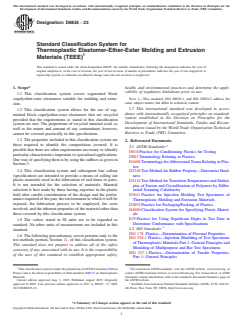
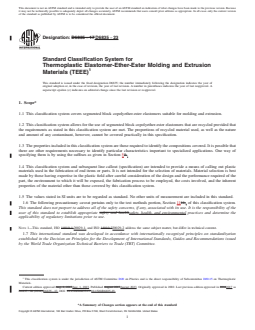
1.1 This classification system covers segmented block copolyether-ester elastomers suitable for molding and extrusion.
1.2 This classification system allows for the use of segmented block copolyether-ester elastomers that are recycled provided that the requirements as stated in this classification system are met. The proportions of recycled material used, as well as the nature and amount of any contaminant, however, cannot be covered practically in this specification.
1.3 The properties included in this classification system are those required to identify the compositions covered. It is possible that there are other requirements necessary to identify particular characteristics important to specialized applications. One way of specifying them is by using the suffixes as given in Section 5.
1.4 This classification system and subsequent line callout (specification) are intended to provide a means of calling out plastic materials used in the fabrication of end items or parts. It is not intended for the selection of materials. Material selection is best made by those having expertise in the plastic field after careful consideration of the design and the performance required of the part, the environment to which it will be exposed, the fabrication process to be employed, the costs involved, and the inherent properties of the material other than those covered by this classification system.
1.5 The values stated in SI units are to be regarded as standard. No other units of measurement are included in this standard.
1.6 The following precautionary caveat pertains only to the test methods portion, Section 11, of this classification system. This standard does not purport to address all of the safety concerns, if any, associated with its use. It is the responsibility of the user of this standard to establish appropriate safety, health, and environmental practices and determine the applicability of regulatory limitations prior to use.
Note 1: This standard, ISO 20029-1, and ISO 20029-2 address the same subject matter, but differ in technical content.
1.7 This international standard was developed in accordance with internationally recognized principles on standardization established in the Decision on Principles for the Development of International Standards, Guides and Recommendations issued by the World Trade Organization Technical Barriers to Trade (TBT) Committee.
- Status
- Published
- Publication Date
- 31-Jul-2023
- Technical Committee
- D20 - Plastics
- Drafting Committee
- D20.15 - Thermoplastic Materials
Buy Documents
ASTM D6835-23 - Standard Classification System for Thermoplastic Elastomer-Ether-Ester Molding and Extrusion Materials (TEEE)
REDLINE ASTM D6835-23 - Standard Classification System for Thermoplastic Elastomer-Ether-Ester Molding and Extrusion Materials (TEEE)
Overview
ASTM D6835-23: Standard Classification System for Thermoplastic Elastomer-Ether-Ester (TEEE) Molding and Extrusion Materials establishes a framework for classifying segmented block copolyether-ester elastomers suitable for molding and extrusion processes. Developed by ASTM International, this classification system provides industry guidance on identifying compositions, integrating recycled materials, and specifying material requirements for TEEE used in end products.
This standard is widely recognized for facilitating the correct specification of TEEE materials in manufacturing and product design, while promoting consistent material quality and performance across various applications.
Key Topics
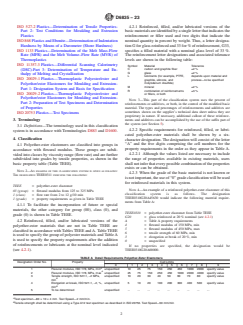
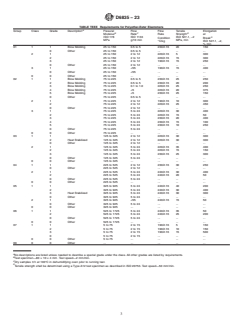
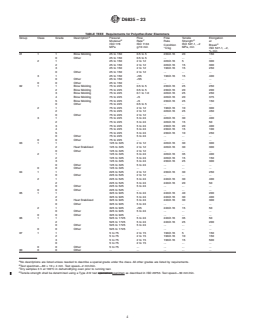
- Classification Parameters: TEEE materials are classified by key physical properties such as flexural modulus, flow rate (viscosity), and tensile properties. These are systematically organized to enable manufacturers and users to specify materials that meet precise requirements.
- Recycled Material Use: The classification system allows the use of recycled TEEE, provided all quality and property requirements are met. However, the exact proportion of recycled content and specifics of possible contaminants are not addressed within the standard.
- Designations and Suffixes: Compositions are identified using group, class, and grade codes reflecting their physical characteristics. Additional suffixes can specify further required properties for specialized applications.
- Reference Test Methods: The standard incorporates test methods for properties including durometer hardness, transition temperatures, melt flow rate, and tensile strength, referencing established ASTM and ISO procedures.
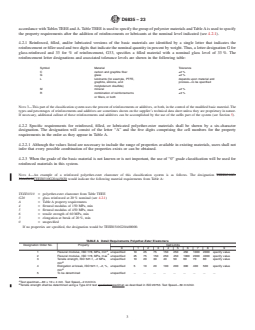
- Reinforcement and Additives: Provisions are included for classifying reinforced, filled, and lubricated TEEE grades. Materials may be identified by specific reinforcement letter codes (e.g., G for glass), along with the nominal percentage, and property cell numbers.
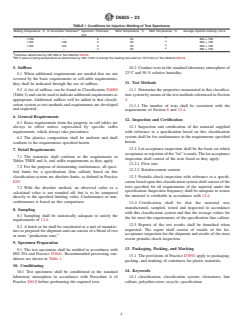
- Inspection and Certification: Manufacturer responsibilities include batch sampling, laboratory conditioning, product testing, and proper documentation to certify compliance with classification requirements.
Applications
The ASTM D6835-23 standard is essential for industries employing thermoplastic elastomer-ether-ester (TEEE) materials in molded and extruded parts, offering a reliable system to specify material characteristics for:
- Automotive components (e.g., hoses, coverings, seals)
- Industrial goods (e.g., conveyor belts, tubing, flexible connectors)
- Consumer products (e.g., appliance housings, footwear)
- Electrical and electronic parts (e.g., cable jackets, connectors)
- General engineering applications requiring a balance of flexibility, chemical resistance, and resilience
Adopting this standard supports the use of recycled TEEE where appropriate, contributing to sustainability goals and resource efficiency.
Related Standards
- ASTM D4000: Classification System for Specifying Plastic Materials
- ASTM D2240: Test Method for Rubber Property - Durometer Hardness
- ASTM D3418: Test Method for Transition Temperatures and Enthalpies of Polymers
- ASTM D3892: Practice for Packaging of Plastics
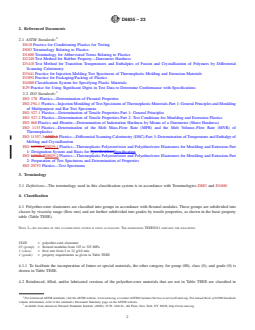
- ISO 20029-1 / ISO 20029-2: Plastics - Thermoplastic Polyester/ester and Polyether/ester Elastomers - Designation and Methods (corresponding ISO standards)
- ISO 178: Plastics - Determination of Flexural Properties
- ISO 527-1, ISO 527-2: Plastics - Determination of Tensile Properties
- ISO 868: Plastics and Ebonite - Hardness by Durometer
Summary
ASTM D6835-23 delivers a comprehensive, globally recognized system for classifying and specifying TEEE molding and extrusion materials. This supports quality assurance, regulatory compliance, and optimizes the selection process for TEEE in diverse industrial, automotive, and consumer applications, fostering reliable product performance and promoting consistency throughout the supply chain.
Relations
- Effective Date
- 01-Feb-2024
- Effective Date
- 01-Nov-2023
- Effective Date
- 01-Jan-2020
- Effective Date
- 01-Aug-2019
- Effective Date
- 15-Apr-2019
- Effective Date
- 01-Feb-2019
- Effective Date
- 01-Dec-2018
- Effective Date
- 01-Nov-2018
- Refers
ASTM D1600-18 - Standard Terminology for Abbreviated Terms Relating to Plastics (Withdrawn 2024) - Effective Date
- 01-Jan-2018
- Effective Date
- 15-Aug-2017
- Effective Date
- 01-Sep-2015
- Effective Date
- 01-Mar-2014
- Effective Date
- 01-Feb-2014
- Effective Date
- 15-Apr-2013
- Effective Date
- 15-Nov-2012
Buy Documents
ASTM D6835-23 - Standard Classification System for Thermoplastic Elastomer-Ether-Ester Molding and Extrusion Materials (TEEE)
REDLINE ASTM D6835-23 - Standard Classification System for Thermoplastic Elastomer-Ether-Ester Molding and Extrusion Materials (TEEE)
Get Certified
Connect with accredited certification bodies for this standard

DIN CERTCO
DIN Group product certification.

Smithers Quality Assessments
US management systems and product certification.
Sponsored listings
Frequently Asked Questions
ASTM D6835-23 is a standard published by ASTM International. Its full title is "Standard Classification System for Thermoplastic Elastomer-Ether-Ester Molding and Extrusion Materials (TEEE)". This standard covers: SCOPE 1.1 This classification system covers segmented block copolyether-ester elastomers suitable for molding and extrusion. 1.2 This classification system allows for the use of segmented block copolyether-ester elastomers that are recycled provided that the requirements as stated in this classification system are met. The proportions of recycled material used, as well as the nature and amount of any contaminant, however, cannot be covered practically in this specification. 1.3 The properties included in this classification system are those required to identify the compositions covered. It is possible that there are other requirements necessary to identify particular characteristics important to specialized applications. One way of specifying them is by using the suffixes as given in Section 5. 1.4 This classification system and subsequent line callout (specification) are intended to provide a means of calling out plastic materials used in the fabrication of end items or parts. It is not intended for the selection of materials. Material selection is best made by those having expertise in the plastic field after careful consideration of the design and the performance required of the part, the environment to which it will be exposed, the fabrication process to be employed, the costs involved, and the inherent properties of the material other than those covered by this classification system. 1.5 The values stated in SI units are to be regarded as standard. No other units of measurement are included in this standard. 1.6 The following precautionary caveat pertains only to the test methods portion, Section 11, of this classification system. This standard does not purport to address all of the safety concerns, if any, associated with its use. It is the responsibility of the user of this standard to establish appropriate safety, health, and environmental practices and determine the applicability of regulatory limitations prior to use. Note 1: This standard, ISO 20029-1, and ISO 20029-2 address the same subject matter, but differ in technical content. 1.7 This international standard was developed in accordance with internationally recognized principles on standardization established in the Decision on Principles for the Development of International Standards, Guides and Recommendations issued by the World Trade Organization Technical Barriers to Trade (TBT) Committee.
SCOPE 1.1 This classification system covers segmented block copolyether-ester elastomers suitable for molding and extrusion. 1.2 This classification system allows for the use of segmented block copolyether-ester elastomers that are recycled provided that the requirements as stated in this classification system are met. The proportions of recycled material used, as well as the nature and amount of any contaminant, however, cannot be covered practically in this specification. 1.3 The properties included in this classification system are those required to identify the compositions covered. It is possible that there are other requirements necessary to identify particular characteristics important to specialized applications. One way of specifying them is by using the suffixes as given in Section 5. 1.4 This classification system and subsequent line callout (specification) are intended to provide a means of calling out plastic materials used in the fabrication of end items or parts. It is not intended for the selection of materials. Material selection is best made by those having expertise in the plastic field after careful consideration of the design and the performance required of the part, the environment to which it will be exposed, the fabrication process to be employed, the costs involved, and the inherent properties of the material other than those covered by this classification system. 1.5 The values stated in SI units are to be regarded as standard. No other units of measurement are included in this standard. 1.6 The following precautionary caveat pertains only to the test methods portion, Section 11, of this classification system. This standard does not purport to address all of the safety concerns, if any, associated with its use. It is the responsibility of the user of this standard to establish appropriate safety, health, and environmental practices and determine the applicability of regulatory limitations prior to use. Note 1: This standard, ISO 20029-1, and ISO 20029-2 address the same subject matter, but differ in technical content. 1.7 This international standard was developed in accordance with internationally recognized principles on standardization established in the Decision on Principles for the Development of International Standards, Guides and Recommendations issued by the World Trade Organization Technical Barriers to Trade (TBT) Committee.
ASTM D6835-23 is classified under the following ICS (International Classification for Standards) categories: 83.080.20 - Thermoplastic materials. The ICS classification helps identify the subject area and facilitates finding related standards.
ASTM D6835-23 has the following relationships with other standards: It is inter standard links to ASTM D883-24, ASTM D883-23, ASTM D883-20, ASTM D883-19c, ASTM D883-19a, ASTM D883-19, ASTM D883-18a, ASTM D883-18, ASTM D1600-18, ASTM D883-17, ASTM D3892-15, ASTM D3641-14, ASTM D1600-14, ASTM D1600-13, ASTM D883-12e1. Understanding these relationships helps ensure you are using the most current and applicable version of the standard.
ASTM D6835-23 is available in PDF format for immediate download after purchase. The document can be added to your cart and obtained through the secure checkout process. Digital delivery ensures instant access to the complete standard document.
Standards Content (Sample)
This international standard was developed in accordance with internationally recognized principles on standardization established in the Decision on Principles for the
Development of International Standards, Guides and Recommendations issued by the World Trade Organization Technical Barriers to Trade (TBT) Committee.
Designation: D6835 − 23
Standard Classification System for
Thermoplastic Elastomer-Ether-Ester Molding and Extrusion
Materials (TEEE)
This standard is issued under the fixed designation D6835; the number immediately following the designation indicates the year of
original adoption or, in the case of revision, the year of last revision. A number in parentheses indicates the year of last reapproval. A
superscript epsilon (´) indicates an editorial change since the last revision or reapproval.
1. Scope* health, and environmental practices and determine the appli-
cability of regulatory limitations prior to use.
1.1 This classification system covers segmented block
copolyether-ester elastomers suitable for molding and extru-
NOTE 1—This standard, ISO 20029-1, and ISO 20029-2 address the
same subject matter, but differ in technical content.
sion.
1.7 This international standard was developed in accor-
1.2 This classification system allows for the use of seg-
dance with internationally recognized principles on standard-
mented block copolyether-ester elastomers that are recycled
ization established in the Decision on Principles for the
provided that the requirements as stated in this classification
Development of International Standards, Guides and Recom-
system are met. The proportions of recycled material used, as
mendations issued by the World Trade Organization Technical
well as the nature and amount of any contaminant, however,
Barriers to Trade (TBT) Committee.
cannot be covered practically in this specification.
1.3 The properties included in this classification system are
2. Referenced Documents
those required to identify the compositions covered. It is
2.1 ASTM Standards:
possible that there are other requirements necessary to identify
D618 Practice for Conditioning Plastics for Testing
particular characteristics important to specialized applications.
D883 Terminology Relating to Plastics
One way of specifying them is by using the suffixes as given in
D1600 Terminology for Abbreviated Terms Relating to Plas-
Section 5.
tics
1.4 This classification system and subsequent line callout
D2240 Test Method for Rubber Property—Durometer Hard-
(specification) are intended to provide a means of calling out
ness
plastic materials used in the fabrication of end items or parts.
D3418 Test Method for Transition Temperatures and Enthal-
It is not intended for the selection of materials. Material
pies of Fusion and Crystallization of Polymers by Differ-
selection is best made by those having expertise in the plastic
ential Scanning Calorimetry
field after careful consideration of the design and the perfor-
D3641 Practice for Injection Molding Test Specimens of
mance required of the part, the environment to which it will be
Thermoplastic Molding and Extrusion Materials
exposed, the fabrication process to be employed, the costs
D3892 Practice for Packaging/Packing of Plastics
involved, and the inherent properties of the material other than
D4000 Classification System for Specifying Plastic Materi-
those covered by this classification system.
als
E29 Practice for Using Significant Digits in Test Data to
1.5 The values stated in SI units are to be regarded as
Determine Conformance with Specifications
standard. No other units of measurement are included in this
2.2 ISO Standards:
standard.
ISO 178 Plastics—Determination of Flexural Properties
1.6 The following precautionary caveat pertains only to the
ISO 294-1 Plastics—Injection Moulding of Test Specimens
test methods portion, Section 11, of this classification system.
of Thermoplastic Materials-Part 1: General Principles and
This standard does not purport to address all of the safety
Moulding of Multipurpose and Bar Test Specimens
concerns, if any, associated with its use. It is the responsibility
ISO 527-1 Plastics—Determination of Tensile Properties-
of the user of this standard to establish appropriate safety,
Part 1: General Principles
1 2
This classification system is under the jurisdiction of ASTM Committee D20 on For referenced ASTM standards, visit the ASTM website, www.astm.org, or
Plastics and is the direct responsibility of Subcommittee D20.15 on Thermoplastic contact ASTM Customer Service at service@astm.org. For Annual Book of ASTM
Materials. Standards volume information, refer to the standard’s Document Summary page on
Current edition approved Aug. 1, 2023. Published August 2023. Originally the ASTM website.
approved in 2002. Last previous edition approved in 2017 as D6835 - 17. DOI: Available from American National Standards Institute (ANSI), 25 W. 43rd St.,
10.1520/D6835-23. 4th Floor, New York, NY 10036, http://www.ansi.org.
*A Summary of Changes section appears at the end of this standard
Copyright © ASTM International, 100 Barr Harbor Drive, PO Box C700, West Conshohocken, PA 19428-2959. United States
D6835 − 23
ISO 527-2 Plastics—Determination of Tensile Properties- 4.2.1 Reinforced, filled, and/or lubricated versions of the
Part 2: Test Conditions for Moulding and Extrusion basic materials are identified by a single letter that indicates the
Plastics reinforcement or filler used and two digits that indicate the
ISO 868 Plastics and Ebonite—Determination of Indentation nominal quantity in percent by weight. Thus, a letter designa-
Hardness by Means of a Durometer (Shore Hardness) tion G for glass-reinforced and 33 for % of reinforcement, G33,
ISO 1133 Plastics—Determination of the Melt Mass-Flow specifies a filled material with a nominal glass level of 33 %.
Rate (MFR) and the Melt Volume–Flow Rate (MVR) of The reinforcement letter designations and associated tolerance
Thermoplastics levels are shown in the following table:
ISO 11357-3 Plastics—Differential Scanning Calorimetry
Symbol Material Tolerance
C carbon and graphite fiber ±2 %
(DSC)-Part 3: Determination of Temperature and En-
G glass ±2 %
thalpy of Melting and Crystallization
L lubricants (for example, PTFE, depends upon material and
ISO 20029-1 Plastics—Thermoplastic Polyester/ester and
graphite, silicone, and process—to be specified
molybdenum disulfide)
Polyether/ester Elastomers for Moulding and Extrusion-
M mineral ±2 %
Part 1: Designation System and Basis for Specification
R combination of reinforcements ±3 %
ISO 20029-2 Plastics—Thermoplastic Polyester/ester and
or fillers, or both
Polyether/ester Elastomers for Moulding and Extrusion-
NOTE 3—This part of the classification system uses the percent of
Part 2: Preparation of Test Specimens and Determination
reinforcements or additives, or both, in the control of the modified basic
of Properties
material. The types and percentages of reinforcements and additives are
sometimes shown on the supplier’s technical data sheet unless they are
ISO 20753 Plastics—Test Specimens
proprietary in nature. If necessary, additional callout of these reinforce-
3. Terminology ments and additives can be accomplished by the use of the suffix part of
the system (see Section 5).
3.1 Definitions—The terminology used in this classification
4.2.2 Specific requirements for reinforced, filled, or lubri-
system is in accordance with Terminologies D883 and D1600.
cated polyether-ester materials shall be shown by a six-
4. Classification
character designation. The designation will consist of the letter
“A” and the five digits comprising the cell numbers for the
4.1 Polyether-ester elastomers are classified into groups in
property requirements in the order as they appear in Table A.
accordance with flexural modulus. These groups are subdi-
4.2.2.1 Although the values listed are necessary to include
vided into classes by viscosity range (flow rate) and are further
the range of properties available in existing materials, users
subdivided into grades by tensile properties, as shown in the
shall not infer that every possible combination of the properties
basic property table (Table TEEE).
exists or can be obtained.
NOTE 2—AN EXAMPLE OF THIS CLASSIFICATION SYSTEM IS GIVEN AS FOLLOWS:
4.2.3 When the grade of the basic material is not known or
THE DESIGNATION TEEE0311 INDICATES THE FOLLOWING:
is not important, the use of “0” grade classification will be used
for reinforced materials in this system.
TEEE = polyether-ester elastomer
NOTE 4—An example of a reinforced polyether-ester elastomer of this
03 (group) = flexural modulus from 125 to 325 MPa
classification system is as follows. The designation
1 (class) = flow rate from 2 to 12 g/10 min
TEEE0310G20A45630 would indicate the following material require-
1 (grade) = property requirements as given in Table TEEE
ments from Table A:
4.1.1 To facilitate the incorporation of future or special
materials, the other category for group (00), class (0), and
TEEE0310 = polyether-ester elastomer from Table TEEE
grade (0) is shown in Table TEEE.
G20 = glass reinforced at 20 % nominal (see 4.2.1)
4.2 Reinforced, filled, and/or lubricated versions of the A = Table A property requirements
4 = flexural modulus of 150 MPa, min
polyether-ester materials that are not in Table TEEE are
5 = flexural modulus of 450 MPa, max
classified in accordance with Tables TEEE and A. Table TEEE
6 = tensile strength of 60 MPa, min
is used to specify the group of polyester materials and Table A
3 = elongation at break of 20 %, min
is used to specify the property requirements after the addition
0 = unspecified
of reinforcements or lubricants at the nominal level indicated
If no properties are specified, the designation would be
TEEE0310G20A00000.
(see 4.2.1
...
This document is not an ASTM standard and is intended only to provide the user of an ASTM standard an indication of what changes have been made to the previous version. Because
it may not be technically possible to adequately depict all changes accurately, ASTM recommends that users consult prior editions as appropriate. In all cases only the current version
of the standard as published by ASTM is to be considered the official document.
Designation: D6835 − 17 D6835 − 23
Standard Classification System for
Thermoplastic Elastomer-Ether-Ester Molding and Extrusion
Materials (TEEE)
This standard is issued under the fixed designation D6835; the number immediately following the designation indicates the year of
original adoption or, in the case of revision, the year of last revision. A number in parentheses indicates the year of last reapproval. A
superscript epsilon (´) indicates an editorial change since the last revision or reapproval.
1. Scope*
1.1 This classification system covers segmented block copolyether-ester elastomers suitable for molding and extrusion.
1.2 This classification system allows for the use of segmented block copolyether-ester elastomers that are recycled provided that
the requirements as stated in this classification system are met. The proportions of recycled material used, as well as the nature
and amount of any contaminant, however, cannot be covered practically in this specification.
1.3 The properties included in this classification system are those required to identify the compositions covered. It is possible that
there are other requirements necessary to identify particular characteristics important to specialized applications. One way of
specifying them is by using the suffixes as given in Section 55.
1.4 This classification system and subsequent line callout (specification) are intended to provide a means of calling out plastic
materials used in the fabrication of end items or parts. It is not intended for the selection of materials. Material selection is best
made by those having expertise in the plastic field after careful consideration of the design and the performance required of the
part, the environment to which it will be exposed, the fabrication process to be employed, the costs involved, and the inherent
properties of the material other than those covered by this classification system.
1.5 The values stated in SI units are to be regarded as standard. No other units of measurement are included in this standard.
1.6 The following precautionary caveat pertains only to the test methods portion, Section 1111,, of this classification system.
This standard does not purport to address all of the safety concerns, if any, associated with its use. It is the responsibility of the
user of this standard to establish appropriate safety and healthsafety, health, and environmental practices and determine the
applicability of regulatory limitations prior to use.
NOTE 1—This standard, ISO 14910-1,20029-1, and ISO 14910-220029-2 address the same subject matter, but differ in technical content.
1.7 This international standard was developed in accordance with internationally recognized principles on standardization
established in the Decision on Principles for the Development of International Standards, Guides and Recommendations issued
by the World Trade Organization Technical Barriers to Trade (TBT) Committee.
This classification system is under the jurisdiction of ASTM Committee D20 on Plastics and is the direct responsibility of Subcommittee D20.15 on Thermoplastic
Materials.
Current edition approved Aug. 1, 2017Aug. 1, 2023. Published August 2017August 2023. Originally approved in 2002. Last previous edition approved in 20142017 as
D6835 - 08 (2014).D6835 - 17. DOI: 10.1520/D6835-17.10.1520/D6835-23.
*A Summary of Changes section appears at the end of this standard
Copyright © ASTM International, 100 Barr Harbor Drive, PO Box C700, West Conshohocken, PA 19428-2959. United States
D6835 − 23
2. Referenced Documents
2.1 ASTM Standards:
D618 Practice for Conditioning Plastics for Testing
D883 Terminology Relating to Plastics
D1600 Terminology for Abbreviated Terms Relating to Plastics
D2240 Test Method for Rubber Property—Durometer Hardness
D3418 Test Method for Transition Temperatures and Enthalpies of Fusion and Crystallization of Polymers by Differential
Scanning Calorimetry
D3641 Practice for Injection Molding Test Specimens of Thermoplastic Molding and Extrusion Materials
D3892 Practice for Packaging/Packing of Plastics
D4000 Classification System for Specifying Plastic Materials
E29 Practice for Using Significant Digits in Test Data to Determine Conformance with Specifications
2.2 ISO Standards:
ISO 178 Plastics—Determination of Flexural Properties
ISO 294-1 Plastics—Injection Moulding of Test Specimens of Thermoplastic Materials-Part 1: General Principles and Moulding
of Multipurpose and Bar Test Specimens
ISO 527-1 Plastics—Determination of Tensile Properties-Part 1: General Principles
ISO 527-2 Plastics—Determination of Tensile Properties-Part 2: Test Conditions for Moulding and Extrusion Plastics
ISO 868 Plastics and Ebonite—Determination of Indentation Hardness by Means of a Durometer (Shore Hardness)
ISO 1133 Plastics—Determination of the Melt Mass-Flow Rate (MFR) and the Melt Volume–Flow Rate (MVR) of
Thermoplastics
ISO 11357-3 AMD 1 Plastics—Differential Scanning Calorimetry (DSC)-Part 3: Determination of Temperature and Enthalpy of
Melting and Crystallization
ISO 14910-120029-1 Plastics—Thermoplastic Polyester/ester and Polyether/ester Elastomers for Moulding and Extrusion-Part
1: Designation System and Basis for SpecificationsSpecification
ISO 14910-220029-2 Plastics—Thermoplastic Polyester/ester and Polyether/ester Elastomers for Moulding and Extrusion-Part
2: Preparation of Test Specimens and Determination of Properties
ISO 20753 Plastics—Test Specimens
3. Terminology
3.1 Definitions—The terminology used in this classification system is in accordance with Terminologies D883 and D1600.
4. Classification
4.1 Polyether-ester elastomers are classified into groups in accordance with flexural modulus. These groups are subdivided into
classes by viscosity range (flow rate) and are further subdivided into grades by tensile properties, as shown in the basic property
table (Table TEEE).
NOTE 2—AN EXAMPLE OF THIS CLASSIFICATION SYSTEM IS GIVEN AS FOLLOWS: THE DESIGNATION TEEE0311 INDICATES THE FOLLOWING:
TEEE = polyether-ester elastomer
03 (group) = flexural modulus from 125 to 325 MPa
1 (class) = flow rate from 2 to 12 g/10 min
1 (grade) = property requirements as given in Table TEEE
4.1.1 To facilitate the incorporation of future or special materials, the other category for group (00), class (0), and grade (0) is
shown in Table TEEE.
4.2 Reinforced, filled, and/or lubricated versions of the polyether-ester materials that are not in Table TEEE are classified in
For referenced ASTM standards, visit the ASTM website, www.astm.org, or contact ASTM Customer Service at service@astm.org. For Annual Book of ASTM Standards
volume information, refer to the standard’s Document Summary page on the ASTM website.
Available from American National Standards Institute (ANSI), 25 W. 43rd St., 4th Floor, New York, NY 10036, http://www.ansi.org.
D6835 − 23
accordance with Tables TEEE and A. Table TEEE is used to specify the group of polyester materials and Table A is used to specify
the property requirements after the addition of reinforcements or lubricants at the nominal level indicated (see 4.2.1).
4.2.1 Reinforced, filled, and/or lubricated versions of the basic materials are identified by a single letter that indicates the
reinforcement or filler used and two digits that indicate the nominal quantity in percent by weight. Thus, a letter designation G for
glass-reinforced and 33 for % of reinforcement, G33, specifies a filled material with a nominal glass level of 33 %. The
reinforcement letter designations and associated tolerance levels are shown in the following table:
Symbol Material Tolerance
C carbon and graphite fiber ±2 %
G glass ±2 %
L lubricants (for example, PTFE, depends upon material and
graphite, silicone, and process—to be specified
molybdenum disulfide)
M mineral ±2 %
R combination of reinforcements ±3 %
or fillers, or both
NOTE 3—This part of the classification system uses the percent of reinforcements or additives, or both, in the control of the modified basic material. The
types and percentages of reinforcements and additives are sometimes shown on the supplier’s technical data sheet unless they are proprietary in nature.
If necessary, additional callout of these reinforcements and additives can be accomplished by the use of the suffix part of the system (see Section 5).
4.2.2 Specific requirements for reinforced, filled, or lubricated polyether-ester materials shall be shown by a six-character
designation. The designation will consist of the letter “A” and the five digits comprising the cell numbers for the property
requirements in the order as they appear in Table A.
4.2.2.1 Although the values listed are necessary to include the range of properties available in existing materials, users shall not
infer that every possible combination of the properties exists or can be obtained.
4.2.3 When the grade of the basic material is not known or is not important, the use of “0” grade classification will be used for
reinforced materials in this system.
NOTE 4—An example of a reinforced polyether-ester elastomer of this classification system is as follows. The designation TEEE0310G-
20A45630TEEE0310G20A45630 would indicate the following material requirements from Table A:
TEEE0310 = polyether-ester elastomer from Table TEEE
G20 = glass reinforced at 20 % nominal (see 4.2.1)
A = Table A property requirements
4 = flexural modulus of 150 MPa, min
5 = flexural modulus of 450 MPa, max
6 = tensile strength of 60 MPa, min
3 = elongation at break of 20 %, min
0 = unspecified
If no properties are specified, the designation would be TEEE0310G20A00000.
TA
...