

ASTM F3400-19
(Test Method)Standard Test Method for In-situ Testing of Functional Properties of Equine Surfaces: Artificial Surfaces
General Information
- Abstract
SIGNIFICANCE AND USE
4.1 This test method specifies test procedures that can easily be used for field testing of equine surfaces. It is a test method that can be consistently applied to any equine surface and can quantitatively measure functional properties and track surface performance changes over time.
SCOPE
1.1 This test method covers the specification for the measurement of the functional properties of equine surfaces; cushioning, impact, firmness, responsiveness and uniformity. This test method specifies test procedures that are appropriate for field testing of equine surfaces. This test method defines the functional properties of equine surfaces. This test method does not specify safety criteria. The extent to which functional properties contribute to individual injury risk is not known.
1.2 Where appropriate values are stated in SI units.
1.3 This standard does not purport to address all of the safety concerns, if any, associated with its use. It is the responsibility of the user of this standard to establish appropriate safety, health, and environmental practices and determine the applicability of regulatory limitations prior to use.
1.4 This international standard was developed in accordance with internationally recognized principles on standardization established in the Decision on Principles for the Development of International Standards, Guides and Recommendations issued by the World Trade Organization Technical Barriers to Trade (TBT) Committee.
- Status
- Published
- Publication Date
- 14-Oct-2019
- Technical Committee
- F08 - Sports Equipment, Playing Surfaces, and Facilities
- Drafting Committee
- F08.28 - Equestrian Surfaces
Overview
ASTM F3400-19 is an international standard developed by ASTM for the in-situ testing of functional properties of equine surfaces, specifically artificial equestrian surfaces. This test method provides consistent, field-applicable procedures for quantifying key surface characteristics such as cushioning, impact firmness, responsiveness, grip, and uniformity. It is designed to help surface owners, operators, and certifiers assess and monitor surface performance, enabling better management of equine venues.
The focus is on quantifiable, repeatable measurement of how artificial equine surfaces perform under simulated hoof impact, helping to track changes over time and support maintenance or remedial actions. While the standard defines how to measure functional properties, it does not set safety thresholds or directly address injury risks.
Key Topics
- Functional Properties Defined: Standardizes the measurement of essential surface characteristics for horse arenas, including:
- Cushioning: The supportiveness versus give of the surface
- Impact Firmness: The shock experienced on hoof contact
- Responsiveness: The spring-like or active feel underfoot
- Grip: The extent of hoof sliding during performance
- Uniformity: Consistency of the surface across the arena
- Field Testing Procedures: Outlines equipment requirements and methods for collecting quantitative data directly onsite. Tests are performed using a specialized device designed to simulate real horse-hoof impact and motion.
- Sampling & Reporting: Details guidance for selecting test locations, measuring surface depth, temperature, and moisture content.
- Data Handling: Specifies use of SI units, filtering of collected signals, calculation of properties, and procedures for data storage and reporting.
- Consistency & Comparison: Enables consistent benchmarking of surface performance year-over-year or before and after maintenance work.
Applications
ASTM F3400-19 is intended for a wide audience involved in the management or certification of equine sporting venues, such as:
- Equestrian Sports Facilities: For routine monitoring of racing tracks, show jumping arenas, and training surfaces-supporting optimal conditions for horse and rider.
- Arena Maintenance Providers: To objectively assess and document the condition of surfaces, plan maintenance, and validate remedial work.
- Surface Manufacturers & Installers: To demonstrate compliance with recognized test methods during handover or warranty periods.
- Event Organizers and Regulators: To verify that surfaces meet consistent, measurable standards before competitions, supporting fairness and horse welfare.
- Researchers: For academia or industry groups studying equine biomechanical interaction and track performance.
This standard drives confidence in artificial equine surface performance, offering quantitative, repeatable assessment tools for ongoing quality control.
Related Standards
- ASTM F3108: Standard Guide for Classification of Footing for Equestrian Surfaces
- ASTM F1936: Standard Specification for Impact Attenuation of Turf Playing Surfaces
- FEI Equine Surfaces Guide: A white paper on properties and maintenance of equestrian surfaces
- ISO/TC 83/SC 6: International standards dealing with sports surfaces
Practical Value
- Provides objective, data-driven assessment criteria for managing artificial equine surfaces
- Supports surface certification and compliance with international best practices
- Helps monitor the effectiveness of maintenance, track performance changes, and inform surface investments
- Improves documentation and communication between facility managers, maintenance teams, and event organizers
This standard is a key tool for those seeking reliable methods for surface testing in the equestrian sports industry, helping to ensure durability, performance, and consistency for artificial equine surfaces. For more information or access to the full test procedures, visit ASTM International.
Frequently Asked Questions
ASTM F3400-19 is a standard published by ASTM International. Its full title is "Standard Test Method for <emph type="bdit">In-situ</emph> Testing of Functional Properties of Equine Surfaces: Artificial Surfaces". This standard covers: SIGNIFICANCE AND USE 4.1 This test method specifies test procedures that can easily be used for field testing of equine surfaces. It is a test method that can be consistently applied to any equine surface and can quantitatively measure functional properties and track surface performance changes over time. SCOPE 1.1 This test method covers the specification for the measurement of the functional properties of equine surfaces; cushioning, impact, firmness, responsiveness and uniformity. This test method specifies test procedures that are appropriate for field testing of equine surfaces. This test method defines the functional properties of equine surfaces. This test method does not specify safety criteria. The extent to which functional properties contribute to individual injury risk is not known. 1.2 Where appropriate values are stated in SI units. 1.3 This standard does not purport to address all of the safety concerns, if any, associated with its use. It is the responsibility of the user of this standard to establish appropriate safety, health, and environmental practices and determine the applicability of regulatory limitations prior to use. 1.4 This international standard was developed in accordance with internationally recognized principles on standardization established in the Decision on Principles for the Development of International Standards, Guides and Recommendations issued by the World Trade Organization Technical Barriers to Trade (TBT) Committee.
SIGNIFICANCE AND USE 4.1 This test method specifies test procedures that can easily be used for field testing of equine surfaces. It is a test method that can be consistently applied to any equine surface and can quantitatively measure functional properties and track surface performance changes over time. SCOPE 1.1 This test method covers the specification for the measurement of the functional properties of equine surfaces; cushioning, impact, firmness, responsiveness and uniformity. This test method specifies test procedures that are appropriate for field testing of equine surfaces. This test method defines the functional properties of equine surfaces. This test method does not specify safety criteria. The extent to which functional properties contribute to individual injury risk is not known. 1.2 Where appropriate values are stated in SI units. 1.3 This standard does not purport to address all of the safety concerns, if any, associated with its use. It is the responsibility of the user of this standard to establish appropriate safety, health, and environmental practices and determine the applicability of regulatory limitations prior to use. 1.4 This international standard was developed in accordance with internationally recognized principles on standardization established in the Decision on Principles for the Development of International Standards, Guides and Recommendations issued by the World Trade Organization Technical Barriers to Trade (TBT) Committee.
ASTM F3400-19 is classified under the following ICS (International Classification for Standards) categories: 97.220.40 - Outdoor and water sports equipment. The ICS classification helps identify the subject area and facilitates finding related standards.
ASTM F3400-19 is available in PDF format for immediate download after purchase. The document can be added to your cart and obtained through the secure checkout process. Digital delivery ensures instant access to the complete standard document.
Standards Content (Sample)
This international standard was developed in accordance with internationally recognized principles on standardization established in the Decision on Principles for the
Development of International Standards, Guides and Recommendations issued by the World Trade Organization Technical Barriers to Trade (TBT) Committee.
Designation:F3400 −19
Standard Test Method for
In-situ Testing of Functional Properties of Equine Surfaces:
Artificial Surfaces
This standard is issued under the fixed designation F3400; the number immediately following the designation indicates the year of
original adoption or, in the case of revision, the year of last revision. A number in parentheses indicates the year of last reapproval. A
superscript epsilon (´) indicates an editorial change since the last revision or reapproval.
1 3
1. Scope 2.1.6 quarter line, n—a line located at either ⁄4 or ⁄4 width
of the surface parallel to the long side.
1.1 This test method covers the specification for the mea-
2.1.7 responsiveness, n—how active or springy the surface
surement of the functional properties of equine surfaces;
feels to the rider.
cushioning, impact, firmness, responsiveness and uniformity.
This test method specifies test procedures that are appropriate
2.1.8 track, n—a regularly used area of the surface that is
for field testing of equine surfaces.This test method defines the
usually 1 to 1.5 m away from and parallel to the perimeter of
functional properties of equine surfaces. This test method does
the surface.
not specify safety criteria. The extent to which functional
2.1.9 uniformity, n—how regular the surface feels when the
properties contribute to individual injury risk is not known.
horse moves across it.
1.2 Where appropriate values are stated in SI units.
3. Summary of Test Method
1.3 This standard does not purport to address all of the
3.1 This procedure specifies the measurement of the func-
safety concerns, if any, associated with its use. It is the
tional properties of equine surfaces that include racing surfaces
responsibility of the user of this standard to establish appro-
using a machine designed to replicate the vertical loading of a
priate safety, health, and environmental practices and deter-
horse’s limb while simultaneously sliding across the track
mine the applicability of regulatory limitations prior to use.
surface. This is accomplished by a falling mass along angled
1.4 This international standard was developed in accor-
railsonthemachine.Asecondaxisperpendiculartothesurface
dance with internationally recognized principles on standard-
allows for sliding motion upon impact. Measurements of
ization established in the Decision on Principles for the
multiple functional properties of the surface is accomplished
Development of International Standards, Guides and Recom-
by the machine’s three-axis load cell that measures forces, the
mendations issued by the World Trade Organization Technical
three-axis accelerometer that measures decelerations, and
Barriers to Trade (TBT) Committee.
string potentiometer that measures deformation and recovery
properties. The data is stored and can be easily downloaded to
2. Terminology
a computer for analysis. The machine is able to collect
2.1 Definitions:
functional property data while replicating the speed and impact
2.1.1 consistency, n—how much the surface changes with
of a realistic horse-hoof-surface collision.
time and use.
4. Significance and Use
2.1.2 corner, n—identifiable area that is being used by
horses to turn from a long to a short side or vice-versa.
4.1 This test method specifies test procedures that can easily
2.1.3 cushioning, n—how much a surface is supportive be used for field testing of equine surfaces. It is a test method
compared to how much it gives when riding on it. that can be consistently applied to any equine surface and can
quantitatively measure functional properties and track surface
2.1.4 grip, n—how much the horse’s foot slides during
performance changes over time.
landing, turning and pushing off.
2.1.5 impact firmness, n—the shock experienced by the
5. Interferences
horse and rider when the hoof contacts the surface.
5.1 To remove unwanted signal noise, appropriate filtering
may be applied to the sampled signals. This must be specified
in the report. And is shown in the Table 1.
This test method is under the jurisdiction of ASTM Committee F08 on Sports
Equipment, Playing Surfaces, and Facilities and is the direct responsibility of 6. Apparatus
Subcommittee F08.28 on Equestrian Surfaces.
6.1 Field testing of equine surfaces in-situ must include the
Current edition approved Oct. 15, 2019. Published December 2019. DOI:
10.1520/F3400-19. following; measurement of the surface cushion moisture
Copyright © ASTM International, 100 Barr Harbor Drive, PO Box C700, West Conshohocken, PA 19428-2959. United States
F3400−19
TABLE 1 Filters Used with OBST Data
the linear bearing arrangement (c). Landing speed is measured
Sensor Filter using a string potentiometer attached to the falling mass of the
Tri-axial load cell 4th order bi-directional Butterworth system (d).
with 400 Hz cut off (1)
6.4 Instrumentation used with the OBST to measure the
Tri-axial accelerometer 4th order bi-directional Butterworth
with 400 Hz cut off (1)
functional properties of equine surfaces is listed in Table 3.
Linear potentiometer or equivalent 4th order bi-directional Butterworth
Signals from the OBST instrumentation are collected at 5000
with 100 Hz cut off (2)
Hz synchronously with a 16 bitA/D converter and a digital I/O
String potentiometer or equivalent 4th order bi-directional Butterworth
with 100 Hz cut off (2)
interface. A user guide for the OBST can be found in
Supplemental Information (see Certification Procedure).
6.5 Atime domain reflectometry (TDR) soil moisture meter
with two 7.5 cm rods is required to obtain in-situ moisture
content, temperature and depth, air analysis (for surfaces
measurement from surfaces that do not contain wax, other
containing binders) and measurement of the functional prop-
moisture replacement products or rubber particles. For all
erties of the surface.
surfaces that a TDR cannot be used, sealable bags approxi-
6.2 Therequirementsoftheequipmentdesignfortestingthe
mately 125 by 150 mm and a sealable container are required.
functional properties of equine surfaces are listed in Table 2.
6.6 For surfaces that contain a binder a temperature probe is
Meaningful between surface comparisons of functional prop-
required to obtain temperature measurements from the surface.
erties are essential.
6.7 Needle probe and narrow hand trowel to measure
6.3 Thedesignofequipment(OronoBiomechanicalSurface
surface cushion depth and inspect the sub-surface (where
Tester (OBST)) and instrumentation currently used to measure
necessary).
the functional properties of equine surfaces in-situ is summa-
rized below with assembly drawing given in Fig. 1. Further 6.8 Forsurfacesthatcontainabinder,aMiniRAE3000 and
1 L cover bell to measure Total Volatile Organic Compounds
information about the OBST can be found at the designer’s
website (10). The tester is a two-axis gravity driven impact (TVOC) are required.
type of apparatus, which drops a hoof shaped projectile (with
7. Sampling, Test Specimens, and Test Units
size 2 steel shoe) at an angle to the soil surface with a landing
speed of approximately 3.8 m/s. The device is supported by a 7.1 For surfaces that contain a binder the temperature probe
framethatismountedtoavehicleofsufficientweighttosecure
should be used. For each of the locations identified for
it to the ground during testing. In principle, the two non{
mechanical testing take an average of 3 readings from the
orthogonal axes of motion drive the hoof into the ground,
probe and record the location (grid reference) and average
which produces a simultaneous downward motion and a
temperature measurement or include the temperature measure-
forward slide of the shoe. This mimics the motion of the
ment in the functional properties file metadata.
forelimb of a horse during the early loading phase. Force is
7.2 Use SI units when it is applicable.
generated by accelerating a 33 kg mass down a long set of rails
7.3 For surfaces that do contain wax, other products that are
that are angled at 12° from a 840 mm vertical height.Asecond
used to substitute moisture or rubber particles, 100 g samples
set of shorter linear bearings that are vertically aligned accom-
should be collected from each location. Place each sample in a
modate a pre-loaded spring and damper system to which the
sealed bag and clearly identify the grid reference on the bag.
hoof is attached. This moves down as a part of the mass
Put all of the samples in a sealable container, label with arena
attached to the slide and when the hoof contacts the ground the
identifiers and date and seal the container.
second preloaded axis is compressed and the difference in
angle between the angled rails and vertically aligned bearings
7.4 Agreed remedial work, maintenance, and, if needed,
forces the hoof to slide forward. Load from the spring-mass-
required alterations in preparation. This should be in consulta-
damper system is recorded directly above the hoof using a
tion with footing experts/on-site maintenance team and labo-
dynamic load cell (a).Acceleration is recorded from a tri-axial
ratories analyzing material samples.
accelerometer attached to a stiff mass above the hoof (b).
8. Calibration and Standardization
Deformation and recovery response is measured from a linear
potentiometer that is attached to the upper and lower aspects of
8.1 Raw signals must be converted from voltages into SI
units for each sensor using current calibration information.
TABLE 2 Equipment Design Requirements
9. Procedure
Design Requirement Current Range Measured in Horses
9.1 Record the size of the arena plus any notable features
Quantification of vertical force 7to14kN (3, 4)
(for example, entrance, equipment store, vehicle access point)
reduction
Quantification of vertical impact 0to350g (5, 6)
acceleration
The sole source of supply of the apparatus known to the committee at this time
Quantification of surface time of propulsive phase ' 0.1 s (7)
is RAE Systems, https://www.raesystems.com. If you are aware of alternative
frequency response
suppliers, please provide this information to ASTM International Headquarters.
Quantification of horizontal sliding/ 20 to 120 mm (8, 9)
shear resistance Your comments will receive careful consideration at a meeting of the responsible
technical committee, which you may attend.
F3400−19
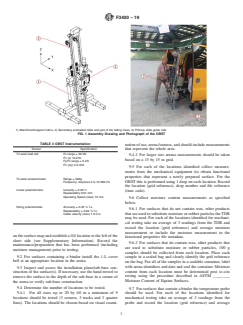
1) Attachment/support frame, 2) Secondary preloaded slide and part of the falling mass, 3) Primary slide guide rails
FIG. 1Assembly Drawing and Photograph of the OBST
TABLE 3 OBST Instrumentation
nation of use, arena features, and should include measurements
Sensor Specification that represent the whole area.
Tri-axial load cell Fz range ± 30 kN
9.4.2 For larger size arenas measurements should be taken
Fn (z) 10 kHz
based on a 15 by 15 m grid.
Fy/Fxrange±5kN
Fn (x/y) 3.6 kHz
9.5 For each of the locations identified collect measure-
ments from the mechanical equipment (to obtain functional
properties that represent a newly prepared surface. For the
Tri-axial accelerometer Range ± 500g
OBST this is performed using 1 drop on each location. Record
Frequency response 2.5–10 000 Hz
the location (grid reference), drop number and file reference
Linear potentiometer Linearity ± 0.05 %
(time code).
Repeatability 0.01 mm
Operating Speed (max) 10 m/s
9.6 Collect moisture content measurements as specified
below.
String potentiometer Accuracy ± 0.25 % f.s.
9.6.1 For surfaces that do not contain wax, other products
Repeatability ± 0.02 % f.s.
that are used to substitute moisture or rubber particles theTDR
Cable velocity (max) 7.6 m/s
may be used. For each of the locations identified for mechani-
cal testing take an average of 3 readings from the TDR and
record the location (grid reference) and average moisture
measurement or include the moisture measurement in the
on the surface map and establish a 0,0 location to the left of the
functional properties file metadata.
short side (see Supplementary Information). Record the
9.6.2 For surfaces that do contain wax, other products that
maintenance/preparation that has been performed (including
are used to substitute moisture or rubber particles, 100 g
moisture management) prior to testing.
samples should be collected from each location.
...