

ASTM A900/A900M-01(2018)
(Test Method)Standard Test Method for Lamination Factor of Amorphous Magnetic Strip
General Information
- Abstract
SIGNIFICANCE AND USE
3.1 Lamination factor S indicates the deficiency of effective material volume which is due to the presence of oxides, roughness, insulating coatings, and other conditions affecting the strip surface.
3.2 This test method is used to predict the fraction of metal that is included in the volume of the firm coil wound from the specimen tape.
SCOPE
1.1 This test method covers measurements of lamination factor (Note 1) of a specimen composed of strips cut from amorphous magnetic material. It is suitable for the determination of lamination factor for thin, flat case, metallic strip ranging in width from 0.25 to 8.00 in. [6.35 mm to 203 mm] and in thickness from 0.0005 to 0.005 in. [12.7 to 127 μm].
Note 1: Lamination factor is also termed space factor or stacking factor.
1.2 The values and equations stated in customary (egs-emu and inch-pound) or SI units are to be regarded separately as standard. Within this standard, SI units are shown in brackets. The values stated in each system may not be exact equivalents; therefore, each system shall be used independently of the other. Combining values from the two systems may result in nonconformance with this standard.
1.3 This standard does not purport to address all of the safety concerns, if any, associated with its use. It is the responsibility of the user of this standard to establish appropriate safety, health, and environmental practices and determine the applicability of regulatory limitations prior to use.
1.4 This international standard was developed in accordance with internationally recognized principles on standardization established in the Decision on Principles for the Development of International Standards, Guides and Recommendations issued by the World Trade Organization Technical Barriers to Trade (TBT) Committee.
- Status
- Published
- Publication Date
- 30-Apr-2018
- Technical Committee
- A06 - Magnetic Properties
- Drafting Committee
- A06.01 - Test Methods
Overview
ASTM A900/A900M-01(2018): Standard Test Method for Lamination Factor of Amorphous Magnetic Strip is an internationally recognized ASTM standard developed to measure the lamination factor-also referred to as space factor or stacking factor-of strips made from amorphous magnetic materials. The lamination factor is a key performance indicator that reflects the effective material volume, accounting for the presence of oxides, surface roughness, insulating coatings, and other surface conditions that may affect material performance.
This standard is applicable to thin, flat, metallic strips with widths ranging from 0.25 to 8.00 inches (6.35 mm to 203 mm) and thicknesses from 0.0005 to 0.005 inches (12.7 µm to 127 µm). The test method is crucial for accurately predicting the proportion of metal included in the volume of a firmly wound coil, which is essential for evaluating the quality and efficiency of magnetic components.
Key Topics
- Lamination Factor (Space/Stacking Factor): Measures the proportion of usable metallic material within a stack of amorphous strips, highlighting material deficiencies due to surface conditions.
- Test Specimen Preparation: Involves selecting, cutting, and stacking strips from an amorphous magnetic tape, ensuring representative sampling from the material lot or coil.
- Measurement Approach: Utilizes specialized micrometers (deadweight, digital, or dial-type) and sample holding fixtures to determine precise thickness and volume measurements of the stack.
- Calculation Method: Compares the actual stacked volume to the equivalent solid volume using mass, physical dimensions, and material density to determine the lamination factor.
- Impact of Surface Conditions: Factors such as oxides, roughness, waviness, or insulating layers are considered as they significantly influence the stacking factor and material efficiency in applications.
Applications
- Quality Control for Magnetic Materials: Used by manufacturers and buyers of amorphous magnetic materials to verify conformance to specified lamination factor thresholds and to ensure consistent product quality.
- Transformer and Inductor Production: Essential for evaluating the core stacking efficiency in electrical transformers, inductors, and similar electromagnetic devices manufactured using amorphous ribbon or strip.
- Material Performance Assessment: Helps predict real-world performance of wound magnetic components by quantifying the actual fraction of active metal within a formed coil or toroid.
- Process Optimization: Provides valuable feedback for optimizing manufacturing processes related to strip casting, coating, and handling to minimize surface imperfections and improve material utilization.
Related Standards
- ASTM A976: Guide for the specification of certain types of amorphous magnetic materials.
- ASTM A876: Standard specification for flat-rolled, silicon-iron, cold-rolled magnetic-dielectric steel.
- IEC 60404-8: Magnetic materials standards by the International Electrotechnical Commission, which may complement this ASTM method.
- ISO/IEC 17025: General requirements for the competence of testing and calibration laboratories, relevant for labs performing this lamination factor measurement.
Keywords: ASTM A900/A900M, lamination factor, stacking factor, space factor, amorphous magnetic strip, test method, magnetic materials, quality control, transformer core, electromagnetic applications, material efficiency.
By adhering to ASTM A900/A900M-01(2018), organizations in the electrical, electronic, and materials industries can ensure reliable, standardized measurement of lamination factors, leading to improved quality assurance and performance assessment of amorphous magnetic components throughout the supply chain.
Relations
- Replaces
ASTM A900/A900M-01(2012) - Standard Test Method for Lamination Factor of Amorphous Magnetic Strip - Effective Date
- 01-May-2018
- Referred By
ASTM A901-19 - Standard Specification for Amorphous Magnetic Core Alloys, Semi-Processed Types - Effective Date
- 01-May-2018
Get Certified
Connect with accredited certification bodies for this standard

IMQ S.p.A. (Certification)
Italian electrical product certification.

SLG Prüf- und Zertifizierungs GmbH
German testing and certification body.

UL Solutions
Global safety science company with testing, inspection and certification.
Sponsored listings
Frequently Asked Questions
ASTM A900/A900M-01(2018) is a standard published by ASTM International. Its full title is "Standard Test Method for Lamination Factor of Amorphous Magnetic Strip". This standard covers: SIGNIFICANCE AND USE 3.1 Lamination factor S indicates the deficiency of effective material volume which is due to the presence of oxides, roughness, insulating coatings, and other conditions affecting the strip surface. 3.2 This test method is used to predict the fraction of metal that is included in the volume of the firm coil wound from the specimen tape. SCOPE 1.1 This test method covers measurements of lamination factor (Note 1) of a specimen composed of strips cut from amorphous magnetic material. It is suitable for the determination of lamination factor for thin, flat case, metallic strip ranging in width from 0.25 to 8.00 in. [6.35 mm to 203 mm] and in thickness from 0.0005 to 0.005 in. [12.7 to 127 μm]. Note 1: Lamination factor is also termed space factor or stacking factor. 1.2 The values and equations stated in customary (egs-emu and inch-pound) or SI units are to be regarded separately as standard. Within this standard, SI units are shown in brackets. The values stated in each system may not be exact equivalents; therefore, each system shall be used independently of the other. Combining values from the two systems may result in nonconformance with this standard. 1.3 This standard does not purport to address all of the safety concerns, if any, associated with its use. It is the responsibility of the user of this standard to establish appropriate safety, health, and environmental practices and determine the applicability of regulatory limitations prior to use. 1.4 This international standard was developed in accordance with internationally recognized principles on standardization established in the Decision on Principles for the Development of International Standards, Guides and Recommendations issued by the World Trade Organization Technical Barriers to Trade (TBT) Committee.
SIGNIFICANCE AND USE 3.1 Lamination factor S indicates the deficiency of effective material volume which is due to the presence of oxides, roughness, insulating coatings, and other conditions affecting the strip surface. 3.2 This test method is used to predict the fraction of metal that is included in the volume of the firm coil wound from the specimen tape. SCOPE 1.1 This test method covers measurements of lamination factor (Note 1) of a specimen composed of strips cut from amorphous magnetic material. It is suitable for the determination of lamination factor for thin, flat case, metallic strip ranging in width from 0.25 to 8.00 in. [6.35 mm to 203 mm] and in thickness from 0.0005 to 0.005 in. [12.7 to 127 μm]. Note 1: Lamination factor is also termed space factor or stacking factor. 1.2 The values and equations stated in customary (egs-emu and inch-pound) or SI units are to be regarded separately as standard. Within this standard, SI units are shown in brackets. The values stated in each system may not be exact equivalents; therefore, each system shall be used independently of the other. Combining values from the two systems may result in nonconformance with this standard. 1.3 This standard does not purport to address all of the safety concerns, if any, associated with its use. It is the responsibility of the user of this standard to establish appropriate safety, health, and environmental practices and determine the applicability of regulatory limitations prior to use. 1.4 This international standard was developed in accordance with internationally recognized principles on standardization established in the Decision on Principles for the Development of International Standards, Guides and Recommendations issued by the World Trade Organization Technical Barriers to Trade (TBT) Committee.
ASTM A900/A900M-01(2018) is classified under the following ICS (International Classification for Standards) categories: 29.030 - Magnetic materials. The ICS classification helps identify the subject area and facilitates finding related standards.
ASTM A900/A900M-01(2018) has the following relationships with other standards: It is inter standard links to ASTM A900/A900M-01(2012), ASTM A901-19. Understanding these relationships helps ensure you are using the most current and applicable version of the standard.
ASTM A900/A900M-01(2018) is available in PDF format for immediate download after purchase. The document can be added to your cart and obtained through the secure checkout process. Digital delivery ensures instant access to the complete standard document.
Standards Content (Sample)
This international standard was developed in accordance with internationally recognized principles on standardization established in the Decision on Principles for the
Development of International Standards, Guides and Recommendations issued by the World Trade Organization Technical Barriers to Trade (TBT) Committee.
Designation: A900/A900M − 01 (Reapproved 2018)
Standard Test Method for
Lamination Factor of Amorphous Magnetic Strip
This standard is issued under the fixed designationA900/A900M; the number immediately following the designation indicates the year
of original adoption or, in the case of revision, the year of last revision.Anumber in parentheses indicates the year of last reapproval.
A superscript epsilon (´) indicates an editorial change since the last revision or reapproval.
1. Scope 3. Significance and Use
1.1 This test method covers measurements of lamination 3.1 Lamination factor S indicates the deficiency of effective
factor (Note 1) of a specimen composed of strips cut from material volume which is due to the presence of oxides,
amorphous magnetic material. It is suitable for the determina- roughness, insulating coatings, and other conditions affecting
tion of lamination factor for thin, flat case, metallic strip the strip surface.
ranging in width from 0.25 to 8.00 in. [6.35 mm to 203 mm]
3.2 This test method is used to predict the fraction of metal
and in thickness from 0.0005 to 0.005 in. [12.7 to 127 µm].
that is included in the volume of the firm coil wound from the
specimen tape.
NOTE 1—Lamination factor is also termed space factor or stacking
factor.
4. Interferences
1.2 The values and equations stated in customary (egs-emu
4.1 This test method is predicated on correctly aligned test
and inch-pound) or SI units are to be regarded separately as
standard. Within this standard, SI units are shown in brackets. strips and uniform compression during test. Both of these
conditions are difficult to meet whenever the test specimens
Thevaluesstatedineachsystemmaynotbeexactequivalents;
therefore,eachsystemshallbeusedindependentlyoftheother. have one or more elevated ridges running lengthwise along the
surface of the strip.
Combining values from the two systems may result in noncon-
formance with this standard.
4.2 This test method also presupposes that the test speci-
1.3 This standard does not purport to address all of the mensarefreefromotherdefects,suchascamberandwaviness,
safety concerns, if any, associated with its use. It is the
that may affect the lamination factor.
responsibility of the user of this standard to establish appro-
5. Apparatus
priate safety, health, and environmental practices and deter-
mine the applicability of regulatory limitations prior to use.
5.1 Micrometers—Two types of micrometers are included
1.4 This international standard was developed in accor-
for use in this test method as follows:
dance with internationally recognized principles on standard-
5.1.1 Motor-Operated, Deadweight (Not Spring) Actuated
ization established in the Decision on Principles for the
Micrometer, conforming to the following requirements:
Development of International Standards, Guides and Recom-
5.1.1.1 The micrometer shall be a deadweight digital- or
mendations issued by the World Trade Organization Technical
dial-type micrometer, having two ground and lapped circular
Barriers to Trade (TBT) Committee.
surfaces with a capacity of not less than 0.030 in. [0.75 mm].
The movable face or presser foot shall have an area of 0.25 to
2 2
2. Summary of Test Method
0.33 in. [160 to 215 mm ] and corresponding to a diameter of
approximately 0.56 to 0.65 in. [14.2 to 16.5 mm]. The fixed
2.1 The laminated test specimen is oriented and aligned,
face or anvil shall be of such size that the whole area of the
then subjected to pressure in a compression device. The
presser foot is in contact with the anvil in the zero position.
resulting volume is then determined from the measured speci-
5.1.1.2 The surface shall be parallel to within 0.00005 in.
men height, width, and length. An equivalent solid volume is
[0.0012 mm] and the presser foot shall move on an axis
calculated from the specimen mass and the true density of the
perpendicular to the anvil.
specimen material. The ratio of the calculated (equivalent
5.1.1.3 The presser foot shall exert a steady pressure on the
solid) volume to the measured volume is the lamination factor.
specimen of 7.0 to 8.0 psi [48 to 55 kPa].
5.1.1.4 A digital readout is preferred. If an analog gauge is
used,thedialshallbeatleast2in.[51mm]indiameter.Itshall
This test method is under the jurisdiction of ASTM Committee A06 on
MagneticPropertiesandisthedirectresponsibilityofSubcommitteeA06.01onTest
be continuously graduated to read directly to 0.0001 in.
Methods.
[0.0025 mm] and shall be required with a telltale hand, if
Current edition approved May 1, 2018. Published June 2018. Originally
necessary,recordingthenumberofcompleterevolutionsofthe
approved in 1991. Last previous edition approved in 2012 as A900/A900M–01
(2012). DOI: 10.1520/A0900_A0900M-01R18. large hand.
Copyright © ASTM International, 100 Barr Harbor Drive, PO Box C700, West Conshohocken, PA 19428-2959. United States
A900/A900M − 01 (2018)
7. Procedure
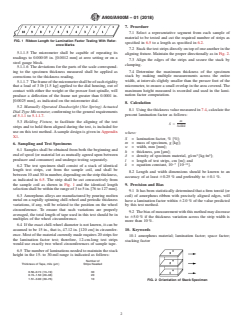
7.1 Select a representative segment from each sample of
material to be tested and cut the required number of strips as
FIG. 1 Ribbon Length for Lamination Factor Testing With Refer-
specified in 6.5 to a length as specified in 6.2.
ence Marks
7.2 Stack the test strips directly on top of one another in the
5.1.1.5 The micrometer shall be capable of repeating its
aligning fixture. Maintain the proper directionally as in Fig. 2.
readings to 0.00005 in. [0.0012 mm] at zero setting or on a
7.3 Align the edges of the strips and secure the stack by
steel gauge block.
clamping.
5.1.1.6 The deviations for the parts of the scale correspond-
7.4 Determine the maximum thickness of the specimen
ing to the specimen thickness measured shall be applied as
stack by making multiple measurements across the entire
corrections to the thickness reading.
width, at intervals slightly smaller than the presser foot of the
5.1.1.7 Theframeofthemicrometershallbeofsuchrigidity
micrometer
...