


ASTM D1252-06(2020)
(Test Method)Standard Test Methods for Chemical Oxygen Demand (Dichromate Oxygen Demand) of Water
Standard Test Methods for Chemical Oxygen Demand (Dichromate Oxygen Demand) of Water
SIGNIFICANCE AND USE
5.1 These test methods are used to chemically determine the maximum quantity of oxygen that could be consumed by biological or natural chemical processes due to impurities in water. Typically this measurement is used to monitor and control oxygen-consuming pollutants, both inorganic and organic, in domestic and industrial wastewaters.
5.2 The relationship of COD to other water quality parameters such as TOC and TOD is described in the literature.3
SCOPE
1.1 These test methods cover the determination of the quantity of oxygen that certain impurities in water will consume, based on the reduction of a dichromate solution under specified conditions. The following test methods are included:
Test Method A — Macro COD by Reflux Digestion and Titration
Test Method B — Micro COD by Sealed Digestion and Spectrometry
1.2 These test methods are limited by the reagents employed to a maximum chemical oxygen demand (COD) of 800 mg/L. Samples with higher COD concentrations may be processed by appropriate dilution of the sample. Modified procedures in each test method (Section 15 for Test Method A, and Section 24 for Test Method B) may be used for waters of low COD content (
1.3 As a general rule, COD results are not accurate if the sample contains more than 1000 mg/L Cl−. Consequently, these test methods should not be applied to samples such as seawaters and brines unless the samples are pretreated as described in Appendix X1.
1.4 This test method was used successfully on a standard made up in reagent water. It is the user’s responsibility to ensure the validity of these test methods for waters of untested matrices.
1.5 The values stated in SI units are to be regarded as standard. No other units of measurement are included in this standard.
1.6 This standard does not purport to address all of the safety concerns, if any, associated with its use. It is the responsibility of the user of this standard to establish appropriate safety, health, and environmental practices and determine the applicability of regulatory limitations prior to use. For specific hazard statements, see Section 8, 15.6, and 24.5.
1.7 This international standard was developed in accordance with internationally recognized principles on standardization established in the Decision on Principles for the Development of International Standards, Guides and Recommendations issued by the World Trade Organization Technical Barriers to Trade (TBT) Committee.
General Information
- Status
- Published
- Publication Date
- 31-Dec-2019
- Technical Committee
- D19 - Water
- Drafting Committee
- D19.06 - Methods for Analysis for Organic Substances in Water
Relations
- Effective Date
- 01-May-2020
- Effective Date
- 01-Jun-2017
- Effective Date
- 01-Jan-2013
- Effective Date
- 01-Sep-2012
- Effective Date
- 15-Jun-2012
- Effective Date
- 01-Dec-2010
- Effective Date
- 01-Mar-2010
- Refers
ASTM E275-08 - Describing and Measuring Performance of Ultraviolet and Visible Spectrophotometers - Effective Date
- 15-Oct-2008
- Effective Date
- 01-Oct-2008
- Effective Date
- 15-Jul-2008
- Effective Date
- 15-Jan-2008
- Effective Date
- 01-Dec-2007
- Effective Date
- 01-Aug-2007
- Effective Date
- 01-Sep-2006
- Effective Date
- 01-Sep-2006
Overview
ASTM D1252-06(2020), Standard Test Methods for Chemical Oxygen Demand (Dichromate Oxygen Demand) of Water, outlines procedures for determining the oxygen required to chemically oxidize impurities in water. By measuring chemical oxygen demand (COD), this standard helps evaluate the presence of both organic and inorganic pollutants that consume oxygen, which is critical for monitoring the quality of domestic and industrial wastewater.
COD analysis is essential for environmental compliance and water treatment process control. The standard is approved for use by regulatory bodies and developed in accordance with internationally recognized principles to facilitate widespread adoption and reliability.
Key Topics
- Purpose of COD Testing: Determines the maximum amount of oxygen that can be consumed by contaminants in water, thus quantifying potential pollution and enabling effective water quality management.
- Test Methods:
- Test Method A: Macro COD by reflux digestion and titration, appropriate for studies requiring greater sample representation and precision.
- Test Method B: Micro COD by sealed digestion and spectrometry, designed for scenarios with limited sample volume or high-throughput requirements.
- Measurement Range: Both methods are generally applicable for COD concentrations up to 800 mg/L. For samples above this limit, dilution is required; for very low COD content, specific modifications are outlined.
- Interferences: High chloride concentrations (>1000 mg/L) may affect accuracy, so seawaters and brines require pretreatment. Certain volatile or hard-to-oxidize organics are partially or not measured.
- Units and Safety: Results are expressed in SI units only. The standard emphasizes the importance of safety, health, and environmental precautions due to the use of hazardous reagents.
Applications
- Wastewater Management: Enables routine monitoring of oxygen-consuming pollutants in municipal and industrial wastewater, supporting regulatory compliance and discharge permit requirements.
- Process Control: Assists treatment plant operators in adjusting operational parameters to optimize pollutant removal and minimize environmental impact.
- Environmental Monitoring: Provides data for tracking pollution trends in surface waters and groundwaters, contributing to watershed management and environmental protection initiatives.
- Laboratory Analysis: Standardizes methods for research and quality control laboratories performing water quality testing.
Related Standards
- ASTM D1193: Specification for reagent water, which is referenced for sample preparation and analytical reagent standards.
- ASTM D1129: Terminology relating to water, for consistent definitions used in COD testing.
- ASTM D3370: Practices for sampling water from flowing process streams.
- ASTM D3223: Test method for total mercury in water, relevant for laboratories performing comprehensive water quality analyses.
- ASTM D5847: Practice for writing quality control specifications for water analysis.
Practical Value
Implementing ASTM D1252 ensures reliable, reproducible COD results, vital for safeguarding water resources and complying with environmental regulations. The standard’s robust methodology supports effective pollution control and water treatment, facilitating environmental stewardship and public health protection.
Keywords: chemical oxygen demand, COD, dichromate oxygen demand, ASTM D1252, wastewater analysis, water quality, environmental monitoring, water treatment, standard test methods, pollution control.
Get Certified
Connect with accredited certification bodies for this standard

CIS Institut d.o.o.
Personal Protective Equipment (PPE) certification body. Notified Body NB-2890 for EU Regulation 2016/425 PPE.

Kiwa BDA Testing
Building and construction product certification.
Kmetijski inštitut Slovenije
Agricultural Institute of Slovenia. Soil testing, plant health, agricultural product analysis.
Sponsored listings
Frequently Asked Questions
ASTM D1252-06(2020) is a standard published by ASTM International. Its full title is "Standard Test Methods for Chemical Oxygen Demand (Dichromate Oxygen Demand) of Water". This standard covers: SIGNIFICANCE AND USE 5.1 These test methods are used to chemically determine the maximum quantity of oxygen that could be consumed by biological or natural chemical processes due to impurities in water. Typically this measurement is used to monitor and control oxygen-consuming pollutants, both inorganic and organic, in domestic and industrial wastewaters. 5.2 The relationship of COD to other water quality parameters such as TOC and TOD is described in the literature.3 SCOPE 1.1 These test methods cover the determination of the quantity of oxygen that certain impurities in water will consume, based on the reduction of a dichromate solution under specified conditions. The following test methods are included: Test Method A — Macro COD by Reflux Digestion and Titration Test Method B — Micro COD by Sealed Digestion and Spectrometry 1.2 These test methods are limited by the reagents employed to a maximum chemical oxygen demand (COD) of 800 mg/L. Samples with higher COD concentrations may be processed by appropriate dilution of the sample. Modified procedures in each test method (Section 15 for Test Method A, and Section 24 for Test Method B) may be used for waters of low COD content ( 1.3 As a general rule, COD results are not accurate if the sample contains more than 1000 mg/L Cl−. Consequently, these test methods should not be applied to samples such as seawaters and brines unless the samples are pretreated as described in Appendix X1. 1.4 This test method was used successfully on a standard made up in reagent water. It is the user’s responsibility to ensure the validity of these test methods for waters of untested matrices. 1.5 The values stated in SI units are to be regarded as standard. No other units of measurement are included in this standard. 1.6 This standard does not purport to address all of the safety concerns, if any, associated with its use. It is the responsibility of the user of this standard to establish appropriate safety, health, and environmental practices and determine the applicability of regulatory limitations prior to use. For specific hazard statements, see Section 8, 15.6, and 24.5. 1.7 This international standard was developed in accordance with internationally recognized principles on standardization established in the Decision on Principles for the Development of International Standards, Guides and Recommendations issued by the World Trade Organization Technical Barriers to Trade (TBT) Committee.
SIGNIFICANCE AND USE 5.1 These test methods are used to chemically determine the maximum quantity of oxygen that could be consumed by biological or natural chemical processes due to impurities in water. Typically this measurement is used to monitor and control oxygen-consuming pollutants, both inorganic and organic, in domestic and industrial wastewaters. 5.2 The relationship of COD to other water quality parameters such as TOC and TOD is described in the literature.3 SCOPE 1.1 These test methods cover the determination of the quantity of oxygen that certain impurities in water will consume, based on the reduction of a dichromate solution under specified conditions. The following test methods are included: Test Method A — Macro COD by Reflux Digestion and Titration Test Method B — Micro COD by Sealed Digestion and Spectrometry 1.2 These test methods are limited by the reagents employed to a maximum chemical oxygen demand (COD) of 800 mg/L. Samples with higher COD concentrations may be processed by appropriate dilution of the sample. Modified procedures in each test method (Section 15 for Test Method A, and Section 24 for Test Method B) may be used for waters of low COD content ( 1.3 As a general rule, COD results are not accurate if the sample contains more than 1000 mg/L Cl−. Consequently, these test methods should not be applied to samples such as seawaters and brines unless the samples are pretreated as described in Appendix X1. 1.4 This test method was used successfully on a standard made up in reagent water. It is the user’s responsibility to ensure the validity of these test methods for waters of untested matrices. 1.5 The values stated in SI units are to be regarded as standard. No other units of measurement are included in this standard. 1.6 This standard does not purport to address all of the safety concerns, if any, associated with its use. It is the responsibility of the user of this standard to establish appropriate safety, health, and environmental practices and determine the applicability of regulatory limitations prior to use. For specific hazard statements, see Section 8, 15.6, and 24.5. 1.7 This international standard was developed in accordance with internationally recognized principles on standardization established in the Decision on Principles for the Development of International Standards, Guides and Recommendations issued by the World Trade Organization Technical Barriers to Trade (TBT) Committee.
ASTM D1252-06(2020) is classified under the following ICS (International Classification for Standards) categories: 13.060.50 - Examination of water for chemical substances. The ICS classification helps identify the subject area and facilitates finding related standards.
ASTM D1252-06(2020) has the following relationships with other standards: It is inter standard links to ASTM D1129-13(2020)e2, ASTM D3223-17, ASTM D5905-98(2013), ASTM D3223-12, ASTM D2777-12, ASTM D3370-10, ASTM D1129-10, ASTM E275-08, ASTM D3370-08, ASTM D5905-98(2008), ASTM D2777-08, ASTM D3370-07, ASTM D3223-02(2007)e1, ASTM D1129-06ae1, ASTM D1129-06a. Understanding these relationships helps ensure you are using the most current and applicable version of the standard.
ASTM D1252-06(2020) is available in PDF format for immediate download after purchase. The document can be added to your cart and obtained through the secure checkout process. Digital delivery ensures instant access to the complete standard document.
Standards Content (Sample)
This international standard was developed in accordance with internationally recognized principles on standardization established in the Decision on Principles for the
Development of International Standards, Guides and Recommendations issued by the World Trade Organization Technical Barriers to Trade (TBT) Committee.
Designation: D1252 − 06 (Reapproved 2020)
Standard Test Methods for
Chemical Oxygen Demand (Dichromate Oxygen Demand) of
Water
This standard is issued under the fixed designation D1252; the number immediately following the designation indicates the year of
original adoption or, in the case of revision, the year of last revision.Anumber in parentheses indicates the year of last reapproval.A
superscript epsilon (´) indicates an editorial change since the last revision or reapproval.
This standard has been approved for use by agencies of the U.S. Department of Defense.
1. Scope 1.7 This international standard was developed in accor-
dance with internationally recognized principles on standard-
1.1 These test methods cover the determination of the
ization established in the Decision on Principles for the
quantity of oxygen that certain impurities in water will
Development of International Standards, Guides and Recom-
consume, based on the reduction of a dichromate solution
mendations issued by the World Trade Organization Technical
under specified conditions. The following test methods are
Barriers to Trade (TBT) Committee.
included:
Test Method A — Macro COD by Reflux Digestion and Titration
2. Referenced Documents
Test MethodB—Micro COD by Sealed Digestion and Spectrometry
1.2 Thesetestmethodsarelimitedbythereagentsemployed
2.1 ASTM Standards:
to a maximum chemical oxygen demand (COD) of 800 mg/L. D1129Terminology Relating to Water
SampleswithhigherCODconcentrationsmaybeprocessedby
D1193Specification for Reagent Water
appropriate dilution of the sample. Modified procedures in D2777Practice for Determination of Precision and Bias of
each test method (Section 15 for Test Method A, and Section
Applicable Test Methods of Committee D19 on Water
24 for Test Method B) may be used for waters of low COD
D3223Test Method for Total Mercury in Water
content (<50 mg/L).
D3370Practices for Sampling Water from Flowing Process
Streams
1.3 As a general rule, COD results are not accurate if the
−
D5847Practice for Writing Quality Control Specifications
samplecontainsmorethan1000mg/LCl .Consequently,these
for Standard Test Methods for Water Analysis
test methods should not be applied to samples such as
D5905Practice for the Preparation of SubstituteWastewater
seawaters and brines unless the samples are pretreated as
E60Practice for Analysis of Metals, Ores, and Related
described in Appendix X1.
Materials by Spectrophotometry
1.4 This test method was used successfully on a standard
E275PracticeforDescribingandMeasuringPerformanceof
made up in reagent water. It is the user’s responsibility to
Ultraviolet and Visible Spectrophotometers
ensure the validity of these test methods for waters of untested
matrices.
3. Terminology
1.5 The values stated in SI units are to be regarded as
3.1 Definitions:
standard. No other units of measurement are included in this
3.1.1 For definitions of terms used in this standard, refer to
standard.
Terminology D1129.
1.6 This standard does not purport to address all of the
3.2 Definitions of Terms Specific to This Standard—The
safety concerns, if any, associated with its use. It is the
responsibility of the user of this standard to establish appro- term “oxygen demand” (COD) in these test methods is defined
in accordance with Terminology D1129 as follows:
priate safety, health, and environmental practices and deter-
mine the applicability of regulatory limitations prior to use.
3.2.1 oxygen demand, n—the amount of oxygen required
For specific hazard statements, see Section 8, 15.6, and 24.5.
underspecifiedtestconditionsfortheoxidationofwaterborne
organic and inorganic matter.
These test methods are under the jurisdiction of ASTM Committee D19 on
Water and are the direct responsibility of Subcommittee D19.06 on Methods for
Analysis for Organic Substances in Water. For referenced ASTM standards, visit the ASTM website, www.astm.org, or
Current edition approved Jan. 1, 2020. Published January 2020. Originally contact ASTM Customer Service at service@astm.org. For Annual Book of ASTM
ɛ1
approved in 1953. Last previous edition approved in 2012 as D1252–06 (2012) . Standards volume information, refer to the standard’s Document Summary page on
DOI: 10.1520/D1252-06R20. the ASTM website.
Copyright © ASTM International, 100 Barr Harbor Drive, PO Box C700, West Conshohocken, PA 19428-2959. United States
D1252 − 06 (2020)
TABLE 1 Test Method A, Recovery of Theoretical COD for
4. Summary of Test Methods
Various Organic Material
4.1 Most organic and oxidizable inorganic substances pres-
Reactivity, Percent of Theoretical
ent in water are oxidized by a standard potassium dichromate Component
A B C D E
1 2 3 4 5
solution in 50% sulfuric acid (vol/vol). The dichromate
Aliphatic Compounds
consumed (Test Method A) or tri-valent chromium produced
Acetone 98 . 96 94 .
(Test Method B) is determined for calculation of the COD Acetic acid 92 92 98 . .
Acrolein 62 . . . .
value.
Butyric acid 89 93 . . .
Dextrose 95 . . . .
4.2 The oxidation of many otherwise refractory organics is
Diethylene glycol 93 . . 70 .
facilitated by the use of silver sulfate that acts as a catalyst in
Ethyl acetate 95 . . 85 .
the reaction.
Methyl ethyl ketone 98 . . 90 .
4.3 These test methods provide for combining the reagents
Aromatic Compounds
and sample in a manner that minimizes the loss of volatile Acetophenone 89 . . . .
Benzaldehyde . . . 80 .
organic materials, if present.
Benzene 60–98 . 41 . .
Benzoic acid 98 . . 100 .
4.4 The oxidation of up to 1000 mg/L of chloride ion is
Dioctyl phthalate 83 . . . .
inhibited by the addition of mercuric sulfate to form stable and
Diphenyl 81 . . . .
soluble mercuric sulfate complex.Atechnique to remove up to
o-cresol 95 . . 95 .
Toluene 83 . . 45 .
40 000 mg/L chloride is shown in Appendix X1 for Test
Potassium acid 100 . . . .
Method B. The maximum chloride concentration that may be
phthalate
tolerated with the procedure for low COD, Test Method A
Nitrogen Compounds
(15.10), has not been established.
Acrylonitrile 48 . . 44 .
4.5 Thechemicalreactioninvolvedinoxidationofmaterials Adenine . . . . 59
Aniline 80 . . 74 .
by dichromate is illustrated by the following reaction with
Butyl amine 57 . . . .
potassium acid phthalate (KC H O ):
8 5 4 Pyridine 0 . 1 . 2
Quinoline . . . . 87
41H SO 110K Cr O 12KC H O
2 4 2 2 7 8 5 4
Trimethylamine 1 . . . .
→10Cr ~SO ! 111K SO 116CO 146H O
2 4 3 2 4 2 2 Tryptophane . . . . 87
Uric acid . . . . 61
Since 10 mol of potassium dichromate has the same oxida-
A
Hamilton, C. E., unpublished data.
tion power as 15 mol of oxygen, the equivalent reaction is:
B
Moore, W. A., and Walker, W. W., Analytical Chemistry, Vol 28, 1956, p. 164.
C
Dobbs, R. A., and Williams, R. T., ibid., Vol 35, 1963 p. 1064.
2KC H O 115O 1H SO →16CO 16H O1K SO
8 5 4 2 2 4 2 2 2 4 D
Buzzell, J. C., Young, R. H. F., and Ryckman, D. W., “Behaviors of Organic
Chemicals in the Aquatic Environment; Part II, Dilute Systems,” Manufacturing
Thus,2molofpotassiumacidphthalateconsumes15molof
Chemists Association, April 1968, p. 34.
oxygen. The theoretical COD of potassium acid phthalate is E
Chudoba, J., and Dalesicky, J., Water Research, Vol 7, No. 5, 1973, p. 663.
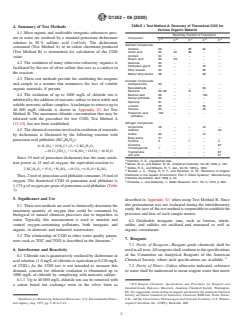
1.175gofoxygenpergramofpotassiumacidphthalate(Table
1).
5. Significance and Use
described in Appendix X1 when using Test Method B. Since
this pretreatment was not evaluated during the interlaboratory
5.1 Thesetestmethodsareusedtochemicallydeterminethe
study,theuserofthetestmethodisresponsibletoestablishthe
maximum quantity of oxygen that could be consumed by
precision and bias of each sample matrix.
biological or natural chemical processes due to impurities in
water. Typically this measurement is used to monitor and
6.2 Oxidizable inorganic ions, such as ferrous, nitrite,
control oxygen-consuming pollutants, both inorganic and
sulfite, and sulfides are oxidized and measured as well as
organic, in domestic and industrial wastewaters.
organic constituents.
5.2 The relationship of COD to other water quality param-
7. Reagents
eters such as TOC and TOD is described in the literature.
7.1 Purity of Reagents—Reagent grade chemicals shall be
6. Interference and Reactivity usedinalltests.Allreagentsshallconformtothespecifications
of the Committee on Analytical Reagents of the American
6.1 Chloride ion is quantitatively oxidized by dichromate in
Chemical Society, where such specifications are available.
acidsolution.(1.0mg/Lofchlorideisequivalentto0.226mg/L
of COD.) As the COD test is not intended to measure this
7.2 Purity of Water—Unless otherwise indicated, reference
demand, concern for chloride oxidation is eliminated up to to water shall be understood to mean reagent water that meets
1000 mg/L of chloride by complexing with mercuric sulfate.
6.1.1 Up to 40 000 mg/L chloride ion can be removed with
ACS Reagent Chemicals, Specifications and Procedures for Reagents and
a cation based ion exchange resin in the silver form as
Standard-Grade Reference Materials, American Chemical Society, Washington,
DC. For suggestions on the testing of reagents not listed by theAmerican Chemical
Society, see Analar Standards for Laboratory Chemicals, BDH Ltd., Poole, Dorset,
Handbook for Monitoring Industrial Wastewater, U.S. Environmental Protec- U.K., and the United States Pharmacopeia and National Formulary, U.S. Pharma-
tion Agency, Aug. 1973, pp. 5-10 to 5-12. copeial Convention, Inc. (USPC), Rockville, MD.
D1252 − 06 (2020)
the purity specifications of Type I or Type II water, presented a low-solution temperature (about 40°C) and permitting oxi-
in Specification D1193. dation to proceed at the lower temperature for a period of time
before reflux is initiated will result in higher recoveries of
8. Hazards
theoretical COD of volatile organics.
8.1 Exercise extreme care when handling concentrated sul-
13. Apparatus
furic acid, especially at the start of the refluxing step (15.7).
13.1 RefluxApparatus—Theapparatusconsistsofa500-mL
8.2 Silver sulfate is poisonous; avoid contact with the
Erlenmeyer or a 300-mL round-bottom flask, made of heat-
chemical and its solution.
resistant glass connected to a 300-mm (12-in.) Allihn con-
8.3 Mercuric sulfate is very toxic; avoid contact with the
denser by means of a ground-glass joint.Any equivalent reflux
chemical and its solution.
apparatus may be substituted, provided that a ground-glass
connection is used between the flask and the condenser, and
9. Sampling
provided that the flask is made of heat-resistant glass.
9.1 Collect the sample in accordance with Practices D3370.
13.2 Sample Heating Apparatus—A heating mantle or hot
9.2 Preserve samples by cooling to 4°C if analyzed within
plate capable of delivering sufficient controlled heat to main-
24 h after sampling, or preserve for up to 28 days at 4°C and
tain a steady reflux rate in the reflux apparatus is satisfactory.
at pH<2by addition of concentrated sulfuric acid. The
13.3 Apparatus for Blending or Homogenizing Samples—A
addition of 2 mL of concentrated sulfuric acid per litre at the
household blender is satisfactory.
time of collection will generally achieve this requirement. The
actual holding time possible without significant change in the
14. Reagents
COD may be less than 28 days, especially when easily
oxidizable substances are present. It is the responsibility of the
14.1 Ferrous Ammonium Sulfate Solution (0.25 N)—
users of the test method to ensure the maximum holding time
Dissolve 98.0 g of ferrous ammonium sulfate solution
for their samples.
(FeSO ·(NH )SO ·6H O) in water.Add 20 mLof sulfuric acid
4 4 4 2
(H SO , sp gr 1.84), cool and dilute to 1 L. Standardize this
2 4
solution daily before use. To standardize, dilute 25.0 mL of
TEST METHOD A
0.25 N potassium dichromate solution (K Cr O ) to about 250
2 2 7
MACRO COD BY REFLUX DIGESTION AND
mL. Add 20 mL of sulfuric acid (sp gr 1.84) and allow the
TITRATION
solution to cool. Titrate with the ferrous ammonium sulfate
solution to be standardized, using the phenanthroline ferrous
10. Scope
sulfate indicator as directed in 15.10. Calculate the normality
10.1 TheamountofdichromateconsumedinTestMethodA
as follows:
is determined by titration rather than the spectrophotometric
N 5 ~A 3B!/C
procedure used in Test Method B. This test method is appro-
priate where larger sample volumes would provide better
where:
precision and better representativeness of where equipment or
N = normality of the ferrous ammonium sulfate solution,
space limitations exist.
A = potassium dichromate solution, mL,
10.2 The precision of this test method in standard solutions B = normality of the potassium dichromate solution, and
C = ferrous ammonium sulfate solution, mL.
containing low-volatility organic compounds has been exam-
ined in the range of approximately 10 to 300 mg/L.
14.2 Ferrous Ammonium Sulfate Solution (0.025 N)—
Dilute100mLof0.25 Nferrousammoniumsulfatesolutionto
11. Summary of Test Method
1 L. Standardize against 0.025 N potassium dichromate solu-
11.1 The sample and standardized dichromate solution, in a
tion as in 14.1. This solution is required only if COD is
50% by volume sulfuric solution, is refluxed for a 2-h
determined in the range of 10 to 50 mg/L.
digestion period.
14.3 Mercuric Sulfate—Powdered mercuric sulfate
11.2 Excess dichromate after the digestion period is titrated
(HgSO ).
with a standard ferrous ammonium sulfate solution using
14.4 Phenanthroline Ferrous Sulfate Indicator Solution—
ortho-phenanthroline ferrous complex as an internal indicator.
Dissolve 1.48 g of 1,10-(ortho)-phenanthroline monohydrate,
together with 0.70 g of ferrous sulfate (FeSO ·7H O), in 100
12. Interferences 4 2
mL of water. This indicator may be purchased already pre-
12.1 Thetestmethoddoesnotuniformlyoxidizeallorganic
pared.
materials.Somecompounds,forexample,arequiteresistantto
14.5 Potassium Acid Phthalate Solution, Standard (1
oxidation, while others, such as carbohydrates, are easily
mL=1 mg COD)—Dissolve 0.851 g of potassium acid phtha-
oxidized. A guide to the behavior of various types of organic
late (KC H O ), primary standard, in water and dilute to 1 L.
materials is provided in Table 1.
8 5 4
12.2 Volatile organics that are difficult to oxidize may be 14.6 Potassium Dichromate Solution, Standard (0.25 N)—
partially lost before oxidation is achieved. Care in maintaining Dissolve12.259gofpotassiumdichromate(K Cr O )primary
2 2 7
D1252 − 06 (2020)
standard grade, previously dried at 103°C for 2 h, in water and
dilute to 1 L in a volumetric flask.
14.7 Potassium Dichromate Solution, Standard (0.025 N)—
Dilute 100.0 mLof 0.25 N potassium dichromate solution to 1
L.This solution is necessary only for determination of COD in
the range of 10 to 50 mg/L.
14.8 Sulfuric Acid-Silver Sulfate Solution—Dissolve15gof
powdered silver sulfate (Ag SO ) in 300 mL of concentrated
2 4
sulfuric acid (sp gr 1.84) and dilute to 1 L with concentrated
sulfuric acid (sp gr 1.84).
15. Procedure
15.1 Homogenize the sample by blending if necessary.
Place50.0mLofthesampleinarefluxflask.Iflessthan50mL
ofthesampleisused,makeupthedifferenceinwater,thenadd
thesamplealiquotandmix.Samplescontainingmorethan800
mg/LCODaredilutedandmixedpreciselywithwaterand50.0
mL of the diluted sample are placed in a reflux flask.
NOTE 1—If the sample is diluted, it must consume at least 5 mL of
dichromate. Dilute the sample if more than 20 mLof the titrant is needed
FIG. 1 Test Method A, Chemical Oxygen Demand (COD) Preci-
to reach the endpoint.
sion of Determination as Overall Standard Deviation
15.2 Place 50 mL of water in a reflux flask for the blank
determination.
fourtimeswithwater.Dilutetheacidsolutiontoabout300mL
15.3 Place the reflux flasks in an ice bath and add1gof
with water and allow the solution to cool to about room
powdered mercuric sulfate, 5.0 mL of concentrated sulfuric
temperature.
acid, and several glass beads or boiling stones. Mix well to
15.9 Add 8 to 10 drops of phenanthroline ferrous sulfate
complete dissolution.
solution and titrate the excess dichromate with 0.25 N ferrous
15.4 Withtheflasksstillintheicebath,addslowlyandwith
ammonium solution. The color change at the end point will be
stirring, 25.0 mL of 0.25 N standard potassium dichromate
sharp, changing from a blue-green to a reddish hue. If the
solution.
solution immediately turns a reddish-brown upon the addition
15.5 With the flasks still in the ice bath, add 70 mL of
oftheindicator,repeattheanalysisonasmallersamplealiquot.
sulfuric acid-silver sulfate solution slowly such that the solu-
NOTE3—Toavoidunnecessarypollutionoftheenvironment,disposeof
tion temperature is maintained as low as possible, preferably
mercury-containingwastesolutionproperly.RefertoTestMethodD3223,
below 40°C.
Appendix XI, for instructions.
NOTE 2—If a particular waste is known to contain no volatile organic
15.10 For waters of low COD (10 to 50 mg/L), use 0.025 N
substances,theacidmixturemaybeaddedgradually,withlessprecaution,
potassiumdichromateandferrousammoniumsulfatesolutions
while the flask is immersed in the iced bath.
(14.2 and 14.7). If the COD is determined to be higher than 50
15.6 Attachtheflaskstothecondensersandstarttheflowof
mg/L after using these reagents, reanalyze the sample, using
coldwater.(Warning—Takecaretoensurethatthecontentsof
the more concentrated reagents.
theflaskarewellmixed;ifnot,superheatingmayresultandthe
16. Calculation
mixture may be expulsed from the open end of the condenser.)
16.1 CalculatetheCODinthesampleinmilligramsperlitre
15.7 Apply heat to the flasks and reflux for 2 h. Place a
as follows:
small beaker or other cover over the open end of each
condenser to prevent intrusion of foreign material.
COD, mg/L 5 A 2 B N 38000 /S
~~ ! !
15.8 Allowtheflaskstocoolandwashdownthecondensers
where:
with about 25 mL of water before removing flasks. If a
A = ferrous ammonium sulfate solutions required for titra-
round-bottom flask has been used, transfer the digestate to a
tion of the blank, mL,
500-mLErlenmeyer flask, washing out the reflux flask three or
D1252 − 06 (2020)
TABLE 2 Test Method A, Recovery and Precision Data
Recovered
Prepared Bias, Statistically
COD, % Bias
COD, mg/L mg/L Significant
mg/L
12.30 12.34 +0.04 +0.33 no
40.2 37.9 −2.3 −5.7 yes
92.0 88.6 −3.4 −3.7 yes
270 257 −13 −4.8 yes
17.6 Prepared Standards—Recoveriesofknownamountsof
CODintheseriesofpreparedstandards(previouslydescribed)
were as shown in Table 2.
TEST METHOD B
MICRO COD BY SEALED DIGESTION AND
SPECTROMETRY
18. Scope
18.1 This test method is essentially equivalent to Test
FIG. 2 Test Method A, Chemical Oxygen Demand (COD) Bias of
Method A, but it utilizes micro volumes of the same reagents
Determinations
contained in a sealable ampule or a screw-top culture tube and
a spectrophotometer or filter photometer to measure absor-
B = ferrousammoniumsulfatesolutionrequiredfortitration
bance or transmittance at selected wavelengths. This test
of the sample, mL,
method is applicable where only small sample volumes are
N = normalityoftheferrousammoniumsulfatesolution,and
available and where large numbers of samples need to be
analyzed.This test method requires less space per analysis and
S = sample used for the test, mL.
uses less of the reagents, minimizing costs and volume of
wastes discharged.
17. Precision and Bias
18.2 This test method was tested on Type II reagent water.
17.1 The overall precision of Test Method A within the
It is the user’s responsibility to ensure the validity of this test
range from 10 to 300 mg/L varies with the quantity being
method for waters of untested matrices.
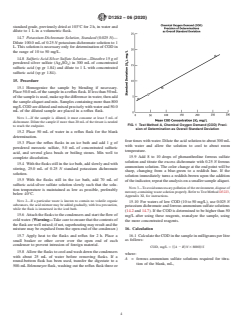
tested according to Fig. 1.
19. Summary of Test Method
17.2 The data used in the calculation of precision are from
EPA “Method Research Study 3” (1971) that involved two
19.1 The dichromate reagent and silver catalyst used in this
levels of COD, 12.3 mg/L (86 laboratories) and 270 mg/L (82
test method are similar to those used inTest MethodA, but the
laboratories), and EPA “Water Pollution Laboratory Perfor-
volumes employed are ⁄20 th of those in Test Method A.
mance Evaluation, No. 8” (1982) that involved two levels of
19.2 Asamplealiquotisintroducedcarefullyintoanampule
COD, 40.2 mg/L (65 laboratories) and 92 mg/L (67 laborato-
or screw-top tube so that the sample is layered on top of
ries).
previously introduced reagents and remains there until the
17.3 Thetestdatawereobtainedonreagentgradewaterand
ampule or tube is sealed. This technique limits evolution of
these precision and bias values may not be applicable to more
heat of solution until the container is sealed, minimizing the
complexwatermatrices.Itistheuser’sresponsibilitytoensure
loss of volatile organics.
the validity of this test method to waters of untested matrices.
19.3 After sealing, the ampule or tube is heated in an oven,
17.4 The precision obtained by the interlaboratory study is
sand bath, or heated block at 150 6 2°C for 2 h. The COD
overall, S. Since very carefully standardized samples in very
t
concentration is determined spectrophotometrically after di-
pure water were used rather than natural samples collected by
gestion. In the low COD range (5 to approximately 50 mg/L),
usual sampling procedures, the estimates do not include the
the loss of hexavalent chromium is measured at 420 nm, while
increase in precision statistics and the potential change in bias
for the high range (50 to approximately 800 mg/L), the
that may be attributed to the sample collection activities.
increase in trivalent chromium is measured at 600 nm. The
ampule or tube serves as the absorption cell.
17.5 The trend of the approximately 5% negative bias is
shown in Fig. 2.
20. Interferences
20.1 InterferencesidentifiedinSection6arealsoapplicable
Supporting data were taken from “Method Research Study 3” (1971) and
to the micro procedure.
“Water Pollution Laboratory Performance No. 8” (1982), Environmental Protection
Agency, National Environmental Research Center, Analytical Quality Control
20.2 Volatile materials will be lost if the sample is mixed
Laboratory, Cincinnati, OH. Supporting data have been filed atASTM International
with the reagents before the ampule or tube is sealed. Volatile
Headquarters and may be obtained by requesting Research Report RR:D19-1044.
Contact ASTM Customer Service at service@astm.org. materials will also be lost during sample homogenization.
D1252 − 06 (2020)
20.3 Potentially, the loss of volatile organics in the micro
procedure will be less than that which may occur in Test
MethodA.Thus,resultsbetweenthetwomethodsmaydifferif
volatile materials are involved.
20.4 Spectrophotometric interferences may exist due to
turbidity of precipitated salts that are too colloidal to settle in
a reasonable period of time. Centrifugation may be used to
speedseparationofthesalts.Thistestmethoddoesnotaddress
a titration procedure for the micro-volume, but if the digested
samples do not clear or spectrophotometric interference is
suspected, the COD result can be determined by titration.
FIG. 3 Typical COD Calibration Curve for Spectrophotometric
COD Method, Ampule Technique (Test Method B)
20.5 The ampule or tube must have window areas that are
free of scratches or smudges. If a suitable window area is not
available, do not consider transfer of the sample. The sample
22.2 Potassium Acid Phthalate Solution, Standard (1
and the blank may be titrated and the results used to calculate
mL=1 mg/L)—See 14.5.
a COD value (see 24.10).
22.3 Potassium Dichromate Digestion Solution:
22.3.1 High Range—Add10.216gofpotassiumdichromate
21. Apparatus
(K Cr O ) dried at 103°C for 2 h, 167 mL of concentrated
2 2 7
21.1 Spectrophotometer or Filter Photometer, suitable for
sulfuric acid (H SO ) (sp gr 1.84) and 33.3 g of mercuric
2 4
measurements at 600 nm and 420 nm using the ampules or
sulfate (HgSO ) to about 750 mL of water, mix, and let cool.
tubes in 21.3 or 21.3.1 as absorption cells. Filter photometers
Dilute the solution to 1 L with water and mix thoroughly.
and photometric practices shall conform to Practice E60.
22.3.2 Low Range—Add 1.022 g of potassium dichromate,
Spectrophotometers shall conform to Practice E275. For some
(K Cr O ) (dried at 103°C for 2 h), 167 mL of concentrated
2 2 7
spectrophotometers, poor sensitivity at 420 nm has been
sul
...
Questions, Comments and Discussion
Ask us and Technical Secretary will try to provide an answer. You can facilitate discussion about the standard in here.
Loading comments...