

ASTM F3093/F3093M-21
(Specification)Standard Specification for Aeroelasticity Requirements
General Information
- Abstract
ABSTRACT
This specification covers requirements and corresponding test methods for airplane aeroelasticity. It requires that the airplane be free from flutter, control reversal, and divergence for any condition of operation within the limit V-n (velocity versus load factor) envelope and at all speeds up to the speed specified for the selected method. In addition, adequate tolerances must be established for quantities which affect flutter, including speed, damping, mass balance, and control system stiffness. The natural frequencies of main structural components must be determined by vibration tests or other approved methods.
This specification also addresses flight flutter tests to be performed to show that the airplane is free from flutter, control reversal, and divergence; dynamic evaluation for turbopropeller-powered airplanes; and modifications to the type design that could affect the flutter characteristics.
SCOPE
1.1 This specification covers the aeroelasticity requirements of the aeroplane. The material was developed through open consensus of international experts in general aviation. This information was created by focusing on Level 1, 2, 3, and 4 Normal Category aeroplanes. The content may be more broadly applicable; it is the responsibility of the Applicant to substantiate broader applicability as a specific means of compliance. The topics covered within this document are: 2. Referenced Documents, 3. Terminology, 4. Flutter.
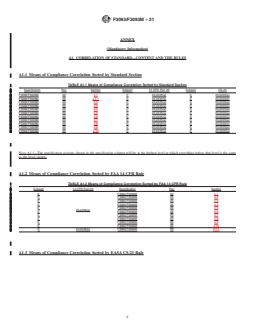
1.2 An applicant intending to propose this information as Means of Compliance for a design approval must seek guidance from their respective oversight authority (for example, published guidance from applicable CAAs) concerning the acceptable use and application thereof. For information on which oversight authorities have accepted this standard (in whole or in part) as an acceptable Means of Compliance to their regulatory requirements (hereinafter “the Rules”), refer to the ASTM Committee F44 web page (www.astm.org/COMMITTEE/F44.htm). Annex A1 maps the Means of Compliance described in this specification to the rules of EASA CS-23, amendment 5, or later, and FAA 14 CFR Part 23, amendment 64, or later.
1.3 Units—This document may present information in either SI units, English Engineering units, or both. The values stated in each system are not necessarily exact equivalents; therefore, to ensure conformance with the standard, each system shall be used independently of the other, and values from the two systems shall not be combined.
1.4 This standard does not purport to address all of the safety concerns, if any, associated with its use. It is the responsibility of the user of this standard to establish appropriate safety, health, and environmental practices and determine the applicability of regulatory limitations prior to use.
1.5 This international standard was developed in accordance with internationally recognized principles on standardization established in the Decision on Principles for the Development of International Standards, Guides and Recommendations issued by the World Trade Organization Technical Barriers to Trade (TBT) Committee.
- Status
- Published
- Publication Date
- 30-Apr-2021
- Technical Committee
- F44 - General Aviation Aircraft
- Drafting Committee
- F44.30 - Structures

Overview
ASTM F3093/F3093M-21: Standard Specification for Aeroelasticity Requirements sets forth comprehensive criteria and test methods for evaluating the aeroelasticity of airplanes. Developed through international consensus, this ASTM standard is primarily intended for Level 1-4 Normal Category aeroplanes, but may be applied more broadly if substantiated. It ensures that aircraft are free from dangerous instabilities such as flutter, control reversal, and divergence across their operational envelope, directly supporting aviation safety and airworthiness compliance.
The specification is widely recognized in the aerospace industry as a means of compliance with regulatory requirements such as EASA CS-23 and FAA 14 CFR Part 23. It provides detailed guidelines on vibration testing, damping verification, and control system performance, ensuring safe airplane operation under a range of conditions.
Key Topics
Aeroelasticity Requirements:
The standard defines strict requirements to ensure aircraft are free from flutter, control reversal, and divergence from the low-speed regime up to the maximum operational speed.Test Methods:
- Ground Vibration Testing (GVT): Used to determine the natural frequencies of main structural components.
- Flight Flutter Testing: Aircraft are tested in actual flight conditions to evaluate vibratory responses and confirm damping margins.
- Analytical Methods: Predictive analyses must cover all speeds up to 1.2 times the design dive speed, limited to Mach 1.0 for subsonic aircraft.
Special Considerations:
- Tolerances: Establishing tolerances for speed, mass balance, damping, and control system stiffness.
- Configuration Limitations: Applicability of simplified flutter criteria is restricted based on design, such as wing configuration, presence of large mass concentrations, or T-shaped tails.
- Dynamic Evaluation for Turboprops: Inclusion of whirl mode dynamics and propeller-structure interactions in assessment.
- Damage Tolerance and Fail-Safe Compliance: Requirements for analyzing flutter characteristics after structural damage or failure scenarios.
- Design Modifications: Ensuring continued compliance following any type design changes impacting aeroelastic properties.
Applications
ASTM F3093/F3093M-21 is essential for:
- Aircraft Certification: Used by applicants as a recognized means of compliance with EASA CS-23 and FAA 14 CFR Part 23 subparts for normal category airplanes.
- Airplane Design & Modification: Guiding manufacturers and designers in establishing aeroelasticity requirements during original design work or post-certification modifications.
- Vibration Testing & Structural Evaluation: Assisting test engineers in planning and conducting vibration and flutter testing, both on the ground and in flight.
- Regulatory Submissions: Facilitating regulatory acceptance for design approvals, especially when proposing compliance with international airworthiness rules.
- Product Improvement: Supporting change management where modifications to aircraft structure, systems, or equipment could affect flutter or other aeroelastic characteristics.
- Industry Best Practices: Providing a harmonized approach to safety and reliability in general aviation aircraft aeroelastic evaluation.
Related Standards
ASTM F3093/F3093M-21 references and complements the following standards and regulatory documents:
- ASTM F3061/F3061M - Specification for Systems and Equipment in Small Aircraft
- ASTM F3115/F3115M - Specification for Structural Durability for Small Aeroplanes
- ASTM F3120/F3120M - Specification for Ice Protection for General Aviation Aircraft
- EASA CS-23 - Certification Specifications for Normal-Category Aeroplanes (Europe)
- FAA 14 CFR Part 23 - Airworthiness Standards: Normal Category Airplanes (United States)
- FAA Airframe and Equipment Engineering Report No. 45 - Simplified Flutter Prevention Criteria
For updated adoption status and applicability as means of compliance, applicants should consult regulatory guidance and the ASTM Committee F44 website.
This standard directly supports aviation safety, structural integrity, and regulatory compliance through thorough, internationally recognized aeroelasticity requirements.
Relations
- Effective Date
- 01-Oct-2023
- Effective Date
- 01-Nov-2019
- Effective Date
- 01-Jun-2019
- Effective Date
- 15-Feb-2017
- Effective Date
- 01-Dec-2016
- Effective Date
- 01-Aug-2016
- Effective Date
- 01-Feb-2016
- Refers
ASTM F3120/F3120M-15 - Standard Specification for Ice Protection for General Aviation Aircraft - Effective Date
- 01-Dec-2015
- Effective Date
- 01-Jun-2015
- Effective Date
- 01-Mar-2015
Get Certified
Connect with accredited certification bodies for this standard

BSI Group
BSI (British Standards Institution) is the business standards company that helps organizations make excellence a habit.

Bureau Veritas
Bureau Veritas is a world leader in laboratory testing, inspection and certification services.

DNV
DNV is an independent assurance and risk management provider.
Sponsored listings
Frequently Asked Questions
ASTM F3093/F3093M-21 is a technical specification published by ASTM International. Its full title is "Standard Specification for Aeroelasticity Requirements". This standard covers: ABSTRACT This specification covers requirements and corresponding test methods for airplane aeroelasticity. It requires that the airplane be free from flutter, control reversal, and divergence for any condition of operation within the limit V-n (velocity versus load factor) envelope and at all speeds up to the speed specified for the selected method. In addition, adequate tolerances must be established for quantities which affect flutter, including speed, damping, mass balance, and control system stiffness. The natural frequencies of main structural components must be determined by vibration tests or other approved methods. This specification also addresses flight flutter tests to be performed to show that the airplane is free from flutter, control reversal, and divergence; dynamic evaluation for turbopropeller-powered airplanes; and modifications to the type design that could affect the flutter characteristics. SCOPE 1.1 This specification covers the aeroelasticity requirements of the aeroplane. The material was developed through open consensus of international experts in general aviation. This information was created by focusing on Level 1, 2, 3, and 4 Normal Category aeroplanes. The content may be more broadly applicable; it is the responsibility of the Applicant to substantiate broader applicability as a specific means of compliance. The topics covered within this document are: 2. Referenced Documents, 3. Terminology, 4. Flutter. 1.2 An applicant intending to propose this information as Means of Compliance for a design approval must seek guidance from their respective oversight authority (for example, published guidance from applicable CAAs) concerning the acceptable use and application thereof. For information on which oversight authorities have accepted this standard (in whole or in part) as an acceptable Means of Compliance to their regulatory requirements (hereinafter “the Rules”), refer to the ASTM Committee F44 web page (www.astm.org/COMMITTEE/F44.htm). Annex A1 maps the Means of Compliance described in this specification to the rules of EASA CS-23, amendment 5, or later, and FAA 14 CFR Part 23, amendment 64, or later. 1.3 Units—This document may present information in either SI units, English Engineering units, or both. The values stated in each system are not necessarily exact equivalents; therefore, to ensure conformance with the standard, each system shall be used independently of the other, and values from the two systems shall not be combined. 1.4 This standard does not purport to address all of the safety concerns, if any, associated with its use. It is the responsibility of the user of this standard to establish appropriate safety, health, and environmental practices and determine the applicability of regulatory limitations prior to use. 1.5 This international standard was developed in accordance with internationally recognized principles on standardization established in the Decision on Principles for the Development of International Standards, Guides and Recommendations issued by the World Trade Organization Technical Barriers to Trade (TBT) Committee.
ABSTRACT This specification covers requirements and corresponding test methods for airplane aeroelasticity. It requires that the airplane be free from flutter, control reversal, and divergence for any condition of operation within the limit V-n (velocity versus load factor) envelope and at all speeds up to the speed specified for the selected method. In addition, adequate tolerances must be established for quantities which affect flutter, including speed, damping, mass balance, and control system stiffness. The natural frequencies of main structural components must be determined by vibration tests or other approved methods. This specification also addresses flight flutter tests to be performed to show that the airplane is free from flutter, control reversal, and divergence; dynamic evaluation for turbopropeller-powered airplanes; and modifications to the type design that could affect the flutter characteristics. SCOPE 1.1 This specification covers the aeroelasticity requirements of the aeroplane. The material was developed through open consensus of international experts in general aviation. This information was created by focusing on Level 1, 2, 3, and 4 Normal Category aeroplanes. The content may be more broadly applicable; it is the responsibility of the Applicant to substantiate broader applicability as a specific means of compliance. The topics covered within this document are: 2. Referenced Documents, 3. Terminology, 4. Flutter. 1.2 An applicant intending to propose this information as Means of Compliance for a design approval must seek guidance from their respective oversight authority (for example, published guidance from applicable CAAs) concerning the acceptable use and application thereof. For information on which oversight authorities have accepted this standard (in whole or in part) as an acceptable Means of Compliance to their regulatory requirements (hereinafter “the Rules”), refer to the ASTM Committee F44 web page (www.astm.org/COMMITTEE/F44.htm). Annex A1 maps the Means of Compliance described in this specification to the rules of EASA CS-23, amendment 5, or later, and FAA 14 CFR Part 23, amendment 64, or later. 1.3 Units—This document may present information in either SI units, English Engineering units, or both. The values stated in each system are not necessarily exact equivalents; therefore, to ensure conformance with the standard, each system shall be used independently of the other, and values from the two systems shall not be combined. 1.4 This standard does not purport to address all of the safety concerns, if any, associated with its use. It is the responsibility of the user of this standard to establish appropriate safety, health, and environmental practices and determine the applicability of regulatory limitations prior to use. 1.5 This international standard was developed in accordance with internationally recognized principles on standardization established in the Decision on Principles for the Development of International Standards, Guides and Recommendations issued by the World Trade Organization Technical Barriers to Trade (TBT) Committee.
ASTM F3093/F3093M-21 is classified under the following ICS (International Classification for Standards) categories: 49.020 - Aircraft and space vehicles in general. The ICS classification helps identify the subject area and facilitates finding related standards.
ASTM F3093/F3093M-21 has the following relationships with other standards: It is inter standard links to ASTM F3061/F3061M-23b, ASTM F3061/F3061M-19a, ASTM F3061/F3061M-19, ASTM F3061/F3061M-17, ASTM F3061/F3061M-16b, ASTM F3061/F3061M-16a, ASTM F3061/F3061M-16, ASTM F3120/F3120M-15, ASTM F3115/F3115M-15, ASTM F3061/F3061M-15. Understanding these relationships helps ensure you are using the most current and applicable version of the standard.
ASTM F3093/F3093M-21 is available in PDF format for immediate download after purchase. The document can be added to your cart and obtained through the secure checkout process. Digital delivery ensures instant access to the complete standard document.
Standards Content (Sample)
This international standard was developed in accordance with internationally recognized principles on standardization established in the Decision on Principles for the
Development of International Standards, Guides and Recommendations issued by the World Trade Organization Technical Barriers to Trade (TBT) Committee.
Designation: F3093/F3093M −21
Standard Specification for
Aeroelasticity Requirements
ThisstandardisissuedunderthefixeddesignationF3093/F3093M;thenumberimmediatelyfollowingthedesignationindicatestheyear
of original adoption or, in the case of revision, the year of last revision. A number in parentheses indicates the year of last reapproval.
A superscript epsilon (´) indicates an editorial change since the last revision or reapproval.
1. Scope ization established in the Decision on Principles for the
Development of International Standards, Guides and Recom-
1.1 This specification covers the aeroelasticity requirements
mendations issued by the World Trade Organization Technical
of the aeroplane. The material was developed through open
Barriers to Trade (TBT) Committee.
consensus of international experts in general aviation. This
information was created by focusing on Level 1, 2, 3, and 4
2. Referenced Documents
Normal Category aeroplanes. The content may be more
2.1 ASTM Standards:
broadly applicable; it is the responsibility of the Applicant to
substantiate broader applicability as a specific means of com- F3061/F3061M Specification for Systems and Equipment in
Small Aircraft
pliance. The topics covered within this document are: 2.
Referenced Documents, 3. Terminology, 4. Flutter. F3115/F3115M Specification for Structural Durability for
Small Aeroplanes
1.2 An applicant intending to propose this information as
F3120/F3120M Specification for Ice Protection for General
Means of Compliance for a design approval must seek guid-
Aviation Aircraft
ance from their respective oversight authority (for example,
2.2 European Union Aviation Safety Agency (EASA) Stan-
published guidance from applicable CAAs) concerning the
dard:
acceptable use and application thereof. For information on
CS-23 Certification Specifications for Normal-Category
which oversight authorities have accepted this standard (in
Aeroplanes
whole or in part) as an acceptable Means of Compliance to
their regulatory requirements (hereinafter “the Rules”), refer to
2.3 Federal Aviation Administration (FAA) Documents:
the ASTM Committee F44 web page (www.astm.org/
14 CFR Part 23 Airworthiness Standards: Normal Category
COMMITTEE/F44.htm). Annex A1 maps the Means of Com-
Airplanes
pliance described in this specification to the rules of EASA
Airframe and Equipment Engineering Report No. 45 (as
CS-23, amendment 5, or later, and FAA 14 CFR Part 23,
corrected) “Simplified Flutter Prevention Criteria” 1955
amendment 64, or later.
3. Terminology
1.3 Units—Thisdocumentmaypresentinformationineither
SI units, English Engineering units, or both. The values stated
3.1 Definitions:
in each system are not necessarily exact equivalents; therefore,
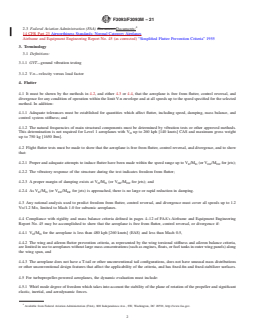
3.1.1 GVT—ground vibration testing
to ensure conformance with the standard, each system shall be
3.1.2 V-n—velocity versus load factor
used independently of the other, and values from the two
systems shall not be combined.
4. Flutter
1.4 This standard does not purport to address all of the
4.1 It must be shown by the methods in 4.2, and either 4.3
safety concerns, if any, associated with its use. It is the
or 4.4, that the aeroplane is free from flutter, control reversal,
responsibility of the user of this standard to establish appro-
and divergence for any condition of operation within the limit
priate safety, health, and environmental practices and deter-
V-n envelope and at all speeds up to the speed specified for the
mine the applicability of regulatory limitations prior to use.
selected method. In addition:
1.5 This international standard was developed in accor-
dance with internationally recognized principles on standard-
For referenced ASTM standards, visit the ASTM website, www.astm.org, or
contact ASTM Customer Service at service@astm.org. For Annual Book of ASTM
ThisspecificationisunderthejurisdictionofASTMCommitteeF44onGeneral Standards volume information, refer to the standard’s Document Summary page on
Aviation Aircraft and is the direct responsibility of Subcommittee F44.30 on the ASTM website.
Structures. Available from European Union Aviation Safety Agency (EASA), Konrad-
Current edition approved May 1, 2021. Published May 2021. Originally Adenauer-Ufer 3, D-50668 Cologne, Germany, https://www.easa.europa.eu/.
approved in 2015. Last previous edition approved in 2020 as F3093/F3093M–20. Available from Federal Aviation Administration (FAA), 800 Independence
DOI: 10.1520/F3093_F3093M–21. Ave., SW, Washington, DC 20591, http://www.faa.gov.
Copyright © ASTM International, 100 Barr Harbor Drive, PO Box C700, West Conshohocken, PA 19428-2959. United States
F3093/F3093M − 21
4.1.1 Adequate tolerances must be established for quantities 4.5 For turbopropeller-powered aeroplanes, the dynamic
which affect flutter, including speed, damping, mass balance, evaluation must include:
and control system stiffness; and 4.5.1 Whirl mode degree of freedom which takes into
4.1.2 Thenaturalfrequenciesofmainstructuralcomponents account the stability of the plane of rotation of the propeller
and significant elastic, inertial, and aerodynamic forces.
must be determined by vibration tests or other approved
methods. This determination is not required for Level 1 4.5.2 Propeller, engine, engine mount, and aeroplane struc-
ture stiffness and damping variations appropriate to the par-
aeroplanes with V up to 260 kph [140 knots] CAS and
D
maximum gross weight up to 750 kg [1650 lbm]. ticular configuration.
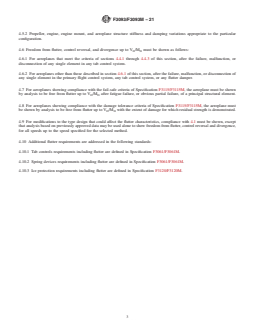
4.6 Freedom from flutter, control reversal, and divergence
4.2 Flight flutter tests must be made to show that the
up to V /M must be shown as follows:
aeroplane is free from flutter, control reversal, and divergence, D D
4.6.1 For aeroplanes that meet the criteria of sections 4.4.1
and to show that:
through 4.4.3 of this section, after the failure, malfunction, or
4.2.1 Proper and adequate attempts to induce flutter have
disconnection of any single element in any tab control system.
been made within the speed range up to V /M (or V /M
D D DF DF
4.6.2 For aeroplanes other than those described in section
for jets);
4.6.1 of this section, after the failure, malfunction, or discon-
4.2.2 The vibratory response of the structure during the test
nection of any single element in the primary flight control
indicates freedom from flutter;
system, any tab control system, or any flutter damper.
4.2.3 A proper margin of damping exists at V /M (or
D D
V /M for jets); and
4.7 For aeroplanes showing compliance with the fail-safe
DF DF
4.2.4 As V /M (or V /M for jets) is approached, there criteria of Specification F3115/F3115M, the aeroplane must be
D D DF DF
is no large or rapid reduction in damping.
shown by analysis to be free from flutter up to V /M after
D D
fatigue failure, or obvious partial failure, of a principal
4.3 Any rational analysis used to predict freedom from
structural element.
flutter, control reversal, and divergence must cover all speeds
up to 1.2 V /1.2 M , limited to Mach 1.0 for subsonic 4.8 For aeroplanes showing compliance with the damage
D D
tolerance criteria of Specification F3115/F3115M, the aero-
aeroplanes.
p
...
This document is not an ASTM standard and is intended only to provide the user of an ASTM standard an indication of what changes have been made to the previous version. Because
it may not be technically possible to adequately depict all changes accurately, ASTM recommends that users consult prior editions as appropriate. In all cases only the current version
of the standard as published by ASTM is to be considered the official document.
Designation: F3093/F3093M − 20 F3093/F3093M − 21
Standard Specification for
Aeroelasticity Requirements
This standard is issued under the fixed designation F3093/F3093M; the number immediately following the designation indicates the year
of original adoption or, in the case of revision, the year of last revision. A number in parentheses indicates the year of last reapproval.
A superscript epsilon (´) indicates an editorial change since the last revision or reapproval.
1. Scope
1.1 This specification covers the aeroelasticity requirements of the aeroplane. The material was developed through open consensus
of international experts in general aviation. This information was created by focusing on Level 1, 2, 3, and 4 Normal Category
aeroplanes. The content may be more broadly applicable; it is the responsibility of the Applicant to substantiate broader
applicability as a specific means of compliance. The topics covered within this document are: 2. Referenced Documents, 3.
Terminology, 4. Flutter.
1.2 An applicant intending to propose this information as Means of Compliance for a design approval must seek guidance from
their respective oversight authority (for example, published guidance from applicable CAAs) concerning the acceptable use and
application thereof. For information on which oversight authorities have accepted this standard (in whole or in part) as an
acceptable Means of Compliance to their regulatory requirements (hereinafter “the Rules”), refer to the ASTM Committee F44 web
page (www.astm.org/COMMITTEE/F44.htm). Annex A1 maps the Means of Compliance described in this specification to the
rules of EASA CS-23, amendment 5, or later, and FAA 14 CFR Part 23, amendment 64, or later.
1.3 Units—This document may present information in either SI units, English Engineering units, or both. The values stated in each
system are not necessarily exact equivalents; therefore, to ensure conformance with the standard, each system shall be used
independently of the other, and values from the two systems shall not be combined.
1.4 This standard does not purport to address all of the safety concerns, if any, associated with its use. It is the responsibility
of the user of this standard to establish appropriate safety, health, and environmental practices and determine the applicability of
regulatory limitations prior to use.
1.5 This international standard was developed in accordance with internationally recognized principles on standardization
established in the Decision on Principles for the Development of International Standards, Guides and Recommendations issued
by the World Trade Organization Technical Barriers to Trade (TBT) Committee.
2. Referenced Documents
2.1 ASTM Standards:
F3061/F3061M Specification for Systems and Equipment in Small Aircraft
F3115/F3115M Specification for Structural Durability for Small Aeroplanes
F3120/F3120M Specification for Ice Protection for General Aviation Aircraft
2.2 European Union Aviation Safety Agency (EASA) Standard:
CS-23 Certification Specifications for Normal-Category Aeroplanes
This specification is under the jurisdiction of ASTM Committee F44 on General Aviation Aircraft and is the direct responsibility of Subcommittee F44.30 on Structures.
Current edition approved March 1, 2020May 1, 2021. Published March 2020May 2021. Originally approved in 2015. Last previous edition approved in 20192020 as
F3093/F3093M–19.–20. DOI: 10.1520/F3093_F3093M–20.10.1520/F3093_F3093M–21.
For referenced ASTM standards, visit the ASTM website, www.astm.org, or contact ASTM Customer Service at service@astm.org. For Annual Book of ASTM Standards
volume information, refer to the standard’s Document Summary page on the ASTM website.
Available from European Union Aviation Safety Agency (EASA), Konrad-Adenauer-Ufer 3, D-50668 Cologne, Germany, https://www.easa.europa.eu/.
Copyright © ASTM International, 100 Barr Harbor Drive, PO Box C700, West Conshohocken, PA 19428-2959. United States
F3093/F3093M − 21
2.3 Federal Aviation Administration (FAA) Document:Documents:
14 CFR Part 23 Airworthiness Standards: Normal Category Airplanes
Airframe and Equipment Engineering Report No. 45 (as corrected) “Simplified Flutter Prevention Criteria” 1955
3. Terminology
3.1 Definitions:
3.1.1 GVT—ground vibration testing
3.1.2 V-n—velocity versus load factor
4. Flutter
4.1 It must be shown by the methods in 4.2, and either 4.3 or 4.4, that the aeroplane is free from flutter, control reversal, and
divergence for any condition of operation within the limit V-n envelope and at all speeds up to the speed specified for the selected
method. In addition:
4.1.1 Adequate tolerances must be established for quantities which affect flutter, including speed, damping, mass balance, and
control system stiffness; and
4.1.2 The natural frequencies of main structural components must be determined by vibration tests or other approved methods.
This determination is not required for Level 1 aeroplanes with V up to 260 kph [140 knots] CAS and maximum gross weight
D
up to 750 kg [1650 lbm].
4.2 Flight flutter tests must be made to show that the aeroplane is free from flutter, control reversal, and divergence, and to show
that:
4.2.1 Proper and adequate attempts to induce flutter have been made within the speed range up to V /M (or V /M for jets);
D D DF DF
4.2.2 The vibratory response of the structure during the test indicates freedom from flutter;
4.2.3 A proper margin of damping exists at V /M (or V /M for jets); and
D D DF DF
4.2.4 As V /M (or V /M for jets) is approached, there is no large or rapid reduction in damping.
D D DF DF
4.3 Any rational analysis used to predict freedom from flutter, control reversal, and divergence must cover all speeds up to 1.2
V /1.2 M , limited to Mach 1.0 for subsonic aeroplanes.
D D
4.4 Compliance with rigidity and mass balance criteria defined in pages 4–12 of FAA’s Airframe and Equipment Engineering
Report No. 45 may be accomplished to show that the aeroplane is free from flutter, control reversal, or divergence if:
4.4.1 V /M for the aeroplane is less than 480 kph [260 knots] (EAS) and less than Mach 0.5,
D D
4.4.2 The wing and aileron flutter prevention criteria, as represented by the wing torsional stiffness and aileron balance criteria,
are limited in use to aeroplanes without large mass concentrations (such as engines, floats, or fuel tanks in outer wing panels) along
the wing span, and
4.4.3 The aeroplane does not have a T-tail or other unconventional tail configurations, does not have unusual mass distributions
or other unconventional design features that affect the applicability of the criteria, and has fixed-fin and fixed-stabilizer surfaces.
4.5 For turbopropeller-powered aeroplanes, the dynamic evaluation must include:
4.5.1 Whirl mode degree of freedom which takes into account the stability of the plane of rotation of the propeller and significant
elastic, inertial, and aerodynamic forces.
Available from Federal Aviation Administration (FAA), 800 Independence Ave., SW, Washington, DC 20591, http://www.faa.gov.
F3093/F3093M − 21
4.5.2 Propeller, engine, engine mount, and aeroplane structure stiff
...