


ASTM D7084-23
(Test Method)Standard Test Method for Determination of Bulk Crush Strength of Catalysts and Catalyst Carriers
Standard Test Method for Determination of Bulk Crush Strength of Catalysts and Catalyst Carriers
SIGNIFICANCE AND USE
5.1 This test method is a means of determining the crushing strength of a catalyst in a bed. Techniques to measure the crushing strength of formed catalyst particles is limited to crushing of individual particles, which may not be related to how the catalyst will crush in a reactor or bed. For some catalysts, such as granules, this technique may be the only viable method for obtaining crushing strength. The production of fines in a reactor is not desired because of the potential of bed compaction and the pressure buildup in the reactor.
SCOPE
1.1 This test method covers the determination of bulk crush strength of a bed of formed catalyst particles 1/32 to 3/16 in. (0.8 to 4.8 mm) in diameter and is intended to provide information concerning the ability of the catalyst material to maintain physical integrity.
1.2 The values stated in inch-pound units are to be regarded as standard. The values given in parentheses are mathematical conversions to SI units that are provided for information only and are not considered standard.
1.3 This standard does not purport to address all of the safety concerns, if any, associated with its use. It is the responsibility of the user of this standard to establish appropriate safety, health, and environmental practices and determine the applicability of regulatory limitations prior to use.
1.4 This international standard was developed in accordance with internationally recognized principles on standardization established in the Decision on Principles for the Development of International Standards, Guides and Recommendations issued by the World Trade Organization Technical Barriers to Trade (TBT) Committee.
General Information
- Status
- Published
- Publication Date
- 14-Dec-2023
- Technical Committee
- D32 - Catalysts
- Drafting Committee
- D32.02 - Physical-Mechanical Properties
Relations
- Effective Date
- 15-Dec-2023
- Effective Date
- 01-Feb-2024
- Effective Date
- 01-Jan-2024
- Effective Date
- 01-Apr-2022
- Effective Date
- 01-Apr-2022
- Effective Date
- 01-Nov-2018
- Effective Date
- 15-Dec-2023
Overview
ASTM D7084-23 - Standard Test Method for Determination of Bulk Crush Strength of Catalysts and Catalyst Carriers is an international standard released by ASTM International. This standard defines a consistent test method for measuring the bulk crush strength of a bed of formed catalyst particles and catalyst carriers within the size range of 1/32 to 3/16 inch (0.8 to 4.8 mm) in diameter. The procedure provides essential data on the physical integrity and mechanical durability of catalyst materials, which is vital for safe and efficient operation in chemical process reactors.
The test aims to replicate the real-world stresses experienced by catalysts in industrial beds, as opposed to measurements taken on individual particles. By simulating these conditions, the standard ensures that producers and users of catalysts can assess material resistance to crushing, thus minimizing fines generation and reducing operational risks such as bed compaction and reactor pressure buildup.
Key Topics
- Bulk crush strength determination: The core focus is to measure the pressure required to generate a specified percentage of fines (typically 1%) in a controlled, reproducible manner using a hydraulic press and specified sample holders.
- Sampling and preparation: Emphasizes obtaining representative samples of catalyst materials, proper drying techniques, and sample handling to ensure accuracy and consistency.
- Test procedure: Describes the use of test cells, hydraulic presses, sieving for fine quantification, and calculation methods for reporting weight percent fines and crush strength.
- Data reporting: Includes requirements for plotting crushing pressure versus weight percent fines, determination of correlation coefficients, and documentation of all critical test parameters.
- Precision and reproducibility: Guidance on conducting interlaboratory studies and interpreting results using standard statistical practices.
- Safety considerations: Stresses that users must assess and address safety, health, and environmental factors related to test execution.
Applications
The ASTM D7084-23 standard is widely applicable across industries that utilize formed catalysts and catalyst carriers, including:
- Petrochemical and refinery processes: Ensuring that catalysts used in reactors maintain their structural integrity to prevent operational issues.
- Chemical manufacturing: Improving process consistency by minimizing fines that can cause product contamination or equipment fouling.
- Catalyst production and quality control: Providing a standardized method for manufacturers to validate and compare the mechanical strength of new catalyst formulations and batches.
- Research and development: Facilitating the comparison of physical durability between different catalyst types and configurations, especially when evaluating new materials or process conditions.
The method is particularly valuable where alternative particle-crush testing is impractical or unrepresentative, such as with granular catalysts. Adhering to this standard helps reduce downtimes caused by catalyst bed failure and supports regulatory compliance in process operations.
Related Standards
Several ASTM standards are referenced and complement ASTM D7084-23, enhancing its value and integrating it into broader quality and testing frameworks:
- ASTM D3766: Terminology Relating to Catalysts and Catalysis.
- ASTM D4180: Test Method for Vibratory Packing Density of Formed Catalyst Particles and Catalyst Carriers.
- ASTM E11: Specification for Woven Wire Test Sieve Cloth and Test Sieves.
- ASTM E105: Guide for Probability Sampling of Materials.
- ASTM E177: Practice for Use of the Terms Precision and Bias in ASTM Test Methods.
- ASTM E456: Terminology Relating to Quality and Statistics.
- ASTM E691: Practice for Conducting an Interlaboratory Study to Determine the Precision of a Test Method.
These related standards ensure consistent terminology, sampling, statistical analysis, and laboratory practices, fostering alignment with international trade and quality requirements.
Keywords: ASTM D7084, bulk crush strength, catalyst carriers, catalyst testing, mechanical strength, fines generation, formed catalyst particles, quality control, reactor performance.
Buy Documents


ASTM D7084-23 - Standard Test Method for Determination of Bulk Crush Strength of Catalysts and Catalyst Carriers
REDLINE ASTM D7084-23 - Standard Test Method for Determination of Bulk Crush Strength of Catalysts and Catalyst Carriers
Get Certified
Connect with accredited certification bodies for this standard

ECOCERT
Organic and sustainability certification.

Eurofins Food Testing Global
Global leader in food, environment, and pharmaceutical product testing.

Intertek Bangladesh
Intertek certification and testing services in Bangladesh.
Sponsored listings
Frequently Asked Questions
ASTM D7084-23 is a standard published by ASTM International. Its full title is "Standard Test Method for Determination of Bulk Crush Strength of Catalysts and Catalyst Carriers". This standard covers: SIGNIFICANCE AND USE 5.1 This test method is a means of determining the crushing strength of a catalyst in a bed. Techniques to measure the crushing strength of formed catalyst particles is limited to crushing of individual particles, which may not be related to how the catalyst will crush in a reactor or bed. For some catalysts, such as granules, this technique may be the only viable method for obtaining crushing strength. The production of fines in a reactor is not desired because of the potential of bed compaction and the pressure buildup in the reactor. SCOPE 1.1 This test method covers the determination of bulk crush strength of a bed of formed catalyst particles 1/32 to 3/16 in. (0.8 to 4.8 mm) in diameter and is intended to provide information concerning the ability of the catalyst material to maintain physical integrity. 1.2 The values stated in inch-pound units are to be regarded as standard. The values given in parentheses are mathematical conversions to SI units that are provided for information only and are not considered standard. 1.3 This standard does not purport to address all of the safety concerns, if any, associated with its use. It is the responsibility of the user of this standard to establish appropriate safety, health, and environmental practices and determine the applicability of regulatory limitations prior to use. 1.4 This international standard was developed in accordance with internationally recognized principles on standardization established in the Decision on Principles for the Development of International Standards, Guides and Recommendations issued by the World Trade Organization Technical Barriers to Trade (TBT) Committee.
SIGNIFICANCE AND USE 5.1 This test method is a means of determining the crushing strength of a catalyst in a bed. Techniques to measure the crushing strength of formed catalyst particles is limited to crushing of individual particles, which may not be related to how the catalyst will crush in a reactor or bed. For some catalysts, such as granules, this technique may be the only viable method for obtaining crushing strength. The production of fines in a reactor is not desired because of the potential of bed compaction and the pressure buildup in the reactor. SCOPE 1.1 This test method covers the determination of bulk crush strength of a bed of formed catalyst particles 1/32 to 3/16 in. (0.8 to 4.8 mm) in diameter and is intended to provide information concerning the ability of the catalyst material to maintain physical integrity. 1.2 The values stated in inch-pound units are to be regarded as standard. The values given in parentheses are mathematical conversions to SI units that are provided for information only and are not considered standard. 1.3 This standard does not purport to address all of the safety concerns, if any, associated with its use. It is the responsibility of the user of this standard to establish appropriate safety, health, and environmental practices and determine the applicability of regulatory limitations prior to use. 1.4 This international standard was developed in accordance with internationally recognized principles on standardization established in the Decision on Principles for the Development of International Standards, Guides and Recommendations issued by the World Trade Organization Technical Barriers to Trade (TBT) Committee.
ASTM D7084-23 is classified under the following ICS (International Classification for Standards) categories: 71.100.99 - Other products of the chemical industry. The ICS classification helps identify the subject area and facilitates finding related standards.
ASTM D7084-23 has the following relationships with other standards: It is inter standard links to ASTM D7084-18, ASTM D3766-24a, ASTM D3766-24, ASTM E456-13a(2022)e1, ASTM E456-13a(2022), ASTM D3766-08(2018), ASTM D8353-20. Understanding these relationships helps ensure you are using the most current and applicable version of the standard.
ASTM D7084-23 is available in PDF format for immediate download after purchase. The document can be added to your cart and obtained through the secure checkout process. Digital delivery ensures instant access to the complete standard document.
Standards Content (Sample)
This international standard was developed in accordance with internationally recognized principles on standardization established in the Decision on Principles for the
Development of International Standards, Guides and Recommendations issued by the World Trade Organization Technical Barriers to Trade (TBT) Committee.
Designation: D7084 − 23
Standard Test Method for
Determination of Bulk Crush Strength of Catalysts and
Catalyst Carriers
This standard is issued under the fixed designation D7084; the number immediately following the designation indicates the year of
original adoption or, in the case of revision, the year of last revision. A number in parentheses indicates the year of last reapproval. A
superscript epsilon (´) indicates an editorial change since the last revision or reapproval.
1. Scope E456 Terminology Relating to Quality and Statistics
E691 Practice for Conducting an Interlaboratory Study to
1.1 This test method covers the determination of bulk crush
Determine the Precision of a Test Method
1 3
strength of a bed of formed catalyst particles ⁄32 to ⁄16 in. (0.8
to 4.8 mm) in diameter and is intended to provide information
3. Terminology
concerning the ability of the catalyst material to maintain
3.1 Definitions:
physical integrity.
3.1.1 See also Terminology D3766.
1.2 The values stated in inch-pound units are to be regarded
3.1.2 bulk crush strength—pressure that generates 1 % fines
as standard. The values given in parentheses are mathematical
for a sample contained in a cylindrical sample holder and
conversions to SI units that are provided for information only
crushed with a piston.
and are not considered standard.
3.1.3 generated fines—particle size after crushing that
1.3 This standard does not purport to address all of the
passes through a sieve one-half of the diameter of the catalyst
safety concerns, if any, associated with its use. It is the
pellet.
responsibility of the user of this standard to establish appro-
priate safety, health, and environmental practices and deter-
4. Summary of Test Method
mine the applicability of regulatory limitations prior to use.
4.1 A representative sample is placed in a cylindrical sample
1.4 This international standard was developed in accor-
holder, which is fitted with a piston. The piston is allowed to
dance with internationally recognized principles on standard-
compress the catalyst at a known pressure. The percent of
ization established in the Decision on Principles for the
generated fines is determined by sieving.
Development of International Standards, Guides and Recom-
mendations issued by the World Trade Organization Technical
5. Significance and Use
Barriers to Trade (TBT) Committee.
5.1 This test method is a means of determining the crushing
2. Referenced Documents
strength of a catalyst in a bed. Techniques to measure the
2 crushing strength of formed catalyst particles is limited to
2.1 ASTM Standards:
crushing of individual particles, which may not be related to
D3766 Terminology Relating to Catalysts and Catalysis
how the catalyst will crush in a reactor or bed. For some
D4180 Test Method for Vibratory Packing Density of
catalysts, such as granules, this technique may be the only
Formed Catalyst Particles and Catalyst Carriers
viable method for obtaining crushing strength. The production
E11 Specification for Woven Wire Test Sieve Cloth and Test
of fines in a reactor is not desired because of the potential of
Sieves
bed compaction and the pressure buildup in the reactor.
E105 Guide for Probability Sampling of Materials
E177 Practice for Use of the Terms Precision and Bias in
6. Apparatus
ASTM Test Methods
6.1 Hydraulic Press, capable of 3200 lb (1450 kg) loading,
including a force gage. Maximum load capacity of the press
This test method is under the jurisdiction of ASTM Committee D32 on
should match with the accuracy measuring the applied force.
Catalysts and is the direct responsibility of Subcommittee D32.02 on Physical-
NOTE 1—Lower maximum load may be acceptable for testing less
Mechanical Properties.
strong materials.
Current edition approved Dec. 15, 2023. Published December 2023. Originally
approved in 2004. Last previous edition approved in 2018 as D7084 – 18. DOI: 6.2 U.S. Standard Sieves, in accordance with E11.
10.1520/D7084-23.
2 6.3 Test Cell, (Fig. 1).
For referenced ASTM standards, visit the ASTM website, www.astm.org, or
NOTE 2—A top loading cell can be used, but reproducibility of this test
contact ASTM Customer Service at service@astm.org. For Annual Book of ASTM
Standards volume information, refer to the standard’s Document Summary page on is a function of the volume being crushed and therefore the constant
the ASTM website. volume cell, as shown in Fig. 1, is recommended. A smaller l/d ratio for
Copyright © ASTM International, 100 Barr Harbor Drive, PO Box C700, West Conshohocken, PA 19428-2959. United States
D7084 − 23
FIG. 1 Test Cell
the cell will alter the results, and for certain applications, it may be more
dry at 673 6 15 K (400 °C) for 3 h. Cool the sample in a
3,4
desirable.
desiccator using freshly regenerated 4A molecular sieves as a
6.4 Drying Oven. desiccant.
NOTE 3—These conditions may not be appropriate for all materials.
6.5 Balance, having a sensitivity of 0.1 g.
NOTE 4—Since many catalyst formulations are strong adsorbents, the
use of No. 4A indicating (cobalt treated) molecular sieve as a desiccating
6.6 Glass Cylinders, with 250-mL feed capacity. Measure in
medium is suggested. The desiccant should be regenerated at 493 to 523 K
accordance with Test Method D4180.
(220 to 260 °C) as required.
6.7 Vibrator, conventional, handheld, with hard rubber or
7.3 Weigh the sample to determine the loss during heating.
metal impactor, in accordance with Test Method D4180.
Calculate the dry bulk density by the following equation:
6.8 Feed Funnel.
DBD 5 BD 1 2 OW 2 DW /OW (1)
~ ~ ! !
6.9 Desiccator, with grade molecular sieve, such as 4A.
where:
DBD = dry bulk density (see Test Method D4180),
7. Procedure
BD = bulk density,
7.1 Determine the bulk density in accordance with Test
OW = weight of original sample, and
Method D4180.
DW = weight of dried sample.
7.2 A test sample of at least 100 mL shall be obtained from
7.4 Calculate the weight of dried sample required to fill a
larger composites by riffling or splitting in acc
...
This document is not an ASTM standard and is intended only to provide the user of an ASTM standard an indication of what changes have been made to the previous version. Because
it may not be technically possible to adequately depict all changes accurately, ASTM recommends that users consult prior editions as appropriate. In all cases only the current version
of the standard as published by ASTM is to be considered the official document.
Designation: D7084 − 18 D7084 − 23
Standard Test Method for
Determination of Bulk Crush Strength of Catalysts and
Catalyst Carriers
This standard is issued under the fixed designation D7084; the number immediately following the designation indicates the year of
original adoption or, in the case of revision, the year of last revision. A number in parentheses indicates the year of last reapproval. A
superscript epsilon (´) indicates an editorial change since the last revision or reapproval.
1. Scope
1 3
1.1 This test method covers the determination of bulk crush strength of a bed of formed catalyst particles ⁄32 to ⁄16 in. (0.8 to 4.8
mm) in diameter and is intended to provide information concerning the ability of the catalyst material to maintain physical
integrity.
1.2 The values stated in inch-pound units are to be regarded as standard. The values given in parentheses are mathematical
conversions to SI units that are provided for information only and are not considered standard.
1.3 This standard does not purport to address all of the safety concerns, if any, associated with its use. It is the responsibility
of the user of this standard to establish appropriate safety, health, and environmental practices and determine the applicability of
regulatory limitations prior to use.
1.4 This international standard was developed in accordance with internationally recognized principles on standardization
established in the Decision on Principles for the Development of International Standards, Guides and Recommendations issued
by the World Trade Organization Technical Barriers to Trade (TBT) Committee.
2. Referenced Documents
2.1 ASTM Standards:
D3766 Terminology Relating to Catalysts and Catalysis
D4180 Test Method for Vibratory Packing Density of Formed Catalyst Particles and Catalyst Carriers
E11 Specification for Woven Wire Test Sieve Cloth and Test Sieves
E105 Guide for Probability Sampling of Materials
E177 Practice for Use of the Terms Precision and Bias in ASTM Test Methods
E456 Terminology Relating to Quality and Statistics
E691 Practice for Conducting an Interlaboratory Study to Determine the Precision of a Test Method
3. Terminology
3.1 Definitions:
3.1.1 See also Terminology D3766.
This test method is under the jurisdiction of ASTM Committee D32 on Catalysts and is the direct responsibility of Subcommittee D32.02 on Physical-Mechanical
Properties.
Current edition approved May 1, 2018Dec. 15, 2023. Published May 2018December 2023. Originally approved in 2004. Last previous edition approved in 20172018 as
D7084–04(2017).D7084 – 18. DOI: 10.1520/D7084-18.10.1520/D7084-23.
For referenced ASTM standards, visit the ASTM website, www.astm.org, or contact ASTM Customer Service at service@astm.org. For Annual Book of ASTM Standards
volume information, refer to the standard’s Document Summary page on the ASTM website.
Copyright © ASTM International, 100 Barr Harbor Drive, PO Box C700, West Conshohocken, PA 19428-2959. United States
D7084 − 23
3.1.2 bulk crush strength—pressure that generates 1 % fines for a sample contained in a cylindrical sample holder and crushed with
a piston.
3.1.3 generated fines—particle size after crushing that passes through a sieve one-half of the diameter of the catalyst pellet.
4. Summary of Test Method
4.1 A representative sample is placed in a cylindrical sample holder, which is fitted with a piston. The piston is allowed to
compress the catalyst at a known pressure. The percent of generated fines is determined by sieving.
5. Significance and Use
5.1 This test method is a means of determining the crushing strength of a catalyst in a bed. Techniques to measure the crushing
strength of formed catalyst particles is limited to crushing of individual particles, which may not be related to how the catalyst will
crush in a reactor or bed. For some catalysts, such as granules, this technique may be the only viable method for obtaining crushing
strength. The production of fines in a reactor is not desired because of the potential of bed compaction and the pressure buildup
in the reactor.
6. Apparatus
6.1 Hydraulic Press, capable of 3200 lb (1450 kg) loading, including a force gage. Maximum load capacity of the press should
match with the accuracy measuring the applied force.
NOTE 1—Lower maximum load may be acceptable for testing less strong materials.
6.2 U.S. Standard Sieves, in accordance with E11.
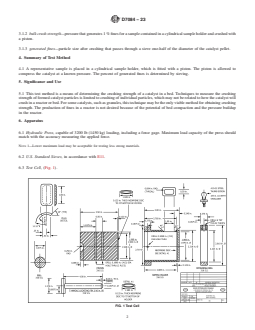
6.3 Test Cell, (Fig. 1).
FIG. 1 Test Cell
D7084 − 23
NOTE 2—A top loading cell can be used, but reproducibility of this test is a function of the volume being crushed and therefore the constant volume cell,
3,4
as shown in Fig. 1, is recommended. A smaller l/d ratio for the cell will alter the results, and for certain applications, it may be more desirable.
6.4 Drying Oven.
6.5 Balance, having a sensitivity of 0.1 g.
6.6 Glass Cylinders, with 250-mL feed capacity. Measure in accordance with Test Method D4180.
6.7 Vibrator, conventional, handheld, with hard rubber or metal impactor, in accordance with Test Method D4180.
6.8 Feed Funnel.
6.9 Desiccator, with grade molecular sieve, such as 4A.
7. Procedure
7.1 Determine the bulk density in accordance with Test Method D4180.
7.2 A test sample of at least 100 mL shall be obtained from larger composites by riffling or splitting in accordance with subsection
STP 447A , with the aim of obtaining a representative sample that represents shape and size distribution of the larger composite.
Practice E105 can provide guidance on constructing a sampling plan. Weigh 100 mL of the sample and dry at 673 6 15 K
(400°C)(400 °C) for 3 h. Cool the sample in a desiccator using freshly regenerated 4A molecular sieves as a desiccant.
NOTE 3—These conditions may not be appropriate for all materials.
NOTE 4—Since many catalyst formulations are strong adsorbents, the use of No. 4A indicating (cobalt treated) molecular sieve as a desiccating medium
is suggested. The desiccant should be regenerated at 493 to 523K523 K (220 to 260°C)260 °C) as required.
7.3 Weigh the sampl
...
Questions, Comments and Discussion
Ask us and Technical Secretary will try to provide an answer. You can facilitate discussion about the standard in here.
Loading comments...