


ASTM D5324-16(2022)
(Guide)Standard Guide for Testing Water-Borne Architectural Coatings
Standard Guide for Testing Water-Borne Architectural Coatings
ABSTRACT
This guide covers the selection and use of procedures for testing water-borne architectural coatings to be used on exterior, interior, or both types of surfaces. The properties that can be examined by the test methods listed herein are as follows: liquid paint properties (skinning, condition in container, coarse particles and foreign matter, density or weight per gallon, fineness of dispersion, flash point, odor, absorption, colorant acceptance, dilution stability, package stability, heat stability, and settling); coating application and film formation characteristics (brush application properties, brush drag, roller application properties, roller spatter, spray application properties, touch-up uniformity, consistency (low-shear viscosity), rheological properties of non-Newtonian liquids, sag resistance, levelling properties, and drying properties); appearance of dry film (color appearance, color differences by visual comparison, color differences using instrumental measurements, directional reflectance, gloss, sheen, hiding power, and yellowness index); properties of dry film (abrasion resistance, adhesion, flexibility, resistance to household chemicals, color change of white enamels, washability and cleansability, blister resistance, exposure resistance, chalking, checking, cracking, erosion, flaking, mildew resistance, and fume resistance); and Coating Analysis (chemical analysis, volatile content, nonvolatile volume content, water content, pigment content, pigment analysis, nonvolatile vehicle content, vehicle separation, and nonvolatile vehicle identification).
SCOPE
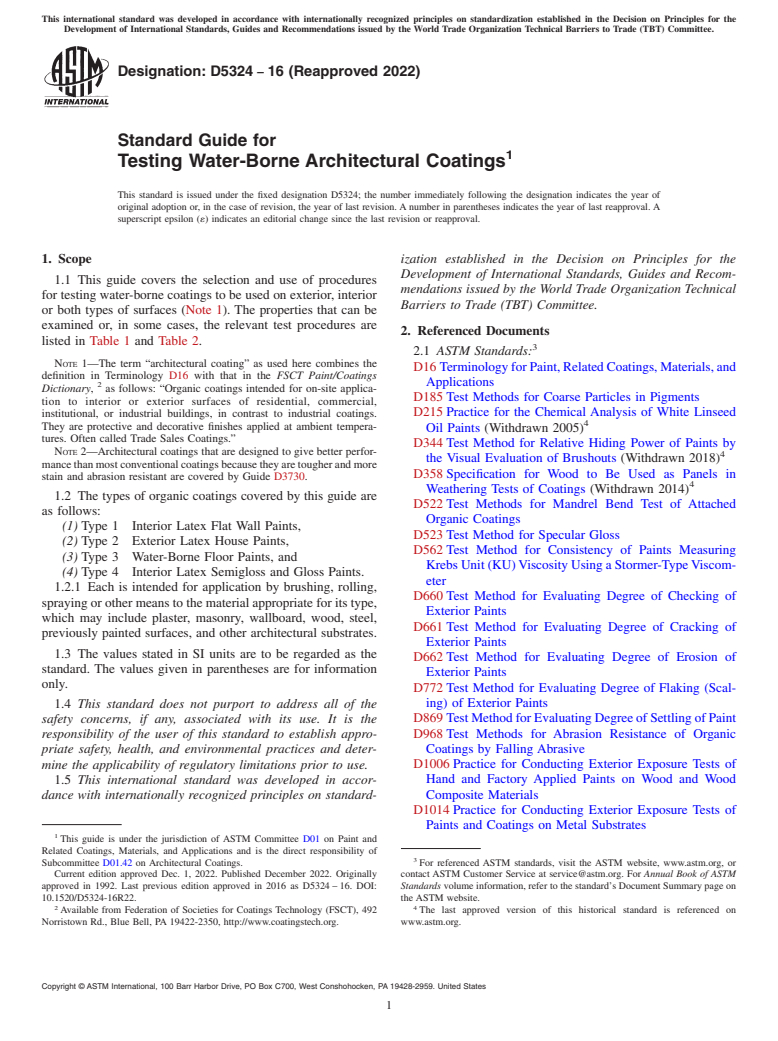
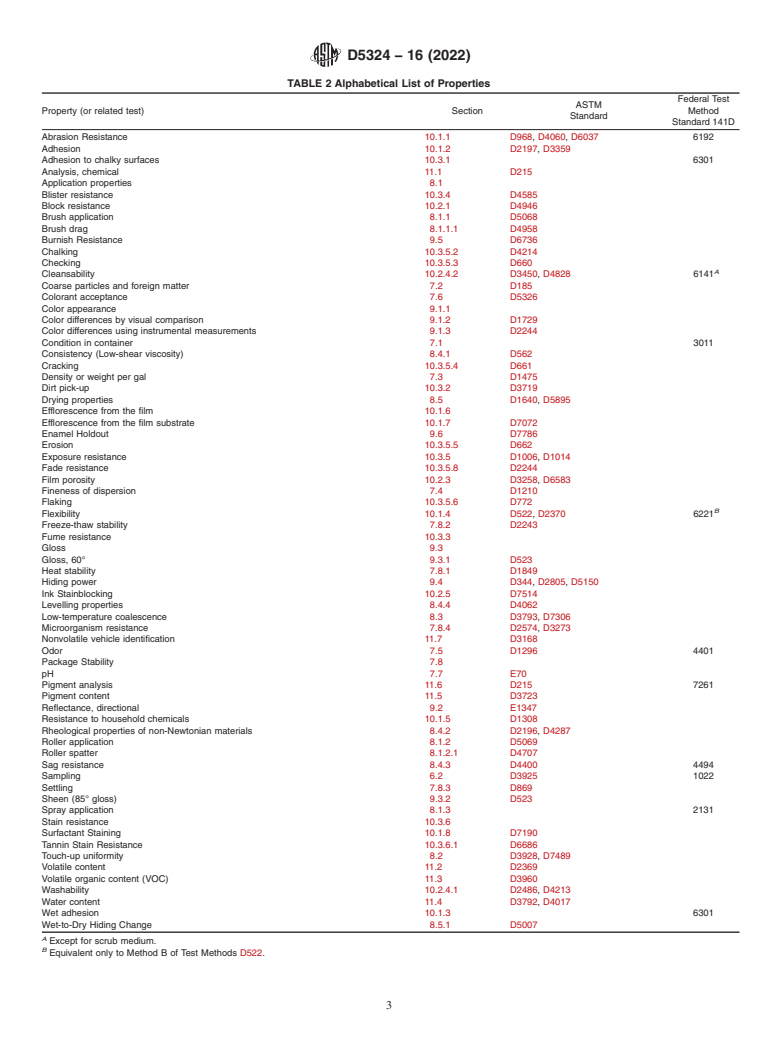
1.1 This guide covers the selection and use of procedures for testing water-borne coatings to be used on exterior, interior or both types of surfaces (Note 1). The properties that can be examined or, in some cases, the relevant test procedures are listed in Table 1 and Table 2.
Note 1: The term “architectural coating” as used here combines the definition in Terminology D16 with that in the FSCT Paint/Coatings Dictionary, 2 as follows: “Organic coatings intended for on-site application to interior or exterior surfaces of residential, commercial, institutional, or industrial buildings, in contrast to industrial coatings. They are protective and decorative finishes applied at ambient temperatures. Often called Trade Sales Coatings.”
Note 2: Architectural coatings that are designed to give better performance than most conventional coatings because they are tougher and more stain and abrasion resistant are covered by Guide D3730.
1.2 The types of organic coatings covered by this guide are as follows:
(1) Type 1 Interior Latex Flat Wall Paints,
(2) Type 2 Exterior Latex House Paints,
(3) Type 3 Water-Borne Floor Paints, and
(4) Type 4 Interior Latex Semigloss and Gloss Paints.
1.2.1 Each is intended for application by brushing, rolling, spraying or other means to the material appropriate for its type, which may include plaster, masonry, wallboard, wood, steel, previously painted surfaces, and other architectural substrates.
1.3 The values stated in SI units are to be regarded as the standard. The values given in parentheses are for information only.
1.4 This standard does not purport to address all of the safety concerns, if any, associated with its use. It is the responsibility of the user of this standard to establish appropriate safety, health, and environmental practices and determine the applicability of regulatory limitations prior to use.
1.5 This international standard was developed in accordance with internationally recognized principles on standardization established in the Decision on Principles for the Development of International Standards, Guides and Recommendations issued by the World Trade Organization Technical Barriers to Trade (TBT) Committee.
General Information
Relations
Standards Content (Sample)
This international standard was developed in accordance with internationally recognized principles on standardization established in the Decision on Principles for the
Development of International Standards, Guides and Recommendations issued by the World Trade Organization Technical Barriers to Trade (TBT) Committee.
Designation: D5324 − 16 (Reapproved 2022)
Standard Guide for
1
Testing Water-Borne Architectural Coatings
This standard is issued under the fixed designation D5324; the number immediately following the designation indicates the year of
original adoption or, in the case of revision, the year of last revision. A number in parentheses indicates the year of last reapproval. A
superscript epsilon (´) indicates an editorial change since the last revision or reapproval.
1. Scope ization established in the Decision on Principles for the
Development of International Standards, Guides and Recom-
1.1 This guide covers the selection and use of procedures
mendations issued by the World Trade Organization Technical
for testing water-borne coatings to be used on exterior, interior
Barriers to Trade (TBT) Committee.
or both types of surfaces (Note 1). The properties that can be
examined or, in some cases, the relevant test procedures are
2. Referenced Documents
listed in Table 1 and Table 2.
3
2.1 ASTM Standards:
NOTE 1—The term “architectural coating” as used here combines the
D16 TerminologyforPaint,RelatedCoatings,Materials,and
definition in Terminology D16 with that in the FSCT Paint/Coatings
Applications
2
Dictionary, as follows: “Organic coatings intended for on-site applica-
D185 Test Methods for Coarse Particles in Pigments
tion to interior or exterior surfaces of residential, commercial,
D215 Practice for the Chemical Analysis of White Linseed
institutional, or industrial buildings, in contrast to industrial coatings.
4
They are protective and decorative finishes applied at ambient tempera-
Oil Paints (Withdrawn 2005)
tures. Often called Trade Sales Coatings.”
D344 Test Method for Relative Hiding Power of Paints by
NOTE 2—Architectural coatings that are designed to give better perfor-
4
the Visual Evaluation of Brushouts (Withdrawn 2018)
mancethanmostconventionalcoatingsbecausetheyaretougherandmore
D358 Specification for Wood to Be Used as Panels in
stain and abrasion resistant are covered by Guide D3730.
4
Weathering Tests of Coatings (Withdrawn 2014)
1.2 The types of organic coatings covered by this guide are
D522 Test Methods for Mandrel Bend Test of Attached
as follows:
Organic Coatings
(1) Type 1 Interior Latex Flat Wall Paints,
D523 Test Method for Specular Gloss
(2) Type 2 Exterior Latex House Paints,
D562 Test Method for Consistency of Paints Measuring
(3) Type 3 Water-Borne Floor Paints, and
KrebsUnit(KU)ViscosityUsingaStormer-TypeViscom-
(4) Type 4 Interior Latex Semigloss and Gloss Paints.
eter
1.2.1 Each is intended for application by brushing, rolling,
D660 Test Method for Evaluating Degree of Checking of
spraying or other means to the material appropriate for its type,
Exterior Paints
which may include plaster, masonry, wallboard, wood, steel,
D661 Test Method for Evaluating Degree of Cracking of
previously painted surfaces, and other architectural substrates.
Exterior Paints
1.3 The values stated in SI units are to be regarded as the
D662 Test Method for Evaluating Degree of Erosion of
standard. The values given in parentheses are for information
Exterior Paints
only.
D772 Test Method for Evaluating Degree of Flaking (Scal-
ing) of Exterior Paints
1.4 This standard does not purport to address all of the
safety concerns, if any, associated with its use. It is the D869 TestMethodforEvaluatingDegreeofSettlingofPaint
D968 Test Methods for Abrasion Resistance of Organic
responsibility of the user of this standard to establish appro-
priate safety, health, and environmental practices and deter- Coatings by Falling Abrasive
D1006 Practice for Conducting Exterior Exposure Tests of
mine the applicability of regulatory limitations prior to use.
1.5 This international standard was developed in accor- Hand and Factory Applied Paints on Wood and Wood
Composite Materials
dance with internationally recognized principles on standard-
D1014 Practice for Conducting Exterior Exposure Tests of
Paints and Coatings on Metal Substrates
1
This guide is under the jurisdiction of ASTM Committee D01 on Paint and
Related Coatings, Materials, and Applications and is the direct responsibility of
3
Subcommittee D01.42 on Architectural Coatings. For referenced ASTM standards, visit the ASTM website, www.astm.org, or
Current edition approved Dec. 1, 2022. Published December 2022. Originally contact ASTM Customer Service at service@astm.org. For Annual Book of ASTM
approved in 1992. Last previous edition approved in 2016 as D5324 – 16. DOI: Standards volume information, refer to the standard’s Document Summary page on
10.1520/D5324-16R22. the ASTM website.
2 4
Available from Federation of Societies for Coatings Technology
...
Questions, Comments and Discussion
Ask us and Technical Secretary will try to provide an answer. You can facilitate discussion about the standard in here.