


ASTM D3138-04(2016)
(Specification)Standard Specification for Solvent Cements for Transition Joints Between Acrylonitrile-Butadiene-Styrene (ABS) and Poly(Vinyl Chloride) (PVC) Non-Pressure Piping Components
Standard Specification for Solvent Cements for Transition Joints Between Acrylonitrile-Butadiene-Styrene (ABS) and Poly(Vinyl Chloride) (PVC) Non-Pressure Piping Components
ABSTRACT
This specification provides general requirements for solvent cements used in joining acrylonitrile-butadiene-styrene (ABS) plastic pipe or fittings to poly(vinyl chloride) (PVC) plastic pipe or fittings in non-pressure applications only. The solvent cement shall be a solution of Class 12454-B, unplasticized poly(vinyl chloride) molding or extrusion compound. Materials shall be tested and the individual grades shall conform to specified values of resin content, dissolution, viscosity, lap shear strength, hydrostatic burst strength, solids content, and bond strength.
SCOPE
1.1 This specification provides general requirements for solvent cements used in joining acrylonitrile-butadiene-styrene (ABS) plastic pipe or fittings to poly(vinyl chloride) (PVC) plastic pipe or fittings.
1.2 These cements are intended for use in cementing transition joints between ABS and PVC materials in non-pressure applications only (25 psi (170 kPa) or less).
Note 1: This specification was developed to provide a means for joining an ABS non-pressure piping system using a solvent-cemented transition joint, for example, joining ABS building drain to a PVC sewer system. The intention was not to create a specification for an all purpose ABS-PVC solvent cement that would be used for mixing of ABS and PVC piping materials nor to specify a cement that could generally be used for either material. Specific cements for ABS or PVC components should be used (see 1.3).
1.3 Solvent cements used for joining PVC pipe and fittings are specified in Specification D2564. Solvent cements used for joining ABS pipe and fittings are specified in Specification D2235.
1.4 A recommended procedure for joining ABS to PVC pipe and fittings for non-pressure applications is given in the appendix.
1.5 The values stated in inch-pound units are to be regarded as standard. The values given in parentheses are mathematical conversions to SI units that are provided for information only and are not considered standard.
1.6 The following safety hazards caveat pertains only to the test methods portion, Section 6, of this specification: This standard does not purport to address all of the safety concerns, if any, associated with its use. It is the responsibility of the user of this standard to establish appropriate safety and health practices and determine the applicability of regulatory limitations prior to use.
General Information
Buy Standard
Standards Content (Sample)
NOTICE: This standard has either been superseded and replaced by a new version or withdrawn.
Contact ASTM International (www.astm.org) for the latest information
Designation:D3138 −04 (Reapproved 2016) An American National Standard
Standard Specification for
Solvent Cements for Transition Joints Between Acrylonitrile-
Butadiene-Styrene (ABS) and Poly(Vinyl Chloride) (PVC)
Non-Pressure Piping Components
This standard is issued under the fixed designation D3138; the number immediately following the designation indicates the year of
original adoption or, in the case of revision, the year of last revision.Anumber in parentheses indicates the year of last reapproval.A
superscript epsilon (´) indicates an editorial change since the last revision or reapproval.
This standard has been approved for use by agencies of the U.S. Department of Defense.
1. Scope 2. Referenced Documents
1.1 This specification provides general requirements for 2.1 ASTM Standards:
solventcementsusedinjoiningacrylonitrile-butadiene-styrene D1084Test Methods for Viscosity of Adhesives
(ABS) plastic pipe or fittings to poly(vinyl chloride) (PVC) D1600TerminologyforAbbreviatedTermsRelatingtoPlas-
plastic pipe or fittings. tics
D1784Specification for Rigid Poly(Vinyl Chloride) (PVC)
1.2 These cements are intended for use in cementing tran-
Compounds and Chlorinated Poly(Vinyl Chloride)
sition joints between ABS and PVC materials in non-pressure
(CPVC) Compounds
applications only (25 psi (170 kPa) or less).
D2235Specification for Solvent Cement for Acrylonitrile-
NOTE 1—This specification was developed to provide a means for
Butadiene-Styrene (ABS) Plastic Pipe and Fittings
joining an ABS non-pressure piping system using a solvent-cemented
D2564Specification for Solvent Cements for Poly(Vinyl
transition joint, for example, joiningABS building drain to a PVC sewer
Chloride) (PVC) Plastic Piping Systems
system. The intention was not to create a specification for an all purpose
D2661 Specification for Acrylonitrile-Butadiene-Styrene
ABS-PVCsolventcementthatwouldbeusedformixingofABSandPVC
piping materials nor to specify a cement that could generally be used for
(ABS) Schedule 40 Plastic Drain, Waste, and Vent Pipe
either material. Specific cements forABS or PVC components should be
and Fittings
used (see 1.3).
D2665Specification for Poly(Vinyl Chloride) (PVC) Plastic
1.3 Solvent cements used for joining PVC pipe and fittings
Drain, Waste, and Vent Pipe and Fittings
are specified in Specification D2564. Solvent cements used for
F402 Practice for Safe Handling of Solvent Cements,
joining ABS pipe and fittings are specified in Specification
Primers, and Cleaners Used for Joining Thermoplastic
D2235.
Pipe and Fittings
F412Terminology Relating to Plastic Piping Systems
1.4 ArecommendedprocedureforjoiningABStoPVCpipe
F493Specification for Solvent Cements for Chlorinated
and fittings for non-pressure applications is given in the
Poly(Vinyl Chloride) (CPVC) Plastic Pipe and Fittings
appendix.
1.5 The values stated in inch-pound units are to be regarded
3. Terminology
as standard. The values given in parentheses are mathematical
3.1 Definitions—Definitions are in accordance with Termi-
conversions to SI units that are provided for information only
nology F412, and abbreviations are in accordance with Termi-
and are not considered standard.
nology D1600, unless otherwise specified.
1.6 The following safety hazards caveat pertains only to the
test methods portion, Section 6, of this specification: This
4. Materials and Manufacture
standard does not purport to address all of the safety concerns,
4.1 The solvent cement shall be a solution of Class
if any, associated with its use. It is the responsibility of the user
12454-B, unplasticized poly(vinyl chloride) molding or extru-
of this standard to establish appropriate safety and health
sioncompoundasclassifiedinSpecificationD1784,orequiva-
practices and determine the applicability of regulatory limita-
lent PVC resin.
tions prior to use.
This specification is under the jurisdiction ofASTM Committee F17 on Plastic
Piping Systems and is the direct responsibility of Subcommittee F17.20 on Joining. For referenced ASTM standards, visit the ASTM website, www.astm.org, or
Current edition approved Nov. 1, 2016. Published November 2016. Originally contact ASTM Customer Service at service@astm.org. For Annual Book of ASTM
approved in 1972. Last previous edition approved in 2011 as D3138–04(2011). Standards volume information, refer to the standard’s Document Summary page on
DOI: 10.1520/D3138-04R16. the ASTM website.
Copyright © ASTM International, 100 Barr Harbor Drive, PO Box C700, West Conshohocken, PA 19428-2959. United States
D3138−04 (2016)
4.2 Either virgin or clean rework material may be used, Remove the tin from the oven and place in a desiccator until
providedthatthereworkmaterialisgeneratedfromthesolvent cooled to room temperature.Weigh the tin and dried sample to
cement manufacturer’s own production, is compatible with the nearest 1 mg.
virgin material, and will produce a cement that meets the
NOTE 4—This material is usually nonhomogeneous and shall be
requirements of this specification.
thoroughly stirred before weighing. The weighing shall also be accom-
plished quickly to avoid loss of solvent by volatilization. Some vacuum
4.3 The cement shall be free-flowing and shall not contain
ovens require a longer period of time than 15 min to reach 248°F (120°C)
lumps, macroscopic undissolved particles, or any foreign
even after preheating. It is recommended that the operator watch closely
matter that will adversely affect the ultimate joint strength or
thetimerequiredtoreach248°F(120°C)and,bymanipulationoftheheat
chemical resistance of the cement.
control mechanism, minimize the amount of time required to reach 248°F
(120°C) while not exceeding the required temperature.
4.4 The cement shall show no gelation. It shall show no
NOTE 5—The use of a vacuum oven is mandatory for drying the
stratification or separation that cannot be removed by stirring
specimen. This oven has neither an exposed heating surface nor an open
or shaking.
flame, thus avoiding the danger of flashing. The oven also provides an
open vacuum to exhaust solvent fumes.
4.5 Inertfillersmaybeadded,providedtheresultingcement
meets all requirements of this specification.
6.1.2.2 After weighing, dissolve the dried sample in THF
and determine quantitatively any inert fillers by means of
4.6 The solvents used in the formulation of this solvent
centrifuging. Deduct the weight of the fillers determined from
cement shall consist of tetrahydrofuran (THF) in combination
the weight of the dried sample prior to calculating the content
with cyclohexanone or methyl ethyl ketone (MEK), or both.
of PVC resin in the cement.
NOTE 2—It is recommended that solvent cements made to this speci-
ficationnotbeorangesincethatcolorisrecommendedforusewithCPVC
NOTE 6—Dissolve most of the dried sample by adding 15 mL of THF
solvent cement under Specification F493.
to the sample in the ointment tin and stirring with a glass rod for 15 min.
Dissolvetheremainderwithasecondadditionof15mLofTHF,followed
5. Other Requirements
by a third addition of 5 mL of THF to rinse the ointment tin. Centrifuge
the entire volume at 20 000 r/min for 15 min. Discard the supernatant
5.1 Resin Content—The PVC resin content shall be 10%
liquid. Add 15 mL of THF to the tube, mix thoroughly, and transfer the
minimum when tested in accordance with 6.1.
tube contents to the ointment tin. Use 2 mL more of THF to wash down
the tube, and pour into the ointment tin. Evaporate off the THF in the
5.2 Dissolution—The cement shall be capable of dissolving
vacuum oven at 248°F (120°C) for 45 min. Cool in desiccator, weigh the
anadditional3weight%ofClass12454-B,PVCcompoundor
tin to the nearest 1 mg, and calculate the percent of inert filler present in
the equivalent PVC resin at 73.4 6 3.6°F (23 6 2°C) without
the cement.
evidence of gelation.
6.1.3 Calculation—Calculate the percentage of PVC resin,
5.3 Viscosity—The minimum viscosity at room temperature
R, as follows:
shall be 90 cP (90 mPa·s) when tested in accordance with 6.2.
R,% 5 @ B 2 A 2 D / C 2 A # 3100
~ ! ~ !
NOTE 3—Cements approaching the minimum viscosity requirement of
where:
thisspecificationgenerallyarenotrecommendedfornoninterference-type
fit (where a gap exists between the pipe and fitting socket).
A = weight of ointment tin,
B = weight of tin and specimen after drying,
5.4 Lap Shear Strength—The minimum average lap shear
C = weight of tin and specimen before drying, and
strength when tested in accordance with 6.3.2 shall be 600 psi
D = weight of inert filler, if present.
(4.1 MPa) after a 72-h curing time.
6.2 Viscosity—Measure the viscosity in accordance with
5.5 Hydrostatic Burst Strength—The minimum average hy-
drostatic burst strength when tested in accordance with 6.3.3 Method B of Test Methods D1084 except that conditioning to
temperature equilibrium only is required. For qualification
shall be 200 psi (1.4 MPa) after a 72-h curing time.
purposes use a Model RVF viscometer, a speed of 10 r/min,
6. Test Methods
andthespindlethat,bytrial,givestheclosestreadingtocenter
rangeofscaleforthecementbeingtested.Otherspeedsmaybe
6.1 Solids Content:
used for quality control purposes.
6.1.1 Apparatus:
6.1.1.1 Ointment Tins (Style No. 12, 1-oz (30-mL), all
6.3 Bond Strength:
metal).
6.3.1 Number of Specimens—A minimum of seven speci-
6.1.1.2 Vacuum Oven.
mens shall be tested for the lap shear strength test (see 5.4).A
6.1.1.3 Analytical Balance.
minimum of five specimens shall be tested for the hydrostatic
6.1.1.4 Centrifuge.
burst strength test (see5.5).
6.1.2 Procedure:
6.3.2 Lap Shear Strength:
6.1.2.1 Stir the sample thoroughly with a spatula before
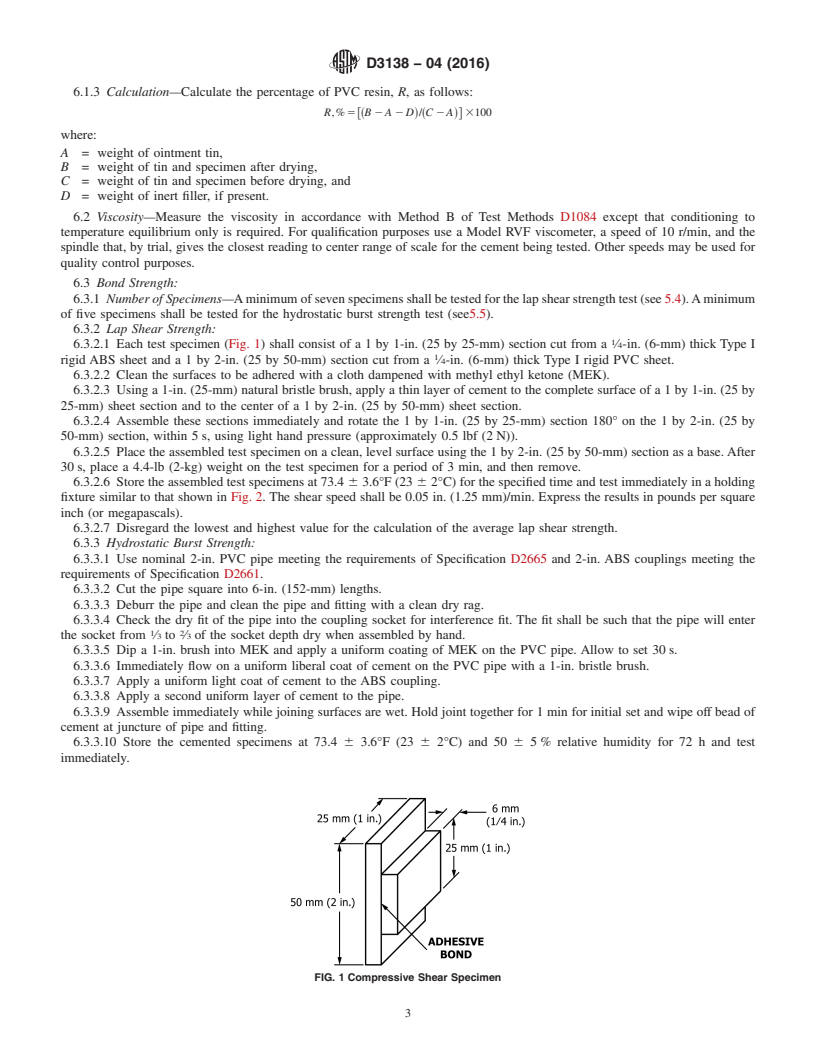
6.3.2.1 Each test specimen (Fig. 1) shall consist ofa1by
weighing (Note 4). Weight 3.0 6 0.5g of the sample to the
1-in. (25 by 25-mm) section cut from a ⁄4-in. (6-mm) thick
nearest 1 mg into a tared ointment tin. Place the tin into the
Type I rigidABS sheet anda1by 2-in. (25 by 50-mm) section
vacuum oven (Note 5), and heat at 248°F (120°C) for 45 min
cut from a ⁄4-in. (6-mm) thick Type I rigid PVC sheet.
+ 15, −0 min. Discard specimens left in for more than 1h.The
vacuummustb
...
This document is not an ASTM standard and is intended only to provide the user of an ASTM standard an indication of what changes have been made to the previous version. Because
it may not be technically possible to adequately depict all changes accurately, ASTM recommends that users consult prior editions as appropriate. In all cases only the current version
of the standard as published by ASTM is to be considered the official document.
Designation: D3138 − 04 (Reapproved 2011) D3138 − 04 (Reapproved 2016)
Standard Specification for
Solvent Cements for Transition Joints Between Acrylonitrile-
Butadiene-Styrene (ABS) and Poly(Vinyl Chloride) (PVC)
Non-Pressure Piping Components
This standard is issued under the fixed designation D3138; the number immediately following the designation indicates the year of
original adoption or, in the case of revision, the year of last revision. A number in parentheses indicates the year of last reapproval. A
superscript epsilon (´) indicates an editorial change since the last revision or reapproval.
This standard has been approved for use by agencies of the U.S. Department of Defense.
1. Scope
1.1 This specification provides general requirements for solvent cements used in joining acrylonitrile-butadiene-styrene (ABS)
plastic pipe or fittings to poly(vinyl chloride) (PVC) plastic pipe or fittings.
1.2 These cements are intended for use in cementing transition joints between ABS and PVC materials in non-pressure
applications only (25 psi (170 kPa) or less).
NOTE 1—This specification was developed to provide a means for joining an ABS non-pressure piping system using a solvent-cemented transition joint,
for example, joining ABS building drain to a PVC sewer system. The intention was not to create a specification for an all purpose ABS-PVC solvent
cement that would be used for mixing of ABS and PVC piping materials nor to specify a cement that could generally be used for either material. Specific
cements for ABS or PVC components should be used (see 1.3).
1.3 Solvent cements used for joining PVC pipe and fittings are specified in Specification D2564. Solvent cements used for
joining ABS pipe and fittings are specified in Specification D2235.
1.4 A recommended procedure for joining ABS to PVC pipe and fittings for non-pressure applications is given in the appendix.
1.5 The values stated in inch-pound units are to be regarded as standard. The values given in parentheses are mathematical
conversions to SI units that are provided for information only and are not considered standard.
1.6 The following safety hazards caveat pertains only to the test methods portion, Section 6, of this specification:This standard
does not purport to address all of the safety concerns, if any, associated with its use. It is the responsibility of the user of this
standard to establish appropriate safety and health practices and determine the applicability of regulatory limitations prior to use.
2. Referenced Documents
2.1 ASTM Standards:
D1084 Test Methods for Viscosity of Adhesives
D1600 Terminology for Abbreviated Terms Relating to Plastics
D1784 Specification for Rigid Poly(Vinyl Chloride) (PVC) Compounds and Chlorinated Poly(Vinyl Chloride) (CPVC)
Compounds
D2235 Specification for Solvent Cement for Acrylonitrile-Butadiene-Styrene (ABS) Plastic Pipe and Fittings
D2564 Specification for Solvent Cements for Poly(Vinyl Chloride) (PVC) Plastic Piping Systems
D2661 Specification for Acrylonitrile-Butadiene-Styrene (ABS) Schedule 40 Plastic Drain, Waste, and Vent Pipe and Fittings
D2665 Specification for Poly(Vinyl Chloride) (PVC) Plastic Drain, Waste, and Vent Pipe and Fittings
F402 Practice for Safe Handling of Solvent Cements, Primers, and Cleaners Used for Joining Thermoplastic Pipe and Fittings
F412 Terminology Relating to Plastic Piping Systems
F493 Specification for Solvent Cements for Chlorinated Poly(Vinyl Chloride) (CPVC) Plastic Pipe and Fittings
3. Terminology
3.1 Definitions—Definitions are in accordance with Terminology F412, and abbreviations are in accordance with Terminology
D1600, unless otherwise specified.
This specification is under the jurisdiction of ASTM Committee F17 on Plastic Piping Systems and is the direct responsibility of Subcommittee F17.20 on Joining.
Current edition approved Feb. 1, 2011Nov. 1, 2016. Published March 2011November 2016. Originally approved in 1972. Last previous edition approved in 20042011 as
D3138 – 04.D3138 – 04(2011). DOI: 10.1520/D3138-04R11.10.1520/D3138-04R16.
For referenced ASTM standards, visit the ASTM website, www.astm.org, or contact ASTM Customer Service at service@astm.org. For Annual Book of ASTM Standards
volume information, refer to the standard’s Document Summary page on the ASTM website.
Copyright © ASTM International, 100 Barr Harbor Drive, PO Box C700, West Conshohocken, PA 19428-2959. United States
D3138 − 04 (2016)
4. Materials and Manufacture
4.1 The solvent cement shall be a solution of Class 12454-B, unplasticized poly(vinyl chloride) molding or extrusion compound
as classified in Specification D1784, or equivalent PVC resin.
4.2 Either virgin or clean rework material may be used, provided that the rework material is generated from the solvent cement
manufacturer’s own production, is compatible with virgin material, and will produce a cement that meets the requirements of this
specification.
4.3 The cement shall be free-flowing and shall not contain lumps, macroscopic undissolved particles, or any foreign matter that
will adversely affect the ultimate joint strength or chemical resistance of the cement.
4.4 The cement shall show no gelation. It shall show no stratification or separation that cannot be removed by stirring or
shaking.
4.5 Inert fillers may be added, provided the resulting cement meets all requirements of this specification.
4.6 The solvents used in the formulation of this solvent cement shall consist of tetrahydrofuran (THF) in combination with
cyclohexanone or methyl ethyl ketone (MEK), or both.
NOTE 2—It is recommended that solvent cements made to this specification not be orange since that color is recommended for use with CPVC solvent
cement under Specification F493.
5. Other Requirements
5.1 Resin Content—The PVC resin content shall be 10 % minimum when tested in accordance with 6.1.
5.2 Dissolution—The cement shall be capable of dissolving an additional 3 weight % of Class 12454-B, PVC compound or the
equivalent PVC resin at 73.4 6 3.6°F (23 6 2°C) without evidence of gelation.
5.3 Viscosity—The minimum viscosity at room temperature shall be 90 cP (90 mPa·s) when tested in accordance with 6.2.
NOTE 3—Cements approaching the minimum viscosity requirement of this specification generally are not recommended for noninterference-type fit
(where a gap exists between the pipe and fitting socket).
5.4 Lap Shear Strength—The minimum average lap shear strength when tested in accordance with 6.3.2 shall be 600 psi (4.1
MPa) after a 72-h curing time.
5.5 Hydrostatic Burst Strength—The minimum average hydrostatic burst strength when tested in accordance with 6.3.3 shall be
200 psi (1.4 MPa) after a 72-h curing time.
6. Test Methods
6.1 Solids Content:
6.1.1 Apparatus:
6.1.1.1 Ointment Tins (Style No. 12, 1-oz (30-mL), all metal).
6.1.1.2 Vacuum Oven. Vacuum Oven.
6.1.1.3 Analytical Balance. Analytical Balance.
6.1.1.4 Centrifuge. Centrifuge.
6.1.2 Procedure:
6.1.2.1 Stir the sample thoroughly with a spatula before weighing (Note 4). Weight 3.0 6 0.5 g of the sample to the nearest 1
mg into a tared ointment tin. Place the tin into the vacuum oven (Note 5), and heat at 248°F (120°C) for 45 min + 15, −0 min.
Discard specimens left in for more than 1 h. The vacuum must be continually in operation to draw off flammable solvents. Absolute
pressure should not exceed 15 mm Hg. Remove the tin from the oven and place in a desiccator until cooled to room temperature.
Weigh the tin and dried sample to the nearest 1 mg.
NOTE 4—This material is usually nonhomogeneous and shall be thoroughly stirred before weighing. The weighing shall also be accomplished quickly
to avoid loss of solvent by volatilization. Some vacuum ovens require a longer period of time than 15 min to reach 120°C, 248°F (120°C) even after
preheating. It is recommended that the operator watch closely the time required to reach 120°C 248°F (120°C) and, by manipulation of the heat control
mechanism, minimize the amount of time required to reach 120°C 248°F (120°C) while not exceeding the required temperature.
NOTE 5—The use of a vacuum oven is mandatory for drying the specimen. This oven has neither an exposed heating surface nor an open flame, thus
avoiding the danger of flashing. The oven also provides an open vacuum to exhaust solvent fumes.
6.1.2.2 After weighing, dissolve the dried sample in THF and determine quantitatively any inert fillers by means of centrifuging.
Deduct the weight of the fillers determined from the weight of the dried sample prior to calculating the content of PVC resin in
the cement.
NOTE 6—Dissolve most of the dried sample by adding 15 mL of THF to the sample in the ointment tin and stirring with a glass rod for 15 min. Dissolve
the remainder with a second addition of 15 mL of THF, followed by a third addition of 5 mL of THF to rinse the ointment tin. Centrifuge the entire volume
at 20 000 r/min for 15 min. Discard the supernatant liquid. Add 15 mL of THF to the tube, mix thoroughly, and transfer the tube contents to the ointment
tin. Use 2 mL more of THF to wash down the tube, and pour into the ointment tin. Evaporate off the THF in the vacuum oven at 248°F (120°C) for 45
min. Cool in desiccator, weigh the tin to the nearest 1 mg, and calculate the percent of inert filler present in the cement.
D3138 − 04 (2016)
6.1.3 Calculation—Calculate the percentage of PVC resin, R, as follows:
R,%5 @~B 2 A 2 D!/~C 2 A!# 3100
where:
A = weight of ointment tin,
B = weight of tin and specimen after drying,
C = weight of tin and specimen before drying, and
D = weight of inert filler, if present.
6.2 Viscosity—Measure the viscosity in accordance with Method B of Test Methods D1084 except that conditioning to
temperature equilibrium only is required. For qualification purposes use a Model RVF viscometer, a speed of 10 r/min, and the
spindle that, by trial, gives the closest reading to center range of scale for the cement being tested. Other speeds may be used for
quality control purposes.
6.3 Bond Strength:
6.3.1 Number of Specimens—A minimum of seven specimens shall be tested for the lap shear strength test (see 5.4). A minimum
of five specimens shall be tested for the
...
Questions, Comments and Discussion
Ask us and Technical Secretary will try to provide an answer. You can facilitate discussion about the standard in here.