


ASTM C729-11(2016)
(Test Method)Standard Test Method for Density of Glass by the Sink-Float Comparator
Standard Test Method for Density of Glass by the Sink-Float Comparator
SIGNIFICANCE AND USE
4.1 The sink-float comparator method of test for glass density provides the most accurate (yet convenient for practical applications) method of evaluating the density of small pieces or specimens of glass. The data obtained are useful for daily quality control of production, acceptance or rejection under specifications, and for special purposes in research and development.
4.2 Although this test scope is limited to a density range from 1.1 to 3.3 g/cm3, it may be extended (in principle) to higher densities by the use of other miscible liquids (Test Method F77) such as water and thallium malonate-formate (approximately 5.0 g/cm3). The stability of the liquid and the precision of the test may be reduced somewhat, however, at higher densities.
SCOPE
1.1 This test method covers the determination of the density of glass or nonporous solids of density from 1.1 to 3.3 g/cm 3. It can be used to determine the apparent density of ceramics or solids, preferably of known porosity.
1.2 This standard does not purport to address all of the safety concerns, if any, associated with its use. It is the responsibility of the user of this standard to establish appropriate safety and health practices and determine the applicability of regulatory limitations prior to use.
General Information
Buy Standard


Standards Content (Sample)
NOTICE: This standard has either been superseded and replaced by a new version or withdrawn.
Contact ASTM International (www.astm.org) for the latest information
Designation: C729 − 11 (Reapproved 2016)
Standard Test Method for
Density of Glass by the Sink-Float Comparator
This standard is issued under the fixed designation C729; the number immediately following the designation indicates the year of
original adoption or, in the case of revision, the year of last revision.Anumber in parentheses indicates the year of last reapproval.A
superscript epsilon (´) indicates an editorial change since the last revision or reapproval.
1. Scope near 25°C, and both the standard and the specimen float in the
solution. The temperature of the system is raised at a uniform
1.1 Thistestmethodcoversthedeterminationofthedensity
3 rate. Because the volumetric expansion coefficient of the
of glass or nonporous solids of density from 1.1 to 3.3 g/cm .
solution is much higher than those of the glass pieces, its
It can be used to determine the apparent density of ceramics or
density decreases more rapidly and eventually both the stan-
solids, preferably of known porosity.
dard and the specimen will sink (settle) in the solution. The
1.2 This standard does not purport to address all of the
temperatures at which the specimen and standard reach the
safety concerns, if any, associated with its use. It is the
mid-pointofthetesttubearenotedandbyuseofspecialtables,
responsibility of the user of this standard to establish appro-
the density of the specimen is obtained.
priate safety and health practices and determine the applica-
3.2 Range of a Given Density Solution—A given density
bility of regulatory limitations prior to use.
solution can be used to measure specimens whose density is
within 60.0200g/cm ofthedensityofthesolutionat35°C,by
2. Referenced Documents
2 operating the comparator bath in the range 25 to 45°C.
2.1 ASTM Standards:
D1217Test Method for Density and Relative Density (Spe-
4. Significance and Use
cific Gravity) of Liquids by Bingham Pycnometer
4.1 The sink-float comparator method of test for glass
E77Test Method for Inspection and Verification of Ther-
densityprovidesthemostaccurate(yetconvenientforpractical
mometers
applications) method of evaluating the density of small pieces
F77Test Method for Apparent Density of Ceramics for
or specimens of glass. The data obtained are useful for daily
Electron Device and Semiconductor Application (With-
quality control of production, acceptance or rejection under
drawn 2001)
specifications, and for special purposes in research and devel-
3. Summary of Method
opment.
3.1 The specimen of unknown density is compared with a
4.2 Although this test scope is limited to a density range
reference standard of known density. The specimen to be
from 1.1 to 3.3 g/cm , it may be extended (in principle) to
measured is placed in a test tube containing a solution whose
higher densities by the use of other miscible liquids (Test
density at 35°C is within 0.0200 g/cm of the density of the Method F77) such as water and thallium malonate-formate
specimen at 25°C. The solution is prepared using miscible
(approximately 5.0 g/cm ). The stability of the liquid and the
liquids of known densities bracketing the desired range. The precision of the test may be reduced somewhat, however, at
tube also contains a glass density reference standard whose
higher densities.
densityat35°Cisclosetothatofthesolutionat35°C;thetube
is immersed in a variable-temperature comparator bath. Ini- 5. Apparatus
tiallythesolutions,specimen,andstandardareatatemperature
5.1 Single Tube and Multiple-Tube Comparators (Test
Method E77)—A single-tube comparator can be constructed
from materials readily available in a typical laboratory, and
This test method is under the jurisdiction of ASTM Committee C14 on Glass
useful if one wishes to measure the density of materials within
and Glass Products and is the direct responsibility of Subcommittee C14.04 on
Physical and Mechanical Properties.
afairlynarrowrange,orifonlyafewtestsneedtoberuneach
Current edition approved Oct. 1, 2016. Published October 2016. Originally
day. The multiple-tube comparator can be purchased commer-
approved in 1972. Last previous edition approved in 2011 as C729–11. DOI:
cially.Itisusefulifmaterialswithawiderangeofdensitymust
10.1520/C0729-11R16.
be tested or if many specimens must be tested each day. The
For referenced ASTM standards, visit the ASTM website, www.astm.org, or
contact ASTM Customer Service at service@astm.org. For Annual Book of ASTM
comparators shall consist of the following:
Standards volume information, refer to the standard’s Document Summary page on
5.1.1 Single-Tube Comparator (Fig. 1):
the ASTM website.
5.1.1.1 Circulating Water Bath, consisting of a 4000-cm
The last approved version of this historical standard is referenced on
www.astm.org. beaker, a cover plate supporting test tubes and thermometer, a
Copyright © ASTM International, 100 Barr Harbor Drive, PO Box C700, West Conshohocken, PA 19428-2959. United States
C729 − 11 (2016)
Metric Equivalents
1 1 3
in. ⁄4 ⁄2 11 ⁄4 29
mm 6.4 12.7 25.4 44.4 51 229
FIG. 1 Single Tube Sink-Float Density Apparatus
cooling water coil made from copper tubing, an electrically tube contains density solution and a thermometer; both test
drivenstirrer,andcontaininganimmersionheaterwithrheostat tubes employ rubber stoppers for supporting the cage or
for controlling heating rate, or heated by an external heat thermometer.
source such as a hot plate.
5.1.1.3 Thermometers, two, mercury, readable to 0.1°C
5.1.1.2 Test Tubes, two, 100-cm capacity. The cover plate between 20 and 50°C. One thermometer passes through a
supports the test tubes, which extended into the water bath. rubberstoppersupportedbythecoverplateintothewaterbath.
One tube contains the density solution, the test specimen, the The second thermometer passes through a rubber stopper into
standard, and a glass or TFE-fluorocarbon cage (Fig. 2) that the test tube that contains density solution only. Thermistors,
keeps the specimens immersed in the solution.The second test resistive thermal devices (RTD), or thermocouples capable of
C729 − 11 (2016)
6.2.4 The density solution consists of mixtures of isopropyl
salicylateand sym-tetrabromoethanefordensitiesbetween1.10
and 2.96 g/cm , and of sym-tetrabromoethane and methylene
iodide for densities between 2.96 and 3.32 g/cm . Proper
amounts of the two liquids to be used are found by simultane-
ous solution of:
ρ V 5ρ V 1ρ V (1)
s s 1 1 2 2
V 5 V 1V (2)
s 1 2
ρ 5 ρ V 1ρ V /~V 1V ! (3)
~ !
s 1 1 2 2 1 2
where:
ρ = density of solution−density of standard at
s
35°C,
FIG. 2 TFE-Flourocarbon Cage for 100-mL Test Tube
V = volume of solution to be prepared,
s
ρ and ρ = densities of the component liquids at 35°C,
1 2
and
measuring and displaying at least 0.1°C accuracy between 20
V and V = volumes of the component liquids at 35°C.
1 2
and 50°C can be used in lieu of mercury thermometers.
6.2.5 Solution Preparation—Approximate volumes of liq-
5.1.2 Multiple-Tube Comparator—The commercially ob-
uids required to supply desired density ρ are shown in Table
s
tainable multiple-tube comparator employs the same principle
1. Mix the two required volumes of liquids 1 and 2 (6.2.4)in
as the single-tube comparator, except that the multiple-tube
a beaker, set on a hot plate, and warm to 35°C. Place a density
typecontainsadditionalspecimentubes.Thesespecimentubes
standard in the solution. Adjust the mixture by adding one or
may contain similar density solutions if a large number of
more drops of either component until the density standard
specimens with similar density are to be measured; they may
settles at 35 6 0.2°C in the well-stirred solution.
contain density solutions of differing density if a number of
specimens with a range of densities are to be measured.
TABLE 1 Volumes of Liquids for Solutions of Various Densities
6. Reagents and Materials
Volume of Material Used, cm
ρ g/cm
s sym-Tetra-
6.1 Density Reference Standards—The reference standard
Isopropyl Methylene
at 35°C
bromo-
shall be a solid piece of glass with a volume between 0.10 and
Salicylate Iodide
ethane
0.15 cm , and a ratio of major to minor dimensions not
2.103 135 165 .
exceeding 2.0. It shall have a smooth surface and be free of
2.136 127 173 .
2.190 120 180 .
seeds, cords, and cracks.Aquantity of such standards may be
2.222 115 185 .
cut from a 20-g piece of glass similarly free of defects, with
2.236 113 187 .
density at 25°C (ρ ) known to 60.0001 g/cm .The density of
25 2.257 109 191 .
2.291 104 196 .
suchastandardglasscanbedeterminedto 60.00001g/cm by
4 2.315 100 200 .
a precise buoyancy method. Determine the settling tempera-
2.335 95 205 .
tureofeachreferencestandardtothenearest0.1°Canddiscard
2.363 92 208 .
2.403 85 215 .
anythatdeviatemorethan0.1°Cfrommeantemperature.Less
2.434 80 220 .
precise density standards are commercially available.
2.448 78 222 .
2.473 74 226 .
6.2 Density Solution—The following organic liquids are
2.495 70 230 .
mixed to provide a solution of the desired density:
2.511 68 232 .
6.2.1 Isopropyl Salicylate, density (25°C) approximately 2.529 65 235 .
2.560 60 240 .
1.10 g/cm or alpha-bromonaphthalene, density (25°C) ap-
2.589 56 244 .
proximately 1.49 g/cm .
2.596 54 246 .
6.2.2 sym-Tetrabromoethane, density (25°C) approximately 2.619 50 250 .
2.633 48 252 .
2.96 g/cm .
2.669 42 258 .
6.2.3 Methylene Iodide, density (25°C) approximately 3.32
2.702 37 263 .
g/cm . 2.728 33 267 .
2.757 28 272 .
NOTE 1—Methylene iodide, sym-tetrabromoethane, and alpha- 2.812 19 281 .
bromonaphthalene are light-sensitive. These liquids should be stored in 2.847 13 287 .
2.863 10 290 .
light-protectivecontainers.Apieceofcopperwireinthemethyleneiodide
2.893 6 294 .
container will help retard decomposition.
2.933 . 300 1
2.960 . 277 23
2.999 . 248 52
Bowman,H.A.,andSchoonover,R.M.,“ProcedureforHighPrecisionDensity
3.035 . 214 86
DeterminationsbyHydrostaticWeighing,” Journal of Research,NationalBureauof
3.054 . 198 102
Standards, 71C, 3, 1967, p. 179. 3.096 . 168 132
...
This document is not an ASTM standard and is intended only to provide the user of an ASTM standard an indication of what changes have been made to the previous version. Because
it may not be technically possible to adequately depict all changes accurately, ASTM recommends that users consult prior editions as appropriate. In all cases only the current version
of the standard as published by ASTM is to be considered the official document.
Designation: C729 − 11 C729 − 11 (Reapproved 2016)
Standard Test Method for
Density of Glass by the Sink-Float Comparator
This standard is issued under the fixed designation C729; the number immediately following the designation indicates the year of
original adoption or, in the case of revision, the year of last revision. A number in parentheses indicates the year of last reapproval. A
superscript epsilon (´) indicates an editorial change since the last revision or reapproval.
1. Scope
1.1 This test method covers the determination of the density of glass or nonporous solids of density from 1.1 to 3.3 g/cm . It
can be used to determine the apparent density of ceramics or solids, preferably of known porosity.
1.2 This standard does not purport to address all of the safety concerns, if any, associated with its use. It is the responsibility
of the user of this standard to establish appropriate safety and health practices and determine the applicability of regulatory
limitations prior to use.
2. Referenced Documents
2.1 ASTM Standards:
D1217 Test Method for Density and Relative Density (Specific Gravity) of Liquids by Bingham Pycnometer
E77 Test Method for Inspection and Verification of Thermometers
F77 Test Method for Apparent Density of Ceramics for Electron Device and Semiconductor Application (Withdrawn 2001)
3. Summary of Method
3.1 The specimen of unknown density is compared with a reference standard of known density. The specimen to be measured
is placed in a test tube containing a solution whose density at 35°C is within 0.0200 g/cm of the density of the specimen at 25°C.
The solution is prepared using miscible liquids of known densities bracketing the desired range. The tube also contains a glass
density reference standard whose density at 35°C is close to that of the solution at 35°C; the tube is immersed in a
variable-temperature comparator bath. Initially the solutions, specimen, and standard are at a temperature near 25°C, and both the
standard and the specimen float in the solution. The temperature of the system is raised at a uniform rate. Because the volumetric
expansion coefficient of the solution is much higher than those of the glass pieces, its density decreases more rapidly and eventually
both the standard and the specimen will sink (settle) in the solution. The temperatures at which the specimen and standard reach
the mid-point of the test tube are noted and by use of special tables, the density of the specimen is obtained.
3.2 Range of a Given Density Solution—A given density solution can be used to measure specimens whose density is within
6 0.0200 60.0200 g/cm of the density of the solution at 35°C, by operating the comparator bath in the range 25 to 45°C.
4. Significance and Use
4.1 The sink-float comparator method of test for glass density provides the most accurate (yet convenient for practical
applications) method of evaluating the density of small pieces or specimens of glass. The data obtained are useful for daily quality
control of production, acceptance or rejection under specifications, and for special purposes in research and development.
4.2 Although this test scope is limited to a density range from 1.1 to 3.3 g/cm , it may be extended (in principle) to higher
densities by the use of other miscible liquids (Test Method F77) such as water and thallium malonate-formate (approximately 5.0
g/cm ). The stability of the liquid and the precision of the test may be reduced somewhat, however, at higher densities.
5. Apparatus
5.1 Single Tube and Multiple-Tube Comparators (Method (Test Method E77)—A single-tube comparator can be constructed
from materials readily available in a typical laboratory, and useful if one wishes to measure the density of materials within a fairly
This test method is under the jurisdiction of ASTM Committee C14 on Glass and Glass Products and is the direct responsibility of Subcommittee C14.04 on Physical
and Mechanical Properties.
Current edition approved Oct. 1, 2011Oct. 1, 2016. Published October 2011October 2016. Originally approved in 1972. Last previous edition approved in 20052011 as
C729 – 05.C729 – 11. DOI: 10.1520/C0729-11.10.1520/C0729-11R16.
For referenced ASTM standards, visit the ASTM website, www.astm.org, or contact ASTM Customer Service at service@astm.org. For Annual Book of ASTM Standards
volume information, refer to the standard’s Document Summary page on the ASTM website.
The last approved version of this historical standard is referenced on www.astm.org.
Copyright © ASTM International, 100 Barr Harbor Drive, PO Box C700, West Conshohocken, PA 19428-2959. United States
C729 − 11 (2016)
narrow range, or if only a few tests need to be run each day. The multiple-tube comparator can be purchased commercially. It is
useful if materials with a wide range of density must be tested or if many specimens must be tested each day. The comparators
shall consist of the following:
5.1.1 Single-Tube Comparator (Fig. 1):
5.1.1.1 Circulating Water Bath, consisting of a 4000-cm beaker, a cover plate supporting test tubes and thermometer, a cooling
water coil made from copper tubing, an electrically driven stirrer, and containing an immersion heater with rheostat for controlling
heating rate, or heated by an external heat source such as a hot plate.
5.1.1.2 Test Tubes, two, 100-cm capacity. The cover plate supports the test tubes, which extended into the water bath. One tube
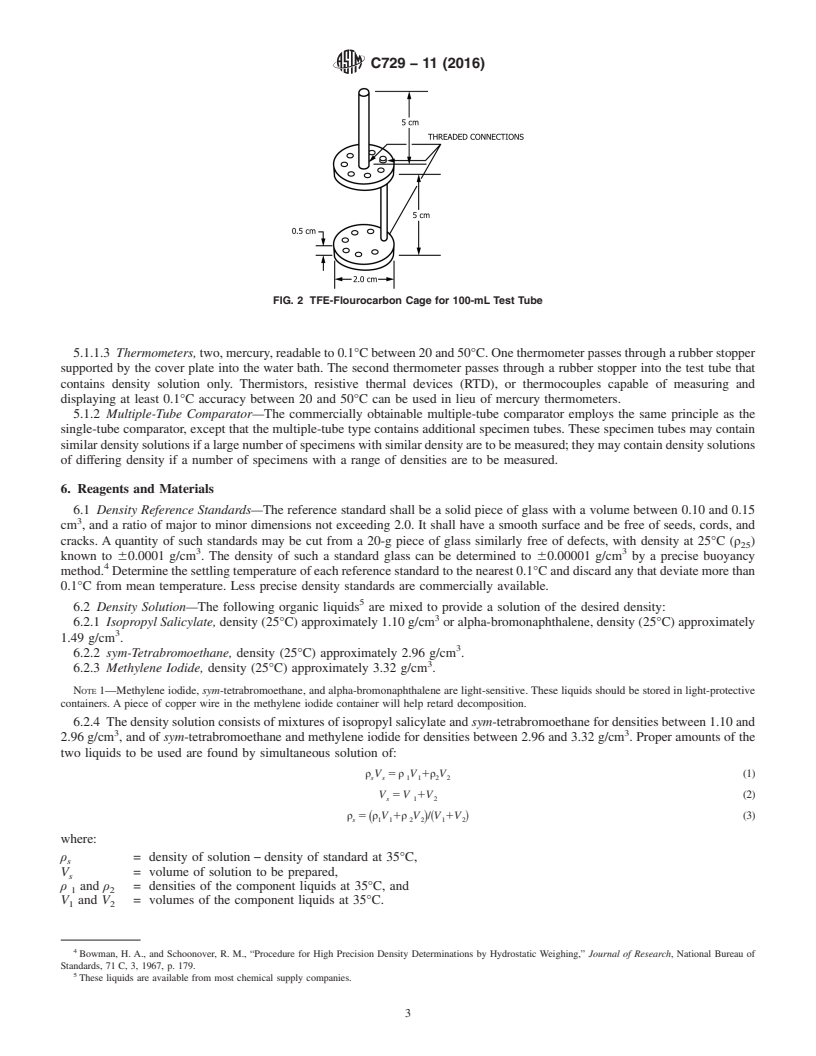
contains the density solution, the test specimen, the standard, and a glass or TFE-fluorocarbon cage (Fig. 2) that keeps the
specimens immersed in the solution. The second test tube contains density solution and a thermometer; both test tubes employ
rubber stoppers for supporting the cage or thermometer.
Metric Equivalents
1 1 3
in. ⁄4 ⁄2 1 1 ⁄4 2 9
mm 6.4 12.7 25.4 44.4 51 229
FIG. 1 Single Tube Sink-Float Density Apparatus
C729 − 11 (2016)
FIG. 2 TFE-Flourocarbon Cage for 100-mL Test Tube
5.1.1.3 Thermometers, two, mercury, readable to 0.1°C between 20 and 50°C. One thermometer passes through a rubber stopper
supported by the cover plate into the water bath. The second thermometer passes through a rubber stopper into the test tube that
contains density solution only. Thermistors, resistive thermal devices (RTD), or thermocouples capable of measuring and
displaying at least 0.1°C accuracy between 20 and 50°C can be used in lieu of mercury thermometers.
5.1.2 Multiple-Tube Comparator—The commercially obtainable multiple-tube comparator employs the same principle as the
single-tube comparator, except that the multiple-tube type contains additional specimen tubes. These specimen tubes may contain
similar density solutions if a large number of specimens with similar density are to be measured; they may contain density solutions
of differing density if a number of specimens with a range of densities are to be measured.
6. Reagents and Materials
6.1 Density Reference Standards—The reference standard shall be a solid piece of glass with a volume between 0.10 and 0.15
cm , and a ratio of major to minor dimensions not exceeding 2.0. It shall have a smooth surface and be free of seeds, cords, and
cracks. A quantity of such standards may be cut from a 20-g piece of glass similarly free of defects, with density at 25°C (ρ )
3 3
known to 60.0001 g/cm . The density of such a standard glass can be determined to 60.00001 g/cm by a precise buoyancy
method. Determine the settling temperature of each reference standard to the nearest 0.1°C and discard any that deviate more than
0.1°C from mean temperature. Less precise density standards are commercially available.
6.2 Density Solution—The following organic liquids are mixed to provide a solution of the desired density:
6.2.1 Isopropyl Salicylate, density (25°C) approximately 1.10 g/cm or alpha-bromonaphthalene, density (25°C) approximately
1.49 g/cm .
6.2.2 sym-Tetrabromoethane, density (25°C) approximately 2.96 g/cm .
6.2.3 Methylene Iodide, density (25°C) approximately 3.32 g/cm .
NOTE 1—Methylene iodide, sym-tetrabromoethane, and alpha-bromonaphthalene are light-sensitive. These liquids should be stored in light-protective
containers. A piece of copper wire in the methylene iodide container will help retard decomposition.
6.2.4 The density solution consists of mixtures of isopropyl salicylate and sym-tetrabromoethane for densities between 1.10 and
3 3
2.96 g/cm , and of sym-tetrabromoethane and methylene iodide for densities between 2.96 and 3.32 g/cm . Proper amounts of the
two liquids to be used are found by simultaneous solution of:
ρ V 5 ρ V 1ρ V (1)
s s 1 1 2 2
V 5 V 1V (2)
s 1 2
ρ 5 ρ V 1ρ V /~V 1V ! (3)
~ !
s 1 1 2 2 1 2
where:
ρ = density of solution − density of standard at 35°C,
s
V = volume of solution to be prepared,
s
ρ and ρ = densities of the component liquids at 35°C, and
1 2
V and V = volumes of the component liquids at 35°C.
1 2
Bowman, H. A., and Schoonover, R. M., “Procedure for High Precision Density Determinations by Hydrostatic Weighing,” Journal of Research, National Bureau of
Standards, 71 C, 3, 1967, p. 179.
These liquids are available from most chemical supply companies.
C729 − 11 (2016)
6.2.5 Solution Preparation—Approximate volumes of liquids required to supply desired density ρ are shown in Table 1. Mix
s
the two required volumes of liquids 1 and 2 (6.2.4) in a beaker, set on a hot plate, and warm to 35°C. Place a density standard
in the solution. Adjust the mixture by adding one or more drops of either component until the density standard settles at 35 6 0.2°C
in the well-stirred solution.
7. Preparation of Density-Temperature Tables
7.1 Tables are prepared from the equations of this section to relate the specimen density at 25°C to its settling temperature.
These tables are prepared once for each glass reference standard-density solution system. Subsequent supplies of density solutions
prepared for use with the same glass reference standard will be sufficiently similar in expansion and density characteristics so that
the same table can be used.
7.2 Determination of Temperature Coeffıcient of Density—
...
Questions, Comments and Discussion
Ask us and Technical Secretary will try to provide an answer. You can facilitate discussion about the standard in here.