

ASTM E865-20
(Specification)Standard Specification for Structural Film Adhesives for Honeycomb Sandwich Panels
General Information
- Abstract
ABSTRACT
This specification covers structural film adhesives used for bonding honeycomb sandwich panels consisting of an aluminum alloy bonded to a nonmetallic core, edge attachments, and other components, and for new production or depot repair. The adhesive shall be manufactured in film form from a thermosetting compound suitable for forming bonds that can withstand long exposures to a range of temperatures and combinations of stress, temperature, and relative humidity encountered during service. The adhesive may be pure or consist of a carrier impregnated with adhesive and shall be uniform in appearance, with a weight in the range specified. Tests for shear, peel, durability, tensile strength, and storage life shall be performed and shall conform to the requirements specified.
SCOPE
1.1 This specification covers film adhesives for bonding of honeycomb sandwich panels. The adhesives are used for new production or depot repair. The adhesives shall be suitable for forming bonds that can withstand long exposures to temperatures from −55 °C to 93 °C (−67 °F to 200 °F) and also withstand the combinations of stress, temperature, and relative humidity expected to be encountered in service. The adhesives shall be used for bonding aluminum alloy facing to nonmetallic core, edge attachments, and other components of a sandwich panel.
1.2 The values stated in SI units are to be regarded as standard where only SI units are given or where SI units are given first followed by inch-pound units; where inch-pound units are given first followed by SI units, the inch-pound units are to regarded as standard.
1.3 This standard does not purport to address all of the safety concerns, if any, associated with its use. It is the responsibility of the user of this standard to establish appropriate safety, health, and environmental practices and determine the applicability of regulatory limitations prior to use.
1.4 This international standard was developed in accordance with internationally recognized principles on standardization established in the Decision on Principles for the Development of International Standards, Guides and Recommendations issued by the World Trade Organization Technical Barriers to Trade (TBT) Committee.
- Status
- Published
- Publication Date
- 31-Aug-2020
- Technical Committee
- E06 - Performance of Buildings
Buy Documents

ASTM E865-20 - Standard Specification for Structural Film Adhesives for Honeycomb Sandwich Panels
REDLINE ASTM E865-20 - Standard Specification for Structural Film Adhesives for Honeycomb Sandwich Panels
Overview
ASTM E865-20: Standard Specification for Structural Film Adhesives for Honeycomb Sandwich Panels establishes requirements for film adhesives specifically designed for bonding aluminum alloy facings to nonmetallic honeycomb core materials, edge attachments, and related components. This international standard applies to adhesives in both new production and depot repair settings, ensuring reliable bonding performance under long-term exposure to variable temperatures, stress, and humidity conditions. The specification helps guarantee that adhesives used in advanced sandwich panel assemblies maintain required mechanical properties and durability, aligning with industry best practices for construction, aerospace, shelter, and transportation sectors.
Key Topics
- Film Adhesive Requirements: Adhesives must be thermosetting, in film form, and provide uniform appearance and specified film weight. Both pure adhesives and those with a carrier are acceptable.
- Temperature and Stress Resistance: The adhesive must maintain bonding performance across a wide temperature range - from −55 °C (−67 °F) to 93 °C (200 °F) - while also resisting combined effects of temperature, stress, and humidity.
- Mechanical Properties: The standard prescribes minimum values for critical properties, such as lap shear strength, peel resistance, and flatwise tensile strength, following rigorous testing methods.
- Testing and Qualification: Prescribed test methods (e.g., ASTM D1002, D3167, D1781, C297/C297M, D2919) are used to qualify adhesives for their strength, durability, and resistance attributes.
- Storage and Shelf Life: Adhesives must retain their specified properties when stored under recommended conditions, with manufacturers required to state the maximum storage period and temperature.
- Quality Conformance: Each lot of adhesive is subjected to qualification and conformance inspections, ensuring consistency and compliance with the standard across production runs.
- Procurement Specifications: Clear documentation is required for procurement, detailing adhesive type, film weight, dimensions, curing conditions, packaging, and compliance with qualification requirements.
Applications
- Building and Construction: Widely used for fabricating structural sandwich panels in shelter construction, relocatable shelters, and other high-performance building components.
- Aerospace and Transportation: Essential in the bonding of lightweight, high-strength honeycomb panels for aircraft, trains, and specialty vehicles, promoting structural integrity and weight reduction.
- Depot Repair and Maintenance: Provides standardized guidance for selecting and qualifying adhesives in maintenance and repair of existing sandwich panel structures.
- Industrial Manufacturing: Assurance of reliability and long-term durability for components exposed to severe environmental and operational stresses.
Related Standards
For those working with ASTM E865-20, several referenced and related standards are crucial for full compliance and best practices:
- ASTM B117: Operating Salt Spray (Fog) Apparatus
- ASTM B209: Aluminum and Aluminum-Alloy Sheet and Plate Specification
- ASTM C297/C297M: Flatwise Tensile Strength of Sandwich Constructions
- ASTM D1002: Apparent Shear Strength of Single-Lap-Joint Adhesively Bonded Metal Specimens
- ASTM D1781: Climbing Drum Peel for Adhesives
- ASTM D2919: Durability of Adhesive Joints Stressed in Shear by Tension Loading
- ASTM D3167: Floating Roller Peel Resistance of Adhesives
- ASTM E864: Surface Preparation of Aluminum Alloys to Be Adhesively Bonded
- ASTM E866 and E1826: Specifications for Corrosion-Inhibiting Adhesive Primers
- ASTM E874: Adhesive Bonding of Aluminum Facings to Nonmetallic Honeycomb Core
Understanding and referencing these standards in conjunction with ASTM E865-20 ensures a comprehensive approach to quality, safety, and durability when manufacturing or repairing honeycomb sandwich panel structures using structural film adhesives.
Keywords: ASTM E865-20, honeycomb sandwich panels, structural film adhesives, aluminum bonding, depot repair, aerospace adhesives, sandwich panel construction, film adhesive specification, durability testing, building standards.
Relations
- Effective Date
- 01-Jul-2019
- Effective Date
- 01-Apr-2019
- Effective Date
- 01-Oct-2018
- Effective Date
- 01-Nov-2017
- Refers
ASTM C297/C297M-16 - Standard Test Method for Flatwise Tensile Strength of Sandwich Constructions - Effective Date
- 01-Apr-2016
- Refers
ASTM C297/C297M-15 - Standard Test Method for Flatwise Tensile Strength of Sandwich Constructions - Effective Date
- 01-Apr-2015
- Effective Date
- 01-Mar-2015
- Effective Date
- 01-Nov-2014
- Effective Date
- 01-Oct-2011
- Effective Date
- 01-Sep-2011
- Effective Date
- 01-May-2011
- Effective Date
- 01-May-2011
- Effective Date
- 01-Nov-2010
- Effective Date
- 01-Nov-2010
- Effective Date
- 01-Nov-2010
Buy Documents
ASTM E865-20 - Standard Specification for Structural Film Adhesives for Honeycomb Sandwich Panels
REDLINE ASTM E865-20 - Standard Specification for Structural Film Adhesives for Honeycomb Sandwich Panels
Get Certified
Connect with accredited certification bodies for this standard

DIN CERTCO
DIN Group product certification.

Smithers Quality Assessments
US management systems and product certification.
Sponsored listings
Frequently Asked Questions
ASTM E865-20 is a technical specification published by ASTM International. Its full title is "Standard Specification for Structural Film Adhesives for Honeycomb Sandwich Panels". This standard covers: ABSTRACT This specification covers structural film adhesives used for bonding honeycomb sandwich panels consisting of an aluminum alloy bonded to a nonmetallic core, edge attachments, and other components, and for new production or depot repair. The adhesive shall be manufactured in film form from a thermosetting compound suitable for forming bonds that can withstand long exposures to a range of temperatures and combinations of stress, temperature, and relative humidity encountered during service. The adhesive may be pure or consist of a carrier impregnated with adhesive and shall be uniform in appearance, with a weight in the range specified. Tests for shear, peel, durability, tensile strength, and storage life shall be performed and shall conform to the requirements specified. SCOPE 1.1 This specification covers film adhesives for bonding of honeycomb sandwich panels. The adhesives are used for new production or depot repair. The adhesives shall be suitable for forming bonds that can withstand long exposures to temperatures from −55 °C to 93 °C (−67 °F to 200 °F) and also withstand the combinations of stress, temperature, and relative humidity expected to be encountered in service. The adhesives shall be used for bonding aluminum alloy facing to nonmetallic core, edge attachments, and other components of a sandwich panel. 1.2 The values stated in SI units are to be regarded as standard where only SI units are given or where SI units are given first followed by inch-pound units; where inch-pound units are given first followed by SI units, the inch-pound units are to regarded as standard. 1.3 This standard does not purport to address all of the safety concerns, if any, associated with its use. It is the responsibility of the user of this standard to establish appropriate safety, health, and environmental practices and determine the applicability of regulatory limitations prior to use. 1.4 This international standard was developed in accordance with internationally recognized principles on standardization established in the Decision on Principles for the Development of International Standards, Guides and Recommendations issued by the World Trade Organization Technical Barriers to Trade (TBT) Committee.
ABSTRACT This specification covers structural film adhesives used for bonding honeycomb sandwich panels consisting of an aluminum alloy bonded to a nonmetallic core, edge attachments, and other components, and for new production or depot repair. The adhesive shall be manufactured in film form from a thermosetting compound suitable for forming bonds that can withstand long exposures to a range of temperatures and combinations of stress, temperature, and relative humidity encountered during service. The adhesive may be pure or consist of a carrier impregnated with adhesive and shall be uniform in appearance, with a weight in the range specified. Tests for shear, peel, durability, tensile strength, and storage life shall be performed and shall conform to the requirements specified. SCOPE 1.1 This specification covers film adhesives for bonding of honeycomb sandwich panels. The adhesives are used for new production or depot repair. The adhesives shall be suitable for forming bonds that can withstand long exposures to temperatures from −55 °C to 93 °C (−67 °F to 200 °F) and also withstand the combinations of stress, temperature, and relative humidity expected to be encountered in service. The adhesives shall be used for bonding aluminum alloy facing to nonmetallic core, edge attachments, and other components of a sandwich panel. 1.2 The values stated in SI units are to be regarded as standard where only SI units are given or where SI units are given first followed by inch-pound units; where inch-pound units are given first followed by SI units, the inch-pound units are to regarded as standard. 1.3 This standard does not purport to address all of the safety concerns, if any, associated with its use. It is the responsibility of the user of this standard to establish appropriate safety, health, and environmental practices and determine the applicability of regulatory limitations prior to use. 1.4 This international standard was developed in accordance with internationally recognized principles on standardization established in the Decision on Principles for the Development of International Standards, Guides and Recommendations issued by the World Trade Organization Technical Barriers to Trade (TBT) Committee.
ASTM E865-20 is classified under the following ICS (International Classification for Standards) categories: 83.180 - Adhesives. The ICS classification helps identify the subject area and facilitates finding related standards.
ASTM E865-20 has the following relationships with other standards: It is inter standard links to ASTM E874-19, ASTM D1002-10(2019), ASTM E1749-18, ASTM D3167-10(2017), ASTM C297/C297M-16, ASTM C297/C297M-15, ASTM E631-15, ASTM E631-14, ASTM B117-11, ASTM E874-11, ASTM E1826-11, ASTM E866-11, ASTM E874-10a, ASTM E1749-10, ASTM B209-10. Understanding these relationships helps ensure you are using the most current and applicable version of the standard.
ASTM E865-20 is available in PDF format for immediate download after purchase. The document can be added to your cart and obtained through the secure checkout process. Digital delivery ensures instant access to the complete standard document.
Standards Content (Sample)
This international standard was developed in accordance with internationally recognized principles on standardization established in the Decision on Principles for the
Development of International Standards, Guides and Recommendations issued by the World Trade Organization Technical Barriers to Trade (TBT) Committee.
Designation:E865 −20
Standard Specification for
Structural Film Adhesives for Honeycomb Sandwich Panels
This standard is issued under the fixed designation E865; the number immediately following the designation indicates the year of
original adoption or, in the case of revision, the year of last revision.Anumber in parentheses indicates the year of last reapproval.A
superscript epsilon (´) indicates an editorial change since the last revision or reapproval.
This standard has been approved for use by agencies of the U.S. Department of Defense.
1. Scope C297/C297MTest Method for Flatwise Tensile Strength of
Sandwich Constructions
1.1 This specification covers film adhesives for bonding of
D1002Test Method for Apparent Shear Strength of Single-
honeycomb sandwich panels. The adhesives are used for new
Lap-Joint Adhesively Bonded Metal Specimens by Ten-
production or depot repair. The adhesives shall be suitable for
sion Loading (Metal-to-Metal)
forming bonds that can withstand long exposures to tempera-
D1781Test Method for Climbing Drum Peel for Adhesives
tures from −55°C to 93°C (−67°F to 200°F) and also
D2919Test Method for Determining Durability ofAdhesive
withstand the combinations of stress, temperature, and relative
Joints Stressed in Shear by Tension Loading
humidity expected to be encountered in service.The adhesives
D3167Test Method for Floating Roller Peel Resistance of
shallbeusedforbondingaluminumalloyfacingtononmetallic
Adhesives
core, edge attachments, and other components of a sandwich
E631Terminology of Building Constructions
panel.
E864Practice for Surface Preparation of Aluminum Alloys
1.2 The values stated in SI units are to be regarded as
to Be Adhesively Bonded in Honeycomb Shelter Panels
standard where only SI units are given or where SI units are
E866 Specification for Corrosion-Inhibiting Adhesive
given first followed by inch-pound units; where inch-pound
Primer forAluminumAlloys to BeAdhesively Bonded in
units are given first followed by SI units, the inch-pound units
Honeycomb Shelter Panels
are to regarded as standard.
E874Practice for Adhesive Bonding of Aluminum Facings
1.3 This standard does not purport to address all of the
to Nonmetallic Honeycomb Core for Shelter Panels
safety concerns, if any, associated with its use. It is the
E1091Specification for Nonmetallic Honeycomb Core for
responsibility of the user of this standard to establish appro-
Use in Shelter Panels
priate safety, health, and environmental practices and deter-
E1749Terminology Relating to Rigid Wall Relocatable
mine the applicability of regulatory limitations prior to use.
Shelters
1.4 This international standard was developed in accor-
E1826Specification for Low Volatile Organic Compound
dance with internationally recognized principles on standard-
(VOC) Corrosion-Inhibiting Adhesive Primer for Alumi-
ization established in the Decision on Principles for the
num Alloys to Be Adhesively Bonded
Development of International Standards, Guides and Recom-
mendations issued by the World Trade Organization Technical 2.2 Federal Specifications:
Barriers to Trade (TBT) Committee. QQ-A-250/8dAluminum Alloy 5052H34, Plate and Sheet
QQ-A-250/11dAluminum Alloy 6061T6, Plate and Sheet
2. Referenced Documents
NOTE 1—Copies of specifications, standards, drawings, and publica-
2.1 ASTM Standards:
tions required by suppliers in connection with specific purchases shall be
B117Practice for Operating Salt Spray (Fog) Apparatus
obtained from the purchaser or as directed by his contracting officer.
B209Specification for Aluminum and Aluminum-Alloy
Sheet and Plate
3. Terminology
1 3.1 Definitions—For definitions of general terms related to
This specification is under the jurisdiction of ASTM Committee E06 on
Performance of Buildings and is the direct responsibility of Subcommittee E06.53
building construction used in this specification, refer toTermi-
on Materials and Processes for Durable Rigidwall Relocatable Structures.
nology E631, and for general terms related to rigid wall
Current edition approved Sept. 1, 2020. Published October 2020. Originally
relocatable shelters, refer to Terminology E1749.
approved in 1982. Last previous edition approved in 2012 as E865–12. DOI:
10.1520/E0865-20.
For referenced ASTM standards, visit the ASTM website, www.astm.org, or
contact ASTM Customer Service at service@astm.org. For Annual Book of ASTM
Standards volume information, refer to the standard’s Document Summary page on Available from DLA Document Services, Building 4/D, 700 Robbins Ave.,
the ASTM website. Philadelphia, PA 19111, http://quicksearch.dla.mil.
Copyright © ASTM International, 100 Barr Harbor Drive, PO Box C700, West Conshohocken, PA 19428-2959. United States
E865−20
4. Ordering Information bids. The qualification shall only apply to the formulation on
which qualification tests have been made.Any changes by the
4.1 Procurement Documents—Purchasersshallselectanyof
manufacturer,suchastheaddingoffillers,changingthecarrier,
the desired options offered herein and the procurement docu-
changingthemethodofmanufacture,orchangingthemassper
ments shall specify the following:
unit area, shall be cause for designating the adhesive as a new
4.1.1 Title, number, and date of this specification;
product. The new product shall be given a new code number
4.1.2 Adhesive type and code number;
and shall not be approved until it has been shown to meet the
4.1.3 Amounts and unit quantities of adhesives required;
requirements of the specification.
4.1.4 Length, width, and film weight of adhesive;
4.1.5 Curing conditions; 5.5 Working Characteristics:
4.1.6 Level of packaging and packing required; and 5.5.1 Application—The adhesive shall be suitable for appli-
4.1.7 Whether or not qualification (see 4.2) is necessary.
cation to metal facings and core materials in accordance with
the manufacturer’s instructions at temperatures between 18°C
4.2 Qualification—In the case of adhesives for which the
and 30°C (65°F and 85°F) and at relative humidities of up to
purchaser requires qualification, comprehensive testing in ac-
50%.
cordancewithSection6shallbeperformedanddocumentedin
5.5.2 Curing—The time, temperature, and pressure used to
a test report.
cure the adhesive shall be within the range specified herein.
5. Requirements 5.5.2.1 Curing Time and Temperature—The adhesive shall
meet the requirements of this specification when cured for not
5.1 Material—The adhesive shall be thermosetting and,
longer than1hata bond line temperature not exceeding
when tested using the tests described in Section 6, shall meet
145°C (293°F).
the strength and durability requirements of this specification.
5.5.2.2 Curing Pressure—In the preparation of specimens
The adhesive shall not have a deleterious effect on the metal
fabricatedforqualification,thepressurerequiredforcuringthe
surfaces being bonded over the range of temperatures at which
adhesive shall not be less than 140 kPa (20 psi) nor more than
the adhesives will be used.
350 kPa (50 psi).
5.2 FormandFilmWeight—Theadhesiveshallbefilmform
5.6 Storage Life—The adhesive manufacturer shall deter-
and shall consist either entirely of adhesive or of a carrier
mine the maximum temperature and the storage period at this
impregnatedwithadhesive.Thefilmweightshallbewithinthe
temperature (from date of manufacture) for which the
range specified in Table 1.
adhesive, when stored in airtight containers or wrapped in
5.3 Appearance—The adhesive film shall be uniform in
suitable vapor barriers, will retain its ability to meet the
appearance. It shall be of a uniform coating that is free of
strength requirements specified in Table 1. These storage
streaks and color variations.
conditions shall be stated in the instruction sheet (see 7.3.1.1).
5.4 Qualification—At the option of the purchaser, the adhe-
5.7 Mechanical Properties—The average mechanical prop-
sivemayberequiredtobeaproduct(see7.3)forlistingonthe
erties of the adhesive shall meet the requirements of Table 1.
applicable qualified products list at the time set for opening of
6. Test Methods
TABLE 1 Physical Requirements for the Film Adhesive
6.1 QualificationTests—Forqualification,theadhesiveshall
A
Test Requirement
be tested using the tests described in this section. Shear tests
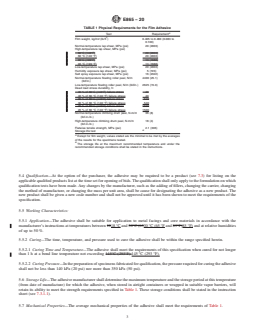
Film weight, kg/m2 (lb/ft ) 0.405 to 0.480 (0.083 to
shall be performed in accordance with Test Method D1002.
0.100)
Normal-temperature lap shear, MPa (psi) 20 (2903)
6.2 Preparation of Test Specimens—Prepare at least ten
High-temperature lap shear, MPa (psi)
60 °C (140 °F) 20 (2903) specimens for each separate test except as otherwise specified
93 °C (199 °F) 13 (1888)
in the individual test methods. The metal bonded shall be
Low-temperature lap shear, MPa (psi) 20 (2903)
6061T6 or 5052H34 aluminum alloy (Federal Specification
Humidity exposure lap shear, MPa (psi) 5 (723)
Salt spray exposure lap shear, MPa (psi) 16 (2322) QQ-A-250/11d or QQ-A-250/8d, respectively, or Specification
Normal-temperature floating roller peel, N/m 4400 (25.1)
B209) cleaned as described in Practice E864 and at the
(lbf/in.)
purchasers option, primed in accordance with Specification
Low-temperature floating roller peel, N/m (lbf/in.) 2625 (15.0)
Dead load stress durability, h: E866 or Specification E1826. Time and temperature of curing
40 % of 60 °C (140 °F) failure stress 40
of the adhesive shall be in accordance with the adhesive
30 % of 60 °C (140 °F) failure stress 540
manufacturer’s most recent recommendation. Test panels or
20 % of 60 °C (140 °F) failure stress 1500
Normal-temperature climbing drum peel, N·m/m 36 (8) specimens, or both, other than the breakaway type shall be cut
(lbf·in./in.)
in such a manner that minimum vibration or heat is generated
High-temperature climbing drum peel, N·m/m 18 (4)
during the cutting operation.
(lbf·in./in.)
Flatwise tensile strength, MPa (psi) 2.1 (306)
6.3 Normal-Temperature Lap Shear—Subject specimens to
B
Storage life test
a lap shear test at normal temperature 25°C 6 3°C (77°F 6
A
Except for film weight, values stated are the minimal to be met by the averages
5°F).
of the results for the specimens tested.
B
The storag
...
This document is not an ASTM standard and is intended only to provide the user of an ASTM standard an indication of what changes have been made to the previous version. Because
it may not be technically possible to adequately depict all changes accurately, ASTM recommends that users consult prior editions as appropriate. In all cases only the current version
of the standard as published by ASTM is to be considered the official document.
Designation: E865 − 12 E865 − 20
Standard Specification for
Structural Film Adhesives for Honeycomb Sandwich Panels
This standard is issued under the fixed designation E865; the number immediately following the designation indicates the year of
original adoption or, in the case of revision, the year of last revision. A number in parentheses indicates the year of last reapproval. A
superscript epsilon (´) indicates an editorial change since the last revision or reapproval.
This standard has been approved for use by agencies of the U.S. Department of Defense.
1. Scope
1.1 This specification covers film adhesives for bonding of honeycomb sandwich panels. The adhesives are used for new
production or depot repair. The adhesives shall be suitable for forming bonds that can withstand long exposures to temperatures
from −55−55 °C to 93°C (−6793 °C (−67 °F to 200°F)200 °F) and also withstand the combinations of stress, temperature, and
relative humidity expected to be encountered in service. The adhesives shall be used for bonding aluminum alloy facing to
nonmetallic core, edge attachments, and other components of a sandwich panel.
1.2 The values stated in SI units are to be regarded as the standard where only SI units are given or where SI units are given first
followed by inch-pound units; where inch-pound units are given first followed by SI units, the inch-pound units are to regarded
as the standard.
1.3 This standard does not purport to address all of the safety concerns, if any, associated with its use. It is the responsibility
of the user of this standard to establish appropriate safety safety, health, and healthenvironmental practices and determine the
applicability of regulatory limitations prior to use.
1.4 This international standard was developed in accordance with internationally recognized principles on standardization
established in the Decision on Principles for the Development of International Standards, Guides and Recommendations issued
by the World Trade Organization Technical Barriers to Trade (TBT) Committee.
2. Referenced Documents
2.1 ASTM Standards:
B117 Practice for Operating Salt Spray (Fog) Apparatus
B209 Specification for Aluminum and Aluminum-Alloy Sheet and Plate
C297/C297M Test Method for Flatwise Tensile Strength of Sandwich Constructions
D1002 Test Method for Apparent Shear Strength of Single-Lap-Joint Adhesively Bonded Metal Specimens by Tension Loading
(Metal-to-Metal)
D1781 Test Method for Climbing Drum Peel for Adhesives
D2919 Test Method for Determining Durability of Adhesive Joints Stressed in Shear by Tension Loading
D3167 Test Method for Floating Roller Peel Resistance of Adhesives
E631 Terminology of Building Constructions
E864 Practice for Surface Preparation of Aluminum Alloys to Be Adhesively Bonded in Honeycomb Shelter Panels
This specification is under the jurisdiction of ASTM Committee E06 on Performance of Buildings and is the direct responsibility of Subcommittee E06.53 on Materials
and Processes for Durable Rigidwall Relocatable Structures.
Current edition approved Nov. 1, 2012Sept. 1, 2020. Published December 2012October 2020. Originally approved in 1982. Last previous edition approved in 20082012
as E865 – 08.E865 – 12. DOI: 10.1520/E0865-12.10.1520/E0865-20.
For referenced ASTM standards, visit the ASTM website, www.astm.org, or contact ASTM Customer Service at service@astm.org. For Annual Book of ASTM Standards
volume information, refer to the standard’sstandard’s Document Summary page on the ASTM website.
Copyright © ASTM International, 100 Barr Harbor Drive, PO Box C700, West Conshohocken, PA 19428-2959. United States
E865 − 20
E866 Specification for Corrosion-Inhibiting Adhesive Primer for Aluminum Alloys to Be Adhesively Bonded in Honeycomb
Shelter Panels
E874 Practice for Adhesive Bonding of Aluminum Facings to Nonmetallic Honeycomb Core for Shelter Panels
E1091 Specification for Nonmetallic Honeycomb Core for Use in Shelter Panels
E1749 Terminology Relating to Rigid Wall Relocatable Shelters
E1826 Specification for Low Volatile Organic Compound (VOC) Corrosion-Inhibiting Adhesive Primer for Aluminum Alloys
to Be Adhesively Bonded
2.2 Federal Specifications:
QQ-A-250/8d Aluminum Alloy 5052H34, Plate and Sheet
QQ-A-250/11d Aluminum Alloy 6061T6, Plate and Sheet
NOTE 1—Copies of specifications, standards, drawings, and publications required by suppliers in connection with specific purchases shall be obtained from
the purchaser or as directed by his contracting officer.
3. Terminology
3.1 Definitions—See Terminologies —For definitions of general terms related to building construction used in this specification,
refer to Terminology E631, and E1749 for definitions of general terms used in this practice.for general terms related to rigid wall
relocatable shelters, refer to Terminology E1749.
4. Ordering Information
4.1 Procurement Documents—Purchasers shall select any of the desired options offered herein and the procurement documents
shall specify the following:
4.1.1 Title, number, and date of this specification;
4.1.2 Adhesive type and code number;
4.1.3 Amounts and unit quantities of adhesives required;
4.1.4 Length, width, and film weight of adhesive;
4.1.5 Curing conditions;
4.1.6 Level of packaging and packing required; and
4.1.7 Whether or not qualification (see 4.2) is necessary.
4.2 Qualification—In the case of adhesives for which the purchaser requires qualification, comprehensive testing in accordance
with Section 6 shall be performed and documented in a test report.
5. Requirements
5.1 Material—The adhesive shall be thermosetting and, when tested using the tests described in Section 6, shall meet the strength
and durability requirements of this specification. The adhesive shall not have a deleterious effect on the metal surfaces being
bonded over the range of temperatures at which the adhesives will be used.
5.2 Form and Film Weight—The adhesive shall be film form and shall consist either entirely of adhesive or of a carrier
impregnated with adhesive. The film weight shall be within the range specified in Table 1.
5.3 Appearance—The adhesive film shall be uniform in appearance. It shall be of a uniform coating that is free of streaks and color
variations.
Available from Standardization Documents Order Desk, DODSSP, Bldg. 4, Section D, DLA Document Services, Building 4/D, 700 Robbins Ave., Philadelphia, PA
19111-5098, http://www.dodssp.daps.mil.19111, http://quicksearch.dla.mil.
E865 − 20
TABLE 1 Physical Requirements for the Film Adhesive
A
Test Requirement
Film weight, kg/m2 (lb/ft ) 0.405 to 0.480 (0.083 to
0.100)
Normal-temperature lap shear, MPa (psi) 20 (2903)
High-temperature lap shear, MPa (psi)
60°C (140°F) 20 (2903)
60 °C (140 °F) 20 (2903)
93°C (199°F) 13 (1888)
93 °C (199 °F) 13 (1888)
Low-temperature lap shear, MPa (psi) 20 (2903)
Humidity exposure lap shear, MPa (psi) 5 (723)
Salt spray exposure lap shear, MPa (psi) 16 (2322)
Normal-temperature floating roller peel, N/m 4400 (25.1)
(lbf/in.)
Low-temperature floating roller peel, N/m (lbf/in.) 2625 (15.0)
Dead load stress durability, h:
40 % of 60°C (140°F) failure stress 40
40 % of 60 °C (140 °F) failure stress 40
30 % of 60°C (140°F) failure stress 540
30 % of 60 °C (140 °F) failure stress 540
20 % of 60°C (140°F) failure stress 1500
20 % of 60 °C (140 °F) failure stress 1500
Normal-temperature climbing drum peel, N·m/m 36 (8)
(lbf·in./in.)
High-temperature climbing drum peel, N·m/m 18 (4)
(lbf·in./in.)
Flatwise tensile strength, MPa (psi) 2.1 (306)
B
Storage life test
A
Except for film weight, values stated are the minimal to be met by the averages
of the results for the specimens tested.
B
The storage life at the maximum recommended temperature and under the
recommended storage conditions shall be stated in the instructions.
5.4 Qualification—At the option of the purchaser, the adhesive may be required to be a product (see 7.3) for listing on the
applicable qualified products list at the time set for opening of bids. The qualification shall only apply to the formulation on which
qualification tests have been made. Any changes by the manufacturer, such as the adding of fillers, changing the carrier, changing
the method of manufacture, or changing the mass per unit area, shall be cause for designating the adhesive as a new product. The
new product shall be given a new code number and shall not be approved until it has been shown to meet the requirements of the
specification.
5.5 Working Characteristics:
5.5.1 Application—The adhesive shall be suitable for application to metal facings and core materials in accordance with the
manufacturer’s instructions at temperatures between 1818 °C and 30°C (6530 °C (65 °F and 85°F)85 °F) and at relative humidities
of up to 50 %.
5.5.2 Curing—The time, temperature, and pressure used to cure the adhesive shall be within the range specified herein.
5.5.2.1 Curing Time and Temperature—The adhesive shall meet the requirements of this specification when cured for not longer
than 1 h at a bond line temperature not exceeding 145°C (293°F).145 °C (293 °F).
5.5.2.2 Curing Pressure—In the preparation of specimens fabricated for qualification, the pressure required for curing the adhesive
shall not be less than 140 kPa (20 psi) nor more than 350 kPa (50 psi).
5.6 Storage Life—The adhesive manufacturer shall determine the maximum temperature and the storage period at this temperature
(from date of manufacture) for which the adhesive, when stored in airtight containers or wrapped in suitable vapor barriers, will
retain its ability to meet the strength requirements specified in Table 1. These storage conditions shall be stated in the instruction
sheet (see 7.3.1.1).
5.7 Mechanical Properties—The average mechanical properties of the adhesive shall meet the requirements of Table 1.
E865 − 20
6. Test Methods
6.1 Qualification Tests—For qualification, the adhesive shall be tested using the tests described in this section. Shear tests shall
be performed in accordance with Test Method D1002.
6.2 Preparation of Test Specimens—Prepare at least ten specimens for each separate test except as otherwise specified in the
individual test methods. The metal bonded shall be 6061T6 or 5052H34 aluminum alloy (Federal Specification QQ-A-250/11d or
QQ-A-250/8d, respectively, or Specification B209) cleaned as described in Practice E864 and at the purchasers option, primed in
accordance with Specification E866 or Specification E1826. Time and temperature of curing of the adhesive shall be in accordance
with the adhesive manufacturer’s most recent recommendation. Test panels or specimens, or both,
...