

ASTM B444-23
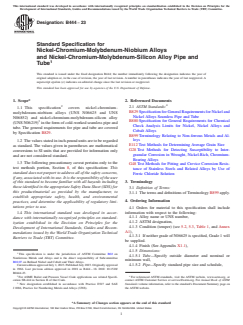
(Specification)Standard Specification for Nickel-Chromium-Molybdenum-Niobium Alloys and Nickel-Chromium-Molybdenum-Silicon Alloy Pipe and Tube
General Information
- Abstract
ABSTRACT
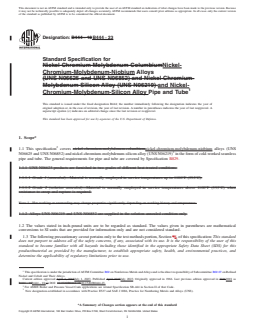
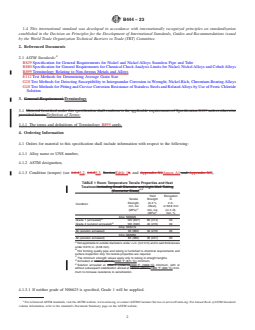
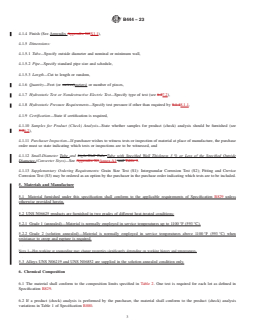
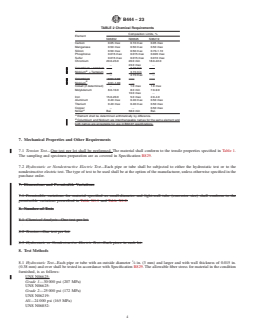
This specification covers UNS N06625 and UNS N06852 nickel-chromium-molybdenum-columbium alloys and UNS N06219 nickel-chromium-molybdenum-silicon alloy in the form of cold-worked seamless pipe and tube. UNS N06625 products are furnished in annealed Grade 1 and solution annealed Grade 2 while UNS N06219 and UNS N06852 are in solution annealed condition only. Chemical testing shall be performed on each type of material and shall conform to the chemical composition limits specified for carbon, manganese, silicon, phosphorus, sulfur, chromium, tantalum, columbium, cobalt, molybdenum, iron, aluminum, titanium, copper, and nickel. The material shall undergo tensile testing and shall conform to the required room temperature tensile properties like tensile strength, yield strength, and elongation depending on the heat treatment used and including small diameter and light-walled tubing. Each pipe or tube shall undergo hydrostatic testing and shall conform to the allowable fiber stress and also be examined with a nondestructive electric test as prescribed.
SCOPE
1.1 This specification2 covers nickel-chromium-molybdenum-niobium alloys (UNS N06625 and UNS N06852) and nickel-chromium-molybdenum-silicon alloy (UNS N06219)3 in the form of cold-worked seamless pipe and tube. The general requirements for pipe and tube are covered by Specification B829.
1.2 The values stated in inch-pound units are to be regarded as standard. The values given in parentheses are mathematical conversions to SI units that are provided for information only and are not considered standard.
1.3 The following precautionary caveat pertains only to the test methods portion, Section 8, of this specification: This standard does not purport to address all of the safety concerns, if any, associated with its use. It is the responsibility of the user of this standard to become familiar with all hazards including those identified in the appropriate Safety Data Sheet (SDS) for this product/material as provided by the manufacturer, to establish appropriate safety, health, and environmental practices, and determine the applicability of regulatory limitations prior to use.
1.4 This international standard was developed in accordance with internationally recognized principles on standardization established in the Decision on Principles for the Development of International Standards, Guides and Recommendations issued by the World Trade Organization Technical Barriers to Trade (TBT) Committee.
- Status
- Published
- Publication Date
- 30-Jun-2023
- Technical Committee
- B02 - Nonferrous Metals and Alloys
- Drafting Committee
- B02.07 - Refined Nickel and Cobalt and Their Alloys
Buy Documents
ASTM B444-23 - Standard Specification for Nickel-Chromium-Molybdenum-Niobium Alloys<brk/> and Nickel-Chromium-Molybdenum-Silicon Alloy Pipe and Tube
REDLINE ASTM B444-23 - Standard Specification for Nickel-Chromium-Molybdenum-Niobium Alloys<brk/> and Nickel-Chromium-Molybdenum-Silicon Alloy Pipe and Tube
Overview
ASTM B444-23 is the key standard specification for seamless pipes and tubes manufactured from nickel-chromium-molybdenum-niobium (UNS N06625 and UNS N06852) and nickel-chromium-molybdenum-silicon (UNS N06219) alloys. Issued by ASTM International, this standard outlines requirements for material composition, mechanical properties, test methods, and dimensional tolerances to ensure the quality and performance of pipe and tube products used in demanding environments. It is widely referenced by industries requiring high corrosion resistance and strength at elevated temperatures.
Key Topics
Material Grades and Types
- UNS N06625: Supplied in Grade 1 (annealed, for up to 1100°F/593°C) and Grade 2 (solution annealed, for above 1100°F/593°C).
- UNS N06852 and UNS N06219: Supplied only in the solution annealed condition.
Chemical Composition
- Strict limits on elements such as carbon, manganese, silicon, phosphorus, sulfur, chromium, niobium, cobalt, molybdenum, iron, aluminum, titanium, copper, and nickel.
Mechanical Properties
- Requirements for tensile strength, yield strength, and elongation, dependent on grade and heat treatment.
- Properties apply to both standard and small-diameter, light-wall tubing.
Testing Procedures
- Each lot must undergo chemical analysis and tensile testing.
- Every pipe or tube is subject to hydrostatic testing or nondestructive electric testing for integrity.
- Available optional supplementary tests: grain size, intergranular corrosion resistance, and pitting/crevice corrosion resistance.
Dimensional Standards
- Tolerances for outside and inside diameters, wall thickness, length, and straightness are defined, especially for small-diameter and light-wall tubing.
Ordering Details
- Purchasers must specify alloy, grade, dimensions, testing requirements, quantity, and preferred inspection procedures.
Applications
ASTM B444-23 seamless nickel alloy pipe and tube are essential in applications where both high strength and resistance to corrosion and heat are required. Typical industries and uses include:
- Chemical Processing: Pipes and tubes carry strong acids, solvents, and other corrosive substances.
- Aerospace and Power Generation: High-performance tubing for heat exchangers, condensers, and propulsion systems.
- Oil and Gas: Use in offshore and subsea equipment exposed to aggressive environments.
- Nuclear and Marine: Systems requiring material reliability under high stress and exposure to seawater or radiation.
- Pharmaceutical and Petrochemical: Tubing for clean-in-place systems, reactors, and high-purity applications.
By meeting ASTM B444-23, products demonstrate consistent quality, safety, and long-term reliability in critical operations where failure can be costly.
Related Standards
- ASTM B829: General requirements for nickel and nickel alloy seamless pipe and tube, referenced for baseline compliance.
- ASTM B880: Chemical check analysis limits for nickel, nickel alloys, and cobalt alloys.
- ASTM B899: Standard terminology relating to non-ferrous metals and alloys.
- ASTM E112: Test methods for determining average grain size.
- ASTM G28: Methods for detecting susceptibility to intergranular corrosion in nickel-rich alloys.
- ASTM G48: Pitting and crevice corrosion resistance testing using ferric chloride.
- ASME SB-444: Boiler and Pressure Vessel Code specification closely harmonized with ASTM B444.
Summary
ASTM B444-23 sets the definitive requirements for manufacturing and purchasing nickel-chromium-molybdenum-niobium and nickel-chromium-molybdenum-silicon alloy seamless pipes and tubes. Adherence to this standard ensures optimal material selection, quality assurance, and safe usage across a range of high-demand industries, supporting both regulatory compliance and superior operational performance.
Relations
- Effective Date
- 01-Apr-2019
- Effective Date
- 01-Nov-2018
- Effective Date
- 01-Apr-2017
- Effective Date
- 01-Oct-2016
- Effective Date
- 01-Oct-2015
- Effective Date
- 01-Oct-2014
- Effective Date
- 01-Feb-2013
- Effective Date
- 15-Nov-2012
- Effective Date
- 01-Sep-2011
- Effective Date
- 01-Nov-2010
- Effective Date
- 01-Oct-2009
- Effective Date
- 01-Oct-2009
- Effective Date
- 15-Apr-2009
- Effective Date
- 01-May-2008
- Effective Date
- 01-Mar-2008
Buy Documents
ASTM B444-23 - Standard Specification for Nickel-Chromium-Molybdenum-Niobium Alloys<brk/> and Nickel-Chromium-Molybdenum-Silicon Alloy Pipe and Tube
REDLINE ASTM B444-23 - Standard Specification for Nickel-Chromium-Molybdenum-Niobium Alloys<brk/> and Nickel-Chromium-Molybdenum-Silicon Alloy Pipe and Tube
Get Certified
Connect with accredited certification bodies for this standard

Element Materials Technology
Materials testing and product certification.

Inštitut za kovinske materiale in tehnologije
Institute of Metals and Technology. Materials testing, metallurgical analysis, NDT.
Sponsored listings
Frequently Asked Questions
ASTM B444-23 is a technical specification published by ASTM International. Its full title is "Standard Specification for Nickel-Chromium-Molybdenum-Niobium Alloys<brk/> and Nickel-Chromium-Molybdenum-Silicon Alloy Pipe and Tube". This standard covers: ABSTRACT This specification covers UNS N06625 and UNS N06852 nickel-chromium-molybdenum-columbium alloys and UNS N06219 nickel-chromium-molybdenum-silicon alloy in the form of cold-worked seamless pipe and tube. UNS N06625 products are furnished in annealed Grade 1 and solution annealed Grade 2 while UNS N06219 and UNS N06852 are in solution annealed condition only. Chemical testing shall be performed on each type of material and shall conform to the chemical composition limits specified for carbon, manganese, silicon, phosphorus, sulfur, chromium, tantalum, columbium, cobalt, molybdenum, iron, aluminum, titanium, copper, and nickel. The material shall undergo tensile testing and shall conform to the required room temperature tensile properties like tensile strength, yield strength, and elongation depending on the heat treatment used and including small diameter and light-walled tubing. Each pipe or tube shall undergo hydrostatic testing and shall conform to the allowable fiber stress and also be examined with a nondestructive electric test as prescribed. SCOPE 1.1 This specification2 covers nickel-chromium-molybdenum-niobium alloys (UNS N06625 and UNS N06852) and nickel-chromium-molybdenum-silicon alloy (UNS N06219)3 in the form of cold-worked seamless pipe and tube. The general requirements for pipe and tube are covered by Specification B829. 1.2 The values stated in inch-pound units are to be regarded as standard. The values given in parentheses are mathematical conversions to SI units that are provided for information only and are not considered standard. 1.3 The following precautionary caveat pertains only to the test methods portion, Section 8, of this specification: This standard does not purport to address all of the safety concerns, if any, associated with its use. It is the responsibility of the user of this standard to become familiar with all hazards including those identified in the appropriate Safety Data Sheet (SDS) for this product/material as provided by the manufacturer, to establish appropriate safety, health, and environmental practices, and determine the applicability of regulatory limitations prior to use. 1.4 This international standard was developed in accordance with internationally recognized principles on standardization established in the Decision on Principles for the Development of International Standards, Guides and Recommendations issued by the World Trade Organization Technical Barriers to Trade (TBT) Committee.
ABSTRACT This specification covers UNS N06625 and UNS N06852 nickel-chromium-molybdenum-columbium alloys and UNS N06219 nickel-chromium-molybdenum-silicon alloy in the form of cold-worked seamless pipe and tube. UNS N06625 products are furnished in annealed Grade 1 and solution annealed Grade 2 while UNS N06219 and UNS N06852 are in solution annealed condition only. Chemical testing shall be performed on each type of material and shall conform to the chemical composition limits specified for carbon, manganese, silicon, phosphorus, sulfur, chromium, tantalum, columbium, cobalt, molybdenum, iron, aluminum, titanium, copper, and nickel. The material shall undergo tensile testing and shall conform to the required room temperature tensile properties like tensile strength, yield strength, and elongation depending on the heat treatment used and including small diameter and light-walled tubing. Each pipe or tube shall undergo hydrostatic testing and shall conform to the allowable fiber stress and also be examined with a nondestructive electric test as prescribed. SCOPE 1.1 This specification2 covers nickel-chromium-molybdenum-niobium alloys (UNS N06625 and UNS N06852) and nickel-chromium-molybdenum-silicon alloy (UNS N06219)3 in the form of cold-worked seamless pipe and tube. The general requirements for pipe and tube are covered by Specification B829. 1.2 The values stated in inch-pound units are to be regarded as standard. The values given in parentheses are mathematical conversions to SI units that are provided for information only and are not considered standard. 1.3 The following precautionary caveat pertains only to the test methods portion, Section 8, of this specification: This standard does not purport to address all of the safety concerns, if any, associated with its use. It is the responsibility of the user of this standard to become familiar with all hazards including those identified in the appropriate Safety Data Sheet (SDS) for this product/material as provided by the manufacturer, to establish appropriate safety, health, and environmental practices, and determine the applicability of regulatory limitations prior to use. 1.4 This international standard was developed in accordance with internationally recognized principles on standardization established in the Decision on Principles for the Development of International Standards, Guides and Recommendations issued by the World Trade Organization Technical Barriers to Trade (TBT) Committee.
ASTM B444-23 is classified under the following ICS (International Classification for Standards) categories: 77.150.40 - Nickel and chromium products. The ICS classification helps identify the subject area and facilitates finding related standards.
ASTM B444-23 has the following relationships with other standards: It is inter standard links to ASTM B829-19, ASTM B829-18, ASTM B829-04a(2017), ASTM B899-16, ASTM B899-15, ASTM B899-14, ASTM B899-13, ASTM E112-12, ASTM G48-11, ASTM E112-10, ASTM B899-09, ASTM B899-09e1, ASTM B829-04a(2009), ASTM G28-02(2008), ASTM B880-03(2008). Understanding these relationships helps ensure you are using the most current and applicable version of the standard.
ASTM B444-23 is available in PDF format for immediate download after purchase. The document can be added to your cart and obtained through the secure checkout process. Digital delivery ensures instant access to the complete standard document.
Standards Content (Sample)
This international standard was developed in accordance with internationally recognized principles on standardization established in the Decision on Principles for the
Development of International Standards, Guides and Recommendations issued by the World Trade Organization Technical Barriers to Trade (TBT) Committee.
Designation: B444 − 23
Standard Specification for
Nickel-Chromium-Molybdenum-Niobium Alloys
and Nickel-Chromium-Molybdenum-Silicon Alloy Pipe and
Tube
This standard is issued under the fixed designation B444; the number immediately following the designation indicates the year of
original adoption or, in the case of revision, the year of last revision. A number in parentheses indicates the year of last reapproval. A
superscript epsilon (´) indicates an editorial change since the last revision or reapproval.
This standard has been approved for use by agencies of the U.S. Department of Defense.
1. Scope* 2. Referenced Documents
2.1 ASTM Standards:
1.1 This specification covers nickel-chromium-
B829 Specification for General Requirements for Nickel and
molybdenum-niobium alloys (UNS N06625 and UNS
Nickel Alloys Seamless Pipe and Tube
N06852) and nickel-chromium-molybdenum-silicon alloy
3 B880 Specification for General Requirements for Chemical
(UNS N06219) in the form of cold-worked seamless pipe and
Check Analysis Limits for Nickel, Nickel Alloys and
tube. The general requirements for pipe and tube are covered
Cobalt Alloys
by Specification B829.
B899 Terminology Relating to Non-ferrous Metals and Al-
1.2 The values stated in inch-pound units are to be regarded loys
E112 Test Methods for Determining Average Grain Size
as standard. The values given in parentheses are mathematical
G28 Test Methods for Detecting Susceptibility to Inter-
conversions to SI units that are provided for information only
granular Corrosion in Wrought, Nickel-Rich, Chromium-
and are not considered standard.
Bearing Alloys
1.3 The following precautionary caveat pertains only to the
G48 Test Methods for Pitting and Crevice Corrosion Resis-
test methods portion, Section 8, of this specification: This
tance of Stainless Steels and Related Alloys by Use of
standard does not purport to address all of the safety concerns,
Ferric Chloride Solution
if any, associated with its use. It is the responsibility of the user
3. Terminology
of this standard to become familiar with all hazards including
those identified in the appropriate Safety Data Sheet (SDS) for
3.1 Definition of Terms:
this product/material as provided by the manufacturer, to
3.1.1 The terms and definitions of Terminology B899 apply.
establish appropriate safety, health, and environmental
4. Ordering Information
practices, and determine the applicability of regulatory limi-
tations prior to use.
4.1 Orders for material to this specification shall include
information with respect to the following:
1.4 This international standard was developed in accor-
4.1.1 Alloy name or UNS number,
dance with internationally recognized principles on standard-
4.1.2 ASTM designation,
ization established in the Decision on Principles for the
4.1.3 Condition (temper) (see 5.2, 5.3, Table 1, and Annex
Development of International Standards, Guides and Recom-
A1),
mendations issued by the World Trade Organization Technical
4.1.3.1 If neither grade of N06625 is specified, Grade 1 will
Barriers to Trade (TBT) Committee.
be supplied.
4.1.4 Finish (See Appendix X1.1),
4.1.5 Dimensions:
This specification is under the jurisdiction of ASTM Committee B02 on
4.1.5.1 Tube—Specify outside diameter and nominal or
Nonferrous Metals and Alloys and is the direct responsibility of Subcommittee
minimum wall,
B02.07 on Refined Nickel and Cobalt and Their Alloys.
4.1.5.2 Pipe—Specify standard pipe size and schedule,
Current edition approved July 1, 2023. Published July 2023. Originally approved
in 1966. Last previous edition approved in 2018 as B444 – 18. DOI: 10.1520/
B0444-23.
2 4
For ASME Boiler and Pressure Vessel Code applications see related Specifi- For referenced ASTM standards, visit the ASTM website, www.astm.org, or
cation SB-444 in Section II of that Code. contact ASTM Customer Service at service@astm.org. For Annual Book of ASTM
New designation established in accordance with Practice E527 and SAE Standards volume information, refer to the standard’s Document Summary page on
J 1086, Practice for Numbering Metals and Alloys (UNS). the ASTM website.
*A Summary of Changes section appears at the end of this standard
Copyright © ASTM International, 100 Barr Harbor Drive, PO Box C700, West Conshohocken, PA 19428-2959. United States
B444 − 23
TABLE 1 Room Temperature Tensile Properties and Heat
5.3 Alloys UNS N06219 and UNS N06852 are supplied in
A,B
Treatment
the solution annealed condition only.
Yield Elongation
Tensile Strength in
6. Chemical Composition
Strength, (0.2 % 2 in.
Condition
min, ksi offset), or 50.8 mm
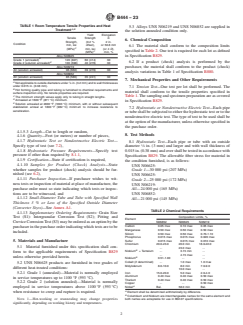
6.1 The material shall conform to the composition limits
C
(MPa) min, ksi (or 4 D),
C specified in Table 2. One test is required for each lot as defined
(MPa) min, %
Alloy N06625 in Specification B829.
D
Grade 1 (annealed) 120 (827) 60 (414) 30
E
6.2 If a product (check) analysis is performed by the
Grade 2 (solution annealed) 100 (690) 40 (276) 30
Alloy N06219
purchaser, the material shall conform to the product (check)
All (solution annealed) 96 (660) 39 (270) 30
analysis variations in Table 1 of Specification B880.
Alloy N06852
All (solution annealed) 85 (586) 35 (241) 30
7. Mechanical Properties and Other Requirements
A
Not applicable to outside diameters under ⁄8 in. (3.2 mm) and to wall thicknesses
under 0.015 in. (0.38 mm).
7.1 Tension Test—One test per lot shall be performed. The
B
Hot forming quality pipe and tubing is furnished to chemical requirements and
material shall conform to the tensile properties specified in
surface inspection only. No tensile properties are required.
C
Table 1. The sampling and specimen preparation are as covered
The minimum strength values apply only to tubing in straight lengths.
D
Annealed at 1600 °F (871 °C) minimum.
in Specification B829.
E
Solution annealed at 2000 °F (1093 °C) minimum, with or without subsequent
stabilization anneal at 1800 °F (982 °C) minimum to increase resistance to
7.2 Hydrostatic or Nondestructive Electric Test—Each pipe
sensitization.
or tube shall be subjected to either the hydrostatic test or to the
nondestructive electric test. The type of test to be used shall be
at the option of the manufacturer, unless otherwise specified in
the purchase order.
4.1.5.3 Length—Cut to length or random,
8. Test Methods
4.1.6 Quantity—Feet (or meters) or number of pieces,
4.1.7 Hydrostatic Test or Nondestructive Electric Test—
8.1 Hydrostatic Test—Each pipe or tube with an outside
Specify type of test (see 7.2),
diameter ⁄8 in. (3 mm) and larger and with wall thickness of
4.1.8 Hydrostatic Pressure Requirements—Specify test
0.015 in. (0.38 mm) and over shall be tested in accordance with
pressure if other than required by 8.1.1,
Specification B829. The allowable fiber stress for material in
4.1.9 Certification—State if certification is required,
the condition furnished, is as follows:
4.1.10 Samples for Product (Check) Analysis—State
UNS N06625:
whether samples for product (check) analysis should be fur-
Grade 1—30 000 psi (207 MPa)
nished (see 6.2),
UNS N06625:
4.1.11 Purchaser Inspection—If purchaser wishes to wit-
Grade 2—25 000 psi (172 MPa)
ness tests or inspection of material at place of manufacture, the
UNS N06219:
purchase order must so state indicating which tests or inspec-
All—24 000 psi (165 MPa)
tions are to be witnessed, and
UNS N06852:
4.1.12 Small-Diameter Tube and Tube with Specified Wall
All—21 000 psi (145 MPa)
Thickness 3 % or Less of the Specified Outside Diameter
(Converter Sizes)—See Annex A1.
TABLE 2 Chemical Requirements
4.1.13 Supplementary Ordering Requirements: Grain Size
Composition Limits, %
Test (S1): Intergranular Corrosion Test (S2); Pitting and
Element
N06852 N06625 N06219
Crevice Corrosion Test (S3) may be ordered as an option by the
Carbon 0.05 max 0.10 max 0.05 max
purchaser in the purchase order indicating which tests are to be
Manganese 0.50 max 0.50 max 0.50 max
included.
Silicon 0.50 max 0.50 max 0.70-1.10
Phosphorus 0.015 max 0.015 max 0.020 max
5. Materials and Manufacture Sulfur 0.015 max 0.015 max 0.010 max
Chromium 20.0-23.0 20.0 min 18.0-22.0
5.1 Material furnished under this specification shall con-
... 23.0 max ...
B
Niobium + Tantalum . 3.15 min .
form to the applicable requirements of Specification B829
... 4.15 max ...
unless otherwise provided herein.
B
Niobium 0.51-1.00 . .
Cobalt (if determined) . 1.0 max 1.0 max
5.2 UNS N06625 products are furnished in two grades of
Molybdenum 8.0-10.0 8.0 min 7.0-9.0
different heat-treated conditions:
10.0 max .
5.2.1 Grade 1 (annealed)—Material is normally employed Iron 15.0-20.0 5.0 max 2.0-4.0
Aluminum 0.40 max 0.40 max 0.50 max
in service temperatures up to 1100 °F (593 °C).
Titanium 0.40 max 0.40 max 0.50 max
5.2.2 Grade 2 (solution annealed)—Material is normally
Copper . . 0.50 max
A
Nickel Bal. 58.0 min Bal.
employed in service temperatures above 1100 °F (593 °C)
A
when resistance to creep and rupture is required.
Element shall be determined arithmetically by difference.
B
Columbium and Niobium are interchangeable names for the same element and
NOTE 1—Hot-working or reannealing may change properties
both names are acceptable for use in B02.07 specifications.
significantly, depending on working history and temperatures.
B444 − 23
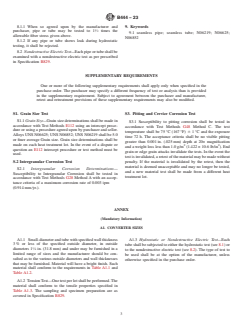
8.1.1 When so agreed upon by the manufacturer and 9. Keywords
purchaser, pipe or tube may be tested to 1 ⁄2 times the
9.1 seamless pipe; seamless tube; N06219; N06625;
allowable fiber stress given above.
N06852
8.1.2 If any pipe or tube shows leak during hydrostatic
testing, it shall be rejected.
8.2 Nondestructive Electric Test—Each pipe or tube shall be
examined with a nondestructive electric test as per prescribed
in Specification B829.
SUPPLEMENTARY REQUIREMENTS
One or more of the following supplementary requirements shall apply only when specified in the
purchase orde
...
This document is not an ASTM standard and is intended only to provide the user of an ASTM standard an indication of what changes have been made to the previous version. Because
it may not be technically possible to adequately depict all changes accurately, ASTM recommends that users consult prior editions as appropriate. In all cases only the current version
of the standard as published by ASTM is to be considered the official document.
Designation: B444 − 18 B444 − 23
Standard Specification for
Nickel-Chromium-Molybdenum-ColumbiumNickel-
Chromium-Molybdenum-Niobium Alloys
(UNS N06625 and UNS N06852) and Nickel-Chromium-
Molybdenum-Silicon Alloy (UNS N06219) and Nickel-
Chromium-Molybdenum-Silicon Alloy Pipe and Tube
This standard is issued under the fixed designation B444; the number immediately following the designation indicates the year of
original adoption or, in the case of revision, the year of last revision. A number in parentheses indicates the year of last reapproval. A
superscript epsilon (´) indicates an editorial change since the last revision or reapproval.
This standard has been approved for use by agencies of the U.S. Department of Defense.
1. Scope*
1.1 This specification covers nickel-chromium-molybdenum-columbiumnickel-chromium-molybdenum-niobium alloys (UNS
N06625 and UNS N06852) and nickel-chromium-molybdenum-silicon alloy (UNS N06219) in the form of cold-worked seamless
pipe and tube. The general requirements for pipe and tube are covered by Specification B829.
1.1.1 UNS N06625 products are furnished in two grades of different heat-treated conditions:
1.1.1.1 Grade 1 (annealed)—Material is normally employed in service temperatures up to 1100°F (593°C).
1.1.1.2 Grade 2 (solution annealed)—Material is normally employed in service temperatures above 1100°F (593°C) when
resistance to creep and rupture is required.
NOTE 1—Hot-working or reannealing may change properties significantly, depending on working history and temperatures.
1.1.2 Alloys UNS N06219 and UNS N06852 are supplied in the solution annealed condition only.
1.2 The values stated in inch-pound units are to be regarded as standard. The values given in parentheses are mathematical
conversions to SI units that are provided for information only and are not considered standard.
1.3 The following precautionary caveat pertains only to the test methods portion, Section 98, of this specification: This standard
does not purport to address all of the safety concerns, if any, associated with its use. It is the responsibility of the user of this
standard to become familiar with all hazards including those identified in the appropriate Safety Data Sheet (SDS) for this
product/material as provided by the manufacturer, to establish appropriate safety, health, and environmental practices, and
determine the applicability of regulatory limitations prior to use.
This specification is under the jurisdiction of ASTM Committee B02 on Nonferrous Metals and Alloys and is the direct responsibility of Subcommittee B02.07 on Refined
Nickel and Cobalt and Their Alloys.
Current edition approved April 1, 2018July 1, 2023. Published April 2018July 2023. Originally approved in 1966. Last previous edition approved in 20162018 as
ɛ1
B444 – 16B444 – 18. . DOI: 10.1520/B0444-18.10.1520/B0444-23.
For ASME Boiler and Pressure Vessel Code applications see related Specification SB-444 in Section II of that Code.
New designation established in accordance with Practice E527 and SAE J 1086, Practice for Numbering Metals and Alloys (UNS).
*A Summary of Changes section appears at the end of this standard
Copyright © ASTM International, 100 Barr Harbor Drive, PO Box C700, West Conshohocken, PA 19428-2959. United States
B444 − 23
1.4 This international standard was developed in accordance with internationally recognized principles on standardization
established in the Decision on Principles for the Development of International Standards, Guides and Recommendations issued
by the World Trade Organization Technical Barriers to Trade (TBT) Committee.
2. Referenced Documents
2.1 ASTM Standards:
B829 Specification for General Requirements for Nickel and Nickel Alloys Seamless Pipe and Tube
B880 Specification for General Requirements for Chemical Check Analysis Limits for Nickel, Nickel Alloys and Cobalt Alloys
B899 Terminology Relating to Non-ferrous Metals and Alloys
E112 Test Methods for Determining Average Grain Size
G28 Test Methods for Detecting Susceptibility to Intergranular Corrosion in Wrought, Nickel-Rich, Chromium-Bearing Alloys
G48 Test Methods for Pitting and Crevice Corrosion Resistance of Stainless Steels and Related Alloys by Use of Ferric Chloride
Solution
3. General Requirement Terminology
3.1 Material furnished under this specification shall conform to the applicable requirements of Specification B829 unless otherwise
provided herein.Definition of Terms:
3.1.1 The terms and definitions of Terminology B899 apply.
4. Ordering Information
4.1 Orders for material to this specification shall include information with respect to the following:
4.1.1 Alloy name or UNS number,
4.1.2 ASTM designation,
4.1.3 Condition (temper) (see 1.1.15.2, 1.1.25.3, SectionTable 16, and Appendix X1Annex A1 and Appendix X2),
TABLE 1 Room Temperature Tensile Properties and Heat
TreatmentIncluding Small Diameter and Light-Wall Tubing
A,B
(Converter Sizes)
Yield Elongation
Tensile Strength in
Strength, (0.2 % 2 in.
Condition
min, ksi offset), or 50.8 mm
C
(MPa) min, ksi (or 4 D),
C
(MPa) min, %
Alloy N06625
D
Grade 1 (annealed) 120 (827) 60 (414) 30
E
Grade 2 (solution annealed) 100 (690) 40 (276) 30
Alloy N06219
All (solution annealed) 96 (660) 39 (270) 30
Alloy N06852
All (solution annealed) 85 (586) 35 (241) 30
A
Not applicable to outside diameters under ⁄8 in. (3.2 mm) and to wall thicknesses
under 0.015 in. (0.38 mm).
B
Hot forming quality pipe and tubing is furnished to chemical requirements and
surface inspection only. No tensile properties are required.
C
The minimum strength values apply only to tubing in straight lengths.
D
Annealed at 1600°F (871°C)1600 °F (871 °C) minimum.
E
Solution annealed at 2000°F (1093°C)2000 °F (1093 °C) minimum, with or
without subsequent stabilization anneal at 1800°F (982°C)1800 °F (982 °C) mini-
mum to increase resistance to sensitization.
4.1.3.1 If neither grade of N06625 is specified, Grade 1 will be supplied.
For referenced ASTM standards, visit the ASTM website, www.astm.org, or contact ASTM Customer Service at service@astm.org. For Annual Book of ASTM Standards
volume information, refer to the standard’s Document Summary page on the ASTM website.
B444 − 23
4.1.4 Finish (See Appendix Appendix X2X1.1),
4.1.5 Dimensions:
4.1.5.1 Tube—Specify outside diameter and nominal or minimum wall,
4.1.5.2 Pipe—Specify standard pipe size and schedule,
4.1.5.3 Length—Cut to length or random,
4.1.6 Quantity—Feet (or metres)meters) or number of pieces,
4.1.7 Hydrostatic Test or Nondestructive Electric Test—Specify type of test (see 6.27.2),
4.1.8 Hydrostatic Pressure Requirements—Specify test pressure if other than required by 9.1.18.1.1,
4.1.9 Certification—State if certification is required,
4.1.10 Samples for Product (Check) Analysis—State whether samples for product (check) analysis should be furnished (see
5.26.2),
4.1.11 Purchaser Inspection—If purchaser wishes to witness tests or inspection of material at place of manufacture, the purchase
order must so state indicating which tests or inspections are to be witnessed, and
4.1.12 Small-Diameter Tube and Light-Wall Tube Tube with Specified Wall Thickness 3 % or Less of the Specified Outside
Diameter (Converter Sizes)—See Appendix X1Annex A1 and Table 1.
4.1.13 Supplementary Ordering Requirements: Grain Size Test (S1): Intergranular Corrosion Test (S2); Pitting and Crevice
Corrosion Test (S3) may be ordered as an option by the purchaser in the purchase order indicating which tests are to be included.
5. Materials and Manufacture
5.1 Material furnished under this specification shall conform to the applicable requirements of Specification B829 unless
otherwise provided herein.
5.2 UNS N06625 products are furnished in two grades of different heat-treated conditions:
5.2.1 Grade 1 (annealed)—Material is normally employed in service temperatures up to 1100 °F (593 °C).
5.2.2 Grade 2 (solution annealed)—Material is normally employed in service temperatures above 1100 °F (593 °C) when
resistance to creep and rupture is required.
NOTE 1—Hot-working or reannealing may change properties significantly, depending on working history and temperatures.
5.3 Alloys UNS N06219 and UNS N06852 are supplied in the solution annealed condition only.
6. Chemical Composition
6.1 The material shall conform to the composition limits specified in Table 2. One test is required for each lot as defined in
Specification B829.
6.2 If a product (check) analysis is performed by the purchaser, the material shall conform to the product (check) analysis
variations in Table 1 of Specification B880.
B444 − 23
TABLE 2 Chemical Requirements
Composition Limits, %
Element
N06852 N06625 N06219
Carbon 0.05 max 0.10 max 0.05 max
Manganese 0.50 max 0.50 max 0.50 max
Silicon 0.50 max 0.50 max 0.70-1.10
Phosphorus 0.015 max 0.015 max 0.020 max
Sulfur 0.015 max 0.015 max 0.010 max
Chromium 20.0-23.0 20.0 min 18.0-22.0
... 23.0 max ...
Columbium + tantalum . 3.15 min .
B
Niobium + Tantalum . 3.15 min .
... 4.15 max ...
Columbium 0.51-1.00 . .
B
Niobium 0.51-1.00 . .
Cobalt (if determined) . 1.0 max 1.0 max
Molybdenum 8.0-10.0 8.0 min 7.0-9.0
10.0 max .
Iron 15.0-20.0 5.0 max 2.0-4.0
Aluminum 0.40 max 0.40 max 0.50 max
Titanium 0.40 max 0.40 max 0.50 max
Copper . . 0.50 max
A
Nickel Bal. 58.0 min Bal.
A
Element shall be determined arithmetically by difference.
B
Columbium and Niobium are interchangeable names for the same element and
both names are acceptable for use in B02.07 specifications.
7. Mechanical Properties and Other Requirements
7.1 Tension Test—One test per lot shall be performed. The material shall conform to the tensile properties specified in Table 1.
The sampling and specimen preparation are as covered in Specification B829.
7.2 Hydrostatic or Nondestructive Electric Test—Each pipe or tube shall be subjected to either the hydrostatic test or to the
nondestructive electric test. The type of test to be used shall be at the option of the manufacturer, unless otherwise specified in the
purchase order.
7. Dimensions and Permissible Variations
7.1 Permissible variations for material specified as small-diameter and light-wall tube (converter size) shall conform to the
permissible variations prescribed in Table X1.1 and Table X1.2.
8. Number of Tests
8.1 Chemical Analysis—One test per lot.
8.2 Tension—One test per lot.
8.3 Hydrostatic or Nondestructive Electric Test—Each piece in each lot.
8. Test Methods
8.1 Hydrostatic Test—Each pipe or tube with an outside diameter ⁄8 in. (3 mm) and larger and with wall thickness of 0.015 in.
(0.38 mm) and over shall be tested in accordance with Specification B829. The allowable fiber stress for material in the condition
furnished, is as follows:
UNS N06625:
Grade 1—30 000 psi (207 MPa)
UNS N06625:
Grade 2—25 000 psi (172 MPa)
UNS N06219:
All—24 000 psi (165 MPa)
UNS N06852:
B444 − 23
All—21 000 psi (145 MPa)
8.1.1 When so agreed upon by the manufacturer and purchaser, pipe or tube may be tested to 1 ⁄2 times the allowable fiber stress
given above.
8.1.2 If any pipe or tube shows leak during hydrostatic testing, it
...