


ASTM F3039-23
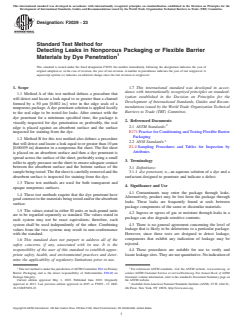
(Test Method)Standard Test Method for Detecting Leaks in Nonporous Packaging or Flexible Barrier Materials by Dye Penetration
Standard Test Method for Detecting Leaks in Nonporous Packaging or Flexible Barrier Materials by Dye Penetration
SIGNIFICANCE AND USE
4.1 Contaminants may enter the package through leaks. Alternatively, product may be lost from the package through leaks. These leaks are frequently found at seals between package components of the same or dissimilar materials.
4.2 Ingress or egress of gas or moisture through leaks in a package can also degrade sensitive contents.
4.3 There is no general agreement concerning the level of leakage that is likely to be deleterious to a particular package. However, since these tests are designed to detect leakage, components that exhibit any indication of leakage may be rejected.
4.4 These procedures are suitable for use to verify and locate leakage sites. They are not quantitative. No indication of leak size can be inferred from the test. Therefore, this method is employed as a go/no-go test.
4.5 These tests are destructive. No package or component test samples exposed to dye penetration testing may be used for final product packaging.
SCOPE
1.1 Method A of this test method defines a procedure that will detect and locate a leak equal to or greater than a channel formed by a 50 µm [0.002 in.] wire in the edge seals of a nonporous package. A dye penetrant solution is applied locally to the seal edge to be tested for leaks. After contact with the dye penetrant for a minimum specified time, the package is visually inspected for dye penetration or, preferably, the seal edge is placed against an absorbent surface and the surface inspected for staining from the dye.
1.2 Method B for this test method also defines a procedure that will detect and locate a leak equal to or greater than 10 µm [0.00039 in] diameter in a nonporous flat sheet. The flat sheet is placed on an absorbent surface and then a dye penetrant is spread across the surface of the sheet, preferably using a small roller to apply pressure on the sheet to ensure adequate contact between the absorbent surface and the bottom surface of the sample being tested. The flat sheet is carefully removed and the absorbent surface is inspected for staining from the dye.
1.3 These test methods are used for both transparent and opaque nonporous surfaces.
1.4 These test methods require that the dye penetrant have good contrast to the materials being tested and/or the absorbent surface.
1.5 The values stated in either SI units or inch-pound units are to be regarded separately as standard. The values stated in each system may not be exact equivalents; therefore, each system shall be used independently of the other. Combining values from the two systems may result in non-conformance with the standard.
1.6 This standard does not purport to address all of the safety concerns, if any, associated with its use. It is the responsibility of the user of this standard to establish appropriate safety, health, and environmental practices and determine the applicability of regulatory limitations prior to use.
1.7 This international standard was developed in accordance with internationally recognized principles on standardization established in the Decision on Principles for the Development of International Standards, Guides and Recommendations issued by the World Trade Organization Technical Barriers to Trade (TBT) Committee.
General Information
- Status
- Published
- Publication Date
- 30-Apr-2023
- Technical Committee
- F02 - Primary Barrier Packaging
- Drafting Committee
- F02.40 - Package Integrity
Relations
- Effective Date
- 01-Apr-2007
- Effective Date
- 15-Nov-1994
Overview
ASTM F3039-23: Standard Test Method for Detecting Leaks in Nonporous Packaging or Flexible Barrier Materials by Dye Penetration provides procedures for identifying leaks in nonporous packaging using dye penetration techniques. Originating from ASTM International, this standard is essential for ensuring the integrity of flexible barrier packaging used across pharmaceuticals, food, medical devices, and other sensitive products. By locating and confirming leaks, this method helps prevent contamination, preserve product quality, and maintain compliance with regulatory requirements.
Key Topics
- Leak Detection Methods: ASTM F3039-23 describes two primary test methods:
- Method A: Detects and locates leaks as small as channels formed by a 50 µm (0.002 in.) wire in edge seals.
- Method B: Identifies leaks or pinholes as small as 10 µm (0.00039 in.) diameter in nonporous flat sheets.
- Dye Penetrant Application: A dye penetrant solution is applied to the packaging or material surface. Penetration of dye through a leak is visually inspected by observing staining on an absorbent surface.
- Qualitative, Non-Quantitative Results: This standard provides a go/no-go outcome. While it is effective in pinpointing the presence or location of leaks, it does not quantify the leak size.
- Destructive Testing: Samples tested by dye penetration methods cannot be used for final product packaging, as the process is destructive.
- Material Compatibility: These methods are applicable to both transparent and opaque nonporous packaging materials.
- Contrast Requirements: The dye must provide sufficient visual contrast against both the test material and the absorbent surface to ensure detection.
Applications
ASTM F3039-23 is widely used in the packaging industry to support quality assurance and regulatory compliance. Key applications include:
- Healthcare Packaging: Verifying seal integrity in sterile medical device containers, pharmaceutical blister packs, and IV bags to prevent contamination and preserve product efficacy.
- Food Packaging: Ensuring leak-free seals and surfaces in flexible pouches, trays, and vacuum packaging to prolong shelf life and maintain safety.
- Industrial Packaging: Evaluating nonporous flexible packages used for chemicals and sensitive components.
- Process Validation and Quality Control: Supporting routine inspection of packaging lines and lot validation to comply with industry and regulatory standards.
- R&D and Material Development: Assessing the performance of new barrier materials or packaging designs under simulated real-world conditions.
Related Standards
Several standards and guidelines are related to packaging integrity and leak detection:
- ASTM E171: Practice for Conditioning and Testing Flexible Barrier Packaging, referenced in F3039 for conditioning guidance.
- ANSI/ASQ Z1.4: Sampling Procedures and Tables for Inspection by Attributes, referenced for appropriate sample size and inspection planning.
- ISO 11607-1 and 11607-2: International standards for packaging for terminally sterilized medical devices, often used alongside ASTM test methods.
- ASTM F1929: Standard Test Method for Detecting Seal Leaks in Porous Medical Packaging by Dye Penetration, applicable to porous packaging.
Adoption of ASTM F3039-23 enables manufacturers and quality control professionals to enhance risk management, deliver consistent product protection, and satisfy regulatory and customer expectations for packaging performance.
Keywords: ASTM F3039-23, leak detection, dye penetration, flexible barrier packaging, nonporous packaging, packaging integrity, seal integrity, pinhole leaks, quality control, packaging standards.
Buy Documents
ASTM F3039-23 - Standard Test Method for Detecting Leaks in Nonporous Packaging or Flexible Barrier Materials by Dye Penetration
REDLINE ASTM F3039-23 - Standard Test Method for Detecting Leaks in Nonporous Packaging or Flexible Barrier Materials by Dye Penetration
Get Certified
Connect with accredited certification bodies for this standard

BRCGS (Brand Reputation Compliance Global Standards)
Global food safety and quality standards owner.
Sponsored listings
Frequently Asked Questions
ASTM F3039-23 is a standard published by ASTM International. Its full title is "Standard Test Method for Detecting Leaks in Nonporous Packaging or Flexible Barrier Materials by Dye Penetration". This standard covers: SIGNIFICANCE AND USE 4.1 Contaminants may enter the package through leaks. Alternatively, product may be lost from the package through leaks. These leaks are frequently found at seals between package components of the same or dissimilar materials. 4.2 Ingress or egress of gas or moisture through leaks in a package can also degrade sensitive contents. 4.3 There is no general agreement concerning the level of leakage that is likely to be deleterious to a particular package. However, since these tests are designed to detect leakage, components that exhibit any indication of leakage may be rejected. 4.4 These procedures are suitable for use to verify and locate leakage sites. They are not quantitative. No indication of leak size can be inferred from the test. Therefore, this method is employed as a go/no-go test. 4.5 These tests are destructive. No package or component test samples exposed to dye penetration testing may be used for final product packaging. SCOPE 1.1 Method A of this test method defines a procedure that will detect and locate a leak equal to or greater than a channel formed by a 50 µm [0.002 in.] wire in the edge seals of a nonporous package. A dye penetrant solution is applied locally to the seal edge to be tested for leaks. After contact with the dye penetrant for a minimum specified time, the package is visually inspected for dye penetration or, preferably, the seal edge is placed against an absorbent surface and the surface inspected for staining from the dye. 1.2 Method B for this test method also defines a procedure that will detect and locate a leak equal to or greater than 10 µm [0.00039 in] diameter in a nonporous flat sheet. The flat sheet is placed on an absorbent surface and then a dye penetrant is spread across the surface of the sheet, preferably using a small roller to apply pressure on the sheet to ensure adequate contact between the absorbent surface and the bottom surface of the sample being tested. The flat sheet is carefully removed and the absorbent surface is inspected for staining from the dye. 1.3 These test methods are used for both transparent and opaque nonporous surfaces. 1.4 These test methods require that the dye penetrant have good contrast to the materials being tested and/or the absorbent surface. 1.5 The values stated in either SI units or inch-pound units are to be regarded separately as standard. The values stated in each system may not be exact equivalents; therefore, each system shall be used independently of the other. Combining values from the two systems may result in non-conformance with the standard. 1.6 This standard does not purport to address all of the safety concerns, if any, associated with its use. It is the responsibility of the user of this standard to establish appropriate safety, health, and environmental practices and determine the applicability of regulatory limitations prior to use. 1.7 This international standard was developed in accordance with internationally recognized principles on standardization established in the Decision on Principles for the Development of International Standards, Guides and Recommendations issued by the World Trade Organization Technical Barriers to Trade (TBT) Committee.
SIGNIFICANCE AND USE 4.1 Contaminants may enter the package through leaks. Alternatively, product may be lost from the package through leaks. These leaks are frequently found at seals between package components of the same or dissimilar materials. 4.2 Ingress or egress of gas or moisture through leaks in a package can also degrade sensitive contents. 4.3 There is no general agreement concerning the level of leakage that is likely to be deleterious to a particular package. However, since these tests are designed to detect leakage, components that exhibit any indication of leakage may be rejected. 4.4 These procedures are suitable for use to verify and locate leakage sites. They are not quantitative. No indication of leak size can be inferred from the test. Therefore, this method is employed as a go/no-go test. 4.5 These tests are destructive. No package or component test samples exposed to dye penetration testing may be used for final product packaging. SCOPE 1.1 Method A of this test method defines a procedure that will detect and locate a leak equal to or greater than a channel formed by a 50 µm [0.002 in.] wire in the edge seals of a nonporous package. A dye penetrant solution is applied locally to the seal edge to be tested for leaks. After contact with the dye penetrant for a minimum specified time, the package is visually inspected for dye penetration or, preferably, the seal edge is placed against an absorbent surface and the surface inspected for staining from the dye. 1.2 Method B for this test method also defines a procedure that will detect and locate a leak equal to or greater than 10 µm [0.00039 in] diameter in a nonporous flat sheet. The flat sheet is placed on an absorbent surface and then a dye penetrant is spread across the surface of the sheet, preferably using a small roller to apply pressure on the sheet to ensure adequate contact between the absorbent surface and the bottom surface of the sample being tested. The flat sheet is carefully removed and the absorbent surface is inspected for staining from the dye. 1.3 These test methods are used for both transparent and opaque nonporous surfaces. 1.4 These test methods require that the dye penetrant have good contrast to the materials being tested and/or the absorbent surface. 1.5 The values stated in either SI units or inch-pound units are to be regarded separately as standard. The values stated in each system may not be exact equivalents; therefore, each system shall be used independently of the other. Combining values from the two systems may result in non-conformance with the standard. 1.6 This standard does not purport to address all of the safety concerns, if any, associated with its use. It is the responsibility of the user of this standard to establish appropriate safety, health, and environmental practices and determine the applicability of regulatory limitations prior to use. 1.7 This international standard was developed in accordance with internationally recognized principles on standardization established in the Decision on Principles for the Development of International Standards, Guides and Recommendations issued by the World Trade Organization Technical Barriers to Trade (TBT) Committee.
ASTM F3039-23 is classified under the following ICS (International Classification for Standards) categories: 55.040 - Packaging materials and accessories. The ICS classification helps identify the subject area and facilitates finding related standards.
ASTM F3039-23 has the following relationships with other standards: It is inter standard links to ASTM E171-94(2007), ASTM E171-94(2002). Understanding these relationships helps ensure you are using the most current and applicable version of the standard.
ASTM F3039-23 is available in PDF format for immediate download after purchase. The document can be added to your cart and obtained through the secure checkout process. Digital delivery ensures instant access to the complete standard document.
Standards Content (Sample)
This international standard was developed in accordance with internationally recognized principles on standardization established in the Decision on Principles for the
Development of International Standards, Guides and Recommendations issued by the World Trade Organization Technical Barriers to Trade (TBT) Committee.
Designation: F3039 − 23
Standard Test Method for
Detecting Leaks in Nonporous Packaging or Flexible Barrier
Materials by Dye Penetration
This standard is issued under the fixed designation F3039; the number immediately following the designation indicates the year of
original adoption or, in the case of revision, the year of last revision. A number in parentheses indicates the year of last reapproval. A
superscript epsilon (´) indicates an editorial change since the last revision or reapproval.
1. Scope 1.7 This international standard was developed in accor-
dance with internationally recognized principles on standard-
1.1 Method A of this test method defines a procedure that
ization established in the Decision on Principles for the
will detect and locate a leak equal to or greater than a channel
Development of International Standards, Guides and Recom-
formed by a 50 μm [0.002 in.] wire in the edge seals of a
mendations issued by the World Trade Organization Technical
nonporous package. A dye penetrant solution is applied locally
Barriers to Trade (TBT) Committee.
to the seal edge to be tested for leaks. After contact with the
dye penetrant for a minimum specified time, the package is
2. Referenced Documents
visually inspected for dye penetration or, preferably, the seal
2.1 ASTM Standards:
edge is placed against an absorbent surface and the surface
E171 Practice for Conditioning and Testing Flexible Barrier
inspected for staining from the dye.
Packaging
1.2 Method B for this test method also defines a procedure
2.2 ANSI Standards:
that will detect and locate a leak equal to or greater than 10 μm
Z1.4 Sampling Procedures and Tables for Inspection by
[0.00039 in] diameter in a nonporous flat sheet. The flat sheet
Attributes
is placed on an absorbent surface and then a dye penetrant is
spread across the surface of the sheet, preferably using a small
3. Terminology
roller to apply pressure on the sheet to ensure adequate contact
between the absorbent surface and the bottom surface of the 3.1 Definitions:
sample being tested. The flat sheet is carefully removed and the 3.1.1 dye penetrant, n—an aqueous solution of a dye and a
absorbent surface is inspected for staining from the dye. surfactant designed to penetrate and indicate a defect.
1.3 These test methods are used for both transparent and
4. Significance and Use
opaque nonporous surfaces.
4.1 Contaminants may enter the package through leaks.
1.4 These test methods require that the dye penetrant have
Alternatively, product may be lost from the package through
good contrast to the materials being tested and/or the absorbent
leaks. These leaks are frequently found at seals between
surface.
package components of the same or dissimilar materials.
1.5 The values stated in either SI units or inch-pound units
4.2 Ingress or egress of gas or moisture through leaks in a
are to be regarded separately as standard. The values stated in
package can also degrade sensitive contents.
each system may not be exact equivalents; therefore, each
4.3 There is no general agreement concerning the level of
system shall be used independently of the other. Combining
values from the two systems may result in non-conformance leakage that is likely to be deleterious to a particular package.
However, since these tests are designed to detect leakage,
with the standard.
components that exhibit any indication of leakage may be
1.6 This standard does not purport to address all of the
rejected.
safety concerns, if any, associated with its use. It is the
responsibility of the user of this standard to establish appro- 4.4 These procedures are suitable for use to verify and
priate safety, health, and environmental practices and deter- locate leakage sites. They are not quantitative. No indication of
mine the applicability of regulatory limitations prior to use.
1 2
This test method is under the jurisdiction of ASTM Committee F02 on Primary For referenced ASTM standards, visit the ASTM website, www.astm.org, or
Barrier Packaging and is the direct responsibility of Subcommittee F02.40 on contact ASTM Customer Service at service@astm.org. For Annual Book of ASTM
Package Integrity. Standards volume information, refer to the standard’s Document Summary page on
Current edition approved May 1, 2023. Published June 2023. Originally the ASTM website.
approved in 2013. Last previous edition approved in 2015 as F3039 – 15. DOI: Available from American National Standards Institute (ANSI), 25 W. 43rd St.,
10.1520/F3039-23. 4th Floor, New York, NY 10036, http://www.ansi.org.
Copyright © ASTM International, 100 Barr Harbor Drive, PO Box C700, West Conshohocken, PA 19428-2959. United States
F3039 − 23
leak size can be inferred from the test. Therefore, this method taken if this practice is chosen as it can result in puncture of the
is employed as a go/no-go test. skin with a contaminated needle. An alternative approach is to
dispense the dye penetrant via a flexible tube attached to a
4.5 These tests are destructive. No package or component
syringe through an opening formed with an appropriate cutting
test samples exposed to dye penetration testing may be used for
instrument.
final product packaging.
7. Test Specimen
5. Apparatus
7.1 The test specimen may consist of a complete packaged
5.1 Means of breaching one of the packaging materials such
product (blemished, rejected, or dummy devices may be used
as a small knife.
if they will not affect test results and are recorded prior to the
5.2 Dye Dispenser, such as an eyedropper or syringe for
test) to assess the package for channels in seals or leaks in the
injection of the dye penetrant solution, or for application of the
surface of the material. Empty packages, or edge seal samples
dye penetrant to the surface of the sheet sample for Method B.
or sheet material may also be used for testing for channels or
5.3 Microscope or optical loop with magnification of 5× to
leaks in the seals or leaks in the surface of the material.
20× (optional).
8. Calibration and Standardization
5.4 Absorbent Surface, such as a white chromatography
8.1 Because this test is not quantitative, calibration is not
paper, white filter paper, or white paper towels. Bright white
applicable.
printer or photocopier paper is preferred for the flat sheet
(Method B) test.
9. Sampling
NOTE 1—An embossed or uneven surface on the absorbent surface can
inhibit consistent contact between the bottom surface of the sample and
9.1 The number of samples tested should be adequate to be
the absorbent surface and can interfere with leak detection.
predictive of performance. Caution should be taken when
5.5 Roller or other means to ensure intimate contact of the
eliminating samples with defects as this can bias results. See
bottom of the sample being tested with the absorbent surface
ANSI/ASQ Z1.4.
(Method B only).
10. Conditioning
5.6 Aqueous dye penetrant solution consisting of a carrier, a
10.1 Packaging must be free of condensation or any other
surfactant, and an indicator dye. Ideally, the surfactant chosen
source of liquid water. Water already in the channel, hole, or
should be nonionic. The chemical properties of the surfactant
potential leak point may render them undetectable with a dye
should be as follows: surface tension between 30 mN ⁄m to
penetrant. If there is any indication that the package has been
33 mN ⁄m, hydrophilic ⁄lipophilic balance (HLB) greater than
exposed to any liquid, it must be thoroughly dried at its typical
10, and the critical micelle concentration (cmc) less than
storage temperature before testing.
2000 ppm.
Wetting agent/ 1.0 % to 10.2 See Practice E171 for conditioning guidance.
surfactant 3.0 %
A
Indicator dye Toluidine blue 0.05 %
11. Procedure
Carrier Distilled water 96.95 % to
98.95 %
11.1 Method A—Testing for channels or leaks in the seal:
A
The chemical name for Toluidine blue is 3-Amino-7-(dimethylamino)-2- 11.1.1 Inject dye penetrant into the package or along seal
methylphenothiazin-5-ium chloride.
edge at a volume of at least 0.25 ml per 25 mm [1 in.] of seal
length.
5.6.1 Because of the viscosity of many surfactants, the
preparation of the solution is most easily accomplished by first
NOTE 2—If puncturing the packaging to allow injection of the dye
taring a container with about 10 % of the required amount of
penetrant solution, care should be taken not to puncture through or
damage other package surfaces. Puncturing of the package is facilitated if
distilled water on a scale. The appropriate amount of surfactant
it is done adjacent to a dummy product inside the package. The product
is added to the distilled water by weight and the mixture gently
will provide a tenting effect that will separate the two sides of the package,
stirred. Vigorous stirring or shaking is not recommended as it
reducing the chance of accidental puncture of both sides.
may cause foaming that may be difficult to dissipate. Once the
11.1.2 Allow the dye penetrant solution to remain in contact
surfactant is dissolved, the remaining distilled water can then
with the seal edge for approximately 5 s. Channels will be
be added, followed by the toluidine blue dye.
detected within this time period.
5.6.2 The solution must remain homogeneous. If precipitate
11.1.3 If the package has a transparent side, the seal may be
is noted, the solution must be replaced.
examined visually through this side. An optical device with 5×
5.6.3 If substitutes for the toluidine blue or the surfactant, or
to 20× magnification may be used for detailed examination. If
both (including options that fall outside the above recom-
the package is opaque or if additional verification is desired,
mended surface tension, HLB, or CMC ranges) are used, their
the outside edge of the seal being tested should be placed
precision and bias must be experimentally determined.
against an absorbent surface for approximately 5 s. After
6. Safety Precautions
carefully lifting the package, examine the absorbent surface.
The presence of stains indicates a channel or leak.
6.1 Injecting dye penetrant into a package with a hypoder-
mic needle and syringe is a common method for performing
...
This document is not an ASTM standard and is intended only to provide the user of an ASTM standard an indication of what changes have been made to the previous version. Because
it may not be technically possible to adequately depict all changes accurately, ASTM recommends that users consult prior editions as appropriate. In all cases only the current version
of the standard as published by ASTM is to be considered the official document.
Designation: F3039 − 15 F3039 − 23
Standard Test Method for
Detecting Leaks in Nonporous Packaging or Flexible Barrier
Materials by Dye Penetration
This standard is issued under the fixed designation F3039; the number immediately following the designation indicates the year of
original adoption or, in the case of revision, the year of last revision. A number in parentheses indicates the year of last reapproval. A
superscript epsilon (´) indicates an editorial change since the last revision or reapproval.
1. Scope
1.1 Method A of this test method defines a procedure that will detect and locate a leak equal to or greater than a channel formed
by a 50 μm [0.002 in.] wire in the edge seals of a nonporous package. A dye penetrant solution is applied locally to the seal edge
to be tested for leaks. After contact with the dye penetrant for a minimum specified time, the package is visually inspected for dye
penetration or, preferably, the seal edge is placed against an absorbent surface and the surface inspected for staining from the dye.
1.2 Method B for this test method also defines a procedure that will detect and locate a leak equal to or greater than 10 μm
[0.00039 in] diameter in a nonporous flat sheet. The flat sheet is placed on an absorbent surface and then a dye penetrant is spread
across the surface of the sheet, preferably using a small roller to apply pressure on the sheet to ensure adequate contact between
the absorbent surface and the bottom surface of the sample being tested. The flat sheet is carefully removed and the absorbent
surface is inspected for staining from the dye.
1.3 These test methods are used for both transparent and opaque nonporous surfaces.
1.4 These test methods require that the dye penetrant have good contrast to the materials being tested and/or the absorbent surface.
1.5 The values stated in either SI units or inch-pound units are to be regarded separately as standard. The values stated in each
system may not be exact equivalents; therefore, each system shall be used independently of the other. Combining values from the
two systems may result in non-conformance with the standard.
1.6 This standard does not purport to address all of the safety concerns, if any, associated with its use. It is the responsibility
of the user of this standard to establish appropriate safety and healthsafety, health, and environmental practices and determine
the applicability of regulatory limitations prior to use.
1.7 This international standard was developed in accordance with internationally recognized principles on standardization
established in the Decision on Principles for the Development of International Standards, Guides and Recommendations issued
by the World Trade Organization Technical Barriers to Trade (TBT) Committee.
2. Referenced Documents
2.1 ASTM Standards:
E171 Practice for Conditioning and Testing Flexible Barrier Packaging
This test method is under the jurisdiction of ASTM Committee F02 on FlexiblePrimary Barrier Packaging and is the direct responsibility of Subcommittee F02.40 on
Package Integrity.
Current edition approved Nov. 1, 2015May 1, 2023. Published January 2015June 2023. Originally approved in 2013. Last previous edition approved in 20132015 as
F3039F3039 – 15.–13. DOI: 10.1520/F3039-15.10.1520/F3039-23.
For referenced ASTM standards, visit the ASTM website, www.astm.org, or contact ASTM Customer Service at service@astm.org. For Annual Book of ASTM Standards
volume information, refer to the standard’s Document Summary page on the ASTM website.
Copyright © ASTM International, 100 Barr Harbor Drive, PO Box C700, West Conshohocken, PA 19428-2959. United States
F3039 − 23
2.2 ANSI Standards:
Z1.4 Sampling Procedures and Tables for Inspection by Attributes
3. Terminology
3.1 Definitions:
3.1.1 dye penetrant—penetrant, n—an aqueous solution of a dye and a surfactant designed to penetrate and indicate a defect.
4. Significance and Use
4.1 Contaminants may enter the package through leaks. Alternatively, product may be lost from the package through leaks. These
leaks are frequently found at seals between package components of the same or dissimilar materials.
4.2 Ingress or egress of gas or moisture through leaks in a package can also degrade sensitive contents.
4.3 There is no general agreement concerning the level of leakage that is likely to be deleterious to a particular package. However,
since these tests are designed to detect leakage, components that exhibit any indication of leakage may be rejected.
4.4 These procedures are suitable for use to verify and locate leakage sites. They are not quantitative. No indication of leak size
can be inferred from the test. Therefore, this method is employed as a go/no-go test.
4.5 These tests are destructive. No package or component test samples exposed to dye penetration testing may be used for final
product packaging.
5. Apparatus
5.1 Means of breaching one of the packaging materials such as a small knife.
5.2 Dye Dispenser, such as an eyedropper or syringe for injection of the dye penetrant solution, or for application of the dye
penetrant to the surface of the sheet sample for Method B.
5.3 Microscope or optical loop with magnification of 5× to 20× (optional).
5.4 Absorbent Surface, such as a white chromatography paper, white filter paper, or white paper towels. Bright white printer or
photocopier paper is preferred for the flat sheet (Method B) test.
NOTE 1—An embossed or uneven surface on the absorbent surface can inhibit consistent contact between the bottom surface of the sample and the
absorbent surface and can interfere with leak detection.
5.5 Roller or other means to ensure intimate contact of the bottom of the sample being tested with the absorbent surface (Method
B only).
5.6 Aqueous dye penetrant solution consisting of a carrier, wetting agent, and indicator dye with a surface tension of 32a
surfactant, and an indicator dye. Ideally, the surfactant chosen should be nonionic. The chemical properties of the surfactant should
be as follows: surface tension between 30 mN dynes/cm or⁄m to 33 mN less.⁄m, hydrophilic One possible dye penetrant solution
formulation consists of, by weight:⁄lipophilic balance (HLB) greater than 10, and the critical micelle concentration (cmc) less than
2000 ppm.
A
Wetting agent Polyethylene glycol octylphenyl ether 3 %
B
Indicator dye Toluidine blue 0.05 %
Carrier Distilled water 96.95 %
Available from American National Standards Institute (ANSI), 25 W. 43rd St., 4th Floor, New York, NY 10036, http://www.ansi.org.
F3039 − 23
Wetting agent/ 1.0 % to
surfactant 3.0 %
A
Indicator dye Toluidine blue 0.05 %
Carrier Distilled water 96.95 % to
98.95 %
A
Polyethylene glycol octylphenyl ether is sold under the brand name Triton X-100.
A
The chemical name for Toluidine blue is 3-Amino-7-(dimethylamino)-2-methylphenothiazin-5-ium chloride.
5.6.1 Because of the viscosity of the polyethylene glycol octylphenyl ether, many surfactants, the preparation of the solution is
most easily accomplished by first taring a container with about 10 % 10 % of the required amount of distilled water on a scale.
The appropriate amount of polyethylene glycol octylphenyl ether surfactant is added to the distilled water by weight and the
mixture stirred or shaken. Once the polyethylene glycol octylphenyl ether gently stirred. Vigorous stirring or shaking is not
recommended as it may cause foaming that may be difficult to dissipate. Once the surfactant is dissolved, the remaining distilled
water can then be added, followed by the toluidine blue dye.
5.6.2 The solution must remain homogeneous. If precipitate is noted, the solution must be replaced.
5.6.3 If substitutes for the toluidine blue and/or Triton X-100 or the surfactant, or both (including options that fall outside the
above recommended surface tension, HLB, or CMC ranges) are used, their precision and bias must be experimentally determined.
6. Safety Precautions
6.1 Injecting dye penetrant into a package with a hypodermic needle and syringe is a common method for performing the seal
channel detection portion of this test. Caution should be taken if this practice is chosen as it can result in puncture of the skin with
a contaminated needle. An alternative approach is to dispense the dye penetrant via a flexible tube attached to a syringe through
an opening formed with an appropriate cutting instrument.
7. Test Specimen
7.1 The test specimen may consist of a complete packaged product (blemished, rejected, or dummy devices may be used if they
will not affect test results and are recorded prior to the test) to assess the package for channels in seals or leaks in the surface of
the material. Empty packages, or edge seal samples or sheet material may also be used for testing for channels or leaks in the seals
or leaks in the surface of the material.
8. Calibration and Standardization
8.1 Because this test is not quantitative, calibration is not applicable.
9. Sampling
9.1 The number of samples tested should be adequate to be predictive of performance. Caution should be taken when eliminating
samples with defects as this can bias results. See ANSI/ASQ Z1.4.
10. Conditioning
10.1 Packaging must be free of condensation or any other source of liquid water. Water already in the channel, hole, or potential
leak point may render them undetectable with a dye penetrant. If there is any indication that the package has been exposed to any
liquid, it must be thoroughly dried at its typical storage temperature before testing.
10.2 See Practice E171 for conditioning guidance.
11. Procedure
11.1 Method A—Testing for channels or leaks in the seal:
11.1.1 Inject dye penetrant into the package or along seal edge at a volume of at least 0.25 ml per 25 mm [1 in.] of seal length.
NOTE 2—If puncturing the packaging to allow injection of the dye penetrant solution, care should be taken not to puncture through or damage other
F3039 − 23
package surfaces. Puncturing of the package is facilitated if it is done adjacent to a dummy product inside the package. The product will provide a tenting
effect that will separate the two sides of the package, reducing the chance of accidental puncture of both sides.
11.1.2 Allow the dye penetrant solution to remain in contact with the seal edge for approximately 5 s. Channels will be detecte
...
Questions, Comments and Discussion
Ask us and Technical Secretary will try to provide an answer. You can facilitate discussion about the standard in here.
Loading comments...