


ASTM D352-97(2016)
(Test Method)Standard Test Methods for Pasted Mica Used in Electrical Insulation
Standard Test Methods for Pasted Mica Used in Electrical Insulation
SIGNIFICANCE AND USE
4.1 This test determines the compressive creep under laboratory conditions or under conditions that may be encountered during manufacture of electrical equipment. It has special significance if the material to be tested is applied as commutator segment insulation. It serves as a measure under specified conditions of the ability of the material to resist deformation while under compressive load, during exposure to elevated temperature for a specified time. This test is suitable for acceptance tests and for manufacturing control.
SCOPE
1.1 These test methods cover the testing of bonded mica splittings and bonded mica paper to be used for commutator insulation, hot molding, heater plates, and other similar insulating purposes.
1.2 These test methods appear in the following sections:
Test
Sections
Compressive Creep
4 – 10
Dielectric Strength
38 – 41
Mica or Binder Content
19
Molding Test
31 – 36
Organic Binder
20 – 24
Resistivity
42 – 46
Silicone Binder
25 – 30
Stability Under Heat and Pressure
11 – 18
1.3 The values stated in inch-pound units are to be regarded as standard. The values given in parentheses are mathematical conversions to SI units that are provided for information only and are not considered standard.
1.4 This standard does not purport to address all of the safety concerns, if any, associated with its use. It is the responsibility of the user of this standard to establish appropriate safety and health practices and determine the applicability of regulatory limitations prior to use. See 40.1 and 45.1 for specific hazard statements.
General Information
Buy Standard
Standards Content (Sample)
NOTICE: This standard has either been superseded and replaced by a new version or withdrawn.
Contact ASTM International (www.astm.org) for the latest information
Designation: D352 − 97 (Reapproved 2016)
Standard Test Methods for
Pasted Mica Used in Electrical Insulation
This standard is issued under the fixed designation D352; the number immediately following the designation indicates the year of
original adoption or, in the case of revision, the year of last revision. A number in parentheses indicates the year of last reapproval. A
superscript epsilon (´) indicates an editorial change since the last revision or reapproval.
1. Scope 3. Terminology
1.1 These test methods cover the testing of bonded mica
3.1 Definitions:
splittings and bonded mica paper to be used for commutator
3.1.1 For definitions of terms relating to electrical
insulation, hot molding, heater plates, and other similar insu-
insulation, refer to Terminology D1711.
lating purposes.
3.2 Definitions of Terms Specific to This Standard:
1.2 These test methods appear in the following sections:
3.2.1 binder content, n, (of pasted mica)—the percent by
Test Sections weight of binder relative to the original weight of a specimen
Compressive Creep 4 – 10
as determined by procedures specified herein.
Dielectric Strength 38 – 41
Mica or Binder Content 19 3.2.1.1 Discussion—Binder content includes any residual
Molding Test 31 – 36
solvent. Pasted mica materials not fully cured (such as molding
Organic Binder 20 – 24
and flexible plates) may contain appreciable quantities of
Resistivity 42 – 46
Silicone Binder 25 – 30
solvent in the binder. This solvent is usually later removed
Stability Under Heat and Pressure 11 – 18
when the material is cured in the manufacture of electrical
1.3 The values stated in inch-pound units are to be regarded
equipment. In such cases, the binder content after cure is less
as standard. The values given in parentheses are mathematical
(by the amount of solvent removed) than would be determined
conversions to SI units that are provided for information only
by this method. To determine the binder content after cure of
and are not considered standard.
materials that are not fully cured, but subsequently will be, it is
1.4 This standard does not purport to address all of the necessary, before initially weighing the specimen, to heat the
safety concerns, if any, associated with its use. It is the specimen for a time and at a temperature that depends upon the
responsibility of the user of this standard to establish appro-
material from which the specimen is prepared.
priate safety and health practices and determine the applica-
3.2.2 compressive creep, n—the change in thickness of a
bility of regulatory limitations prior to use. See 40.1 and 45.1
bonded micaceous material resulting from exposure to elevated
for specific hazard statements.
temperature for a specified time while a specimen is under a
specified compressive load.
2. Referenced Documents
3.2.3 mica content, n, (of pasted mica)—the percent by
2.1 ASTM Standards:
weight of mica relative to the original weight equal to 100 %
D149 Test Method for Dielectric Breakdown Voltage and
minus the binder content as determined by procedures specified
Dielectric Strength of Solid Electrical Insulating Materials
herein.
at Commercial Power Frequencies
D257 Test Methods for DC Resistance or Conductance of
COMPRESSIVE CREEP
Insulating Materials
D1711 Terminology Relating to Electrical Insulation
4. Significance and Use
4.1 This test determines the compressive creep under labo-
ratory conditions or under conditions that may be encountered
These test methods are under the jurisdiction of ASTM Committee D09 on
Electrical and Electronic Insulating Materials and are the direct responsibility of during manufacture of electrical equipment. It has special
Subcommittee D09.01 on Electrical Insulating Products.
significance if the material to be tested is applied as commu-
Current edition approved May 15, 2016. Published May 2016. Originally
ε1 tator segment insulation. It serves as a measure under specified
approved in 1932. Last previous edition approved in 2008 as D352 – 97 (2008) .
DOI: 10.1520/D0352-97R16. conditions of the ability of the material to resist deformation
For referenced ASTM standards, visit the ASTM website, www.astm.org, or
while under compressive load, during exposure to elevated
contact ASTM Customer Service at service@astm.org. For Annual Book of ASTM
temperature for a specified time. This test is suitable for
Standards volume information, refer to the standard’s Document Summary page on
the ASTM website. acceptance tests and for manufacturing control.
Copyright © ASTM International, 100 Barr Harbor Drive, PO Box C700, West Conshohocken, PA 19428-2959. United States
D352 − 97 (2016)
5. Apparatus 7.3 Remove the thermal insulation and, while maintaining
the pressure, allow the specimen to cool until the temperature
5.1 Hydraulic Press—A hydraulic press having temperature
is 5°C above the temperature (room ambient) at which the
controlled, electrically heated platens, or a press with other
original thickness was measured. Control the rate of cooling
provisions for heating the specimen and controlling the tem-
such that it does not exceed the rate at which the temperature
perature. The platens shall be at least 4 by 4 in. (102 by 102
was raised. Then determine the thickness of the stack while
mm) in size. The press shall be capable of exerting a force of
under 1000-psi compressive load.
at least 4000 lb (18 kN). The apparatus shall be capable of
NOTE 1—Experience has shown that in order to cool the specimen to the
maintaining a specimen temperature of at least 200 6 5°C. It
specified temperature within a reasonable time, forced-cooling means
is preferable that the apparatus have platens with water ducts or
must be employed. It is suggested that a fan be initially utilized to force
other provisions for cooling the specimen. (See Note 1 in 7.3.)
air across the specimen for the first 5 min, after which cooling water may
be allowed to circulate in ducts provided in the platens. The rate of water
5.2 Pressure Gage—A pressure gage capable of determining
flow, if used, should be adjusted to give a cooling rate no greater than the
the pressure on the specimen with an accuracy of 65 %.
rate at which the specimen was initially heated.
5.3 Thickness Gage—A thickness gage capable of measur-
8. Calculation
ing the thickness of the specimen to the nearest 0.001 in. (0.025
8.1 Calculate the percentage compressive creep, C, as fol-
mm).
lows:
5.4 Potentiometer—Temperature measuring instrument and
C, % 5 T 2 T' /T 3 100 (1)
@~ ! #
a No. 30 AWG or smaller thermocouple with overall accuracy
of 6 2°C for measurement of specimen temperature.
where:
5.5 Steel Plates—Two 4 by 4-in. (102 by 102-mm) or larger
T = thickness of the stack at 1000 psi (7 MPa) before
polished steel plates of at least ⁄16-in. (1.6-mm) thickness, heating, and
surface ground so that the top and bottom surfaces of each T' = thickness of the stack at 1000 psi after heating.
piece are parallel, one plate each for the top and bottom of the
9. Report
test specimen.
9.1 Report the following information:
6. Test Specimen 9.1.1 The identity of the material,
9.1.2 The nominal thickness of the pasted mica,
6.1 The test specimen shall consist of a sufficient number of
9.1.3 The observed values of T and T',
pieces of bonded micaceous plate, 2 by 2 in. (51 by 51 mm) in
9.1.4 The percentage compressive creep, and
size, to form a stack approximately but not greater than 1.000
9.1.5 The specimen temperature.
in. (25.40 mm) in thickness. The pieces shall be selected so as
to be representative of the entire sheet. At least three specimens
10. Precision and Bias
shall be tested for each lot of material.
10.1 This method has been in use for many years but no
statement for precision has been made and no activity is
7. Procedure
planned to develop such a statement.
7.1 Center the stacked specimen between the 4 by 4-in. (102
10.2 A statement of bias is not possible due to a lack of a
by 102-mm) steel plates and then center this assembly in the
standard reference material.
press. Place the thermocouple between pieces near the middle
of the stack. Carefully align the stack to form a right parallel-
STABILITY UNDER HEAT AND PRESSURE
epiped. Apply a pressure of 1000 psi (7 MPa) to the specimen
surfaces, and carefully determine the average thickness of the 11. Scope
stack by means of the gage. Where inside gages are used,
11.1 The test for stability under heat and pressure deter-
measure the thickness at each of the four corners as close to the
mines mica or binder displacement, or both, under the specified
specimen as possible. Measurements shall be made within 5
conditions of test.
min.
12. Significance and Use
7.2 Pack approximately 2 in. (51 mm) of thermal insulation
12.1 This test serves as a measure of the ability of bonded
material around the specimen without disturbing it. Heat the
micaceous materials to maintain their physical integrity under
specimen to 160 6 5°C or 200 6 5°C as specified. The time
exposure to heat and pressure. It has special significance where
required to reach the specified temperature should be not less
the material to be tested is employed as commutator segment
than 30 min nor more than 75 min. The platen temperature
insulation. This test is suitable for acceptance tests and for
shall not exceed the specified temperature by more than the
manufacturing control.
specified tolerance. If the specimen is heated by other means,
the surrounding medium shall not exceed the specified tem-
13. Nature of Test
perature by more than the specified tolerance. Allow the
specimen to remain at the specified temperature for 2 h after 13.1 This test method utilizes the application of a shearing
reaching that temperature, and at the same time maintain the force as well as a compressive force, which is accomplished by
1000-psi pressure. placing the specimens between specified wedges, thereby
D352 − 97 (2016)
causing the applied force to resolve into compression and shear 5 +1, −0 min. Do not allow the platen temperature to exceed
components. This test is particularly useful for material used in the specimen temperature by more than 10°C.
commutator assemblies where shearing as well as compressive
16.3 Adjust both gages to read zero. Apply and hold a
forces are encountered. Test results are expressed quantita-
pressure of 4400 psi (30 MPa) within 5 s on the top and bottom
tively as units of linear deflection.
assembly surfaces and maintain for 15 min at the specified
temperature. Record the deflection as determined by the top
14. Apparatus
and bottom dial gages after 15 s, 30 s, 1, 2, 5, 10, and 15 min
14.1 Hydraulic Press, Pressure Gage, and Thermocouple as
beginning with the instant that the 4400 psi pressure is
described in Section 5, except that the hydraulic press shall be
obtained.
capable of producing a force of 26 400 lb (118 kN) on the
specimen,
17. Report
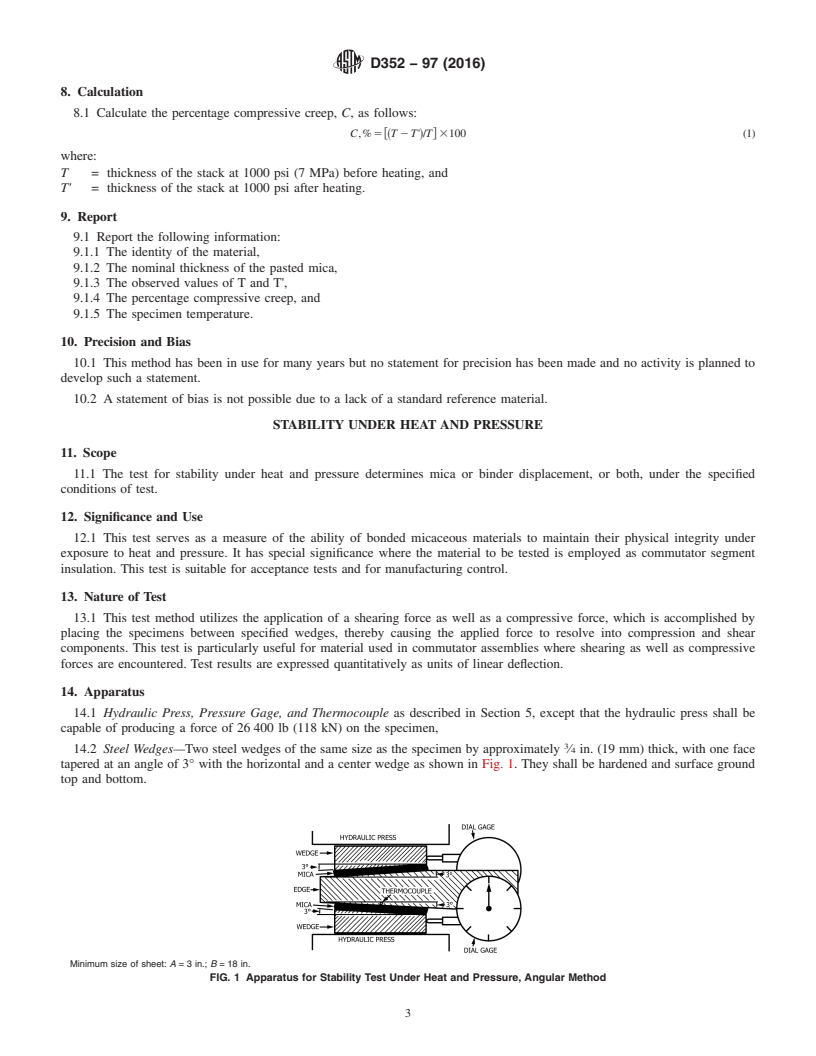
14.2 Steel Wedges—Two steel wedges of the same size as
17.1 Report the following information:
the specimen by approximately ⁄4 in. (19 mm) thick, with one
17.1.1 The identity of the material,
face tapered at an angle of 3° with the horizontal and a center
17.1.2 The dimensions of the specimen used,
wedge as shown in Fig. 1. They shall be hardened and surface
17.1.3 The temperature used, and
ground top and bottom.
17.1.4 The average deflection at each of the time intervals in
accordance with 16.3.
14.3 Dial Gages—Two dial gages having 0.001-in. (0.02-
mm) graduations and a range of at least ⁄2-in. (13-mm),
18. Precision and Bias
designed to be accurate at the specified test temperature, and
suitably mounted on the steel wedges described in 14.2. 18.1 See 10.1.
18.2 See 10.2.
NOTE 2—Where the dial gages are mounted through nonmetallic
bushings, or if some other suitable method is used to interrupt the metallic
thermal path, it shall not be necessary to utilize gages designed to be MICA OR BINDER CONTENT
accurate at the test temperature.
19. Significance and Use
15. Test Specimen
19.1 Physical (such as the ability to hot mold, flexibility)
15.1 The specimen shall consist of two rectangular pieces of
and electrical (such as dielectric strength, resistivity) properties
bonded micaceous plate between 4 and 6 in. (2580 and 3870
of bonded micaceous materials are affected, among other
mm ) in area, the shorter side being not less than 1 ⁄2 in. (38
things, by the proportional contents of the binder and mica. The
mm).
methods for mica or binder content are suitable for acceptance
tests and manufacturing control.
16. Procedure
ORGANIC BINDER
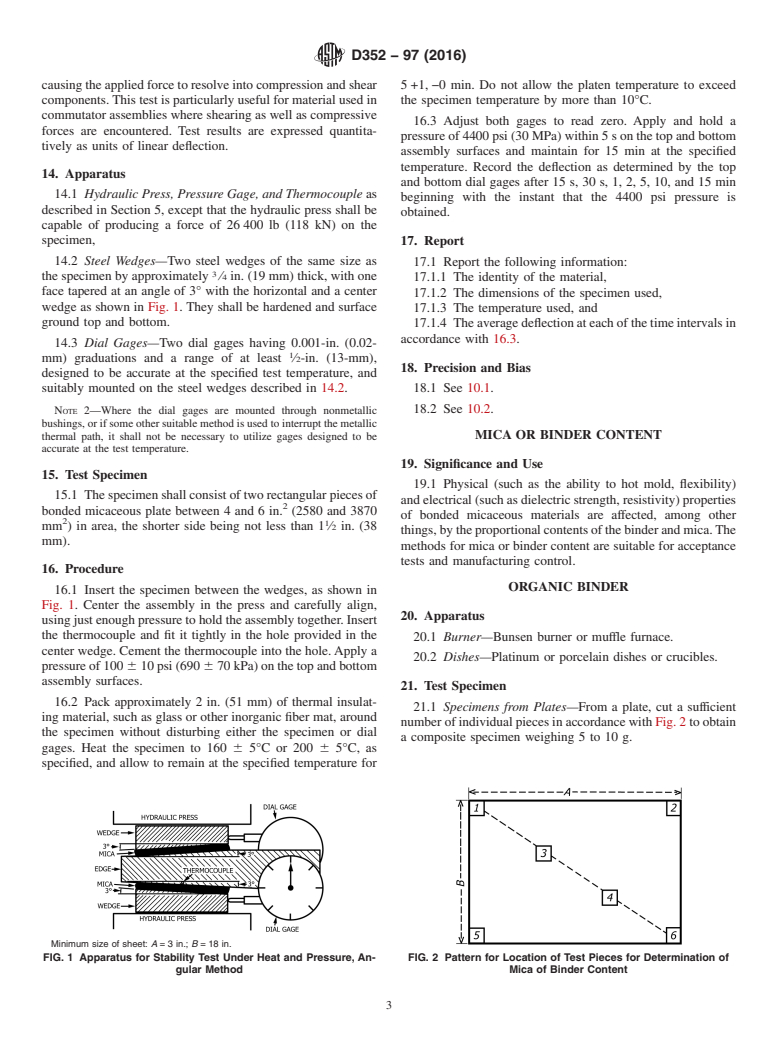
16.1 Insert the specimen between the wedges, as shown in
Fig. 1. Center the assembly in the press and carefully align,
20. Apparatus
using just enough pressure to hold the assembly together. Insert
the thermocouple and fit it tightly in the hole provided in the
20.1 Burner—Bunsen burner or muffle furnace.
center wedge. Cement the thermocouple into the hole. Apply a
20.2 Dishes—Platinum or porcelain dishes or crucibles.
pressure of 100 6 10 psi (690 6 70 kPa) on the top and bottom
assembly surfaces.
21. Test Specimen
16.2 Pack approximately 2 in. (51 mm) of thermal insulat-
21.1 Specimens from Plates—From a plate, cut a sufficient
ing material, such as glass or other inorganic fiber mat, around
number of individual pieces in accordance with Fig. 2 to obtain
the specimen without disturbing either the specimen or dial
a composite specimen weighing 5 to 10 g.
gages. Heat the specimen to 160 6 5°C or 200 6 5°C, as
specified, and allow to remain at the specified temperature for
Minimum size of sheet: A = 3 in.; B = 18 in.
FIG. 1 Apparatus for Stability Test Under Heat and Pressure, An- FIG. 2 Pattern for Location of Test Pieces for Determination of
gular Method Mica of Binder Content
D352 − 97 (2016)
21.2 Specimens From Fabricated Parts—From a lot, take a 26. Reagents
representative test specimen weighing 5 to 10 g.
26.1 Butyl Alcohol, normal, cp grade.
26.2 Toluol, cp grade.
22. Procedure
26.3 Alkaline Solvent—Dissolve about 5 g of potassium
22.1 Warning—This test method involves the use of heat to
hydroxide (KOH) (ACS grade) in 100-mL normal butyl
remove organic material which in a gaseous state may be
alcohol and add 400 mL of toluol.
hazardous. Conduct this test under a hood equipped with
adequate ventilation. Alternatively, a muffle furnace with an
26.4 Ethyl Alcohol, cp grade.
adequate exhaust system may be used to burn off the mica until
it is carbon free.
27. Test Specimen
22.2 Weigh each specimen to the nearest 0.001 g in a tared 27.1 Refer to Fig. 2. Cut sufficient material into pieces
dish or crucible.
approximately ⁄4 in. (6 mm) size to obtain a specimen of
...
This document is not an ASTM standard and is intended only to provide the user of an ASTM standard an indication of what changes have been made to the previous version. Because
it may not be technically possible to adequately depict all changes accurately, ASTM recommends that users consult prior editions as appropriate. In all cases only the current version
of the standard as published by ASTM is to be considered the official document.
´1
Designation: D352 − 97 (Reapproved 2008) D352 − 97 (Reapproved 2016)
Standard Test Methods for
Pasted Mica Used in Electrical Insulation
This standard is issued under the fixed designation D352; the number immediately following the designation indicates the year of
original adoption or, in the case of revision, the year of last revision. A number in parentheses indicates the year of last reapproval. A
superscript epsilon (´) indicates an editorial change since the last revision or reapproval.
ε NOTE—The units statement in subsection 1.4 was corrected editorially in July 2008.
1. Scope
1.1 These test methods cover the testing of bonded mica splittings and bonded mica paper to be used for commutator insulation,
hot molding, heater plates, and other similar insulating purposes.
1.2 These test methods appear in the following sections:
Test Sections
Compressive Creep 4 – 10
Dielectric Strength 38 – 41
Mica or Binder Content 19
Molding Test 31 – 36
Organic Binder 20 – 24
Resistivity 42 – 46
Silicone Binder 25 – 30
Stability Under Heat and Pressure 11 – 18
1.3 The values stated in inch-pound units are to be regarded as standard. The values given in parentheses are mathematical
conversions to SI units that are provided for information only and are not considered standard.
1.4 This standard does not purport to address all of the safety concerns, if any, associated with its use. It is the responsibility
of the user of this standard to establish appropriate safety and health practices and determine the applicability of regulatory
limitations prior to use. See 40.1 and 45.1 for specific hazard statements.
2. Referenced Documents
2.1 ASTM Standards:
D149 Test Method for Dielectric Breakdown Voltage and Dielectric Strength of Solid Electrical Insulating Materials at
Commercial Power Frequencies
D257 Test Methods for DC Resistance or Conductance of Insulating Materials
D1711 Terminology Relating to Electrical Insulation
3. Terminology
3.1 Definitions:
3.1.1 For definitions of terms relating to electrical insulation, refer to Terminology D1711.
3.2 Definitions of Terms Specific to This Standard:
3.2.1 binder content, n, (of pasted mica)—the percent by weight of binder relative to the original weight of a specimen as
determined by procedures specified herein.
These test methods are under the jurisdiction of ASTM Committee D09 on Electrical and Electronic Insulating Materials and are the direct responsibility of Subcommittee
D09.19 on Dielectric Sheet and Roll Products (Disbanded 4/2016).
Current edition approved May 1, 2008May 15, 2016. Published July 2008May 2016. Originally approved in 1932. Last previous edition approved in 20032008 as
ε1
D352 – 97 (2008) (2003). DOI: 10.1520/D0352-97R08E01.10.1520/D0352-97R16.
For referenced ASTM standards, visit the ASTM website, www.astm.org, or contact ASTM Customer Service at service@astm.org. For Annual Book of ASTM Standards
volume information, refer to the standard’s Document Summary page on the ASTM website.
3.2.1.1 Discussion—
Binder content includes any residual solvent. Pasted mica materials not fully cured (such as molding and flexible plates) may
contain appreciable quantities of solvent in the binder. This solvent is usually later removed when the material is cured in the
Copyright © ASTM International, 100 Barr Harbor Drive, PO Box C700, West Conshohocken, PA 19428-2959. United States
D352 − 97 (2016)
manufacture of electrical equipment. In such cases, the binder content after cure is less (by the amount of solvent removed) than
would be determined by this method. To determine the binder content after cure of materials that are not fully cured, but
subsequently will be, it is necessary, before initially weighing the specimen, to heat the specimen for a time and at a temperature
that depends upon the material from which the specimen is prepared.
3.2.2 compressive creep, n—the change in thickness of a bonded micaceous material resulting from exposure to elevated
temperature for a specified time while a specimen is under a specified compressive load.
3.2.3 mica content, n, (of pasted mica)—the percent by weight of mica relative to the original weight equal to 100 % minus the
binder content as determined by procedures specified herein.
COMPRESSIVE CREEP
4. Significance and Use
4.1 This test determines the compressive creep under laboratory conditions or under conditions that may be encountered during
manufacture of electrical equipment. It has special significance if the material to be tested is applied as commutator segment
insulation. It serves as a measure under specified conditions of the ability of the material to resist deformation while under
compressive load, during exposure to elevated temperature for a specified time. This test is suitable for acceptance tests and for
manufacturing control.
5. Apparatus
5.1 Hydraulic Press—A hydraulic press having temperature controlled, electrically heated platens, or a press with other
provisions for heating the specimen and controlling the temperature. The platens shall be at least 4 by 4 in. (102 by 102 mm) in
size. The press shall be capable of exerting a force of at least 4000 lb (18 kN). The apparatus shall be capable of maintaining a
specimen temperature of at least 200 6 5°C. It is preferable that the apparatus have platens with water ducts or other provisions
for cooling the specimen. (See Note 1 in 7.3.)
5.2 Pressure Gage—A pressure gage capable of determining the pressure on the specimen with an accuracy of 65 %.
5.3 Thickness Gage—A thickness gage capable of measuring the thickness of the specimen to the nearest 0.001 in. (0.025 mm).
5.4 Potentiometer—Temperature measuring instrument and a No. 30 AWG or smaller thermocouple with overall accuracy of
6 2°C for measurement of specimen temperature.
5.5 Steel Plates—Two 4 by 4-in. (102 by 102-mm) or larger polished steel plates of at least ⁄16-in. (1.6-mm) thickness, surface
ground so that the top and bottom surfaces of each piece are parallel, one plate each for the top and bottom of the test specimen.
6. Test Specimen
6.1 The test specimen shall consist of a sufficient number of pieces of bonded micaceous plate, 2 by 2 in. (51 by 51 mm) in
size, to form a stack approximately but not greater than 1.000 in. (25.40 mm) in thickness. The pieces shall be selected so as to
be representative of the entire sheet. At least three specimens shall be tested for each lot of material.
7. Procedure
7.1 Center the stacked specimen between the 4 by 4-in. (102 by 102-mm) steel plates and then center this assembly in the press.
Place the thermocouple between pieces near the middle of the stack. Carefully align the stack to form a right parallelepiped. Apply
a pressure of 1000 psi (7 MPa) to the specimen surfaces, and carefully determine the average thickness of the stack by means of
the gage. Where inside gages are used, measure the thickness at each of the four corners as close to the specimen as possible.
Measurements shall be made within 5 min.
7.2 Pack approximately 2 in. (51 mm) of thermal insulation material around the specimen without disturbing it. Heat the
specimen to 160 6 5°C or 200 6 5°C as specified. The time required to reach the specified temperature should be not less than
30 min nor more than 75 min. The platen temperature shall not exceed the specified temperature by more than the specified
tolerance. If the specimen is heated by other means, the surrounding medium shall not exceed the specified temperature by more
than the specified tolerance. Allow the specimen to remain at the specified temperature for 2 h after reaching that temperature, and
at the same time maintain the 1000-psi pressure.
7.3 Remove the thermal insulation and, while maintaining the pressure, allow the specimen to cool until the temperature is 5°C
above the temperature (room ambient) at which the original thickness was measured. Control the rate of cooling such that it does
not exceed the rate at which the temperature was raised. Then determine the thickness of the stack while under 1000-psi
compressive load.
NOTE 1—Experience has shown that in order to cool the specimen to the specified temperature within a reasonable time, forced-cooling means must
be employed. It is suggested that a fan be initially utilized to force air across the specimen for the first 5 min, after which cooling water may be allowed
to circulate in ducts provided in the platens. The rate of water flow, if used, should be adjusted to give a cooling rate no greater than the rate at which
the specimen was initially heated.
D352 − 97 (2016)
8. Calculation
8.1 Calculate the percentage compressive creep, C, as follows:
C,%5 T 2 T' /T 3100 (1)
@~ ! #
where:
T = thickness of the stack at 1000 psi (7 MPa) before heating, and
T' = thickness of the stack at 1000 psi after heating.
9. Report
9.1 Report the following information:
9.1.1 The identity of the material,
9.1.2 The nominal thickness of the pasted mica,
9.1.3 The observed values of T and T',
9.1.4 The percentage compressive creep, and
9.1.5 The specimen temperature.
10. Precision and Bias
10.1 This method has been in use for many years but no statement for precision has been made and no activity is planned to
develop such a statement.
10.2 A statement of bias is not possible due to a lack of a standard reference material.
STABILITY UNDER HEAT AND PRESSURE
11. Scope
11.1 The test for stability under heat and pressure determines mica or binder displacement, or both, under the specified
conditions of test.
12. Significance and Use
12.1 This test serves as a measure of the ability of bonded micaceous materials to maintain their physical integrity under
exposure to heat and pressure. It has special significance where the material to be tested is employed as commutator segment
insulation. This test is suitable for acceptance tests and for manufacturing control.
13. Nature of Test
13.1 This test method utilizes the application of a shearing force as well as a compressive force, which is accomplished by
placing the specimens between specified wedges, thereby causing the applied force to resolve into compression and shear
components. This test is particularly useful for material used in commutator assemblies where shearing as well as compressive
forces are encountered. Test results are expressed quantitatively as units of linear deflection.
14. Apparatus
14.1 Hydraulic Press, Pressure Gage, and Thermocouple as described in Section 5, except that the hydraulic press shall be
capable of producing a force of 26 400 lb (118 kN) on the specimen,
14.2 Steel Wedges—Two steel wedges of the same size as the specimen by approximately ⁄4 in. (19 mm) thick, with one face
tapered at an angle of 3° with the horizontal and a center wedge as shown in Fig. 1. They shall be hardened and surface ground
top and bottom.
Minimum size of sheet: A = 3 in.; B = 18 in.
FIG. 1 Apparatus for Stability Test Under Heat and Pressure, Angular Method
D352 − 97 (2016)
14.3 Dial Gages—Two dial gages having 0.001-in. (0.02-mm) graduations and a range of at least ⁄2-in. (13-mm), designed to
be accurate at the specified test temperature, and suitably mounted on the steel wedges described in 14.2.
NOTE 2—Where the dial gages are mounted through nonmetallic bushings, or if some other suitable method is used to interrupt the metallic thermal
path, it shall not be necessary to utilize gages designed to be accurate at the test temperature.
15. Test Specimen
2 2
15.1 The specimen shall consist of two rectangular pieces of bonded micaceous plate between 4 and 6 in. (2580 and 3870 mm )
in area, the shorter side being not less than 1 ⁄2 in. (38 mm).
16. Procedure
16.1 Insert the specimen between the wedges, as shown in Fig. 1. Center the assembly in the press and carefully align, using
just enough pressure to hold the assembly together. Insert the thermocouple and fit it tightly in the hole provided in the center
wedge. Cement the thermocouple into the hole. Apply a pressure of 100 6 10 psi (690 6 70 kPa) on the top and bottom assembly
surfaces.
16.2 Pack approximately 2 in. (51 mm) of thermal insulating material, such as glass or other inorganic fiber mat, around the
specimen without disturbing either the specimen or dial gages. Heat the specimen to 160 6 5°C or 200 6 5°C, as specified, and
allow to remain at the specified temperature for 5 +1, −0 min. Do not allow the platen temperature to exceed the specimen
temperature by more than 10°C.
16.3 Adjust both gages to read zero. Apply and hold a pressure of 4400 psi (30 MPa) within 5 s on the top and bottom assembly
surfaces and maintain for 15 min at the specified temperature. Record the deflection as determined by the top and bottom dial gages
after 15 s, 30 s, 1, 2, 5, 10, and 15 min beginning with the instant that the 4400 psi pressure is obtained.
17. Report
17.1 Report the following information:
17.1.1 The identity of the material,
17.1.2 The dimensions of the specimen used,
17.1.3 The temperature used, and
17.1.4 The average deflection at each of the time intervals in accordance with 16.3.
18. Precision and Bias
18.1 See 10.1.
18.2 See 10.2.
MICA OR BINDER CONTENT
19. Significance and Use
19.1 Physical (such as the ability to hot mold, flexibility) and electrical (such as dielectric strength, resistivity) properties of
bonded micaceous materials are affected, among other things, by the proportional contents of the binder and mica. The methods
for mica or binder content are suitable for acceptance tests and manufacturing control.
ORGANIC BINDER
20. Apparatus
20.1 Burner—Bunsen burner or muffle furnace.
20.2 Dishes—Platinum or porcelain dishes or crucibles.
21. Test Specimen
21.1 Specimens from Plates—From a plate, cut a sufficient number of individual pieces in accordance with Fig. 2 to obtain a
composite specimen weighing 5 to 10 g.
21.2 Specimens From Fabricated Parts—From a lot, take a representative test specimen weighing 5 to 10 g.
22. Procedure
22.1 Warning—This test method involves the use of heat to remove organic material which in a gaseous state may be
hazardous. Conduct this test under a hood equipped with adequate ventilation. Alternatively, a muffle furnace with an adequate
exhaust system may be used to burn off the mica until it is carbon free.
22.2 Weigh each specimen to the nearest 0.001 g in a tared dish or crucible.
D352
...
Questions, Comments and Discussion
Ask us and Technical Secretary will try to provide an answer. You can facilitate discussion about the standard in here.