


ASTM F3149-15(2021)
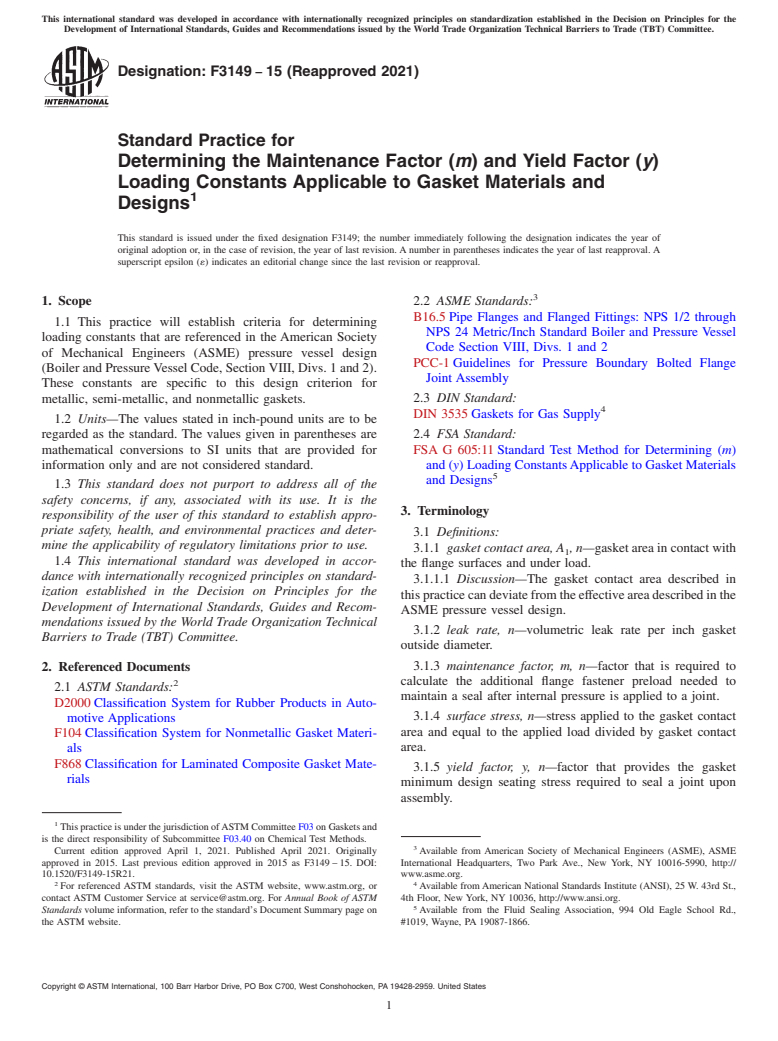
(Practice)Standard Practice for Determining the Maintenance Factor (m) and Yield Factor (y) Loading Constants Applicable to Gasket Materials and Designs
Standard Practice for Determining the Maintenance Factor (<emph type="bdit">m</emph >) and Yield Factor (<emph type="bdit">y</emph>) Loading Constants Applicable to Gasket Materials and Designs
SIGNIFICANCE AND USE
4.1 The gasket factors are a function of leak rate; therefore, this practice generates curves. Constants for use in the ASME Boiler and Pressure Vessel Code, Section VIII, Appendix 2 code calculations are selected from these data. Specific m and y values can be selected based on a maximum desired leak rate or derived from these data as described in this procedure. This practice addresses the influence of leak rate and gasket thickness on a gasket’s ability to provide a seal initially and in operation. This practice is performed at room temperature; therefore, this practice does not account for all conditions, such as high temperature or thermal cycling or both, that bolted flange connections may be subject to in field application.
4.2 This practice determines two general characteristics that are specific to the ASME design criteria. Caution should be exercised when comparing yield and maintenance factors between gasket materials, and it is recommended that the m and y curves be compared. Selecting a gasket material for use in an application should not be based exclusively on these two general characteristics. Gasket material selection for a given application should consider additional information not described in this practice, which includes, but is not limited to, chemical resistance, thermal resistance, creep relaxation, compressibility, and accommodation of thermal cycling.
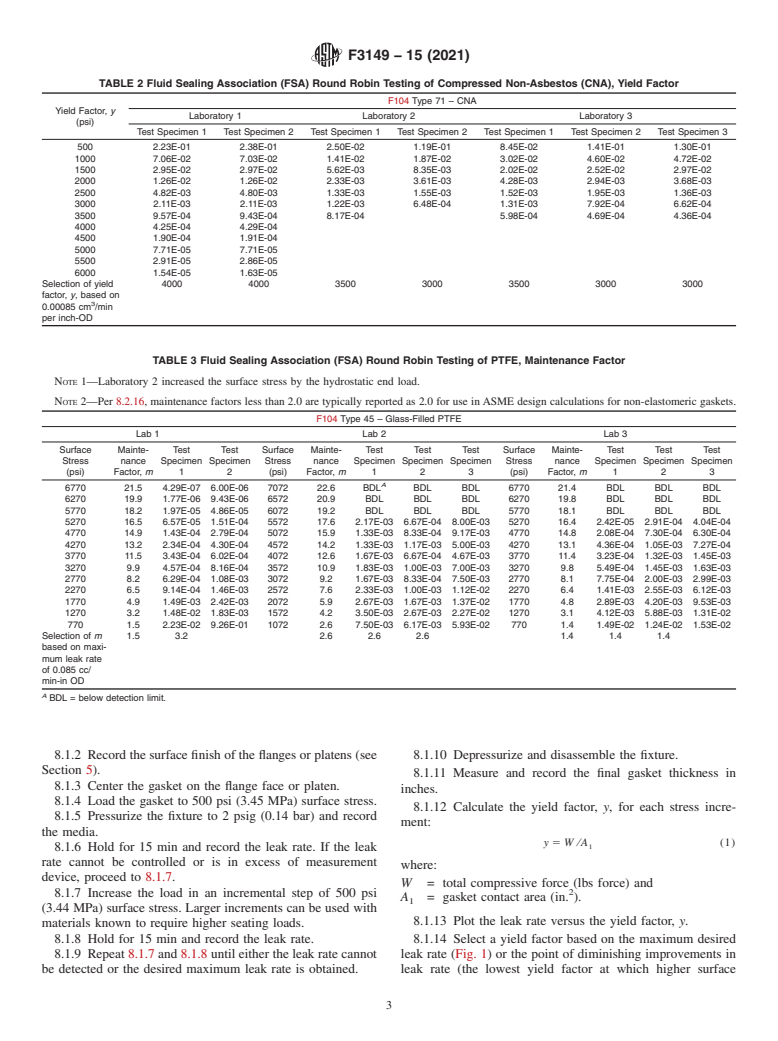
4.3 This practice builds upon work conducted in the Fluid Sealing Association (FSA G 605:11). The associated round robin data is provided for reference in Tables 1-4. (A) BDL = below detection limit. (A) BDL = below detection limit.
SCOPE
1.1 This practice will establish criteria for determining loading constants that are referenced in the American Society of Mechanical Engineers (ASME) pressure vessel design (Boiler and Pressure Vessel Code, Section VIII, Divs. 1 and 2). These constants are specific to this design criterion for metallic, semi-metallic, and nonmetallic gaskets.
1.2 Units—The values stated in inch-pound units are to be regarded as the standard. The values given in parentheses are mathematical conversions to SI units that are provided for information only and are not considered standard.
1.3 This standard does not purport to address all of the safety concerns, if any, associated with its use. It is the responsibility of the user of this standard to establish appropriate safety, health, and environmental practices and determine the applicability of regulatory limitations prior to use.
1.4 This international standard was developed in accordance with internationally recognized principles on standardization established in the Decision on Principles for the Development of International Standards, Guides and Recommendations issued by the World Trade Organization Technical Barriers to Trade (TBT) Committee.
General Information
Buy Standard
Standards Content (Sample)
This international standard was developed in accordance with internationally recognized principles on standardization established in the Decision on Principles for the
Development of International Standards, Guides and Recommendations issued by the World Trade Organization Technical Barriers to Trade (TBT) Committee.
Designation: F3149 −15 (Reapproved 2021)
Standard Practice for
Determining the Maintenance Factor (m) and Yield Factor (y)
Loading Constants Applicable to Gasket Materials and
1
Designs
This standard is issued under the fixed designation F3149; the number immediately following the designation indicates the year of
original adoption or, in the case of revision, the year of last revision. A number in parentheses indicates the year of last reapproval. A
superscript epsilon (´) indicates an editorial change since the last revision or reapproval.
3
1. Scope 2.2 ASME Standards:
B16.5 Pipe Flanges and Flanged Fittings: NPS 1/2 through
1.1 This practice will establish criteria for determining
NPS 24 Metric/Inch Standard Boiler and Pressure Vessel
loading constants that are referenced in the American Society
Code Section VIII, Divs. 1 and 2
of Mechanical Engineers (ASME) pressure vessel design
PCC-1 Guidelines for Pressure Boundary Bolted Flange
(Boiler and PressureVessel Code, SectionVIII, Divs. 1 and 2).
Joint Assembly
These constants are specific to this design criterion for
metallic, semi-metallic, and nonmetallic gaskets. 2.3 DIN Standard:
4
DIN 3535 Gaskets for Gas Supply
1.2 Units—The values stated in inch-pound units are to be
regarded as the standard. The values given in parentheses are 2.4 FSA Standard:
mathematical conversions to SI units that are provided for FSA G 605:11 Standard Test Method for Determining (m)
information only and are not considered standard. and (y) Loading ConstantsApplicable to Gasket Materials
5
and Designs
1.3 This standard does not purport to address all of the
safety concerns, if any, associated with its use. It is the
3. Terminology
responsibility of the user of this standard to establish appro-
priate safety, health, and environmental practices and deter-
3.1 Definitions:
mine the applicability of regulatory limitations prior to use.
3.1.1 gasket contact area, A ,n—gasket area in contact with
1
1.4 This international standard was developed in accor-
the flange surfaces and under load.
dance with internationally recognized principles on standard-
3.1.1.1 Discussion—The gasket contact area described in
ization established in the Decision on Principles for the
thispracticecandeviatefromtheeffectiveareadescribedinthe
Development of International Standards, Guides and Recom-
ASME pressure vessel design.
mendations issued by the World Trade Organization Technical
3.1.2 leak rate, n—volumetric leak rate per inch gasket
Barriers to Trade (TBT) Committee.
outside diameter.
3.1.3 maintenance factor, m, n—factor that is required to
2. Referenced Documents
2 calculate the additional flange fastener preload needed to
2.1 ASTM Standards:
maintain a seal after internal pressure is applied to a joint.
D2000 Classification System for Rubber Products in Auto-
3.1.4 surface stress, n—stress applied to the gasket contact
motive Applications
area and equal to the applied load divided by gasket contact
F104 Classification System for Nonmetallic Gasket Materi-
area.
als
F868 Classification for Laminated Composite Gasket Mate-
3.1.5 yield factor, y, n—factor that provides the gasket
rials
minimum design seating stress required to seal a joint upon
assembly.
1
This practice is under the jurisdiction ofASTM Committee F03 on Gaskets and
is the direct responsibility of Subcommittee F03.40 on Chemical Test Methods.
3
Current edition approved April 1, 2021. Published April 2021. Originally Available from American Society of Mechanical Engineers (ASME), ASME
approved in 2015. Last previous edition approved in 2015 as F3149 – 15. DOI: International Headquarters, Two Park Ave., New York, NY 10016-5990, http://
10.1520/F3149-15R21. www.asme.org.
2 4
For referenced ASTM standards, visit the ASTM website, www.astm.org, or Available from American National Standards Institute (ANSI), 25 W. 43rd St.,
contact ASTM Customer Service at service@astm.org. For Annual Book of ASTM 4th Floor, New York, NY 10036, http://www.ansi.org.
5
Standards volume information, refer to the standard’s Document Summary page on Available from the Fluid Sealing Association, 994 Old Eagle School Rd.,
the ASTM website. #1019, Wayne, PA 19087-1866.
Copyright © ASTM International, 100 Barr Harbor Drive, PO Box C700, West Conshohocken, PA 19428-2959. United States
1
---------------------- Page: 1 ----------------------
F3149 − 15 (2021)
3.1.5.1 Discussion—This assumes no pressure and, 5.3 Hydraulically loaded flanges or platen presses are ac-
therefore, a lack of hydrostatic end load effect on the assembly. ceptable.(Theuseofmanualloadingplatensisnotacceptable.)
Reported in psi. If a bolted flange fixture is selected, then loading of the
...
Questions, Comments and Discussion
Ask us and Technical Secretary will try to provide an answer. You can facilitate discussion about the standard in here.