


ASTM E2403-06(2018)
(Test Method)Standard Test Method for Sulfated Ash of Organic Materials by Thermogravimetry
Standard Test Method for Sulfated Ash of Organic Materials by Thermogravimetry
SIGNIFICANCE AND USE
5.1 The sulfated ash may be used to indicate the level of known metal-containing additives or impurities in an organic material. When phosphorus is absent, barium, calcium, magnesium, sodium and potassium are converted to their sulfates. Tin and zinc are converted to their oxides.
5.2 This test method may be used for research and development, specification acceptance, and quality assurance purposes.
SCOPE
1.1 This test method describes the determination of sulfated ash content (sometimes called residue-on-ignition) of organic materials by thermogravimetry. This test method converts common metals found in organic materials (such as sodium, potassium, lithium, calcium, magnesium, zinc, and tin) into their sulfate salts permitting estimation of their total content as sulfates or oxides. The range of this test method is from 0.1 to 100 % metal content.
1.2 The values stated in SI units are to be regarded as standard. No other units of measurement are included in this standard.
1.3 This standard does not purport to address all of the safety concerns, if any, associated with its use. It is the responsibility of the user of this standard to establish appropriate safety, health, and environmental practices and determine the applicability of regulatory limitations prior to use.
1.4 This international standard was developed in accordance with internationally recognized principles on standardization established in the Decision on Principles for the Development of International Standards, Guides and Recommendations issued by the World Trade Organization Technical Barriers to Trade (TBT) Committee.
General Information
Buy Standard
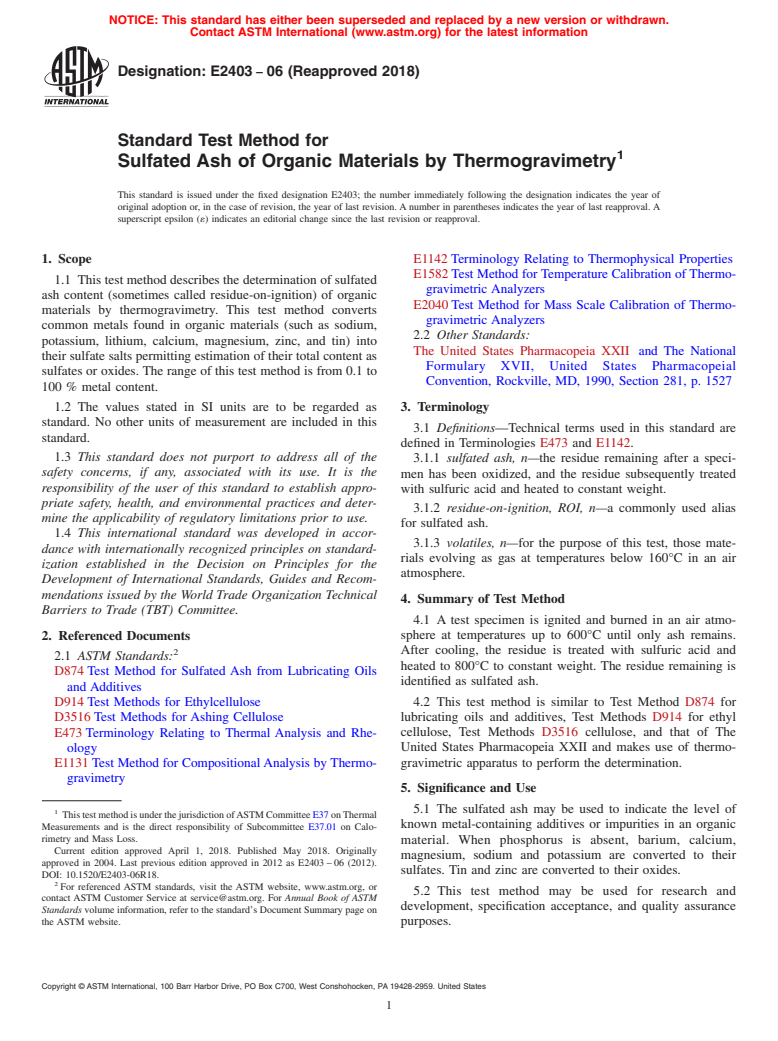
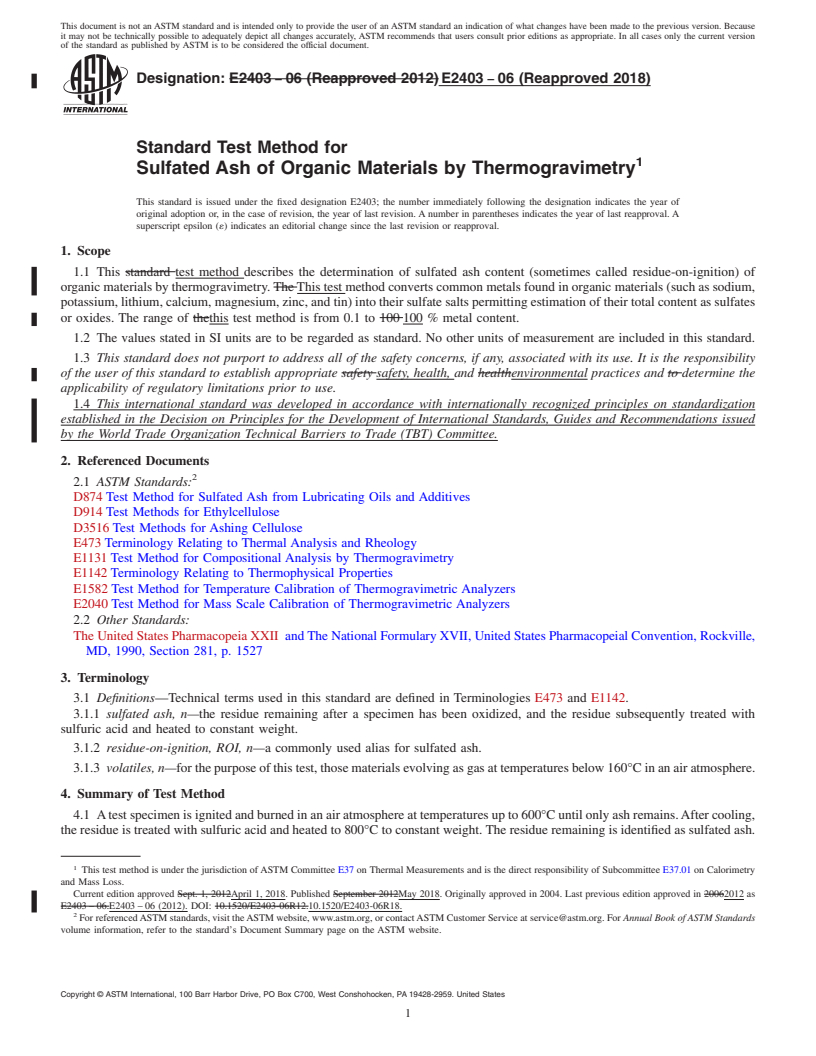
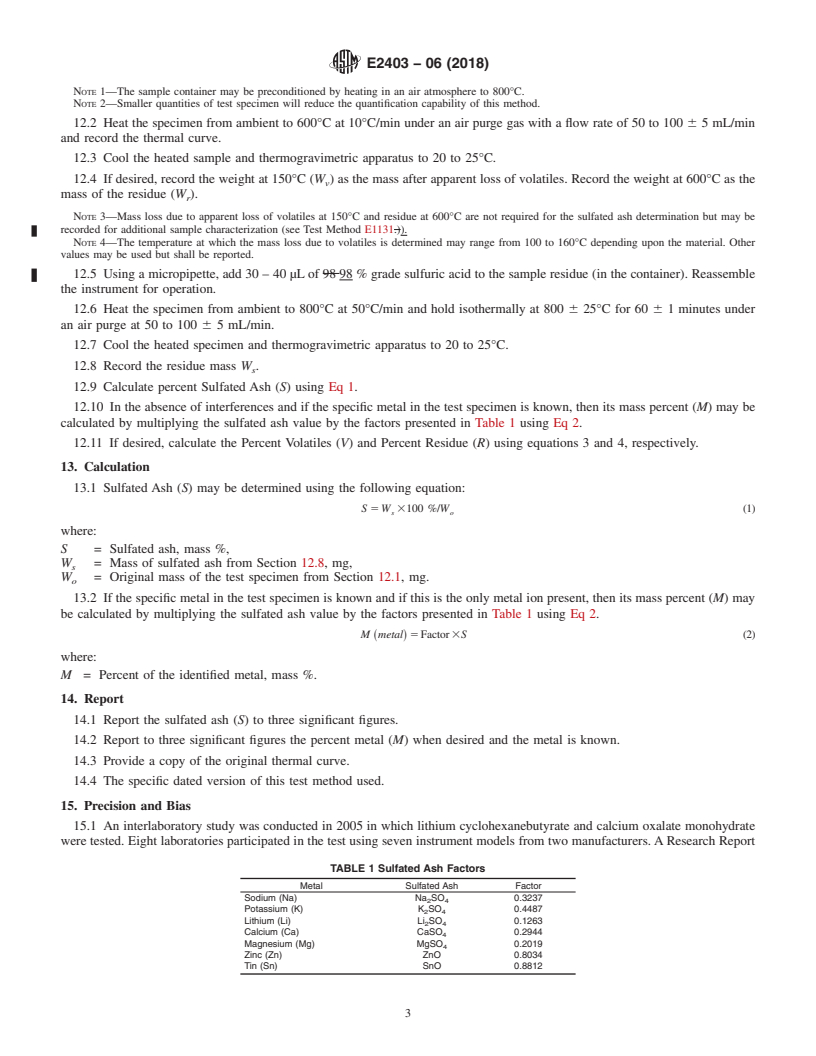
Standards Content (Sample)
NOTICE: This standard has either been superseded and replaced by a new version or withdrawn.
Contact ASTM International (www.astm.org) for the latest information
Designation: E2403 − 06 (Reapproved 2018)
Standard Test Method for
Sulfated Ash of Organic Materials by Thermogravimetry
This standard is issued under the fixed designation E2403; the number immediately following the designation indicates the year of
original adoption or, in the case of revision, the year of last revision. A number in parentheses indicates the year of last reapproval. A
superscript epsilon (´) indicates an editorial change since the last revision or reapproval.
1. Scope E1142 Terminology Relating to Thermophysical Properties
E1582 Test Method for Temperature Calibration of Thermo-
1.1 This test method describes the determination of sulfated
gravimetric Analyzers
ash content (sometimes called residue-on-ignition) of organic
E2040 Test Method for Mass Scale Calibration of Thermo-
materials by thermogravimetry. This test method converts
gravimetric Analyzers
common metals found in organic materials (such as sodium,
2.2 Other Standards:
potassium, lithium, calcium, magnesium, zinc, and tin) into
The United States Pharmacopeia XXII and The National
their sulfate salts permitting estimation of their total content as
Formulary XVII, United States Pharmacopeial
sulfates or oxides. The range of this test method is from 0.1 to
Convention, Rockville, MD, 1990, Section 281, p. 1527
100 % metal content.
1.2 The values stated in SI units are to be regarded as 3. Terminology
standard. No other units of measurement are included in this
3.1 Definitions—Technical terms used in this standard are
standard.
defined in Terminologies E473 and E1142.
1.3 This standard does not purport to address all of the
3.1.1 sulfated ash, n—the residue remaining after a speci-
safety concerns, if any, associated with its use. It is the
men has been oxidized, and the residue subsequently treated
responsibility of the user of this standard to establish appro-
with sulfuric acid and heated to constant weight.
priate safety, health, and environmental practices and deter-
3.1.2 residue-on-ignition, ROI, n—a commonly used alias
mine the applicability of regulatory limitations prior to use.
for sulfated ash.
1.4 This international standard was developed in accor-
3.1.3 volatiles, n—for the purpose of this test, those mate-
dance with internationally recognized principles on standard-
rials evolving as gas at temperatures below 160°C in an air
ization established in the Decision on Principles for the
atmosphere.
Development of International Standards, Guides and Recom-
mendations issued by the World Trade Organization Technical
4. Summary of Test Method
Barriers to Trade (TBT) Committee.
4.1 A test specimen is ignited and burned in an air atmo-
2. Referenced Documents sphere at temperatures up to 600°C until only ash remains.
2 After cooling, the residue is treated with sulfuric acid and
2.1 ASTM Standards:
heated to 800°C to constant weight. The residue remaining is
D874 Test Method for Sulfated Ash from Lubricating Oils
identified as sulfated ash.
and Additives
D914 Test Methods for Ethylcellulose 4.2 This test method is similar to Test Method D874 for
lubricating oils and additives, Test Methods D914 for ethyl
D3516 Test Methods for Ashing Cellulose
E473 Terminology Relating to Thermal Analysis and Rhe- cellulose, Test Methods D3516 cellulose, and that of The
United States Pharmacopeia XXII and makes use of thermo-
ology
E1131 Test Method for Compositional Analysis by Thermo- gravimetric apparatus to perform the determination.
gravimetry
5. Significance and Use
5.1 The sulfated ash may be used to indicate the level of
This test method is under the jurisdiction of ASTM Committee E37 on Thermal
known metal-containing additives or impurities in an organic
Measurements and is the direct responsibility of Subcommittee E37.01 on Calo-
rimetry and Mass Loss.
material. When phosphorus is absent, barium, calcium,
Current edition approved April 1, 2018. Published May 2018. Originally
magnesium, sodium and potassium are converted to their
approved in 2004. Last previous edition approved in 2012 as E2403 – 06 (2012).
sulfates. Tin and zinc are converted to their oxides.
DOI: 10.1520/E2403-06R18.
For referenced ASTM standards, visit the ASTM website, www.astm.org, or
5.2 This test method may be used for research and
contact ASTM Customer Service at service@astm.org. For Annual Book of ASTM
development, specification acceptance, and quality assurance
Standards volume information, refer to the standard’s Document Summary page on
the ASTM website. purposes.
Copyright © ASTM International, 100 Barr Harbor Drive, PO Box C700, West Conshohocken, PA 19428-2959. United States
E2403 − 06 (2018)
6. Interferences 11. Calibration and Standardization
6.1 If phosphorus is present with metals, it partially or 11.1 Perform temperature calibration of the thermogravi-
wholly remains in the sulfated ash as metal phosphates. metric analyzer according to Test Method E1582 using refer-
ence materials suitable for the temperature range of this
6.2 Sulfur and chlorides do not interfere.
method, namely 25 to 800°C.
7. Apparatus
11.2 Perform mass calibration of the thermogravimetric
analyzer according to Test Method E2040.
7.1 Thermogravimetric Analyzer (TGA)—The essential in-
strumentation required to provide the minimum thermogravi-
12. Procedure
metric analytical capability for this test method includes:
7.1.1 A thermobalance composed of: 12.1 Transfer 30 to 40 mg of the sample into a tared, clean,
and dry sample container. Assemble the thermogravimetric
7.1.1.1 A furnace to provide uniform controlled heating of a
specimen to a constant temperature of 850°C and at a constant analyzer for operation. Record the initial weight of the test
specimen as W to within 60.01 mg
rate of 5 to 60°C/min
o
7.1.1.2 A temperature sensor to provide an indication of the
NOTE 1—The sample container may be preconditioned by heating in an
specimen or furnace temperature to 61°C.
air atmosphere to 800°C.
7.1.1.3 A continuously recording balance to measure the
NOTE 2—Smaller quantities of test specimen will reduce the quantifi-
cation capability of this method.
specimen mass with a minimum capacity of 50 mg and a
sensitivity of 60.01 mg.
12.2 Heat the specimen from ambient to 600°C at 10°C/min
7.1.1.4 A means of maintaining the specimen or container
under an air purge gas with a flow rate of 50 to 100 6 5
under atmospheric control of air at a purge flow rate of 50 to
mL/min and record the thermal curve.
100 mL/min 6 5 mL/min.
12.3 Cool the heated sample and thermogravimetric appa-
7.1.2 A temperature controller capable of executing a spe-
ratus to 20 to 25°C.
cific temperature program by operating the furnace between
12.4 If desired, record the weight at 150°C (W ) as the mass
selected temperature limit at a rate of 5 to 60°C/min and to an v
after apparent loss of volatiles. Record the weight at 600°C as
isothermal temperature of up to 850°C which is maintained
the mass of the residue (W ).
constant to 610°C for a minimum of 70 minutes. r
7.1.3 A recording device, capable of recording and display-
NOTE 3—Mass loss due to apparent loss of volatiles at 150°C and
ing any fraction of the specimen mass signal (TGA curve)
residue at 600°C are not required for the sulfated ash determination but
may be recorded for additional sample characterization (see Test Method
including si
...
This document is not an ASTM standard and is intended only to provide the user of an ASTM standard an indication of what changes have been made to the previous version. Because
it may not be technically possible to adequately depict all changes accurately, ASTM recommends that users consult prior editions as appropriate. In all cases only the current version
of the standard as published by ASTM is to be considered the official document.
Designation: E2403 − 06 (Reapproved 2012) E2403 − 06 (Reapproved 2018)
Standard Test Method for
Sulfated Ash of Organic Materials by Thermogravimetry
This standard is issued under the fixed designation E2403; the number immediately following the designation indicates the year of
original adoption or, in the case of revision, the year of last revision. A number in parentheses indicates the year of last reapproval. A
superscript epsilon (´) indicates an editorial change since the last revision or reapproval.
1. Scope
1.1 This standard test method describes the determination of sulfated ash content (sometimes called residue-on-ignition) of
organic materials by thermogravimetry. The This test method converts common metals found in organic materials (such as sodium,
potassium, lithium, calcium, magnesium, zinc, and tin) into their sulfate salts permitting estimation of their total content as sulfates
or oxides. The range of thethis test method is from 0.1 to 100 100 % metal content.
1.2 The values stated in SI units are to be regarded as standard. No other units of measurement are included in this standard.
1.3 This standard does not purport to address all of the safety concerns, if any, associated with its use. It is the responsibility
of the user of this standard to establish appropriate safety safety, health, and healthenvironmental practices and to determine the
applicability of regulatory limitations prior to use.
1.4 This international standard was developed in accordance with internationally recognized principles on standardization
established in the Decision on Principles for the Development of International Standards, Guides and Recommendations issued
by the World Trade Organization Technical Barriers to Trade (TBT) Committee.
2. Referenced Documents
2.1 ASTM Standards:
D874 Test Method for Sulfated Ash from Lubricating Oils and Additives
D914 Test Methods for Ethylcellulose
D3516 Test Methods for Ashing Cellulose
E473 Terminology Relating to Thermal Analysis and Rheology
E1131 Test Method for Compositional Analysis by Thermogravimetry
E1142 Terminology Relating to Thermophysical Properties
E1582 Test Method for Temperature Calibration of Thermogravimetric Analyzers
E2040 Test Method for Mass Scale Calibration of Thermogravimetric Analyzers
2.2 Other Standards:
The United States Pharmacopeia XXII and The National Formulary XVII, United States Pharmacopeial Convention, Rockville,
MD, 1990, Section 281, p. 1527
3. Terminology
3.1 Definitions—Technical terms used in this standard are defined in Terminologies E473 and E1142.
3.1.1 sulfated ash, n—the residue remaining after a specimen has been oxidized, and the residue subsequently treated with
sulfuric acid and heated to constant weight.
3.1.2 residue-on-ignition, ROI, n—a commonly used alias for sulfated ash.
3.1.3 volatiles, n—for the purpose of this test, those materials evolving as gas at temperatures below 160°C in an air atmosphere.
4. Summary of Test Method
4.1 A test specimen is ignited and burned in an air atmosphere at temperatures up to 600°C until only ash remains. After cooling,
the residue is treated with sulfuric acid and heated to 800°C to constant weight. The residue remaining is identified as sulfated ash.
This test method is under the jurisdiction of ASTM Committee E37 on Thermal Measurements and is the direct responsibility of Subcommittee E37.01 on Calorimetry
and Mass Loss.
Current edition approved Sept. 1, 2012April 1, 2018. Published September 2012May 2018. Originally approved in 2004. Last previous edition approved in 20062012 as
E2403 – 06.E2403 – 06 (2012). DOI: 10.1520/E2403-06R12.10.1520/E2403-06R18.
For referenced ASTM standards, visit the ASTM website, www.astm.org, or contact ASTM Customer Service at service@astm.org. For Annual Book of ASTM Standards
volume information, refer to the standard’s Document Summary page on the ASTM website.
Copyright © ASTM International, 100 Barr Harbor Drive, PO Box C700, West Conshohocken, PA 19428-2959. United States
E2403 − 06 (2018)
4.2 This test method is similar to Test Method D874 for lubricating oils and additives, Test Methods D914 for ethyl cellulose,
Test Methods D3516 cellulose, and that of The United States Pharmacopeia XXII and makes use of thermogravimetric apparatus
to perform the determination.
5. Significance and Use
5.1 The sulfated ash may be used to indicate the level of known metal-containing additives or impurities in an organic material.
When phosphorus is absent, barium, calcium, magnesium, sodium and potassium are converted to their sulfates. Tin and zinc are
converted to their oxides.
5.2 This standard test method may be used for research and development, specification acceptance, and quality assurance
purposes.
6. Interferences
6.1 If phosphorus is present with metals, it partially or wholly remains in the sulfated ash as metal phosphates.
6.2 Sulfur and chlorides do not interfere.
7. Apparatus
7.1 Thermogravimetric Analyzer (TGA)—The essential instrumentation required to provide the minimum thermogravimetric
analytical capability for this standard test method includes:
7.1.1 A thermobalance composed of:
7.1.1.1 A furnace to provide uniform controlled heating of a specimen to a constant temperature of 850°C and at a constant rate
of 5 to 60°C/min
7.1.1.2 A temperature sensor to provide an indication of the specimen or furnace temperature to 61°C.
7.1.1.3 A continuously recording balance to measure the specimen mass with a minimum capacity of 50 mg and a sensitivity
of 60.01 mg.
7.1.1.4 A means of maintaining the specimen or container under atmospheric control of air at a purge flow rate of 50 to 100
mL/min 6 5 mL/min.
7.1.2 A temperature controller capable of executing a specific temperature program by operating the furnace between selected
temperature limit at a rate of 5 to 60°C/min and to an isothermal temperature of up to 850°C which is maintained constant to
610°C for a minimum of 70 minutes.
7.1.3 A recording device, capable of recording and displaying any fraction of the specimen mass signal (TGA curve) including
signal noise.
7.1.4 Containers (pans, crucibles, etc.) that are inert to the specimen and to concentrated sulfuric acid and that will remain
gravimetrically stable up to 850°C. Platinum is a common material of construction for this purpose.
7.2 Graduated micropipette with capacity of 40–50 μL
8. Reagents and Materials
8.1 Sulfuric acid, concentrated (98 %), with a relative density of 1.84. (Warning—Poison. Corrosive. Strong Oxidizer.)
8.2 Air—Zero grade or better purity
9. Hazards
9.1 Sulfuric acid may be corrosive to some thermogravimetric apparatus. A regular visual inspection of the apparatus will
determine if any corrosion is taking place.
9.2 The exhausted purge gas from the apparatus will contain sulfuric acid fumes. This purge gas shall be treated by exhausting
to a acid hood or by bubbling through a solution of sodium bicarbonate to absorb the acidic fumes.
10. Preparation of Apparatus
10.1 After turning the power on, allow the instrument to equilibrate for at least one hour prior to any measurements.
10.2 Perform any cleaning and calibration procedures described by the manufacturer in the apparatus Operator’s Manual.
11. Calibration and Standardization
11.1 Perform temperature calibration of the thermogravimetric analyzer accord
...
Questions, Comments and Discussion
Ask us and Technical Secretary will try to provide an answer. You can facilitate discussion about the standard in here.