

ASTM A727/A727M-14(2019)
(Specification)Standard Specification for Carbon Steel Forgings for Piping Components with Inherent Notch Toughness
General Information
- Abstract
ABSTRACT
This specification covers forged carbon steel piping components intended primarily for service in pressure piping systems from a specific temperature range where inherent notch toughness is desired, but where notch toughness testing is not required. Included are forged or ring-rolled flanges, forged fittings, and valves made to specified dimensions. The steel shall be made by one or more of the following processes: open-hearth, basic-oxygen, or electric-furnace, and shall be fully killed, fine-grain practice. Following plastic working, the forgings shall be heat treated by normalizing, or normalizing and tempering, or quenching and tempering. The forgings shall be subjected to tension, hardness, and hydrostatic tests.
SCOPE
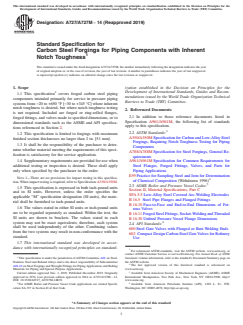
1.1 This specification2 covers forged carbon steel piping components intended primarily for service in pressure piping systems from −20 to +650 °F [−30 to +345 °C] where inherent notch toughness is desired, but where notch toughness testing is not required. Included are forged or ring-rolled flanges, forged fittings, and valves made to specified dimensions, or to dimensional standards such as the ASME and API specifications referenced in Section 2.
1.2 This specification is limited to forgings with maximum finished section thicknesses no larger than 2 in. [51 mm].
1.3 It shall be the responsibility of the purchaser to determine whether material meeting the requirements of this specification is satisfactory for the service application.
1.4 Supplementary requirements are provided for use when additional testing or inspection is desired. These shall apply only when specified by the purchaser in the order.
Note 1: There are no provisions for impact testing in this specification. When impact testing is required, refer to Specification A350/A350M.
1.5 This specification is expressed in both inch-pound units and in SI units. However, unless the order specifies the applicable “M” specification designation (SI units), the material shall be furnished to inch-pound units.
1.6 The values stated in either SI units or inch-pound units are to be regarded separately as standard. Within the text, the SI units are shown in brackets. The values stated in each system may not be exact equivalents; therefore, each system shall be used independently of the other. Combining values from the two systems may result in non-conformance with the standard.
1.7 This international standard was developed in accordance with internationally recognized principles on standardization established in the Decision on Principles for the Development of International Standards, Guides and Recommendations issued by the World Trade Organization Technical Barriers to Trade (TBT) Committee.
- Status
- Published
- Publication Date
- 30-Nov-2019
- Technical Committee
- A01 - Steel, Stainless Steel and Related Alloys

Overview
ASTM A727/A727M-14(2019) is an international standard developed by ASTM International that specifies requirements for forged carbon steel piping components. These components are intended primarily for use in pressure piping systems within a temperature range of −20 to +650 °F [−30 to +345 °C], where inherent notch toughness is desired, but direct notch toughness testing is not required. The standard covers a variety of carbon steel forgings, including flanges, fittings, and valves manufactured to either specified or referenced dimensional standards such as those set by ASME and API.
This specification is particularly important for applications demanding reliable performance in both low and high temperature service conditions, with the standard limiting finished section thicknesses to a maximum of 2 inches [51 mm]. Purchasers are responsible for determining material suitability for their specific service environments. ASTM A727/A727M also provides optional supplementary requirements for additional testing or inspection upon request.
Key Topics
- Material and Manufacture:
- Covers carbon steel produced by open-hearth, basic-oxygen, or electric-furnace processes.
- Steel must be fully killed and produced using fine-grain practice.
- Forgings are subjected to required heat treatments such as normalizing, or normalizing and tempering, or quenching and tempering.
- Component Scope:
- Applies to forged or ring-rolled flanges, forged fittings, and valves.
- Dimensional conformance to ASME and API referenced specifications is allowed.
- Mechanical and Chemical Testing:
- Tension, hardness, and hydrostatic tests are required to verify mechanical properties.
- Strict control of chemical composition, including carbon, manganese, phosphorus, sulfur, and silicon.
- No impact (notch toughness) testing required; for such needs, refer to ASTM A350/A350M.
- Ordering and Certification:
- Purchaser must provide any additional requirements or supplementary testing needs during ordering.
- Certification includes heat treatment details, results of chemical and mechanical tests, and any supplementary order requirements.
Applications
ASTM A727/A727M-14(2019) is widely used for the specification and procurement of carbon steel forgings in industries where pressure piping systems require a balance of strength and toughness across broad temperature ranges, including:
- Oil and Gas Industry: For pipelines, valves, and fittings exposed to varying pressure and temperature environments.
- Chemical Processing: In process piping, where resistance to brittle fracture is critical, but mandatory impact testing is not required.
- Power Generation: For steam and water lines where pressure and temperature extremes are common.
- General Industrial Applications: Where reliability of forged flanges, fittings, and valves is essential for safety and performance.
The standard’s comprehensive requirements ensure that forged components possess inherent toughness without the need for direct impact testing, making it a practical choice for many engineering applications.
Related Standards
Several other ASTM, ASME, and API standards are referenced and closely related to ASTM A727/A727M, including:
- ASTM A350/A350M: Specification for carbon and low-alloy steel forgings requiring notch toughness testing for piping components.
- ASTM A788/A788M: General requirements for steel forgings.
- ASTM A961/A961M: Common requirements for steel flanges, forged fittings, and valves for piping applications.
- ASME B16.5/B16.11/B16.10/B16.30: Standards for pipe flanges, fittings, valve dimensions.
- API 600 & API 602: Steel gate valves for refinery and pipeline use.
Ensuring compatibility with these standards helps manufacturers and project engineers maintain system integrity and regulatory compliance.
Keywords: ASTM A727, carbon steel forgings, piping components, inherent notch toughness, pressure piping systems, flanges, fittings, valves, ASME, API, mechanical testing, chemical composition, industrial standards.
Relations
- Effective Date
- 01-Dec-2019
- Effective Date
- 01-Mar-2024
- Effective Date
- 01-Nov-2019
- Effective Date
- 01-May-2019
- Effective Date
- 01-Nov-2018
- Effective Date
- 01-Sep-2018
- Effective Date
- 01-Mar-2018
- Effective Date
- 01-Nov-2017
- Effective Date
- 01-Sep-2017
- Effective Date
- 01-May-2017
- Effective Date
- 01-Dec-2016
- Effective Date
- 01-Jun-2016
- Effective Date
- 01-Nov-2015
- Effective Date
- 01-May-2015
- Effective Date
- 01-Nov-2014
Get Certified
Connect with accredited certification bodies for this standard

Element Materials Technology
Materials testing and product certification.

Inštitut za kovinske materiale in tehnologije
Institute of Metals and Technology. Materials testing, metallurgical analysis, NDT.
Sponsored listings
Frequently Asked Questions
ASTM A727/A727M-14(2019) is a technical specification published by ASTM International. Its full title is "Standard Specification for Carbon Steel Forgings for Piping Components with Inherent Notch Toughness". This standard covers: ABSTRACT This specification covers forged carbon steel piping components intended primarily for service in pressure piping systems from a specific temperature range where inherent notch toughness is desired, but where notch toughness testing is not required. Included are forged or ring-rolled flanges, forged fittings, and valves made to specified dimensions. The steel shall be made by one or more of the following processes: open-hearth, basic-oxygen, or electric-furnace, and shall be fully killed, fine-grain practice. Following plastic working, the forgings shall be heat treated by normalizing, or normalizing and tempering, or quenching and tempering. The forgings shall be subjected to tension, hardness, and hydrostatic tests. SCOPE 1.1 This specification2 covers forged carbon steel piping components intended primarily for service in pressure piping systems from −20 to +650 °F [−30 to +345 °C] where inherent notch toughness is desired, but where notch toughness testing is not required. Included are forged or ring-rolled flanges, forged fittings, and valves made to specified dimensions, or to dimensional standards such as the ASME and API specifications referenced in Section 2. 1.2 This specification is limited to forgings with maximum finished section thicknesses no larger than 2 in. [51 mm]. 1.3 It shall be the responsibility of the purchaser to determine whether material meeting the requirements of this specification is satisfactory for the service application. 1.4 Supplementary requirements are provided for use when additional testing or inspection is desired. These shall apply only when specified by the purchaser in the order. Note 1: There are no provisions for impact testing in this specification. When impact testing is required, refer to Specification A350/A350M. 1.5 This specification is expressed in both inch-pound units and in SI units. However, unless the order specifies the applicable “M” specification designation (SI units), the material shall be furnished to inch-pound units. 1.6 The values stated in either SI units or inch-pound units are to be regarded separately as standard. Within the text, the SI units are shown in brackets. The values stated in each system may not be exact equivalents; therefore, each system shall be used independently of the other. Combining values from the two systems may result in non-conformance with the standard. 1.7 This international standard was developed in accordance with internationally recognized principles on standardization established in the Decision on Principles for the Development of International Standards, Guides and Recommendations issued by the World Trade Organization Technical Barriers to Trade (TBT) Committee.
ABSTRACT This specification covers forged carbon steel piping components intended primarily for service in pressure piping systems from a specific temperature range where inherent notch toughness is desired, but where notch toughness testing is not required. Included are forged or ring-rolled flanges, forged fittings, and valves made to specified dimensions. The steel shall be made by one or more of the following processes: open-hearth, basic-oxygen, or electric-furnace, and shall be fully killed, fine-grain practice. Following plastic working, the forgings shall be heat treated by normalizing, or normalizing and tempering, or quenching and tempering. The forgings shall be subjected to tension, hardness, and hydrostatic tests. SCOPE 1.1 This specification2 covers forged carbon steel piping components intended primarily for service in pressure piping systems from −20 to +650 °F [−30 to +345 °C] where inherent notch toughness is desired, but where notch toughness testing is not required. Included are forged or ring-rolled flanges, forged fittings, and valves made to specified dimensions, or to dimensional standards such as the ASME and API specifications referenced in Section 2. 1.2 This specification is limited to forgings with maximum finished section thicknesses no larger than 2 in. [51 mm]. 1.3 It shall be the responsibility of the purchaser to determine whether material meeting the requirements of this specification is satisfactory for the service application. 1.4 Supplementary requirements are provided for use when additional testing or inspection is desired. These shall apply only when specified by the purchaser in the order. Note 1: There are no provisions for impact testing in this specification. When impact testing is required, refer to Specification A350/A350M. 1.5 This specification is expressed in both inch-pound units and in SI units. However, unless the order specifies the applicable “M” specification designation (SI units), the material shall be furnished to inch-pound units. 1.6 The values stated in either SI units or inch-pound units are to be regarded separately as standard. Within the text, the SI units are shown in brackets. The values stated in each system may not be exact equivalents; therefore, each system shall be used independently of the other. Combining values from the two systems may result in non-conformance with the standard. 1.7 This international standard was developed in accordance with internationally recognized principles on standardization established in the Decision on Principles for the Development of International Standards, Guides and Recommendations issued by the World Trade Organization Technical Barriers to Trade (TBT) Committee.
ASTM A727/A727M-14(2019) is classified under the following ICS (International Classification for Standards) categories: 77.140.85 - Iron and steel forgings. The ICS classification helps identify the subject area and facilitates finding related standards.
ASTM A727/A727M-14(2019) has the following relationships with other standards: It is inter standard links to ASTM A727/A727M-14, ASTM A350/A350M-24, ASTM A961/A961M-19a, ASTM A788/A788M-19, ASTM A788/A788M-18b, ASTM A788/A788M-18a, ASTM A788/A788M-18, ASTM A788/A788M-17a, ASTM A350/A350M-17, ASTM A788/A788M-17, ASTM A788/A788M-16a, ASTM A961/A961M-16, ASTM A961/A961M-15, ASTM A788/A788M-15, ASTM A961/A961M-14. Understanding these relationships helps ensure you are using the most current and applicable version of the standard.
ASTM A727/A727M-14(2019) is available in PDF format for immediate download after purchase. The document can be added to your cart and obtained through the secure checkout process. Digital delivery ensures instant access to the complete standard document.
Standards Content (Sample)
This international standard was developed in accordance with internationally recognized principles on standardization established in the Decision on Principles for the
Development of International Standards, Guides and Recommendations issued by the World Trade Organization Technical Barriers to Trade (TBT) Committee.
Designation:A727/A727M −14 (Reapproved 2019)
Standard Specification for
Carbon Steel Forgings for Piping Components with Inherent
Notch Toughness
This standard is issued under the fixed designationA727/A727M; the number immediately following the designation indicates the year
of original adoption or, in the case of revision, the year of last revision.Anumber in parentheses indicates the year of last reapproval.
A superscript epsilon (´) indicates an editorial change since the last revision or reapproval.
1. Scope ization established in the Decision on Principles for the
2 Development of International Standards, Guides and Recom-
1.1 This specification covers forged carbon steel piping
mendations issued by the World Trade Organization Technical
components intended primarily for service in pressure piping
Barriers to Trade (TBT) Committee.
systems from −20 to +650 °F [−30 to +345 °C] where inherent
notch toughness is desired, but where notch toughness testing
2. Referenced Documents
is not required. Included are forged or ring-rolled flanges,
2.1 In addition to those reference documents listed in
forged fittings, and valves made to specified dimensions, or to
Specification A961/A961M, the following list of standards
dimensional standards such as the ASME and API specifica-
apply to this specification.
tions referenced in Section 2.
2.2 ASTM Standards:
1.2 This specification is limited to forgings with maximum
A350/A350MSpecificationforCarbonandLow-AlloySteel
finished section thicknesses no larger than 2 in. [51 mm].
Forgings, Requiring Notch Toughness Testing for Piping
1.3 It shall be the responsibility of the purchaser to deter-
Components
mine whether material meeting the requirements of this speci-
A788/A788MSpecification for Steel Forgings, General Re-
fication is satisfactory for the service application.
quirements
1.4 Supplementary requirements are provided for use when A961/A961MSpecification for Common Requirements for
additional testing or inspection is desired. These shall apply
Steel Flanges, Forged Fittings, Valves, and Parts for
only when specified by the purchaser in the order. Piping Applications
E59Practice for Sampling Steel and Iron for Determination
NOTE 1—There are no provisions for impact testing in this specifica-
of Chemical Composition (Withdrawn 1996)
tion.Whenimpacttestingisrequired,refertoSpecificationA350/A350M.
2.3 ASME Boiler and Pressure Vessel Codes:
1.5 This specification is expressed in both inch-pound units
Section II, Material Specifications, Part C
and in SI units. However, unless the order specifies the
SFA5.5Low-Alloy Steel Covered Arc-Welding Electrodes
applicable “M” specification designation (SI units), the mate-
B16.5 Steel Pipe Flanges and Flanged Fittings
rial shall be furnished to inch-pound units.
B16.10Face-to-Face and End-to-End Dimensions of Fer-
1.6 The values stated in either SI units or inch-pound units
rous Valves
are to be regarded separately as standard. Within the text, the
B16.11ForgedSteelFittings,Socket-WeldingandThreaded
SI units are shown in brackets. The values stated in each
B16.30Unfired Pressure Vessel Flange Dimensions
system may not be exact equivalents; therefore, each system 6
2.4 API Standards:
shall be used independently of the other. Combining values
600Steel Gate Valves with Flanged or Butt-Welding Ends
from the two systems may result in non-conformance with the
602 CompactDesignCarbonSteelGateValvesforRefinery
standard.
Use
1.7 This international standard was developed in accor-
dance with internationally recognized principles on standard-
For referenced ASTM standards, visit the ASTM website, www.astm.org, or
contact ASTM Customer Service at service@astm.org. For Annual Book of ASTM
This specification is under the jurisdiction ofASTM Committee A01 on Steel, Standards volume information, refer to the standard’s Document Summary page on
Stainless Steel and RelatedAlloys and is the direct responsibility of Subcommittee the ASTM website.
A01.22onSteelForgingsandWroughtFittingsforPipingApplicationsandBolting The last approved version of this historical standard is referenced on
Materials for Piping and Special Purpose Applications. www.astm.org.
Current edition approved Dec. 1, 2019. Published December 2019. Originally Available from American Society of Mechanical Engineers (ASME), ASME
approved in 1976. Last previous edition approved in 2014 as A727/A727M–14. International Headquarters, Two Park Ave., New York, NY 10016-5990, http://
DOI: 10.1520/A0727_A0727M-14R19. www.asme.org.
For ASME Boiler and Pressure Vessel Code applications see related Specifi- Available from American Petroleum Institute (API), 1220 L. St., NW,
cation SA-727 in Section II of that Code. Washington, DC 20005-4070, http://api-ec.api.org.
*A Summary of Changes section appears at the end of this standard
Copyright © ASTM International, 100 Barr Harbor Drive, PO Box C700, West Conshohocken, PA 19428-2959. United States
A727/A727M−14 (2019)
605Large Diameter Carbon Steel Flanges min/25 mm] of maximum section thickness, with minimum
holding time at tempering temperature not less than 30 min.
2.5 MSS Standard:
MSS SP-25Standard Marking System for Valves, Fittings,
6. Chemical Composition
Flanges, and Unions
6.1 The steel shall conform to the requirements as to
3. General Requirements and Ordering Information
chemical composition prescribed in Table 1.
3.1 Product furnished to this specification shall conform to
6.2 Steels to which lead has been added shall not be used.
the requirements of Specification A961/A961M, including any
supplementary requirements that are indicated in the purchase
7. Mechanical Requirements
order.FailuretocomplywiththerequirementsofSpecification
7.1 Tension Tests:
A961/A961M constitutes nonconformance with this specifica-
7.1.1 Requirements—The material shall conform to require-
tion. In case of a conflict between the requirements of this
ments for tensile properties prescribed in Table 2.
specificationandSpecificationA961/A961M,thisspecification
7.1.1.1 The test specimen shall be obtained from a rough or
shall prevail.
finished production forging, or prolongation thereof, or it may
3.2 It is the purchaser’s responsibility to specify in the
be obtained from separately forged test blanks from the same
purchase order all ordering information necessary to purchase
heat of steel as the production forging. The test blank shall be
the needed material. Examples of such information include but
reduced by forging in a manner similar to that for the products
are not limited to the following:
represented, shall receive approximately the same hot working
3.2.1 Additional requirements (see 16.1).
and reduction, be of the same nominal thickness, and receive
the same heat treatment as the finished products represented.
4. Materials and Manufacture
The test material shall be treated in the same furnace at the
same time as the forging it represents, subject to the require-
4.1 The steel shall be made by one or more of the following
ments of 7.1.2.1.
processes: open-hearth, basic-oxygen, or electric-furnace, and
shall be fully killed, fine-grain practice.
4.2 Forgings shall be manufactured from ingots, blooms,
TABLE 1 Chemical Requirements
billets, slabs, or bars. These items shall be forged, rolled, or
strandcast. Elements Composition, %
Carbon
4.3 A sufficient discard shall be made from the ingot to
Heat Analysis 0.25 max
secure freedom from injurious piping and undue segregation.
Product Analysis 0.28 max
Manganese
4.4 Thefinishedproductshallbeaforgingasdefinedbythe
Heat Analysis 0.90 to 1.35
Terminology section of Specification A788/A788M.
Product Analysis 0.84 to 1.41
Phosphorus
Heat Analysis 0.035 max
5. Heat Treatment
Product Analysis 0.043 max
Sulfur
5.1 Following plastic working, the forging manufacturer
Heat Analysis 0.025 max
shallheattreattheforgingsbynormalizing,ornormalizingand
Product Analysis 0.033 max
tempering, or quenching and tempering. Silicon
Heat Analysis 0.15 to 0.30
5.1.1 Normalizing—The procedure for normalizing shall
Product Analysis 0.13 to 0.32
consist of uniformly heating the forgings to a temperature
Nickel
A
between 1550 and 1700 °F [845 and 925 °C], holding a
Heat Analysis 0.40
Product Analysis 0.43
sufficient time to attain uniform temperature throughout, and
Chromium
cooling in still air.The forging shall be at a temperature below A,B
Heat Analysis 0.30
1000 °F [540 °C] before heating for normalizing.
Product Analysis 0.34
Molybdenum
5.1.2 Quenching—The procedure for quenching shall con-
A,B
Heat Analysis 0.12
sist of uniformly heating the forging to a temperature between
Product Analysis 0.13
1550 and 1700 °F [845 and 925 °C], holding a sufficient time Copper
A
Heat Analysis 0.40
toattainuniformtemperaturethroughout,andquenchingintoa
Product Analysis 0.43
suitable liquid medium. The forging shall be at a temperature C
Niobium (Nb)
below 1000 °F [540 °C] before heating for quenching. Heat Analysis 0.02
Product Analysis 0.03
5.1.3 Tempering—Theprocedurefortemperingshallconsist
V
...