


ASTM D1512-21
(Test Method)Standard Test Methods for Carbon Black-pH Value
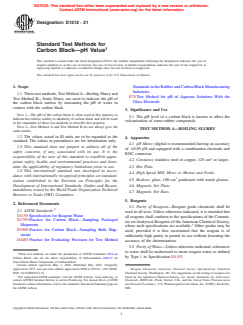
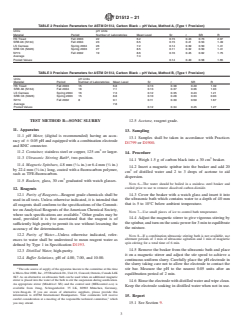
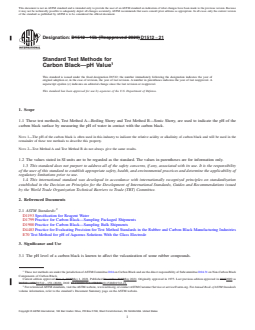
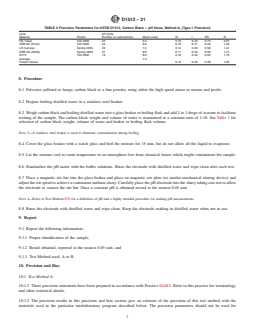
Standard Test Methods for Carbon Black-pH Value
SIGNIFICANCE AND USE
3.1 The pH level of a carbon black is known to affect the vulcanization of some rubber compounds.
SCOPE
1.1 These test methods, Test Method A-Boiling Slurry and Test Method B-Sonic Slurry, are used to indicate the pH of the carbon black surface by measuring the pH of water in contact with the carbon black.
Note 1: The pH of the carbon black is often used in this industry to indicate the relative acidity or alkalinity of carbon black and will be used in the remainder of these test methods to describe this property.
Note 2: Test Method A and Test Method B do not always give the same results.
1.2 The values stated in SI units are to be regarded as the standard. The values in parentheses are for information only.
1.3 This standard does not purport to address all of the safety concerns, if any, associated with its use. It is the responsibility of the user of this standard to establish appropriate safety, health, and environmental practices and determine the applicability of regulatory limitations prior to use.
1.4 This international standard was developed in accordance with internationally recognized principles on standardization established in the Decision on Principles for the Development of International Standards, Guides and Recommendations issued by the World Trade Organization Technical Barriers to Trade (TBT) Committee.
General Information
Frequently Asked Questions
ASTM D1512-21 is a standard published by ASTM International. Its full title is "Standard Test Methods for Carbon Black-pH Value". This standard covers: SIGNIFICANCE AND USE 3.1 The pH level of a carbon black is known to affect the vulcanization of some rubber compounds. SCOPE 1.1 These test methods, Test Method A-Boiling Slurry and Test Method B-Sonic Slurry, are used to indicate the pH of the carbon black surface by measuring the pH of water in contact with the carbon black. Note 1: The pH of the carbon black is often used in this industry to indicate the relative acidity or alkalinity of carbon black and will be used in the remainder of these test methods to describe this property. Note 2: Test Method A and Test Method B do not always give the same results. 1.2 The values stated in SI units are to be regarded as the standard. The values in parentheses are for information only. 1.3 This standard does not purport to address all of the safety concerns, if any, associated with its use. It is the responsibility of the user of this standard to establish appropriate safety, health, and environmental practices and determine the applicability of regulatory limitations prior to use. 1.4 This international standard was developed in accordance with internationally recognized principles on standardization established in the Decision on Principles for the Development of International Standards, Guides and Recommendations issued by the World Trade Organization Technical Barriers to Trade (TBT) Committee.
SIGNIFICANCE AND USE 3.1 The pH level of a carbon black is known to affect the vulcanization of some rubber compounds. SCOPE 1.1 These test methods, Test Method A-Boiling Slurry and Test Method B-Sonic Slurry, are used to indicate the pH of the carbon black surface by measuring the pH of water in contact with the carbon black. Note 1: The pH of the carbon black is often used in this industry to indicate the relative acidity or alkalinity of carbon black and will be used in the remainder of these test methods to describe this property. Note 2: Test Method A and Test Method B do not always give the same results. 1.2 The values stated in SI units are to be regarded as the standard. The values in parentheses are for information only. 1.3 This standard does not purport to address all of the safety concerns, if any, associated with its use. It is the responsibility of the user of this standard to establish appropriate safety, health, and environmental practices and determine the applicability of regulatory limitations prior to use. 1.4 This international standard was developed in accordance with internationally recognized principles on standardization established in the Decision on Principles for the Development of International Standards, Guides and Recommendations issued by the World Trade Organization Technical Barriers to Trade (TBT) Committee.
ASTM D1512-21 is classified under the following ICS (International Classification for Standards) categories: 83.040.20 - Rubber compounding ingredients. The ICS classification helps identify the subject area and facilitates finding related standards.
You can purchase ASTM D1512-21 directly from iTeh Standards. The document is available in PDF format and is delivered instantly after payment. Add the standard to your cart and complete the secure checkout process. iTeh Standards is an authorized distributor of ASTM standards.
Standards Content (Sample)
NOTICE: This standard has either been superseded and replaced by a new version or withdrawn.
Contact ASTM International (www.astm.org) for the latest information
Designation: D1512 − 21
Standard Test Methods for
Carbon Black—pH Value
This standard is issued under the fixed designation D1512; the number immediately following the designation indicates the year of
original adoption or, in the case of revision, the year of last revision. A number in parentheses indicates the year of last reapproval. A
superscript epsilon (´) indicates an editorial change since the last revision or reapproval.
This standard has been approved for use by agencies of the U.S. Department of Defense.
1. Scope Standards in the Rubber and Carbon Black Manufacturing
Industries
1.1 These test methods, Test Method A—Boiling Slurry and
E70 Test Method for pH of Aqueous Solutions With the
Test Method B—Sonic Slurry, are used to indicate the pH of
Glass Electrode
the carbon black surface by measuring the pH of water in
contact with the carbon black.
3. Significance and Use
NOTE 1—The pH of the carbon black is often used in this industry to
3.1 The pH level of a carbon black is known to affect the
indicate the relative acidity or alkalinity of carbon black and will be used
vulcanization of some rubber compounds.
in the remainder of these test methods to describe this property.
NOTE 2—Test Method A and Test Method B do not always give the
TEST METHOD A—BOILING SLURRY
same results.
1.2 The values stated in SI units are to be regarded as the
4. Apparatus
standard. The values in parentheses are for information only.
4.1 pH Meter, (digital is recommended) having an accuracy
1.3 This standard does not purport to address all of the
of 60.05 pH and equipped with a combination electrode and
safety concerns, if any, associated with its use. It is the
RNC connector.
responsibility of the user of this standard to establish appro-
4.2 Container, stainless steel or copper, 125 cm or larger.
priate safety, health, and environmental practices and deter-
mine the applicability of regulatory limitations prior to use. 4.3 Hot Plate.
1.4 This international standard was developed in accor-
4.4 High Speed Mill, Mixer or Mortar and Pestle.
dance with internationally recognized principles on standard-
4.5 Beakers, glass, 100 cm graduated with watch glasses.
ization established in the Decision on Principles for the
Development of International Standards, Guides and Recom-
4.6 Magnetic Stir Plate.
mendations issued by the World Trade Organization Technical
4.7 Magnetic Stir Bars.
Barriers to Trade (TBT) Committee.
5. Reagents
2. Referenced Documents
5.1 Purity of Reagents—Reagent grade chemicals shall be
2.1 ASTM Standards:
used in all tests. Unless otherwise indicated, it is intended that
D1193 Specification for Reagent Water
all reagents shall conform to the specifications of the Commit-
D1799 Practice for Carbon Black—Sampling Packaged
tee on Analytical Reagents of the American Chemical Society,
Shipments
where such specifications are available. Other grades may be
D1900 Practice for Carbon Black—Sampling Bulk Ship-
used, provided it is first ascertained that the reagent is of
ments
sufficiently high purity to permit its use without lessening the
D4483 Practice for Evaluating Precision for Test Method
accuracy of the determination.
5.2 Purity of Water—Unless otherwise indicated, references
to water shall be understood to mean reagent water as defined
These test methods are under the jurisdiction of ASTM Committee D24 on
by Type 1 in Specification D1193.
Carbon Black and are the direct responsibility of Subcommittee D24.31 on
Non-Carbon Black Components of Carbon Black.
Current edition approved May 1, 2021. Published May 2021. Originally
approved in 1975. Last previous edition approved in 2020 as D1512 – 15b (2020). Reagent Chemicals, American Chemical Society Specifications, American
DOI: 10.1520/D1512-21. Chemical Society, Washington, DC. For suggestions on the testing of reagents not
For referenced ASTM standards, visit the ASTM website, www.astm.org, or listed by the American Chemical Society, see Analar Standards for Laboratory
contact ASTM Customer Service at service@astm.org. For Annual Book of ASTM Chemicals, BDH Ltd., Poole, Dorset, U.K., and the United States Pharmacopeia
Standards volume information, refer to the standard’s Document Summary page on and National Formulary, U.S. Pharmacopeial Convention, Inc. (USPC), Rockville,
the ASTM website. MD.
Copyright © ASTM International, 100 Barr Harbor Drive, PO Box C700, West Conshohocken, PA 19428-2959. United States
D1512 − 21
TABLE 1 Carbon Black Weight and Water Volumes
10. Precision and Bias
Carbon black Volume of water Beaker or flask
10.1 Test Method A:
3 3
weight, g cm volume, cm
10 100 200
10.1.1 These precision statements have been prepared in
20 200 250
accordance with Practice D4483. Refer to this practice for
terminology and other statistical details.
10.1.2 The precision results in this precision and bias
section give an estimate of the precision of this test method
5.3 Distilled Water, high purity.
with the materials used in the particular interlaboratory pro-
5.4 Buffer Solutions, pH of 4.00, 7.00, and 10.00.
gram described below. The precision parameters should not be
5.5 Acetone, reagent grade.
used for acceptance or rejection testing of any group of
materials without documentation that they are applicable to
6. Sampling
those particular materials and the specific testing protocols of
6.1 Samples shall be taken in accordance with Practices the test method. Any appropriate value may be used from Table
D1799 or D1900.
2.
10.1.3 A type 1 inter-laboratory precision program was
7. Calibration
conducted as detailed in Table 2. Both repeatability and
7.1 Calibrate the pH meter using buffer solutions according reproducibility represent short term (daily) testing conditions.
to manufacturer’s instructions. The testing was performed using two operators in each
laboratory performing the test once on each material on each of
8. Procedure
two days (total of four tests).
10.1.4 The results of the precision calculations for this test
8.1 Pulverize pelleted or lumpy carbon black to a fine
powder, using either the high speed mixer or mortar and pestle. are given in Table 2. The materials are arranged in ascending
“mean level” order.
8.2 Prepare boiling distilled water in a stainless steel beaker.
10.1.4.1 Repeatability—The pooled absolute repeatability, r,
8.3 Weigh carbon black and boiling distilled water into a
of this test has been established as 0.40 pH units. Any other
glass beaker or boiling flask and add 2 to 3 drops of acetone to
value in Table 2 may be used as an estimate of repeatability, as
facilitate wetting of the sample. The carbon black weight and
appropriate. The difference between two single test results (or
volume of water is maintained at a constant ratio of 1:10. See
determinations) found on identical test material under the
Table 1 for selection of carbon black weight, volume of water
repeatability conditions prescribed for this test will exceed the
and beaker or boiling flask volume.
repeatability on an average of not more than once in 20 cases
in the normal and correct operation of the method. Two single
NOTE 3—A stainless steel beaker is used to eliminate contamination
during boiling.
test results that differ by more than the appropriate value from
Table 2 must be suspected of being from different populations
8.4 Cover the glass beaker with a watch glass and boil the
and some appropriate action taken.
mixture for 15 min, but do not allow all the liquid to evaporate.
8.5 Let the mixture cool to room temperature in an atmo-
NOTE 5—Appropriate action may be an investigation of the test method
procedure or apparatus for faulty operation or the declaration of a
sphere free from chemical fumes which might contaminate the
significant difference in the two materials, samples, etc., which generated
sample.
the two test results.
8.6 Standardize the pH meter with the buffer solutions.
10.1.4.2 Reproducibility—The pooled absolute
Rinse the electrode with distilled water and wipe clean after
reproducibility, R, of this test has been established as 1.65 pH
each test.
units. Any other value in Table 2 may be used as an estimate of
8.7 Place a magnetic stir bar into the glass beaker and place
reproducibility, as appropriate. The difference between two
on magnetic stir plate (or similar mechanical stirring device)
single and independent test results found by two operators
and adjust the stir speed to achieve a continuous uniform
working under the prescribed reproducibility conditions in
slurry. Carefully place the pH electrode into the slurry taking
different laboratories on identical test material will exceed the
care not to allow the electrode to contact the stir bar. Once a
reproducibility on an average of not more than once in 20 cases
constant pH is obtained record to the nearest 0.05 unit.
in the normal and correct operation of the method. Two single
test results produced in different laboratories that differ by
NOTE 4—Refer to Test Method E70 for a definition of pH and a highly
detailed procedure for making pH measurements. more than the appropriate value from Table 2 must be
suspected of being from different populations and some appro-
8.8 Rinse the electrode with distilled water and wipe clean.
priate investigative or technical/commercial action taken.
Keep the electrode soaking in distilled water when not in use.
10.2 Bias—In test method terminology, bias is the difference
9. Report
between an average test value and the reference (true) test
9.1 Report the following information
...
This document is not an ASTM standard and is intended only to provide the user of an ASTM standard an indication of what changes have been made to the previous version. Because
it may not be technically possible to adequately depict all changes accurately, ASTM recommends that users consult prior editions as appropriate. In all cases only the current version
of the standard as published by ASTM is to be considered the official document.
Designation: D1512 − 15b (Reapproved 2020) D1512 − 21
Standard Test Methods for
Carbon Black—pH Value
This standard is issued under the fixed designation D1512; the number immediately following the designation indicates the year of
original adoption or, in the case of revision, the year of last revision. A number in parentheses indicates the year of last reapproval. A
superscript epsilon (´) indicates an editorial change since the last revision or reapproval.
This standard has been approved for use by agencies of the U.S. Department of Defense.
1. Scope
1.1 These test methods, Test Method A—Boiling Slurry and Test Method B—Sonic Slurry, are used to indicate the pH of the
carbon black surface by measuring the pH of water in contact with the carbon black.
NOTE 1—The pH of the carbon black is often used in this industry to indicate the relative acidity or alkalinity of carbon black and will be used in the
remainder of these test methods to describe this property.
NOTE 2—Test Method A and Test Method B do not always give the same results.
1.2 The values stated in SI units are to be regarded as the standard. The values in parentheses are for information only.
1.3 This standard does not purport to address all of the safety concerns, if any, associated with its use. It is the responsibility
of the user of this standard to establish appropriate safety, health, and environmental practices and determine the applicability of
regulatory limitations prior to use.
1.4 This international standard was developed in accordance with internationally recognized principles on standardization
established in the Decision on Principles for the Development of International Standards, Guides and Recommendations issued
by the World Trade Organization Technical Barriers to Trade (TBT) Committee.
2. Referenced Documents
2.1 ASTM Standards:
D1193 Specification for Reagent Water
D1799 Practice for Carbon Black—Sampling Packaged Shipments
D1900 Practice for Carbon Black—Sampling Bulk Shipments
D4483 Practice for Evaluating Precision for Test Method Standards in the Rubber and Carbon Black Manufacturing Industries
E70 Test Method for pH of Aqueous Solutions With the Glass Electrode
3. Significance and Use
3.1 The pH level of a carbon black is known to affect the vulcanization of some rubber compounds.
These test methods are under the jurisdiction of ASTM Committee D24 on Carbon Black and are the direct responsibility of Subcommittee D24.31 on Non-Carbon Black
Components of Carbon Black.
Current edition approved Nov. 1, 2020May 1, 2021. Published December 2020May 2021. Originally approved in 1975. Last previous edition approved in 20152020 as
D1512 – 15b.D1512 – 15b (2020). DOI: 10.1520/D1512-15BR20.10.1520/D1512-21.
For referenced ASTM standards, visit the ASTM website, www.astm.org, or contact ASTM Customer Service at service@astm.org. For Annual Book of ASTM Standards
volume information, refer to the standard’s Document Summary page on the ASTM website.
Copyright © ASTM International, 100 Barr Harbor Drive, PO Box C700, West Conshohocken, PA 19428-2959. United States
D1512 − 21
TEST METHOD A—BOILING SLURRY
4. Apparatus
4.1 pH Meter, (digital is recommended) having an accuracy of 60.05 pH and equipped with a combination electrode and RNC
connector.
4.2 Container, stainless steel or copper, 125 cm or larger.
4.3 Hot Plate.
4.4 High Speed Mill, Mixer or Mortar and Pestle.
4.5 Beakers, glass, 100 cm graduated with watch glasses.
4.6 Magnetic Stir Plate.
4.7 Magnetic Stir Bars.
5. Reagents
5.1 Purity of Reagents—Reagent grade chemicals shall be used in all tests. Unless otherwise indicated, it is intended that all
reagents shall conform to the specifications of the Committee on Analytical Reagents of the American Chemical Society, where
such specifications are available. Other grades may be used, provided it is first ascertained that the reagent is of sufficiently high
purity to permit its use without lessening the accuracy of the determination.
5.2 Purity of Water—Unless otherwise indicated, references to water shall be understood to mean reagent water as defined by Type
1 in Specification D1193.
5.3 Distilled Water, high purity.
5.4 Buffer Solutions, pH of 4.00, 7.00, and 10.00.
5.5 Acetone, reagent grade.
6. Sampling
6.1 Samples shall be taken in accordance with Practices D1799 or D1900.
7. Calibration
7.1 Calibrate the pH meter using buffer solutions according to manufacturer’s instructions.
TABLE 1 Carbon Black Weight and Water Volumes
Carbon black Volume of water Beaker or flask
3 3
weight, g cm volume, cm
10 100 200
20 200 250
Reagent Chemicals, American Chemical Society Specifications, American Chemical Society, Washington, DC. For suggestions on the testing of reagents not listed by
the American Chemical Society, see Analar Standards for Laboratory Chemicals, BDH Ltd., Poole, Dorset, U.K., and the United States Pharmacopeia and National
Formulary, U.S. Pharmacopeial Convention, Inc. (USPC), Rockville, MD.
D1512 − 21
TABLE 2 Precision Parameters for ASTM D1512, Carbon Black -- pH Value, Method A, (Type 1 Precision)
Units pH Units
Material Period Number of Laboratories Mean Level Sr r SR R
HS Tread Fall 2003 22 6.2 0.15 0.43 0.73 2.07
SRB A6 (N134) Fall 2004 23 6.5 0.15 0.41 0.53 1.49
LS Carcass Spring 2004 26 7.2 0.14 0.39 0.50 1.41
SRB C6 (N326) Spring 2003 27 8.5 0.11 0.32 0.50 1.41
N774 Fall 2002 19 8.6 0.16 0.45 0.62 1.75
Average 7.4
Pooled Values 0.14 0.40 0.58 1.65
8. Procedure
8.1 Pulverize pelleted or lumpy carbon black to a fine powder, using either the high speed mixer or mortar and pestle.
8.2 Prepare boiling distilled water in a stainless steel beaker.
8.3 Weigh carbon black and boiling distilled water into a glass beaker or boiling flask and add 2 to 3 drops of acetone to facilitate
wetting of the sample. The carbon black weight and volume of water is maintained at a constant ratio of 1:10. See Table 1 for
selection of carbon black weight, volume of water and beaker or boiling flask volume.
NOTE 3—A stainless steel beaker is used to eliminate contamination during boiling.
8.4 Cover the glass beaker with a watch glass and boil the mixture for 15 min, but do not allow all the liquid to evaporate.
8.5 Let the mixture cool to room temperature in an atmosphere free from chemical fumes which might contaminate the sample.
8.6 Standardize the pH meter with the buffer solutions. Rinse the electrode with distilled water and wipe clean after each test.
8.7 Place a magnetic stir bar into the glass beaker and place on magnetic stir plate (or similar mechanical stirring device) and
adjust the stir speed to achieve a continuous uniform slurry. Carefully place the pH electrode into the slurry taking care not to allow
the electrode to contact the stir bar. Once a constant pH is obtained record to the nearest 0.05 unit.
NOTE 4—Refer to Test Method E70 for a definition of pH and a highly detailed procedure for making pH measurements.
8.8 Rinse the electrode with distilled water and wipe clean. Keep the electrode soaking in distilled water when not in use.
9. Report
9.1 Report the following information:
9.1.1 Proper identification of the sample,
9.1.2 Result obtained, reported to the nearest 0.05 unit, and
9.1.3 Test Method used, A or B.
10. Precision and Bias
10.1 Test Method A:
10.1.1 These precision statements have been prepared in accordance with Practice D4483. Refer to this practice for terminology
and other statistical details.
10.1.2 The precision results in this precision and bias section give an estimate of the precision of this test method with the
materials used in the particular interlaboratory program described below. The precision parameters should not be used for
D1512 − 21
acceptance or rejection testing of any group of materials without documentation that they are applicable to those particular
materials and the specific testing protocols of the test method. Any appropriate value may be used from Table 2.
10.1.3 A type 1 inter-laboratory precision program was conducted as detailed in Table 2. Both repeatability and reproducibility
represent short term (daily) testing conditions. The testing was performed using two operators in each laboratory performing the
test once on each material on each of two days (total of four tests).
10.1.4 The results of the precision calculations for this test are given in Table 2. The materials are arranged in ascending “mean
level” order.
10.1.4.1 Repeatability—The pooled absolute repeatability, r, of this test has been established as 0.40 pH units. Any other value in
Table 2 may be used as an estimate of repeatability, as appropriate. The difference between two single test results (or
determinations) found on identical test material under the repeatability conditions prescribed for this test will exceed the
repeatability on an average of not more than once in 20 cases in the normal and correct operation of the method. Two single test
results that differ by more than the appropriate value from Table 2 must be suspected of being from different populations and some
appropriate action taken.
NOTE 5—Appropriate action may be an investigation of the test method procedure or apparatus for faulty operation or the declaration of a significant
difference in the two materials, samples, etc., which generated the two test results.
10.1.4.2 Reproducibility—The pooled absolute rep
...
Questions, Comments and Discussion
Ask us and Technical Secretary will try to provide an answer. You can facilitate discussion about the standard in here.
Loading comments...