

ASTM E1201-19
(Practice)Standard Practice for Sampling Zooplankton with Conical Tow Nets
General Information
- Abstract
SIGNIFICANCE AND USE
3.1 The advantages of using conical tow nets are as follows:
3.1.1 They are relatively inexpensive and highly versatile in a variety of inland, estuarine, coastal, and marine waters.
3.1.2 They can be used from a small or large powered boat with a minimum of auxiliary equipment.
3.1.3 They can be used to collect qualitative samples and semiquantitative samples when fitted with a flowmeter and even better samples when fitted with a companion meter on the outside of the hoop to monitor filtering efficiency.
3.2 The disadvantages of conical tow nets are as follows:
3.2.1 When equipped with a flowmeter they require frequent maintenance including calibration and, in some types, lubrication.
3.2.2 They are effective only where drawn through a stream of water having considerable thickness. They are not suitable for collecting samples from a small or restricted region.
3.2.3 They are not suitable for collecting in very shallow water.
3.2.4 They are clogged by grass beds, coelenterates, and filamentous algae.
3.2.5 When used with a flowmeter, they collect only qualitative samples, or semiquantitative samples.
3.2.6 When sampling discrete depths using a horizontal tow, the sample can be contaminated from other depths during the deployment and retrieval of the samples if opening and closing devices are not used.
3.3 There are several special considerations that shall be observed when using conical tow nets. They are:
3.3.1 Conical tow net samplers are designed to be towed at speeds less than three knots; however, greater speeds have been used for the larger nets with a concomitant increase in capture.2
3.3.2 A conical tow net 0.5 m in diameter or larger shall be used to reduce avoidance by organisms.2
3.3.3 The nets shall be washed frequently and inspected for pin-size holes, tears, net deterioration, and other anomalies.
3.3.4 Nets should be allowed to dry while suspended full length in air and in subdued light prior to storage.
...
SCOPE
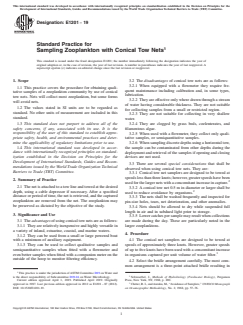
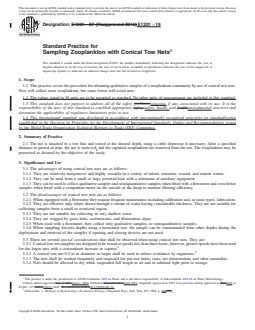
1.1 This practice covers the procedure for obtaining qualitative samples of a zooplankton community by use of conical tow nets. Nets will collect most zooplankton, but some forms will avoid nets.
1.2 The values stated in SI units are to be regarded as standard. No other units of measurement are included in this standard.
1.3 This standard does not purport to address all of the safety concerns, if any, associated with its use. It is the responsibility of the user of this standard to establish appropriate safety, health, and environmental practices and determine the applicability of regulatory limitations prior to use.
1.4 This international standard was developed in accordance with internationally recognized principles on standardization established in the Decision on Principles for the Development of International Standards, Guides and Recommendations issued by the World Trade Organization Technical Barriers to Trade (TBT) Committee.
- Status
- Published
- Publication Date
- 31-Mar-2019
- Technical Committee
- D19 - Water
- Drafting Committee
- D19.24 - Water Microbiology



Overview
ASTM E1201-19 - Standard Practice for Sampling Zooplankton with Conical Tow Nets outlines recognized procedures for collecting qualitative samples of zooplankton using conical tow nets in varied aquatic environments. Developed by ASTM Committee D19 on Water, this international standard addresses both the advantages and limitations of conical tow net methods and provides guidance on equipment selection, sampling technique, and considerations for sample quality. The standard is widely referenced for environmental monitoring, ecological studies, and aquatic research, ensuring consistency and reliability in zooplankton sampling practices.
Key Topics
Versatility and Use Cases
Conical tow nets are highly adaptable for use in inland, estuarine, coastal, and marine waters. They are cost-effective, require minimal auxiliary equipment, and can be deployed from both small and large powered boats.Sample Types
The method enables collection of qualitative and, with modifications, semiquantitative samples. Fitting the net with a flowmeter improves the ability to quantify water volume filtered, providing better sample data.Equipment Considerations
- Use nets of at least 0.5 m diameter to reduce organism avoidance.
- Mesh size selection is critical for capturing the target zooplankton sizes and minimizing gear clogging.
- Regular inspection and maintenance of nets and flowmeters are necessary to uphold sampling efficiency.
Operational Guidelines
- Tow nets at speeds below three knots for best results; higher speeds may increase capture rates for larger nets.
- Avoid sampling in shallow or restricted regions as net effectiveness is reduced.
- Take precautions to prevent sample contamination, especially during horizontal tows or when sampling discrete depths.
Limitations and Challenges
- Flowmeter-equipped nets require careful calibration and frequent maintenance.
- Nets can become clogged by detritus, algae, or dense vegetation.
- Some zooplankton may avoid nets, particularly during daylight sampling.
Best Practices for Net Care
- Wash and inspect nets frequently for damage.
- Allow nets to dry completely and in subdued light prior to storage to prevent deterioration.
Applications
Environmental Monitoring
Used by environmental agencies and laboratories to assess water quality, ecosystem health, and the impact of human activities on aquatic environments.Ecological Research
Supports studies on biodiversity, zooplankton population dynamics, food webs, and fishery resources in both freshwater and marine systems.Regulatory Compliance
Provides standardized methods for data collection required by regulatory frameworks for water resource management, impact assessments, and compliance monitoring.Academic and Educational Use
Referenced in research publications, environmental education, and training programs on aquatic sampling techniques.
Related Standards
- ASTM D3977 - Standard Test Methods for Determining Sediment Concentration in Water Samples
- ISO 5667 - Guidance on water quality sampling methods
- UNESCO Monographs on Oceanographic Methodology - International references for marine sampling techniques
- ASTM D4840 - Guide for Sample Chain-of-Custody Procedures
By following ASTM E1201-19, professionals ensure accurate, repeatable, and internationally recognized practices in zooplankton sampling using conical tow nets. For detailed requirements and updates, always refer to the latest version published by ASTM International.
Relations
- Effective Date
- 01-Apr-2019
Get Certified
Connect with accredited certification bodies for this standard

CIS Institut d.o.o.
Personal Protective Equipment (PPE) certification body. Notified Body NB-2890 for EU Regulation 2016/425 PPE.

Kiwa BDA Testing
Building and construction product certification.
Kmetijski inštitut Slovenije
Agricultural Institute of Slovenia. Soil testing, plant health, agricultural product analysis.
Sponsored listings
Frequently Asked Questions
ASTM E1201-19 is a standard published by ASTM International. Its full title is "Standard Practice for Sampling Zooplankton with Conical Tow Nets". This standard covers: SIGNIFICANCE AND USE 3.1 The advantages of using conical tow nets are as follows: 3.1.1 They are relatively inexpensive and highly versatile in a variety of inland, estuarine, coastal, and marine waters. 3.1.2 They can be used from a small or large powered boat with a minimum of auxiliary equipment. 3.1.3 They can be used to collect qualitative samples and semiquantitative samples when fitted with a flowmeter and even better samples when fitted with a companion meter on the outside of the hoop to monitor filtering efficiency. 3.2 The disadvantages of conical tow nets are as follows: 3.2.1 When equipped with a flowmeter they require frequent maintenance including calibration and, in some types, lubrication. 3.2.2 They are effective only where drawn through a stream of water having considerable thickness. They are not suitable for collecting samples from a small or restricted region. 3.2.3 They are not suitable for collecting in very shallow water. 3.2.4 They are clogged by grass beds, coelenterates, and filamentous algae. 3.2.5 When used with a flowmeter, they collect only qualitative samples, or semiquantitative samples. 3.2.6 When sampling discrete depths using a horizontal tow, the sample can be contaminated from other depths during the deployment and retrieval of the samples if opening and closing devices are not used. 3.3 There are several special considerations that shall be observed when using conical tow nets. They are: 3.3.1 Conical tow net samplers are designed to be towed at speeds less than three knots; however, greater speeds have been used for the larger nets with a concomitant increase in capture.2 3.3.2 A conical tow net 0.5 m in diameter or larger shall be used to reduce avoidance by organisms.2 3.3.3 The nets shall be washed frequently and inspected for pin-size holes, tears, net deterioration, and other anomalies. 3.3.4 Nets should be allowed to dry while suspended full length in air and in subdued light prior to storage. ... SCOPE 1.1 This practice covers the procedure for obtaining qualitative samples of a zooplankton community by use of conical tow nets. Nets will collect most zooplankton, but some forms will avoid nets. 1.2 The values stated in SI units are to be regarded as standard. No other units of measurement are included in this standard. 1.3 This standard does not purport to address all of the safety concerns, if any, associated with its use. It is the responsibility of the user of this standard to establish appropriate safety, health, and environmental practices and determine the applicability of regulatory limitations prior to use. 1.4 This international standard was developed in accordance with internationally recognized principles on standardization established in the Decision on Principles for the Development of International Standards, Guides and Recommendations issued by the World Trade Organization Technical Barriers to Trade (TBT) Committee.
SIGNIFICANCE AND USE 3.1 The advantages of using conical tow nets are as follows: 3.1.1 They are relatively inexpensive and highly versatile in a variety of inland, estuarine, coastal, and marine waters. 3.1.2 They can be used from a small or large powered boat with a minimum of auxiliary equipment. 3.1.3 They can be used to collect qualitative samples and semiquantitative samples when fitted with a flowmeter and even better samples when fitted with a companion meter on the outside of the hoop to monitor filtering efficiency. 3.2 The disadvantages of conical tow nets are as follows: 3.2.1 When equipped with a flowmeter they require frequent maintenance including calibration and, in some types, lubrication. 3.2.2 They are effective only where drawn through a stream of water having considerable thickness. They are not suitable for collecting samples from a small or restricted region. 3.2.3 They are not suitable for collecting in very shallow water. 3.2.4 They are clogged by grass beds, coelenterates, and filamentous algae. 3.2.5 When used with a flowmeter, they collect only qualitative samples, or semiquantitative samples. 3.2.6 When sampling discrete depths using a horizontal tow, the sample can be contaminated from other depths during the deployment and retrieval of the samples if opening and closing devices are not used. 3.3 There are several special considerations that shall be observed when using conical tow nets. They are: 3.3.1 Conical tow net samplers are designed to be towed at speeds less than three knots; however, greater speeds have been used for the larger nets with a concomitant increase in capture.2 3.3.2 A conical tow net 0.5 m in diameter or larger shall be used to reduce avoidance by organisms.2 3.3.3 The nets shall be washed frequently and inspected for pin-size holes, tears, net deterioration, and other anomalies. 3.3.4 Nets should be allowed to dry while suspended full length in air and in subdued light prior to storage. ... SCOPE 1.1 This practice covers the procedure for obtaining qualitative samples of a zooplankton community by use of conical tow nets. Nets will collect most zooplankton, but some forms will avoid nets. 1.2 The values stated in SI units are to be regarded as standard. No other units of measurement are included in this standard. 1.3 This standard does not purport to address all of the safety concerns, if any, associated with its use. It is the responsibility of the user of this standard to establish appropriate safety, health, and environmental practices and determine the applicability of regulatory limitations prior to use. 1.4 This international standard was developed in accordance with internationally recognized principles on standardization established in the Decision on Principles for the Development of International Standards, Guides and Recommendations issued by the World Trade Organization Technical Barriers to Trade (TBT) Committee.
ASTM E1201-19 is classified under the following ICS (International Classification for Standards) categories: 13.060.30 - Sewage water. The ICS classification helps identify the subject area and facilitates finding related standards.
ASTM E1201-19 has the following relationships with other standards: It is inter standard links to ASTM E1201-87(2012). Understanding these relationships helps ensure you are using the most current and applicable version of the standard.
ASTM E1201-19 is available in PDF format for immediate download after purchase. The document can be added to your cart and obtained through the secure checkout process. Digital delivery ensures instant access to the complete standard document.
Standards Content (Sample)
This international standard was developed in accordance with internationally recognized principles on standardization established in the Decision on Principles for the
Development of International Standards, Guides and Recommendations issued by the World Trade Organization Technical Barriers to Trade (TBT) Committee.
Designation: E1201 − 19
Standard Practice for
Sampling Zooplankton with Conical Tow Nets
This standard is issued under the fixed designation E1201; the number immediately following the designation indicates the year of
original adoption or, in the case of revision, the year of last revision. A number in parentheses indicates the year of last reapproval. A
superscript epsilon (´) indicates an editorial change since the last revision or reapproval.
1. Scope 3.2 The disadvantages of conical tow nets are as follows:
3.2.1 When equipped with a flowmeter they require fre-
1.1 This practice covers the procedure for obtaining quali-
quent maintenance including calibration and, in some types,
tative samples of a zooplankton community by use of conical
lubrication.
tow nets. Nets will collect most zooplankton, but some forms
3.2.2 They are effective only where drawn through a stream
will avoid nets.
of water having considerable thickness. They are not suitable
1.2 The values stated in SI units are to be regarded as
for collecting samples from a small or restricted region.
standard. No other units of measurement are included in this
3.2.3 They are not suitable for collecting in very shallow
standard.
water.
1.3 This standard does not purport to address all of the 3.2.4 They are clogged by grass beds, coelenterates, and
safety concerns, if any, associated with its use. It is the
filamentous algae.
responsibility of the user of this standard to establish appro- 3.2.5 When used with a flowmeter, they collect only quali-
priate safety, health, and environmental practices and deter-
tative samples, or semiquantitative samples.
mine the applicability of regulatory limitations prior to use. 3.2.6 When sampling discrete depths using a horizontal tow,
1.4 This international standard was developed in accor-
the sample can be contaminated from other depths during the
dance with internationally recognized principles on standard- deployment and retrieval of the samples if opening and closing
ization established in the Decision on Principles for the
devices are not used.
Development of International Standards, Guides and Recom-
3.3 There are several special considerations that shall be
mendations issued by the World Trade Organization Technical
observed when using conical tow nets. They are:
Barriers to Trade (TBT) Committee.
3.3.1 Conical tow net samplers are designed to be towed at
speedslessthanthreeknots;however,greaterspeedshavebeen
2. Summary of Practice
usedforthelargernetswithaconcomitantincreaseincapture.
2.1 The net is attached to a tow line and towed at the desired
3.3.2 A conical tow net 0.5 m in diameter or larger shall be
depth, using a cable depressor if necessary. After a specified
used to reduce avoidance by organisms.
distance or period of time, the net is retrieved, and the captured
3.3.3 The nets shall be washed frequently and inspected for
zooplankton are removed from the net. The zooplankton may
pin-size holes, tears, net deterioration, and other anomalies.
be preserved as dictated by the objective of the study.
3.3.4 Nets should be allowed to dry while suspended full
length in air and in subdued light prior to storage.
3. Significance and Use
3.3.5 Lower catches per sample may result when collections
3.1 Theadvantagesofusingconicaltownetsareasfollows: are made during the day. These are particularly noted in the
3.1.1 They are relatively inexpensive and highly versatile in larger zooplanktons.
a variety of inland, estuarine, coastal, and marine waters.
4. Procedure
3.1.2 They can be used from a small or large powered boat
with a minimum of auxiliary equipment. 4.1 The conical net samplers are designed to be towed at
3.1.3 They can be used to collect qualitative samples and speeds of approximately three knots. However, greater speeds
semiquantitative samples when fitted with a flowmeter and of up to five knots have been used with a concomitant increase
even better samples when fitted with a companion meter on the in organisms captured per unit volume of water filter.
outside of the hoop to monitor filtering efficiency.
4.2 Select the bridle arrangement carefully. The most com-
mon arrangement is a three-point attached bridle resulting in
This practice is under the jurisdiction of ASTM Committee D19 on Water and
is the direct responsibility of Subcommittee D19.24 on Water Microbiology. Schwoerbel, J., Methods of Hydrobiology (Freshwater Biology), Pergamon
Current edition approved April 1, 2019. Published April 2019. Originally Press, New York, NY, 1968, p. 200.
approved in 1987. Last previous edition approved in 2012 as E1201 – 87 (2012). Clutter, R. I., andAnraku, M., “Avoidance of Samplers,”UNESCOMonograph
DOI: 10.1520/E1201-19. on Oceanographic Methodology, No. 2, 1968, pp. 57–76.
Copyright © ASTM International, 100 Barr Harbor Drive, PO Box C700, West Conshohocken, PA 19428-2959. United States
E1201 − 19
A
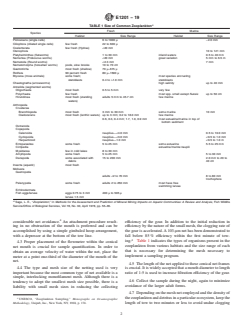
TABLE 1 Size of Common Zooplankton
Fresh Marine
Species
Habitat Size Range Habitat Size Range
Protozoans (single cells) 6 to 1000 µ −2.0 mm
Ciliophora (ciliated single cells) few fresh 22
...
This document is not an ASTM standard and is intended only to provide the user of an ASTM standard an indication of what changes have been made to the previous version. Because
it may not be technically possible to adequately depict all changes accurately, ASTM recommends that users consult prior editions as appropriate. In all cases only the current version
of the standard as published by ASTM is to be considered the official document.
Designation: E1201 − 87 (Reapproved 2012) E1201 − 19
Standard Practice for
Sampling Zooplankton with Conical Tow Nets
This standard is issued under the fixed designation E1201; the number immediately following the designation indicates the year of
original adoption or, in the case of revision, the year of last revision. A number in parentheses indicates the year of last reapproval. A
superscript epsilon (´) indicates an editorial change since the last revision or reapproval.
1. Scope
1.1 This practice covers the procedure for obtaining qualitative samples of a zooplankton community by use of conical tow nets.
Nets will collect most zooplankton, but some forms will avoid nets.
1.2 The values stated in SI units are to be regarded as standard. No other units of measurement are included in this standard.
1.3 This standard does not purport to address all of the safety problems,concerns, if any, associated with its use. It is the
responsibility of the user of this standard to establish appropriate safety safety, health, and healthenvironmental practices and
determine the applicability of regulatory limitations prior to use.
1.4 This international standard was developed in accordance with internationally recognized principles on standardization
established in the Decision on Principles for the Development of International Standards, Guides and Recommendations issued
by the World Trade Organization Technical Barriers to Trade (TBT) Committee.
2. Summary of Practice
2.1 The net is attached to a tow line and towed at the desired depth, using a cable depressor if necessary. After a specified
distance or period of time, the net is retrieved, and the captured zooplankton are removed from the net. The zooplankton may be
preserved as dictated by the objective of the study.
3. Significance and Use
3.1 The advantages of using conical tow nets are as follows:
3.1.1 They are relatively inexpensive and highly versatile in a variety of inland, estuarine, coastal, and marine waters.
3.1.2 They can be used from a small or large powered boat with a minimum of auxiliary equipment.
3.1.3 They can be used to collect qualitative samples and semiquantitative samples when fitted with a flowmeter and even better
samples when fitted with a companion meter on the outside of the hoop to monitor filtering efficiency.
3.2 The disadvantages of conical tow nets are as follows:
3.2.1 When equipped with a flowmeter they require frequent maintenance including calibration and, in some types, lubrication.
3.2.2 They are effective only where drawn through a stream of water having considerable thickness. They are not suitable for
collecting samples from a small or restricted region.
3.2.3 They are not suitable for collecting in very shallow water.
3.2.4 They are clogged by grass beds, coelenterates, and filamentous algae.
3.2.5 When used with a flowmeter, they collect only qualitative samples, or semiquantitative samples.
3.2.6 When sampling discrete depths using a horizontal tow, the sample can be contaminated from other depths during the
deployment and retrieval of the samples if opening and closing devices are not used.
3.3 There are several special considerations that shall be observed when using conical tow nets. They are:
3.3.1 Conical tow net samplers are designed to be towed at speeds less than three knots; however, greater speeds have been used
for the larger nets with a concomitant increase in capture.
3.3.2 A conical tow net 0.5 m in diameter or larger shall be used to reduce avoidance by organisms.
3.3.3 The nets shall be washed frequently and inspected for pin-size holes, tears, net deterioration, and other anomalies.
3.3.4 Nets should be allowed to dry while suspended full length in air and in subdued light prior to storage.
This practice is under the jurisdiction of ASTM Committee D19 on Water and is the direct responsibility of Subcommittee D19.24 on Water Microbiology.
Current edition approved Dec. 1, 2012April 1, 2019. Published December 2012April 2019. Originally approved in 1987. Last previous edition approved in 20042012 as
E1201 – 87 (2004).(2012). DOI: 10.1520/E1201-87R12.10.1520/E1201-19.
Schwoerbel, J., Methods of Hydrobiology (Freshwater Biology), Pergamon Press, New York, NY, 1968, p. 200200.
Copyright © ASTM International, 100 Barr Harbor Drive, PO Box C700, West Conshohocken, PA 19428-2959. United States
E1201 − 19
3.3.5 Lower catches per sample may result when collections are made during the day. These are particularly noted in the larger
zooplanktons.
4. Procedure
4.1 The conical net samplers are designed to be towed at speeds of approximately three knots. However, greater speeds of up
to five knots have been used with a concomitant increase in organisms captured per unit volume of water filter.
A
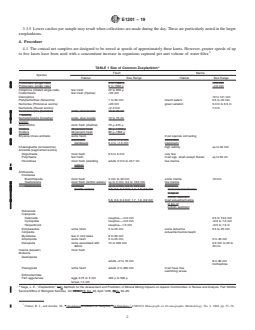
TABLE 1 Size of Common Zooplankton
Fresh Marine
Species
Habitat Size Range Habitat Size Range
Protozoans (single cells) 6 to 1,000 μ −2.0 mm
Protozoans (single cells) 6 to 1000 μ −2.0 mm
Ciliophora (ciliated single cells) few fresh 22 to 600 μ
Coelenterata few fresh (Hydras) <20 mm
Ctenophora 10 to 121 mm
Platyhelminthes (flatworms) 1 to 30 mm inland waters 0.5 to 40 mm
Nemertea (Proboscus worms) <20 mm great variation 5 mm to 6.5 m
Nematoda (Round worms) <2.3 mm 7 mm
Nematomorpha (horsehair pools, slow brooks 10 to 70 cm
worms)
Nematomorpha (horsehair pools, slow
...