

ASTM D4823-95(2019)
(Guide)Standard Guide for Core Sampling Submerged, Unconsolidated Sediments
General Information
- Abstract
ABSTRACT
This guide covers core-sampling submerged, unconsolidated sediments. It also covers terminology, advantages and disadvantages of different types of core samplers, core-distortions that may occur during sampling, techniques for detecting and minimizing core distortions, and methods for dissecting and preserving sediment cores. Sampling procedures and equipment are divided into categories based on water depth. Critical dimensions and properties of open-barrel and piston samplers like the cutting-bit angle, core-liner diameter, inside friction factor, outside friction factor, area factor, core-barrel length, barrel surfaces, and chemical composition of sampler parts shall conform to this standard guide. The following factors shall be considered for decisions in choosing between an open-barrel sampler and a piston sampler: depth of penetration, core compaction, flow-in distortion, surface disturbance, and repenetration. Driving techniques included in this guide are free core samplers, implosive and explosive samplers, punch-corer samplers, vibratory-driven samplers and impact-driven samplers. Guides are also included for collecting short cores in shallow water, collecting long cores in shallow water, and collecting short and long cores for a range of water depth. Field record shall be provided for every sampling operation. Guides are also provided for core extrusion for samplers with no liners, slitting core and core liners, sectioning cores, sampling through liner walls, preserving cores, and displaying cores.
SCOPE
1.1 This guide covers core-sampling terminology, advantages and disadvantages of different types of core samplers, core-distortions that may occur during sampling, techniques for detecting and minimizing core distortions, and methods for dissecting and preserving sediment cores.
1.2 In this guide, sampling procedures and equipment are divided into the following categories based on water depth: sampling in depths shallower than 0.5 m, sampling in depths between 0.5 m and 10 m, and sampling in depths exceeding 10 m. Each category is divided into two sections: equipment for collecting short cores and equipment for collecting long cores.
1.3 This guide emphasizes general principles. Only in a few instances are step-by-step instructions given. Because core sampling is a field-based operation, methods and equipment must usually be modified to suit local conditions. This modification process requires two essential ingredients: operator skill and judgment. Neither can be replaced by written rules.
1.4 Drawings of samplers are included to show sizes and proportions. These samplers are offered primarily as examples (or generic representations) of equipment that can be purchased commercially or built from plans in technical journals.
1.5 This guide is a brief summary of published scientific articles and engineering reports. These references are listed in this guide. These documents provide operational details that are not given in this guide but are nevertheless essential to the successful planning and completion of core sampling projects.
1.6 The values stated in SI units are to be regarded as standard. No other units of measurement are included in this standard.
1.7 This standard does not purport to address all of the safety concerns, if any, associated with its use. It is the responsibility of the user of this standard to establish appropriate safety, health, and environmental practices and determine the applicability of regulatory limitations prior to use. For specific warning statements, see 6.3 and 11.5.
1.8 This international standard was developed in accordance with internationally recognized principles on standardization established in the Decision on Principles for the Development of International Standards, Guides and Recommendations issued by the World Trade Organization Technical Barriers to Trade (TBT) Committee.
- Status
- Published
- Publication Date
- 31-Oct-2019
- Technical Committee
- D19 - Water
- Drafting Committee
- D19.07 - Sediments, Geomorphology, and Open-Channel Flow
Overview
ASTM D4823-95(2019), titled Standard Guide for Core Sampling Submerged, Unconsolidated Sediments, provides comprehensive guidelines for collecting sediment cores from underwater environments. Developed by ASTM International, this standard addresses key considerations for successful core sampling, including terminology, selection of sampling equipment, techniques to minimize sample distortion, and best practices for handling and preserving sediment cores. Sampling solutions are classified according to water depth, and the guide discusses the critical properties of core samplers such as cutting-bit angle, core-liner diameter, and friction factors, ensuring reliable and minimally disturbed sediment samples essential for scientific, geotechnical, and environmental studies.
Key Topics
- Core Sampling Methodology: Details on the use of open-barrel and piston samplers, including their respective advantages and disadvantages.
- Water Depth Considerations: Divides sampling protocols into shallow (<0.5 m), intermediate (0.5-10 m), and deep water (>10 m), covering both short and long core collection.
- Core Distortion: Identifies various sources of core distortion, such as core compaction and flow-in, and provides techniques for minimizing sample disturbance.
- Sampler Selection Criteria: Offers guidance based on depth of penetration, desired core quality, equipment capabilities, and field conditions.
- Driving Techniques: Describes methods for penetrating sediment, from weight- and momentum-based approaches to vibratory and impact-driven systems.
- Sample Handling: Covers methods for extruding, slitting, sectioning, preserving, and displaying sediment cores to maintain integrity from the field to the laboratory.
- Critical Sampler Parameters: Emphasizes the importance of sampler geometry and material composition to minimize sample contamination and data bias.
Applications
The procedures outlined in ASTM D4823-95(2019) are widely applicable across several sectors:
- Environmental Assessment: Collection of undisturbed sediment cores for contamination analysis, pollutant profiling, and environmental impact studies in lakes, rivers, reservoirs, and coastal zones.
- Geotechnical Engineering: Site investigation for construction, dredging, and stability assessments, where knowledge of subsurface sediment structure is necessary.
- Scientific Research: Supports paleoenvironmental studies, climate reconstruction, sediment transport modeling, and aquatic ecosystem investigations through minimally disturbed samples.
- Regulatory Compliance: Enabling laboratories and field operators to meet international and local standards for sample integrity in water and sediment quality monitoring programs.
By following ASTM D4823, organizations ensure repeatable, reliable, and scientifically valid core sampling results, supporting data quality and comparability across projects and regulatory jurisdictions.
Related Standards
Integrating ASTM D4823-95(2019) with other key standards ensures comprehensive sediment sampling workflows:
- ASTM D420 - Guide for Site Characterization for Engineering Design and Construction Purposes
- ASTM D1129 - Terminology Relating to Water
- ASTM D1452 - Practice for Soil Exploration and Sampling by Auger Borings
- ASTM D1586 - Test Method for Standard Penetration Test (SPT) and Split-Barrel Sampling of Soils
- ASTM D1587 - Practice for Thin-Walled Tube Sampling of Fine-Grained Soils for Geotechnical Purposes
- ASTM D4220 - Practices for Preserving and Transporting Soil Samples
- ASTM D4410 - Terminology for Fluvial Sediment
Following these standards alongside ASTM D4823-95(2019) promotes data reliability, regulatory compliance, and best practices across sediment core sampling and analysis operations.
Keywords: ASTM D4823-95, core sampling, sediment core, unconsolidated sediments, underwater sampling, piston sampler, open-barrel sampler, sediment preservation, environmental monitoring, geotechnical assessment, core distortion, sediment analysis standards.
Relations
- Effective Date
- 01-Nov-2019
- Effective Date
- 01-May-2020
- Effective Date
- 01-Feb-2018
- Effective Date
- 01-Jan-2016
- Effective Date
- 15-May-2012
- Effective Date
- 01-Nov-2011
- Effective Date
- 01-Mar-2010
- Effective Date
- 01-Feb-2010
- Effective Date
- 15-Feb-2009
- Refers
ASTM D1587-08 - Standard Practice for Thin-Walled Tube Sampling of Soils for Geotechnical Purposes - Effective Date
- 01-Oct-2008
- Effective Date
- 01-Oct-2008
- Effective Date
- 01-Feb-2008
- Effective Date
- 01-Sep-2007
- Effective Date
- 15-Jul-2007
- Effective Date
- 01-Jul-2007
Get Certified
Connect with accredited certification bodies for this standard

CIS Institut d.o.o.
Personal Protective Equipment (PPE) certification body. Notified Body NB-2890 for EU Regulation 2016/425 PPE.

Kiwa BDA Testing
Building and construction product certification.
Kmetijski inštitut Slovenije
Agricultural Institute of Slovenia. Soil testing, plant health, agricultural product analysis.
Sponsored listings
Frequently Asked Questions
ASTM D4823-95(2019) is a guide published by ASTM International. Its full title is "Standard Guide for Core Sampling Submerged, Unconsolidated Sediments". This standard covers: ABSTRACT This guide covers core-sampling submerged, unconsolidated sediments. It also covers terminology, advantages and disadvantages of different types of core samplers, core-distortions that may occur during sampling, techniques for detecting and minimizing core distortions, and methods for dissecting and preserving sediment cores. Sampling procedures and equipment are divided into categories based on water depth. Critical dimensions and properties of open-barrel and piston samplers like the cutting-bit angle, core-liner diameter, inside friction factor, outside friction factor, area factor, core-barrel length, barrel surfaces, and chemical composition of sampler parts shall conform to this standard guide. The following factors shall be considered for decisions in choosing between an open-barrel sampler and a piston sampler: depth of penetration, core compaction, flow-in distortion, surface disturbance, and repenetration. Driving techniques included in this guide are free core samplers, implosive and explosive samplers, punch-corer samplers, vibratory-driven samplers and impact-driven samplers. Guides are also included for collecting short cores in shallow water, collecting long cores in shallow water, and collecting short and long cores for a range of water depth. Field record shall be provided for every sampling operation. Guides are also provided for core extrusion for samplers with no liners, slitting core and core liners, sectioning cores, sampling through liner walls, preserving cores, and displaying cores. SCOPE 1.1 This guide covers core-sampling terminology, advantages and disadvantages of different types of core samplers, core-distortions that may occur during sampling, techniques for detecting and minimizing core distortions, and methods for dissecting and preserving sediment cores. 1.2 In this guide, sampling procedures and equipment are divided into the following categories based on water depth: sampling in depths shallower than 0.5 m, sampling in depths between 0.5 m and 10 m, and sampling in depths exceeding 10 m. Each category is divided into two sections: equipment for collecting short cores and equipment for collecting long cores. 1.3 This guide emphasizes general principles. Only in a few instances are step-by-step instructions given. Because core sampling is a field-based operation, methods and equipment must usually be modified to suit local conditions. This modification process requires two essential ingredients: operator skill and judgment. Neither can be replaced by written rules. 1.4 Drawings of samplers are included to show sizes and proportions. These samplers are offered primarily as examples (or generic representations) of equipment that can be purchased commercially or built from plans in technical journals. 1.5 This guide is a brief summary of published scientific articles and engineering reports. These references are listed in this guide. These documents provide operational details that are not given in this guide but are nevertheless essential to the successful planning and completion of core sampling projects. 1.6 The values stated in SI units are to be regarded as standard. No other units of measurement are included in this standard. 1.7 This standard does not purport to address all of the safety concerns, if any, associated with its use. It is the responsibility of the user of this standard to establish appropriate safety, health, and environmental practices and determine the applicability of regulatory limitations prior to use. For specific warning statements, see 6.3 and 11.5. 1.8 This international standard was developed in accordance with internationally recognized principles on standardization established in the Decision on Principles for the Development of International Standards, Guides and Recommendations issued by the World Trade Organization Technical Barriers to Trade (TBT) Committee.
ABSTRACT This guide covers core-sampling submerged, unconsolidated sediments. It also covers terminology, advantages and disadvantages of different types of core samplers, core-distortions that may occur during sampling, techniques for detecting and minimizing core distortions, and methods for dissecting and preserving sediment cores. Sampling procedures and equipment are divided into categories based on water depth. Critical dimensions and properties of open-barrel and piston samplers like the cutting-bit angle, core-liner diameter, inside friction factor, outside friction factor, area factor, core-barrel length, barrel surfaces, and chemical composition of sampler parts shall conform to this standard guide. The following factors shall be considered for decisions in choosing between an open-barrel sampler and a piston sampler: depth of penetration, core compaction, flow-in distortion, surface disturbance, and repenetration. Driving techniques included in this guide are free core samplers, implosive and explosive samplers, punch-corer samplers, vibratory-driven samplers and impact-driven samplers. Guides are also included for collecting short cores in shallow water, collecting long cores in shallow water, and collecting short and long cores for a range of water depth. Field record shall be provided for every sampling operation. Guides are also provided for core extrusion for samplers with no liners, slitting core and core liners, sectioning cores, sampling through liner walls, preserving cores, and displaying cores. SCOPE 1.1 This guide covers core-sampling terminology, advantages and disadvantages of different types of core samplers, core-distortions that may occur during sampling, techniques for detecting and minimizing core distortions, and methods for dissecting and preserving sediment cores. 1.2 In this guide, sampling procedures and equipment are divided into the following categories based on water depth: sampling in depths shallower than 0.5 m, sampling in depths between 0.5 m and 10 m, and sampling in depths exceeding 10 m. Each category is divided into two sections: equipment for collecting short cores and equipment for collecting long cores. 1.3 This guide emphasizes general principles. Only in a few instances are step-by-step instructions given. Because core sampling is a field-based operation, methods and equipment must usually be modified to suit local conditions. This modification process requires two essential ingredients: operator skill and judgment. Neither can be replaced by written rules. 1.4 Drawings of samplers are included to show sizes and proportions. These samplers are offered primarily as examples (or generic representations) of equipment that can be purchased commercially or built from plans in technical journals. 1.5 This guide is a brief summary of published scientific articles and engineering reports. These references are listed in this guide. These documents provide operational details that are not given in this guide but are nevertheless essential to the successful planning and completion of core sampling projects. 1.6 The values stated in SI units are to be regarded as standard. No other units of measurement are included in this standard. 1.7 This standard does not purport to address all of the safety concerns, if any, associated with its use. It is the responsibility of the user of this standard to establish appropriate safety, health, and environmental practices and determine the applicability of regulatory limitations prior to use. For specific warning statements, see 6.3 and 11.5. 1.8 This international standard was developed in accordance with internationally recognized principles on standardization established in the Decision on Principles for the Development of International Standards, Guides and Recommendations issued by the World Trade Organization Technical Barriers to Trade (TBT) Committee.
ASTM D4823-95(2019) is classified under the following ICS (International Classification for Standards) categories: 13.060.30 - Sewage water. The ICS classification helps identify the subject area and facilitates finding related standards.
ASTM D4823-95(2019) has the following relationships with other standards: It is inter standard links to ASTM D4823-95(2014), ASTM D1129-13(2020)e2, ASTM D420-18, ASTM D4410-16, ASTM D1587-08(2012)e1, ASTM D1586-11, ASTM D1129-10, ASTM D4410-10, ASTM D1452-09, ASTM D1587-08, ASTM D1586-08a, ASTM D1586-08, ASTM D1452-07a, ASTM D1452-07, ASTM D4220-95(2007). Understanding these relationships helps ensure you are using the most current and applicable version of the standard.
ASTM D4823-95(2019) is available in PDF format for immediate download after purchase. The document can be added to your cart and obtained through the secure checkout process. Digital delivery ensures instant access to the complete standard document.
Standards Content (Sample)
This international standard was developed in accordance with internationally recognized principles on standardization established in the Decision on Principles for the
Development of International Standards, Guides and Recommendations issued by the World Trade Organization Technical Barriers to Trade (TBT) Committee.
Designation: D4823 − 95 (Reapproved 2019)
Standard Guide for
Core Sampling Submerged, Unconsolidated Sediments
This standard is issued under the fixed designation D4823; the number immediately following the designation indicates the year of
original adoption or, in the case of revision, the year of last revision. A number in parentheses indicates the year of last reapproval. A
superscript epsilon (´) indicates an editorial change since the last revision or reapproval.
1. Scope 1.8 This international standard was developed in accor-
dance with internationally recognized principles on standard-
1.1 This guide covers core-sampling terminology, advan-
ization established in the Decision on Principles for the
tages and disadvantages of different types of core samplers,
Development of International Standards, Guides and Recom-
core-distortions that may occur during sampling, techniques
mendations issued by the World Trade Organization Technical
for detecting and minimizing core distortions, and methods for
Barriers to Trade (TBT) Committee.
dissecting and preserving sediment cores.
1.2 In this guide, sampling procedures and equipment are
2. Referenced Documents
divided into the following categories based on water depth:
2.1 ASTM Standards:
sampling in depths shallower than 0.5 m, sampling in depths
D420 Guide for Site Characterization for Engineering De-
between 0.5 m and 10 m, and sampling in depths exceeding 10
sign and Construction Purposes
m. Each category is divided into two sections: equipment for
D1129 Terminology Relating to Water
collecting short cores and equipment for collecting long cores.
D1452 Practice for Soil Exploration and Sampling byAuger
1.3 This guide emphasizes general principles. Only in a few
Borings
instances are step-by-step instructions given. Because core
D1586 Test Method for Standard PenetrationTest (SPT) and
sampling is a field-based operation, methods and equipment
Split-Barrel Sampling of Soils
must usually be modified to suit local conditions. This modi-
D1587 Practice for Thin-Walled Tube Sampling of Fine-
fication process requires two essential ingredients: operator
Grained Soils for Geotechnical Purposes
skill and judgment. Neither can be replaced by written rules.
D4220 Practices for Preserving and Transporting Soil
1.4 Drawings of samplers are included to show sizes and
Samples
proportions. These samplers are offered primarily as examples
D4410 Terminology for Fluvial Sediment
(orgenericrepresentations)ofequipmentthatcanbepurchased
commercially or built from plans in technical journals.
3. Terminology
1.5 This guide is a brief summary of published scientific
3.1 Definitions:
articles and engineering reports. These references are listed in
3.1.1 For definitions of terms used in this standard, refer to
this guide. These documents provide operational details that
Terminologies D1129 and D4410.
are not given in this guide but are nevertheless essential to the
3.2 Definitions of Terms Specific to This Standard:
successful planning and completion of core sampling projects.
3.2.1 check valve, n—adevice(seeFig.1) mountedatopan
1.6 The values stated in SI units are to be regarded as
open-barrel core sampler.As the sampler moves down through
standard. No other units of measurement are included in this
water and sediment, the valve remains open to allow water to
standard.
flow up through the barrel. When downward motion stops, the
1.7 This standard does not purport to address all of the
valve closes. During retrieval, the valve remains closed and
safety concerns, if any, associated with its use. It is the
creates suction that holds the core inside the barrel.
responsibility of the user of this standard to establish appro-
3.2.2 core, n—a vertical column of sediment cut from a
priate safety, health, and environmental practices and deter-
parent deposit.
mine the applicability of regulatory limitations prior to use.
For specific warning statements, see 6.3 and 11.5.
1 2
This guide is under the jurisdiction of ASTM Committee D19 on Water and is For referenced ASTM standards, visit the ASTM website, www.astm.org, or
the direct responsibility of Subcommittee D19.07 on Sediments, Geomorphology, contact ASTM Customer Service at service@astm.org. For Annual Book of ASTM
and Open-Channel Flow. Standards volume information, refer to the standard’s Document Summary page on
Current edition approved Nov. 1, 2019. Published January 2020. Originally the ASTM website.
approved in 1988. Last previous edition approved in 2014 as D4823 – 95 (2014). The boldface numbers in parentheses refer to a list of references at the end of
DOI: 10.1520/D4823-95R19. this standard.
Copyright © ASTM International, 100 Barr Harbor Drive, PO Box C700, West Conshohocken, PA 19428-2959. United States
D4823 − 95 (2019)
NOTE 1—(a) Strips of metal foil slide up through the core barrel as the
cutting edge advances downward. (4) (b) The plastic sleeve unfolds from
pleats stored near the cutting edge. This sleeve surrounds the core as the
barrel moves down. (3)
NOTE 1—Dark bands represent stiff sediments; light bands represent
FIG. 3 Core Conveyors
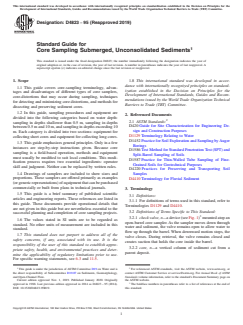
plastic sediments. As coring proceeds, sediment below the barrel moves
laterallyawayfromthecuttingedgeandplasticsedimentsinsidethebarrel
arecompressed.“A”isthecore’slengthand“B”isthebarrel’spenetration
depth.
3.2.7 extrude, v—the act of pushing a core from a core
FIG. 1 Deformations Caused by Open-Barrel Core Samplers (1)
barrel or a core-barrel liner.
3.2.8 open-barrel sampler, n—in simplest form, a straight
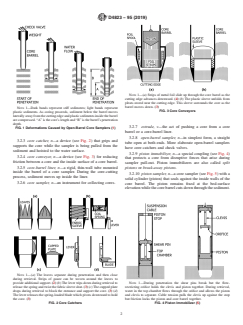
3.2.3 core catcher, n—a device (see Fig. 2) that grips and
tube open at both ends. More elaborate open-barrel samplers
supports the core while the sampler is being pulled from the
have core catchers and check valves.
sediment and hoisted to the water surface.
3.2.9 piston immobilizer, n—a special coupling (see Fig. 4)
3.2.4 core conveyor, n—a device (see Fig. 3) for reducing
that protects a core from disruptive forces that arise during
friction between a core and the inside surface of a core barrel.
sampler pull-out. Piston immobilizers are also called split
3.2.5 core-barrel liner, n—a rigid, thin-wall tube mounted
pistons or break-away pistons.
inside the barrel of a core sampler. During the core-cutting
3.2.10 piston sampler, n—a core sampler (see Fig. 5) with a
process, sediment moves up inside the liner.
solid cylinder (piston) that seals against the inside walls of the
3.2.6 core sampler, n—an instrument for collecting cores.
core barrel. The piston remains fixed at the bed-surface
elevationwhilethecorebarrelcutsdownthroughthesediment.
NOTE 1—(a) The leaves separate during penetration and then close
during retrieval. Strips of gauze can be woven around the leaves to
provide additional support. (2) (b)The lever trips down during retrieval to NOTE 1—During penetration the shear pins break but the flow-
release the spring and twist the fabric sleeve shut. (3) (c)The cupped plate restricting orifice holds the clevis and piston together. During retrieval,
drops during retrieval to block the entrance and support the core. (3) (d) water in the top chamber flows through the orifice and allows the piston
The lever releases the spring-loaded blade which pivots downward to hold and clevis to separate. Cable tension pulls the clevis up against the stop
the core. (3) but friction locks the piston and core barrel together.
FIG. 2 Core Catchers FIG. 4 Piston Immobilizer (5)
D4823 − 95 (2019)
3.2.15 undisturbed sample, n—sediment particles that have
not been rearranged relative to one another by the process used
to cut and isolate the particles from their parent deposit. All
core samples are disturbed to some degree because raising the
cores to the water surface causes pore water and trapped gases
to expand (10). In common usage, the term “undisturbed
sample” describes particles that have been rearranged but only
to a slight degree.
4. Critical Dimensions of Open-Barrel and Piston
Samplers
4.1 Dimensions of a sampler’s cutting bit, core tube, and
core-tube liner (see Fig. 7) are critical in applications requiring
undisturbed samples. These dimensions control the amount of
distortion in recovered cores. The recommendations in this
section were developed from tests on open-barrel core sam-
plers (11); however, the recommendations are usually extended
NOTE 1—(a) The sampler is lowered slowly through the water. (b) The
sampler falls free when the trip weight contacts the bed. (c) The core
to cover piston-type core samplers.
barrel cuts downward but the piston remains stationary.
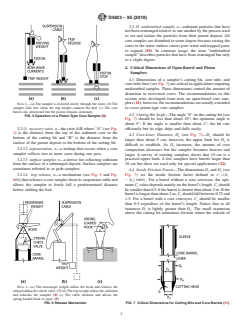
4.2 Cutting-Bit Angle—The angle “b” on the cutting bit (see
FIG. 5 Operation of a Piston-Type Core Sampler (6)
Fig. 7) should be less than about 10°; the optimum angle is
about 5°. If the angle is smaller than about 2°, the bit cuts
3.2.11 recovery ratio, n—the ratioA/B where “A” (see Fig.
efficiently but its edge chips and dulls easily.
1) is the distance from the top of the sediment core to the
4.3 Core-Liner Diameter, D (see Fig. 7)—D should be
s s
bottom of the cutting bit and “B” is the distance from the
larger than about 5 cm; however, the upper limit for D is
s
surface of the parent deposit to the bottom of the cutting bit.
difficult to establish. As D increases, the amount of core
s
3.2.12 repenetration, n—a mishap that occurs when a core
compaction decreases but the sampler becomes heavier and
sampler collects two or more cores during one pass.
larger. A survey of existing samplers shows that 10 cm is a
practical upper limit. A few samplers have barrels larger than
3.2.13 surface sampler, n—a device for collecting sediment
from the surface of a submerged deposit. Surface samplers are 10 cm but these are used only for special applications (12).
sometimes referred to as grab samplers.
4.4 Inside Friction Factor—The dimensions D and D (see
s e
3.2.14 trip release, n—a mechanism (see Fig. 5 and Fig. Fig. 7) set the inside friction factor defined as C 5 D
~
i s
6(b)) that releases a core sampler from its suspension cable and 2 D ! 100⁄D . For a barrel without a core conveyor, the opti-
e e
allows the sampler to freely fall a predetermined distance mum C value depends mainly on the barrel’s length. C should
i i
before striking the bed. be smaller than 0.5 if the barrel is shorter than about 2 m. If the
barrelislongerthanabout2m, C shouldfallbetween0.75and
i
1.5. For a barrel with a core conveyor, C should be smaller
i
than 0.5 regardless of the barrel’s length. Notice that in all
instances D is lightly greater than D . The small expansion
s e
above the cutting bit minimizes friction where the outside of
NOTE 1—(a) The messenger weight strikes the hook and releases the
string holding the check valve. (7) (b)The trip weight strikes the sediment
and unhooks the sampler. (8) (c) The cable slackens and allows the
spring-loaded hook to open. (9)
FIG. 6 Release Mechanism FIG. 7 Critical Dimensions for Cutting Bits and Core Barrels (11)
D4823 − 95 (2019)
the core contacts the inside of the barrel or liner. Friction 10, and 20 apply to slow-penetrating, open-barrel samplers.
distorts the core’s strata by bending horizontal layers into Studies suggest that all of these factors can be increased by
curved, bowl-shaped surfaces shown on the upper part of Fig. raising the sampler’s penetration speed or using a piston
8. Friction also causes overall end-to-end compaction of the sampler instead of an open-barrel sampler.
core and thereby reduces recovery ratios. If friction becomes
4.8 Barrel Surfaces—All surfaces contacting the core
very large, sediment fails to enter the cutting bit. Instead,
should be smooth and free of protruding edges to reduce
sediment moves aside as the bit penetrates downward. This
internal friction and minimize core distortion. The surfaces
lateral motion, commonly referred to as “staking,” prevents
should also be clean and chemically inert if the core is to be
deep-lying strata from being sampled. It is important to
analyzed for contaminants or if the core is to be stored in its
observe upper limits on C because too large an expansion
i
liner for long periods of time.
causes another form of distortion, the core slumps against the
4.9 ChemicalCompositionofSamplerParts—Samplerparts
walls as the sediment slides up into the barrel.
must not contain substances that interfere with chemical
4.5 Outside Friction Factor—The dimensions D and D
w t
analysis of the cores. For example, barrels, pistons, and core
(see Fig. 7) set the outside friction factor defined as C 5~D
o w
catchers made of plastic should not be used if tests include
2 D 100⁄D . C should be zero for barrels used in cohesionless
!
t t o
phthalate concentrations. Misleading data will result from
sediments; but C should be between 1.0 and about 3.0 for
o
plasticizer contamination of the sediments.
barrels used in cohesive sediments. Notice that in all instances
D is larger than D. The small contraction above the bit
5. Open-Barrel Samplers Versus Piston Samplers
w t
reduces friction at the outside surface of the barrel and makes
5.1 Users sometimes face difficult decisions in choosing
it easier to push the core barrel into the bed. On a long barrel,
between an open-barrel sampler and a piston sampler. The
friction can be reduced by installing one or more sleeves (see
decision frequently depends not only upon characteristics of
Fig. 7). The sleeves not only plough a path for the barrel but
the two samplers but also upon other factors such as hoisting-
they also serve as clamps to hold barrel sections together.
equipment capabilities, working platform stability, water
4.6 Area Factor—The dimensions D and D set the area
depth, operator experience, and the purpose for collecting the
w e
2 2
factor defined as C 5~D ! 100⁄D . C should be less than 10 or
cores.Thissectioncoversfactorstoconsiderbeforemakingthe
a w e a
possibly 15. Notice that C is proportional to the area of
final choice.
a
sediment displaced by the bit divided by the area of the bit’s
5.2 Depth of Penetration—Most open-barrel samplers and
entrance; therefore, C is an index of disturbance at the cutting
a
most piston samplers rely on momentum to drive their barrels
edge. A sampler with too large an area factor tends to
into sediment deposits. Momentum-driven samplers are re-
oversample during early stages of penetration when friction
leased at a predetermined point so as to acquire momentum
along the inner wall of the barrel is low. Oversampling occurs
while falling toward the bed. A momentum-driven piston
because sediment laying below and outside the bit shift inward
sampler generally penetrates deeper than a momentum-driven
as the bit cuts downward.
open-barrel sampler provided the two samplers have equal
4.7 Core-Barrel Length—A sampler’s core barrel should be
weights, equal barrel-diameters, and equal fall-distances (6).
slightly longer than L, the longest core that can be collected
5.3 Core Compaction—When compared under equal test
without causing significant compaction. L and D (see Fig. 7)
s
conditions (see 5.2), a piston sampler causes less core com-
set the core-length factor defined as L 5L⁄D . L should be less
f s f
paction than an open-barrel sampler. However, the piston must
than 5.0 (or possibly 10) for a sampler used in cohesive
be held motionless at the bed-surface elevation while the barrel
sediments, but L should be less than 10 (or possibly 20) for a
f
penetrates downward. If the piston is allowed to shift down
samplerusedincohesionlesssediments.Theconstantfactors5,
with the barrel, the core undergoes serious compaction.
5.4 Flow-in Distortion—Flow-in distortion is caused by
suction at the entrance of a sampler. Sediment is sucked into
the barrel instead of being severed and encircles by the cutting
edge. Flow-in rarely occurs with open-barrel samplers;
however, it can be a problem with piston samplers (14).
Flow-in usually occurs during pull-out following a shallow
penetration. Conditions leading to flow-in are shown in Fig.
5(c). The barrel is at the end of its downward travel but the
piston lies below the piston stop. During pull-out, the upward
force on the cable slides the piston up through the barrel before
the cutting edge clears the bed.As the piston slides, it pulls the
core up through the barrel. As the core moves, sediment flows
in to fill the void at the lower end of the barrel. Strata lines at
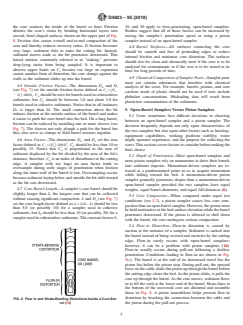
the bottom of the recovered core are distorted and resemble
those in Fig. 8. A piston immobilizer helps prevent flow-in
distortion by breaking the connection between the cable and
FIG. 8 Flow in and Strata-Bending Distortions Inside a Core Bar-
rel (13) the piston during the pull-out process.
D4823 − 95 (2019)
5.5 Surface Disturbance—Surface sediment, material lying
at the interface between water and bed, is easily disturbed by
bow-wave currents (see Fig. 5(a)) that travel ahead of a
sampler’s cutting bit. A piston sampler creates a strong bow
waveasthebarrel,whichisblockedbythepiston,fallsthrough
the water. Fine-grained, unconsolidated sediments are blown
aside just before the cutting edge contacts the bed. An
open-barrel sampler creates a weak bow-wave because the
barrel is unobstructed. However, adding a core catcher or a
check valve to an open-barrel sampler restricts water flow
through the barrel and makes the bow-wave stronger. Check
valves come in a variety of sizes, shapes, and styles. These
characteristics should be carefully considered before making a
final selection. The valve should have an opening approxi-
matelyequaltothecross-sectionalareaofthebarrel.Thevalve
should open fully during the sampler’s descent and then close
NOTE 1—(a) The sampler falls toward the bed. (b) The bottom section
and seal tightly during the sampler’s ascent.
drives the core barrel into the sediment. (c) The bottom section unlatches
and releases the float. (d) The float and core rise to the surface.
5.6 Repenetration—Repenetration occasionally occurs in
FIG. 9 Operation of a Free Corer (6)
shallow-watersamplingiftheworkingplatform(boatorbarge)
rolls and heaves; however, repenetration usually occurs in
on the bed; however, the float, core barrel, and core sample rise
deep-water sampling that requires a long cable (1). During the
to the water surface (Fig. 9(d)) where they are retrieved. Free
initial stage of pull out, the cable stretches as tension gradually
corers are useful if many samples must be collected rapidly.
increases. Suddenly, the sediment relaxes its grip on the barrel
Free cores are costly to operate because the lower sections
and the lower section of cable contracts as the sampler springs
must be replaced and because the latches sometimes fail.
upward.Arapidsequenceofeventsfollow.Ashockwaveraces
6.3 Implosive and Explosive Samplers—These samplers are
up the cable, reflects off the hoist drum, and then travels back
driven by high pressures developed by either implosions or
down to the sampler (15). Upon reaching the bottom, the shock
explosions (16). An implosive-driven sampler has an electri-
wave abruptly lowers the sampler and the cutting bit cores the
cally operated valve and a cylindrical cavity fitted with a
toplayerofsedimentasecondtime.Thisupanddownbobbing
piston. The sampler is lowered to the bed, then the valve is
action may occur several times before the sampler can be
openedsothathigh-pressurewateraroundthesamplercanrush
hoisted to a safe level above the bed. The severity of repen-
into the cavity and push against the piston.As the piston slides,
etration depends on the type of sampler used. With an
it pulls against cables (or rods) which exert a downward thrust
open-barrel sampler, the first core that is cut can shift up the
on the barrel and upward thrust on the sampler’s frame.
barrel and easily escape through the check valve as additional
Implosive samplers are complicated, expensive to purchase,
cores enter the bit. With a piston sampler, the first core fills the
and restricted to deep-water applications. However, the sam-
barrel if the sampler cuts to full penetration. Since the first core
plers have the advantage of being lighter than momentum-
cannot move past the piston, the sampler offers high resistance
drivensamplers.Anexplosive-drivensamplerhasachargethat
to repenetration.
detonates when the sampler touches bottom. The expanding
6. Driving Core Samplers into Sediment Deposits gas produces a strong downward force on the core barrel.
Using explosive-driven samplers has a redeeming feature in
6.1 Two techniques are frequently used to drive core sam-
that they are lighter than momentum-driven samplers.
plers into sediment deposits. One technique depends entirely
(Warning—Because of the possibility of injury when using
on weight. A weight-driven sampler is lowered slowly until
explosive samplers, it is suggested that specially trained
friction along the barrel wall stops downward penetration. The
personnel handle this apparatus.)
other technique is based on momentum. A momentum-driven
sampler is dropped from a specified height by a trip-release 6.4 Punch-CorerSamplers—Punchcorersarepusheddown-
mechanism. As the sampler falls, it gains momentum that ward by using a stiff rod connected to a jack, drill rig, or heavy
drives the barrel into the deposit. Paragraphs 6.2 – 6.6 cover weight. The samplers may be either open-barrel or piston
other driving techniques that are occasionally used in special types. Punch corers are commonly used in shallow water.
situations. Maximumoperatingdepthsaresetprimarilybytherigidityand
length of the push rod. A sampling spud (Fig. 10) is a form of
6.2 “Free” Core Samplers—Operation of a “free” core
punch corer since the spud is pushed with a rod; however, the
sampler, sometimes referred to as a “boomerang-core sampler”
spud does not collect a true core sample. Instead, small
ora“free-fallcorer”isshowninFig.9.Thesamplerisdropped
specimens of sediment are trapped in the cup-shaped cavities.
into the water and then gains speed and momentum by falling
Color, softness, and grain-size profiles along the spud are
through the entire water column (see Fig. 9(a)). After the core
approximate indexes of profiles in the sampled deposit.
barrel has reached full penetration (see Fig. 9(b)), a latch (not
shown) disconnects the core barrel and float from the heavily 6.5 Vibratory-Driven Samplers—High-frequency vibration
weighted lower section (Fig. 9(c)). The lower section remains helps to reduce friction on a core barrel. Sediment is pulsed
D4823 − 95 (2019)
NOTE 1—(a) The cryogenic-gravel sampler, a freeze-type sampler. (20)
(b) The Van Stratten, an open-barrel sampler. (3) (c) The BMH-53, a
piston sampler. (21) (d) The gravel-cutting sampler. (22)
NOTE 1—The spud is pushed or driven into the sediment deposit.As the
NOTE2—Fig.12(b)hasbeenreprintedfromBouma,A.H., Methods for
spud is pulled up, sediment becomes trapped in the cup-shaped cavities.
the Study of Sedimentary Structures, 1969, with the permission of John
FIG. 10 Sampling Spud (17)
Wiley and Sons, Inc., New York, NY.
FIG. 12 Core Samplers for Water Depths Less Than About ⁄2 m
away from the barrel, then the sampler advances downward a
short distance pulsing and advancing alternates rapidly so that
7. Samplers for Specific Field Conditions
the barrel cuts downward at a nearly uniform rate.The vibrator
7.1 Collecting Short Cores in Shallow Water:
(see Fig. 11) which is fastened to the top end of the core barrel,
7.1.1 TheVanStrattensamplershowninFig.12(b)hasbeen
receives power through an electric cable or compressed-air
found satisfactory for the purpose of coring soft, cohesive
tube. Sediment grains inside the core are realigned by the
sediments covered by water shallower than about 50 cm. This
vibration; however, compaction and strata-bending are nearly
sampler is easy to make with a lathe and ordinary hand tools.
eliminated. Vibratory-driven samplers can be used through a
The core barrel is a pipe with a diameter of about 10 cm and
broad range of water depths. According to Hubbell and Glenn
alengthofabout60cm.Onthick-walledpipe,oneendmustbe
(18),thesamplersworkespeciallywellinsandysedimentsthat
turned to form a sharp cutting edge: on thin-walled stove pipe,
are difficult to penetrate with other types of core samplers.
no sharpening is required. Scribe a vertical reference line on
6.6 Impact-Driven Samplers—Some gravity deposits that
the outside surface if north-south alignment of the core is
cannot be penetrated with open-ended barrels, can be pierced
important in subsequent laboratory analysis. The stove-pipe
with pointed pipes (see Fig. 12(a)) driven with a heavy
has a seam that serves as a ready-made reference line. Glue a
hammer. The pipes are filled with carbon-dioxide gas which
rubber sheet under the lid to form a water-tight seal with the
slowly freezes the surrounding sediment. When freezing is
pipe’s upper edge. To use the sampler, first loosen the lid and
complete, the pipes along with their load of frozen sediment
align the reference mark.Then apply a steady pressure to force
are pulled free with a hoist suspended from a portable tripod.
the sampler down into the sediment. Avoid hammering; it
disturbs the core and usually fails to increase penetration.
Holding the core inside the barrel during pullout is sometimes
difficult. One solution is to excavate sediment from around the
pipe and push a flat plate under the core. The pipe, plate, and
core can then be lifted as a unit. Another solution is to fill the
pipe brimful with water and then close and seal the lid. The
suction formed during pullout helps to support the core.
7.1.2 The BMH-53 sampler shown in Fig. 12(c) has been
found satisfactory for the purpose of coring sandy sediments
that are difficult to penetrate with the sampler shown in Fig.
12(b).ABMH-53samplerisfrequentlyusedforsamplingbeds
of wadeable rivers. The operating handle is connected to the
piston and the frame handle is connected to the core barrel.
Before collecting a sample, push the two handles together to
set the piston flush with the barrel’s cutting edge. Set the
cutting edge against the bed and then cut the core by pressing
down on the frame handle while holding the operating handle
stationary. A slight rocking motion may be necessary to
achieve full penetration and break the core loose from the bed.
To retrieve the core, first grip the stem of the operating handle
sothatthepistoncannotshiftinsidethebarrelandthenquickly
FIG. 11 Vibratory-Type Core Sampler (19) lift the sampler above the water. To eject the core, push the
D4823 − 95 (2019)
handles together and catch the sediment in a clear carton. If the betowedorwinchedtothesamplingsite,waterdepthsmustbe
core slumps, it must be regarded as a highly disturbed sample. shallower than about 0.5 m and the underlying sediment must
be strong enough to support the rig’s weight.
7.1.3 Gravel beds can be sampled with the cryogenic
7.2.2 Hvorslev’ssampler(Fig.13),orButter’ssampler(Fig.
sampler shown in Fig. 12(a). The pointed stainless-steel stakes
14), have been found satisfactory for this purpose. Trained
are 1.3-m long sections of 2.5-cm pipe. Using a sledge, drive
operators are needed because these samplers are easily dam-
the stakes through holes in the guide plates and down into the
aged by improper use, incorrect assembly, or poor lubrication.
bed. The flat guides hold the stakes upright and maintain a 7.6
7.2.3 Cores are collected in segments that, depending on
cm spacing between centers. After all three stakes have been
soil firmness, range in length from about 0.4 to about 0.6 m.
seated, connect the couplings to the manifold ona9kgCO
7.2.4 To begin a coring operation, set the piston flush with
fire extinguisher fitted with a hand-wheel valve. When the
the barrel’s cutting edge and then set the bottom of the barrel
valve is opened, cold CO fills the pipes and freezes the
sediment to the stakes. Lift the entire unit out of the bed with against the sediment. While holding the sampler in this
position, lower a section of piston rod (1.3 cm pipe fitted with
a hoist suspended from a portable tripod erected over the
sampler. Collect subsamples of the stratified-sediment layers flush couplings) through the top end of the drill rod then screw
the piston rod into the coupling atop the sampler. When the
by first laying the stakes and frozen core across metal boxes
threads are fully engaged, unlock the piston by rotating the rod
placed side-by-side. About seven boxes, each 10 cm wide, are
through the proper angle (five clockwise revolutions for
usually required. As the sediment thaws, particles fall into the
Hvorslev’s sampler and ⁄4-clockwise revolution for Butter’s
boxes and are segregated according to position along the core.
sampler). Clamp the piston rod to the drill-rig frame or, to a
A blowtorch helps to speed the thawing process.
stationaryframeindependentofthedrillrig.Thefirstsectionof
7.1.4 Another gravel-bed sampler is shown in Fig. 12(d).
core is cut by pushing down on the drill rod. This drive should
The gravel cutter, a ⁄2-m diameter cylinder, is turned and
be made in one continuous stroke and the barrel should not be
pushed into the bed by hand. Serrations on the cutting edge
allowed to rotate as it moves down. Avoid overdriving. Stop
help to plow through sand and gravel-size particles. When the
the motion when the barrel has advanced to within a few
cutter is in place, sediment is excavated layer-by-layer and
centimetres of its rated maximum travel. Remove the piston
placed in the sample box. If desired, samples can be sieved
rod, break the core from the parent material by turning the drill
through the screened opening.
rod a few degrees, and then carefully lift the sampler along
7.1.5 A lightweight sampler for use in shallow, cobblebed
with the core back to the surface. A mechanism inside the
streams (23) can be made by removing both ends from a 30
samplerautomaticallylocksthepistontothebarrelandthereby
gallon barrel. By pressing down on the cylinder formed by the
supports the core during the lifting operation. As an added
barrel walls, a circular section of stream bed and the water
precaution against losing the core, slide a plate (or hand) under
column above it are isolated and shielded from the flow. Fine
the barrel before the cutting edge clears the water.
grains lying on or between the cobbles can then be lifted and
7.2.5 After extruding the core, enlarge and then clean the
entrained by circulating the trapped water through a small
sampling hole (see Fig. 15) by augering or wash boring. If the
pumpor,ifmilderagitationispreferred,bystirringwithalarge
sampling walls are too weak to stand, they must be cased.
paddle. The suspended particles are then dip sampled with
When the hole is ready, collect another core section by
quart bottles. If the fine-grain deposits inside the barrel’s
footprint are thicker than about 10 mm, they can be sampled
with a scoop. Next, the armoured surface layer is sampled by
manually removing the particles within the circle formed by
the drum’s rim. To avoid sampling the subsurface layer, the
operator starts at one point and makes only one traverse around
the area. Particles lying under the rim are collected only if
more than half their surface lies inside the circle. In the last
phase,subsurfacematerialissampledtoadepthof0.15to0.30
m by using a stainless steel bowl.Aprybar may be required to
loosen large, tightly wedged particles.
7.1.6 To avoid loosing fines when sampling flows that
overtop the barrel, a bag (0.81-m wide by 1.5-m long) made
from filter mesh having about 0.149 mm openings should be
placed over the barrel’s upper rim and secured with an elastic
cord.Aslit in the bag about 0.15 m long allows the operator to
insert an arm and the necessary tools. Anchors are needed in
flows that overtop the barrel and exceed speeds of about 0.8
m/s. Snorkeling or SCUBA equipment is required when
sampling depths exceed about 1.3 m.
7.2 Collecting Long Cores in Shallow Water:
7.2.1 Collecting long cores requires a well-drilling rig
NOTE 1—The center section houses complex mechanical linkages.
modified for soil-sampling applications. Because the rig mus
...