

ASTM C1809-20
(Practice)Standard Practice for Preparation of Specimens and Reporting of Results for Permeance Testing of Pressure Sensitive Adhesive Sealed Joints in Insulation Vapor Retarders
General Information
- Abstract
SIGNIFICANCE AND USE
5.1 PSA joints are a necessary and critical component of an insulation vapor retarder system and, in addition to knowing the permeance of the vapor retarder being used, assessing the permeance of the joints is necessary to indicate the expected performance of the system.
5.2 Test Methods E96/E96M do not include instructions specific to preparing multiple-piece assemblies such as PSA joints. This practice provides those instructions.
5.3 There are a number of variables involved in making a psa joint, and those need to be considered in specimen preparation and data reporting. Such variables include:
5.3.1 Means of applying pressure to seal the joint,
5.3.2 Amount of pressure applied,
5.3.3 Dwell time prior to test,
5.3.4 Backing surface upon which joint is prepared,
5.3.5 Ambient conditions for specimen preparation,
5.3.6 Dimensions of materials,
5.3.7 Configuration of joint,
5.3.8 Dish size,
5.3.9 Test area of specimen, and
5.3.10 Area of joint.
5.4 It is not likely that field-installed joints will achieve as good a seal as those prepared in the laboratory. Field installations often involve extremes in ambient conditions, surface contamination, limited space, varying pipe radii, varying pressure applied, and variation in base insulation density and rigidity.
5.4.1 Results obtained through application of this practice and Test Methods E96/E96M are best used to compare materials and configurations. It is urged not to equate actual field performance with the results obtained in a laboratory setting.
SCOPE
1.1 This practice provides instruction for the preparation of test specimens of pressure sensitive adhesive (PSA) sealed joints of the type employed in insulation vapor retarder systems, for subsequent testing per Test Methods E96/E96M to determine the water vapor permeance (“permeance”) of those joints. It does not cover preparation of other types of joints.
1.2 This practice provides requirements for the content of reports issued in conjunction with Test Methods E96/E96M testing of these joints.
1.3 Joints are made with factory coated PSA tapes or PSA coated laminate jacket (vapor retarder cladding) materials.
1.3.1 The types of materials and joints to be tested are generally encountered in mechanical systems in commercial and industrial insulation applications, and in HVAC systems insulation.
1.3.2 Typical PSA joints that are employed in vapor retarder systems for mechanical insulation include:
1.3.2.1 Overlap with double-sided tape.
1.3.2.2 Overlap with coated laminate jacket.
1.3.2.3 Butt with single-sided insulation tape.
1.3.2.4 Intersection of overlap and butt joint.
1.4 Test Methods E96/E96M are to be followed for specific testing instruction beyond the areas of guidance provided herein, that is, after the specimens are prepared in the desired test configuration.
1.5 The values stated in inch-pound units are to be regarded as standard. The values given in parentheses are mathematical conversions to SI units that are provided for information only and are not considered standard.
1.6 This standard does not purport to address all of the safety concerns, if any, associated with its use. It is the responsibility of the user of this standard to establish appropriate safety, health, and environmental practices and determine the applicability of regulatory limitations prior to use.
1.7 This international standard was developed in accordance with internationally recognized principles on standardization established in the Decision on Principles for the Development of International Standards, Guides and Recommendations issued by the World Trade Organization Technical Barriers to Trade (TBT) Committee.
- Status
- Published
- Publication Date
- 29-Feb-2020
- Technical Committee
- C16 - Thermal Insulation
- Drafting Committee
- C16.40 - Insulation Systems
Buy Documents
ASTM C1809-20 - Standard Practice for Preparation of Specimens and Reporting of Results for Permeance Testing of Pressure Sensitive Adhesive Sealed Joints in Insulation Vapor Retarders
REDLINE ASTM C1809-20 - Standard Practice for Preparation of Specimens and Reporting of Results for Permeance Testing of Pressure Sensitive Adhesive Sealed Joints in Insulation Vapor Retarders
Overview
ASTM C1809-20 specifies the standard practice for preparing specimens and reporting results for permeance testing of pressure sensitive adhesive (PSA) sealed joints in insulation vapor retarders. This document, developed by ASTM International, provides critical guidance for laboratories and industry professionals assessing the water vapor permeance of PSA joints used in mechanical insulation and HVAC vapor retarder systems. It ensures repeatable and comparable permeance test results, supporting effective moisture control in thermal insulation systems.
Key Topics
- Importance of PSA Joints in Vapor Retarders: PSA joints are essential to the integrity of insulation vapor retarder systems. Evaluating the permeance of these joints, in addition to vapor retarder materials, indicates overall system performance.
- Specimen Preparation Procedures: The standard outlines specific techniques for constructing and sealing test specimens, addressing variables such as:
- Application method and type of PSA tape or laminate jacket
- Amount and method of pressure applied during seal formation
- Dwell time before testing
- Preparation surfaces and ambient conditions
- Material dimensions and joint configuration
- Testing Methodology: Instructions support subsequent permeance testing according to ASTM E96/E96M, ensuring consistency with recognized water vapor transmission test methods.
- Reporting Requirements: Provides detailed guidelines on reporting, including identification of materials, joint types, test conditions, and calculated permeance at tested width.
Applications
ASTM C1809-20 is applicable to:
- Commercial and Industrial Insulation Installations: Including HVAC systems where insulation vapor barriers are jointed using PSA tapes or PSA-coated jackets.
- Mechanical System Insulation: For assemblies with overlapping joints, butt joints, and combinations using pressure sensitive adhesives.
- Material and Configuration Evaluation: Laboratories and manufacturers can use the standard to compare the performance of different vapor retarder materials and joint designs under controlled conditions.
Types of PSA joints commonly encountered and covered by this standard include:
- Overlap joints with double-sided tape
- Overlap joints with coated laminate jacket
- Butt joints with single-sided insulation tape
- Intersecting overlap and butt joints
Note: Field-installed joints may differ in performance from laboratory-prepared specimens due to site conditions such as surface contamination, temperatures, and applied pressure. Results are therefore best suited for comparative analysis rather than direct prediction of field performance.
Related Standards
- ASTM E96/E96M: Test Methods for Water Vapor Transmission of Materials. Provides the underlying test method for determining the water vapor permeance of membranes and barriers, referenced directly for testing procedures after specimen preparation.
- ASTM C1775: Specification for Laminate Protective Jacket and Tape for Use over Thermal Insulation for Outdoor Applications. Defines relevant tape and jacket materials that may be used in PSA joint construction.
- ASTM C168: Terminology Relating to Thermal Insulation. Offers relevant definitions, supporting clear communication and reporting.
Practical Value
Complying with ASTM C1809-20 enables consistent and standardized permeance evaluation of PSA joints in insulation vapor retarder systems. This leads to:
- Improved quality control for insulation materials and installation methods
- More accurate product specification for moisture control in thermal insulation
- Enhanced reliability of laboratory test reports that support design decisions in HVAC and mechanical system insulation
By standardizing specimen preparation and reporting, this practice assists manufacturers, specifiers, and facility managers in selecting and benchmarking effective insulation vapor barriers, ultimately supporting the durability and performance of building and industrial systems.
Relations
- Effective Date
- 01-Mar-2020
- Effective Date
- 15-Apr-2024
- Effective Date
- 01-Mar-2024
- Effective Date
- 15-Nov-2023
- Effective Date
- 15-Apr-2018
- Effective Date
- 01-Jun-2017
- Effective Date
- 15-Oct-2015
- Effective Date
- 01-Jun-2015
- Effective Date
- 01-May-2015
- Effective Date
- 15-Oct-2014
- Effective Date
- 01-Nov-2013
- Effective Date
- 01-Sep-2013
- Effective Date
- 01-Apr-2013
- Effective Date
- 15-Dec-2012
- Effective Date
- 01-Oct-2010
Buy Documents
ASTM C1809-20 - Standard Practice for Preparation of Specimens and Reporting of Results for Permeance Testing of Pressure Sensitive Adhesive Sealed Joints in Insulation Vapor Retarders
REDLINE ASTM C1809-20 - Standard Practice for Preparation of Specimens and Reporting of Results for Permeance Testing of Pressure Sensitive Adhesive Sealed Joints in Insulation Vapor Retarders
Get Certified
Connect with accredited certification bodies for this standard

DIBt (Deutsches Institut für Bautechnik)
German Institute for Building Technology.
DIN CERTCO
DIN Group product certification.

Aboma Certification B.V.
Specialized in construction, metal, and transport sectors.
Sponsored listings
Frequently Asked Questions
ASTM C1809-20 is a standard published by ASTM International. Its full title is "Standard Practice for Preparation of Specimens and Reporting of Results for Permeance Testing of Pressure Sensitive Adhesive Sealed Joints in Insulation Vapor Retarders". This standard covers: SIGNIFICANCE AND USE 5.1 PSA joints are a necessary and critical component of an insulation vapor retarder system and, in addition to knowing the permeance of the vapor retarder being used, assessing the permeance of the joints is necessary to indicate the expected performance of the system. 5.2 Test Methods E96/E96M do not include instructions specific to preparing multiple-piece assemblies such as PSA joints. This practice provides those instructions. 5.3 There are a number of variables involved in making a psa joint, and those need to be considered in specimen preparation and data reporting. Such variables include: 5.3.1 Means of applying pressure to seal the joint, 5.3.2 Amount of pressure applied, 5.3.3 Dwell time prior to test, 5.3.4 Backing surface upon which joint is prepared, 5.3.5 Ambient conditions for specimen preparation, 5.3.6 Dimensions of materials, 5.3.7 Configuration of joint, 5.3.8 Dish size, 5.3.9 Test area of specimen, and 5.3.10 Area of joint. 5.4 It is not likely that field-installed joints will achieve as good a seal as those prepared in the laboratory. Field installations often involve extremes in ambient conditions, surface contamination, limited space, varying pipe radii, varying pressure applied, and variation in base insulation density and rigidity. 5.4.1 Results obtained through application of this practice and Test Methods E96/E96M are best used to compare materials and configurations. It is urged not to equate actual field performance with the results obtained in a laboratory setting. SCOPE 1.1 This practice provides instruction for the preparation of test specimens of pressure sensitive adhesive (PSA) sealed joints of the type employed in insulation vapor retarder systems, for subsequent testing per Test Methods E96/E96M to determine the water vapor permeance (“permeance”) of those joints. It does not cover preparation of other types of joints. 1.2 This practice provides requirements for the content of reports issued in conjunction with Test Methods E96/E96M testing of these joints. 1.3 Joints are made with factory coated PSA tapes or PSA coated laminate jacket (vapor retarder cladding) materials. 1.3.1 The types of materials and joints to be tested are generally encountered in mechanical systems in commercial and industrial insulation applications, and in HVAC systems insulation. 1.3.2 Typical PSA joints that are employed in vapor retarder systems for mechanical insulation include: 1.3.2.1 Overlap with double-sided tape. 1.3.2.2 Overlap with coated laminate jacket. 1.3.2.3 Butt with single-sided insulation tape. 1.3.2.4 Intersection of overlap and butt joint. 1.4 Test Methods E96/E96M are to be followed for specific testing instruction beyond the areas of guidance provided herein, that is, after the specimens are prepared in the desired test configuration. 1.5 The values stated in inch-pound units are to be regarded as standard. The values given in parentheses are mathematical conversions to SI units that are provided for information only and are not considered standard. 1.6 This standard does not purport to address all of the safety concerns, if any, associated with its use. It is the responsibility of the user of this standard to establish appropriate safety, health, and environmental practices and determine the applicability of regulatory limitations prior to use. 1.7 This international standard was developed in accordance with internationally recognized principles on standardization established in the Decision on Principles for the Development of International Standards, Guides and Recommendations issued by the World Trade Organization Technical Barriers to Trade (TBT) Committee.
SIGNIFICANCE AND USE 5.1 PSA joints are a necessary and critical component of an insulation vapor retarder system and, in addition to knowing the permeance of the vapor retarder being used, assessing the permeance of the joints is necessary to indicate the expected performance of the system. 5.2 Test Methods E96/E96M do not include instructions specific to preparing multiple-piece assemblies such as PSA joints. This practice provides those instructions. 5.3 There are a number of variables involved in making a psa joint, and those need to be considered in specimen preparation and data reporting. Such variables include: 5.3.1 Means of applying pressure to seal the joint, 5.3.2 Amount of pressure applied, 5.3.3 Dwell time prior to test, 5.3.4 Backing surface upon which joint is prepared, 5.3.5 Ambient conditions for specimen preparation, 5.3.6 Dimensions of materials, 5.3.7 Configuration of joint, 5.3.8 Dish size, 5.3.9 Test area of specimen, and 5.3.10 Area of joint. 5.4 It is not likely that field-installed joints will achieve as good a seal as those prepared in the laboratory. Field installations often involve extremes in ambient conditions, surface contamination, limited space, varying pipe radii, varying pressure applied, and variation in base insulation density and rigidity. 5.4.1 Results obtained through application of this practice and Test Methods E96/E96M are best used to compare materials and configurations. It is urged not to equate actual field performance with the results obtained in a laboratory setting. SCOPE 1.1 This practice provides instruction for the preparation of test specimens of pressure sensitive adhesive (PSA) sealed joints of the type employed in insulation vapor retarder systems, for subsequent testing per Test Methods E96/E96M to determine the water vapor permeance (“permeance”) of those joints. It does not cover preparation of other types of joints. 1.2 This practice provides requirements for the content of reports issued in conjunction with Test Methods E96/E96M testing of these joints. 1.3 Joints are made with factory coated PSA tapes or PSA coated laminate jacket (vapor retarder cladding) materials. 1.3.1 The types of materials and joints to be tested are generally encountered in mechanical systems in commercial and industrial insulation applications, and in HVAC systems insulation. 1.3.2 Typical PSA joints that are employed in vapor retarder systems for mechanical insulation include: 1.3.2.1 Overlap with double-sided tape. 1.3.2.2 Overlap with coated laminate jacket. 1.3.2.3 Butt with single-sided insulation tape. 1.3.2.4 Intersection of overlap and butt joint. 1.4 Test Methods E96/E96M are to be followed for specific testing instruction beyond the areas of guidance provided herein, that is, after the specimens are prepared in the desired test configuration. 1.5 The values stated in inch-pound units are to be regarded as standard. The values given in parentheses are mathematical conversions to SI units that are provided for information only and are not considered standard. 1.6 This standard does not purport to address all of the safety concerns, if any, associated with its use. It is the responsibility of the user of this standard to establish appropriate safety, health, and environmental practices and determine the applicability of regulatory limitations prior to use. 1.7 This international standard was developed in accordance with internationally recognized principles on standardization established in the Decision on Principles for the Development of International Standards, Guides and Recommendations issued by the World Trade Organization Technical Barriers to Trade (TBT) Committee.
ASTM C1809-20 is classified under the following ICS (International Classification for Standards) categories: 91.100.50 - Binders. Sealing materials. The ICS classification helps identify the subject area and facilitates finding related standards.
ASTM C1809-20 has the following relationships with other standards: It is inter standard links to ASTM C1809-19, ASTM C168-24, ASTM E96/E96M-24, ASTM E96/E96M-23, ASTM C168-18, ASTM C168-17, ASTM C168-15a, ASTM C168-15, ASTM E96/E96M-15, ASTM E96/E96M-14, ASTM E96/E96M-13, ASTM C1775-13, ASTM C168-13, ASTM E96/E96M-12, ASTM E96/E96M-10. Understanding these relationships helps ensure you are using the most current and applicable version of the standard.
ASTM C1809-20 is available in PDF format for immediate download after purchase. The document can be added to your cart and obtained through the secure checkout process. Digital delivery ensures instant access to the complete standard document.
Standards Content (Sample)
This international standard was developed in accordance with internationally recognized principles on standardization established in the Decision on Principles for the
Development of International Standards, Guides and Recommendations issued by the World Trade Organization Technical Barriers to Trade (TBT) Committee.
Designation: C1809 − 20
Standard Practice for
Preparation of Specimens and Reporting of Results for
Permeance Testing of Pressure Sensitive Adhesive Sealed
Joints in Insulation Vapor Retarders
This standard is issued under the fixed designation C1809; the number immediately following the designation indicates the year of
original adoption or, in the case of revision, the year of last revision. A number in parentheses indicates the year of last reapproval. A
superscript epsilon (´) indicates an editorial change since the last revision or reapproval.
1. Scope priate safety, health, and environmental practices and deter-
mine the applicability of regulatory limitations prior to use.
1.1 This practice provides instruction for the preparation of
1.7 This international standard was developed in accor-
test specimens of pressure sensitive adhesive (PSA) sealed
dance with internationally recognized principles on standard-
joints of the type employed in insulation vapor retarder
ization established in the Decision on Principles for the
systems, for subsequent testing perTest Methods E96/E96M to
Development of International Standards, Guides and Recom-
determine the water vapor permeance (“permeance”) of those
mendations issued by the World Trade Organization Technical
joints. It does not cover preparation of other types of joints.
Barriers to Trade (TBT) Committee.
1.2 This practice provides requirements for the content of
reports issued in conjunction with Test Methods E96/E96M
2. Referenced Documents
testing of these joints.
2.1 ASTM Standards:
1.3 Joints are made with factory coated PSA tapes or PSA
C1775 Specification for Laminate Protective Jacket and
coated laminate jacket (vapor retarder cladding) materials.
Tape for Use over Thermal Insulation for Outdoor Appli-
1.3.1 The types of materials and joints to be tested are
cations
generally encountered in mechanical systems in commercial
E96/E96M Test Methods for Water Vapor Transmission of
and industrial insulation applications, and in HVAC systems
Materials
insulation.
C168 Terminology Relating to Thermal Insulation
1.3.2 Typical PSAjoints that are employed in vapor retarder
systems for mechanical insulation include: 3. Terminology
1.3.2.1 Overlap with double-sided tape.
3.1 Definitions:
1.3.2.2 Overlap with coated laminate jacket.
3.1.1 laminate jacket—see Specification C1775.
1.3.2.3 Butt with single-sided insulation tape.
3.1.2 water vapor permeance, water vapor barrier—see
1.3.2.4 Intersection of overlap and butt joint.
Terminology C168.
1.4 Test Methods E96/E96M are to be followed for specific
3.2 Definitions of Terms Specific to This Standard:
testing instruction beyond the areas of guidance provided
3.2.1 pressure sensitive adhesive, n—an adhesive that re-
herein, that is, after the specimens are prepared in the desired
quires some degree of pressure, and only pressure, to ad-
test configuration.
equately bond to a substrate.
1.5 The values stated in inch-pound units are to be regarded
3.2.2 SSL tape, n—A pressure sensitive, double-sided “Self
as standard. The values given in parentheses are mathematical
Sealing Lap” tape that is commonly used to seal the longitu-
conversions to SI units that are provided for information only
dinal overlap joint in pipe insulation jacketing.
and are not considered standard.
1.6 This standard does not purport to address all of the
4. Summary of Practice
safety concerns, if any, associated with its use. It is the
4.1 Specimen preparation as directed herein addresses con-
responsibility of the user of this standard to establish appro-
figuration and sealing of PSAjoints for subsequent permeance
testing.
This practice is under the jurisdiction of ASTM Committee C16 on Thermal
Insulation and is the direct responsibility of Subcommittee C16.40 on Insulation
Systems. For referenced ASTM standards, visit the ASTM website, www.astm.org, or
Current edition approved March 1, 2020. Published March 2020. Originally contact ASTM Customer Service at service@astm.org. For Annual Book of ASTM
approved in 2015. Last previous edition approved in 2019 as C1809 – 19. DOI: Standards volume information, refer to the standard’s Document Summary page on
10.1520/C1809-20. the ASTM website.
Copyright © ASTM International, 100 Barr Harbor Drive, PO Box C700, West Conshohocken, PA 19428-2959. United States
C1809 − 20
4.2 The permeance test is performed per Test Methods sided taped joints. The dimensions given in Annex A1 are for
E96/E96M. information only. Specimen dimensions are determined by the
user.
5. Significance and Use
6.5 In all cases, make the vapor retarder sheet somewhat
5.1 PSAjoints are a necessary and critical component of an larger than the test specimen dimensions, then trim to correct
size after making joint(s).
insulation vapor retarder system and, in addition to knowing
the permeance of the vapor retarder being used, assessing the
6.6 To seal the joint, use a 4 in. (102 mm) wide plastic tape
permeance of the joints is necessary to indicate the expected
applicator squeegee, available from insulation tape suppliers.
performance of the system.
6.6.1 Apply a manual force of nominally 5 lb (2.3 kg) when
rubbing the joint with the squeegee.
5.2 Test Methods E96/E96M do not include instructions
6.6.1.1 Practice exerting this force by applying the rubbing
specific to preparing multiple-piece assemblies such as PSA
joints. This practice provides those instructions. motion on a flat digital scale of 10 to 20 lb (4.5 to 9.0 kg)
capacity.
5.3 There are a number of variables involved in making a
6.6.2 Rub down the joint using two passes in one direction
psa joint, and those need to be considered in specimen
only.
preparation and data reporting. Such variables include:
6.7 Do not apply additional force or passes to any parts of
5.3.1 Means of applying pressure to seal the joint,
the joint.
5.3.2 Amount of pressure applied,
5.3.3 Dwell time prior to test,
6.8 If one surface of the vapor retarder or tape is hygro-
5.3.4 Backing surface upon which joint is prepared,
scopic (such as standard ASJ with exposed paper), test with
5.3.5 Ambient conditions for specimen preparation,
non-hygroscopic side up. (In this case the joint is “upside
5.3.6 Dimensions of materials, down”, but this should not affect moisture ingress.)
5.3.7 Configuration of joint,
7. Test Methods
5.3.8 Dish size,
5.3.9 Test area of specimen, and
7.1 Test Methods E96/E96M is to be used, employing a
5.3.10 Area of joint.
wax/resin seal.
5.4 It is not likely that field-installed joints will achieve as
7.2 Test the vapor retarder without joints to establish its
good a seal as those prepared in the laboratory. Field installa-
permeance.
tions often involve extremes in ambient conditions, surface
7.3 Test the specimens with joints.
contamination, limited space, varying pipe radii, varying pres-
sure applied, and variation in base insulation density and
NOTE 1—Per Test Methods E96/E96M, for a given configuration, three
or four specimens, plus a blank specimen, are tested.
rigidity.
5.4.1 Results obtained through application of this practice
7.4 Any test chamber conditions may be employed. The
and Test Methods E96/E96M are best used to compare mate-
following are either commonly used, or may be appropriate for
rials and configurations. It is urged not to equate actual field
expected end use conditions or specification requirements:
performance with the results obtained in a laboratory setting.
7.4.1 Test Methods E96/E96M Procedure A, desiccant
method at 73°F (23°C).
6. Procedure
7.4.2 Test Methods E96/E96M Procedure B, water method
at 73°F (23°C).
6.1 Use a test dish of any dimension, circular or rectangular.
7.4.3 Test Methods E96/E96M Procedure E, desiccant
6.2 Use a wax damming plate that produces an exposed
method at 100°F (38°C).
specimen test surface. When using a circular dish, measure the
diameter of the exposed portion of the specimen. Measure the
8. Calculations
length and the width of the exposed surface of the specimen
8.1 Permeance of the PSA joint is based on the area of the
when using a rectangular dish.
joint. The calculation method for the area of the joint for
6.3 Prepare specimens on a flat, smooth, hard and rigid
circularspecimeniscontainedin8.1.1.Thecalculationmethod
surface, such as laboratory bench top, under standard condi-
for the area of square or rectangular specimen is contained in
tions of 73°, 6 2°F (23°, 6 0.7°C) and 50 6 5% RH.
8.1.2.
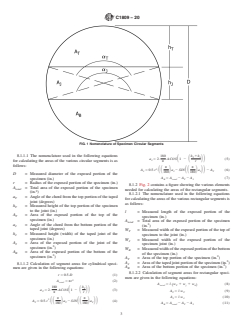
6.4 See AnnexA1 for examples of butt joints, overlap seam 8.1.1 Fig. 1 contains a drawing showing the various ele-
with double sided taped joints, and overlap seam with single mentsne
...
This document is not an ASTM standard and is intended only to provide the user of an ASTM standard an indication of what changes have been made to the previous version. Because
it may not be technically possible to adequately depict all changes accurately, ASTM recommends that users consult prior editions as appropriate. In all cases only the current version
of the standard as published by ASTM is to be considered the official document.
Designation: C1809 − 19 C1809 − 20
Standard Practice for
Preparation of Specimens and Reporting of Results for
Permeance Testing of Pressure Sensitive Adhesive Sealed
Joints in Insulation Vapor Retarders
This standard is issued under the fixed designation C1809; the number immediately following the designation indicates the year of
original adoption or, in the case of revision, the year of last revision. A number in parentheses indicates the year of last reapproval. A
superscript epsilon (´) indicates an editorial change since the last revision or reapproval.
1. Scope
1.1 This practice provides instruction for the preparation of test specimens of pressure sensitive adhesive (PSA) sealed joints
of the type employed in insulation vapor retarder systems, for subsequent testing per Test Methods E96/E96M to determine the
water vapor permeance (“permeance”) of those joints. It does not cover preparation of other types of joints.
1.2 This practice provides requirements for the content of reports issued in conjunction with Test Methods E96/E96M testing
of these joints.
1.3 Joints are made with factory coated PSA tapes or PSA coated laminate jacket (vapor retarder cladding) materials.
1.3.1 The types of materials and joints to be tested are generally encountered in mechanical systems in commercial and
industrial insulation applications, and in HVAC systems insulation.
1.3.2 Typical PSA joints that are employed in vapor retarder systems for mechanical insulation include:
1.3.2.1 Overlap with double-sided tape.
1.3.2.2 Overlap with coated laminate jacket.
1.3.2.3 Butt with single-sided insulation tape.
1.3.2.4 Intersection of overlap and butt joint.
1.4 Test Methods E96/E96M are to be followed for specific testing instruction beyond the areas of guidance provided herein,
that is, after the specimens are prepared in the desired test configuration.
1.5 The values stated in inch-pound units are to be regarded as standard. The values given in parentheses are mathematical
conversions to SI units that are provided for information only and are not considered standard.
1.6 This standard does not purport to address all of the safety concerns, if any, associated with its use. It is the responsibility
of the user of this standard to establish appropriate safety, health, and environmental practices and determine the applicability of
regulatory limitations prior to use.
1.7 This international standard was developed in accordance with internationally recognized principles on standardization
established in the Decision on Principles for the Development of International Standards, Guides and Recommendations issued
by the World Trade Organization Technical Barriers to Trade (TBT) Committee.
2. Referenced Documents
2.1 ASTM Standards:
C1775 Specification for Laminate Protective Jacket and Tape for Use over Thermal Insulation for Outdoor Applications
E96/E96M Test Methods for Water Vapor Transmission of Materials
C168 Terminology Relating to Thermal Insulation
3. Terminology
3.1 Definitions:
3.1.1 laminate jacket—see Specification C1775.
This practice is under the jurisdiction of ASTM Committee C16 on Thermal Insulation and is the direct responsibility of Subcommittee C16.40 on Insulation Systems.
Current edition approved Sept. 1, 2019March 1, 2020. Published September 2019March 2020. Originally approved in 2015. Last previous edition approved in 20162019
as C1809 – 16.C1809 – 19. DOI: 10.1520/C1809-19.10.1520/C1809-20.
For referenced ASTM standards, visit the ASTM website, www.astm.org, or contact ASTM Customer Service at service@astm.org. For Annual Book of ASTM Standards
volume information, refer to the standard’s Document Summary page on the ASTM website.
Copyright © ASTM International, 100 Barr Harbor Drive, PO Box C700, West Conshohocken, PA 19428-2959. United States
C1809 − 20
3.1.2 water vapor permeance, water vapor barrier—see Terminology C168.
3.2 Definitions of Terms Specific to This Standard:
3.2.1 pressure sensitive adhesive, n—an adhesive that requires some degree of pressure, and only pressure, to adequately bond
to a substrate.
3.2.2 SSL tape, n—A pressure sensitive, double-sided “Self Sealing Lap” tape that is commonly used to seal the longitudinal
overlap joint in pipe insulation jacketing.
4. Summary of Practice
4.1 Specimen preparation as directed herein addresses configuration and sealing of PSA joints for subsequent permeance testing.
4.2 The permeance test is performed per Test Methods E96/E96M.
5. Significance and Use
5.1 PSA joints are a necessary and critical component of an insulation vapor retarder system and, in addition to knowing the
permeance of the vapor retarder being used, assessing the permeance of the joints is necessary to indicate the expected performance
of the system.
5.2 Test Methods E96/E96M do not include instructions specific to preparing multiple-piece assemblies such as PSA joints. This
practice provides those instructions.
5.3 There are a number of variables involved in making a psa joint, and those need to be considered in specimen preparation
and data reporting. Such variables include:
5.3.1 Means of applying pressure to seal the joint,
5.3.2 Amount of pressure applied,
5.3.3 Dwell time prior to test,
5.3.4 Backing surface upon which joint is prepared,
5.3.5 Ambient conditions for specimen preparation,
5.3.6 Dimensions of materials,
5.3.7 Configuration of joint,
5.3.8 Dish size,
5.3.9 Test area of specimen, and
5.3.10 Area of joint.
5.4 It is not likely that field-installed joints will achieve as good a seal as those prepared in the laboratory. Field installations
often involve extremes in ambient conditions, surface contamination, limited space, varying pipe radii, varying pressure applied,
and variation in base insulation density and rigidity.
5.4.1 Results obtained through application of this practice and Test Methods E96/E96M are best used to compare materials and
configurations. It is urged not to equate actual field performance with the results obtained in a laboratory setting.
6. Procedure
6.1 Use a test dish of any dimension, circular or rectangular.
6.2 Use a wax damming plate that produces an exposed specimen test surface. When using a circular dish, measure the diameter
of the exposed portion of the specimen. Measure the length and the width of the exposed surface of the specimen when using a
rectangular dish.
6.3 Prepare specimens on a flat, smooth, hard and rigid surface, such as laboratory bench top, under standard conditions of 73°,
6 2°F (23°, 6 0.7°C) and 50 6 5% RH.
6.4 See Annex A1 for examples of butt joints, overlap seam with double sided taped joints, and overlap seam with single sided
taped joints. The dimensions given in Annex A1 are for information only. Specimen dimensions are determined by the user.
6.5 In all cases, make the vapor retarder sheet somewhat larger than the test specimen dimensions, then trim to correct size after
making joint(s).
6.6 To seal the joint, use a 4 in. (102 mm) wide plastic tape applicator squeegee, available from insulation tape suppliers.
6.6.1 Apply a manual force of nominally 5 lb (2.3 kg) when rubbing the joint with the squeegee.
6.6.1.1 Practice exerting this force by applying the rubbing motion on a flat digital scale of 10 to 20 lb (4.5 to 9.0 kg) capacity.
6.6.2 Rub down the joint using two passes in one direction only.
6.7 Do not apply additional force or passes to any parts of the joint.
6.8 If one surface of the vapor retarder or tape is hygroscopic (such as standard ASJ with exposed paper), test with
non-hygroscopic side up. (In this case the joint is “upside down”, but this should not affect moisture ingress.)
C1809 − 20
7. Test Methods
7.1 Test Methods E96/E96M is to be used, employing a wax/resin seal.
7.2 Test the vapor retarder without joints to establish its permeance.
7.3 Test the specimens with joints.
NOTE 1—Per Test Methods E96/E96M, for a given configuration, three or four specimens, plus a blank specimen, are tested.
7.4 Any test chamber conditions may be employed. The following are either commonly used, or may be appropriate for
expected end use conditions or specification requirements:
7.4.1 Test Methods E96/E96M Procedure A, desiccant method at 73°F (23°C).
7.4.2 Test Methods E96/E96M Procedure B, water method at 73°F (23°C).
7.4.3 Test Methods E96/E96M Procedure E, desiccant method at 100°F (38°C).
8. Calculations
8.1 Permeance of the PSA joint is based on the area of the joint. The calculation method for the area of the joint for circular
specimen is contained in 8.1.1. The calculation method for the
...