

ASTM C5-18
(Specification)Standard Specification for Quicklime for Structural Purposes
General Information
- Abstract
ABSTRACT
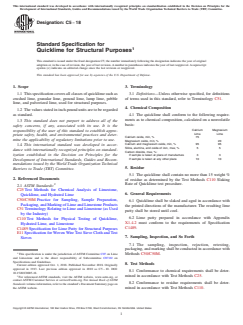
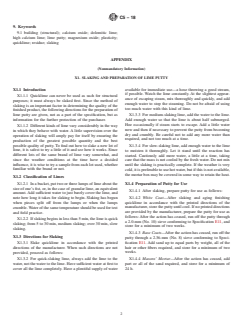
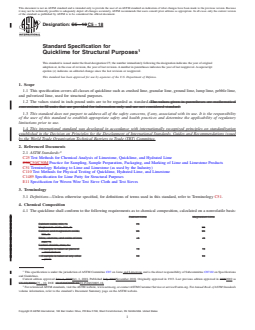
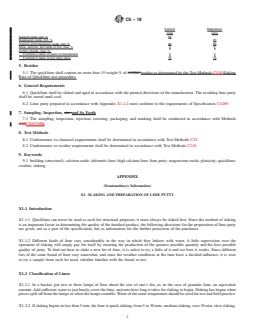
This specification covers all classes of quicklime such as crushed lime, granular lime, ground lime, lump lime, pebble lime, and pulverized lime, used for structural purposes. The quicklime shall conform to the chemical composition requirements specified. Quicklime shall be slaked and aged in accordance with printed directions of the manufacturer. The resulting lime putty shall be stored until cool. Test methods shall be performed for the chemical requirements, plasticity and residue requirements.
SCOPE
1.1 This specification covers all classes of quicklime such as crushed lime, granular lime, ground lime, lump lime, pebble lime, and pulverized lime, used for structural purposes.
1.2 The values stated in inch-pound units are to be regarded as standard.
1.3 This standard does not purport to address all of the safety concerns, if any, associated with its use. It is the responsibility of the user of this standard to establish appropriate safety and health practices and determine the applicability of regulatory limitations prior to use.
1.4 This international standard was developed in accordance with internationally recognized principles on standardization established in the Decision on Principles for the Development of International Standards, Guides and Recommendations issued by the World Trade Organization Technical Barriers to Trade (TBT) Committee.
- Status
- Published
- Publication Date
- 30-Sep-2018
- Technical Committee
- C07 - Lime and Limestone
- Drafting Committee
- C07.02 - Specifications and Guidelines




Overview
ASTM C5-18 - Standard Specification for Quicklime for Structural Purposes sets requirements for all classes of quicklime-crushed, granular, ground, lump, pebble, and pulverized-intended for use in building and construction applications. Developed by ASTM International, this specification addresses the chemical and physical characteristics necessary for quicklime to function reliably in structural uses. The standard outlines requirements for slaking, aging, and storage of lime putty, as well as methods for testing chemical composition, plasticity, and residue.
Quicklime, primarily composed of calcium oxide or magnesium oxide, plays a crucial role in the construction industry as a binder in mortars, plasters, and other building materials. Adherence to ASTM C5-18 ensures uniform product quality and performance consistency, meeting the high standards expected in structural construction projects.
Key Topics
- Applicability: Covers various forms of quicklime suitable for structural purposes, including but not limited to crushed, granular, ground, lump, and pulverized quicklime.
- Chemical Composition: Sets minimum and maximum limits for calcium oxide, magnesium oxide, combined calcium and magnesium oxides, and restricts impurities such as silica, alumina, and iron oxides.
- Example thresholds include minimum 75% calcium oxide or 20% magnesium oxide, with combined oxides totaling at least 95%.
- Residue Requirements: Specifies that quicklime must contain no more than 15% residue as measured by standardized test methods.
- Preparation and Use: Quicklime must be slaked (reacted with water) and aged according to the manufacturer’s printed instructions before use. The resulting lime putty must be cooled and stored appropriately before application.
- Testing and Quality Control: Chemical content and residue levels are verified using established test methods referenced within the standard, supporting quality assurance in material selection.
- Safety Considerations: Users must follow appropriate safety and health practices, recognizing the reactive nature of quicklime, particularly during slaking.
Applications
Quicklime conforming to ASTM C5-18 is widely used in structural applications that demand reliable bonding and durability. Practical uses include:
- Mortar and Plaster Production: Quicklime is slaked and processed into lime putty, which serves as a key ingredient in building mortars and wall plasters for masonry construction.
- Lime-Based Structural Products: Essential for the preparation of lime-based mortars, renders, and coatings that enhance the strength, weather-resistance, and workability of masonry assemblies.
- Restoration and Conservation: Ideal for historic restoration work where traditional lime products are required to match the original construction methods and materials.
- Infrastructure Projects: Suitable for use in civil infrastructure such as bridges, tunnels, and retaining walls where lime is employed for soil stabilization and structural integrity.
By adhering to ASTM C5-18, project managers and construction professionals ensure that the quicklime used in their projects will meet demanding structural performance criteria and regulatory expectations.
Related Standards
Compliance with ASTM C5-18 often involves cross-reference to additional ASTM and industry standards to ensure complete material specification and quality assurance:
- ASTM C25 – Test Methods for Chemical Analysis of Limestone, Quicklime, and Hydrated Lime
- ASTM C50/C50M – Practice for Sampling, Sample Preparation, Packaging, and Marking of Lime and Limestone Products
- ASTM C51 – Terminology Relating to Lime and Limestone (as used by the industry)
- ASTM C110 – Test Methods for Physical Testing of Quicklime, Hydrated Lime, and Limestone
- ASTM C1489 – Specification for Lime Putty for Structural Purposes
- ASTM E11 – Specification for Woven Wire Test Sieve Cloth and Test Sieves
Familiarity with these related standards ensures thorough understanding of quality, testing protocols, and terminology critical for the proper use of structural quicklime in construction projects.
Keywords: ASTM C5-18, quicklime, structural lime, crushed lime, building lime, lime putty, chemical composition, residue, slaking, construction materials, mortar, plaster, ASTM standard
Relations
- Effective Date
- 01-Oct-2023
- Effective Date
- 01-Dec-2019
- Effective Date
- 01-May-2019
- Effective Date
- 01-Dec-2018
- Refers
ASTM C110-16 - Standard Test Methods for Physical Testing of Quicklime, Hydrated Lime, and Limestone - Effective Date
- 01-Dec-2016
- Effective Date
- 01-Jun-2015
- Refers
ASTM C110-15 - Standard Test Methods for Physical Testing of Quicklime, Hydrated Lime, and Limestone - Effective Date
- 01-Jun-2015
- Effective Date
- 01-Dec-2014
- Refers
ASTM C110-14 - Standard Test Methods for Physical Testing of Quicklime, Hydrated Lime, and Limestone - Effective Date
- 01-Dec-2014
- Effective Date
- 01-Oct-2013
- Effective Date
- 01-Jun-2013
- Effective Date
- 01-Jul-2012
- Effective Date
- 01-Jun-2011
- Effective Date
- 01-Jun-2011
- Refers
ASTM C110-11 - Standard Test Methods for Physical Testing of Quicklime, Hydrated Lime, and Limestone - Effective Date
- 01-Jun-2011
Get Certified
Connect with accredited certification bodies for this standard

DIBt (Deutsches Institut für Bautechnik)
German Institute for Building Technology.
DIN CERTCO
DIN Group product certification.

Aboma Certification B.V.
Specialized in construction, metal, and transport sectors.
Sponsored listings
Frequently Asked Questions
ASTM C5-18 is a technical specification published by ASTM International. Its full title is "Standard Specification for Quicklime for Structural Purposes". This standard covers: ABSTRACT This specification covers all classes of quicklime such as crushed lime, granular lime, ground lime, lump lime, pebble lime, and pulverized lime, used for structural purposes. The quicklime shall conform to the chemical composition requirements specified. Quicklime shall be slaked and aged in accordance with printed directions of the manufacturer. The resulting lime putty shall be stored until cool. Test methods shall be performed for the chemical requirements, plasticity and residue requirements. SCOPE 1.1 This specification covers all classes of quicklime such as crushed lime, granular lime, ground lime, lump lime, pebble lime, and pulverized lime, used for structural purposes. 1.2 The values stated in inch-pound units are to be regarded as standard. 1.3 This standard does not purport to address all of the safety concerns, if any, associated with its use. It is the responsibility of the user of this standard to establish appropriate safety and health practices and determine the applicability of regulatory limitations prior to use. 1.4 This international standard was developed in accordance with internationally recognized principles on standardization established in the Decision on Principles for the Development of International Standards, Guides and Recommendations issued by the World Trade Organization Technical Barriers to Trade (TBT) Committee.
ABSTRACT This specification covers all classes of quicklime such as crushed lime, granular lime, ground lime, lump lime, pebble lime, and pulverized lime, used for structural purposes. The quicklime shall conform to the chemical composition requirements specified. Quicklime shall be slaked and aged in accordance with printed directions of the manufacturer. The resulting lime putty shall be stored until cool. Test methods shall be performed for the chemical requirements, plasticity and residue requirements. SCOPE 1.1 This specification covers all classes of quicklime such as crushed lime, granular lime, ground lime, lump lime, pebble lime, and pulverized lime, used for structural purposes. 1.2 The values stated in inch-pound units are to be regarded as standard. 1.3 This standard does not purport to address all of the safety concerns, if any, associated with its use. It is the responsibility of the user of this standard to establish appropriate safety and health practices and determine the applicability of regulatory limitations prior to use. 1.4 This international standard was developed in accordance with internationally recognized principles on standardization established in the Decision on Principles for the Development of International Standards, Guides and Recommendations issued by the World Trade Organization Technical Barriers to Trade (TBT) Committee.
ASTM C5-18 is classified under the following ICS (International Classification for Standards) categories: 91.100.10 - Cement. Gypsum. Lime. Mortar. The ICS classification helps identify the subject area and facilitates finding related standards.
ASTM C5-18 has the following relationships with other standards: It is inter standard links to ASTM C51-23, ASTM C50/C50M-13(2019), ASTM C25-19e1, ASTM C51-18, ASTM C110-16, ASTM C110-15e1, ASTM C110-15, ASTM C110-14e1, ASTM C110-14, ASTM E11-13, ASTM C50/C50M-13, ASTM C50/C50M-12, ASTM C25-11e1, ASTM C51-11, ASTM C110-11. Understanding these relationships helps ensure you are using the most current and applicable version of the standard.
ASTM C5-18 is available in PDF format for immediate download after purchase. The document can be added to your cart and obtained through the secure checkout process. Digital delivery ensures instant access to the complete standard document.
Standards Content (Sample)
This international standard was developed in accordance with internationally recognized principles on standardization established in the Decision on Principles for the
Development of International Standards, Guides and Recommendations issued by the World Trade Organization Technical Barriers to Trade (TBT) Committee.
Designation: C5 − 18
Standard Specification for
Quicklime for Structural Purposes
This standard is issued under the fixed designation C5; the number immediately following the designation indicates the year of original
adoption or, in the case of revision, the year of last revision. A number in parentheses indicates the year of last reapproval. A superscript
epsilon (´) indicates an editorial change since the last revision or reapproval.
This standard has been approved for use by agencies of the U.S. Department of Defense.
1. Scope 3. Terminology
3.1 Definitions—Unless otherwise specified, for definitions
1.1 This specification covers all classes of quicklime such as
crushed lime, granular lime, ground lime, lump lime, pebble of terms used in this standard, refer to Terminology C51.
lime, and pulverized lime, used for structural purposes.
4. Chemical Composition
1.2 The values stated in inch-pound units are to be regarded
as standard.
4.1 The quicklime shall conform to the following require-
ments as to chemical composition, calculated on a nonvolatile
1.3 This standard does not purport to address all of the
basis:
safety concerns, if any, associated with its use. It is the
Calcium Magnesium
responsibility of the user of this standard to establish appro-
Lime Lime
priate safety, health, and environmental practices and deter-
Calcium oxide, min, % 75
mine the applicability of regulatory limitations prior to use.
Magnesium oxide, min, % 20
Calcium and magnesium oxide, min, % 95 95
1.4 This international standard was developed in accor-
Silica, alumina, and oxide of iron, max, % 5 5
dance with internationally recognized principles on standard-
Carbon dioxide, max, %:
ization established in the Decision on Principles for the
If sample is taken at place of manufacture 3 3
If sample is taken at any other place 10 10
Development of International Standards, Guides and Recom-
mendations issued by the World Trade Organization Technical
5. Residue
Barriers to Trade (TBT) Committee.
5.1 The quicklime shall contain no more than 15 weight %
2. Referenced Documents
of residue as determined by the Test Methods C110 Slaking
Rate of Quicklime test procedure.
2.1 ASTM Standards:
C25 Test Methods for Chemical Analysis of Limestone,
6. General Requirements
Quicklime, and Hydrated Lime
C50/C50M Practice for Sampling, Sample Preparation,
6.1 Quicklime shall be slaked and aged in accordance with
Packaging, and Marking of Lime and Limestone Products
the printed directions of the manufacturer. The resulting lime
C51 Terminology Relating to Lime and Limestone (as Used
putty shall be stored until cool.
by the Industry)
6.2 Lime putty prepared in accordance with Appendix
C110 Test Methods for Physical Testing of Quicklime,
X1.4.2 must conform to the requirements of Specification
Hydrated Lime, and Limestone
C1489.
C1489 Specification for Lime Putty for Structural Purposes
E11 Specification for Woven Wire Test Sieve Cloth and Test
7. Sampling, Inspection, and So Forth
Sieves
7.1 The sampling, inspection, rejection, retesting,
packaging, and marking shall be conducted in accordance with
This specification is under the jurisdiction of ASTM Committee C07 on Lime Methods C50/C50M.
and Limestone and is the direct responsibility of Subcommittee C07.02 on
Specifications and Guidelines.
8. Test Methods
Current edition approved Oct. 1, 2018. Published November 2018. Originally
approved in 1913. Last previous edition approved in 2010 as C5 – 10. DOI:
8.1 Conformance to chemical requirements shall be deter-
10.1520/C0005-18.
2 mined in accordance with Test Methods C25.
For referenced ASTM standards, visit the ASTM website, www.astm.org, or
contact ASTM Customer Service at service@astm.org. For Annual Book of ASTM
8.2 Conformance to residue requirements shall be deter-
Standards volume information, refer to the standard’s Document Summary page on
the ASTM website. mined in accordance with Test Methods C110.
Copyright © ASTM International, 100 Barr Harbor Drive, PO Box C700, West Conshohocken, PA 19428-2959. United States
C5 − 18
9. Keywords
9.1 building (structural); calcium oxide; dolomitic lime;
high calcium lime; lime putty; magnesium oxide; plasticity;
quicklime; residue; slaking
APPENDIX
(Nonmandatory Information)
X1. SLAKING AND PREPARATION OF LIME PUTTY
X1.1 Introduction available for immediate use—a hose throwing a good stream,
if possible. Watch the lime constantly. At the slightest appear-
X1.1.1 Quicklime can never be used as such for structural
ance of escaping steam, mix thoroughly and quickly, and add
purposes; it must always be slaked first. Since the method of
enough water to stop the steaming. Do not be afraid of using
slaking is an
...
This document is not an ASTM standard and is intended only to provide the user of an ASTM standard an indication of what changes have been made to the previous version. Because
it may not be technically possible to adequately depict all changes accurately, ASTM recommends that users consult prior editions as appropriate. In all cases only the current version
of the standard as published by ASTM is to be considered the official document.
Designation: C5 − 10 C5 − 18
Standard Specification for
Quicklime for Structural Purposes
This standard is issued under the fixed designation C5; the number immediately following the designation indicates the year of original
adoption or, in the case of revision, the year of last revision. A number in parentheses indicates the year of last reapproval. A superscript
epsilon (´) indicates an editorial change since the last revision or reapproval.
This standard has been approved for use by agencies of the U.S. Department of Defense.
1. Scope
1.1 This specification covers all classes of quicklime such as crushed lime, granular lime, ground lime, lump lime, pebble lime,
and pulverized lime, used for structural purposes.
1.2 The values stated in inch-pound units are to be regarded as standard. The values given in parentheses are mathematical
conversions to SI units that are provided for information only and are not considered standard.
1.3 This standard does not purport to address all of the safety concerns, if any, associated with its use. It is the responsibility
of the user of this standard to establish appropriate safety and health practices and determine the applicability of regulatory
limitations prior to use.
1.4 This international standard was developed in accordance with internationally recognized principles on standardization
established in the Decision on Principles for the Development of International Standards, Guides and Recommendations issued
by the World Trade Organization Technical Barriers to Trade (TBT) Committee.
2. Referenced Documents
2.1 ASTM Standards:
C25 Test Methods for Chemical Analysis of Limestone, Quicklime, and Hydrated Lime
C50C50/C50M Practice for Sampling, Sample Preparation, Packaging, and Marking of Lime and Limestone Products
C51 Terminology Relating to Lime and Limestone (as used by the Industry)
C110 Test Methods for Physical Testing of Quicklime, Hydrated Lime, and Limestone
C1489 Specification for Lime Putty for Structural Purposes
E11 Specification for Woven Wire Test Sieve Cloth and Test Sieves
3. Terminology
3.1 Definitions—Unless otherwise specified, for definitions of terms used in this standard, refer to Terminology C51.
4. Chemical Composition
4.1 The quicklime shall conform to the following requirements as to chemical composition, calculated on a nonvolatile basis:
Calcium Lime Magnesium Lime
Calcium oxide, min, % 75
Magnesium oxide, min, % 20
Calcium and magnesium oxide, 95 95
min, %
Silica, alumina, and oxide of iron, 5 5
max, %
Carbon dioxide, max, %:
If sample is taken at place of 3 3
manufacture
If sample is taken at any other 10 10
place
This specification is under the jurisdiction of ASTM Committee C07 on Lime and Limestone and is the direct responsibility of Subcommittee C07.02 on Specifications
and Guidelines.
Current edition approved June 1, 2010Oct. 1, 2018. Published July 2010November 2018. Originally approved in 1913. Last previous edition approved in 20092010 as
C5–03(2009).C5 – 10. DOI: 10.1520/C0005-10.10.1520/C0005-18.
For referenced ASTM standards, visit the ASTM website, www.astm.org, or contact ASTM Customer Service at service@astm.org. For Annual Book of ASTM Standards
volume information, refer to the standard’s Document Summary page on the ASTM website.
Copyright © ASTM International, 100 Barr Harbor Drive, PO Box C700, West Conshohocken, PA 19428-2959. United States
C5 − 18
Calcium Magnesium
Lime Lime
Calcium oxide, min, % 75
Magnesium oxide, min, % 20
Calcium and magnesium oxide, min, % 95 95
Silica, alumina, and oxide of iron, max, % 5 5
Carbon dioxide, max, %:
If sample is taken at place of manufacture 3 3
If sample is taken at any other place 10 10
5. Residue
5.1 The quicklime shall contain no more than 15 weight % of residue.residue as determined by the Test Methods C110 Slaking
Rate of Quicklime test procedure.
6. General Requirements
6.1 Quicklime shall be slaked and aged in accordance with the printed directions of the manufacturer. The resulting lime putty
shall be stored until cool.
6.2 Lime putty prepared in accordance with Appendix X1.4.2 must conform to the requirements of Specification C1489.
7. Sampling, Inspection, etc. and So Forth
7.1 The sampling, inspection, rejection, retesting, packaging, and marking shall be conducted in accordance with Methods
C50C50/C50M.
8. Test Methods
8.1 Conformance to chemical requirements shall be determined in accordance with Test Methods C25.
8.2 Conformance to residue requirements shall be determined in accordance with Test Methods C110.
9. Keywords
9.1 building (structural); calcium oxide; dolomitic lime; high calcium lime; lime putty; magnesium oxide; plasticity; quicklime;
residue; slaking
APPENDIX
(Nonmandatory Information)
X1. SLAKING AND PREPARATION OF LIME PUTTY
X1.1 Introduction
X1.1.1 Quicklime can never be used as such for structural purposes; it must always be slaked first.
...