

ASTM F3141-23
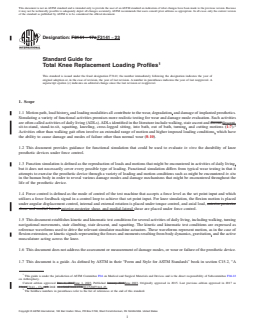
(Guide)Standard Guide for Total Knee Replacement Loading Profiles
General Information
- Abstract
SIGNIFICANCE AND USE
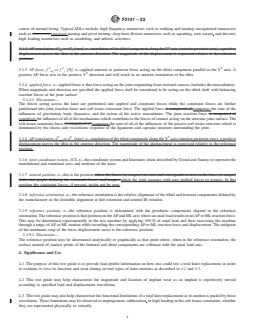
4.1 The purpose of this test guide is to provide load profile information on how one could test a total knee replacement in order to evaluate in vitro its function and wear during several types of knee motions as described in 4.2 and 4.3.
4.2 This test guide may help characterize the magnitude and location of implant wear as an implant is repetitively moved according to specified load and displacement waveforms.
4.3 This test guide may also help characterize the functional limitations of a total knee replacement as its motion is guided by these waveforms. These limitations may be observed as impingement, subluxation, or high loading in the soft tissue constraints, whether they are represented physically or virtually.
4.4 The motions and load conditions in vivo will, in general, differ from the load and motions defined in this guide. The results obtained from this guide cannot be used to directly predict in vivo performance. However, this guide is designed to allow for comparisons in performance of different knee designs, when tested under similar conditions.
SCOPE
1.1 Motion path, load history, and loading modalities all contribute to the wear, degradation, and damage of implanted prosthetics. Simulating a variety of functional activities promises more realistic testing for wear and damage mode evaluation. Such activities are often called activities of daily living (ADLs). ADLs identified in the literature include walking, stair ascent and descent, sit-to-stand, stand-to-sit, squatting, kneeling, cross-legged sitting, into bath, out of bath, turning, and cutting motions (1-7).2 Activities other than walking gait often involve an extended range of motion and higher imposed loading conditions, which have the ability to cause damage and modes of failure other than normal wear (8-10).
1.2 This document provides guidance for functional simulation that could be used to evaluate in vitro the durability of knee prosthetic devices under force control.
1.3 Function simulation is defined as the reproduction of loads and motions that might be encountered in activities of daily living, but it does not necessarily cover every possible type of loading. Functional simulation differs from typical wear testing in that it attempts to exercise the prosthetic device through a variety of loading and motion conditions such as might be encountered in situ in the human body in order to reveal various damage modes and damage mechanisms that might be encountered throughout the life of the prosthetic device.
1.4 Force control is defined as the mode of control of the test machine that accepts a force level as the set point input and which utilizes a force feedback signal in a control loop to achieve that set point input. For knee simulation, the flexion motion is placed under angular displacement control, internal and external rotation is placed under torque control, and axial load, anterior-posterior shear, and medial-lateral shear are placed under force control.
1.5 This document establishes kinetic and kinematic test conditions for several activities of daily living, including walking, turning navigational movements, stair climbing, stair descent, and squatting. The kinetic and kinematic test conditions are expressed as reference waveforms used to drive the relevant simulator machine actuators. These waveforms represent motion, as in the case of flexion extension, or kinetic signals representing the forces and moments resulting from body dynamics, gravitation, and the active musculature acting across the knee.
1.6 This document does not address the assessment or measurement of damage modes, or wear or failure of the prosthetic device.
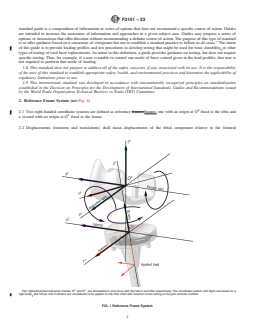
1.7 This document is a guide. As defined by ASTM in their “Form and Style for ASTM Standards” book in section C15.2, “A standard guide is a compendium of information or series of options that does not recommend a specific course of action. Guides are intended ...
- Status
- Published
- Publication Date
- 31-May-2023
- Technical Committee
- F04 - Medical and Surgical Materials and Devices
- Drafting Committee
- F04.22 - Arthroplasty
Overview
ASTM F3141-23: Standard Guide for Total Knee Replacement Loading Profiles provides a comprehensive framework for simulating the loading conditions experienced by total knee replacement (TKR) prostheses during diverse activities of daily living (ADLs). Developed by ASTM, this guide helps researchers, designers, and regulatory professionals implement in vitro test protocols that mimic functional loads and motions to assess the durability, wear, and potential limitations of knee implants. While the simulated conditions do not directly predict in vivo performance, they provide valuable comparative data on different TKR designs when tested under standardized profiles.
Key Topics
- Functional Simulation: This standard describes function simulation-replicating loads and motion paths the knee undergoes during activities like walking, stair climbing, squatting, or pivoting. This approach highlights possible knee implant damage modes and mechanisms.
- ADL-Based Profiles: The guide specifies kinetic and kinematic test conditions for common ADLs, including:
- Straight walking
- Stair ascent and descent
- Sit-to-stand and return
- Pivot turn
- Crossover turn
- Load and Displacement Waveforms: Reference waveforms are provided to replicate the forces, moments, and angles generated during each ADL.
- Test Apparatus Specifications: The standard details the requirements for knee joint motion simulators, including force, torque, and displacement control, measurement accuracy, and calibration.
- Data Collection and Analysis: Guidance on data acquisition, tracking accuracy, calibration procedures, and documentation is included to ensure rigorous, reproducible results.
Applications
- Comparative Wear Testing: Using standardized load profiles, manufacturers and researchers can compare wear, degradation, and damage performance among different TKR designs under physiologically relevant loading conditions.
- Design Evaluation: The guide supports evaluation of implant function and identification of failure modes such as impingement, subluxation, or excessive tissue loading, supporting iterative design improvement.
- Regulatory Submissions: Results generated under ASTM F3141-23 protocols provide recognized evidence of durability and safety, facilitating regulatory review and approval processes.
- Quality Assurance: Consistent in vitro testing protocols enhance product reliability by ensuring implants meet durability expectations across a range of real-world movement scenarios.
- Academic Research: The standard is widely used in biomechanical and medical device research to explore implant performance under realistic joint loading, fostering innovations in knee prosthesis technology.
Related Standards
- ASTM F2792: Guide for wear testing of joint prostheses.
- ISO 14243 series: International standards for knee implant wear simulation, referenced for load ratios and test conditions.
- ASTM F2083: Specification for devices that mechanically support articulation of the knee.
- ASTM F1223: Standard for evaluating forces on joint prostheses.
- ASTM E4: Guide for calibration of force-measuring devices.
Keywords: total knee replacement, TKR durability testing, knee prosthesis, wear simulation, activities of daily living (ADLs), implant loading profiles, ASTM F3141-23, biomechanical testing, prosthetic design evaluation, in vitro joint simulation, orthopedic implant standards.
By following ASTM F3141-23, organizations can develop robust, comparable test data on knee prosthesis performance, leading to safer and more effective medical devices for patients worldwide.
Get Certified
Connect with accredited certification bodies for this standard

BSI Group
BSI (British Standards Institution) is the business standards company that helps organizations make excellence a habit.

TÜV Rheinland
TÜV Rheinland is a leading international provider of technical services.

TÜV SÜD
TÜV SÜD is a trusted partner of choice for safety, security and sustainability solutions.
Sponsored listings
Frequently Asked Questions
ASTM F3141-23 is a guide published by ASTM International. Its full title is "Standard Guide for Total Knee Replacement Loading Profiles". This standard covers: SIGNIFICANCE AND USE 4.1 The purpose of this test guide is to provide load profile information on how one could test a total knee replacement in order to evaluate in vitro its function and wear during several types of knee motions as described in 4.2 and 4.3. 4.2 This test guide may help characterize the magnitude and location of implant wear as an implant is repetitively moved according to specified load and displacement waveforms. 4.3 This test guide may also help characterize the functional limitations of a total knee replacement as its motion is guided by these waveforms. These limitations may be observed as impingement, subluxation, or high loading in the soft tissue constraints, whether they are represented physically or virtually. 4.4 The motions and load conditions in vivo will, in general, differ from the load and motions defined in this guide. The results obtained from this guide cannot be used to directly predict in vivo performance. However, this guide is designed to allow for comparisons in performance of different knee designs, when tested under similar conditions. SCOPE 1.1 Motion path, load history, and loading modalities all contribute to the wear, degradation, and damage of implanted prosthetics. Simulating a variety of functional activities promises more realistic testing for wear and damage mode evaluation. Such activities are often called activities of daily living (ADLs). ADLs identified in the literature include walking, stair ascent and descent, sit-to-stand, stand-to-sit, squatting, kneeling, cross-legged sitting, into bath, out of bath, turning, and cutting motions (1-7).2 Activities other than walking gait often involve an extended range of motion and higher imposed loading conditions, which have the ability to cause damage and modes of failure other than normal wear (8-10). 1.2 This document provides guidance for functional simulation that could be used to evaluate in vitro the durability of knee prosthetic devices under force control. 1.3 Function simulation is defined as the reproduction of loads and motions that might be encountered in activities of daily living, but it does not necessarily cover every possible type of loading. Functional simulation differs from typical wear testing in that it attempts to exercise the prosthetic device through a variety of loading and motion conditions such as might be encountered in situ in the human body in order to reveal various damage modes and damage mechanisms that might be encountered throughout the life of the prosthetic device. 1.4 Force control is defined as the mode of control of the test machine that accepts a force level as the set point input and which utilizes a force feedback signal in a control loop to achieve that set point input. For knee simulation, the flexion motion is placed under angular displacement control, internal and external rotation is placed under torque control, and axial load, anterior-posterior shear, and medial-lateral shear are placed under force control. 1.5 This document establishes kinetic and kinematic test conditions for several activities of daily living, including walking, turning navigational movements, stair climbing, stair descent, and squatting. The kinetic and kinematic test conditions are expressed as reference waveforms used to drive the relevant simulator machine actuators. These waveforms represent motion, as in the case of flexion extension, or kinetic signals representing the forces and moments resulting from body dynamics, gravitation, and the active musculature acting across the knee. 1.6 This document does not address the assessment or measurement of damage modes, or wear or failure of the prosthetic device. 1.7 This document is a guide. As defined by ASTM in their “Form and Style for ASTM Standards” book in section C15.2, “A standard guide is a compendium of information or series of options that does not recommend a specific course of action. Guides are intended ...
SIGNIFICANCE AND USE 4.1 The purpose of this test guide is to provide load profile information on how one could test a total knee replacement in order to evaluate in vitro its function and wear during several types of knee motions as described in 4.2 and 4.3. 4.2 This test guide may help characterize the magnitude and location of implant wear as an implant is repetitively moved according to specified load and displacement waveforms. 4.3 This test guide may also help characterize the functional limitations of a total knee replacement as its motion is guided by these waveforms. These limitations may be observed as impingement, subluxation, or high loading in the soft tissue constraints, whether they are represented physically or virtually. 4.4 The motions and load conditions in vivo will, in general, differ from the load and motions defined in this guide. The results obtained from this guide cannot be used to directly predict in vivo performance. However, this guide is designed to allow for comparisons in performance of different knee designs, when tested under similar conditions. SCOPE 1.1 Motion path, load history, and loading modalities all contribute to the wear, degradation, and damage of implanted prosthetics. Simulating a variety of functional activities promises more realistic testing for wear and damage mode evaluation. Such activities are often called activities of daily living (ADLs). ADLs identified in the literature include walking, stair ascent and descent, sit-to-stand, stand-to-sit, squatting, kneeling, cross-legged sitting, into bath, out of bath, turning, and cutting motions (1-7).2 Activities other than walking gait often involve an extended range of motion and higher imposed loading conditions, which have the ability to cause damage and modes of failure other than normal wear (8-10). 1.2 This document provides guidance for functional simulation that could be used to evaluate in vitro the durability of knee prosthetic devices under force control. 1.3 Function simulation is defined as the reproduction of loads and motions that might be encountered in activities of daily living, but it does not necessarily cover every possible type of loading. Functional simulation differs from typical wear testing in that it attempts to exercise the prosthetic device through a variety of loading and motion conditions such as might be encountered in situ in the human body in order to reveal various damage modes and damage mechanisms that might be encountered throughout the life of the prosthetic device. 1.4 Force control is defined as the mode of control of the test machine that accepts a force level as the set point input and which utilizes a force feedback signal in a control loop to achieve that set point input. For knee simulation, the flexion motion is placed under angular displacement control, internal and external rotation is placed under torque control, and axial load, anterior-posterior shear, and medial-lateral shear are placed under force control. 1.5 This document establishes kinetic and kinematic test conditions for several activities of daily living, including walking, turning navigational movements, stair climbing, stair descent, and squatting. The kinetic and kinematic test conditions are expressed as reference waveforms used to drive the relevant simulator machine actuators. These waveforms represent motion, as in the case of flexion extension, or kinetic signals representing the forces and moments resulting from body dynamics, gravitation, and the active musculature acting across the knee. 1.6 This document does not address the assessment or measurement of damage modes, or wear or failure of the prosthetic device. 1.7 This document is a guide. As defined by ASTM in their “Form and Style for ASTM Standards” book in section C15.2, “A standard guide is a compendium of information or series of options that does not recommend a specific course of action. Guides are intended ...
ASTM F3141-23 is classified under the following ICS (International Classification for Standards) categories: 11.040.40 - Implants for surgery, prosthetics and orthotics. The ICS classification helps identify the subject area and facilitates finding related standards.
ASTM F3141-23 is available in PDF format for immediate download after purchase. The document can be added to your cart and obtained through the secure checkout process. Digital delivery ensures instant access to the complete standard document.
Standards Content (Sample)
This international standard was developed in accordance with internationally recognized principles on standardization established in the Decision on Principles for the
Development of International Standards, Guides and Recommendations issued by the World Trade Organization Technical Barriers to Trade (TBT) Committee.
Designation: F3141 − 23
Standard Guide for
Total Knee Replacement Loading Profiles
This standard is issued under the fixed designation F3141; the number immediately following the designation indicates the year of
original adoption or, in the case of revision, the year of last revision. A number in parentheses indicates the year of last reapproval. A
superscript epsilon (´) indicates an editorial change since the last revision or reapproval.
1. Scope 1.5 This document establishes kinetic and kinematic test
conditions for several activities of daily living, including
1.1 Motion path, load history, and loading modalities all
walking, turning navigational movements, stair climbing, stair
contribute to the wear, degradation, and damage of implanted
descent, and squatting. The kinetic and kinematic test condi-
prosthetics. Simulating a variety of functional activities prom-
tions are expressed as reference waveforms used to drive the
ises more realistic testing for wear and damage mode evalua-
relevant simulator machine actuators. These waveforms repre-
tion. Such activities are often called activities of daily living
sent motion, as in the case of flexion extension, or kinetic
(ADLs). ADLs identified in the literature include walking, stair
signals representing the forces and moments resulting from
ascent and descent, sit-to-stand, stand-to-sit, squatting,
body dynamics, gravitation, and the active musculature acting
kneeling, cross-legged sitting, into bath, out of bath, turning,
across the knee.
and cutting motions (1-7). Activities other than walking gait
often involve an extended range of motion and higher imposed
1.6 This document does not address the assessment or
loading conditions, which have the ability to cause damage and
measurement of damage modes, or wear or failure of the
modes of failure other than normal wear (8-10).
prosthetic device.
1.2 This document provides guidance for functional simu-
1.7 This document is a guide. As defined by ASTM in their
lation that could be used to evaluate in vitro the durability of
“Form and Style for ASTM Standards” book in section C15.2,
knee prosthetic devices under force control.
“A standard guide is a compendium of information or series of
1.3 Function simulation is defined as the reproduction of
options that does not recommend a specific course of action.
loads and motions that might be encountered in activities of
Guides are intended to increase the awareness of information
daily living, but it does not necessarily cover every possible
and approaches in a given subject area. Guides may propose a
type of loading. Functional simulation differs from typical
series of options or instructions that offer direction without
wear testing in that it attempts to exercise the prosthetic device
recommending a definite course of action. The purpose of this
through a variety of loading and motion conditions such as
type of standard is to offer guidance based on a consensus of
might be encountered in situ in the human body in order to
viewpoints but not to establish a standard practice to follow in
reveal various damage modes and damage mechanisms that
all cases.” The intent of this guide is to provide loading profiles
might be encountered throughout the life of the prosthetic
and test procedures to develop testing that might be used for
device.
wear, durability, or other types of testing of total knee
1.4 Force control is defined as the mode of control of the
replacements. As noted in this definition, a guide provides
test machine that accepts a force level as the set point input and guidance on testing, but does not require specific testing. Thus,
which utilizes a force feedback signal in a control loop to
for example, if a user is unable to control one mode of force
achieve that set point input. For knee simulation, the flexion
control given in the load profiles, that user is not required to
motion is placed under angular displacement control, internal
perform that mode of loading.
and external rotation is placed under torque control, and axial
1.8 This standard does not purport to address all of the
load, anterior-posterior shear, and medial-lateral shear are
safety concerns, if any, associated with its use. It is the
placed under force control.
responsibility of the user of this standard to establish appro-
priate safety, health, and environmental practices and deter-
mine the applicability of regulatory limitations prior to use.
This guide is under the jurisdiction of ASTM Committee F04 on Medical and
1.9 This international standard was developed in accor-
Surgical Materials and Devices and is the direct responsibility of Subcommittee
dance with internationally recognized principles on standard-
F04.22 on Arthroplasty.
Current edition approved June 1, 2023. Published June 2023. Originally
ization established in the Decision on Principles for the
approved in 2015. Last previous edition approved in 2017 as F3141 – 17a. DOI:
Development of International Standards, Guides and Recom-
10.1520/F3141-23.
mendations issued by the World Trade Organization Technical
The boldface numbers in parentheses refer to the list of references at the end of
this standard. Barriers to Trade (TBT) Committee.
Copyright © ASTM International, 100 Barr Harbor Drive, PO Box C700, West Conshohocken, PA 19428-2959. United States
F3141 − 23
TABLE 1 Anatomical Meaning of Coordinate System Axes and
2. Reference Frame System (see Fig. 1)
Abbreviations
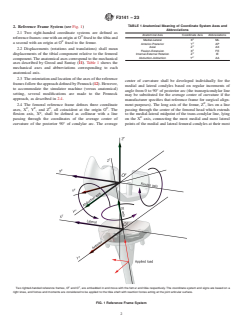
2.1 Two right-handed coordinate systems are defined as
Anatomical Axis Coordinate Axis Abbreviations
T
reference frames: one with an origin at O fixed to the tibia and
F
Medial-Lateral X ML
F
a second with an origin at O fixed to the femur. T
Anterior-Posterior Y AP
T
Axial Z AX
2.2 Displacements (rotations and translations) shall mean
F
Flexion-Extension X FE
T
displacements of the tibial component relative to the femoral
Internal-External Rotation Z IE
F’
Abduction-Adduction Y AA
component. The anatomical axes correspond to the mechanical
axes described by Grood and Suntay (11). Table 1 shows the
mechanical axes and abbreviations corresponding to each
anatomical axis.
2.3 The orientation and location of the axes of the reference
center of curvature shall be developed individually for the
frames follow the approach defined by Pennock (12). However,
medial and lateral condyles based on regular increments of
to accommodate the simulator machine (versus anatomical)
angle from 0 to 90° of posterior arc (the transepicondylar line
setting, several modifications are made to the Pennock
may be substituted for the average center of curvature if the
approach, as described in 2.4.
manufacturer specifies that reference frame for surgical align-
F
2.4 The femoral reference frame defines three coordinate ment purposes). The long axis of the femur, Z , lies on a line
F F F F
axes, X , Y , and Z , all coincident at the origin O . The passing through the center of the femoral head which extends
F
flexion axis, X , shall be defined as collinear with a line to the medial-lateral midpoint of the trans-condylar line, lying
F
passing through the coordinates of the average center of on the X axis, connecting the most medial and most lateral
curvature of the posterior 90° of condylar arc. The average points of the medial and lateral femoral condyles at their most
F T
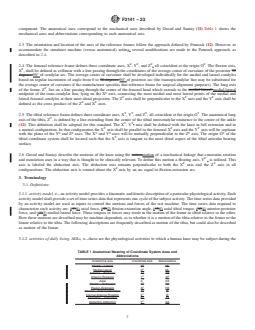
Two righted-handed reference frames, O and O , are embedded in and move with the femur and tibia respectively. The coordinate system and signs are based on a
right knee, and forces and moments are considered to be applied to the tibia shaft with reaction forces acting at the joint articular surface.
FIG. 1 Reference Frame System
F3141 − 23
F F
distal projection. The Z axis shall be perpendicular to the X applied force shall be considered to be acting on the tibial shaft
F
axis and the Y axis shall be defined as the cross product of the with balancing reaction forces at the joint surface.
F F
Z and X axes.
3.1.4.1 Discussion—The forces acting across the knee are
partitioned into applied and constraint forces while the con-
2.5 The tibial reference frame defines three coordinate axes,
T T T T
straint forces are further partitioned into joint reaction force
X , Y , and Z , all coincident at the origin O . The anatomical
T
and soft tissue constraint force. The applied force comprises
long axis of the tibia, Z , is defined by a line extending from
the sum of the influences of gravitation, body dynamics, and
the center of the tibial intercondylar eminence to the center of
the action of the active musculature. The joint reaction force
the ankle (12). This definition shall be adopted for this
T T
comprises the influence of all of the mechanisms which
standard. The X , Y axis shall be defined with the knee in full
contribute to the forces of contact acting on the articular joint
extension and in a neutral configuration. In that configuration
T F T
surface. The soft tissue constraint force comprises the sum of
the X axis shall be parallel to the femoral X axis and the Y
F F
all of the influences of the passive soft tissue structure which is
axis will be coplanar with the plane of the Y and Z axes. The
T T T
dominated by the elastic and viscoelastic response of the
X and Y axes will be mutually perpendicular to the Z axis.
T
ligaments and capsular structure surrounding the joint.
The origin O of the tibial coordinate system shall be located
T T T
such that the X axis is tangent to the most distal aspect of the 3.1.5 AP translation, d or d [mm], n—translation of the
ap y
T
tibial articular bearing surface. tibial component along the Y axis (anterior-posterior axis); a
positive displacement moves the tibia in the anterior direction.
2.6 Grood and Suntay describe the motions of the knee
The magnitude of the displacement is expressed relative to the
using the motion of a mechanical linkage that constrains
reference position.
rotation and translation axes in a way that is thought to be
F’
clinically relevant. To define this motion a floating axis, Y , is 3.1.6 joint coordinate system, JCS, n—the coordinate sys-
tem and kinematic chain described by Grood and Suntay to
utilized. This axis is labeled the abduction axis. The abduction
F T
axis remains perpendicular to both the X axis and the Z axis represent the translational and rotational axes and motions of
F
the knee.
in all configurations. The abduction axis is rotated about the X
axis by an arc equal to flexion-extension arc.
3.1.7 neutral position, n—this is the position which the joint
assumes with zero applied forces or torques. In this position the
3. Terminology
constraint forces, if present, might not be zero.
3.1 Definitions:
3.1.8 reference orientation, n—the reference orientation is
3.1.1 activity model, n—an activity model provides a kine-
the relative alignment of the tibial and femoral components
matic and kinetic description of a particular physiological
defined by the manufacturer as the desirable alignment at full
activity. Each activity model shall provide a set of time series
extension and neutral IE rotation.
data that represents one cycle of the subject activity. The time
3.1.9 reference position, n—the reference position is deter-
series data provided by an activity model are used as inputs to
mined with the prosthetic components aligned in the reference
control the motions and forces of the test machine. The time
orientation. The reference position is that position on the AP
series data required to characterize each activity are: (1) axial
and ML axis where an axial load results in no AP or ML
force, (2) flexion-extension angle, (3) axial tibial torque, (4)
reaction force. This may be determined experimentally in the
anterior-posterior force, and (5) medial-lateral force. These
test machine by applying 100 N of axial load and then
torques or forces may result in the motion of the femur or tibial
exercising the machine through a range of AP or ML motion
relative to the other. How these motions are described may be
while recording the corresponding AP or ML reaction force and
machine-dependent, as to whether it is a motion of the tibia
displacement. The midpoint of the minimum cusp of the force
relative to the femur or the femur relative to the tibia. The
displacement curve is the reference position.
following descriptions are frequently described as motion of
3.1.9.1 Discussion—The reference position may be deter-
the tibia, but could also be described as motion of the femur.
mined analytically or graphically as that point where, when in
3.1.2 activities of daily living, ADLs, n—these are the
the reference orientation, the surface normal of contact points
physiological activities to which a human knee may be subject
of the femoral and tibial components are collinear with the
during the course of normal living. Typical ADLs include: high
axial load axis.
frequency maneuvers such as walking and turning; naviga-
tional maneuvers such as crossover turning and pivot turning;
4. Significance and Use
deep knee flexion maneuvers such as squatting, stair ascent,
4.1 The purpose of this test guide is to provide load profile
and descent; high loading maneuvers such as stumbling; and
information on how one could test a total knee replacement in
athletic activities.
order to evaluate in vitro its function and wear during several
T T
3.1.3 AP force, f or f [N], n—applied anterior or
ap y
types of knee motions as described in 4.2 and 4.3.
T
posterior force acting on the tibial component parallel to the Y
T
4.2 This test guide may help characterize the magnitude and
axis. A positive AP force acts in the positive Y direction and
location of implant wear as an implant is repetitively moved
will result in an anterior translation of the tibia.
according to specified load and displacement waveforms.
3.1.4 applied force, n—applied force is that force acting on
the joint originating from external sources (includes the mus- 4.3 This test guide may also help characterize the functional
culature). When magnitude and direction are specified the limitations of a total knee replacement as its motion is guided
F3141 − 23
TABLE 3 Control Scheme for Each Degree of Freedom
by these waveforms. These limitations may be observed as
impingement, subluxation, or high loading in the soft tissue Anatomical Axis Coordinate Axis Control Method
F
constraints, whether they are represented physically or virtu- ML X Force control
T
AP Y Force control
ally.
T
AX Z Force control
F
FE X Displacement control
4.4 The motions and load conditions in vivo will, in general,
T
IE Z Torque control
differ from the load and motions defined in this guide. The
F’
AA Y Unconstrained
results obtained from this guide cannot be used to directly
predict in vivo performance. However, this guide is designed to
allow for comparisons in performance of different knee
TABLE 4 Tracking Error Calculation Method
designs, when tested under similar conditions.
Anatomical Axis Coordinate Axis Error Method
F
ML X Constraint sum error
T
5. Apparatus
AP Y Constraint sum error
T
AX Z Force error
5.1 A joint motion simulator machine is required for this
F
FE X Displacement error
T
testing.
IE Z Constraint sum error
5.2 Suggested cyclic frequency specified for each activity is
given in Table 2. The cyclic frequency for each activity should
TABLE 5 Kinetic Measurement Instrumentation
be physiologically relevant. If an accelerated or other non-
Anatomical Axis Coordinate Axis Comment
physiological rate is used, then a justification considering
F
ML Force X Shall be measured
lubrication, thermal, and kinematic effects should be provided.
T
AP Force Y Shall be measured
T
AX Force Z Shall be measured
5.3 Distribution of Activity Motions—The testing system
F
FE Moment X Optionally measured
shall be equipped with a means to select and run different
T
IE Moment Z Shall be measured
F’
ensembles of reference waveforms representing various activi- AA Moment Y Optionally measured
ties of daily living (ADLs). The six activities shall be per-
formed in the order listed in Table 2. The percent of each
activity is based on data from Glaister et al. (13), Grant et al.
optional are recommended but not required. Data acquisition
(14), and Morlock et al. (15). Some functional or wear testing
and storage requirements are discussed in 5.9.
may require only a subset of the activities in Table 2.
5.7.2 Force and torque measurements shall be made with an
5.4 Means of Mounting Specimen—The system should in-
accuracy of 65 % of the maximum absolute value of the
clude a means for repeatably mounting and dismounting
waveform of the applied force.
specimens to maintain alignment and positioning to facilitate
5.8 Kinematic Measurement Instrumentation:
removal for gravimetric wear measurements and other wear
5.8.1 The testing system shall be equipped with instrumen-
evaluation and measurement processes if tested in that manner.
tation to measure the linear displacements and angular dis-
5.5 Control Method for Each Axis—The system shall pro-
placements (Table 6). Those items indicated in the comments
vide a means to control each axis of motion (Table 3). The
section as imperative are mandatory for the use of this guide;
required degrees of freedom and the control scheme for each
those items indicated optional are recommended but not
degree of freedom are defined in Table 3.
required. Data acquisition and storage requirements are dis-
cussed in 5.9.
5.6 Tracking Error—The testing system shall be equipped
5.8.2 Linear displacements should be measured with an
with a means to measure the tracking error of each of the
accuracy of 60.2 mm and angular measurements with an
controlled degrees of freedom (Table 4). Data acquisition and
accuracy of 60.5°.
storage requirements are discussed in 5.9.
5.9 Data Acquisition System:
5.7 Kinetic Measurement Instrumentation:
5.9.1 The testing system shall be equipped with a means to
5.7.1 The testing system shall be equipped with instrumen-
digitize and record measured and calculated values provided by
tation to measure the forces and moments (Table 5). Those
the machine’s instrumentation as discussed in 5.7 and 5.8. Each
items indicated in the comments section as imperative are
channel should be sampled at a minimum rate of 200 samples
mandatory for the use of this guide; those items indicated
per second. A two-pole analog Butterworth filter (or similar)
with a 100 Hz cutoff frequency should be provided for
TABLE 2 Distribution of Activities
Suggested
Activity Percent Period (sec) TABLE 6 Kinematic Measurement Instrumentation
Frequency (Hz)
Anatomical Axis Coordinate Axis Comment
Straight walking 54% 1.16 0.86
F
Pivot turn 18% 1.20 0.83 ML Displacement X Shall be measured
T
Cross over turn 18% 1.20 0.83 AP Displacement Y Shall be measured
T
Stair ascent 5% 1.28 0.78 AX Displacement Z Optionally measured
F
Stair descent 5% 1.25 0.80 FE Angle X Shall be measured
T
Sit stand sit 1% 2.45 0.41 IE Angle Z Shall be measured
F’
Total cycles 100% AA Angle Y Optionally measured
F3141 − 23
anti-aliasing. Data should be digitized with a minimum of 12 7. Number of Test Specimens and Cycles
bits of digital resolution.
7.1 A minimum of three test specimens of an implant design
5.9.2 Recorded data should include the reference waveform
shall be tested.
for all controlled channels, the force and torque signals of 5.7,
7.2 The number of test cycles should be determined and
the displacement and angle signals of 5.8, and optionally the
justified by the user.
calculated error signals.
5.9.3 At least one time series sample with a duration of at
8. Calibration
least one waveform cycle should be saved for every instance
8.1 Calibration of all force and torque measuring instru-
that the reference waveforms are changed after the waveform
ments and all displacement and angular displacement measur-
has reached a steady state if the protocol allows it to reach
ing instruments shall be performed according to the instrument
steady state. Multiple samples should not be averaged as this
manufacturer’s recommendation.
occludes higher frequency content that may reveal vibration
and jitter which can inadvertently elevate or diminish wear 9. Loading, Alignment, and Fixturing
results. This sample should include the date, time, test identi-
9.1 The mounting or loading of specimens controls the
fication information, and cycle count summary for the test
alignment and relative position of specimens in the test
protocol.
machine, which in turn significantly affects the kinematics and
5.9.4 RMS error of the system tracking performance should
kinetics of the test. A means should be provided to ensure the
be calculated periodically for each of the reference waveforms.
accurate repeatable mounting of specimens through the use of
RMS deviations of more than 5 % of full scale should be
appropriate fixturing. A measurement method should be used to
flagged and corrective action should be taken. A record or log
document the position and alignment of the prosthetic compo-
of proper operation based on RMS error should be maintained
nents once mounted. Such measurement can be accomplished
on a daily basis.
using calipers to determine positions of appropriate landmarks
on the prosthetic components.
5.10 Offset Compressive Loading Distribution—The testing
9.1.1 The reference orientation is the relative alignment of
system should be equipped with a means to adjust the loading
the tibial and femoral components defined by the manufacturer
between the medial and lateral compartments of the prosthetic
as the desirable alignment at full extension and neutral IE
component. The ratio of the loading between the medial and
rotation.
lateral compartments should be determined according to ISO
9.1.2 The reference position is determined with the pros-
14243-1 subclause 3.4 (16).
thetic components aligned in the reference orientation. The
5.11 IE Motion—The testing system should include a means
reference position is that position on the AP and ML axis where
to allow the axis of IE rotation to float freely relative to the
an axial load results in no AP or ML reaction force. This may
femoral component in the transverse plane. This center of
be experimentally determined in the test machine by applying
rotation should adjust freely to accommodate the constraints
100 N of axial load and then exercising the machine through a
provided by the articular surface contact kinetics and soft
range of AP or ML motion while recording the corresponding
tissue.
AP or ML reaction force and displacement. The midpoint of the
5.11.1 IE Motion Axes and Mounting Location—The motion
minimum cusp of the force displacement curve is the reference
axes are shown in Fig. 1. The IE rotation axis should remain
position. The 100 N force was selected to seat the femoral
parallel to the tibial shaft and should not be constrained in
component into the tibial.
either the AP or ML axes. IE rotation should be permitted to
9.1.3 The reference position may be determined analytically
occur around an axis established by the natural constraints of
or graphically as that point where, when in the reference
articular contact and soft tissue constraint. This is particularly
orientation, the surface normal of contact points of the femoral
important with medial pivot designs which may undergo
and tibial components are collinear with the axial load axis.
reduced torsional kinematics with a central (that is, more
9.1.4 IE Motion Axes and Mounting Location—The motion
laterally positioned) axis of IE rotation.
axes are shown in Fig. 1. The IE rotation axis should remain
5.11.2 If the testing system imposes position constraints on
parallel to the tibial shaft and should not be constrained on
the IE rotation axis, then the IE axis should pass through the
either the AP or ML axes. IE rotation should be permitted to
midpoint of the line segment joining the contact points of the
occur around an axis established by the natural constraints of
medial and lateral condyles when the prosthesis is in the
articular contact and soft tissue constraint. This is particularly
reference orientation and position.
important with medial pivot designs which may undergo
reduced torsional kinematics with a more laterally positioned
6. Hazards
axis of IE rotation.
9.1.5 If the testing system imposes positional constraints on
6.1 Crushing Hazard—Simulator machines produce crush-
the IE rotation axis, then the IE axis should pass through the
ing level forces. During operation the machines should be
midpoint of the line segment joining the contact points of the
enclosed or equipped with automatic shut-off devices to
medial and lateral condyles when the prosthesis is in the
prevent penetration into the operating space. During setup a
reference orientation and position.
low force mode of operation should be selected and used to
mount and manipulate components. Operators shall be trained 9.2 Mounting Specimens—The tibial component should be
to understand the potential crushing hazard. mounted with a posterior slope referenced to the axial load axis
F3141 − 23
or the AP axis (see Fig. 1) in accordance with the manufactur- 11. Loading Regimes for ADLs
er’s recommendation. Mounting should include the tibial tray
11.1 The user shall use the heavy load curve unless the user
mechanism designed to retain the tibial bearing component in
can justify use of the mean loading curve. See Figs. 2-7. See
service.
Appendix X1, Appendix X2, and Appendix X3 for loading
curve data sources, curve development, and numerical data.
10. Procedure
12. Report
10.1 Verify force measurement instrumentation and dis-
12.1 The report should include the following:
placement measurement instrumentation function.
12.1.1 The identity of the test specimens; size; material
10.2 Mount the femoral and tibial components on their type; manufacturer; method of sterilization; test medium;
respective fixtures in accordance with Sections 2 and 9.
protein concentration of the test medium; and the time, date,
and duration of the testing.
10.3 Set up the machine program selecting the desired
12.1.2 A description of the test machine, numbers stations,
activities’ reference waveforms and the desired constraint
control methodology, and calibration dates and traceability
characteristics. Create a verification program with the same
information for the system measurement instrumentation. Any
waveforms and constraint characteristics that is programmed to
changes to the control methodology, such as not using one or
provide only 200 cycles of motion for each activity waveform.
more modes of force control of a load profile, as allowed in 1.7,
10.4 Verify the kinetics and kinematics with a throw-away
shall be noted in the report along with a justification.
sample of similar geometry in place in the machine. Tune the 12.1.3 A graphical representation of the series of the applied
machine as necessary to achieve a suitable tracking perfor-
reference waveforms, and graphical representation of a typical
mance.
measurement of the resulting kinetics and kinematics.
12.1.4 A quantitative representation of the RMS tracking
10.5 Mount the test component fixtures in the machine.
performance over the course of the testing process.
10.6 Run the verification program and take data at the 150
12.1.5 A statement of results:
cycle point of each of the reference waveforms. Verify that the
12.1.5.1 The total number of cycles applied,
kinetics and kinematics are consistent with the loading char-
12.1.5.2 The reason for terminating the test if less than the
acteristics specified in Section 11.
required number of cycles was reached, and
12.1.5.3 Any deviation from the standard testing approach.
10.7 Start the test program.
13. Keywords
10.8 Continue until the required number of cycles has been
reached or evidence of failure is observed upon examination. 13.1 arthroplasty; durability testing; knee prosthesis
F3141 − 23
Loading curves produced from eight subjects in the Orthoload database, Bergmann et al., 2014 (17, 18). Heavy loads were normalized in the y direction from the
minimum of (Mean – 1 SD) to the maximum of (Mean + 1 SD). From left to right top to bottom the figures are the time series data corresponding to ML (Fx), AP (Fy), AX
(Fz), IE (Mz), and FE (Flexion Extension) loads and motions. The horizontal axis is time expressed as a percent of the cycle duration. The vertical axis shows load in N
or Nm for force or torque normalized to body weight and angle in degrees for flexion.
FIG. 2 Straight Walking Gait for Mean (light yellow) and Heavy (dark orange) Loading
F3141 − 23
Loading curves produced from eight subjects in the Orthoload database, Bergmann et al., 2014 (17, 18). Heavy loads were normalized in the y direction from the
minimum of (Mean – 1 SD) to the maximum of (Mean + 1 SD). From left to right top to bottom the figures are the time series data corresponding to ML (Fx), AP (Fy), AX
(Fz), IE (Mz), and FE (Flexion Extension) loads and motions. The horizontal axis is time expressed as a percent of the cycle duration. The vertical axis shows load in N
or Nm for force or torque normalized to body weight and angle in degrees for flexion.
FIG. 3 Stair Ascent for Mean (light yellow) and Heavy (dark orange) Loading
F3141 − 23
Loading curves produced from eight subjects in the Orthoload database Bergmann et al., 2014 (17, 18). Heavy loads were normalized in the y direction from the minimum
of (Mean – 1 SD) to the maximum of (Mean + 1 SD). From left to right top to bottom the figures are the time series data corresponding to ML (Fx), AP (Fy), AX (Fz), IE
(Mz), and FE (Flexion Extension) loads and motions. The horizontal axis is time expressed as a percent of the cycle duration. The vertical axis shows load in N or Nm
for force or torque normalized to body weight and angle in degrees for flexion.
FIG. 4 Stair Descent for Mean (light yellow) and Heavy (dark orange) Loading
F3141 − 23
Loading curves produced from five subjects in the Orthoload database (18). Heavy loads were normalized in the y direction from the minimum of (Mean – 1 SD) to the
maximum of (Mean + 1 SD). From left to right top to bottom the figures are the time series data corresponding to ML (Fx), AP (Fy), AX (Fz), IE (Mz), and FE (Flexion
Extension) loads and motions. The horizontal axis is time expressed as a percent of the cycle duration. The vertical axis shows load in N or Nm for force or torque
normalized to body weight and angle in degrees for flexion.
FIG. 5 Sit to Stand to Sit for Mean (light yellow) and Heavy (dark orange) Loading
F3141 − 23
Heavy loads were normalized in the y direction from the minimum of (Mean – 1 SD) to the maximum of (Mean + 1 SD). From left to right top to bottom the figures are
the time series data corresponding to ML (Fx), AP (Fy), AX (Fz), IE (Mz), and FE (Flexion Extension) loads and motions. The horizontal axis is time expressed as a percent
of the cycle duration. The vertical axis shows load in N or Nm for force or torque normalized to body weight and angle in degrees for flexion.
FIG. 6 Pivot Turn for Mean (light yellow) and Heavy (dark orange) Loading
F3141 − 23
Heavy loads were normalized in the y direction from the minimum of (Mean – 1 SD) to the maximum of (Mean + 1 SD). From left to right top to bottom the figures are
the time series data corresponding to ML (Fx), AP (Fy), AX (Fz), IE (Mz), and FE (Flexion Extension) loads and motions. The horizontal axis is time expressed as a percent
of the cycle duration. The vertical axis shows load in N or Nm for force or torque normalized to body weight and angle in degrees for flexion.
FIG. 7 Crossover Turn for Mean (light yellow) and Heavy (dark orange) Loading
F3141 − 23
APPENDIXES
(Nonmandatory Information)
X1. DATA SOURCES AND REFERENCES
X1.1 Data sources and references for activities models: X1.3 Although no suggestions or requirements for soft
tissue constraint are given in this guide, the user may consult
X1.1.1 Bergmann group (18-21), Hatfield et al. (22), Catani
the following sources and references for IE constraint models:
(23), Riener (24), Yoshioka et al. (25), Taylor et al. (26),
Costigan et al. (8), and Glaister et al. (27, 28). X1.3.1 Markolf et al. (35), Robinson et al. (42), Grood et al.
(32), Gollehon et al. (31), Hsu et al. (43), Borotikar (37), and
X1.2 Although no suggestions or requirements for soft
Lorbach et al. (44).
tissue constraint are given in this guide, the user may consult
the following for AP constraint models:
X1.4 Although no suggestions or requirements for soft
tissue constraint are given in this guide, the user may consult
X1.2.1 Amis et al. (29), Race et al. (30), Gollehon et al.
the following for medial-lateral constraint models:
(31), Grood et al. (32), Bergfeld et al. (33), Shoemaker and
Markolf (34), Markolf et al. (35), Fukubayashi et al. (36),
X1.4.1 Piziali et al. (38, 45).
Borotikar (37), Piziali et al. (38), Frey et al. (39), Kanamori et
al. (40), and Levy et al. (41). X1.5 The distribution of activities was extracted from the
following references.
X1.2.2 The user will have to decide how to implement any
constraint models, whether mechanical or virtual. X1.5.1 Morlock et al. (15) and Glaister et al. (13).
X2. RATIONALE
X2.1 The objective of this test method is to provide loading X2.3 It is important to recognize that this is a standard guide
profiles that can be used to test the durability of total knee that is intended to allow the user flexibility in testing. For
implants. example, some users may not be able to conduct testing that
requires ML force control. Those users can still use this guide
X2.2 Loading profiles for level walking, stair ascent, stair
by allowing ML motion and measuring ML force during
descent, and sit-stand-sit activities were obtained from the
testing. The intent of this guide is to make these loading
publicly available OrthoLoad database (17, 18). The pivot and
profiles available in an ASTM guide. They can then be used as
crossover turn data was obtained from Bergman et al. (18) and
part of different types of total knee replacement testing
Taylor et al. (26). Level walking, stair ascent, and stair descent
developed by different users. New loading profiles may result
data were referenced in 2014 and includes data from eight
from testing based on these profiles.
individuals with an instrumented TKR. The sit-stand-sit activ-
ity was based on six of these individuals.
X2.4 Knee motion is defined by using the Grood and Suntay
X2.2.1 Data used from the OrthoLoad website was already
definition of knee motion. This definition is widely used to
parsed into individual cycles that were averaged for each describe knee joint kinematics. It allows for comparison
subject and normalized to body weight. Data from all subjects
between different testing machines.
was averaged to produce a single curve for each activity. A
moving average was used to smooth the activity curve. The X2.5 The order of testing the various activities of daily
curves presented as ‘Mean’ curves are generated from the living listed in Table 2 has been specified to facilitate compar-
average of all subjects multiplied by a body weight of 100 kg. ing results among different users.
The ‘Heavy’ loading curves were created by normalizing the
‘Mean’ curves in the Y direction from the minimum point on X2.6 In Section 11, the user is required to use the heavy
the ‘Mean’ curve minus 1 standard deviation (Min – 1SD), to loading curve unless they can justify the use of the mean curve.
the maximum point on the ‘Mean’ curve plus 1 standard This is required to facilitate comparing results between differ-
deviation (Max + 1SD). ent users.
F3141 − 23
X3. NUMERICAL DATA OF LOADING REGIMES FOR ADLs
X3.1 See Tables X3.1-X3.6 for numerical data of loading X3.1.3 See Table X3.3 for stair descent.
regimes for ADLs.
X3.1.4 See Table X3.4 for sit to stand to sit.
X3.1.1 See Table X3.1 for level walking.
X3.1.5 See Table X3.5 for pivot turn during gait.
X3.1.2 See Table X3.2 for stair ascent. X3.1.6 See Table X3.6 for crossover turn during gait.
F3141 − 23
TABLE X3.1 Walking for 100 kg Subject
Average Loading (100 kg subject) Heavy Loading (100 kg Subject)
Cycle FE ML AP Axial IE ML AP Axial IE
% Deg N N N Nm N N N Nm
0.0 9.13 10.18 -40.08 847.50 1.73 5.94 -65.89 915.56 3.01
0.5 10.31 16.61 -24.34 875.13 1.56 23.29 -44.97 949.68 2.72
1.0 11.19 21.34 -11.09 909.08 1.41 36.07 -27.35 991.62 2.45
1.5 11.85 23.86 -1.84 944.30 1.28 42.85 -15.07 1035.12 2.23
2.0 12.53 26.03 8.13 985.55 1.16 48.72 -1.80 1086.07 2.02
2.5 13.10 27.85 18.50 1031.98 1.04 53.63 11.97 1143.42 1.81
3.0 13.39 29.74 29.09 1081.44 0.91 58.74 26.06 1204.52 1.58
3.5 13.61 31.81 39.32 1129.43 0.78 64.32 39.65 1263.79 1.35
4.0 14.09 34.07 49.57 1177.45 0.65 70.43 53.27 1323.11 1.13
4.5 14.71 36.45 59.68 1225.39 0.51 76.85 66.72 1382.32 0.89
5.0 15.38 38.60 69.70 1274.71 0.38 82.66 80.03 1443.25 0.65
5.5 16.06 40.16 80.47 1330.49 0.23 86.86 94.35 1512.14 0.39
6.0 16.68 40.92 92.10 1393.48 0.08 88.92 109.81 1589.94 0.13
6.5 17.23 40.86 104.36 1461.13 -0.07 88.75 126.10 1673.50 -0.12
7.0 17.73 39.97 117.47 1533.88 -0.23 86.34 143.53 1763.37 -0.41
7.5 18.24 38.23 130.62 1606.60 -0.41 81.65 161.02 1853.19 -0.72
8.0 18.74 35.50 143.94 1679.53 -0.61 74.29 178.73 1943.27 -1.08
8.5 19.21 31.70 156.77 1749.46 -0.83 64.02 195.77 2029.65 -1.47
9.0 19.63 27.06 168.40 1814.34 -1.06 51.49 211.24 2109.78 -1.86
9.5 19.99 21.56 178.93 1875.73 -1.30 36.65 225.23 2185.62 -2.28
10.0 20.34 15.51 187.98 1932.02 -1.51 20.33 237.26 2255.14 -2.65
10.5 20.66 9.32 195.40 1982.38 -1.72 3.61 247.12 2317.34 -3.01
11.0 20.95 2.98 201.45 2028.41 -1.91 -13.50 255.17 2374.21 -3.35
11.5 21.20 -3.25 206.11 2068.70 -2.11 -30.31 261.37 2423.98 -3.69
12.0 21.42 -9.13 209.47 2102.58 -2.29 -46.19 265.83 2465.83 -4.00
12.5 21.60 -14.74 211.71 2131.27 -2.46 -61.34 268.81 2501.26 -4.31
13.0 21.73 -19.79 212.84 2153.65 -2.62 -74.97 270.31 2528.90 -4.59
13.5 21.83 -24.35 213.03 2170.87 -2.77 -87.28 270.56 2550.17 -4.85
14.0 21.89 -28.16 212.45 2182.95 -2.90 -97.56 269.79 2565.09 -5.08
14.5 21.90 -30.97 211.36 2190.38 -3.01 -105.15 268.34 2574.27 -5.27
15.0 21.88 -32.78 209.85 2193.88 -3.10 -110.04 266.34 2578.59 -5.42
15.5 21.83 -33.53 208.04 2193.56 -3.16 -112.05 263.93 2578.19 -5.53
16.0 21.76 -33.31 206.05 2189.95 -3.20 -111.46 261.28 2573.74 -5.59
16.5 21.66 -32.28 203.76 2183.42 -3.21 -108.68 258.23 2565.67 -5.61
17.0 21.53 -30.68 201.08 2174.16 -3.21 -104.35 254.68 2554.24 -5.61
17.5 21.40 -28.79 198.06 2162.57 -3.19 -99.26 250.67 2539.91 -5.57
18.0 21.24 -26.79 194.59 2148.54 -3.15 -93.86 246.05 2522.58 -5.51
18.5 21.05 -24.91 190.74 2132.75 -3.11 -88.79 240.94 2503.08 -5.43
19.0 20.83 -23.19 186.41 2114.90 -3.05 -84.14 235.18 2481.04 -5.33
19.5 20.60 -21.67 181.77 2096.35 -2.97 -80.03 229.01 2458.12 -5.20
20.0 20.35 -20.28 176.99 2078.55 -2.90 -76.30 222.65 2436.14 -5.07
20.5 20.10 -18.92 171.95 2061.24 -2.82 -72.61 215.95 2414.75 -4.93
21.0 19.88 -17.49 166.77 2044.71 -2.73 -68.76 209.07 2394.34 -4.77
21.5 19.64 -15.92 161.41 2028.67 -2.63 -64.52 201.94 2374.53 -4.61
22.0 19.34 -14.11 155.61 2011.84 -2.53 -59.64 194.24 2353.74 -4.43
22.5 19.04 -12.25 149.94 1994.74 -2.42 -54.61 186.70 2332.61 -4.23
23.0 18.78 -10.30 144.42 1976.94 -2.30 -49.34 179.36 2310.63 -4.03
23.5 18.56 -8.36 139.13 1958.86 -2.18 -44.10 172.33 2288.30 -3.82
24.0 18.33 -6.51 134.34 1941.45 -2.06 -39.12 165.95 2266.80 -3.61
24.5 18.12 -4.74 130.03 1924.71 -1.94 -34.35 160.24 2246.11 -3.39
25.0 17.90 -3.06 126.16 1909.08 -1.80 -29.80 155.09 2226.80 -3.16
25.5 17.70 -1.44 122.66 1895.13 -1.67 -25.44 150.44 2209.57 -2.92
26.0 17.50 0.20 119.52 1882.95 -1.52 -21.01 146.26 2194.54 -2.66
26.5 17.29 1.85 116.85 1872.95 -1.36 -16.55 142.72 2182.19 -2.39
27.0 17.04 3.48 114.57 1865.07 -1.20 -12.16 139.68 2172.44 -2.10
27.5 16.79 5.10 112.45 1858.94 -1.03 -7.79 136.87 2164.88 -1.80
28.0 16.49 6.63 110.51 1854.65 -0.85 -3.65 134.28 2159.57 -1.50
28.5 16.15 8.09 108.67 1851.81 -0.67 0.29 131.84 2156.07 -1.17
29.0 15.83 9.42 107.03 1850.90 -0.47 3.90 129.66 2154.94 -0.83
29.5 15.52 10.60 105.68 1852.22 -0.27 7.08 127.86 2156.58 -0.47
30.0 15.26 11.67 104.56 1855.91 -0.05 9.96 126.38 2161.14 -0.09
30.5 15.06 12.63 103.68 1862.09 0.18 12.55 125.21 2168.77 0.30
31.0 14.87 13.51 102.94 1870.64 0.41 14.93 124.21 2179.32 0.70
31.5 14.69 14.37 102.19 1881.34 0.65 17.25 123.22 2192.54 1.12
32.0 14.49 15.18 101.42 1893.35 0.89 19.44 122.20 2207.38 1.54
32.5 14.19 15.95 100.64 1907.16 1.13 21.52 121.16 2224.44 1.96
33.0 13.90 16.61 99.91 1922.74 1.38 23.29 120.19 2243.68 2.39
33.5 13.74 17.07 99.31 1940.05 1.63 24.53 119.40 2265.07 2.83
34.0 13.61 17.28 98.94 1960.17 1.89 25.11 118.90 2289.92 3.29
34.5 13.48 17.25 98.73 1982.73 2.16 25.03 118.63 2317.78 3.76
35.0 13.31 17.03 98.50 2006.12 2.44 24.43 118.32 2346.67 4.26
35.5 13.20 16.63 98.13 2030.22 2.73 23.34 117.83 2376.44 4.76
36.0 13.11 16.11 97.53 2053.85 3.02 21.95 117.02 2405.63 5.26
F3141 − 23
TABLE X3.1 Continued
Average Loading (100 kg subject) Heavy Loading (100 kg Subject)
Cycle FE ML AP Axial IE ML AP Axial IE
% Deg N N N Nm N N N Nm
36.5 13.02 15.57 96.58 2075.57 3.29 20.47 115.77 2432.45 5.74
37.0 12.95 14.99 95.25 2095.71 3.58 18.91 114.00 2457.33 6.24
37.5 12.90 14.42 93.72 2114.47 3.85 17.38 111.96 2480.51 6.71
38.0 12.86 13.87 92.04 2133.70 4.13 15.89 109.72 2504.25 7.20
38.5 12.84 13.35 90.38 2154.02 4.42 14.48 107.53 2529.36 7.70
39.0 12.84 12.86 88.92 2176.15 4.71 13.18 105.58 2556.69 8.21
39.5 12.84 12.39 87.67 2201.25 5.00 11.91 103.92 2587.70 8.72
40.0 12.87 11.93 86.71 2228.57 5.28 10.67 102.64 2621.44 9.21
40.5 12.91 11.53 86.04 2257.35 5.55 9.58 101.76 2656.99 9.68
41.0 12.97 11.23 85.50 2288.01 5.83 8.76 101.04 2694.86 10.17
41.5 13.06 11.06 84.96 2318.46 6.09 8.30 100.32 2732.47 10.63
42.0 13.18 10.98 84.40 2349.61 6.35 8.08 99.57 2770.94 11.09
42.5 13.28 10.92 83.95 2380.91 6.63 7.92 98.98 2809.61 11.56
43.0 13.34 10.80 83.63 2411.08 6.89 7.60 98.55 2846.88 12.03
43.5 13.40 10.60 83.32 2440.74 7.14 7.07 98.14 2883.51 12.45
44.0 13.44 10.37 82.95 2469.36 7.36 6.45 97.64 2918.87 12.85
44.5 13.47 10.20 82.32 2496.28 7.57 6.00 96.80 2952.12 13.22
45.0 13.46 10.14 81.17 2521.78 7.76 5.81 95.28 2983.61 13.54
45.5 13.47 10.20 79.34 2544.58 7.91 5.99 92.86 3011.77 13.81
46.0 13.53 10.36 76.93 2563.97 8.05 6.42 89.64 3035.73 14.05
46.5 13.63 10.61 73.89 2580.48 8.17 7.09 85.61 3056.12 14.26
47.0 13.75 10.99 70.41 2593.23 8.27 8.12 80.97 3071.86 14.44
47.5 13.89 11.64 66.33 2602.46 8.36 9.88 75.56 3083.26 14.59
48.0 14.06 12.65 61.71 2607.75 8.43 12.59 69.42 3089.80 14.71
48.5 14.23 14.03 56.58 2608.88 8.47 16.34 62.59 3091.20 14.79
49.0 14.45 15.86 50.65 2605.58 8.50 21.26 54.72 3087.13 14.83
49.5 14.66 18.01 43.85 2597.60 8.50 27.08 45.68 3077.26 14.83
50.0 14.89 20.22 36.30 2585.42 8.48 33.04 35.64 3062.22 14.79
50.5 15.19 22.35 27.94 2568.47 8.43 38.80 24.52 3041.29 14.70
51.0 15.52 24.21 19.13 2546.58 8.35 43.82 12.81 3014.24 14.57
51.5 15.90 25.64 10.33 2519.80 8.24 47.66 1.12 2981.16 14.39
52.0 16.33 26.58 1.52 2486.40 8.11 50.21 -10.59 2939.91 14.16
52.5 16.75 27.10 -6.89 2446.77 7.96 51.61 -21.77 2890.96 13.89
53.0 17.18 27.36 -15.25 2398.90 7.78 52.32 -32.89 2831.83 13.58
53.5 17.77 27.49 -23.40 2343.31 7.57 52.65 -43.72 2763.16 13.22
54.0 18.42 27.58 -31.13 2281.22 7.36 52.92 -54.00 2686.48 12.84
54.5 19.14 27.75 -38.62 2210.09 7.11 53.35 -63.96 2598.61 12.41
55.0 19.93 28.04 -45.61 2130.90 6.85 54.15 -73.25 2500.80 11.95
55.5 20.78 28.48 -51.99 2045.41 6.58 55.33 -81.72 2395.21 11.48
56.0 21.72 29.06 -57.98 1950.72 6.29 56.89 -89.69 2278.24 10.97
56.5 22.73 29.78 -63.34 1851.00 5.96 58.83 -96.82 2155.06 10.40
57.0 23.94 30.76 -68.16 1743.65 5.62 61.48 -103.22 2022.48 9.81
57.5 25.15 32.04 -72.16 1631.74 5.25 64.95 -108.54 1884.24 9.16
58.0 26.43 33.70 -75.08 1518.98 4.84 69.41 -112.42 1744.96 8.44
58.5 27.84 35.90 -76.88 1402.82 4.39 75.35 -114.82 1601.48
...
This document is not an ASTM standard and is intended only to provide the user of an ASTM standard an indication of what changes have been made to the previous version. Because
it may not be technically possible to adequately depict all changes accurately, ASTM recommends that users consult prior editions as appropriate. In all cases only the current version
of the standard as published by ASTM is to be considered the official document.
Designation: F3141 − 17a F3141 − 23
Standard Guide for
Total Knee Replacement Loading Profiles
This standard is issued under the fixed designation F3141; the number immediately following the designation indicates the year of
original adoption or, in the case of revision, the year of last revision. A number in parentheses indicates the year of last reapproval. A
superscript epsilon (´) indicates an editorial change since the last revision or reapproval.
1. Scope
1.1 Motion path, load history, and loading modalities all contribute to the wear, degradation, and damage of implanted prosthetics.
Simulating a variety of functional activities promises more realistic testing for wear and damage mode evaluation. Such activities
are often called activities of daily living (ADLs). ADLs identified in the literature include walking, stair ascent and decent,descent,
sit-to-stand, stand-to-sit, squatting, kneeling, cross-legged sitting, into bath, out of bath, turning, and cutting motions (1-7).
Activities other than walking gait often involve an extended range of motion and higher imposed loading conditions, which have
the ability to cause damage and modes of failure other than normal wear (8-10).
1.2 This document provides guidance for functional simulation that could be used to evaluate in vitro the durability of knee
prosthetic devices under force control.
1.3 Function simulation is defined as the reproduction of loads and motions that might be encountered in activities of daily living,
but it does not necessarily cover every possible type of loading. Functional simulation differs from typical wear testing in that it
attempts to exercise the prosthetic device through a variety of loading and motion conditions such as might be encountered in situ
in the human body in order to reveal various damage modes and damage mechanisms that might be encountered throughout the
life of the prosthetic device.
1.4 Force control is defined as the mode of control of the test machine that accepts a force level as the set point input and which
utilizes a force feedback signal in a control loop to achieve that set point input. For knee simulation, the flexion motion is placed
under angular displacement control, internal and external rotation is placed under torque control, and axial load, anterior posterior
shear and medial lateral anterior-posterior shear, and medial-lateral shear are placed under force control.
1.5 This document establishes kinetic and kinematic test conditions for several activities of daily living, including walking, turning
navigational movements, stair climbing, stair descent, and squatting. The kinetic and kinematic test conditions are expressed as
reference waveforms used to drive the relevant simulator machine actuators. These waveforms represent motion, as in the case of
flexion extension, or kinetic signals representing the forces and moments resulting from body dynamics, gravitation, and the active
musculature acting across the knee.
1.6 This document does not address the assessment or measurement of damage modes, or wear or failure of the prosthetic device.
1.7 This document is a guide. As defined by ASTM in their “Form and Style for ASTM Standards” book in section C15.2, “A
This guide is under the jurisdiction of ASTM Committee F04 on Medical and Surgical Materials and Devices and is the direct responsibility of Subcommittee F04.22
on Arthroplasty.
Current edition approved Dec. 1, 2017June 1, 2023. Published January 2018June 2023. Originally approved in 2015. Last previous edition approved in 2017 as
F3141F3141 – 17a.–17. DOI: 10.1520/F3141-17A.10.1520/F3141-23.
The boldface numbers in parentheses refer to the list of references at the end of this standard.
Copyright © ASTM International, 100 Barr Harbor Drive, PO Box C700, West Conshohocken, PA 19428-2959. United States
F3141 − 23
standard guide is a compendium of information or series of options that does not recommend a specific course of action. Guides
are intended to increase the awareness of information and approaches in a given subject area. Guides may propose a series of
options or instructions that offer direction without recommending a definite course of action. The purpose of this type of standard
is to offer guidance based on a consensus of viewpoints but not to establish a standard practice to follow in all cases.” The intent
of this guide is to provide loading profiles and test procedures to develop testing that might be used for wear, durability, or other
types of testing of total knee replacements. As noted in this definition, a guide provides guidance on testing, but does not require
specific testing. Thus, for example, if a user is unable to control one mode of force control given in the load profiles, that user is
not required to perform that mode of loading.
1.8 This standard does not purport to address all of the safety concerns, if any, associated with its use. It is the responsibility
of the user of this standard to establish appropriate safety, health, and environmental practices and determine the applicability of
regulatory limitations prior to use.
1.9 This international standard was developed in accordance with internationally recognized principles on standardization
established in the Decision on Principles for the Development of International Standards, Guides and Recommendations issued
by the World Trade Organization Technical Barriers to Trade (TBT) Committee.
2. Reference Frame System (see Fig. 1)
T
2.1 Two right-handed coordinate systems are defined as reference frames;frames: one with an origin at O fixed to the tibia and
F
a second with an origin at O fixed to the femur.
2.2 Displacements (rotations and translations) shall mean displacements of the tibial component relative to the femoral
F T
Two righted-handed reference frames, O and O , are embedded in and move with the femur and tibia respectively. The coordinate system and signs are based on a
right knee, and forces and moments are considered to be applied to the tibia shaft with reaction forces acting at the joint articular surface.
FIG. 1 Reference Frame System
F3141 − 23
component. The anatomical axes correspond to the mechanical axes described by Grood and Suntay (11).Table 1 shows the
mechanical axes and abbreviations corresponding to each anatomical axis.
2.3 The orientation and location of the axes of the reference frames follow the approach defined by Pennock (12). However, to
accommodate the simulator machine (versus anatomical) setting, several modifications are made to the Pennock approach, as
described in 2.4.
F F F F
2.4 The femoral reference frame defines three coordinate axes, X , Y , and Z , all coincident at the origin O . The flexion axis,
F
X , shall be defined as collinear with a line passing through the coordinates of the average center of curvature of the posterior 90
degrees 90° of condylar arc. The average center of curvature shall be developed individually for the medial and lateral condyles
based on regular increments of angle from 0 to 90 degrees 90° of posterior arc (the transepicondylar line may be substituted for
the average center of curvature if the manufacturer specifies that reference frame for surgical alignment purposes). The long axis
F
of the femur, Z , lies on a line passing through the center of the femoral head which extends to the medial lateral medial-lateral
F
midpoint of the trans-condylar line, lying on the X axis, connecting the most medial and most lateral points of the medial and
F F F
lateral femoral condyles at their most distal projection. The Z axis shall be perpendicular to the X axis and the Y axis shall be
F F
defined as the cross product of the Z and X axes.
T T T T
2.5 The tibial reference frame defines three coordinate axes, X , Y , and Z , all coincident at the origin O . The anatomical long
T
axis of the tibia, Z , is defined by a line extending from the center of the tibial intercondylar eminence to the center of the ankle
T T
(12). This definition shall be adopted for this standard. The X , Y , axis shall be defined with the knee in full extension and in
T F T
a neutral configuration. In that configuration the X axis shall be parallel to the femoral X axis and the Y axis will be coplanar
F F T T T T
with the plane of the Y and Z axes. The X and Y axes will be mutually perpendicular to the Z axis. The origin O of the
T
tibial coordinate system shall be located such that the X axis is tangent to the most distal aspect of the tibial articular bearing
surface.
2.6 Grood and Suntay describe the motions of the knee using the notionmotion of a mechanical linkage that constrains rotation
F’
and translation axes in a way that is thought to be clinically relevant. To define this motion a floating axis, Y , is utilized. This
F T
axis is labeled the abduction axis. The abduction axis remains perpendicular to both the X axis and the Z axis in all
F
configurations. The abduction axis is rotated about the X axis by an arc equal to flexion-extension arc.
3. Terminology
3.1 Definitions:
3.1.1 activity model, n—an activity model provides a kinematic and kinetic description of a particular physiological activity. Each
activity model shall provide a set of time series data that represents one cycle of the subject activity. The time series data provided
by an activity model are used as inputs to control the motions and forces of the test machine. The time series data required to
characterize each activity are: ((1)1) axial force, ((2)2) flexion-extension angle, ((3)3) axial tibial torque, ((4)4) anterior-posterior
force, and ((5)5) medial-lateral force. These torques or forces may result in the motion of the femur or tibial relative to the other.
How these motions are described may be machine-dependent, as to whether it is a motion of the tibia relative to the femur or the
femur relative to the tibia. The following descriptions are frequently described as motion of the tibia, but could also be described
as motion of the femur.
3.1.2 activities of daily living, ADLs, n—these are the physiological activities to which a human knee may be subject during the
TABLE 1 Anatomical Meaning of Coordinate System Axes and
Abbreviations
Anatomical Axis Coordinate Axis Abbreviations
F
Medial – Lateral X ML
F
Medial-Lateral X ML
T
Anterior – Posterior Y AP
T
Anterior-Posterior Y AP
T
Axial Z AX
F
Flexion – Extension X FE
F
Flexion-Extension X FE
T
Internal – External Rotation Z IE
T
Internal-External Rotation Z IE
F’
Abduction – Adduction Y AA
F’
Abduction-Adduction Y AA
F3141 − 23
course of normal living. Typical ADLs include: high frequency maneuvers such as walking and turning; navigational maneuvers
such as cross over crossover turning and pivot turning; deep knee flexion maneuvers such as squatting, stair ascent, and descent;
high loading maneuvers such as stumbling; and athletic activities.
T T T
3.1.3 AP translation, d or d [mm], n—translation of the tibial component along the Y axis (anterior posterior axis); a positive
ap y
displacement moves the tibia in the anterior direction. The magnitude of the displacement is expressed relative to the reference
position.
T T T
3.1.3 AP force, f or f [N], n—applied anterior or posterior force acting on the tibial component parallel to the Y axis. A
ap y
T
positive AP force acts in the positive Y direction and will result in an anterior translation of the tibia.
3.1.4 applied force, n—applied force is that force acting on the joint originating from external sources (includes the musculature).
When magnitude and direction are specified the applied force shall be considered to be acting on the tibial shaft with balancing
reaction forces at the joint surface.
3.1.4.1 Discussion—
The forces acting across the knee are partitioned into applied and constraint forces while the constraint forces are further
partitioned into joint reaction force and soft tissue constraint force. The applied force is comprised of comprises the sum of the
influences of gravitation, body dynamics, and the action of the active musculature. The joint reaction force is comprised of
comprises the influence of all of the mechanisms which contribute to the forces of contact acting on the articular joint surface. The
soft tissue constraint force is comprised of comprises the sum of all of the influences of the passive soft tissue structure which is
dominated by the elastic and viscoelastic response of the ligaments and capsular structure surrounding the joint.
T T T
3.1.5 AP translation, d or d [mm], n—translation of the tibial component along the Y axis (anterior-posterior axis); a positive
ap y
displacement moves the tibia in the anterior direction. The magnitude of the displacement is expressed relative to the reference
position.
3.1.6 joint coordinate system, JCS, n—the coordinate system and kinematic chain described by Grood and Suntay to represent the
translational and rotational axes and motions of the knee.
3.1.7 neutral position, n—this is the position where the forces (or torques) are zero and corresponds to zero on the force (or torque)
deflection graphs defining the constraint forces and torques.which the joint assumes with zero applied forces or torques. In this
position the constraint forces, if present, might not be zero.
3.1.8 reference orientation, n—the reference orientation is the relative alignment of the tibial and femoral components defined by
the manufacturer as the desirable alignment at full extension and neutral IE rotation.
3.1.9 reference position, n—the reference position is determined with the prosthetic components aligned in the reference
orientation. The reference position is that position on the AP and ML axis where an axial load results in no AP or ML reaction force.
This may be determined experimentally in the test machine by applying 100 N of axial load and then exercising the machine
through a range of AP or ML motion while recording the corresponding AP or ML reaction force and displacement. The midpoint
of the minimum cusp of the force displacement curve is the reference position.
3.1.9.1 Discussion—
The reference position may be determined analytically or graphically as that point where, when in the reference orientation, the
surface normal of contact points of the femoral and tibial components are collinear with the axial load axis.
4. Significance and Use
4.1 The purpose of this test guide is to provide load profile information on how one could test a total knee replacement in order
to evaluate in vitro its function and wear during several types of knee motions as described in 4.2 and 4.3.
4.2 This test guide may help characterize the magnitude and location of implant wear as an implant is repetitively moved
according to specified load and displacement waveforms.
4.3 This test guide may also help characterize the functional limitations of a total knee replacement as its motion is guided by these
waveforms. These limitations may be observed as impingement, subluxation, or high loading in the soft tissue constraints, whether
they are represented physically or virtually.
F3141 − 23
4.4 The motions and load conditions in vivo will, in general, differ from the load and motions defined in this guide. The results
obtained from this guide cannot be used to directly predict in vivo performance. However, this guide is designed to allow for
comparisons in performance of different knee designs, when tested under similar conditions.
5. Apparatus
5.1 A joint motion simulator machine is required for this testing.
5.2 Suggested cyclic frequency specified for each activity is given in Table 2. The cyclic frequency for each activity should be
physiologically relevant. If an accelerated or other non-physiological rate is used, then a justification considering lubrication,
thermal, and kinematic effects should be provided.
5.3 Distribution of Activity Motions—The testing system shall be equipped with a means to select and run different ensembles of
reference waveforms representing various activities of daily living (ADLs). The six activities shall be performed in the order listed
in Table 2. The percent of each activity is based on data from Glaister et alal. (13), Grant et alal. (14), and Morlock et alal. (15).
Some functional or wear testing may require only a subset of the activities in Table 2.
5.4 Means of Mounting Specimen—The system should include a means for repeatably mounting and dismounting specimens to
maintain alignment and positioning to facilitate removal for gravimetric wear measurements and other wear evaluation and
measurement processes if so tested in that manner.
5.5 Control Method for Each Axis—The system shall provide a means to control each axis of motion (Table 3). The required
degrees of freedom and the control scheme for each degree of freedom are defined in (Table 3).
5.6 Tracking Error—The testing system shall be equipped with a means to measure the tracking error of each of the controlled
degrees of freedom (Table 4). Data acquisition and storage requirements are discussed in 5.9.
5.7 Kinetic Measurement Instrumentation:
5.7.1 The testing system shall be equipped with instrumentation to measure the forces and moments (Table 5). Those items
indicated in the comments section as imperative are mandatory for the use of this guide; those items indicated optional are
recommended but not required. Data acquisition and storage requirements are discussed in 5.9.
5.7.2 Force and torque measurements shall be made with an accuracy of 65 % of the maximum absolute value of the waveform
of the applied force.
5.8 Kinematic Measurement Instrumentation:
5.8.1 The testing system shall be equipped with instrumentation to measure the linear displacements and angular displacements
(Table 6). Those items indicated in the comments section as imperative are mandatory for the use of this guide; those items
indicated optional are recommended but not required. Data acquisition and storage requirements are discussed in 5.9.
5.8.2 Linear displacements should be measured with an accuracy of 60.2 mm and angular measurements with an accuracy of
60.5°.
TABLE 2 Distribution of Activities
Suggested
Activity Percent Period (sec)
Frequency (Hz)
Straight walking 54% 1.16 0.86
Pivot turn 18% 1.20 0.83
Cross over turn 18% 1.20 0.83
Stair ascent 5% 1.28 0.78
Stair descent 5% 1.25 0.80
Sit stand sit 1% 2.45 0.41
Total cycles 100%
F3141 − 23
TABLE 3 Control Scheme for Each Degree of Freedom
Anatomical Axis Coordinate Axis Control Method
F
ML X Force control
T
AP Y Force control
T
AX Z Force control
F
FE X Displacement control
T
IE Z Torque control
F’
AA Y Unconstrained
TABLE 4 Tracking Error Calculation Method
Anatomical Axis Coordinate Axis Error Method
F
ML X Constraint sum error
T
AP Y Constraint sum error
T
AX Z Force error
F
FE X Displacement error
T
IE Z Constraint sum error
TABLE 5 Kinetic Measurement Instrumentation
Anatomical Axis Coordinate Axis Comment
F
ML Force X Shall be measured
T
AP Force Y Shall be measured
T
AX Force Z Shall be measured
F
FE Moment X Optionally measured
T
IE Moment Z Shall be measured
F’
AA Moment Y Optionally measured
TABLE 6 Kinematic Measurement Instrumentation
Anatomical Axis Coordinate Axis Comment
F
ML Displacement X Shall be measured
T
AP Displacement Y Shall be measured
T
AX Displacement Z Optionally measured
F
FE Angle X Shall be measured
T
IE Angle Z Shall be measured
F’
AA Angle Y Optionally measured
5.9 Data Acquisition System:
5.9.1 The testing system shall be equipped with a means to digitize and record measured and calculated values provided by the
machine’s instrumentation as discussed in sections 5.7 and 5.8. Each channel should be sampled at a minimum rate of 200 samples
per second. A two-pole analog Butterworth filter (or similar) with a 100 Hz cutoff frequency should be provided for anti-aliasing.
Data should be digitized with a minimum of 12 bits of digital resolution.
5.9.2 Recorded data should include the reference waveform for all controlled channels, the force and torque signals of section 5.7,
the displacement and angle signals of section 5.8, and optionally the calculated error signals.
5.9.3 At least one time series sample with a duration of at least one waveform cycle should be saved for every instance that the
reference waveforms are changed after the waveform has reached a steady state if the protocol allows it to reach steady state.
Multiple samples should not be averaged as this occludes higher frequency content that may reveal vibration and jitter which can
inadvertently elevate or diminish wear results. This sample should include the date, time, test identification information, and cycle
count summary for the test protocol.
5.9.4 RMS error of the system tracking performance should be calculated periodically for each of the reference waveforms. RMS
deviations of more than 5%5 % of full scale should be flagged and corrective action should be taken. A record or log of proper
operation based on RMS error should be maintained on a daily basis.
5.10 Varus/Valgus Moment—Offset Compressive Loading Distribution—The testing system should be equipped with a means to
adjust the varus/valgus moment to proportion the axial load loading between the medial and lateral compartments of the prosthetic
component. The nominal ratio of load should be 57% medial to 43% lateral. Other ratiosratio of the loading between the medial
F3141 − 23
and lateral compartments should be determined according to ISO 14243-1 subclause 3.4 can (16be ).used if reported. This
adjustment may be static; however, a means to monitor the load proportioning or moment should be available.
5.11 IE Moment—Motion—The testing system should include a means to allow the axis of IE rotation to float freely relative to
the femoral component in the transverse plane. This center of rotation should adjust freely to accommodate the constraints provided
by the articular surface contact kinetics and soft tissue.
5.11.1 IE Motion Axes and Mounting Location—The motion axes are shown in Fig. 1. The IE rotation axis should remain parallel
to the tibial shaft and should not be constrained onin either the AP or ML axes. IE rotation should be permitted to occur around
an axis established by the natural constraints of articular contact and soft tissue constraint. This is particularly important with
medial pivot designs which may undergo reduced torsional kinematics with a central (that is, more laterally positionedpositioned)
axis of IE rotation.
5.11.2 If the testing system imposes position constraints on the IE rotation axis, then the IE axis should pass through the midpoint
of the line segment joining the contact points of the medial and lateral condyles when the prosthesis is in the reference orientation
and position.
6. Hazards
6.1 Crushing Hazard—Simulator machines produce crushing level forces. During operation the machines should be enclosed or
equipped with automatic shut-off devices to prevent penetration into the operating space. During setup a low force mode of
operation should be selected and used to mount and manipulate components. Operators shall be trained to understand the potential
crushing hazard.
7. Number of Test Specimens and Cycles
7.1 A minimum of 3three test specimens of an implant design shall be tested.
7.2 The number of test cycles should be determined and justified by the user.
8. Calibration
8.1 Calibration of all force- and torque-measuring force and torque measuring instruments and all displacement and angular
displacement measuring instruments shall be performed according to the instrument manufacturer’s recommendation.
9. Loading, Alignment, and Fixturing
9.1 The mounting or loading of specimens controls the alignment and relative position of specimens in the test machine, which
in turn significantly affects the kinematics and kinetics of the test. A means should be provided to ensure the accurate repeatable
mounting of specimens through the use of appropriate fixturing. A measurement method should be used to document the position
and alignment of the prosthetic components once mounted. Such measurement can be accomplished using calipers to determine
positions of appropriate landmarks on the prosthetic components.
9.1.1 The reference orientation is the relative alignment of the tibial and femoral components defined by the manufacturer as the
desirable alignment at full extension and neutral IE rotation.
9.1.2 The reference position is determined with the prosthetic components aligned in the reference orientation. The reference
position is that position on the AP and ML axis where an axial load results in no AP or ML reaction force. This may be
experimentally determined in the test machine by applying 100 N of axial load and then exercising the machine through a range
of AP or ML motion while recording the corresponding AP or ML reaction force and displacement. The midpoint of the minimum
cusp of the force displacement curve is the reference position. The 100 N force was selected to seat the femoral component into
the tibial.
9.1.3 The reference position may be determined analytically or graphically as that point where, when in the reference orientation,
the surface normal of contact points of the femoral and tibial components are collinear with the axial load axis.
9.1.4 IE Motion Axes and Mounting Location—The motion axes are shown in Fig. 1. The IE rotation axis should remain parallel
F3141 − 23
to the tibial shaft and should not be constrained on either the AP or ML axes. IE rotation should be permitted to occur around an
axis established by the natural constraints of articular contact and soft tissue constraint. This is particularly important with medial
pivot designs which may undergo reduced torsional kinematics with a more laterally positioned axis of IE rotation.
9.1.5 If the testing system imposes positional constraints on the IE rotation axis, then the IE axis should pass through the midpoint
of the line segment joining the contact points of the medial and lateral condyles when the prosthesis is in the reference orientation
and position.
9.2 Mounting Specimens—The tibial component should be mounted with a posterior slope referenced to the axial load axis or the
AP axis (see Fig. 1) in accordance with the manufacturer’s recommendation. Mounting should include the tibial tray mechanism
designed to retain the tibial bearing component in service.
10. Procedure
10.1 Verify force measurement instrumentation and displacement measurement instrumentation function.
10.2 Mount the femoral and tibial components on their respective fixtures in accordance with Sections 2 and 9.
10.3 Set up the machine program selecting the desired activitiesactivities’ reference waveforms and the desired constraint
characteristics. Create a verification program with the same waveforms and constraint characteristics that is programmed to provide
only 200 cycles of motion for each activity waveform.
10.4 Verify the kinetics and kinematics with a throw-away sample of similar geometry in place in the machine. Tune the machine
as necessary to achieve a suitable tracking performance.
10.5 Mount the test component fixtures in the machine.
10.6 Run the verification program and take data at the 150 cycle point of each of the reference waveforms. Verify that the kinetics
and kinematics are consistent with the loading characteristics specified in Section 11.
10.7 Start the test program.
10.8 Continue until the required number of cycles has been reached or evidence of failure is observed upon examination.
11. Loading Regimes for ADLs
11.1 The user shall use the heavy load curve unless the user can justify use of the mean loading curve. See Figs. 2-7. See Appendix
X1, Appendix X2, and Appendix X3 for loading curve data sources, curve development, and numerical data.
12. Report
12.1 The report should include the following:
12.1.1 The identity of the test specimens; size; material type; manufacturer; method of sterilization; test medium; protein
concentration of the test medium; and the time, date, and duration of the testing.
12.1.2 A description of the test machine, numbers stations, control methodology, and calibration dates and traceability information
for the system measurement instrumentation. Any changes to the control methodology, such as not using one or more modes of
force control of a load profile, as allowed in 1.7, shall be noted in the report along with a justification.
12.1.3 A graphical representation of the series of the applied reference waveforms, and graphical representation of a typical
measurement of the resulting kinetics and kinematics.
12.1.4 A quantitative representation of the RMS tracking performance over the course of the testing process.
12.1.5 A statement of results:
F3141 − 23
Loading curves produced from eight subjects in the Orthoload database, Bergmann et al., 2014 (1617, 1718). Heavy loads were normalized in the y direction from the
minimum of (Mean – 1 SD) to the maximum of (Mean + 1 SD). From left to right top to bottom the figures are the time series data corresponding to ML (Fx), AP (Fy), AX
(Fz), IE (Mz)(Mz), and FE (Flexion Extension) loads and motions. The horizontal axis is time expressed as a percent of the cycle duration. The vertical axis shows load
in N or Nm for force or torque normalized to body weight and angle in degrees for flexion.
FIG. 2 Straight Walking Gait for Mean (light yellow) and Heavy (dark orange) Loading
12.1.5.1 The total number of cycles applied,
12.1.5.2 The reason for terminating the test if less than the required number of cycles werewas reached, and
F3141 − 23
Loading curves produced from eight subjects in the Orthoload database, Bergmann et al., 2014 (1617, 1718). Heavy loads were normalized in the y direction from the
minimum of (Mean – 1 SD) to the maximum of (Mean + 1 SD). From left to right top to bottom the figures are the time series data corresponding to ML (Fx), AP (Fy), AX
(Fz), IE (Mz)(Mz), and FE (Flexion Extension) loads and motions. The horizontal axis is time expressed as a percent of the cycle duration. The vertical axis shows load
in N or Nm for force or torque normalized to body weight and angle in degrees for flexion.
FIG. 3 Stair Ascent for Mean (light yellow) and Heavy (dark orange) Loading
12.1.5.3 Any deviation from the standard testing approach.
13. Keywords
13.1 arthroplasty; durability testing; knee prosthesis
F3141 − 23
Loading curves produced from eight subjects in the Orthoload database Bergmann et al., 2014 (1617, 1718). Heavy loads were normalized in the y direction from the
minimum of (Mean – 1 SD) to the maximum of (Mean + 1 SD). From left to right top to bottom the figures are the time series data corresponding to ML (Fx), AP (Fy), AX
(Fz), IE (Mz)(Mz), and FE (Flexion Extension) loads and motions. The horizontal axis is time expressed as a percent of the cycle duration. The vertical axis shows load
in N or Nm for force or torque normalized to body weight and angle in degrees for flexion.
FIG. 4 Stair Descent for Mean (light yellow) and Heavy (dark orange) Loading
F3141 − 23
Loading curves produced from five subjects in the Orthoload database (1718). Heavy loads were normalized in the y direction from the minimum of (Mean – 1 SD) to
the maximum of (Mean + 1 SD). From left to right top to bottom the figures are the time series data corresponding to ML (Fx), AP (Fy), AX (Fz), IE (Mz)(Mz), and FE (Flexion
Extension) loads and motions. The horizontal axis is time expressed as a percent of the cycle duration. The vertical axis shows load in N or Nm for force or torque
normalized to body weight and angle in degrees for flexion.
FIG. 5 Sit to Stand to Sit for Mean (light yellow) and Heavy (dark orange) Loading
F3141 − 23
Heavy loads were normalized in the y direction from the minimum of (Mean – 1 SD) to the maximum of (Mean + 1 SD). From left to right top to bottom the figures are
the time series data corresponding to ML (Fx), AP (Fy), AX (Fz), IE (Mz)(Mz), and FE (Flexion Extension) loads and motions. The horizontal axis is time expressed as a
percent of the cycle duration. The vertical axis shows load in N or Nm for force or torque normalized to body weight and angle in degrees for flexion.
FIG. 6 Pivot Turn for Mean (light yellow) and Heavy (dark orange) Loading
F3141 − 23
Heavy loads were normalized in the y direction from the minimum of (Mean – 1 SD) to the maximum of (Mean + 1 SD). From left to right top to bottom the figures are
the time series data corresponding to ML (Fx), AP (Fy), AX (Fz), IE (Mz)(Mz), and FE (Flexion Extension) loads and motions. The horizontal axis is time expressed as a
percent of the cycle duration. The vertical axis shows load in N or Nm for force or torque normalized to body weight and angle in degrees for flexion.
FIG. 7 Crossover Turn for Mean (light yellow) and Heavy (dark orange) Loading
F3141 − 23
APPENDIXES
(Nonmandatory Information)
X1. DATA SOURCES AND REFERENCES
X1.1 Data sources and references for activities models:
X1.1.1 Bergmann group (1718-21, 18, 19, 20), Hatfield et alal. (2122), Catani (2223), Riener (2324), Yoshioka et alal. (2425),
Taylor et alal. (2526), Costigan et alal. (8)), and Glaister et alal. (2627, 2728).
X1.2 Although no suggestions or requirements for soft tissue constraint are given in this guide, the user may consult the following
for AP constraint models:
X1.2.1 Amis et alal. (2829), Race et alal. (2930), Gollehon et alal. (3031), Grood et alal. (3132), Bergfeld et alal. (3233),
Shoemaker and Markolf (3334), Markolf et alal. (3435), Fukubayashi et alal. (3536), Borotikar (3637), Piziali et alal. (3738), Frey
et alal. (3839), Kanamori et alal. (3940)), and Levy et alal. (4041).
X1.2.2 The user will have to decide how to implement any constraint models, whether mechanical or virtual.
X1.3 Although no suggestions or requirements for soft tissue constraint are given in this guide, the user may consult the following
sources and references for IE constraint models:
X1.3.1 Markolf et alal. (3435), Robinson et alal. (4142), Grood et alal. (3132), Gollehon et alal. (3031), Hsu et alal. (4243),
Borotikar (3637)), and Lorbach et alal. (4344).
X1.4 Although no suggestions or requirements for soft tissue constraint are given in this guide, the user may consult the following
for medial lateral medial-lateral constraint models:
X1.4.1 Piziali et alal. (3738, 4445).
X1.5 The distribution of activities was extracted from the following references.
X1.5.1 Morlock et alal. (15) and Glaister et alal. (13).
F3141 − 23
X2. RATIONALE
X2.1 The objective of this test method is to provide loading profiles that can be used to test the durability of total knee implants.
X2.2 Loading profiles for level walking, stair ascent, stair descent, and sit-stand-sit activities were obtained from the
publicallypublicly available OrthoLoad database (1617, 1718). The pivot and crossover turn data was obtained from Bergman et
alal. (1718) and Taylor et alal. (2526). Level walking, stair ascent, and stair descent data were referenced in 2014 and includes data
from 8eight individuals with an instrumented TKR. The sit-stand-sit activity was based on 6six of these individuals.
X2.2.1 Data used from the OrthoLoad website was already parsed into individual cycles that were averaged for each subject and
normalized to body weight. Data from all subjects was averaged to produce a single curve for each activity. A moving average was
used to smooth the activity curve. The curves presented as ‘Mean’ curves are generated from the average of all subjects multiplied
by a body weight of 100 kg. The ‘Heavy’ loading curves were created by normalizing the ‘Mean’ curves in the Y direction from
the minimum point on the ‘Mean’ curve minus 1 standard deviation (Min – 1SD), to the maximum point on the ‘Mean’ curve plus
1 standard deviation (Max + 1SD).
X2.3 It is important to recognize that this is a standard guide that is intended to allow the user flexibility in testing. For example,
some users may not be able to conduct testing that requires ML force control. Those users can still use this guide by allowing ML
motion and measuring ML force during testing. The intent of this guide is to make these loading profiles available in an ASTM
guide. They can then be used as part of different types of total knee replacement testing developed by different users. New loading
profiles may be result from testing based on these profiles.
X2.4 Knee motion is defined by using the Grood and Suntay definition of knee motion. This definition is widely used to describe
knee joint kinematics. It allows for comparison between different testing machines.
X2.5 The order of testing the various activities of daily living listed in Table 2 has been specified to facilitate comparing results
among different users.
X2.6 In Section 11, the user is required to use the heavy loading curve unless they can justify the useruse of the mean curve. This
is required to facilitate comparing results between different users.
X3. NUMERICAL DATA OF LOADING REGIMES FOR ADLs
X3.1 See Tables X3.1-X3.6 for numerical data of loading regimes for ADLs.
X3.1.1 See Table X3.1 for level walking.
X3.1.2 See Table X3.2 for stair ascent.
X3.1.3 See Table X3.3 for stair descent.
F3141 − 23
TABLE X3.1 Walking for 100 kg Subject
Average Loading (100 kg subject) Heavy Loading (100 kg Subject)
Cycle FE ML AP Axial IE ML AP Axial IE
% Deg N N N Nm N N N Nm
0.0 9.13 10.18 -40.08 847.50 1.73 5.94 -65.89 915.56 3.01
0.5 10.31 16.61 -24.34 875.13 1.56 23.29 -44.97 949.68 2.72
1.0 11.19 21.34 -11.09 909.08 1.41 36.07 -27.35 991.62 2.45
1.5 11.85 23.86 -1.84 944.30 1.28 42.85 -15.07 1035.12 2.23
2.0 12.53 26.03 8.13 985.55 1.16 48.72 -1.80 1086.07 2.02
2.5 13.10 27.85 18.50 1031.98 1.04 53.63 11.97 1143.42 1.81
3.0 13.39 29.74 29.09 1081.44 0.91 58.74 26.06 1204.52 1.58
3.5 13.61 31.81 39.32 1129.43 0.78 64.32 39.65 1263.79 1.35
4.0 14.09 34.07 49.57 1177.45 0.65 70.43 53.27 1323.11 1.13
4.5 14.71 36.45 59.68 1225.39 0.51 76.85 66.72 1382.32 0.89
5.0 15.38 38.60 69.70 1274.71 0.38 82.66 80.03 1443.25 0.65
5.5 16.06 40.16 80.47 1330.49 0.23 86.86 94.35 1512.14 0.39
6.0 16.68 40.92 92.10 1393.48 0.08 88.92 109.81 1589.94 0.13
6.5 17.23 40.86 104.36 1461.13 -0.07 88.75 126.10 1673.50 -0.12
7.0 17.73 39.97 117.47 1533.88 -0.23 86.34 143.53 1763.37 -0.41
7.5 18.24 38.23 130.62 1606.60 -0.41 81.65 161.02 1853.19 -0.72
8.0 18.74 35.50 143.94 1679.53 -0.61 74.29 178.73 1943.27 -1.08
8.5 19.21 31.70 156.77 1749.46 -0.83 64.02 195.77 2029.65 -1.47
9.0 19.63 27.06 168.40 1814.34 -1.06 51.49 211.24 2109.78 -1.86
9.5 19.99 21.56 178.93 1875.73 -1.30 36.65 225.23 2185.62 -2.28
10.0 20.34 15.51 187.98 1932.02 -1.51 20.33 237.26 2255.14 -2.65
10.5 20.66 9.32 195.40 1982.38 -1.72 3.61 247.12 2317.34 -3.01
11.0 20.95 2.98 201.45 2028.41 -1.91 -13.50 255.17 2374.21 -3.35
11.5 21.20 -3.25 206.11 2068.70 -2.11 -30.31 261.37 2423.98 -3.69
12.0 21.42 -9.13 209.47 2102.58 -2.29 -46.19 265.83 2465.83 -4.00
12.5 21.60 -14.74 211.71 2131.27 -2.46 -61.34 268.81 2501.26 -4.31
13.0 21.73 -19.79 212.84 2153.65 -2.62 -74.97 270.31 2528.90 -4.59
13.5 21.83 -24.35 213.03 2170.87 -2.77 -87.28 270.56 2550.17 -4.85
14.0 21.89 -28.16 212.45 2182.95 -2.90 -97.56 269.79 2565.09 -5.08
14.5 21.90 -30.97 211.36 2190.38 -3.01 -105.15 268.34 2574.27 -5.27
15.0 21.88 -32.78 209.85 2193.88 -3.10 -110.04 266.34 2578.59 -5.42
15.5 21.83 -33.53 208.04 2193.56 -3.16 -112.05 263.93 2578.19 -5.53
16.0 21.76 -33.31 206.05 2189.95 -3.20 -111.46 261.28 2573.74 -5.59
16.5 21.66 -32.28 203.76 2183.42 -3.21 -108.68 258.23 2565.67 -5.61
17.0 21.53 -30.68 201.08 2174.16 -3.21 -104.35 254.68 2554.24 -5.61
17.5 21.40 -28.79 198.06 2162.57 -3.19 -99.26 250.67 2539.91 -5.57
18.0 21.24 -26.79 194.59 2148.54 -3.15 -93.86 246.05 2522.58 -5.51
18.5 21.05 -24.91 190.74 2132.75 -3.11 -88.79 240.94 2503.08 -5.43
19.0 20.83 -23.19 186.41 2114.90 -3.05 -84.14 235.18 2481.04 -5.33
19.5 20.60 -21.67 181.77 2096.35 -2.97 -80.03 229.01 2458.12 -5.20
20.0 20.35 -20.28 176.99 2078.55 -2.90 -76.30 222.65 2436.14 -5.07
20.5 20.10 -18.92 171.95 2061.24 -2.82 -72.61 215.95 2414.75 -4.93
21.0 19.88 -17.49 166.77 2044.71 -2.73 -68.76 209.07 2394.34 -4.77
21.5 19.64 -15.92 161.41 2028.67 -2.63 -64.52 201.94 2374.53 -4.61
22.0 19.34 -14.11 155.61 2011.84 -2.53 -59.64 194.24 2353.74 -4.43
22.5 19.04 -12.25 149.94 1994.74 -2.42 -54.61 186.70 2332.61 -4.23
23.0 18.78 -10.30 144.42 1976.94 -2.30 -49.34 179.36 2310.63 -4.03
23.5 18.56 -8.36 139.13 1958.86 -2.18 -44.10 172.33 2288.30 -3.82
24.0 18.33 -6.51 134.34 1941.45 -2.06 -39.12 165.95 2266.80 -3.61
24.5 18.12 -4.74 130.03 1924.71 -1.94 -34.35 160.24 2246.11 -3.39
25.0 17.90 -3.06 126.16 1909.08 -1.80 -29.80 155.09 2226.80 -3.16
25.5 17.70 -1.44 122.66 1895.13 -1.67 -25.44 150.44 2209.57 -2.92
26.0 17.50 0.20 119.52 1882.95 -1.52 -21.01 146.26 2194.54 -2.66
26.5 17.29 1.85 116.85 1872.95 -1.36 -16.55 142.72 2182.19 -2.39
27.0 17.04 3.48 114.57 1865.07 -1.20 -12.16 139.68 2172.44 -2.10
27.5 16.79 5.10 112.45 1858.94 -1.03 -7.79 136.87 2164.88 -1.80
28.0 16.49 6.63 110.51 1854.65 -0.85 -3.65 134.28 2159.57 -1.50
28.5 16.15 8.09 108.67 1851.81 -0.67 0.29 131.84 2156.07 -1.17
29.0 15.83 9.42 107.03 1850.90 -0.47 3.90 129.66 2154.94 -0.83
29.5 15.52 10.60 105.68 1852.22 -0.27 7.08 127.86 2156.58 -0.47
30.0 15.26 11.67 104.56 1855.91 -0.05 9.96 126.38 2161.14 -0.09
30.5 15.06 12.63 103.68 1862.09 0.18 12.55 125.21 2168.77 0.30
31.0 14.87 13.51 102.94 1870.64 0.41 14.93 124.21 2179.32 0.70
31.5 14.69 14.37 102.19 1881.34 0.65 17.25 123.22 2192.54 1.12
32.0 14.49 15.18 101.42 1893.35 0.89 19.44 122.20 2207.38 1.54
32.5 14.19 15.95 100.64 1907.16 1.13 21.52 121.16 2224.44 1.96
33.0 13.90 16.61 99.91 1922.74 1.38 23.29 120.19 2243.68 2.39
33.5 13.74 17.07 99.31 1940.05 1.63 24.53 119.40 2265.07 2.83
34.0 13.61 17.28 98.94 1960.17 1.89 25.11 118.90 2289.92 3.29
34.5 13.48 17.25 98.73 1982.73 2.16 25.03 118.63 2317.78 3.76
35.0 13.31 17.03 98.50 2006.12 2.44 24.43 118.32 2346.67 4.26
35.5 13.20 16.63 98.13 2030.22 2.73 23.34 117.83 2376.44 4.76
36.0 13.11 16.11 97.53 2053.85 3.02 21.95 117.02 2405.63 5.26
F3141 − 23
TABLE X3.1 Continued
Average Loading (100 kg subject) Heavy Loading (100 kg Subject)
Cycle FE ML AP Axial IE ML AP Axial IE
% Deg N N N Nm N N N Nm
36.5 13.02 15.57 96.58 2075.57 3.29 20.47 115.77 2432.45 5.74
37.0 12.95 14.99 95.25 2095.71 3.58 18.91 114.00 2457.33 6.24
37.5 12.90 14.42 93.72 2114.47 3.85 17.38 111.96 2480.51 6.71
38.0 12.86 13.87 92.04 2133.70 4.13 15.89 109.72 2504.25 7.20
38.5 12.84 13.35 90.38 2154.02 4.42 14.48 107.53 2529.36 7.70
39.0 12.84 12.86 88.92 2176.15 4.71 13.18 105.58 2556.69 8.21
39.5 12.84 12.39 87.67 2201.25 5.00 11.91 103.92 2587.70 8.72
40.0 12.87 11.93 86.71 2228.57 5.28 10.67 102.64 2621.44 9.21
40.5 12.91 11.53 86.04 2257.35 5.55 9.58 101.76 2656.99 9.68
41.0 12.97 11.23 85.50 2288.01 5.83 8.76 101.04 2694.86 10.17
41.5 13.06 11.06 84.96 2318.46 6.09 8.30 100.32 2732.47 10.63
42.0 13.18 10.98 84.40 2349.61 6.35 8.08 99.57 2770.94 11.09
42.5 13.28 10.92 83.95 2380.91 6.63 7.92 98.98 2809.61 11.56
43.0 13.34 10.80 83.63 2411.08 6.89 7.60 98.55 2846.88 12.03
43.5 13.40 10.60 83.32 2440.74 7.14 7.07 98.14 2883.51 12.45
44.0 13.44 10.37 82.95 2469.36 7.36 6.45 97.64 2918.87 12.85
44.5 13.47 10.20 82.32 2496.28 7.57 6.00 96.80 2952.12 13.22
45.0 13.46 10.14 81.17 2521.78 7.76 5.81 95.28 2983.61 13.54
45.5 13.47 10.20 79.34 2544.58 7.91 5.99 92.86 3011.77 13.81
46.0 13.53 10.36 76.93 2563.97 8.05 6.42 89.64 3035.73 14.05
46.5 13.63 10.61 73.89 2580.48 8.17 7.09 85.61 3056.12 14.26
47.0 13.75 10.99 70.41 2593.23 8.27 8.12 80.97 3071.86 14.44
47.5 13.89
...