

ASTM B560-20
(Specification)Standard Specification for Modern Pewter Alloys
General Information
- Abstract
ABSTRACT
This specification covers three modern alloy types, made from tin, antimony, and copper, used in the fabrication of pewter articles by casting, spinning, drawing, or forming. These alloy types include: castings (Type I), sheets (Type 2), and special-purpose alloys (Type 3). The metal may be supplied in the form of bar, ingot, rolled sheet, and circle, all of which shall be available in the specified nominal dimensions (thickness, width, length, and/or diameter) and mass. Pewter alloy shall be defined as having a composition within the prescribed range for tin, antimony, and copper, and shall conform to the specified impurity limits for lead, arsenic, iron, and zinc.
SCOPE
1.1 This specification covers three Pewter alloy types as shown in Table 1, made from tin, antimony, and copper, used in the production and fabrication of finished or semi-finished pewter products by casting, spinning, drawing, or forming. The metal may be supplied in the form of bars, ingots, rolled sheet, and circles.
1.2 Pewter alloy shall be defined as having a composition within the range from 90 to 98 % tin, 1 to 8 % antimony, and 0.25 to 3 % copper. Compositions are given in Table 1.
1.3 The values stated in inch-pound units are to be regarded as standard. The values given in parentheses are mathematical conversions to SI units that are provided for information only and are not considered standard.
1.4 This standard does not purport to address all of the safety concerns, if any, associated with its use. It is the responsibility of the user of this standard to become familiar with all hazards including those identified in the appropriate Material Safety Data Sheet (MSDS) for this product/material as provided by the manufacturer, to establish appropriate safety, health, and environmental practices, and determine the applicability of regulatory limitations prior to use.
1.5 This international standard was developed in accordance with internationally recognized principles on standardization established in the Decision on Principles for the Development of International Standards, Guides and Recommendations issued by the World Trade Organization Technical Barriers to Trade (TBT) Committee.
- Status
- Published
- Publication Date
- 30-Sep-2020
- Technical Committee
- B02 - Nonferrous Metals and Alloys
- Drafting Committee
- B02.02 - Refined Lead, Tin, Antimony, and Their Alloys

Overview
ASTM B560-20: Standard Specification for Modern Pewter Alloys establishes comprehensive requirements for the composition, forms, and fabrication methods of modern pewter alloys utilized in various applications. Published by ASTM International, this specification applies to pewter alloys primarily composed of tin, antimony, and copper and is widely adopted for producing finished or semi-finished pewter products through casting, spinning, drawing, or forming. The standard defines essential chemical composition ranges for tin (90-98%), antimony (1-8%), and copper (0.25-3%), with controlled impurity limits for lead, arsenic, iron, and zinc, ensuring the safety, reliability, and performance of pewter articles.
Key Topics
- Alloy Types: The standard covers three primary types:
- Type 1: Casting Alloys, optimized for cast pewter products
- Type 2: Sheet Alloys, suitable for spun or formed articles
- Type 3: Special-Purpose Alloys, with higher tin content for softer applications
- Product Forms: Pewter alloys may be supplied as bars, ingots, rolled sheets, or circles, available in specified thicknesses, widths, lengths, and diameters.
- Chemical Composition: Strict ranges are outlined for major constituents (tin, antimony, copper) and maximum allowed impurities (lead, arsenic, iron, zinc).
- Dimensional Tolerances: The standard provides nominal thickness, width, length, and mass requirements for pewter sheet and circle forms.
- Quality Requirements: The specification includes guidelines on surface finish, uniformity in quality and composition, and appearance, particularly for products intended for consumer or decorative uses.
- Sampling and Analysis: Procedures for sampling, chemical analysis, and quality control are established to ensure conformance with requirements.
- Product Marking: Details on proper marking of products and packaging to support traceability and identification.
Applications
ASTM B560-20 is essential for manufacturers, artisans, and suppliers involved in the production of pewter components across diverse industries. Practical applications include:
- Tableware and Drinkware: Pewter mugs, tumblers, vegetable dishes, and pitchers that require safety and durability in contact with food and beverages.
- Decorative Objects: Creating ornaments, awards, and functional art pieces due to pewter's attractive appearance and working properties.
- Industrial and Craft Manufacturing: Bars, ingots, and sheets for metalworking, spinning, drawing, and custom part fabrication.
- Special-Purpose Items: Utilizing softer pewter alloys for specific applications where malleability is critical.
The standard assures stakeholders that supplied pewter alloys meet required safety, quality, and composition standards, limiting hazardous impurities and supporting product longevity and consumer safety.
Related Standards
Adherence to ASTM B560-20 is often complemented by the following related ASTM standards to ensure best practices in analysis, sampling, and classification:
- ASTM E29: Practice for Using Significant Digits in Test Data to Determine Conformance with Specifications
- ASTM E88: Practice for Sampling Nonferrous Metals and Alloys in Cast Form for Determination of Chemical Composition
- ASTM E527: Practice for Numbering Metals and Alloys in the Unified Numbering System (UNS)
- (Withdrawn but referenced) ASTM E51 and E57: Methods for Chemical Analysis of Tin and White Metal Alloys
Practical Value
By implementing ASTM B560-20, organizations ensure the consistent production of modern pewter alloys with reliable mechanical properties and chemical purity, reducing risks in both decorative and functional applications. This specification is crucial for regulatory compliance, consumer protection, and the advancement of quality standards in the pewter manufacturing industry.
Relations
- Effective Date
- 01-Sep-2017
- Effective Date
- 01-May-2011
- Effective Date
- 01-Oct-2008
- Effective Date
- 15-Nov-2006
- Effective Date
- 15-Sep-2006
- Effective Date
- 01-May-2006
- Effective Date
- 01-Oct-2005
- Effective Date
- 01-Dec-2004
- Effective Date
- 10-Apr-2003
- Effective Date
- 10-May-2002
- Effective Date
- 01-Jan-2001
- Effective Date
- 01-Jan-2001
- Effective Date
- 10-May-1999
- Effective Date
- 10-Mar-1997
Get Certified
Connect with accredited certification bodies for this standard

Element Materials Technology
Materials testing and product certification.

Inštitut za kovinske materiale in tehnologije
Institute of Metals and Technology. Materials testing, metallurgical analysis, NDT.
Sponsored listings
Frequently Asked Questions
ASTM B560-20 is a technical specification published by ASTM International. Its full title is "Standard Specification for Modern Pewter Alloys". This standard covers: ABSTRACT This specification covers three modern alloy types, made from tin, antimony, and copper, used in the fabrication of pewter articles by casting, spinning, drawing, or forming. These alloy types include: castings (Type I), sheets (Type 2), and special-purpose alloys (Type 3). The metal may be supplied in the form of bar, ingot, rolled sheet, and circle, all of which shall be available in the specified nominal dimensions (thickness, width, length, and/or diameter) and mass. Pewter alloy shall be defined as having a composition within the prescribed range for tin, antimony, and copper, and shall conform to the specified impurity limits for lead, arsenic, iron, and zinc. SCOPE 1.1 This specification covers three Pewter alloy types as shown in Table 1, made from tin, antimony, and copper, used in the production and fabrication of finished or semi-finished pewter products by casting, spinning, drawing, or forming. The metal may be supplied in the form of bars, ingots, rolled sheet, and circles. 1.2 Pewter alloy shall be defined as having a composition within the range from 90 to 98 % tin, 1 to 8 % antimony, and 0.25 to 3 % copper. Compositions are given in Table 1. 1.3 The values stated in inch-pound units are to be regarded as standard. The values given in parentheses are mathematical conversions to SI units that are provided for information only and are not considered standard. 1.4 This standard does not purport to address all of the safety concerns, if any, associated with its use. It is the responsibility of the user of this standard to become familiar with all hazards including those identified in the appropriate Material Safety Data Sheet (MSDS) for this product/material as provided by the manufacturer, to establish appropriate safety, health, and environmental practices, and determine the applicability of regulatory limitations prior to use. 1.5 This international standard was developed in accordance with internationally recognized principles on standardization established in the Decision on Principles for the Development of International Standards, Guides and Recommendations issued by the World Trade Organization Technical Barriers to Trade (TBT) Committee.
ABSTRACT This specification covers three modern alloy types, made from tin, antimony, and copper, used in the fabrication of pewter articles by casting, spinning, drawing, or forming. These alloy types include: castings (Type I), sheets (Type 2), and special-purpose alloys (Type 3). The metal may be supplied in the form of bar, ingot, rolled sheet, and circle, all of which shall be available in the specified nominal dimensions (thickness, width, length, and/or diameter) and mass. Pewter alloy shall be defined as having a composition within the prescribed range for tin, antimony, and copper, and shall conform to the specified impurity limits for lead, arsenic, iron, and zinc. SCOPE 1.1 This specification covers three Pewter alloy types as shown in Table 1, made from tin, antimony, and copper, used in the production and fabrication of finished or semi-finished pewter products by casting, spinning, drawing, or forming. The metal may be supplied in the form of bars, ingots, rolled sheet, and circles. 1.2 Pewter alloy shall be defined as having a composition within the range from 90 to 98 % tin, 1 to 8 % antimony, and 0.25 to 3 % copper. Compositions are given in Table 1. 1.3 The values stated in inch-pound units are to be regarded as standard. The values given in parentheses are mathematical conversions to SI units that are provided for information only and are not considered standard. 1.4 This standard does not purport to address all of the safety concerns, if any, associated with its use. It is the responsibility of the user of this standard to become familiar with all hazards including those identified in the appropriate Material Safety Data Sheet (MSDS) for this product/material as provided by the manufacturer, to establish appropriate safety, health, and environmental practices, and determine the applicability of regulatory limitations prior to use. 1.5 This international standard was developed in accordance with internationally recognized principles on standardization established in the Decision on Principles for the Development of International Standards, Guides and Recommendations issued by the World Trade Organization Technical Barriers to Trade (TBT) Committee.
ASTM B560-20 is classified under the following ICS (International Classification for Standards) categories: 77.120.60 - Lead, zinc, tin and their alloys. The ICS classification helps identify the subject area and facilitates finding related standards.
ASTM B560-20 has the following relationships with other standards: It is inter standard links to ASTM E88-11(2017), ASTM E88-11, ASTM E29-08, ASTM E29-06b, ASTM E29-06a, ASTM E29-06, ASTM E88-91(2005), ASTM E29-04, ASTM E527-83(2003), ASTM E29-02e1, ASTM E88-91(1996), ASTM E88-91(2001), ASTM E29-93a(1999), ASTM E527-83(1997)e1. Understanding these relationships helps ensure you are using the most current and applicable version of the standard.
ASTM B560-20 is available in PDF format for immediate download after purchase. The document can be added to your cart and obtained through the secure checkout process. Digital delivery ensures instant access to the complete standard document.
Standards Content (Sample)
This international standard was developed in accordance with internationally recognized principles on standardization established in the Decision on Principles for the
Development of International Standards, Guides and Recommendations issued by the World Trade Organization Technical Barriers to Trade (TBT) Committee.
Designation:B560 −20
Standard Specification for
Modern Pewter Alloys
This standard is issued under the fixed designation B560; the number immediately following the designation indicates the year of
original adoption or, in the case of revision, the year of last revision. A number in parentheses indicates the year of last reapproval. A
superscript epsilon (´) indicates an editorial change since the last revision or reapproval.
1. Scope* E51 Method for Spectrographic Analysis of Tin Alloys by
the Powder Technique (Withdrawn 1983)
1.1 This specification covers three Pewter alloy types as
E57 Methods for ChemicalAnalysis ofWhite Metal Bearing
shown in Table 1, made from tin, antimony, and copper, used
Alloys (Withdrawn 1986)
in the production and fabrication of finished or semi-finished
E88 Practice for Sampling Nonferrous Metals and Alloys in
pewterproductsbycasting,spinning,drawing,orforming.The
Cast Form for Determination of Chemical Composition
metal may be supplied in the form of bars, ingots, rolled sheet,
E527 Practice for Numbering Metals and Alloys in the
and circles.
Unified Numbering System (UNS)
1.2 Pewter alloy shall be defined as having a composition
within the range from 90 to 98 % tin, 1 to 8 % antimony, and
3. Classification
0.25 to 3 % copper. Compositions are given in Table 1.
3.1 The hardness and workability of pewter varies with the
1.3 The values stated in inch-pound units are to be regarded
amount of antimony and copper alloyed with the tin. Casting
as standard. The values given in parentheses are mathematical
alloys generally contain less copper and a slightly higher tin
conversions to SI units that are provided for information only
content than sheet alloys. The composition for castings (Type
and are not considered standard.
1) and sheet (Type 2) are shown in Table 1, but individual
fabricators may choose compositions in the range given for
1.4 This standard does not purport to address all of the
each type.Aspecial-purpose alloy (Type 3), high in tin, is used
safety concerns, if any, associated with its use. It is the
for articles requiring a softer metal.All types shall conform to
responsibility of the user of this standard to become familiar
the impurity limits shown in Table 1.
with all hazards including those identified in the appropriate
Material Safety Data Sheet (MSDS) for this product/material
3.2 The following applies to all specified limits in this
as provided by the manufacturer, to establish appropriate
standard: For purposes of determining conformance with these
safety, health, and environmental practices, and determine the
specifications an observed value or a calculated value shall be
applicability of regulatory limitations prior to use.
rounded “to the nearest unit” in the last right-hand place of
1.5 This international standard was developed in accor-
figures used in expressing the limiting value, in accordance
dance with internationally recognized principles on standard-
with the rounding method of Practice E29.
ization established in the Decision on Principles for the
Development of International Standards, Guides and Recom- 4. Ordering Information
mendations issued by the World Trade Organization Technical
4.1 Orders for material under this specification should
Barriers to Trade (TBT) Committee.
include the following:
4.1.1 Quantity,
2. Referenced Documents
4.1.2 Form—bars, sheet, or circles,
2.1 ASTM Standards:
4.1.3 Type and composition (Table 1),
E29 Practice for Using Significant Digits in Test Data to
4.1.4 Size (sheet—thickness, width and length; circles—
Determine Conformance with Specifications
thickness and diameter), and
4.1.5 Marking.
This specification is under the jurisdiction of ASTM Committee B02 on
5. Materials and Manufacture
Nonferrous Metals and Alloys and is the direct responsibility of Subcommittee
B02.02 on Refined Lead, Tin, Antimony, and Their Alloys. 5.1 The manufacturer shall use care to have each shipment
Current edition approved Oct. 1, 2020. Published October 2020. Originally
of each form as uniform in quality and composition as possible
approved in 1972. Last previous edition approved in 2014 as B560 – 00 (2014).
and of a commercially satisfactory appearance.
DOI: 10.1520/B0560-20.
For referenced ASTM standards, visit the ASTM website, www.astm.org, or
contact ASTM Customer Service at service@astm.org. For Annual Book of ASTM
Standards volume information, refer to the standard’s Document Summary page on The last approved version of this historical standard is referenced on
the ASTM website. www.astm.org.
*A Summary of Changes section appears at the end of this standard
Copyright © ASTM International, 100 Barr Harbor Drive, PO Box C700, West Conshohocken, PA 19428-2959. United States
B560−20
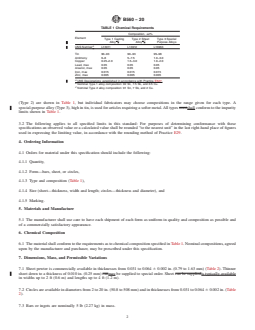
TABLE 1 Chemical Requirements
7.2 Circles are available in diameters from 2 to 20 in. (50.8
Composition, -wt% to 508 mm) and in thicknesses from 0.031 to 0.064 6 0.002 in.
Element
Type 1 Casting Type 2 Sheet Type 3 Special (Table 2).
B C
Alloy Alloy Purpose Alloys
7.3 Bars or ingots are nominally 5 lb (2.27 kg) in mass.
A
UNS Number L13911 L13912 L13963
8. Workmanship, Finish, and Appearance
Tin 90–93 90–93 95–98
Antimony 6–8 5–7.5 1.0–3.0
8.1 Surface defects in bars or ingots are of no importance.
Copper 0.25–2.0 1.5–3.0 1.0–2.0
Surface defects in sheet pewter or circles may be a cause for
Lead, max 0.05 0.05 0.05
Arsenic, max 0.05 0.05 0.05
rejection if the defects (pits or dents) cannot be removed to the
Iron, max 0.015 0.015 0.015
total satisfaction of the purchaser by polishing. Rejection of an
Zinc, max 0.005 0.005 0.005
entire shipment should be made only if the surface defects are
A
UNS Designations established in accordance with Practice E527.
B present on a substantial percentage of the shipment.
Nominal Type 1 alloy composition: 92 Sn, 7.5 Sb, and 0.5 Cu.
C
Nominal Type 2 alloy composition: 91 Sn, 7 Sb, and 2 Cu.
9. Sampling
9.1 Unless otherwise agreed upon by the manufacturer and
the purchaser, heat (ladle) analyses furnished by the manufac-
turer shall be accepted as defining the composition of the
6. Chemical Composition
material furnished.
6.1 The material shall conform to the requirements as to
9.2 If samples for check analyses are desired, they shall be
chemical composition specified in Table 1. Nominal
so specified by the purchaser at the time of placement of the
compositions, agreed upon by the manufacturer and purchaser,
order.
may be prescribed under this specification.
9.3 Check analyses samples shall consist of three bars or
7. Dimensions, Mass, and Permissible Va
...
This document is not an ASTM standard and is intended only to provide the user of an ASTM standard an indication of what changes have been made to the previous version. Because
it may not be technically possible to adequately depict all changes accurately, ASTM recommends that users consult prior editions as appropriate. In all cases only the current version
of the standard as published by ASTM is to be considered the official document.
Designation: B560 − 00 (Reapproved 2014) B560 − 20
Standard Specification for
Modern Pewter Alloys
This standard is issued under the fixed designation B560; the number immediately following the designation indicates the year of
original adoption or, in the case of revision, the year of last revision. A number in parentheses indicates the year of last reapproval. A
superscript epsilon (´) indicates an editorial change since the last revision or reapproval.
1. Scope Scope*
1.1 This specification covers three alloy types, Pewter alloy types as shown in Table 1, made from tin, antimony, and copper, used
in the production and fabrication of pewter articlesfinished or semi-finished pewter products by casting, spinning, drawing, or
forming. The metal may be supplied in the form of bars, ingots, rolled sheet, and circles.
1.2 Pewter alloy shall be defined as having a composition within the range from 90 to 98 % tin, 1 to 8 % antimony, and 0.25 to
3 % copper. Compositions are given in Table 1.
1.3 The values stated in inch-pound units are to be regarded as standard. The values given in parentheses are mathematical
conversions to SI units that are provided for information only and are not considered standard.
1.4 This standard does not purport to address all of the safety concerns, if any, associated with its use. It is the responsibility
of the user of this standard to become familiar with all hazards including those identified in the appropriate Material Safety Data
Sheet (MSDS) for this product/material as provided by the manufacturer, to establish appropriate safety safety, health, and
healthenvironmental practices, and determine the applicability of regulatory limitations prior to use.
1.5 This international standard was developed in accordance with internationally recognized principles on standardization
established in the Decision on Principles for the Development of International Standards, Guides and Recommendations issued
by the World Trade Organization Technical Barriers to Trade (TBT) Committee.
2. Referenced Documents
2.1 ASTM Standards:
E29 Practice for Using Significant Digits in Test Data to Determine Conformance with Specifications
E51 Method for Spectrographic Analysis of Tin Alloys by the Powder Technique (Withdrawn 1983)
E57 Methods for Chemical Analysis of White Metal Bearing Alloys (Withdrawn 1986)
E88 Practice for Sampling Nonferrous Metals and Alloys in Cast Form for Determination of Chemical Composition
E527 Practice for Numbering Metals and Alloys in the Unified Numbering System (UNS)
3. Classification
3.1 The hardness and workability of pewter varies with the amount of antimony and copper alloyed with the tin. Casting alloys
generally contain less copper and a slightly higher tin content than sheet alloys. The composition for castings (Type 1) and sheet
This specification is under the jurisdiction of ASTM Committee B02 on Nonferrous Metals and Alloys and is the direct responsibility of Subcommittee B02.02 on Refined
Lead, Tin, Antimony, and Their Alloys.
Current edition approved Oct. 1, 2014Oct. 1, 2020. Published October 2014October 2020. Originally approved in 1972. Last previous edition approved in 20102014 as
B560 – 00 (2010).(2014). DOI: 10.1520/B0560-00R14.10.1520/B0560-20.
For referenced ASTM standards, visit the ASTM website, www.astm.org, or contact ASTM Customer Service at service@astm.org. For Annual Book of ASTM Standards
volume information, refer to the standard’s Document Summary page on the ASTM website.
The last approved version of this historical standard is referenced on www.astm.org.
*A Summary of Changes section appears at the end of this standard
Copyright © ASTM International, 100 Barr Harbor Drive, PO Box C700, West Conshohocken, PA 19428-2959. United States
B560 − 20
TABLE 1 Chemical Requirements
Composition, -wt%
Element
Type 1 Casting Type 2 Sheet Type 3 Special
AB BC
Alloy Alloy Purpose Alloys
A
UNS Number L13911 L13912 L13963
Tin 90–93 90–93 95–98
Antimony 6–8 5–7.5 1.0–3.0
Copper 0.25–2.0 1.5–3.0 1.0–2.0
Lead, max 0.05 0.05 0.05
Arsenic, max 0.05 0.05 0.05
Iron, max 0.015 0.015 0.015
Zinc, max 0.005 0.005 0.005
A
UNS Designations established in accordance with Practice E527.
B
Nominal Type 1 alloy composition: 92 Sn, 7.5 Sb, and 0.5 Cu.
C
Nominal Type 2 alloy composition: 91 Sn, 7 Sb, and 2 Cu.
(Type 2) are shown in Table 1, but individual fabricators may choose compositions in the range given for each type. A
special-purpose alloy (Type 3), high in tin, is used for articles requiring a softer metal. All types mustshall conform to the impurity
limits shown in Table 1.
3.2 The following applies to all specified limits in this standard: For purposes of determining conformance with these
specifications an observed value or a calculated value shall be rounded “to the nearest unit” in the last right-hand place of figures
used in expressing the limiting value, in accordance with the rounding method of Practice E29.
4. Ordering Information
4.1 Orders for material under this specification should include the following:
4.1.1 Quantity,
4.1.2 Form—bars, sheet, or circles,
4.1.3 Type and composition (Table 1),
4.1.4 Size (sheet—thickness, width and length; circles—thickness and diameter), and
4.1.5 Marking.
5. Materials and Manufacture
5.1 The manufacturer shall use care to have each shipment of each form as uniform in quality and composition as possible and
of a commercially satisfactory appearance.
6. Chemical Composition
6.1 The material shall conform to the requirements as to chemical composition specified in Table 1. Nominal compositions, agreed
upon by the manufacturer and purchaser, may be prescribed under this specification.
7. Dimensions, Mass, and Permissible Variations
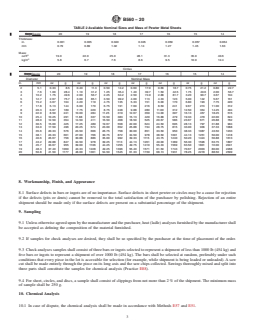
7.1 Sheet pewter is commercially available in thicknesses from 0.031 to 0.064 6 0.002 in. (0.79 to 1.63 mm) (Table 2). Thinner
sheet down to a thickness of 0.010 in. (0.25 mm) canmay be supplied to special order. Sheet can be suppliedis typically available
in widths up to 2 ft (0.6 m) and lengths up to 4 ft (1.2 m).
7.2 Circles are available in diameters from 2 to 20 in. (50.8 to 508 mm) and in thicknesses from 0.031 to 0.064 6 0.002 in. (Table
2).
7.3 Bars or ingots are nominally 5 lb (2.27 kg) in mass.
B560 − 20
TABLE 2 Available Nominal Sizes and Mass of Pewter Metal Sheets
GageGauge 20 19 18 17 16 15 14
Thickness:
in. 0.031 0.035 0.040 0.045 0.050 0.057 0.064
mm 0.79 0.89 1.02 1.14 1.27 1.45 1.63
Mass:
oz/ft 19.0 22.0 25.0 28.1 31.3 35.9 40.6
kg/m 5.8 6.7 7.6 8.6 9.5 10.9 12.4
Circles
GageGauge 20 19 18 17 16 15 14
Diameter Nominal Mass
in
...