

ASTM F2128-22
(Test Method)Standard Test Method for Treestand Repetitive Loading Capability
General Information
- Abstract
SIGNIFICANCE AND USE
5.1 This test method is intended for quality assurance and production control purposes with recognition that individual usage will vary considerably. This test method is not intended to be an independent material or product-acceptance test.
SCOPE
1.1 This test method covers the procedures for determining the capability of climbing and ladder treestands, climbing sticks (Sectional and Continuous), and tripods/towers to withstand repeated loading relative to the manufacturer's rated capacity. For actual specification requirements for each subject unit refer to Specification F3249.
1.2 The values stated in inch-pound units are to be regarded as standard. The values given in parentheses are mathematical conversions to SI units that are provided for information only and are not considered standard.
1.3 This standard does not purport to address all of the safety concerns, if any, associated with its use. It is the responsibility of the user of this standard to establish appropriate safety, health, and environmental practices and determine the applicability of regulatory limitations prior to use.
1.4 This international standard was developed in accordance with internationally recognized principles on standardization established in the Decision on Principles for the Development of International Standards, Guides and Recommendations issued by the World Trade Organization Technical Barriers to Trade (TBT) Committee.
- Status
- Published
- Publication Date
- 14-Dec-2022
- Technical Committee
- F08 - Sports Equipment, Playing Surfaces, and Facilities
- Drafting Committee
- F08.18 - Treestands

Overview
ASTM F2128-22: Standard Test Method for Treestand Repetitive Loading Capability establishes standardized procedures for evaluating the ability of treestands and associated climbing aids to withstand repeated loading cycles. This test method is fundamental for manufacturers and testing organizations to conduct quality assurance and production control of climbing treestands, ladder treestands, climbing sticks (sectional and continuous), tripods, and towers. The test focuses on the performance of these devices under conditions simulating real-world, repetitive use, ensuring the equipment's structure remains reliable over time according to the manufacturer's specified capacity.
ASTM F2128-22 is internationally recognized, supporting consistency in testing practices in alignment with global trade standards.
Key Topics
- Scope of Application: Covers climbing treestands, ladder treestands, fixed position treestands, climbing sticks, and tripod/tower stands.
- Testing Methodology:
- Repetitive loading procedures are implemented to simulate long-term, regular usage.
- Loads are applied in accordance with the manufacturer’s rated capacity.
- Focuses on visual inspection after repeated cycles for any signs of yielding, cracking, or permanent deformation.
- Safety and Compliance:
- Intended for quality assurance and production control, not for independent material or product acceptance.
- Requires users to establish safety, health, and environmental protocols as part of the test process.
- Measurement Units: Inch-pound (imperial) units are standard; SI metric units provided for reference only.
- Documentation Requirements: Calls for detailed recording of test conditions, subject identification, calibration, and test results, including photographs and descriptions of defects or movement.
Applications
The practical applications of ASTM F2128-22 are pivotal to the treestand industry, specifically in:
- Product Development and Design: Manufacturers utilize this standard to test the endurance of treestands and climbing aids, informing design improvements to increase durability and safety.
- Quality Assurance Programs: Factories and testing laboratories incorporate this method to routinely check that products meet durability requirements before shipment.
- Certification Processes: While compliance with ASTM F2128-22 is integral to certification schemes for treestands, it is not, by itself, a certification standard. Rather, it is used in conjunction with other relevant standards.
- Industry Best Practices: Enables consistent comparative evaluation, fostering trust and safety in outdoor recreation products among consumers and regulatory bodies.
- Regulatory Compliance: Supports manufacturers in demonstrating adherence to international and national safety regulations, especially in markets that recognize ASTM standards.
Related Standards
- ASTM F3249 - Specification for Treestands, Climbing Sticks, and Tripod or Tower Stands. Reference for actual specification requirements for subject units tested under F2128-22.
- ASTM F2124 (Withdrawn 2017) - Previously referenced practice for testing load capacity, relevant for historical context.
- ISO and WTO TBT Principles - Aligns with globally accepted standardization methodologies, supporting access to international markets.
Conclusion
ASTM F2128-22 delivers a robust framework for assessing the repetitive loading capability of treestand equipment. By following this standardized test method, manufacturers, testing laboratories, and quality assurance teams can better ensure the longevity, performance, and marketability of their treestands and climbing aids, ultimately contributing to higher safety and satisfaction for end-users in recreational and professional outdoor settings.
Keywords: treestand test method, repetitive loading, climbing treestand, ladder treestand, climbing sticks, tripod tower, outdoor safety equipment, ASTM standards
Relations
- Refers
ASTM F3249-24 - Standard Specification for Treestands, Climbing Sticks, and Tripod or Tower Stands - Effective Date
- 01-Feb-2024
- Refers
ASTM F3249-20 - Standard Specification for Treestands, Climbing Sticks, and Tripod or Tower Stands - Effective Date
- 01-Apr-2020
- Refers
ASTM F3249-17 - Standard Specification for Treestands, Climbing Sticks, and Tripod or Tower Stands - Effective Date
- 15-Jun-2017
Frequently Asked Questions
ASTM F2128-22 is a standard published by ASTM International. Its full title is "Standard Test Method for Treestand Repetitive Loading Capability". This standard covers: SIGNIFICANCE AND USE 5.1 This test method is intended for quality assurance and production control purposes with recognition that individual usage will vary considerably. This test method is not intended to be an independent material or product-acceptance test. SCOPE 1.1 This test method covers the procedures for determining the capability of climbing and ladder treestands, climbing sticks (Sectional and Continuous), and tripods/towers to withstand repeated loading relative to the manufacturer's rated capacity. For actual specification requirements for each subject unit refer to Specification F3249. 1.2 The values stated in inch-pound units are to be regarded as standard. The values given in parentheses are mathematical conversions to SI units that are provided for information only and are not considered standard. 1.3 This standard does not purport to address all of the safety concerns, if any, associated with its use. It is the responsibility of the user of this standard to establish appropriate safety, health, and environmental practices and determine the applicability of regulatory limitations prior to use. 1.4 This international standard was developed in accordance with internationally recognized principles on standardization established in the Decision on Principles for the Development of International Standards, Guides and Recommendations issued by the World Trade Organization Technical Barriers to Trade (TBT) Committee.
SIGNIFICANCE AND USE 5.1 This test method is intended for quality assurance and production control purposes with recognition that individual usage will vary considerably. This test method is not intended to be an independent material or product-acceptance test. SCOPE 1.1 This test method covers the procedures for determining the capability of climbing and ladder treestands, climbing sticks (Sectional and Continuous), and tripods/towers to withstand repeated loading relative to the manufacturer's rated capacity. For actual specification requirements for each subject unit refer to Specification F3249. 1.2 The values stated in inch-pound units are to be regarded as standard. The values given in parentheses are mathematical conversions to SI units that are provided for information only and are not considered standard. 1.3 This standard does not purport to address all of the safety concerns, if any, associated with its use. It is the responsibility of the user of this standard to establish appropriate safety, health, and environmental practices and determine the applicability of regulatory limitations prior to use. 1.4 This international standard was developed in accordance with internationally recognized principles on standardization established in the Decision on Principles for the Development of International Standards, Guides and Recommendations issued by the World Trade Organization Technical Barriers to Trade (TBT) Committee.
ASTM F2128-22 is classified under the following ICS (International Classification for Standards) categories: 97.220.40 - Outdoor and water sports equipment. The ICS classification helps identify the subject area and facilitates finding related standards.
ASTM F2128-22 has the following relationships with other standards: It is inter standard links to ASTM F3249-24, ASTM F3249-20, ASTM F3249-17. Understanding these relationships helps ensure you are using the most current and applicable version of the standard.
ASTM F2128-22 is available in PDF format for immediate download after purchase. The document can be added to your cart and obtained through the secure checkout process. Digital delivery ensures instant access to the complete standard document.
Standards Content (Sample)
This international standard was developed in accordance with internationally recognized principles on standardization established in the Decision on Principles for the
Development of International Standards, Guides and Recommendations issued by the World Trade Organization Technical Barriers to Trade (TBT) Committee.
Designation: F2128 − 22 An American National Standard
Standard Test Method for
Treestand Repetitive Loading Capability
This standard is issued under the fixed designation F2128; the number immediately following the designation indicates the year of
original adoption or, in the case of revision, the year of last revision. A number in parentheses indicates the year of last reapproval. A
superscript epsilon (´) indicates an editorial change since the last revision or reapproval.
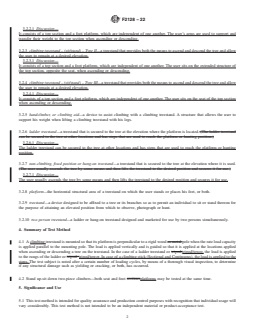
1. Scope 3.2.1 backbar or V-bar—the adjustable component of a
climbing treestand or handclimber that engages the tree to
1.1 This test method covers the procedures for determining
provide support.
the capability of climbing and ladder treestands, climbing
3.2.1.1 Discussion—The backbar may be rigid or flexible.
sticks (Sectional and Continuous), and tripods/towers to with-
stand repeated loading relative to the manufacturer’s rated
3.2.2 climbing treestand – (hand climber) – Type I—a
capacity. For actual specification requirements for each subject
treestand that provides both the means to ascend and descend
unit refer to Specification F3249.
the tree and allow the user to remain at a desired elevation.
1.2 The values stated in inch-pound units are to be regarded 3.2.2.1 Discussion—It consists of a top section and a foot
platform, which are independent of one another. The user’s
as standard. The values given in parentheses are mathematical
arms are used to support and transfer their weight to the top
conversions to SI units that are provided for information only
section when ascending or descending.
and are not considered standard.
1.3 This standard does not purport to address all of the
3.2.3 climbing treestand – (sit/stand) – Type II—a treestand
safety concerns, if any, associated with its use. It is the that provides both the means to ascend and descend the tree
responsibility of the user of this standard to establish appro-
and allow the user to remain at a desired elevation.
priate safety, health, and environmental practices and deter-
3.2.3.1 Discussion—It consists of a top section and a foot
mine the applicability of regulatory limitations prior to use.
platform, which are independent of one another. The user sits
1.4 This international standard was developed in accor-
on the extended structure of the top section, opposite the seat,
dance with internationally recognized principles on standard-
when ascending or descending.
ization established in the Decision on Principles for the
3.2.4 climbing treestand – (sit/stand) – Type III—a treestand
Development of International Standards, Guides and Recom-
that provides both the means to ascend and descend the tree
mendations issued by the World Trade Organization Technical
and allow the user to remain at a desired elevation.
Barriers to Trade (TBT) Committee.
3.2.4.1 Discussion—It consists of a top section and a foot
platform, which are independent of one another. The user sits
2. Referenced Documents
on the seat of the top section when ascending or descending.
2.1 ASTM Standards:
3.2.5 handclimber, or climbing aid—a device to assist
F3249 Specification for Treestands, Climbing Sticks, and
climbing with a climbing treestand. A structure that allows the
Tripod or Tower Stands
user to support his weight when lifting a climbing treestand
with his legs.
3. Terminology
3.2.6 ladder treestand—atreestandthatissecuredtothetree
3.1 The terminology and definitions in the referenced docu-
at the elevation where the platform is located.
ments are applicable to this practice.
3.2.6.1 Discussion—The ladder treestand can be secured to
3.2 Definitions:
the tree at other locations and has steps that are used to reach
the platform or hunting position.
3.2.7 non-climbing, fixed position or hang-on treestand—a
This test method is under the jurisdiction of ASTM Committee F08 on Sports
treestand that is secured to the tree at the elevation where it is
Equipment, Playing Surfaces, and Facilities and is the direct responsibility of
Subcommittee F08.18 on Treestands. used.
Current edition approved Dec. 15, 2022. Published January 2023. Originally
3.2.7.1 Discussion—The user usually ascends the tree by
approved in 2001. Last previous edition approved in 2021 as F2128 – 13 (2021).
some means and then lifts the treestand to the desired position
DOI: 10.1520/F2128-22.
For referenced ASTM standards, visit the ASTM website, www.astm.org, or and secures it for use.
contact ASTM Customer Service at service@astm.org. For Annual Book of ASTM
3.2.8 platform—the horizontal structural area of a treestand
Standards volume information, refer to the standard’s Document Summary page on
the ASTM website. on which the user stands or places his feet, or both.
Copyright © ASTM International, 100 Barr Harbor Drive, PO Box C700, West Conshohocken, PA 19428-2959. United States
F2128 − 22
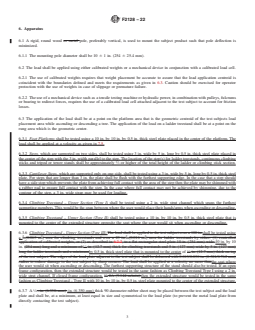
3.2.9 treestand—a device designed to be affixed to a tree or 6.3.2 Steps, which are supported on two sides, shall be
its branches so as to permit an individual to sit or stand thereon tested using 3 in. wide by 5 in. long by 0.5 in. thick steel plate
for the purpose of attaining an elevated position from which to placed in the center of the step with the 3 in. width parallel to
observe, photograph or hunt. the step. The location of the step(s) for ladder treestands,
continuous climbing sticks and tripod or tower stands shall be
3.2.10 two person treestand—a ladder or hang-on treestand
approximately ⁄3 or higher of the total height of the ladder or
designed and marketed for use by two persons simultaneously.
climbing stick section.
4. Summary of Test Method 6.3.3 Cantilever Steps, which are supported only on one
side, shall be tested using a 3 in. wide by 5 in. long by 0.5 in.
4.1 A climbing treestand is mounted so that its platform is
thick steel plate. For steps that are longer than 3 in. the plate
perpendicular to a rigid wood pole when the rate load capacity
shall be flush with the furthest supporting edge. In the case that
is applied parallel to the mounting pole. The load is applied
a step should have a side stop which prevents the plate from
vertically and is guided so that it is applied at the locations
achieving full contact with the area of the step then the plate
applied when ascending or descending a tree on the treestand.
may be shimmed with a rubber pad to ensure full contact with
In the case of a ladder treestand or tripod/tower, the load is
the step. In the case where full contact may not be achieved by
applied to the rungs of the ladder or tripod/tower. In case of a
shimming,duetothecontourofthestep,a3in.widestrapmay
climbing stick (Sectional and Continuous), the load is applied
be used for loading.
to the steps. The test subject is noted after a certain number of
6.3.4 Climbing Treestand – Upper Section (Type I) shall be
loading cycles, by means of a thorough visual inspection, to
tested using a 2 in. wide strut channel which spans the furthest
determine if any structural damage such as yielding or
supporting members. This would be the span between where
cracking, or both, has occurred.
the user would place their hands/arms when ascending or
4.2 Stand up-sit down two-piece climbers—both seat and
descending.
foot platforms may be tested at the same time.
6.3.5 Climbing Treestand – Upper Section (Type II) shall be
tested using a 10 in. by 10 in. by 0.5 in. thick steel plate that
5. Significance and Use
is mounted to the center of the extended structure opposite the
5.1 This test method is intended for quality assurance and
seat where the user would sit when ascending or descending.
production control purposes with recognition that individual
6.3.6 Climbing Treestand – Upper Section (Type III) shall
usage will vary considerably. This test method is not intended
be tested using a 10 in. by 10 in. by 0.5 in. thick steel plate that
to be an independent material or product-acceptance test.
is mounted to the center of the seat where the user would sit
when ascending or descending. The furthest supporting struc-
6. Apparatus
ture of the stand should also be tested. If an open frame
6.1 Arigid, round wood pole, preferably vertical, is used to
configuration, then the e
...
This document is not an ASTM standard and is intended only to provide the user of an ASTM standard an indication of what changes have been made to the previous version. Because
it may not be technically possible to adequately depict all changes accurately, ASTM recommends that users consult prior editions as appropriate. In all cases only the current version
of the standard as published by ASTM is to be considered the official document.
Designation: F2128 − 13 (Reapproved 2021) F2128 − 22 An American National Standard
Standard Test Method for
Treestand Repetitive Loading Capability
This standard is issued under the fixed designation F2128; the number immediately following the designation indicates the year of
original adoption or, in the case of revision, the year of last revision. A number in parentheses indicates the year of last reapproval. A
superscript epsilon (´) indicates an editorial change since the last revision or reapproval.
1. Scope
1.1 This test method covers the procedures for determining the capability of climbing and ladder treestands and tripods treestands,
climbing sticks (Sectional and Continuous), and tripods/towers to withstand repeated loading relative to the manufacturer’s rated
capacity. For actual specification requirements for each subject unit refer to Specification F3249.
1.2 The values stated in inch-pound units are to be regarded as standard. The values given in parentheses are mathematical
conversions to SI units that are provided for information only and are not considered standard.
1.3 This standard does not purport to address all of the safety concerns, if any, associated with its use. It is the responsibility
of the user of this standard to establish appropriate safety, health, and environmental practices and determine the applicability of
regulatory limitations prior to use.
1.4 This international standard was developed in accordance with internationally recognized principles on standardization
established in the Decision on Principles for the Development of International Standards, Guides and Recommendations issued
by the World Trade Organization Technical Barriers to Trade (TBT) Committee.
2. Referenced Documents
2.1 ASTM Standards:
F2124F3249 Practice for Testing Treestand Ladder, Tripod Stand and Climbing Stick Load CapacitySpecification for Treestands,
Climbing Sticks, and Tripod or Tower Stands (Withdrawn 2017)
3. Terminology
3.1 The terminology and definitions in the referenced documents are applicable to this practice.
3.2 Definitions:
3.2.1 backbar or V-bar—the adjustable component of a climbing treestand or handclimber that engages the tree to provide support.
The backbar may be rigid or flexible.
3.2.1.1 Discussion—
The backbar may be rigid or flexible.
3.2.2 climbing treestand—treestand – (hand climber) – Type I—a treestand that provides both the means to ascend and descend
the tree,tree and allow the user to remain at a desired elevation.
This test method is under the jurisdiction of ASTM Committee F08 on Sports Equipment, Playing Surfaces, and Facilities and is the direct responsibility of Subcommittee
F08.18 on Treestands.
Current edition approved Dec. 1, 2021Dec. 15, 2022. Published December 2021January 2023. Originally approved in 2001. Last previous edition approved in 20132021
as F2128 – 13.F2128 – 13 (2021). DOI: 10.1520/F2128-13R21.10.1520/F2128-22.
For referenced ASTM standards, visit the ASTM website, www.astm.org, or contact ASTM Customer Service at service@astm.org. For Annual Book of ASTM Standards
volume information, refer to the standard’s Document Summary page on the ASTM website.
Copyright © ASTM International, 100 Barr Harbor Drive, PO Box C700, West Conshohocken, PA 19428-2959. United States
F2128 − 22
3.2.2.1 Discussion—
It consists of a top section and a foot platform, which are independent of one another. The user’s arms are used to support and
transfer their weight to the top section when ascending or descending.
3.2.3 climbing treestand – (sit/stand) – Type II—a treestand that provides both the means to ascend and descend the tree and allow
the user to remain at a desired elevation.
3.2.3.1 Discussion—
It consists of a top section and a foot platform, which are independent of one another. The user sits on the extended structure of
the top section, opposite the seat, when ascending or descending.
3.2.4 climbing treestand – (sit/stand) – Type III—a treestand that provides both the means to ascend and descend the tree and allow
the user to remain at a desired elevation.
3.2.4.1 Discussion—
It consists of a top section and a foot platform, which are independent of one another. The user sits on the seat of the top section
when ascending or descending.
3.2.5 handclimber, or climbing aid—a device to assist climbing with a climbing treestand. A structure that allows the user to
support his weight when lifting a climbing treestand with his legs.
3.2.6 ladder treestand—a treestand that is secured to the tree at the elevation where the platform is located. (The ladder treestand
can be secured to the tree at other locations and has steps that are used to reach the platform or hunting position.)
3.2.6.1 Discussion—
The ladder treestand can be secured to the tree at other locations and has steps that are used to reach the platform or hunting
position.
3.2.7 non-climbing, fixed position or hang-on treestand—a treestand that is secured to the tree at the elevation where it is used.
(The user usually ascends the tree by some means and then lifts the treestand to the desired position and secures it for use.)
3.2.7.1 Discussion—
The user usually ascends the tree by some means and then lifts the treestand to the desired position and secures it for use.
3.2.8 platform—the horizontal structural area of a treestand on which the user stands or places his feet, or both.
3.2.9 treestand—a device designed to be affixed to a tree or its branches so as to permit an individual to sit or stand thereon for
the purpose of attaining an elevated position from which to observe, photograph or hunt.
3.2.10 two person treestand—a ladder or hang-on treestand designed and marketed for use by two persons simultaneously.
4. Summary of Test Method
4.1 A climbing treestand is mounted so that its platform is perpendicular to a rigid wood or metal pole when the rate load capacity
is applied parallel to the mounting pole. The load is applied vertically and is guided so that it is applied at the locations applied
when ascending or descending a tree on the treestand. In the case of a ladder treestand or tripod,tripod/tower, the load is applied
to the rungs of the ladder or tripod. tripod/tower. In case of a climbing stick (Sectional and Continuous), the load is applied to the
steps. The test subject is noted after a certain number of loading cycles, by means of a thorough visual inspection, to determine
if any structural damage such as yielding or cracking, or both, has occurred.
4.2 Stand up-sit down two-piece climbers—both seat and foot sectionsplatforms may be tested at the same time.
5. Significance and Use
5.1 This test method is intended for quality assurance and production control purposes with recognition that individual usage will
vary considerably. This test method is not intended to be an independent material or product-acceptance test.
F2128 − 22
6. Apparatus
6.1 A rigid, round wood or metal pole, preferably vertical, is used to mount the subject product such that pole deflection is
minimized.
6.1.1 The mounting pole diameter shall be 10 6 1 in. (254 6 25.4 mm).
6.2 The load shall be applied using either calibrated weights or a mechanical device in conjunction with a calibrated load cell.
6.2.1 The use of calibrated weights requires that weight placement be accurate to assure that the load application centroid is
coincident with the boundaries defined and meets the requirements as given in 6.3. Caution should be exercised for operator
protection with the use of weights in case of slippage or premature failure.
6.2.2 The use of a mechanical device such as a tensile testing machine or hydraulic power, in combination with pulleys, fulcrums
or bearing to redirect forces, requires the use of a calibrated load cell attached adjacent to the test subject to account for friction
losses.
6.3 The application of the load shall be at a point on the platform area that is the geometric centroid of the test subjects load
placement area while ascending or descending a tree. The application of the load on a ladder treestand shall be at a point on the
rung area which is the geometric center.
6.3.1 Foot Platforms shall be tested using a 10 in. by 10 in. by 0.5 in. thick steel plate placed in the center of the platform. The
load shall be applied at a velocity as given in 7.5.
6.3.2 Steps, which are supported on two sides, shall be tested using 3 in. wide by 5 in. long by 0.5 in. thick steel plate placed in
the center of the step with the 3 in. width parallel to the step. The location of the step(s) for ladder treestands, continuous climbing
sticks and tripod or tower stands shall be approximately ⁄3 or higher of the total height of the ladder or climbing stick section.
6.3.3 Cantilever Steps, which are supported only on one side, shall be tested using a 3 in. wide by 5 in. long by 0.5 in. thick steel
plate. For steps that are longer than 3 in. the plate shall be flush with the furthest supporting edge. In the case that a step should
have a side stop which prevents the plate from achieving full contact with the area of the step then the plate may be shimmed with
a rubber pad to ensure full contact with the step. In the case where full contact may not be achieved by shimming, due to the
contour of the step, a 3 in. wide strap may be used for loading.
6.3.4 Climbing Treestand – Upper Section (Type I) shall be tested using a 2 in. wide strut channel which spans the furthest
supporting members. This would be the span between where the user would place their hands
...