

ASTM F3150-18(2024)
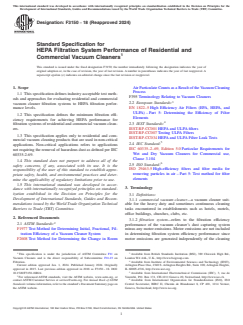
(Specification)Standard Specification for HEPA Filtration System Performance of Residential and Commercial Vacuum Cleaners
General Information
- Abstract
ABSTRACT
This specification defines the minimum filtration efficiency requirements for achieving HEPA performance for filtration systems of residential and commercial vacuum cleaners. Only residential and commercial vacuum cleaning products that are used in non-critical applications (applications not requiring the removal of hazardous dust as defined per IEC 60335-2-69) are covered by this specification.
SCOPE
1.1 This specification defines industry acceptable test methods and approaches for evaluating residential and commercial vacuum cleaner filtration systems to HEPA filtration performance levels.
1.2 This specification defines the minimum filtration efficiency requirements for achieving HEPA performance for filtration systems of residential and commercial vacuum cleaners.
1.3 This specification applies only to residential and commercial vacuum cleaning products that are used in non-critical applications. Non-critical applications refers to applications not requiring the removal of hazardous dust as defined per IEC 60335-2-69.
1.4 This standard does not purport to address all of the safety concerns, if any, associated with its use. It is the responsibility of the user of this standard to establish appropriate safety, health, and environmental practices and determine the applicability of regulatory limitations prior to use.
1.5 This international standard was developed in accordance with internationally recognized principles on standardization established in the Decision on Principles for the Development of International Standards, Guides and Recommendations issued by the World Trade Organization Technical Barriers to Trade (TBT) Committee.
- Status
- Published
- Publication Date
- 31-Dec-2023
- Technical Committee
- F11 - Vacuum Cleaners
- Drafting Committee
- F11.23 - Filtration


Overview
ASTM F3150-18(2024): Standard Specification for HEPA Filtration System Performance of Residential and Commercial Vacuum Cleaners defines the minimum filtration efficiency requirements and test methods necessary for vacuum cleaners to claim High Efficiency Particulate Air (HEPA) performance. Developed by ASTM, this international standard focuses on filtration systems in residential and commercial vacuum cleaners used for non-critical applications-specifically, environments that do not require the removal of hazardous dust as outlined in IEC 60335-2-69.
By establishing harmonized terminology, criteria, and test options, ASTM F3150-18(2024) enables manufacturers, consumers, and regulatory bodies to understand and ensure HEPA-level filtration system performance in vacuum cleaning products. This standard does not address safety and regulatory restrictions, for which users must determine relevant requirements.
Key Topics
- HEPA Filtration Requirements: Specifies the minimum filtration efficiency (99.97% at the 0.3 to 0.5 micron range) required for HEPA designation when tested according to accepted industry methods.
- Test Methods: Details two testing options for verifying HEPA performance:
- A two-step approach that tests both the primary filter (per industry standard such as IEST-RP-CC001, EN 1822-5, or ISO 29463-5) and the complete vacuum system (using ASTM F1977).
- A single test of the complete vacuum, modified per referenced standards, measuring the overall system’s filtration efficiency.
- Sampling and Evaluation: Describes guidelines for selecting representative filter elements and vacuum cleaner units for testing to ensure statistically meaningful performance verification.
- Scope and Limits: Applies exclusively to residential and commercial vacuum cleaners used in general, non-critical cleaning applications-not for removal of hazardous or regulated dusts.
- Terminology: Establishes consistent definitions for commercial and residential vacuum cleaners, filtration systems, and HEPA performance.
Applications
ASTM F3150-18(2024) delivers practical value across several sectors:
- Manufacturers: Provides clear, industry-accepted benchmarks for designing, labeling, and marketing residential and commercial vacuum cleaners as HEPA-compliant.
- Quality Assurance: Outlines uniform test protocols (e.g., ASTM F1977, EN 1822-5, ISO 29463-5) to validate product performance, ensuring reliable removal of ultrafine particles and allergens from indoor environments.
- Procurement and Specification: Enables purchasers, facility managers, and consumers to confidently select vacuum cleaners that meet stringent particle retention requirements for healthier indoor air.
- Regulatory and Compliance: Assists in international product acceptance by referencing globally recognized filtration efficiency and test criteria, supporting alignment with international trade and safety expectations.
- Laboratories and Testing Bodies: Offers standardized sampling guidelines and performance thresholds for impartial third-party verification of HEPA filtration claims.
Note: This standard does not cover vacuum cleaners for critical use, such as asbestos abatement or hazardous material removal, which require compliance with specific safety regulations.
Related Standards
ASTM F3150-18(2024) references and aligns with the following key standards:
- ASTM F1977: Determining Initial, Fractional Filtration Efficiency of a Vacuum Cleaner System
- ASTM F2608: Change in Room Air Particulate Counts as a Result of the Vacuum Cleaning Process
- EN 1822-5: Determining the Efficiency of EPA, HEPA, and ULPA Filter Elements
- IEST-RP-CC001, IEST-RP-CC007, IEST-RP-CC034: HEPA and ULPA filters and their testing methods
- IEC 60335-2-69: Particular Requirements for Wet and Dry Vacuum Cleaners for Commercial Use (hazardous dust provisions)
- ISO 29463-5: High-efficiency filters and test methods for removing airborne particles
Together, these documents provide a globally coherent framework for the evaluation, certification, and specification of vacuum cleaner HEPA filtration system performance.
For more information or to access the full standard, visit the ASTM website.
Relations
- Effective Date
- 01-Jan-2024
Frequently Asked Questions
ASTM F3150-18(2024) is a technical specification published by ASTM International. Its full title is "Standard Specification for HEPA Filtration System Performance of Residential and Commercial Vacuum Cleaners". This standard covers: ABSTRACT This specification defines the minimum filtration efficiency requirements for achieving HEPA performance for filtration systems of residential and commercial vacuum cleaners. Only residential and commercial vacuum cleaning products that are used in non-critical applications (applications not requiring the removal of hazardous dust as defined per IEC 60335-2-69) are covered by this specification. SCOPE 1.1 This specification defines industry acceptable test methods and approaches for evaluating residential and commercial vacuum cleaner filtration systems to HEPA filtration performance levels. 1.2 This specification defines the minimum filtration efficiency requirements for achieving HEPA performance for filtration systems of residential and commercial vacuum cleaners. 1.3 This specification applies only to residential and commercial vacuum cleaning products that are used in non-critical applications. Non-critical applications refers to applications not requiring the removal of hazardous dust as defined per IEC 60335-2-69. 1.4 This standard does not purport to address all of the safety concerns, if any, associated with its use. It is the responsibility of the user of this standard to establish appropriate safety, health, and environmental practices and determine the applicability of regulatory limitations prior to use. 1.5 This international standard was developed in accordance with internationally recognized principles on standardization established in the Decision on Principles for the Development of International Standards, Guides and Recommendations issued by the World Trade Organization Technical Barriers to Trade (TBT) Committee.
ABSTRACT This specification defines the minimum filtration efficiency requirements for achieving HEPA performance for filtration systems of residential and commercial vacuum cleaners. Only residential and commercial vacuum cleaning products that are used in non-critical applications (applications not requiring the removal of hazardous dust as defined per IEC 60335-2-69) are covered by this specification. SCOPE 1.1 This specification defines industry acceptable test methods and approaches for evaluating residential and commercial vacuum cleaner filtration systems to HEPA filtration performance levels. 1.2 This specification defines the minimum filtration efficiency requirements for achieving HEPA performance for filtration systems of residential and commercial vacuum cleaners. 1.3 This specification applies only to residential and commercial vacuum cleaning products that are used in non-critical applications. Non-critical applications refers to applications not requiring the removal of hazardous dust as defined per IEC 60335-2-69. 1.4 This standard does not purport to address all of the safety concerns, if any, associated with its use. It is the responsibility of the user of this standard to establish appropriate safety, health, and environmental practices and determine the applicability of regulatory limitations prior to use. 1.5 This international standard was developed in accordance with internationally recognized principles on standardization established in the Decision on Principles for the Development of International Standards, Guides and Recommendations issued by the World Trade Organization Technical Barriers to Trade (TBT) Committee.
ASTM F3150-18(2024) is classified under the following ICS (International Classification for Standards) categories: 97.080 - Cleaning appliances. The ICS classification helps identify the subject area and facilitates finding related standards.
ASTM F3150-18(2024) has the following relationships with other standards: It is inter standard links to ASTM F3150-18. Understanding these relationships helps ensure you are using the most current and applicable version of the standard.
ASTM F3150-18(2024) is available in PDF format for immediate download after purchase. The document can be added to your cart and obtained through the secure checkout process. Digital delivery ensures instant access to the complete standard document.
Standards Content (Sample)
This international standard was developed in accordance with internationally recognized principles on standardization established in the Decision on Principles for the
Development of International Standards, Guides and Recommendations issued by the World Trade Organization Technical Barriers to Trade (TBT) Committee.
Designation: F3150 − 18 (Reapproved 2024)
Standard Specification for
HEPA Filtration System Performance of Residential and
Commercial Vacuum Cleaners
This standard is issued under the fixed designation F3150; the number immediately following the designation indicates the year of
original adoption or, in the case of revision, the year of last revision. A number in parentheses indicates the year of last reapproval. A
superscript epsilon (´) indicates an editorial change since the last revision or reapproval.
1. Scope Air Particulate Counts as a Result of the Vacuum Cleaning
Process
1.1 This specification defines industry acceptable test meth-
F395 Terminology Relating to Vacuum Cleaners
ods and approaches for evaluating residential and commercial
vacuum cleaner filtration systems to HEPA filtration perfor- 2.2 European Standards:
EN 1822–5 High Efficiency Air Filters (EPA, HEPA, and
mance levels.
ULPA) – Part 5: Determining the Efficiency of Filter
1.2 This specification defines the minimum filtration effi-
Elements
ciency requirements for achieving HEPA performance for
2.3 IEST Standards:
filtration systems of residential and commercial vacuum clean-
IEST-RP-CC001 HEPA and ULPA filters
ers.
IEST-RP-CC007 Testing ULPA Filters
1.3 This specification applies only to residential and com-
IEST-RP-CC034 HEPA and ULPA Filter Leak Tests
mercial vacuum cleaning products that are used in non-critical
2.4 IEC Standard:
applications. Non-critical applications refers to applications
IEC 60335–2–69, Edition 5.0 Particular Requirements for
not requiring the removal of hazardous dust as defined per IEC
Wet and Dry Vacuum Cleaners for Commercial use,
60335-2-69.
Clause 3.104
1.4 This standard does not purport to address all of the
2.5 ISO Standard:
safety concerns, if any, associated with its use. It is the
ISO 29463-5 High-efficiency filters and filter media for
responsibility of the user of this standard to establish appro-
removing particles in air – Part 5: Test method for filter
priate safety, health, and environmental practices and deter-
elements
mine the applicability of regulatory limitations prior to use.
1.5 This international standard was developed in accor-
3. Terminology
dance with internationally recognized principles on standard-
ization established in the Decision on Principles for the
3.1 Definitions:
Development of International Standards, Guides and Recom-
3.1.1 commercial vacuum cleaner—a vacuum cleaner suit-
mendations issued by the World Trade Organization Technical
able for the heavy duty and sometimes continuous cleaning
Barriers to Trade (TBT) Committee.
tasks encountered in establishments such as hotels, motels,
office buildings, churches, clubs, etc.
2. Referenced Documents
3.1.2 filtration system—refers to the filtration efficiency
2.1 ASTM Standards: performance of the vacuum cleaner’s dust capturing system
F1977 Test Method for Determining Initial, Fractional, Fil-
minus any motor emissions. Motor emissions are not included
tration Efficiency of a Vacuum Cleaner System in determining filtration system efficiency performance since
F2608 Test Method for Determining the Change in Room
motor emissions are generated independently of the cleaning
1 3
This specification is under the jurisdiction of ASTM Committee F11 on Available from British Standards Institution (BSI), 389 Chiswick High Rd.,
Vacuum Cleaners and is the direct responsibility of Subcommittee F11.23 on London W4 4AL, U.K., http://www.bsigroup.com.
Filtration. Available from Institute of Environmental Sciences and Technology (IEST),
Current edition approved Jan. 1, 2024. Published January 2024. Originally Arlington Place One, 2340 S. Arlington Heights Rd., Suite 100, Arlington Heights,
approved in 2015. Last previous edition approved in 2018 as F3150 – 18. DOI: IL 60005-4516, http://www.iest.org.
10.1520/F3150-18R24. Available from International Electrotechnical Commission (IEC), 3, rue de
For referenced ASTM standards, visit the ASTM website, www.astm.org, or Varembé, P.O. Box 131, CH-1211 Geneva 20, Switzerland, http://www.iec.ch.
contact ASTM Customer Service at service@astm.org. For Annual Book of ASTM Available from International Organization for Standardization (ISO), ISO
Standards volume information, refer to the standard’s Document Summary page on Central Secretariat, BIBC II, Chemin de Blandonnet 8, CP 401, 1214 Vernier,
the ASTM website. Geneva, Switzerland, http://www.iso.org.
Copyright © ASTM International, 100 Barr Harbor Drive, PO Box C700, West Conshohocken, PA 19428-2959. United States
F3150 − 18 (2024)
process and are not a part of the dust and debris being removed 5. Test Methods
from the floor surface. Motor emissions are addressed under
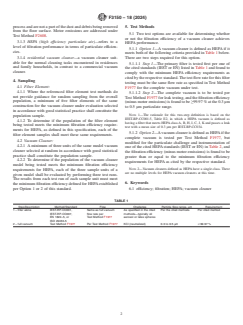
5.1 Two test options are available for determining whether
Test Method F2608.
or not the filtration efficiency of a vacuum cleaner achieves
3.1.3 HEPA (high effıciency particulate air)—refers to a
HEPA performance.
level of filtration performance in terms of part
...