


ASTM E60-11(2016)
(Practice)Standard Practice for Analysis of Metals, Ores, and Related Materials by Spectrophotometry
Standard Practice for Analysis of Metals, Ores, and Related Materials by Spectrophotometry
ABSTRACT
This practice covers general recommendations for photoelectric photometers and spectrometers and for photometric practice for chemical analysis of metals, ores, and related materials. However, this practice does not include a description of every apparatus nor does it present recommendations on every detail of practice in photometric or spectrophotometric methods of chemical analysis of metals. To improve photoelectric photometers and spectrophotometers, some suggestions related to their components are mentioned, in particular, the radiation source (illuminant), filters, monochromators, absorption cells, photosensitive tubes, and current-measuring devices. In addition, prior to using photometric methods in the chemical analysis of metals, ores, and related materials, it is recommended that a complete photometric investigation of the reaction be performed. The investigation shall involve the study of the specificity of the reagent used to produce absorption; validity of Beer's law; effects of salts, solvent, pH, temperature, concentration of reagents, and the order of adding reagents; time required for absorption development and the stability of the absorption; absorption curve of the reagent and the absorbing substances; and optimum concentration range for quantitative analysis.
SCOPE
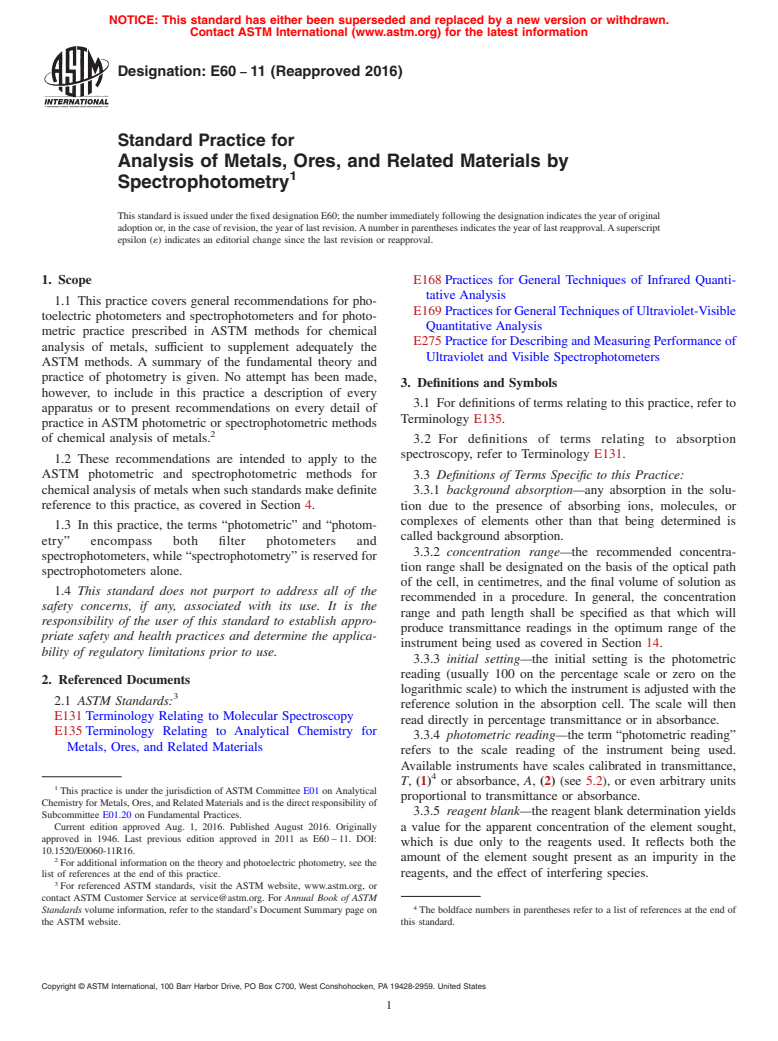
1.1 This practice covers general recommendations for photoelectric photometers and spectrophotometers and for photometric practice prescribed in ASTM methods for chemical analysis of metals, sufficient to supplement adequately the ASTM methods. A summary of the fundamental theory and practice of photometry is given. No attempt has been made, however, to include in this practice a description of every apparatus or to present recommendations on every detail of practice in ASTM photometric or spectrophotometric methods of chemical analysis of metals.2
1.2 These recommendations are intended to apply to the ASTM photometric and spectrophotometric methods for chemical analysis of metals when such standards make definite reference to this practice, as covered in Section 4.
1.3 In this practice, the terms “photometric” and “photometry” encompass both filter photometers and spectrophotometers, while “spectrophotometry” is reserved for spectrophotometers alone.
1.4 This standard does not purport to address all of the safety concerns, if any, associated with its use. It is the responsibility of the user of this standard to establish appropriate safety and health practices and determine the applicability of regulatory limitations prior to use.
General Information
Buy Standard
Standards Content (Sample)
NOTICE: This standard has either been superseded and replaced by a new version or withdrawn.
Contact ASTM International (www.astm.org) for the latest information
Designation: E60 − 11 (Reapproved 2016)
Standard Practice for
Analysis of Metals, Ores, and Related Materials by
Spectrophotometry
This standard is issued under the fixed designation E60; the number immediately following the designation indicates the year of original
adoption or, in the case of revision, the year of last revision.Anumber in parentheses indicates the year of last reapproval.Asuperscript
epsilon (´) indicates an editorial change since the last revision or reapproval.
1. Scope E168 Practices for General Techniques of Infrared Quanti-
tative Analysis
1.1 This practice covers general recommendations for pho-
E169 PracticesforGeneralTechniquesofUltraviolet-Visible
toelectric photometers and spectrophotometers and for photo-
Quantitative Analysis
metric practice prescribed in ASTM methods for chemical
E275 PracticeforDescribingandMeasuringPerformanceof
analysis of metals, sufficient to supplement adequately the
Ultraviolet and Visible Spectrophotometers
ASTM methods. A summary of the fundamental theory and
practice of photometry is given. No attempt has been made,
3. Definitions and Symbols
however, to include in this practice a description of every
3.1 For definitions of terms relating to this practice, refer to
apparatus or to present recommendations on every detail of
Terminology E135.
practice inASTM photometric or spectrophotometric methods
of chemical analysis of metals. 3.2 For definitions of terms relating to absorption
spectroscopy, refer to Terminology E131.
1.2 These recommendations are intended to apply to the
ASTM photometric and spectrophotometric methods for 3.3 Definitions of Terms Specific to this Practice:
chemical analysis of metals when such standards make definite
3.3.1 background absorption—any absorption in the solu-
reference to this practice, as covered in Section 4. tion due to the presence of absorbing ions, molecules, or
complexes of elements other than that being determined is
1.3 In this practice, the terms “photometric” and “photom-
called background absorption.
etry” encompass both filter photometers and
3.3.2 concentration range—the recommended concentra-
spectrophotometers, while “spectrophotometry” is reserved for
tion range shall be designated on the basis of the optical path
spectrophotometers alone.
of the cell, in centimetres, and the final volume of solution as
1.4 This standard does not purport to address all of the
recommended in a procedure. In general, the concentration
safety concerns, if any, associated with its use. It is the
range and path length shall be specified as that which will
responsibility of the user of this standard to establish appro-
produce transmittance readings in the optimum range of the
priate safety and health practices and determine the applica-
instrument being used as covered in Section 14.
bility of regulatory limitations prior to use.
3.3.3 initial setting—the initial setting is the photometric
reading (usually 100 on the percentage scale or zero on the
2. Referenced Documents
logarithmic scale) to which the instrument is adjusted with the
2.1 ASTM Standards:
reference solution in the absorption cell. The scale will then
E131 Terminology Relating to Molecular Spectroscopy
read directly in percentage transmittance or in absorbance.
E135 Terminology Relating to Analytical Chemistry for
3.3.4 photometric reading—the term “photometric reading”
Metals, Ores, and Related Materials
refers to the scale reading of the instrument being used.
Available instruments have scales calibrated in transmittance,
T, (1) or absorbance, A, (2) (see 5.2), or even arbitrary units
This practice is under the jurisdiction of ASTM Committee E01 on Analytical
proportional to transmittance or absorbance.
Chemistry for Metals, Ores, and Related Materials and is the direct responsibility of
3.3.5 reagent blank—the reagent blank determination yields
Subcommittee E01.20 on Fundamental Practices.
Current edition approved Aug. 1, 2016. Published August 2016. Originally
a value for the apparent concentration of the element sought,
approved in 1946. Last previous edition approved in 2011 as E60 – 11. DOI:
which is due only to the reagents used. It reflects both the
10.1520/E0060-11R16.
amount of the element sought present as an impurity in the
For additional information on the theory and photoelectric photometry, see the
list of references at the end of this practice. reagents, and the effect of interfering species.
For referenced ASTM standards, visit the ASTM website, www.astm.org, or
contact ASTM Customer Service at service@astm.org. For Annual Book of ASTM
Standards volume information, refer to the standard’s Document Summary page on The boldface numbers in parentheses refer to a list of references at the end of
the ASTM website. this standard.
Copyright © ASTM International, 100 Barr Harbor Drive, PO Box C700, West Conshohocken, PA 19428-2959. United States
E60 − 11 (2016)
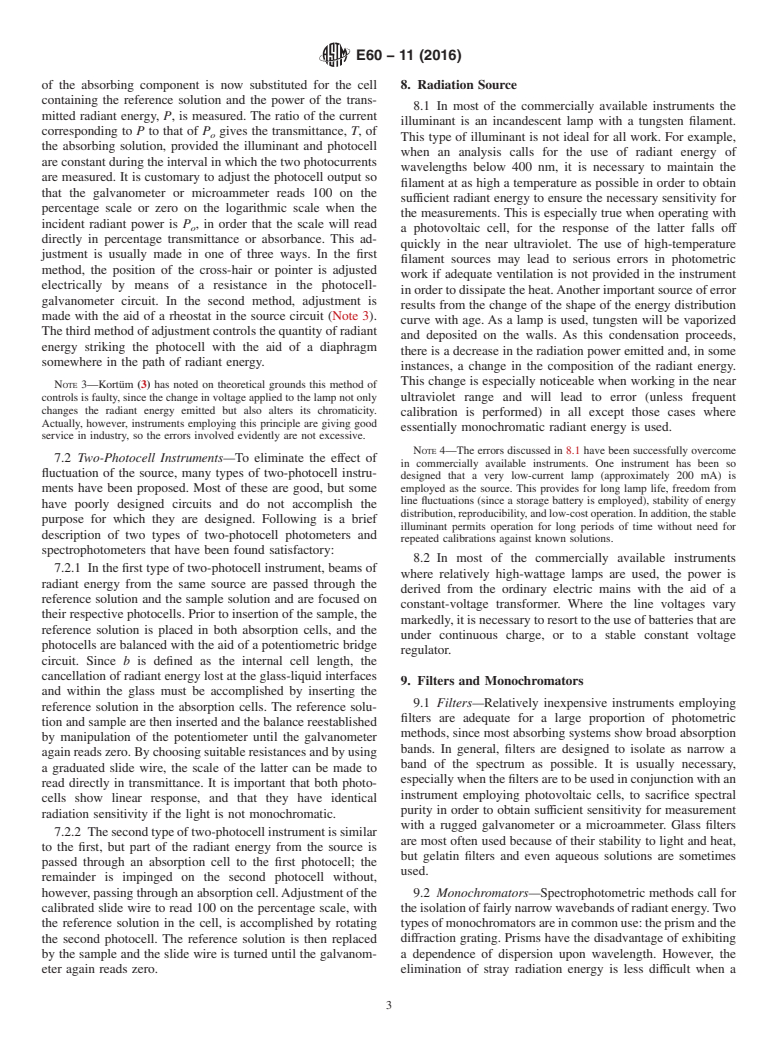
3.3.6 reference solution—photometric readings consist of a and c. Theoretically, in the determination of a for an absorbing
comparison of the intensities of the radiant energy transmitted system, a single measurement at a given wavelength on a
bytheabsorbingsolutionandtheradiantenergytransmittedby solution of known concentration will suffice. However, it is
the solvent. Any solution to which the transmittance of the safer to use the average value obtained with three or more
absorbing solution of the substance being measured is com- concentrations, covering the range over which the determina-
pared shall be known as the reference solution. tionsarelikelytobemadeandmakingseveralreadingsateach
concentration. The validity of the Bouguer-Beer law for a
4. Reference to This Practice in Standards particular system can be tested by showing that a remains
constant when b and c are changed.
4.1 The inclusion of the following paragraph, or a suitable
equivalent, in any ASTM test method (preferably after the
APPARATUS
section on scope) shall constitute due notification that the
photometers, spectrophotometers, and photometric practice
6. General Requirements for Photometers and
prescribed in that test method are subject to the recommenda-
Spectrophotometers
tions set forth in this practice.
6.1 A photoelectric photometer consists essentially of the
“Photometers, Spectrophotometers, and Photometric
following:
Practice—Photometers, spectrophotometers, and photometric
NOTE 1—The choice of an instrument may naturally be based on price
practice prescribed in this test method shall conform toASTM
considerations, since there is no point in using a more elaborate (and,
Practice E60, Practice for Analysis of Metals, Ores, and
incidentally, more expensive) instrument than is necessary. In addition to
Related Materials by Spectrophotometry.
satisfactory performance from the purely physical standpoint, the instru-
ment should be compact, rugged enough to stand routine use, and not
5. Theory require too much manipulation. The scales should be easily read, and the
absorption cells should be easily removed and replaced, as the clearing,
5.1 Photoelectric photometry is based on Bouguer’s and
refilling, and placing of the cells in the instrument consume a major
Beer’s (or the Lambert-Beer) laws which are combined in the
portion of the time required. It is advantageous to have an instrument that
following expression: permits the use of cells of different depth (see Practice E275).
2abc
6.1.1 An illuminant (radiant energy source),
P 5 P 10
o
6.1.2 A device for selecting relatively monochromatic radi-
where:
ant energy (consisting of a diffraction grating or a prism with
P = transmitted radiant power,
selection slit, or a filter),
P = incident radiant power, or a quantity proportional to it,
o 6.1.3 One or more absorption cells to hold the sample,
as measured with pure solvent in the beam,
calibration, reagent blank, or reference solutions, and
a = absorptivity, a constant characteristic of the solution
6.1.4 An arrangement for photometric measurement of the
and the frequency of the incident radiant energy,
intensity of the transmitted radiant energy, consisting of one or
b = internal cell length (usually in centimetres) of the
more photocells or photosensitive tubes, and suitable devices
column of absorbing material, and
for measuring current or potential.
c = concentration of the absorbing substance, g/L.
6.2 Precision instruments that employ monochromators ca-
5.2 Transmittance, T, and absorbance, A, have the following
pable of supplying radiant energy of high purity at any chosen
values:
wavelength within their range are usually referred to as
T 5 P/P spectrophotometers. Instruments employing filters are known
o
A 5 log 1/T 5 log P /P
~ ! ~ !
as filter photometers or abridged spectrophotometers, and
10 10 o
usually isolate relatively broad bands of radiant energy. Fre-
where P and P have the values given in 5.1.
o
quently the absorption peak of the compound being measured
5.3 From the transposed form of the Bouguer-Beer
is relatively broad, and sufficient accuracy can be obtained
equation, A = abc, it is evident that at constant b, a plot of A
using a fairly broad band (10 nm to 75 nm) of radiant energy
versus cgivesastraightlineifBeer’slawisfollowed.Thisline
for the measurement (Note 2). Other times the absorption
will pass through the origin if the practice of cancelling out
peaksarenarrow,andradiantenergyofhighpurity(1nmto10
solvent reflections and absorption and other blanks is em-
nm) is required. This applies particularly if accurate values are
ployed.
to be obtained in those systems of measurement based on the
additive nature of absorbance values.
5.4 In photometry it is customary to make indirect compari-
son with solutions of known concentration by means of
NOTE 2—One nanometre (nm) equals one millimicron (mµ).
calibration curves or charts. When Beer’s law is obeyed and
when a satisfactory instrument is employed, it is possible to 7. Types of Photometers and Spectrophotometers
dispense with the curve or chart. Thus, from the transposed
7.1 Single-Photocell Instruments—In most single-photocell
form of the Bouguer-Beer law, c = A/ab, it is evident that once
instruments, the radiant energy passes from the monochroma-
a has been determined for any system, c can be obtained, since
tor or filter through the reference solution to a photocell. The
b is known and A can be measured.
photocurrent is measured by a galvanometer or a microamme-
5.5 The value for a can be obtained from the equation ter and its magnitude is a measure of the incident radiant
a = A/cb by substituting the measured value of A for a given b power, P .An identical absorption cell containing the solution
o
E60 − 11 (2016)
of the absorbing component is now substituted for the cell 8. Radiation Source
containing the reference solution and the power of the trans-
8.1 In most of the commercially available instruments the
mitted radiant energy, P, is measured. The ratio of the current
illuminant is an incandescent lamp with a tungsten filament.
corresponding to P to that of P gives the transmittance, T,of
o
This type of illuminant is not ideal for all work. For example,
the absorbing solution, provided the illuminant and photocell
when an analysis calls for the use of radiant energy of
are constant during the interval in which the two photocurrents
wavelengths below 400 nm, it is necessary to maintain the
are measured. It is customary to adjust the photocell output so
filament at as high a temperature as possible in order to obtain
that the galvanometer or microammeter reads 100 on the
sufficient radiant energy to ensure the necessary sensitivity for
percentage scale or zero on the logarithmic scale when the
the measurements. This is especially true when operating with
incident radiant power is P , in order that the scale will read
o
a photovoltaic cell, for the response of the latter falls off
directly in percentage transmittance or absorbance. This ad-
quickly in the near ultraviolet. The use of high-temperature
justment is usually made in one of three ways. In the first
filament sources may lead to serious errors in photometric
method, the position of the cross-hair or pointer is adjusted
work if adequate ventilation is not provided in the instrument
electrically by means of a resistance in the photocell-
inordertodissipatetheheat.Anotherimportantsourceoferror
galvanometer circuit. In the second method, adjustment is
results from the change of the shape of the energy distribution
made with the aid of a rheostat in the source circuit (Note 3).
curve with age. As a lamp is used, tungsten will be vaporized
The third method of adjustment controls the quantity of radiant
and deposited on the walls. As this condensation proceeds,
energy striking the photocell with the aid of a diaphragm
there is a decrease in the radiation power emitted and, in some
somewhere in the path of radiant energy.
instances, a change in the composition of the radiant energy.
This change is especially noticeable when working in the near
NOTE 3—Kortüm (3) has noted on theoretical grounds this method of
ultraviolet range and will lead to error (unless frequent
controls is faulty, since the change in voltage applied to the lamp not only
changes the radiant energy emitted but also alters its chromaticity.
calibration is performed) in all except those cases where
Actually, however, instruments employing this principle are giving good
essentially monochromatic radiant energy is used.
service in industry, so the errors involved evidently are not excessive.
NOTE 4—The errors discussed in 8.1 have been successfully overcome
7.2 Two-Photocell Instruments—To eliminate the effect of
in commercially available instruments. One instrument has been so
fluctuation of the source, many types of two-photocell instru-
designed that a very low-current lamp (approximately 200 mA) is
ments have been proposed. Most of these are good, but some employed as the source. This provides for long lamp life, freedom from
line fluctuations (since a storage battery is employed), stability of energy
have poorly designed circuits and do not accomplish the
distribution,reproducibility,andlow-costoperation.Inaddition,thestable
purpose for which they are designed. Following is a brief
illuminant permits operation for long periods of time without need for
description of two types of two-photocell photometers and
repeated calibrations against known solutions.
spectrophotometers that have been found satisfactory:
8.2 In most of the commercially available instruments
7.2.1 In the first type of two-photocell instrument, beams of
where relatively high-wattage lamps are used, the power is
radiant energy from the same source are passed through the
derived from the
...
This document is not an ASTM standard and is intended only to provide the user of an ASTM standard an indication of what changes have been made to the previous version. Because
it may not be technically possible to adequately depict all changes accurately, ASTM recommends that users consult prior editions as appropriate. In all cases only the current version
of the standard as published by ASTM is to be considered the official document.
Designation: E60 − 11 E60 − 11 (Reapproved 2016)
Standard Practice for
Analysis of Metals, Ores, and Related Materials by
Spectrophotometry
This standard is issued under the fixed designation E60; the number immediately following the designation indicates the year of original
adoption or, in the case of revision, the year of last revision. A number in parentheses indicates the year of last reapproval. A superscript
epsilon (´) indicates an editorial change since the last revision or reapproval.
This standard has been approved for use by agencies of the U.S. Department of Defense.
1. Scope
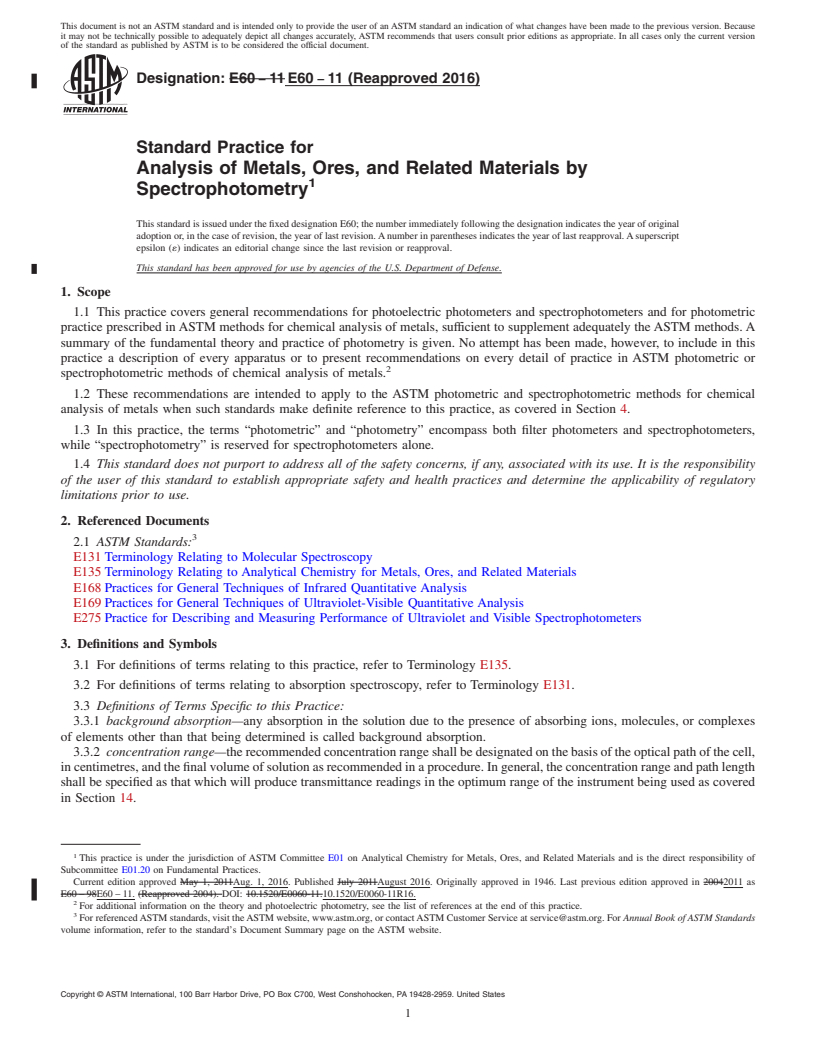
1.1 This practice covers general recommendations for photoelectric photometers and spectrophotometers and for photometric
practice prescribed in ASTM methods for chemical analysis of metals, sufficient to supplement adequately the ASTM methods. A
summary of the fundamental theory and practice of photometry is given. No attempt has been made, however, to include in this
practice a description of every apparatus or to present recommendations on every detail of practice in ASTM photometric or
spectrophotometric methods of chemical analysis of metals.
1.2 These recommendations are intended to apply to the ASTM photometric and spectrophotometric methods for chemical
analysis of metals when such standards make definite reference to this practice, as covered in Section 4.
1.3 In this practice, the terms “photometric” and “photometry” encompass both filter photometers and spectrophotometers,
while “spectrophotometry” is reserved for spectrophotometers alone.
1.4 This standard does not purport to address all of the safety concerns, if any, associated with its use. It is the responsibility
of the user of this standard to establish appropriate safety and health practices and determine the applicability of regulatory
limitations prior to use.
2. Referenced Documents
2.1 ASTM Standards:
E131 Terminology Relating to Molecular Spectroscopy
E135 Terminology Relating to Analytical Chemistry for Metals, Ores, and Related Materials
E168 Practices for General Techniques of Infrared Quantitative Analysis
E169 Practices for General Techniques of Ultraviolet-Visible Quantitative Analysis
E275 Practice for Describing and Measuring Performance of Ultraviolet and Visible Spectrophotometers
3. Definitions and Symbols
3.1 For definitions of terms relating to this practice, refer to Terminology E135.
3.2 For definitions of terms relating to absorption spectroscopy, refer to Terminology E131.
3.3 Definitions of Terms Specific to this Practice:
3.3.1 background absorption—any absorption in the solution due to the presence of absorbing ions, molecules, or complexes
of elements other than that being determined is called background absorption.
3.3.2 concentration range—the recommended concentration range shall be designated on the basis of the optical path of the cell,
in centimetres, and the final volume of solution as recommended in a procedure. In general, the concentration range and path length
shall be specified as that which will produce transmittance readings in the optimum range of the instrument being used as covered
in Section 14.
This practice is under the jurisdiction of ASTM Committee E01 on Analytical Chemistry for Metals, Ores, and Related Materials and is the direct responsibility of
Subcommittee E01.20 on Fundamental Practices.
Current edition approved May 1, 2011Aug. 1, 2016. Published July 2011August 2016. Originally approved in 1946. Last previous edition approved in 20042011 as
E60 – 98E60 – 11. (Reapproved 2004). DOI: 10.1520/E0060-11.10.1520/E0060-11R16.
For additional information on the theory and photoelectric photometry, see the list of references at the end of this practice.
For referenced ASTM standards, visit the ASTM website, www.astm.org, or contact ASTM Customer Service at service@astm.org. For Annual Book of ASTM Standards
volume information, refer to the standard’s Document Summary page on the ASTM website.
Copyright © ASTM International, 100 Barr Harbor Drive, PO Box C700, West Conshohocken, PA 19428-2959. United States
E60 − 11 (2016)
3.3.3 initial setting—the initial setting is the photometric reading (usually 100 on the percentage scale or zero on the logarithmic
scale) to which the instrument is adjusted with the reference solution in the absorption cell. The scale will then read directly in
percentage transmittance or in absorbance.
3.3.4 photometric reading—the term “photometric reading” refers to the scale reading of the instrument being used. Available
instruments have scales calibrated in transmittance, T,(1) or absorbance, A,(2) (see 5.2), or even arbitrary units proportional to
transmittance or absorbance.
3.3.5 reagent blank—the reagent blank determination yields a value for the apparent concentration of the element sought, which
is due only to the reagents used. It reflects both the amount of the element sought present as an impurity in the reagents, and the
effect of interfering species.
3.3.6 reference solution—photometric readings consist of a comparison of the intensities of the radiant energy transmitted by
the absorbing solution and the radiant energy transmitted by the solvent. Any solution to which the transmittance of the absorbing
solution of the substance being measured is compared shall be known as the reference solution.
4. Reference to This Practice in Standards
4.1 The inclusion of the following paragraph, or a suitable equivalent, in any ASTM test method (preferably after the section
on scope) shall constitute due notification that the photometers, spectrophotometers, and photometric practice prescribed in that
test method are subject to the recommendations set forth in this practice.
“Photometers, Spectrophotometers, and Photometric Practice—Photometers, spectrophotometers, and photometric practice
prescribed in this test method shall conform to ASTM Practice E60, Practice for Analysis of Metals, Ores, and Related Materials
by Spectrophotometry.
5. Theory
5.1 Photoelectric photometry is based on Bouguer’s and Beer’s (or the Lambert-Beer) laws which are combined in the following
expression:
2abc
P 5 P 10
o
where:
P = transmitted radiant power,
P = incident radiant power, or a quantity proportional to it, as measured with pure solvent in the beam,
o
a = absorptivity, a constant characteristic of the solution and the frequency of the incident radiant energy,
b = internal cell length (usually in centimetres) of the column of absorbing material, and
c = concentration of the absorbing substance, g/L.
5.2 Transmittance, T, and absorbance, A, have the following values:
T 5 P/P
o
A 5 log 1/T 5 log P /P
~ ! ~ !
10 10 o
where P and P have the values given in 5.1.
o
5.3 From the transposed form of the Bouguer-Beer equation, A = abc, it is evident that at constant b, a plot of A versus c gives
a straight line if Beer’s law is followed. This line will pass through the origin if the usual practice of cancelling out solvent
reflections and absorption and other blanks is employed.
5.4 In photometry it is customary to make indirect comparison with solutions of known concentration by means of calibration
curves or charts. When Beer’s law is obeyed and when a satisfactory instrument is employed, it is possible to dispense with the
curve or chart. Thus, from the transposed form of the Bouguer-Beer law, c = A/ab, it is evident that once a has been determined
for any system, c can be obtained, since b is known and A can be measured.
5.5 The value for a can be obtained from the equation a = A/cb by substituting the measured value of A for a given b and c.
Theoretically, in the determination of a for an absorbing system, a single measurement at a given wavelength on a solution of
known concentration will suffice. Actually, however, However, it is safer to use the average value obtained with three or more
concentrations, covering the range over which the determinations are likely to be made and making several readings at each
concentration. The validity of the Bouguer-Beer law for a particular system can be tested by showing that a remains constant when
b and c are changed.
APPARATUS
6. General Requirements for Photometers and Spectrophotometers
6.1 A photoelectric photometer consists essentially of the following:
NOTE 1—The choice of an instrument may naturally be based on price considerations, since there is no point in using a more elaborate (and,
The boldface numbers in parentheses refer to a list of references at the end of this standard.
E60 − 11 (2016)
incidentally, more expensive) instrument than is necessary. In addition to satisfactory performance from the purely physical standpoint, the instrument
should be compact, rugged enough to stand routine use, and not require too much manipulation. The scales should be easily read, and the absorption cells
should be easily removed and replaced, as the clearing, refilling, and placing of the cells in the instrument consume a major portion of the time required.
It is advantageous to have an instrument that permits the use of cells of different depth (see Practice E275).
6.1.1 An illuminant (radiant energy source),
6.1.2 A device for selecting relatively monochromatic radiant energy (consisting of a diffraction grating or a prism with
selection slit, or a filter),
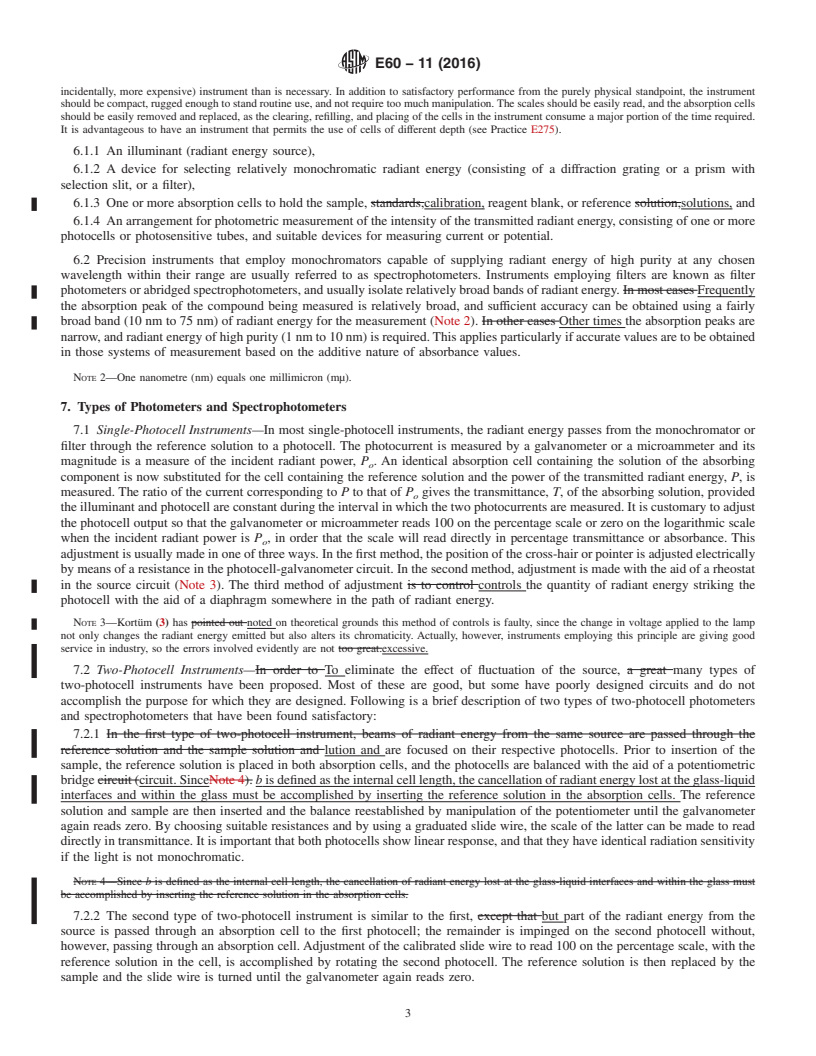
6.1.3 One or more absorption cells to hold the sample, standards,calibration, reagent blank, or reference solution,solutions, and
6.1.4 An arrangement for photometric measurement of the intensity of the transmitted radiant energy, consisting of one or more
photocells or photosensitive tubes, and suitable devices for measuring current or potential.
6.2 Precision instruments that employ monochromators capable of supplying radiant energy of high purity at any chosen
wavelength within their range are usually referred to as spectrophotometers. Instruments employing filters are known as filter
photometers or abridged spectrophotometers, and usually isolate relatively broad bands of radiant energy. In most cases Frequently
the absorption peak of the compound being measured is relatively broad, and sufficient accuracy can be obtained using a fairly
broad band (10 nm to 75 nm) of radiant energy for the measurement (Note 2). In other cases Other times the absorption peaks are
narrow, and radiant energy of high purity (1 nm to 10 nm) is required. This applies particularly if accurate values are to be obtained
in those systems of measurement based on the additive nature of absorbance values.
NOTE 2—One nanometre (nm) equals one millimicron (mμ).
7. Types of Photometers and Spectrophotometers
7.1 Single-Photocell Instruments—In most single-photocell instruments, the radiant energy passes from the monochromator or
filter through the reference solution to a photocell. The photocurrent is measured by a galvanometer or a microammeter and its
magnitude is a measure of the incident radiant power, P . An identical absorption cell containing the solution of the absorbing
o
component is now substituted for the cell containing the reference solution and the power of the transmitted radiant energy, P, is
measured. The ratio of the current corresponding to P to that of P gives the transmittance, T, of the absorbing solution, provided
o
the illuminant and photocell are constant during the interval in which the two photocurrents are measured. It is customary to adjust
the photocell output so that the galvanometer or microammeter reads 100 on the percentage scale or zero on the logarithmic scale
when the incident radiant power is P , in order that the scale will read directly in percentage transmittance or absorbance. This
o
adjustment is usually made in one of three ways. In the first method, the position of the cross-hair or pointer is adjusted electrically
by means of a resistance in the photocell-galvanometer circuit. In the second method, adjustment is made with the aid of a rheostat
in the source circuit (Note 3). The third method of adjustment is to control controls the quantity of radiant energy striking the
photocell with the aid of a diaphragm somewhere in the path of radiant energy.
NOTE 3—Kortüm (3) has pointed out noted on theoretical grounds this method of controls is faulty, since the change in voltage applied to the lamp
not only changes the radiant energy emitted but also alters its chromaticity. Actually, however, instruments employing this principle are giving good
service in industry, so the errors involved evidently are not too great.excessive.
7.2 Two-Photocell Instruments—In order to To eliminate the effect of fluctuation of the source, a great many types of
two-photocell instruments have been proposed. Most of these are good, but some have poorly designed circuits and do not
accomplish the purpose for which they are designed. Following is a brief description of two types of two-photocell photometers
and spectrophotometers that have been found satisfactory:
7.2.1 In the first type of two-photocell instrument, beams of radiant energy from the same source are passed through the
reference solution and the sample solution and lution and are focused on their respective photocells. Prior to insertion of the
sample, the reference solution is placed in both absorption cells, and the photocells are balanced with the aid of a potentiometric
bridge circuit (circuit. SinceNote 4). b is defined as the internal cell length, the cancellation of radiant energy lost at the glass-liquid
interfaces and within the glass must be accomplished by inserting the reference solution in the absorption cells. The reference
solution and sample are then inserted and the balance reestablished by manipulation of the potentiometer until the galvanometer
again reads zero. By choosing suitable resistances and by using a graduated slide wire, the scale of the latter can be made to read
directly in transmittance. It is important that both photocells show linear response, and that they have identical radiation sensitivity
if the light is not monochromatic.
NOTE 4—Since b is defined as the internal cell length, the cancellation of radiant energy lost at the glass-liquid interfaces and within the glass must
be accomplished by inserting the reference solution in the absorption cells.
7.2.2 The second type of two-photocell instrument is similar to the first, except that but part of the radiant energy from the
source is passed through an absorption cell to the first photocell; the remainder is impinged on the second ph
...
Questions, Comments and Discussion
Ask us and Technical Secretary will try to provide an answer. You can facilitate discussion about the standard in here.