


ASTM B367-13(2017)
(Specification)Standard Specification for Titanium and Titanium Alloy Castings
Standard Specification for Titanium and Titanium Alloy Castings
ABSTRACT
This specification covers the standard requirements for titanium and titanium alloy castings intended for general corrosion resistant and industrial applications. Materials for this specification shall be melted by conventional processes used for reactive metals such as consumable electrode and induction-slag, plasma arc, induction-skull, and electron beam melting processes. The materials shall undergo chemical, pour, and product analysis to determine the chemical composition which shall conform to the requirements for nitrogen, carbon, hydrogen, iron, oxygen, aluminum, vanadium, tin, ruthenium, palladium, cobalt, molybdenum, chromium, nickel, niobium, zirconium, silicon, and titanium. All castings shall be supplied in the as-cast condition except when post-weld heat treatment is required wherein it shall consist of a stress relief performed at certain temperatures. The surface of the castings shall be free of adhering mold material, scale, cracks, and hot tears as determined by visual inspection.
SCOPE
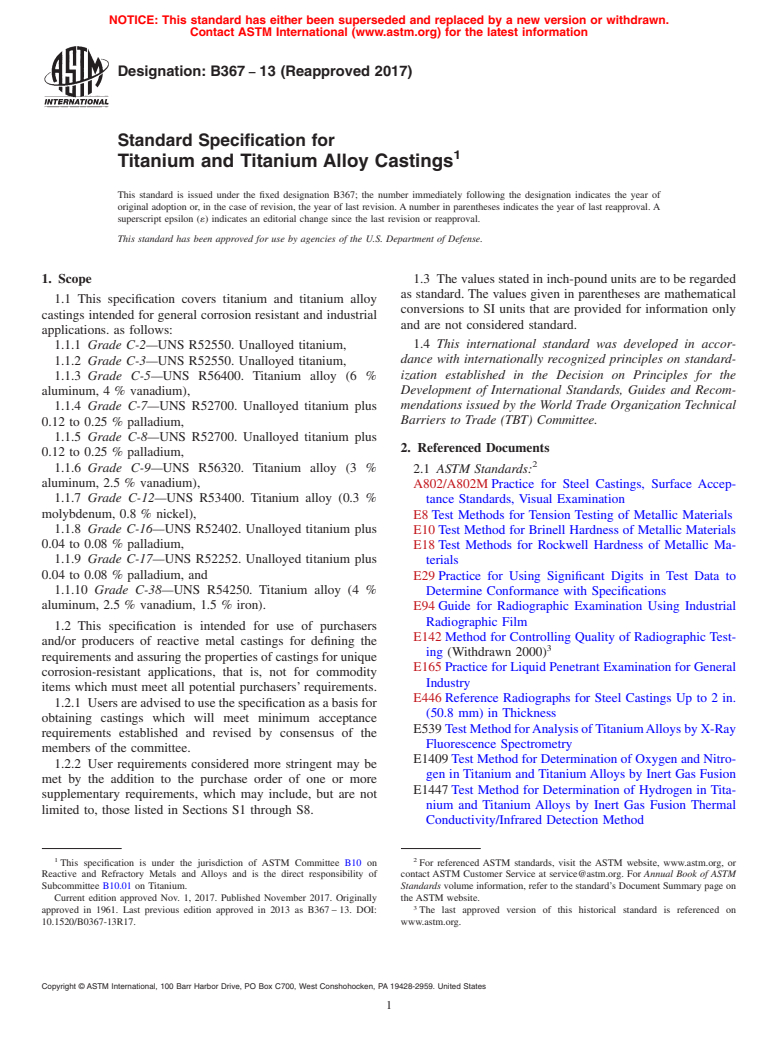
1.1 This specification covers titanium and titanium alloy castings intended for general corrosion resistant and industrial applications. as follows:
1.1.1 Grade C-2—UNS R52550. Unalloyed titanium,
1.1.2 Grade C-3—UNS R52550. Unalloyed titanium,
1.1.3 Grade C-5—UNS R56400. Titanium alloy (6 % aluminum, 4 % vanadium),
1.1.4 Grade C-7—UNS R52700. Unalloyed titanium plus 0.12 to 0.25 % palladium,
1.1.5 Grade C-8—UNS R52700. Unalloyed titanium plus 0.12 to 0.25 % palladium,
1.1.6 Grade C-9—UNS R56320. Titanium alloy (3 % aluminum, 2.5 % vanadium),
1.1.7 Grade C-12—UNS R53400. Titanium alloy (0.3 % molybdenum, 0.8 % nickel),
1.1.8 Grade C-16—UNS R52402. Unalloyed titanium plus 0.04 to 0.08 % palladium,
1.1.9 Grade C-17—UNS R52252. Unalloyed titanium plus 0.04 to 0.08 % palladium, and
1.1.10 Grade C-38—UNS R54250. Titanium alloy (4 % aluminum, 2.5 % vanadium, 1.5 % iron).
1.2 This specification is intended for use of purchasers and/or producers of reactive metal castings for defining the requirements and assuring the properties of castings for unique corrosion-resistant applications, that is, not for commodity items which must meet all potential purchasers’ requirements.
1.2.1 Users are advised to use the specification as a basis for obtaining castings which will meet minimum acceptance requirements established and revised by consensus of the members of the committee.
1.2.2 User requirements considered more stringent may be met by the addition to the purchase order of one or more supplementary requirements, which may include, but are not limited to, those listed in Sections S1 through S8.
1.3 The values stated in inch-pound units are to be regarded as standard. The values given in parentheses are mathematical conversions to SI units that are provided for information only and are not considered standard.
1.4 This international standard was developed in accordance with internationally recognized principles on standardization established in the Decision on Principles for the Development of International Standards, Guides and Recommendations issued by the World Trade Organization Technical Barriers to Trade (TBT) Committee.
General Information
Buy Standard
Standards Content (Sample)
NOTICE: This standard has either been superseded and replaced by a new version or withdrawn.
Contact ASTM International (www.astm.org) for the latest information
Designation:B367 −13 (Reapproved 2017)
Standard Specification for
Titanium and Titanium Alloy Castings
This standard is issued under the fixed designation B367; the number immediately following the designation indicates the year of
original adoption or, in the case of revision, the year of last revision. A number in parentheses indicates the year of last reapproval. A
superscript epsilon (´) indicates an editorial change since the last revision or reapproval.
This standard has been approved for use by agencies of the U.S. Department of Defense.
1. Scope 1.3 The values stated in inch-pound units are to be regarded
as standard. The values given in parentheses are mathematical
1.1 This specification covers titanium and titanium alloy
conversions to SI units that are provided for information only
castings intended for general corrosion resistant and industrial
and are not considered standard.
applications. as follows:
1.4 This international standard was developed in accor-
1.1.1 Grade C-2—UNS R52550. Unalloyed titanium,
dance with internationally recognized principles on standard-
1.1.2 Grade C-3—UNS R52550. Unalloyed titanium,
ization established in the Decision on Principles for the
1.1.3 Grade C-5—UNS R56400. Titanium alloy (6 %
Development of International Standards, Guides and Recom-
aluminum, 4 % vanadium),
mendations issued by the World Trade Organization Technical
1.1.4 Grade C-7—UNS R52700. Unalloyed titanium plus
Barriers to Trade (TBT) Committee.
0.12 to 0.25 % palladium,
1.1.5 Grade C-8—UNS R52700. Unalloyed titanium plus
2. Referenced Documents
0.12 to 0.25 % palladium,
1.1.6 Grade C-9—UNS R56320. Titanium alloy (3 % 2.1 ASTM Standards:
aluminum, 2.5 % vanadium),
A802/A802M Practice for Steel Castings, Surface Accep-
1.1.7 Grade C-12—UNS R53400. Titanium alloy (0.3 % tance Standards, Visual Examination
molybdenum, 0.8 % nickel),
E8 Test Methods for Tension Testing of Metallic Materials
1.1.8 Grade C-16—UNS R52402. Unalloyed titanium plus E10 Test Method for Brinell Hardness of Metallic Materials
0.04 to 0.08 % palladium,
E18 Test Methods for Rockwell Hardness of Metallic Ma-
1.1.9 Grade C-17—UNS R52252. Unalloyed titanium plus terials
0.04 to 0.08 % palladium, and
E29 Practice for Using Significant Digits in Test Data to
1.1.10 Grade C-38—UNS R54250. Titanium alloy (4 % Determine Conformance with Specifications
aluminum, 2.5 % vanadium, 1.5 % iron).
E94 Guide for Radiographic Examination Using Industrial
Radiographic Film
1.2 This specification is intended for use of purchasers
E142 Method for Controlling Quality of Radiographic Test-
and/or producers of reactive metal castings for defining the
ing (Withdrawn 2000)
requirements and assuring the properties of castings for unique
E165 Practice for Liquid Penetrant Examination for General
corrosion-resistant applications, that is, not for commodity
Industry
items which must meet all potential purchasers’ requirements.
E446 Reference Radiographs for Steel Castings Up to 2 in.
1.2.1 Usersareadvisedtousethespecificationasabasisfor
(50.8 mm) in Thickness
obtaining castings which will meet minimum acceptance
E539 TestMethodforAnalysisofTitaniumAlloysbyX-Ray
requirements established and revised by consensus of the
Fluorescence Spectrometry
members of the committee.
E1409 Test Method for Determination of Oxygen and Nitro-
1.2.2 User requirements considered more stringent may be
gen in Titanium and TitaniumAlloys by Inert Gas Fusion
met by the addition to the purchase order of one or more
E1447 Test Method for Determination of Hydrogen in Tita-
supplementary requirements, which may include, but are not
nium and Titanium Alloys by Inert Gas Fusion Thermal
limited to, those listed in Sections S1 through S8.
Conductivity/Infrared Detection Method
1 2
This specification is under the jurisdiction of ASTM Committee B10 on For referenced ASTM standards, visit the ASTM website, www.astm.org, or
Reactive and Refractory Metals and Alloys and is the direct responsibility of contact ASTM Customer Service at service@astm.org. For Annual Book of ASTM
Subcommittee B10.01 on Titanium. Standards volume information, refer to the standard’s Document Summary page on
Current edition approved Nov. 1, 2017. Published November 2017. Originally the ASTM website.
approved in 1961. Last previous edition approved in 2013 as B367 – 13. DOI: The last approved version of this historical standard is referenced on
10.1520/B0367-13R17. www.astm.org.
Copyright © ASTM International, 100 Barr Harbor Drive, PO Box C700, West Conshohocken, PA 19428-2959. United States
B367−13 (2017)
E1941 Test Method for Determination of Carbon in Refrac- 6.3 Product Analysis—Product analysis tolerances do not
tory and Reactive Metals andTheirAlloys by Combustion broaden the specified heat analysis requirements, but cover
Analysis
variations between laboratories in the measurement of chemi-
E2371 Test Method for Analysis of Titanium and Titanium
cal content. The producer shall not ship material which is
Alloys by Direct Current Plasma and Inductively Coupled
outside the limits specified in Table 1 for the applicable grade.
Plasma Atomic Emission Spectrometry (Performance-
Product analysis limits shall be as specified in Table 2.
Based Test Methodology)
6.4 Sampling—Samples for chemical analysis may be made
E2626 Guide for Spectrometric Analysis of Reactive and
by the purchaser on a representative casting from any lot. Due
Refractory Metals (Withdrawn 2017)
to the possibility of oxygen or other interstitial contamination,
3. Terminology
samples for oxygen, carbon, hydrogen, and nitrogen analysis
shall be taken no closer than ⁄4 in. (6.3 mm) to a cast surface
3.1 Definitions of Terms Specific to This Standard:
except that castings too thin for this shall be analyzed on
3.1.1 lot, n—shall consist of all castings of the same design
representative material. The chemical composition determined
produced from the same pour.
shall conform to the analysis in Table 1 within the check
3.1.2 pour, n—shallconsistofallmaterialmeltedandcastat
analysis variations shown in Table 2 or shall be subject to
one time.
rejection by the purchaser.
4. Ordering Information
7. Heat Treatment
4.1 Orders for castings to this specification shall include the
following as required, to describe the requirements adequately:
7.1 Unless otherwise specified in the contract, all castings
4.1.1 Description of the castings by pattern number or
willbesuppliedintheas-castconditionexceptwhenpost-weld
drawing. Dimensional tolerances shall be included on the
heat treatment is required.
casting drawing,
7.2 Ifpost-weldheattreatmentisrequired,itshallconsistof
4.1.2 Quantity,
4.1.3 Grade designation (see Table 1), a stress relief performed at 1075 6 25°F (580 6 14°C) for
4.1.4 Options in the specification, and Grades C-2, C-3, C-7, C-8, C-12, C-16 and C-17, and 1200 6
4.1.5 Supplementary requirements desired, including the 25°F (650 6 14°C) for Grades C-5, C-6, C-9, C-18, and C-38.
standards of acceptance.
Time at temperature shall be a minimum of ⁄2 h plus an
additional ⁄2 h at temperature per inch of thickness for section
5. Materials and Manufacture
sizes greater than 1 in. (25 mm). After heat treatment, the
5.1 Materials for this specification shall be melted by
castings should be cooled in air or in the furnace to ambient
conventional processes used for reactive metals. Typical meth-
temperature unless otherwise agreed upon between the pur-
ods include the consumable electrode and induction-slag,
chaser and producer.
plasma arc, induction-skull, and electron beam melting pro-
cesses.
8. Methods of Chemical Analysis
6. Chemical Composition
8.1 The chemical analysis shall normally be conducted
using theASTM standard test methods referenced in2.1. Other
6.1 Pour Analysis—An analysis of each pour shall be made
industry standard methods may be used where the ASTM test
by the producer from a sample such as a casting or test bar that
methods in 2.1 do not adequately cover the elements in the
is representative of the pour. The chemical composition deter-
material or by agreement between the producer and purchaser.
mined shall conform to the requirements specified for the
Alternate techniques are discussed in Guide E2626.
relevant grade in Table 1.
6.1.1 The elements listed in Table 1 are intentional alloy
additions or elements which are inherent to the manufacture of 9. Workmanship, Finish, and Appearance
titanium sponge, ingot or mill product.
9.1 All castings shall be made in a workman-like manner
6.1.1.1 Elements other than those listed in Table 1 are
and shall conform to the dimensions in drawings furnished by
deemed to be capable of occurring in the grades listed in Table
the purchaser before manufacturing is started. If the pattern is
1 by and only by way of unregulated or unanalyzed scrap
supplied by the purchaser, the dimensions of the casting shall
additions to the ingot melt. Therefore product analysis for
be as predicted by the pattern.
elements not listed in Table 1 shall not be required unless
specified and shall be considered to be in excess of the intent
9.2 The surface of the casting shall be free of adhering mold
of this specification.
material, scale, cracks, and hot tears as determined by visual
6.1.2 Elements intentionally added to the melt must be
examination.Othersurfacediscontinuitiesshallmeetthevisual
identified, analyzed, and reported in the chemical analysis.
acceptance standards specified in the order. Practice A802/
A802M or other visual standards may be used to define
6.2 When agreed upon by the producer and the purchaser
acceptable surface discontinuities and finish. Unacceptable
and requested by the purchaser in his written purchase order,
surface discontinuities shall be removed and their removal
chemical analysis shall be completed for specific residual
elements not listed in this specification. verified by visual examination of the resultant cavities.
B367−13 (2017)
TABLE 1 Chemical Requirements
A,B,C,D,E
Composition, Weight Percent
Other Other
Oxygen Iron Elements, Elements,
UNS Carbon, range Nitrogen, Hydrogen, range max. max.
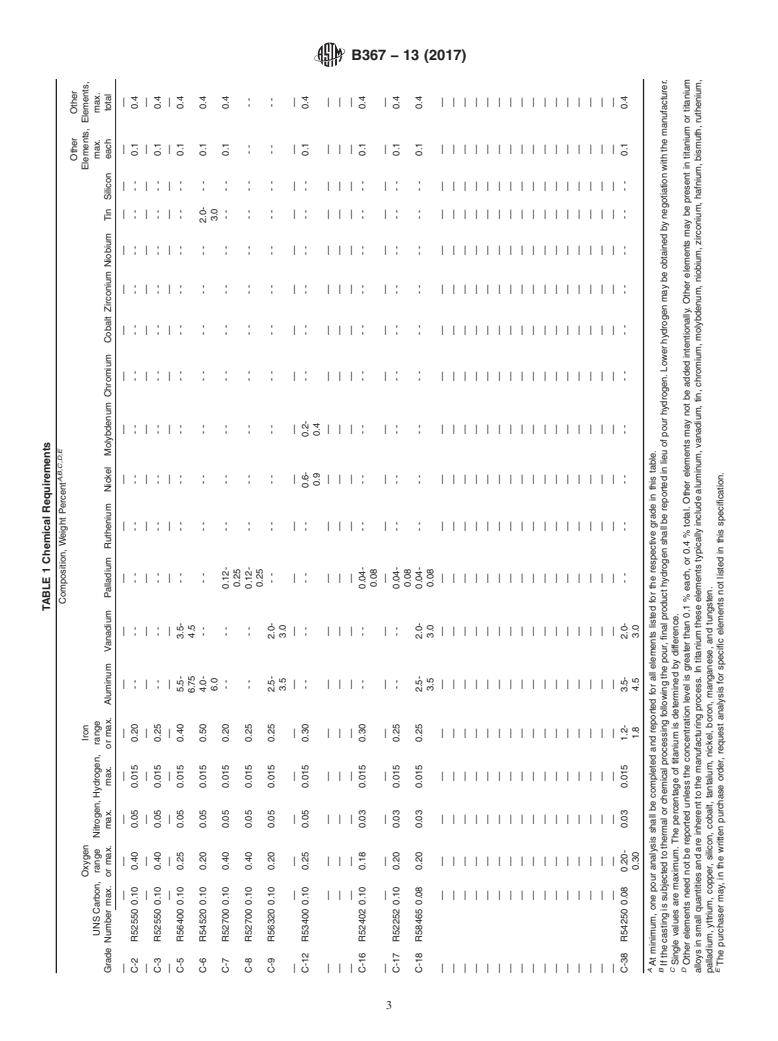
Grade Number max. or max. max. max. or max. Aluminum Vanadium Palladium Ruthenium Nickel Molybdenum Chromium Cobalt Zirconium Niobium Tin Silicon each total
— — — — — — ——— — — —— — — — —— — —
C-2 R52550 0.10 0.40 0.05 0.015 0.20 - - - - - - - - - - - - - - - - - - - - - - - - 0.1 0.4
— — — — — — ——— — — —— — — — —— — —
C-3 R52550 0.10 0.40 0.05 0.015 0.25 - - - - - - - - - - - - - - - - - - - - - - - - 0.1 0.4
— — — — — — ——— — — —— — — — —— — —
C-5 R56400 0.10 0.25 0.05 0.015 0.40 5.5- 3.5- -- -- -- -- -- -- -- -- -- -- 0.1 0.4
6.75 4.5
C-6 R54520 0.10 0.20 0.05 0.015 0.50 4.0- -- -- -- -- -- -- -- -- -- 2.0- -- 0.1 0.4
6.0 3.0
C-7 R52700 0.10 0.40 0.05 0.015 0.20 - - - - 0.12- -- -- -- -- -- -- -- -- -- 0.1 0.4
0.25
C-8 R52700 0.10 0.40 0.05 0.015 0.25 - - - - 0.12- -- -- -- -- -- -- -- -- -- -- --
0.25
C-9 R56320 0.10 0.20 0.05 0.015 0.25 2.5- 2.0- -- -- -- -- -- -- -- -- -- -- -- --
3.5 3.0
— — — — — — ——— — — —— — — — —— — —
C-12 R53400 0.10 0.25 0.05 0.015 0.30 - - - - - - - - 0.6- 0.2- -- -- -- -- -- -- 0.1 0.4
0.9 0.4
— — — — — — ——— — — —— — — — —— — —
— — — — — — ——— — — —— — — — —— — —
— — — — — — ——— — — —— — — — —— — —
C-16 R52402 0.10 0.18 0.03 0.015 0.30 - - - - 0.04- -- -- -- -- -- -- -- -- -- 0.1 0.4
0.08
— — — — — — ——— — — —— — — — —— — —
C-17 R52252 0.10 0.20 0.03 0.015 0.25 - - - - 0.04- -- -- -- -- -- -- -- -- -- 0.1 0.4
0.08
C-18 R58465 0.08 0.20 0.03 0.015 0.25 2.5- 2.0- 0.04- -- -- -- -- -- -- -- -- -- 0.1 0.4
3.5 3.0 0.08
— — — — — — ——— — — —— — — — —— — —
— — — — — — ——— — — —— — — — —— — —
— — — — — — ——— — — —— — — — —— — —
— — — — — — ——— — — —— — — — —— — —
— — — — — — ——— — — —— — — — —— — —
— — — — — — ——— — — —— — — — —— — —
— — — — — — ——— — — —— — — — —— — —
— — — — — — ——— — — —— — — — —— — —
— — — — — — ——— — — —— — — — —— — —
— — — — — — ——— — — —— — — — —— — —
— — — — — — ——— — — —— — — — —— — —
— — — — — — ——— — — —— — — — —— — —
— — — — — — ——— — — —— — — — —— — —
— — — — — — ——— — — —— — — — —— — —
— — — — — — ——— — — —— — — — —— — —
— — — — — — ——— — — —— — — — —— — —
C-38 R54250 0.08 0.20- 0.03 0.015 1.2- 3.5- 2.0- -- -- -- -- -- -- -- -- -- -- 0.1 0.4
0.30 1.8 4.5 3.0
A
At minimum, one pour analysis shall be completed and reported for all elements listed for the respective grade in this table.
B
If the casting is subjected to thermal or chemical processing following the pour, final product hydrogen shall be reported in lieu of pour hydrogen. Lower hydrogen may be obtained by negotiation with the manufacturer.
C
Single values are maximum. The percentage of titanium is determined by difference.
D
Other elements need not be reported unless the concentration level is greater than 0.1 % each, or 0.4 % total. Other elements may not be added intentionally. Other elements may be present in titanium or titanium
alloys in small quantities and are inherent to the manufacturing process. In titanium these elements typically include aluminum, vanadium, tin, chromium, molybdenum, niobium, zirconium, hafnium, bismuth, ruthenium,
palladium, yttrium, copper, silicon, cobalt, tantalum, nickel, boron, manganese, and tungsten.
E
The purchaser may, in the written purchase order, request analysis for specific elements not listed in this specification.
B367−13 (2017)
TABLE 2 Check Analysis Tolerances
12. Inspection
Maximum or Range, Permissible Variation in
Element 12.1 The producer shall afford the purchaser’s inspector all
Weight % Check Analysis
reasonable facilities necessary to satisfy him that the material
Nitrogen 0.05 +0.02
is being produced and furnished in accordance with this
Carbon 0.10 +0.02
Hydrogen 0.015 +0.003
specification. Foundry inspection by the purchaser shall not
Iron 1.2–1.8 ±0.20
interfere unnecessarily with the producer’s operations.
Iron 0.50 +0.15
0.40 +0.08
12.2 If the results of any chemical or mechanical property
0.25 +0.05
test lot are not in conformance with the requirements of this
0.20 +0.04
Oxygen 0.25 +0.05 specification, the lot may be retested at the option of the
0.20 +0.04
producer. The frequency of the retest will double the initial
Aluminum 2.5–6.75 ±0.40
number of tests. If the results of the retest conform to the
Vanadium 2.0–4.5 ±0.15
Tin 2.0–3.0 ±0.15
specification, then the retest values will become the test values
Palladium 0.04–0.25 ±0.02
for certification. Only original conforming test results or the
Molybdenum 0.2–0.4 ±0.04
conforming retest results shall be reported to the purchaser. If
Nickel 0.3–0.9 ±0.05
Other (each) 0.10 +0.02 the results for the retest fail to conform to the specification, the
material will be rej
...
This document is not an ASTM standard and is intended only to provide the user of an ASTM standard an indication of what changes have been made to the previous version. Because
it may not be technically possible to adequately depict all changes accurately, ASTM recommends that users consult prior editions as appropriate. In all cases only the current version
of the standard as published by ASTM is to be considered the official document.
Designation: B367 − 13 B367 − 13 (Reapproved 2017)
Standard Specification for
Titanium and Titanium Alloy Castings
This standard is issued under the fixed designation B367; the number immediately following the designation indicates the year of
original adoption or, in the case of revision, the year of last revision. A number in parentheses indicates the year of last reapproval. A
superscript epsilon (´) indicates an editorial change since the last revision or reapproval.
This standard has been approved for use by agencies of the U.S. Department of Defense.
1. Scope*Scope
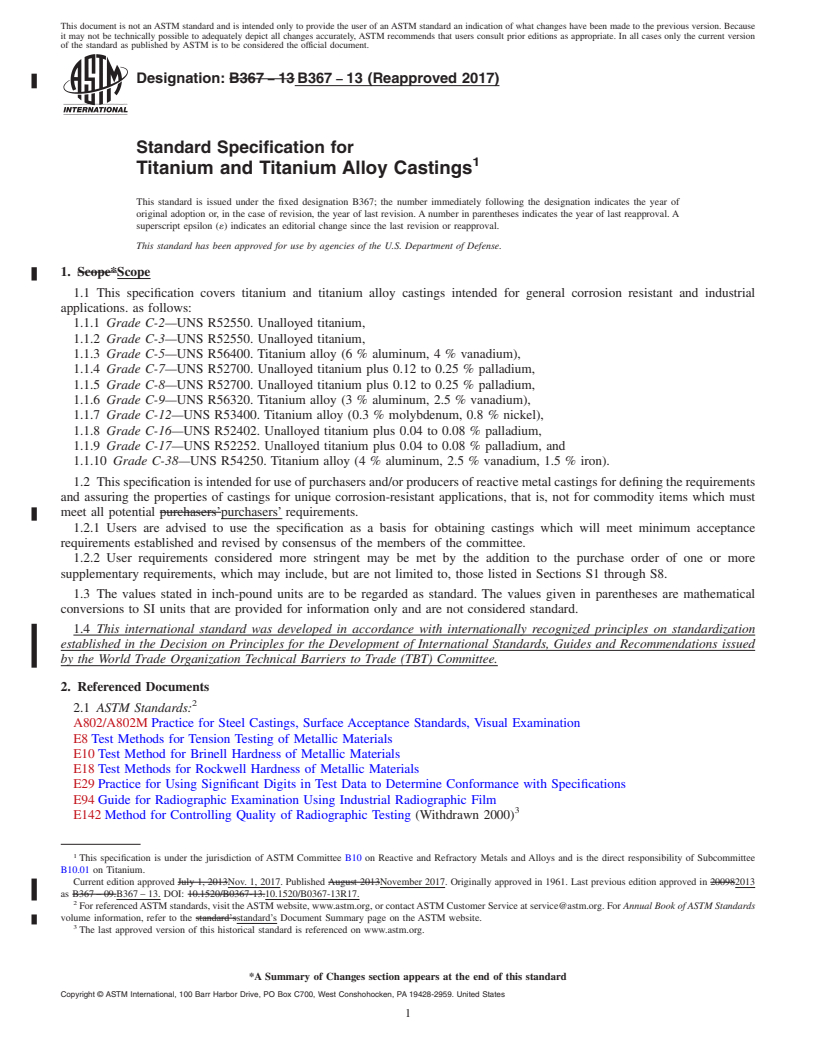
1.1 This specification covers titanium and titanium alloy castings intended for general corrosion resistant and industrial
applications. as follows:
1.1.1 Grade C-2—UNS R52550. Unalloyed titanium,
1.1.2 Grade C-3—UNS R52550. Unalloyed titanium,
1.1.3 Grade C-5—UNS R56400. Titanium alloy (6 % aluminum, 4 % vanadium),
1.1.4 Grade C-7—UNS R52700. Unalloyed titanium plus 0.12 to 0.25 % palladium,
1.1.5 Grade C-8—UNS R52700. Unalloyed titanium plus 0.12 to 0.25 % palladium,
1.1.6 Grade C-9—UNS R56320. Titanium alloy (3 % aluminum, 2.5 % vanadium),
1.1.7 Grade C-12—UNS R53400. Titanium alloy (0.3 % molybdenum, 0.8 % nickel),
1.1.8 Grade C-16—UNS R52402. Unalloyed titanium plus 0.04 to 0.08 % palladium,
1.1.9 Grade C-17—UNS R52252. Unalloyed titanium plus 0.04 to 0.08 % palladium, and
1.1.10 Grade C-38—UNS R54250. Titanium alloy (4 % aluminum, 2.5 % vanadium, 1.5 % iron).
1.2 This specification is intended for use of purchasers and/or producers of reactive metal castings for defining the requirements
and assuring the properties of castings for unique corrosion-resistant applications, that is, not for commodity items which must
meet all potential purchasers’purchasers’ requirements.
1.2.1 Users are advised to use the specification as a basis for obtaining castings which will meet minimum acceptance
requirements established and revised by consensus of the members of the committee.
1.2.2 User requirements considered more stringent may be met by the addition to the purchase order of one or more
supplementary requirements, which may include, but are not limited to, those listed in Sections S1 through S8.
1.3 The values stated in inch-pound units are to be regarded as standard. The values given in parentheses are mathematical
conversions to SI units that are provided for information only and are not considered standard.
1.4 This international standard was developed in accordance with internationally recognized principles on standardization
established in the Decision on Principles for the Development of International Standards, Guides and Recommendations issued
by the World Trade Organization Technical Barriers to Trade (TBT) Committee.
2. Referenced Documents
2.1 ASTM Standards:
A802/A802M Practice for Steel Castings, Surface Acceptance Standards, Visual Examination
E8 Test Methods for Tension Testing of Metallic Materials
E10 Test Method for Brinell Hardness of Metallic Materials
E18 Test Methods for Rockwell Hardness of Metallic Materials
E29 Practice for Using Significant Digits in Test Data to Determine Conformance with Specifications
E94 Guide for Radiographic Examination Using Industrial Radiographic Film
E142 Method for Controlling Quality of Radiographic Testing (Withdrawn 2000)
This specification is under the jurisdiction of ASTM Committee B10 on Reactive and Refractory Metals and Alloys and is the direct responsibility of Subcommittee
B10.01 on Titanium.
Current edition approved July 1, 2013Nov. 1, 2017. Published August 2013November 2017. Originally approved in 1961. Last previous edition approved in 200982013
as B367 – 09.B367 – 13. DOI: 10.1520/B0367-13.10.1520/B0367-13R17.
For referenced ASTM standards, visit the ASTM website, www.astm.org, or contact ASTM Customer Service at service@astm.org. For Annual Book of ASTM Standards
volume information, refer to the standard’sstandard’s Document Summary page on the ASTM website.
The last approved version of this historical standard is referenced on www.astm.org.
*A Summary of Changes section appears at the end of this standard
Copyright © ASTM International, 100 Barr Harbor Drive, PO Box C700, West Conshohocken, PA 19428-2959. United States
B367 − 13 (2017)
E165 Practice for Liquid Penetrant Examination for General Industry
E446 Reference Radiographs for Steel Castings Up to 2 in. (50.8 mm) in Thickness
E539 Test Method for Analysis of Titanium Alloys by X-Ray Fluorescence Spectrometry
E1409 Test Method for Determination of Oxygen and Nitrogen in Titanium and Titanium Alloys by Inert Gas Fusion
E1447 Test Method for Determination of Hydrogen in Titanium and Titanium Alloys by Inert Gas Fusion Thermal
Conductivity/Infrared Detection Method
E1941 Test Method for Determination of Carbon in Refractory and Reactive Metals and Their Alloys by Combustion Analysis
E2371 Test Method for Analysis of Titanium and Titanium Alloys by Direct Current Plasma and Inductively Coupled Plasma
Atomic Emission Spectrometry (Performance-Based Test Methodology)
E2626 Guide for Spectrometric Analysis of Reactive and Refractory Metals (Withdrawn 2017)
3. Terminology
3.1 Definitions of Terms Specific to This Standard:
3.1.1 lot, n—shall consist of all castings of the same design produced from the same pour.
3.1.2 pour, n—shall consist of all material melted and cast at one time.
4. Ordering Information
4.1 Orders for castings to this specification shall include the following as required, to describe the requirements adequately:
4.1.1 Description of the castings by pattern number or drawing. Dimensional tolerances shall be included on the casting
drawing,
4.1.2 Quantity,
4.1.3 Grade designation (see Table 1),
4.1.4 Options in the specification, and
4.1.5 Supplementary requirements desired, including the standards of acceptance.
5. Materials and Manufacture
5.1 Materials for this specification shall be melted by conventional processes used for reactive metals. Typical methods include
the consumable electrode and induction-slag, plasma arc, induction-skull, and electron beam melting processes.
6. Chemical Composition
6.1 Pour Analysis—An analysis of each pour shall be made by the producer from a sample such as a casting or test bar that is
representative of the pour. The chemical composition determined shall conform to the requirements specified for the relevant grade
in Table 1.
6.1.1 The elements listed in Table 1 are intentional alloy additions or elements which are inherent to the manufacture of titanium
sponge, ingot or mill product.
6.1.1.1 Elements other than those listed in Table 1 are deemed to be capable of occurring in the grades listed in Table 1 by and
only by way of unregulated or unanalyzed scrap additions to the ingot melt. Therefore product analysis for elements not listed in
Table 1 shall not be required unless specified and shall be considered to be in excess of the intent of this specification.
6.1.2 Elements intentionally added to the melt must be identified, analyzed, and reported in the chemical analysis.
6.2 When agreed upon by the producer and the purchaser and requested by the purchaser in his written purchase order, chemical
analysis shall be completed for specific residual elements not listed in this specification.
6.3 Product Analysis—Product analysis tolerances do not broaden the specified heat analysis requirements, but cover variations
between laboratories in the measurement of chemical content. The producer shall not ship material which is outside the limits
specified in Table 1 for the applicable grade. Product analysis limits shall be as specified in Table 2.
6.4 Sampling—Samples for chemical analysis may be made by the purchaser on a representative casting from any lot. Due to
the possibility of oxygen or other interstitial contamination, samples for oxygen, carbon, hydrogen, and nitrogen analysis shall be
taken no closer than ⁄4 in. (6.3 mm) to a cast surface except that castings too thin for this shall be analyzed on representative
material. The chemical composition determined shall conform to the analysis in Table 1 within the check analysis variations shown
in Table 2 or shall be subject to rejection by the purchaser.
7. Heat Treatment
7.1 Unless otherwise specified in the contract, all castings will be supplied in the as-cast condition except when post-weld heat
treatment is required.
7.2 If post-weld heat treatment is required, it shall consist of a stress relief performed at 1075 6 25°F (580 6 14°C) for Grades
C-2, C-3, C-7, C-8, C-12, C-16 and C-17, and 1200 6 25°F (650 6 14°C) for Grades C-5, C-6, C-9, C-18, and C-38. Time at
1 1
temperature shall be a minimum of ⁄2 h plus an additional ⁄2 h at temperature per inch of thickness for section sizes greater than
B367 − 13 (2017)
TABLE 1 Chemical Requirements
A,B,C,D,E
Composition, Weight Percent
Other Other
Oxygen Iron Elements, Elements,
UNS Carbon, range Nitrogen, Hydrogen, range max. max.
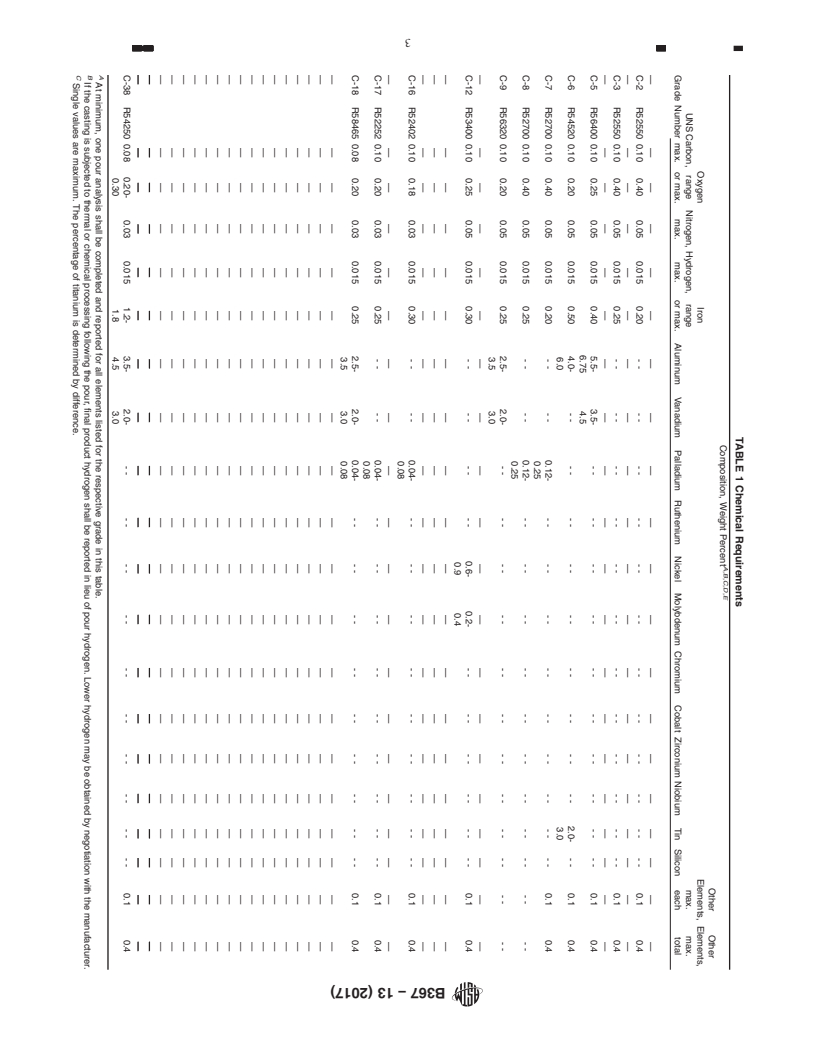
Grade Number max. or max. max. max. or max. Aluminum Vanadium Palladium Ruthenium Nickel Molybdenum Chromium Cobalt Zirconium Niobium Tin Silicon each total
— — — — — — — — — — — — — — — — — — — —
C-2 R52550 0.10 0.40 0.05 0.015 0.20 - - - - - - - - - - - - - - - - - - - - - - - - 0.1 0.4
— — — — — — — — — — — — — — — — — — — —
C-3 R52550 0.10 0.40 0.05 0.015 0.25 - - - - - - - - - - - - - - - - - - - - - - - - 0.1 0.4
— — — — — — — — — — — — — — — — — — — —
C-5 R56400 0.10 0.25 0.05 0.015 0.40 5.5- 3.5- - - - - - - - - - - - - - - - - - - - - 0.1 0.4
6.75 4.5
C-6 R54520 0.10 0.20 0.05 0.015 0.50 4.0- - - - - - - - - - - - - - - - - - - 2.0- - - 0.1 0.4
6.0 3.0
C-7 R52700 0.10 0.40 0.05 0.015 0.20 - - - - 0.12- - - - - - - - - - - - - - - - - - - 0.1 0.4
0.25
C-8 R52700 0.10 0.40 0.05 0.015 0.25 - - - - 0.12- - - - - - - - - - - - - - - - - - - - - - -
0.25
C-9 R56320 0.10 0.20 0.05 0.015 0.25 2.5- 2.0- - - - - - - - - - - - - - - - - - - - - - - - -
3.5 3.0
— — — — — — — — — — — — — — — — — — — —
C-12 R53400 0.10 0.25 0.05 0.015 0.30 - - - - - - - - 0.6- 0.2- - - - - - - - - - - - - 0.1 0.4
0.9 0.4
— — — — — — — — — — — — — — — — — — — —
— — — — — — — — — — — — — — — — — — — —
— — — — — — — — — — — — — — — — — — — —
C-16 R52402 0.10 0.18 0.03 0.015 0.30 - - - - 0.04- - - - - - - - - - - - - - - - - - - 0.1 0.4
0.08
— — — — — — — — — — — — — — — — — — — —
C-17 R52252 0.10 0.20 0.03 0.015 0.25 - - - - 0.04- - - - - - - - - - - - - - - - - - - 0.1 0.4
0.08
C-18 R58465 0.08 0.20 0.03 0.015 0.25 2.5- 2.0- 0.04- - - - - - - - - - - - - - - - - - - 0.1 0.4
3.5 3.0 0.08
— — — — — — — — — — — — — — — — — — — —
— — — — — — — — — — — — — — — — — — — —
— — — — — — — — — — — — — — — — — — — —
— — — — — — — — — — — — — — — — — — — —
— — — — — — — — — — — — — — — — — — — —
— — — — — — — — — — — — — — — — — — — —
— — — — — — — — — — — — — — — — — — — —
— — — — — — — — — — — — — — — — — — — —
— — — — — — — — — — — — — — — — — — — —
— — — — — — — — — — — — — — — — — — — —
— — — — — — — — — — — — — — — — — — — —
— — — — — — — — — — — — — — — — — — — —
— — — — — — — — — — — — — — — — — — — —
— — — — — — — — — — — — — — — — — — — —
— — — — — — — — — — — — — — — — — — — —
— — — — — — — — — — — — — — — — — — — —
— — — — — — — — — — — — — — — — — — — —
— — — — — — — — — — — — — — — — — — — —
C-38 R54250 0.08 0.20- 0.03 0.015 1.2- 3.5- 2.0- - - - - - - - - - - - - - - - - - - - - 0.1 0.4
0.30 1.8 4.5 3.0
A
At minimum, one pour analysis shall be completed and reported for all elements listed for the respective grade in this table.
B
If the casting is subjected to thermal or chemical processing following the pour, final product hydrogen shall be reported in lieu of pour hydrogen. Lower hydrogen may be obtained by negotiation with the manufacturer.
C
Single values are maximum. The percentage of titanium is determined by difference.
B367 − 13 (2017)
D
Other elements need not be reported unless the concentration level is greater than 0.1 % each, or 0.4 % total. Other elements may not be added intentionally. Other elements may be present in titanium or titanium
alloys in small quantities and are inherent to the manufacturing process. In titanium these elements typically include aluminum, vanadium, tin, chromium, molybdenum, niobium, zirconium, hafnium, bismuth, ruthenium,
palladium, yttrium, copper, silicon, cobalt, tantalum, nickel, boron, manganese, and tungsten.
E
The purchaser may, in the written purchase order, request analysis for specific elements not listed in this specification.
B367 − 13 (2017)
TABLE 2 Check Analysis Tolerances
Maximum or Range, Permissible Variation in
Element
Weight % Check Analysis
Nitrogen 0.05 +0.02
Carbon 0.10 +0.02
Hydrogen 0.015 +0.003
Iron 1.2–1.8 ±0.20
Iron 0.50 +0.15
0.40 +0.08
0.25 +0.05
0.20 +0.04
Oxygen 0.25 +0.05
0.20 +0.04
Aluminum 2.5–6.75 ±0.40
Vanadium 2.0–4.5 ±0.15
Tin 2.0–3.0 ±0.15
Palladium 0.04–0.25 ±0.02
Molybdenum 0.2–0.4 ±0.04
Nickel 0.3–0.9 ±0.05
Other (each) 0.10 +0.02
1 in. (25 mm). After heat treatment, the castings should be cooled in air or in the furnace to ambient temperature unless otherwise
agreed upon between the purchaser and producer.
8. Methods of Chemical Analysis
8.1 The chemical analysis shall normally be conducted using the ASTM standard test methods referenced in 2.1. Other industry
standard methods may be used where the ASTM test methods in 2.1 do not adequately cover the elements in the material or by
agreement between the producer and purchaser. Alternate techniques are discussed in Guide E2626.
9. Workmanship, Finish, and Appearance
9.1 All castings shall be made in a workman-like manner and shall conform to the dimensions in drawings furnished by the
purchaser before manufacturing is started. If the pattern is supplied by the purchaser, the dimensions of the casting shall be as
predicted by the pattern.
9.2 The surface of the casting shall be free of adhering mold material, scale, cracks, and hot tears as determined by visual
examination. Other surface discontinuities shall meet the visual acceptance standards specified in the order. Practice A802/A802M
or other visual standards may be used to define acceptable surface discontinuities and finish. Unacceptable surface discontinuities
shall be removed and their removal verified by visual examination of the resultant cavities.
10. Repair by Welding
10.1 If repairs are required, these shall be made using
...
Questions, Comments and Discussion
Ask us and Technical Secretary will try to provide an answer. You can facilitate discussion about the standard in here.