

ASTM B502/B502M-23
(Specification)Standard Specification for Aluminum-Clad Steel Core Wire for Use in Overhead Electrical Aluminum Conductors
General Information
- Abstract
ABSTRACT
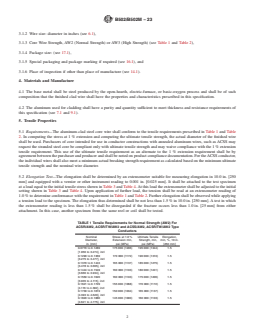
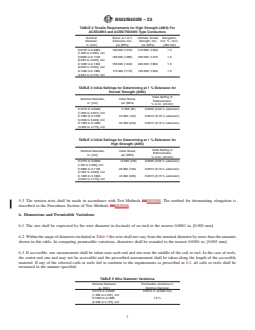
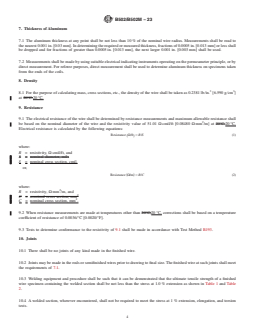
This specification covers round, aluminum-clad steel core wire used for mechanical reinforcement in the manufacture of aluminum conductors, aluminum-clad steel reinforced. The base metal shall be steel produced by the openhearth, electric-furnace, or basic-oxygen process and shall be of such composition that the finished clad wire shall have the properties and characteristics prescribed in this specification. The aluminum used for cladding shall have a purity and quantity sufficient to meet thickness and resistance requirements of this specification. The material shall conform to the required tensile properties such as stress, tensile strength, and elongation. The aluminum-clad steel core shall undergo elongation test, tension test, and torsion test. The elongation test shall be determined by an extensometer equipped with a vernier or other instrument reading. In the torsion test, a small tensile load shall be applied to the specimen during testing. The specimen shall be twisted by rotating one of the vises in the same direction until fracture occurs.
SCOPE
1.1 This specification covers round, aluminum-clad steel core wire with two designations of tensile strengths, AW2 (Normal Strength) and AW3 (High Strength).
1.2 The values stated in either SI units or inch-pound units are to be regarded separately as standard. The values stated in each system are not necessarily exact equivalents; therefore, to ensure conformance with the standard, each system shall be used independently of the other, and values from the two systems shall not be combined.
1.2.1 For conductor sizes designated by AWG, the requirements in SI units have been numerically converted from corresponding values stated or derived in inch-pound units. For conductor sizes designated by SI units only, the requirements are stated or derived in SI units.
1.3 This international standard was developed in accordance with internationally recognized principles on standardization established in the Decision on Principles for the Development of International Standards, Guides and Recommendations issued by the World Trade Organization Technical Barriers to Trade (TBT) Committee.
- Status
- Published
- Publication Date
- 30-Sep-2023
- Technical Committee
- B01 - Electrical Conductors
- Drafting Committee
- B01.06 - Bi-Metallic Conductors
Buy Documents

ASTM B502/B502M-23 - Standard Specification for Aluminum-Clad Steel Core Wire for Use in Overhead Electrical Aluminum Conductors
REDLINE ASTM B502/B502M-23 - Standard Specification for Aluminum-Clad Steel Core Wire for Use in Overhead Electrical Aluminum Conductors
Overview
ASTM B502/B502M-23 is the internationally recognized standard specification for round, aluminum-clad steel core wire used in overhead electrical aluminum conductors, including aluminum-clad steel reinforced (ACSR) and related types. Developed by ASTM, this specification establishes the requirements for both normal strength (AW2) and high strength (AW3) variants of aluminum-clad steel core wire, defining their mechanical and electrical properties for dependable performance in power transmission and distribution systems.
This standard is crucial for ensuring the quality, durability, and performance consistency of aluminum-clad steel core wires, which provide essential mechanical reinforcement while maintaining electrical conductivity in high-voltage power lines.
Key Topics
Essential Aspects Covered by ASTM B502/B502M-23:
- Tensile Strength: The standard specifies two strength designations-AW2 (Normal Strength) and AW3 (High Strength)-to meet varied application requirements in electrical conductors.
- Material Composition: Base steel is produced via open-hearth, electric-furnace, or basic-oxygen processes, with aluminum cladding meeting purity and thickness specifications for electrical and mechanical reliability.
- Dimensional Tolerances: Defines permissible diameter variations and minimum aluminum cladding thickness to ensure performance and compatibility with conductor assemblies.
- Mechanical Tests: Mandates elongation and torsion tests for evaluating ductility and resistance to mechanical stresses.
- Electrical Resistance: Specifies maximum allowable resistance values and measurement methods, ensuring optimal conductor efficiency.
- Joint and Finish Requirements: Restricts joints in finished wire, prescribes welding quality, and requires smooth, defect-free surface finishes.
- Packaging and Identification: Details requirements for coil/reel marking, packaging, and shipment to protect wire integrity.
Applications
Practical Uses of Aluminum-Clad Steel Core Wire:
Aluminum-clad steel core wire manufactured to ASTM B502/B502M-23 is widely used in:
- Overhead Power Transmission Lines: As the structural core in ACSR, ACSR/TW, ACSS, and ACSS/TW conductors, offering a combination of high tensile strength and corrosion resistance.
- Electrical Distribution Systems: Used where reliability and long service life in exposure to environmental elements are critical.
- Utility Grid Modernization: Supports upgrades or new installations that require advanced conductor materials for higher capacity and efficiency in electric grids.
By adhering to this standard, manufacturers and utilities ensure that overhead electrical conductors meet industry requirements for safety, longevity, and performance, minimizing the risk of power failures and maintenance costs.
Related Standards
For comprehensive compliance and integration, the following related ASTM standards and test methods should be referenced:
- ASTM B193 - Test Method for Resistivity of Electrical Conductor Materials
- ASTM E8/E8M - Test Methods for Tension Testing of Metallic Materials
- ASTM B502/B502M forms part of a suite of standards managed by ASTM Committee B01 on Electrical Conductors and Subcommittee B01.06 on Bi-Metallic Conductors.
Key terms and keywords: aluminum-clad steel core wire, ACSR, ACSS, overhead electrical conductors, ASTM B502/B502M, mechanical reinforcement, high strength wire, electrical resistance, utility conductor standards.
By following ASTM B502/B502M-23, organizations achieve consistency, quality assurance, and regulatory compliance for aluminum-clad steel core wires in critical electrical infrastructure projects worldwide.
Relations
- Effective Date
- 01-Oct-2023
- Effective Date
- 01-Jan-2024
- Effective Date
- 01-May-2022
- Effective Date
- 01-Oct-2023
- Effective Date
- 01-Oct-2023
- Effective Date
- 01-Oct-2023
- Effective Date
- 01-Oct-2023
- Effective Date
- 01-Oct-2023
- Effective Date
- 01-Oct-2023
- Effective Date
- 01-Oct-2023
- Referred By
ASTM B1006-17(2023) - Standard Specification for Electrical Overhead Conductor Code Word Names - Effective Date
- 01-Oct-2023
- Effective Date
- 01-Oct-2023
Buy Documents
ASTM B502/B502M-23 - Standard Specification for Aluminum-Clad Steel Core Wire for Use in Overhead Electrical Aluminum Conductors
REDLINE ASTM B502/B502M-23 - Standard Specification for Aluminum-Clad Steel Core Wire for Use in Overhead Electrical Aluminum Conductors
Get Certified
Connect with accredited certification bodies for this standard

IMQ S.p.A. (Certification)
Italian electrical product certification.

SLG Prüf- und Zertifizierungs GmbH
German testing and certification body.

UL Solutions
Global safety science company with testing, inspection and certification.
Sponsored listings
Frequently Asked Questions
ASTM B502/B502M-23 is a technical specification published by ASTM International. Its full title is "Standard Specification for Aluminum-Clad Steel Core Wire for Use in Overhead Electrical Aluminum Conductors". This standard covers: ABSTRACT This specification covers round, aluminum-clad steel core wire used for mechanical reinforcement in the manufacture of aluminum conductors, aluminum-clad steel reinforced. The base metal shall be steel produced by the openhearth, electric-furnace, or basic-oxygen process and shall be of such composition that the finished clad wire shall have the properties and characteristics prescribed in this specification. The aluminum used for cladding shall have a purity and quantity sufficient to meet thickness and resistance requirements of this specification. The material shall conform to the required tensile properties such as stress, tensile strength, and elongation. The aluminum-clad steel core shall undergo elongation test, tension test, and torsion test. The elongation test shall be determined by an extensometer equipped with a vernier or other instrument reading. In the torsion test, a small tensile load shall be applied to the specimen during testing. The specimen shall be twisted by rotating one of the vises in the same direction until fracture occurs. SCOPE 1.1 This specification covers round, aluminum-clad steel core wire with two designations of tensile strengths, AW2 (Normal Strength) and AW3 (High Strength). 1.2 The values stated in either SI units or inch-pound units are to be regarded separately as standard. The values stated in each system are not necessarily exact equivalents; therefore, to ensure conformance with the standard, each system shall be used independently of the other, and values from the two systems shall not be combined. 1.2.1 For conductor sizes designated by AWG, the requirements in SI units have been numerically converted from corresponding values stated or derived in inch-pound units. For conductor sizes designated by SI units only, the requirements are stated or derived in SI units. 1.3 This international standard was developed in accordance with internationally recognized principles on standardization established in the Decision on Principles for the Development of International Standards, Guides and Recommendations issued by the World Trade Organization Technical Barriers to Trade (TBT) Committee.
ABSTRACT This specification covers round, aluminum-clad steel core wire used for mechanical reinforcement in the manufacture of aluminum conductors, aluminum-clad steel reinforced. The base metal shall be steel produced by the openhearth, electric-furnace, or basic-oxygen process and shall be of such composition that the finished clad wire shall have the properties and characteristics prescribed in this specification. The aluminum used for cladding shall have a purity and quantity sufficient to meet thickness and resistance requirements of this specification. The material shall conform to the required tensile properties such as stress, tensile strength, and elongation. The aluminum-clad steel core shall undergo elongation test, tension test, and torsion test. The elongation test shall be determined by an extensometer equipped with a vernier or other instrument reading. In the torsion test, a small tensile load shall be applied to the specimen during testing. The specimen shall be twisted by rotating one of the vises in the same direction until fracture occurs. SCOPE 1.1 This specification covers round, aluminum-clad steel core wire with two designations of tensile strengths, AW2 (Normal Strength) and AW3 (High Strength). 1.2 The values stated in either SI units or inch-pound units are to be regarded separately as standard. The values stated in each system are not necessarily exact equivalents; therefore, to ensure conformance with the standard, each system shall be used independently of the other, and values from the two systems shall not be combined. 1.2.1 For conductor sizes designated by AWG, the requirements in SI units have been numerically converted from corresponding values stated or derived in inch-pound units. For conductor sizes designated by SI units only, the requirements are stated or derived in SI units. 1.3 This international standard was developed in accordance with internationally recognized principles on standardization established in the Decision on Principles for the Development of International Standards, Guides and Recommendations issued by the World Trade Organization Technical Barriers to Trade (TBT) Committee.
ASTM B502/B502M-23 is classified under the following ICS (International Classification for Standards) categories: 29.060.10 - Wires. The ICS classification helps identify the subject area and facilitates finding related standards.
ASTM B502/B502M-23 has the following relationships with other standards: It is inter standard links to ASTM B502/B502M-19, ASTM E8/E8M-24, ASTM E8/E8M-22, ASTM B779-22, ASTM B701/B701M-22e1, ASTM B856-22, ASTM B549-22, ASTM B857-22, ASTM B500/B500M-22, ASTM B401-22, ASTM B1006-17(2023), ASTM B711-22. Understanding these relationships helps ensure you are using the most current and applicable version of the standard.
ASTM B502/B502M-23 is available in PDF format for immediate download after purchase. The document can be added to your cart and obtained through the secure checkout process. Digital delivery ensures instant access to the complete standard document.
Standards Content (Sample)
This international standard was developed in accordance with internationally recognized principles on standardization established in the Decision on Principles for the
Development of International Standards, Guides and Recommendations issued by the World Trade Organization Technical Barriers to Trade (TBT) Committee.
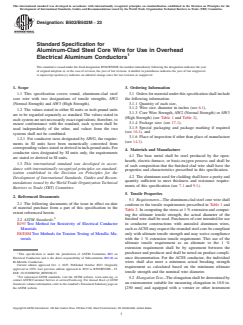
Designation: B502/B502M − 23
Standard Specification for
Aluminum-Clad Steel Core Wire for Use in Overhead
Electrical Aluminum Conductors
This standard is issued under the fixed designation B502/B502M; the number immediately following the designation indicates the year
of original adoption or, in the case of revision, the year of last revision. A number in parentheses indicates the year of last reapproval.
A superscript epsilon (´) indicates an editorial change since the last revision or reapproval.
1. Scope 3. Ordering Information
1.1 This specification covers round, aluminum-clad steel 3.1 Orders for material under this specification shall include
core wire with two designations of tensile strengths, AW2 the following information:
(Normal Strength) and AW3 (High Strength). 3.1.1 Quantity of each size,
3.1.2 Wire size: diameter in inches (see 6.1),
1.2 The values stated in either SI units or inch-pound units
3.1.3 Core Wire Strength, AW2 (Normal Strength) or AW3
are to be regarded separately as standard. The values stated in
(High Strength) (see Table 1 and Table 2),
each system are not necessarily exact equivalents; therefore, to
3.1.4 Package size: (see 17.1),
ensure conformance with the standard, each system shall be
3.1.5 Special packaging and package marking if required
used independently of the other, and values from the two
(see 16.1), and
systems shall not be combined.
3.1.6 Place of inspection if other than place of manufacture
1.2.1 For conductor sizes designated by AWG, the require-
(see 14.1).
ments in SI units have been numerically converted from
corresponding values stated or derived in inch-pound units. For
4. Materials and Manufacture
conductor sizes designated by SI units only, the requirements
4.1 The base metal shall be steel produced by the open-
are stated or derived in SI units.
hearth, electric-furnace, or basic-oxygen process and shall be
1.3 This international standard was developed in accor-
of such composition that the finished clad wire shall have the
dance with internationally recognized principles on standard-
properties and characteristics prescribed in this specification.
ization established in the Decision on Principles for the
4.2 The aluminum used for cladding shall have a purity and
Development of International Standards, Guides and Recom-
quantity sufficient to meet thickness and resistance require-
mendations issued by the World Trade Organization Technical
ments of this specification (see 7.1 and 9.1).
Barriers to Trade (TBT) Committee.
5. Tensile Properties
2. Referenced Documents
5.1 Requirements—The aluminum-clad steel core wire shall
2.1 The following documents of the issue in effect on date
conform to the tensile requirements prescribed in Table 1 and
of material purchase form a part of this specification to the
Table 2. In computing the stress at 1 % extension and comput-
extent referenced herein.
ing the ultimate tensile strength, the actual diameter of the
2.2 ASTM Standards: finished wire shall be used. Purchasers of core intended for use
in conductor constructions with annealed aluminum wires,
B193 Test Method for Resistivity of Electrical Conductor
Materials such as ACSS may request the stranded steel core be compliant
only with ultimate tensile strength and may waive compliance
E8/E8M Test Methods for Tension Testing of Metallic Ma-
terials with the 1 % extension tensile requirement. This use of the
ultimate tensile requirement as an alternate to the 1 %
extension requirement shall be by agreement between the
purchaser and producer and shall be noted on product compli-
This specification is under the jurisdiction of ASTM Committee B01 on
ance documentation. For the ACSS conductor, the individual
Electrical Conductors and is the direct responsibility of Subcommittee B01.06 on
Bi-Metallic Conductors.
wires shall also meet a minimum actual breaking strength
Current edition approved Oct. 1, 2023. Published October 2023. Originally
requirement as calculated based on the minimum ultimate
approved in 1970. Last previous edition approved in 2019 as B502/B502M – 19.
tensile strength and the nominal wire diameter.
DOI: 10.1520/B0502_B0502M-23.
For referenced ASTM standards, visit the ASTM website, www.astm.org, or
5.2 Elongation Test—The elongation shall be determined by
contact ASTM Customer Service at service@astm.org. For Annual Book of ASTM
an extensometer suitable for measuring elongation in 10.0 in.
Standards volume information, refer to the standard’s Document Summary page on
the ASTM website. [250 mm] and equipped with a vernier or other instrument
Copyright © ASTM International, 100 Barr Harbor Drive, PO Box C700, West Conshohocken, PA 19428-2959. United States
B502/B502M − 23
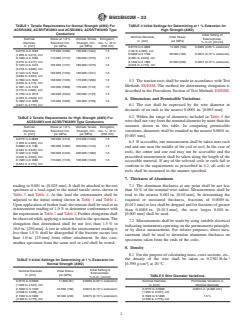
TABLE 1 Tensile Requirements for Normal Strength (AW2) For TABLE 4 Initial Settings for Determining at 1 % Extension for
ACSR/AW2, ACSR/TW/AW2 and ACSS/AW2, ACSR/TW/AW2 Type High Strength (AW3)
Conductors
Initial Setting of
Nominal Diameter, Initial Stress,
Extensometer,
Nominal Stress at 1.0 % Ultimate Tensile Elongation,
in. [mm] psi (MPa)
% in./in. [cm/cm]
Diameter, Extension min, Strength, min, min, %, 10 in.
in. [mm] psi (MPa) psi (MPa) [250 mm]
0.0770 to 0.0899 14 000 (100) 0.0005 (0.05 % extension)
[1.96 to 2.283], incl
0.0770 to 0.1289 175 000 (1206) 195 000 (1344) 1.5
0.0900 to 0.1199 28 000 (190) 0.0010 (0.10 % extension)
[1.956 to 3.274], incl
[2.284 to 3.045], incl
0.1290 to 0.1369 170 000 (1172) 190 000 (1310) 1.5
0.1200 to 0.1880 42 000 (290) 0.0015 (0.15 % extension)
[3.275 to 3.477], incl
[3.046 to 4.775], incl
0.1370 to 0.1443 165 000 (1137) 185 000 (1275) 1.5
[3.478 to 3.665], incl
0.1444 to 0.1549 160 000 (1103) 180 000 (1241) 1.5
[3.666 to 3.934], incl
0.1550 to 0.1620 160 000 (1103) 175 000 (1206) 1.5
5.3 The tension tests shall be made in accordance with Test
[3.935 to 4.115], incl
Methods E8/E8M. The method for determining elongation is
0.1621 to 0.1729 155 000 (1068) 170 000 (1172) 1.5
[4.116 to 4.392], incl
described in the Procedures Section of Test Methods E8/E8M.
0.1730 to 0.1819 150 000 (1034) 165 000 (1137) 1.5
[4.393 to 4.620], incl
6. Dimensions and Permissible Variations
0.1820 to 0.1880 145 000 (1000) 160 000 (1103) 1.5
[4.621 to 4.775], incl
6.1 The size shall be expressed by the wire diameter in
decimals of an inch to the nearest 0.0001 in. [0.003 mm].
6.2 Within the range of diameters included in Table 5 the
TABLE 2 Tensile Requirements for High Strength (AW3) For
wire shall not vary from the nominal diameter by more than the
ACSS/AW3 and ACSS/TW/AW3 Type Conductors
amounts shown in this table. In computing permissible
Nominal Stress at 1.0 % Ultimate Tensile Elongation,
Diameter, Extension min, Strength, min, min, %, 10 in. variations, diameters shall be rounded to the nearest 0.0001 in.
in. [mm] psi (MPa) psi (MPa) [250 mm]
[0.003 mm].
0.0770 to 0.0899 190 000 (1310) 210 000 (1450) 1.5
6.3 If accessible, one measurement shall be taken near each
[1.956 to 2.283], incl
0.0900 to 0.1199 185 000 (1280) 205 000 (1410) 1.5
end and one near the middle of the coil or reel. In the case of
[2.284 to 3.045], incl
reels, the center and one end may not be accessible and the
0.1200 to 0.1399 180 000 (1240) 200 000 (1380) 1.5
prescribed measurement shall be taken along the length of the
[3.046 to 3.553], incl
0.1400 to 0.1880 170 000 (1170) 195 000 (1340) 1.5
accessible material. If any of the selected coils or reels fail to
[3.554 to 4.775], incl
conform to the requirements as prescribed in 6.2, all coils or
reels shall be measured in the manner specified.
7. Thickness of Aluminum
reading to 0.001 in. [0.025 mm]. It shall be attached to the test
7.1 The aluminum thickness at any point shall be not less
specimen at a load equal to the initial tensile stress shown in than 10 % of
...
This document is not an ASTM standard and is intended only to provide the user of an ASTM standard an indication of what changes have been made to the previous version. Because
it may not be technically possible to adequately depict all changes accurately, ASTM recommends that users consult prior editions as appropriate. In all cases only the current version
of the standard as published by ASTM is to be considered the official document.
Designation: B502/B502M − 19 B502/B502M − 23
Standard Specification for
Aluminum-Clad Steel Core Wire for Use in Overhead
Electrical Aluminum Conductors
This standard is issued under the fixed designation B502/B502M; the number immediately following the designation indicates the year
of original adoption or, in the case of revision, the year of last revision. A number in parentheses indicates the year of last reapproval.
A superscript epsilon (´) indicates an editorial change since the last revision or reapproval.
1. Scope
1.1 This specification covers round, aluminum-clad steel core wire with two designations of tensile strengths, AW2 (Normal
Strength) and AW3 (High Strength).
1.2 The values stated in either SI units or inch-pound units are to be regarded separately as standard. The values stated in each
system are not necessarily exact equivalents; therefore, to ensure conformance with the standard, each system shall be used
independently of the other, and values from the two systems shall not be combined.
1.2.1 For conductor sizes designated by AWG, the requirements in SI units have been numerically converted from corresponding
values stated or derived in inch-pound units. For conductor sizes designated by SI units only, the requirements are stated or derived
in SI units.
1.3 This international standard was developed in accordance with internationally recognized principles on standardization
established in the Decision on Principles for the Development of International Standards, Guides and Recommendations issued
by the World Trade Organization Technical Barriers to Trade (TBT) Committee.
2. Referenced Documents
2.1 The following documents of the issue in effect on date of material purchase form a part of this specification to the extent
referenced herein.
2.2 ASTM Standards:
B193 Test Method for Resistivity of Electrical Conductor Materials
E8E8/E8M Test Methods for Tension Testing of Metallic Materials [Metric] E0008_E0008M
3. Ordering Information
3.1 Orders for material under this specification shall include the following information:
3.1.1 Quantity of each size,
This specification is under the jurisdiction of ASTM Committee B01 on Electrical Conductors and is the direct responsibility of Subcommittee B01.06 on Bi-Metallic
Conductors.
Current edition approved Oct. 1, 2019Oct. 1, 2023. Published October 2019October 2023. Originally approved in 1970. Last previous edition approved in 20172019 as
B502/B502M – 10 (2017).B502/B502M – 19. DOI: 10.1520/B0502_B0502M-19.10.1520/B0502_B0502M-23.
For referenced ASTM standards, visit the ASTM website, www.astm.org, or contact ASTM Customer Service at service@astm.org. For Annual Book of ASTM Standards
volume information, refer to the standard’s Document Summary page on the ASTM website.
Copyright © ASTM International, 100 Barr Harbor Drive, PO Box C700, West Conshohocken, PA 19428-2959. United States
B502/B502M − 23
3.1.2 Wire size: diameter in inches (see 6.1),
3.1.3 Core Wire Strength, AW2 (Normal Strength) or AW3 (High Strength) (see Table 1 and Table 2),
3.1.4 Package size: (see 17.1),
3.1.5 Special packaging and package marking if required (see 16.1), and
3.1.6 Place of inspection if other than place of manufacture (see 14.1).
4. Materials and Manufacture
4.1 The base metal shall be steel produced by the open-hearth, electric-furnace, or basic-oxygen process and shall be of such
composition that the finished clad wire shall have the properties and characteristics prescribed in this specification.
4.2 The aluminum used for cladding shall have a purity and quantity sufficient to meet thickness and resistance requirements of
this specification (see 7.1 and 9.1).
5. Tensile Properties
5.1 Requirements—The aluminum-clad steel core wire shall conform to the tensile requirements prescribed in Table 1 and Table
2. In computing the stress at 1 % extension and computing the ultimate tensile strength, the actual diameter of the finished wire
shall be used. Purchasers of core intended for use in conductor constructions with annealed aluminum wires, such as ACSS may
request the stranded steel core be compliant only with ultimate tensile strength and may waive compliance with the 1 % extension
tensile requirement. This use of the ultimate tensile requirement as an alternate to the 1 % extension requirement shall be by
agreement between the purchaser and producer and shall be noted on product compliance documentation. For the ACSS conductor,
the individual wires shall also meet a minimum actual breaking strength requirement as calculated based on the minimum ultimate
tensile strength and the nominal wire diameter.
5.2 Elongation Test—The elongation shall be determined by an extensometer suitable for measuring elongation in 10.0 in. [250
mm] and equipped with a vernier or other instrument reading to 0.001 in. [0.025 mm]. It shall be attached to the test specimen
at a load equal to the initial tensile stress shown in Table 3 and Table 4. At this load the extensometer shall be adjusted to the initial
setting shown in Table 3 and Table 4. Upon application of further load, the tension shall be read at an extensometer reading of
1.0 % to determine conformance with the requirement in Table 1 and Table 2. Further elongation shall be observed while applying
a tension load to the specimen. The elongation thus determined shall be not less than 1.5 % in 10.0 in. [250 mm]. A test in which
the extensometer reading is less than 1.5 % shall be disregarded if the fracture occurs less than 1.0 in. [25 mm] from either
attachment. In this case, another specimen from the same reel or coil shall be tested.
TABLE 1 Tensile Requirements for Normal Strength (AW2) For
ACSR/AW2, ACSR/TW/AW2 and ACSS/AW2, ACSR/TW/AW2 Type
Conductors
Nominal Stress at 1.0 % Ultimate Tensile Elongation,
Diameter, Extension min, Strength, min, min, %, 10 in.
in. [mm] psi (MPa) psi (MPa) [250 mm]
0.0770 to 0.1289 175 000 (1206) 195 000 (1344) 1.5
[1.956 to 3.274], incl
0.1290 to 0.1369 170 000 (1172) 190 000 (1310) 1.5
[3.275 to 3.477], incl
0.1370 to 0.1443 165 000 (1137) 185 000 (1275) 1.5
[3.478 to 3.665], incl
0.1444 to 0.1549 160 000 (1103) 180 000 (1241) 1.5
[3.666 to 3.934], incl
0.1550 to 0.1620 160 000 (1103) 175 000 (1206) 1.5
[3.935 to 4.115], incl
0.1621 to 0.1729 155 000 (1068) 170 000 (1172) 1.5
[4.116 to 4.392], incl
0.1730 to 0.1819 150 000 (1034) 165 000 (1137) 1.5
[4.393 to 4.620], incl
0.1820 to 0.1880 145 000 (1000) 160 000 (1103) 1.5
[4.621 to 4.775], incl
B502/B502M − 23
TABLE 2 Tensile Requirements for High Strength (AW3) For
ACSS/AW3 and ACSS/TW/AW3 Type Conductors
Nominal Stress at 1.0 % Ultimate Tensile Elongation,
Diameter, Extension min, Strength, min, min, %, 10 in.
in. [mm] psi (MPa) psi (MPa) [250 mm]
0.0770 to 0.0899 190 000 (1310) 210 000 (1450) 1.5
[1.956 to 2.283], incl
0.0900 to 0.1199 185 000 (1280) 205 000 (1410) 1.5
[2.284 to 3.045], incl
0.1200 to 0.1399 180 000 (1240) 200 000 (1380) 1.5
[3.046 to 3.553], incl
0.1400 to 0.1880 170 000 (1170) 195 000 (1340) 1.5
[3.554 to 4.775], incl
TABLE 3 Initial Settings for Determining at 1 % Extension for
Normal Strength (AW2)
Initial Setting of
Nominal Diameter, Initial Stress,
Extensometer,
in. [mm] psi (MPa)
% in./in. [cm/cm]
0.0770 to 0.0999 11 800 (81) 0.0005 (0.05 % extension)
[1.956 to 2.537], incl
0.1000 to 0.1299 23 500 (162) 0.0010 (0.10 % extension)
[2.538 to 3.299], incl
0.1300 to 0.1880 35 300 (243) 0.0015 (0.15 % extension)
[3.300 to 4.775], incl
TABLE 4 Initial Settings for Determining at 1 % Extension for
High Strength (AW3)
Initial Setting of
Nominal Diameter, Initial Stress,
Extensometer,
in. [mm] psi (MPa)
% in./in. [cm/cm]
0.0770 to 0.0899 14 000 (100) 0.0005 (0.05 % extension)
[1.96 to 2.283], incl
0.0900 to 0.1199 28 000 (190) 0.0010 (0.10 % extension)
[2.284 to 3.045], incl
0.1200 to 0.18
...