


ASTM C1581/C1581M-18a
(Test Method)Standard Test Method for Determining Age at Cracking and Induced Tensile Stress Characteristics of Mortar and Concrete under Restrained Shrinkage
Standard Test Method for Determining Age at Cracking and Induced Tensile Stress Characteristics of Mortar and Concrete under Restrained Shrinkage
SIGNIFICANCE AND USE
5.1 This test method is for relative comparison of materials and is not intended to determine the age at cracking of mortar or concrete in any specific type of structure, configuration, or exposure.
5.2 This test method is applicable to mixtures with aggregates of 13-mm [0.5-in.] maximum nominal size or less.
5.3 This test method is useful for determining the relative likelihood of early-age cracking of different cementitious mixtures and for aiding in the selection of cement-based materials that are less likely to crack under retrained shrinkage. Actual cracking tendency in service depends on many variables including type of structure, degree of restraint, rate of property development, construction and curing methods, and environmental conditions.
5.4 This test method can be used to determine the relative effects of material variations on induced tensile stresses and cracking potential. These variations can include, but are not limited to, aggregate source, aggregate gradation, cement type, cement content, water content, supplementary cementing materials, or chemical admixtures.
5.5 For materials that have not cracked during the test, the rate of tensile stress development at the time the test is terminated provides a basis for comparison of the materials.
SCOPE
1.1 This test method covers the laboratory determination of the age at cracking and induced tensile stress characteristics of mortar or concrete specimens under restrained shrinkage. The procedure can be used to determine the effects of variations in the proportions and material properties of mortar or concrete on cracking due to both drying shrinkage and deformations caused by autogenous shrinkage and heat of hydration.
1.2 This test method is not intended for expansive materials.
1.3 The values stated in either SI units or inch-pound units are to be regarded separately as standard. The values stated in each system may not be exact equivalents; therefore, each system shall be used independently of the other. Combining values from the two systems may result in non-conformance with the standard.
1.4 This standard does not purport to address all of the safety concerns, if any, associated with its use. It is the responsibility of the user of this standard to establish appropriate safety, health, and environmental practices and determine the applicability of regulatory limitations prior to use.(Warning—Fresh hydraulic cementitious mixtures are caustic and may cause chemical burns to skin and tissue upon prolonged exposure.2)
1.5 This international standard was developed in accordance with internationally recognized principles on standardization established in the Decision on Principles for the Development of International Standards, Guides and Recommendations issued by the World Trade Organization Technical Barriers to Trade (TBT) Committee.
General Information
- Status
- Published
- Publication Date
- 30-Jun-2018
- Technical Committee
- C09 - Concrete and Concrete Aggregates
- Drafting Committee
- C09.68 - Volume Change
Relations
- Effective Date
- 01-Jul-2018
- Effective Date
- 15-Dec-2019
- Effective Date
- 01-Apr-2019
- Effective Date
- 01-Jan-2019
- Effective Date
- 01-Oct-2018
- Effective Date
- 01-Jul-2018
- Effective Date
- 01-Jan-2018
- Effective Date
- 15-Jun-2017
- Effective Date
- 01-Apr-2017
- Effective Date
- 15-Dec-2016
- Effective Date
- 15-Mar-2016
- Effective Date
- 01-Feb-2016
- Effective Date
- 01-Feb-2016
- Effective Date
- 15-Dec-2015
- Effective Date
- 01-Oct-2015
Overview
ASTM C1581/C1581M-18a is the standard test method for determining the age at cracking and induced tensile stress characteristics of mortar and concrete under restrained shrinkage. Developed by ASTM International, this test method provides a laboratory procedure for evaluating the cracking potential of cementitious mixtures subjected to restrained shrinkage. The standard is widely referenced in the concrete industry to compare the propensity for early-age cracking among different mortar and concrete mixes.
The method is primarily intended for relative material comparisons and not for predicting absolute cracking time in specific structures. It is suitable for mixtures containing aggregates with a maximum nominal size of 13 mm (0.5 in.) or less.
Key Topics
- Cracking Under Restrained Shrinkage: The test assesses cracking behavior due to both drying shrinkage and internal deformations caused by autogenous shrinkage or heat of hydration.
- Relative Material Performance: The method compares different mixtures' likelihood of early-age cracking, aiding in selection of materials with lower cracking potential.
- Influence of Material Variables: The procedure allows users to evaluate effects from changes in aggregate type, cement type, mixture proportions, water content, supplementary cementitious materials, and chemical admixtures.
- Testing Process:
- Freshly mixed mortar or concrete is placed in a ring-shaped mold with an instrumented steel ring.
- Shrinkage strain in the steel ring is continuously monitored.
- Cracking is identified by a sudden drop in measured strain.
- Age at cracking, initial strain, and maximum strain are recorded.
- Tensile stress development rate is calculated for comparative assessment.
- Reporting & Classification: Results include properties of tested materials, curing conditions, environmental data, and cracking classification based on age and stress rate.
Applications
ASTM C1581/C1581M-18a is widely used in research, quality control, and product development in the following areas:
- Concrete Mix Design: Supports the optimization of mixtures by identifying those less prone to early-age cracking, crucial for structural performance and durability.
- Material Qualification: Assists in selecting suitable cementitious materials or admixtures for specific construction needs, such as bridge decks, pavements, and precast elements.
- Evaluating Admixture Effects: Helps gauge the impact of fibers, shrinkage-reducing agents, or supplementary cementitious materials on cracking risk.
- Quality Control in Preconstruction: Used by testing laboratories and material suppliers to reduce the likelihood of cracking-related failures in concrete applications.
This standard is particularly valuable for concrete professionals aiming to improve durability and service life of structures exposed to restrained shrinkage conditions.
Related Standards
ASTM C1581/C1581M-18a refers to and works alongside several other ASTM and industry standards, including:
- ASTM C33/C33M - Specification for Concrete Aggregates
- ASTM C125 - Terminology Relating to Concrete and Concrete Aggregates
- ASTM C150/C150M, C595/C595M, C1157/C1157M - Specifications for Hydraulic Cements
- ASTM C138/C138M - Test Method for Density, Yield, and Air Content of Concrete
- ASTM C143/C143M - Test Method for Slump of Hydraulic-Cement Concrete
- ASTM C192/C192M - Practice for Making and Curing Concrete Test Specimens in the Laboratory
- ASTM C171 - Specification for Sheet Materials for Curing Concrete
- ASTM C387/C387M - Specification for Packaged, Dry, Combined Materials for Concrete and High Strength Mortar
- ASTM C1437 - Test Method for Flow of Hydraulic Cement Mortar
Practical Value
ASTM C1581/C1581M-18a serves as an essential tool for engineers, material producers, and specifiers working to minimize cracking in concrete structures. By providing a standardized approach to compare cracking tendencies, this method enhances the reliability of concrete in critical infrastructure and supports the overall objective of producing more durable, crack-resistant concrete products.
Keywords: restrained shrinkage, cracking, tensile stress, ring test, mortar, concrete, ASTM C1581/C1581M, shrinkage cracking, concrete durability.
Buy Documents
ASTM C1581/C1581M-18a - Standard Test Method for Determining Age at Cracking and Induced Tensile Stress Characteristics of Mortar and Concrete under Restrained Shrinkage
REDLINE ASTM C1581/C1581M-18a - Standard Test Method for Determining Age at Cracking and Induced Tensile Stress Characteristics of Mortar and Concrete under Restrained Shrinkage
Get Certified
Connect with accredited certification bodies for this standard

ICC Evaluation Service
Building products evaluation and certification.

QAI Laboratories
Building and construction product testing and certification.

Aboma Certification B.V.
Specialized in construction, metal, and transport sectors.
Sponsored listings
Frequently Asked Questions
ASTM C1581/C1581M-18a is a standard published by ASTM International. Its full title is "Standard Test Method for Determining Age at Cracking and Induced Tensile Stress Characteristics of Mortar and Concrete under Restrained Shrinkage". This standard covers: SIGNIFICANCE AND USE 5.1 This test method is for relative comparison of materials and is not intended to determine the age at cracking of mortar or concrete in any specific type of structure, configuration, or exposure. 5.2 This test method is applicable to mixtures with aggregates of 13-mm [0.5-in.] maximum nominal size or less. 5.3 This test method is useful for determining the relative likelihood of early-age cracking of different cementitious mixtures and for aiding in the selection of cement-based materials that are less likely to crack under retrained shrinkage. Actual cracking tendency in service depends on many variables including type of structure, degree of restraint, rate of property development, construction and curing methods, and environmental conditions. 5.4 This test method can be used to determine the relative effects of material variations on induced tensile stresses and cracking potential. These variations can include, but are not limited to, aggregate source, aggregate gradation, cement type, cement content, water content, supplementary cementing materials, or chemical admixtures. 5.5 For materials that have not cracked during the test, the rate of tensile stress development at the time the test is terminated provides a basis for comparison of the materials. SCOPE 1.1 This test method covers the laboratory determination of the age at cracking and induced tensile stress characteristics of mortar or concrete specimens under restrained shrinkage. The procedure can be used to determine the effects of variations in the proportions and material properties of mortar or concrete on cracking due to both drying shrinkage and deformations caused by autogenous shrinkage and heat of hydration. 1.2 This test method is not intended for expansive materials. 1.3 The values stated in either SI units or inch-pound units are to be regarded separately as standard. The values stated in each system may not be exact equivalents; therefore, each system shall be used independently of the other. Combining values from the two systems may result in non-conformance with the standard. 1.4 This standard does not purport to address all of the safety concerns, if any, associated with its use. It is the responsibility of the user of this standard to establish appropriate safety, health, and environmental practices and determine the applicability of regulatory limitations prior to use.(Warning—Fresh hydraulic cementitious mixtures are caustic and may cause chemical burns to skin and tissue upon prolonged exposure.2) 1.5 This international standard was developed in accordance with internationally recognized principles on standardization established in the Decision on Principles for the Development of International Standards, Guides and Recommendations issued by the World Trade Organization Technical Barriers to Trade (TBT) Committee.
SIGNIFICANCE AND USE 5.1 This test method is for relative comparison of materials and is not intended to determine the age at cracking of mortar or concrete in any specific type of structure, configuration, or exposure. 5.2 This test method is applicable to mixtures with aggregates of 13-mm [0.5-in.] maximum nominal size or less. 5.3 This test method is useful for determining the relative likelihood of early-age cracking of different cementitious mixtures and for aiding in the selection of cement-based materials that are less likely to crack under retrained shrinkage. Actual cracking tendency in service depends on many variables including type of structure, degree of restraint, rate of property development, construction and curing methods, and environmental conditions. 5.4 This test method can be used to determine the relative effects of material variations on induced tensile stresses and cracking potential. These variations can include, but are not limited to, aggregate source, aggregate gradation, cement type, cement content, water content, supplementary cementing materials, or chemical admixtures. 5.5 For materials that have not cracked during the test, the rate of tensile stress development at the time the test is terminated provides a basis for comparison of the materials. SCOPE 1.1 This test method covers the laboratory determination of the age at cracking and induced tensile stress characteristics of mortar or concrete specimens under restrained shrinkage. The procedure can be used to determine the effects of variations in the proportions and material properties of mortar or concrete on cracking due to both drying shrinkage and deformations caused by autogenous shrinkage and heat of hydration. 1.2 This test method is not intended for expansive materials. 1.3 The values stated in either SI units or inch-pound units are to be regarded separately as standard. The values stated in each system may not be exact equivalents; therefore, each system shall be used independently of the other. Combining values from the two systems may result in non-conformance with the standard. 1.4 This standard does not purport to address all of the safety concerns, if any, associated with its use. It is the responsibility of the user of this standard to establish appropriate safety, health, and environmental practices and determine the applicability of regulatory limitations prior to use.(Warning—Fresh hydraulic cementitious mixtures are caustic and may cause chemical burns to skin and tissue upon prolonged exposure.2) 1.5 This international standard was developed in accordance with internationally recognized principles on standardization established in the Decision on Principles for the Development of International Standards, Guides and Recommendations issued by the World Trade Organization Technical Barriers to Trade (TBT) Committee.
ASTM C1581/C1581M-18a is classified under the following ICS (International Classification for Standards) categories: 91.100.30 - Concrete and concrete products. The ICS classification helps identify the subject area and facilitates finding related standards.
ASTM C1581/C1581M-18a has the following relationships with other standards: It is inter standard links to ASTM C1581/C1581M-18, ASTM C125-19a, ASTM C150/C150M-19, ASTM C125-19, ASTM C125-18b, ASTM C125-18a, ASTM C125-18, ASTM C1157/C1157M-17, ASTM C595/C595M-17, ASTM C125-16, ASTM C150/C150M-16, ASTM C192/C192M-16, ASTM C33/C33M-16e1, ASTM C125-15b, ASTM C387/C387M-15. Understanding these relationships helps ensure you are using the most current and applicable version of the standard.
ASTM C1581/C1581M-18a is available in PDF format for immediate download after purchase. The document can be added to your cart and obtained through the secure checkout process. Digital delivery ensures instant access to the complete standard document.
Standards Content (Sample)
This international standard was developed in accordance with internationally recognized principles on standardization established in the Decision on Principles for the
Development of International Standards, Guides and Recommendations issued by the World Trade Organization Technical Barriers to Trade (TBT) Committee.
Designation: C1581/C1581M − 18a
Standard Test Method for
Determining Age at Cracking and Induced Tensile Stress
Characteristics of Mortar and Concrete under Restrained
Shrinkage
This standard is issued under the fixed designation C1581/C1581M; the number immediately following the designation indicates the
year of original adoption or, in the case of revision, the year of last revision. A number in parentheses indicates the year of last
reapproval. A superscript epsilon (´) indicates an editorial change since the last revision or reapproval.
1. Scope* 2. Referenced Documents
1.1 This test method covers the laboratory determination of
2.1 ASTM Standards:
the age at cracking and induced tensile stress characteristics of
C33/C33MSpecification for Concrete Aggregates
mortar or concrete specimens under restrained shrinkage. The
C125Terminology Relating to Concrete and Concrete Ag-
procedure can be used to determine the effects of variations in
gregates
the proportions and material properties of mortar or concrete
C138/C138MTestMethodforDensity(UnitWeight),Yield,
on cracking due to both drying shrinkage and deformations
and Air Content (Gravimetric) of Concrete
caused by autogenous shrinkage and heat of hydration.
C143/C143MTest Method for Slump of Hydraulic-Cement
Concrete
1.2 Thistestmethodisnotintendedforexpansivematerials.
C150/C150MSpecification for Portland Cement
1.3 The values stated in either SI units or inch-pound units
C171Specification for Sheet Materials for Curing Concrete
are to be regarded separately as standard. The values stated in
C192/C192MPracticeforMakingandCuringConcreteTest
each system may not be exact equivalents; therefore, each
Specimens in the Laboratory
system shall be used independently of the other. Combining
C387/C387MSpecification for Packaged, Dry, Combined
values from the two systems may result in non-conformance
Materials for Concrete and High Strength Mortar
with the standard.
C595/C595MSpecification for Blended Hydraulic Cements
1.4 This standard does not purport to address all of the C1157/C1157MPerformance Specification for Hydraulic
Cement
safety concerns, if any, associated with its use. It is the
responsibility of the user of this standard to establish appro- C1437Test Method for Flow of Hydraulic Cement Mortar
F441/F441MSpecificationforChlorinatedPoly(VinylChlo-
priate safety, health, and environmental practices and deter-
mine the applicability of regulatory limitations prior to ride) (CPVC) Plastic Pipe, Schedules 40 and 80
use.(Warning—Fresh hydraulic cementitious mixtures are
2.2 ASME Standards:
caustic and may cause chemical burns to skin and tissue upon
B46.1Surface Texture (Surface Roughness, Waviness and
prolonged exposure. )
Lay)
1.5 This international standard was developed in accor-
dance with internationally recognized principles on standard-
3. Terminology
ization established in the Decision on Principles for the
3.1 Definitions:
Development of International Standards, Guides and Recom-
3.1.1 For definitions of terms used in this test method, refer
mendations issued by the World Trade Organization Technical
to Terminology C125.
Barriers to Trade (TBT) Committee.
3.2 Definitions of Terms Specific to This Standard:
This test method is under the jurisdiction of ASTM Committee C09 on
Concrete and ConcreteAggregates and is the direct responsibility of Subcommittee For referenced ASTM standards, visit the ASTM website, www.astm.org, or
C09.68 on Volume Change. contact ASTM Customer Service at service@astm.org. For Annual Book of ASTM
Current edition approved July 1, 2018. Published September 2018. Originally Standards volume information, refer to the standard’s Document Summary page on
approved in 2004. Last previous edition approved in 2018 as C1581/C1581M–18. the ASTM website.
DOI: 10.1520/C1581_C1581M-18A. Available from American Society of Mechanical Engineers (ASME), ASME
Section on Safety Precautions, Manual of Aggregate and Concrete Testing , International Headquarters, Three Park Ave., New York, NY 10016-5990, http://
Annual Book of ASTM Standards, Vol 04.02. www.asme.org.
*A Summary of Changes section appears at the end of this standard
Copyright © ASTM International, 100 Barr Harbor Drive, PO Box C700, West Conshohocken, PA 19428-2959. United States
C1581/C1581M − 18a
3.2.1 age at cracking, n—the age of each test specimen, 6. Apparatus
measured from the time of casting, when a sudden decrease in
6.1 Steel Ring—Structuralsteelpipewithawallthicknessof
strain occurs.
13 6 1 mm [0.50 6 0.05 in.], an outside diameter of 330 6
3.2.2 elapsed time, n—thedifferencebetweeneachrecorded
3mm [13.0 6 0.12 in.] and a height of 150 6 6 mm [6.0 6
time when strain is measured and the time when drying was
0.25in.] (see Fig. 1). Machine the inner and outer faces to
initiated.
produce smooth surfaces with a texture of 1.6 micrometres [63
3.2.3 initial strain, n—thestrainvalueinthesteelringwhen microinches] or finer, as defined in ASME B46.1.
drying is initiated.
6.2 Strain Gages—As a minimum, use two electrical resis-
3.2.4 net strain, n—the value corresponding to the differ-
tancestraingagestomonitorthestraindevelopmentinthesteel
ence between the strain in the steel ring at each recorded time
ring. Each strain gage shall be wired in a quarter-bridge
and the initial strain.
configuration(thatis,onelegofafullWheatstonebridge).See
Note 1 for additional information.
3.2.5 strain rate factor, n—theslopeofthebest-fitlinetothe
values of net strain plotted as a function of the square root of
6.3 Data Acquisition System—The data acquisition system
elapsed time for each strain gage.
shall be compatible with the strain instrumentation and auto-
3.2.6 stress rate, n—therateoftensilestressdevelopmentin
maticallyrecordeachstraingageindependently.Theresolution
the test specimen at the time of cracking or when the test is
of the system shall be 60.0000005 m/m [in./in.]. The system
terminated and obtained in accordance with Eq 2.
shall be capable of recording strain data at intervals not to
exceed 30 minutes.
4. Summary of Test Method
NOTE 1—Use of a precision resistor, to balance the leg of the bridge, a
4.1 A sample of freshly mixed mortar or concrete is com-
strain conditioner input module, to complete the other half of the bridge,
pacted in a circular mold around an instrumented steel ring.
anda16-channelinterfaceboardhasbeenfoundtoadequatelyprovidethe
The compressive strain developed in the steel ring caused by
required resolution of the system.
shrinkageofthemortarorconcretespecimenismeasuredfrom
6.4 Base—Epoxy-coated plywood or other non-absorptive
the time of casting (1-6). Cracking of the test specimen is
and non-reactive surface.
indicated by a sudden decrease in the steel ring strain.The age
atcrackingandtherateoftensilestressdevelopmentinthetest 6.5 Outer Ring—Use one of the following alternative ma-
specimen are indicators of the material’s resistance to cracking terials as the outer ring.
under restrained shrinkage.
6.5.1 PVC Pipe—Schedule 80-18 PVC pipe, in accordance
with Specification F441/F441M, with a 405 6 3-mm [16.0 6
5. Significance and Use
0.12-in.] inside diameter and 150 6 6-mm [6.0 6 0.25-in.]
5.1 This test method is for relative comparison of materials
height (see Fig. 1).
and is not intended to determine the age at cracking of mortar
6.5.2 Steel Outer Ring—3-mm [0.125-in.] thick steel sheet-
or concrete in any specific type of structure, configuration, or
ing formed to obtain a 405 6 3-mm [16.0 6 0.12-in.] inside
exposure.
diameter and 150 6 6-mm [6.0 6 0.25-in.] height.
5.2 This test method is applicable to mixtures with aggre-
6.5.3 Other Materials—Other suitable non-absorptive and
gates of 13-mm [0.5-in.] maximum nominal size or less.
non-reactivematerialsformedtoobtaina405 63-mm[16.0 6
0.12-in.] inside diameter and 150 6 6-mm [6.0 6 0.25-in.]
5.3 This test method is useful for determining the relative
height.
likelihood of early-age cracking of different cementitious
mixtures and for aiding in the selection of cement-based
6.6 Testing Environment—Store the specimens in an envi-
materialsthatarelesslikelytocrackunderretrainedshrinkage.
ronmentally controlled room with constant air temperature of
Actualcrackingtendencyinservicedependsonmanyvariables
23.0 6 2.0°C [73.5 6 3.5°F] and relative humidity of 50 6
including type of structure, degree of restraint, rate of property
4%.
development, construction and curing methods, and environ-
mental conditions.
7. Materials and Mixing
5.4 This test method can be used to determine the relative
7.1 Materials:
effects of material variations on induced tensile stresses and
7.1.1 Cement—Cement shall conform to Specifications
cracking potential. These variations can include, but are not
C150/C150M, C595/C595M,or C1157/C1157M.
limitedto,aggregatesource,aggregategradation,cementtype,
7.1.2 Aggregates—Aggregates shall conform to Specifica-
cement content, water content, supplementary cementing
tion C33/C33M. The maximum nominal size of the coarse
materials, or chemical admixtures.
aggregate shall be 13 mm [0.5 in.] or less.
5.5 For materials that have not cracked during the test, the
7.2 Mixing:
rate of tensile stress development at the time the test is
7.2.1 Concrete Mixtures—Machine mix the concrete as
terminated provides a basis for comparison of the materials.
prescribed in Practice C192/C192M.
7.2.2 Mortar Mixtures—Mix the mortar as prescribed in
The boldface numbers in parenthesis refer to the list of references at the end of
this test method. Specification C387/C387M.
C1581/C1581M − 18a
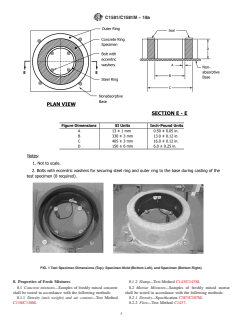
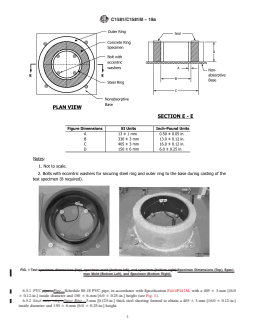
FIG. 1 Test Specimen Dimensions (Top), Specimen Mold (Bottom Left), and Specimen (Bottom Right).
8. Properties of Fresh Mixtures 8.1.2 Slump—Test Method C143/C143M.
8.1 Concrete mixtures—Samples of freshly mixed concrete 8.2 Mortar Mixtures—Samples of freshly mixed mortar
shall be tested in accordance with the following methods: shall be tested in accordance with the following methods:
8.1.1 Density (unit weight) and air content—Test Method 8.2.1 Density—Specification C387/C387M.
C138/C138M. 8.2.2 Flow—Test Method C1437.
C1581/C1581M − 18a
9. Specimen Fabrication and Test Setup meeting the requirements of Specification C171. Begin the
curing process within 5 minutes after the first strain reading. If
9.1 Bond two strain gages at midheight locations on the
the curing period is longer than 24 h, remove the outer ring at
interiorsurfaceofthesteelringalongadiameter;thatis,mount
24 h and continue the curing process.
the second gage diametrically opposite the first gage. Orient
9.7 At the end of curing and between strain measurements,
the gages to measure strain in the circumferential direction.
Follow the manufacturer’s procedures for mounting and wa- prepare the test specimens for drying as follows. Complete the
terproofing the gages on the steel ring and connecting lead- test specimen preparation within 15 minutes.
wires to the strain gage tabs. 9.7.1 Remove the outer ring, if it is still in place, and/or
remove the polyethylene film and burlap.
9.2 Test Specimen Mold—The test specimen mold consists
9.7.2 Gently remove loose material, if present, from the top
of a base, an inner steel ring and an outer ring.
surface of the test specimen.
9.2.1 Fabricateabaseforeachtestspecimenasdescribedin
9.7.3 Seal the top surface of the test specimen using one of
Section 6.4. The top surface of each base shall minimize
the following alternative procedures.
frictional restraint of the specimen.
NOTE 4—With the top surface sealed, and the specimen resting on its
NOTE 2—Use of an epoxy coating or a Mylar sheet covering has been
base, the test specimen dries from the outer circumferential surface only.
found to provide a suitable surface between the test specimen and the
9.7.3.1 Paraffın Wax—Coat the top surface of the test
base.
specimenwithmoltenparaffinwax.Takeprecautionstoensure
9.2.2 Secure the steel ring to the base before casting using
that the outer circumference of the test specimen is not coated
bolts with eccentric washers (see Fig. 1).
with the paraffin wax.
9.2.2.1 Coattheoutersurfaceofthesteelringwitharelease
agent.
NOTE 5—Use of a 40-mm [1.5-in.] wide brush has been found to be an
appropriate means of applying the paraffin wax to the top surface of the
9.2.3 Coat the inner surface of the outer ring with a release
test specimens.
agent.
9.2.4 Secure the outer ring to the base to complete the test 9.7.3.2 Adhesive Aluminum-foil Tape—Seal the top surface
of the test specimen with adhesive aluminum-foil tape.
specimen mold using bolts with eccentric washers. Maintain a
38 6 1.5-mm [1.50 6 0.06-in.] space between the inner steel
...
This document is not an ASTM standard and is intended only to provide the user of an ASTM standard an indication of what changes have been made to the previous version. Because
it may not be technically possible to adequately depict all changes accurately, ASTM recommends that users consult prior editions as appropriate. In all cases only the current version
of the standard as published by ASTM is to be considered the official document.
Designation: C1581/C1581M − 18 C1581/C1581M − 18a
Standard Test Method for
Determining Age at Cracking and Induced Tensile Stress
Characteristics of Mortar and Concrete under Restrained
Shrinkage
This standard is issued under the fixed designation C1581/C1581M; the number immediately following the designation indicates the
year of original adoption or, in the case of revision, the year of last revision. A number in parentheses indicates the year of last
reapproval. A superscript epsilon (´) indicates an editorial change since the last revision or reapproval.
1. Scope*
1.1 This test method covers the laboratory determination of the age at cracking and induced tensile stress characteristics of
mortar or concrete specimens under restrained shrinkage. The procedure can be used to determine the effects of variations in the
proportions and material properties of mortar or concrete on cracking due to both drying shrinkage and deformations caused by
autogenous shrinkage and heat of hydration.
1.2 This test method is not intended for expansive materials.
1.3 The values stated in either SI units or inch-pound units are to be regarded separately as standard. The values stated in each
system may not be exact equivalents; therefore, each system shall be used independently of the other. Combining values from the
two systems may result in non-conformance with the standard.
1.4 This standard does not purport to address all of the safety concerns, if any, associated with its use. It is the responsibility
of the user of this standard to establish appropriate safety, health, and environmental practices and determine the applicability of
regulatory limitations prior to use.(Warning—Fresh hydraulic cementitious mixtures are caustic and may cause chemical burns
to skin and tissue upon prolonged exposure. )
1.5 This international standard was developed in accordance with internationally recognized principles on standardization
established in the Decision on Principles for the Development of International Standards, Guides and Recommendations issued
by the World Trade Organization Technical Barriers to Trade (TBT) Committee.
2. Referenced Documents
2.1 ASTM Standards:
C33/C33M Specification for Concrete Aggregates
C125 Terminology Relating to Concrete and Concrete Aggregates
C138/C138M Test Method for Density (Unit Weight), Yield, and Air Content (Gravimetric) of Concrete
C143/C143M Test Method for Slump of Hydraulic-Cement Concrete
C150/C150M Specification for Portland Cement
C171 Specification for Sheet Materials for Curing Concrete
C192/C192M Practice for Making and Curing Concrete Test Specimens in the Laboratory
C387/C387M Specification for Packaged, Dry, Combined Materials for Concrete and High Strength Mortar
C595/C595M Specification for Blended Hydraulic Cements
C1157/C1157M Performance Specification for Hydraulic Cement
C1437 Test Method for Flow of Hydraulic Cement Mortar
F441/F441M Specification for Chlorinated Poly(Vinyl Chloride) (CPVC) Plastic Pipe, Schedules 40 and 80
2.2 ASME Standards:
B 46.1 Surface Texture (Surface Roughness, Waviness and Lay)
This test method is under the jurisdiction of ASTM Committee C09 on Concrete and Concrete Aggregates and is the direct responsibility of Subcommittee C09.68 on
Volume Change.
Current edition approved Feb. 15, 2018July 1, 2018. Published March 2018September 2018. Originally approved in 2004. Last previous edition approved in 20162018
as C1581/C1581M – 16.C1581/C1581M – 18. DOI: 10.1520/C1581_C1581M-18.10.1520/C1581_C1581M-18A.
Section on Safety Precautions, Manual of Aggregate and Concrete Testing , Annual Book of ASTM Standards, Vol 04.02.
For referenced ASTM standards, visit the ASTM website, www.astm.org, or contact ASTM Customer Service at service@astm.org. For Annual Book of ASTM Standards
volume information, refer to the standard’s Document Summary page on the ASTM website.
Available from American Society of Mechanical Engineers (ASME), ASME International Headquarters, Three Park Ave., New York, NY 10016-5990, http://
www.asme.org.
*A Summary of Changes section appears at the end of this standard
Copyright © ASTM International, 100 Barr Harbor Drive, PO Box C700, West Conshohocken, PA 19428-2959. United States
C1581/C1581M − 18a
3. Terminology
3.1 Definitions:
3.1.1 For definitions of terms used in this test method, refer to Terminology C125.
3.2 Definitions of Terms Specific to This Standard:
3.2.1 age at cracking, n—the age of each test specimen, measured from the time of casting, when a sudden decrease in strain
occurs.
3.2.2 elapsed time, n—the difference between each recorded time when strain is measured and the time when drying was
initiated.
3.2.3 initial strain, n—the strain value in the steel ring when drying is initiated.
3.2.4 net strain, n—the value corresponding to the difference between the strain in the steel ring at each recorded time and the
initial strain.
3.2.5 strain rate factor, n—the slope of the best-fit line to the values of net strain plotted as a function of the square root of
elapsed time for each strain gage.
3.2.6 stress rate, n—the rate of tensile stress development in the test specimen at the time of cracking or when the test is
terminated and obtained in accordance with Eq 2.
4. Summary of Test Method
4.1 A sample of freshly mixed mortar or concrete is compacted in a circular mold around an instrumented steel ring. The
compressive strain developed in the steel ring caused by shrinkage of the mortar or concrete specimen is measured from the time
of casting (1-6). Cracking of the test specimen is indicated by a sudden decrease in the steel ring strain. The age at cracking and
the rate of tensile stress development in the test specimen are indicators of the material’s resistance to cracking under restrained
shrinkage.
5. Significance and Use
5.1 This test method is for relative comparison of materials and is not intended to determine the age at cracking of mortar or
concrete in any specific type of structure, configuration, or exposure.
5.2 This test method is applicable to mixtures with aggregates of 13-mm [0.5-in.] maximum nominal size or less.
5.3 This test method is useful for determining the relative likelihood of early-age cracking of different cementitious mixtures
and for aiding in the selection of cement-based materials that are less likely to crack under retrained shrinkage. Actual cracking
tendency in service depends on many variables including type of structure, degree of restraint, rate of property development,
construction and curing methods, and environmental conditions.
5.4 This test method can be used to determine the relative effects of material variations on induced tensile stresses and cracking
potential. These variations can include, but are not limited to, aggregate source, aggregate gradation, cement type, cement content,
water content, supplementary cementing materials, or chemical admixtures.
5.5 For materials that have not cracked during the test, the rate of tensile stress development at the time the test is terminated
provides a basis for comparison of the materials.
6. Apparatus
6.1 Steel ring—Ring—Structural steel pipe with a wall thickness of 13 6 1 mm [0.50 6 0.05 in.], an outside diameter of 330
6 3 mm 3 mm [13.0 6 0.12 in.] and a height of 150 6 6 mm [6.0 6 0.25 in.] 0.25 in.] (see Fig. 1). Machine the inner and outer
faces to produce smooth surfaces with a texture of 1.6 micrometres [63 microinches] or finer, as defined in ASME B 46.1.
6.2 Strain gages—Gages—As a minimum, use two electrical resistance strain gages to monitor the strain development in the
steel ring. Each strain gage shall be wired in a quarter-bridge configuration (that is, one leg of a full Wheatstone bridge). See Note
1 for additional information.
6.3 Data acquisition system—Acquisition System—The data acquisition system shall be compatible with the strain instrumen-
tation and automatically record each strain gage independently. The resolution of the system shall be 60.0000005 m/m [in./in.].
The system shall be capable of recording strain data at intervals not to exceed 30 minutes.
NOTE 1—Use of a precision resistor, to balance the leg of the bridge, a strain conditioner input module, to complete the other half of the bridge, and
a 16-channel interface board has been found to adequately provide the required resolution of the system.
6.4 Base—Epoxy-coated plywood or other non-absorptive and non-reactive surface.
6.5 Outer ring—Ring—Use one of the following alternative materials as the outer ring.
The boldface numbers in parenthesis refer to the list of references at the end of this test method.
C1581/C1581M − 18a
FIG. 1 Test specimen dimensions (top), specimen mold (bottom left), and specimen (bottom right).Specimen Dimensions (Top), Speci-
men Mold (Bottom Left), and Specimen (Bottom Right).
6.5.1 PVC pipe—Pipe—Schedule 80-18 PVC pipe, in accordance with Specification F441/F441M, with a 405 6 3-mm [16.0
6 0.12-in.] inside diameter and 150 6 6-mm [6.0 6 0.25-in.] height (see Fig. 1).
6.5.2 Steel outer ring—Outer Ring—3-mm [0.125-in.] thick steel sheeting formed to obtain a 405 6 3-mm [16.0 6 0.12-in.]
inside diameter and 150 6 6-mm [6.0 6 0.25-in.] height.
C1581/C1581M − 18a
6.5.3 Other materials—Materials—Other suitable non-absorptive and non-reactive materials formed to obtain a 405 6 3-mm
[16.0 6 0.12-in.] inside diameter and 150 6 6-mm [6.0 6 0.25-in.] height.
6.6 Testing environment—Environment—Store the specimens in an environmentally controlled room with constant air
temperature of 23.0 6 2.0 °C 2.0°C [73.5 6 3.5 °F] 3.5°F] and relative humidity of 50 6 4 %.
7. Materials and Mixing
7.1 Materials:
7.1.1 Cement—Cement shall conform to Specifications C150/C150M, C595/C595M, or C1157/C1157M.
7.1.2 Aggregates—Aggregates shall conform to Specification C33/C33M. The maximum nominal size of the coarse aggregate
shall be 13 mm [0.5 in.] or less.
7.2 Mixing:
7.2.1 Concrete mixtures—Mixtures—Machine mix the concrete as prescribed in Practice C192/C192M.
7.2.2 Mortar mixtures—Mixtures—Mix the mortar as prescribed in Specification C387/C387M.
8. Properties of Fresh Mixtures
8.1 Concrete mixtures—Samples of freshly mixed concrete shall be tested in accordance with the following methods:
8.1.1 Density (unit weight) and air content—Test Method C138/C138M.
8.1.2 Slump—Test Method C143/C143M.
8.2 Mortar mixtures—Mixtures—Samples of freshly mixed mortar shall be tested in accordance with the following methods:
8.2.1 Density—Specification C387/C387M.
8.2.2 Flow—Test Method C1437.
9. Specimen Fabrication and Test Setup
9.1 Bond two strain gages at midheight locations on the interior surface of the steel ring along a diameter; that is, mount the
second gage diametrically opposite the first gage. Orient the gages to measure strain in the circumferential direction. Follow the
manufacturer’s procedures for mounting and waterproofing the gages on the steel ring and connecting lead-wires to the strain gage
tabs.
9.2 Test specimen mold—Specimen Mold—The test specimen mold consists of a base, an inner steel ring and an outer ring.
9.2.1 Fabricate a base for each test specimen as described in Section 6.4. The top surface of each base shall minimize frictional
restraint of the specimen.
NOTE 2—Use of an epoxy coating or a Mylar sheet covering has been found to provide a suitable surface between the test specimen and the base.
9.2.2 Secure the steel ring to the base before casting using bolts with eccentric washers (see Fig. 1).
9.2.2.1 Coat the outer surface of the steel ring with a release agent.
9.2.3 Coat the inner surface of the outer ring with a release agent.
9.2.4 Secure the outer ring to the base to complete the test specimen mold using bolts with eccentric washers. Maintain a 38
6 1.5-mm [1.50 6 0.06-in.] space between the inner steel ring and the outer ring (see Fig. 1).
9.3 Make and cure at least three test specimens for each material and test condition following the applicable requirements of
Practice C192/C192M. In making a specimen, place the test specimen mold on a vibrating table, fill the mold in two approximately
equal layers, rod each layer 75 times using a 10-mm [ ⁄8-in.] diameter rod, and vibrate each layer to consolidate the mixture.
9.4 Strike-off the test specimen surface after consolidation. Finish with the minimum manipulation necessary to achieve a flat
surface. Remove any fresh concrete or mortar that has spilled inside the steel ring or outside the outer ring so that the base is clean.
Transfer the test specimens to the testing environment within 10 minutes after completion of casting.
9.5 Upon transfer of the test specimens to the testing environment, immediately loosen the bolts with eccentric washers and
rotate the washers so they are not in contact with the steel ring and outer ring. Within 2 minutes after loosening the bolts with
eccentric washers, connect the strain gage lead-wires to the data acquisition system, record the time, and begin monitoring the
strain gages at intervals not greater than 30 minutes. Ensure that the strain gage connecting wires are clean of loose material before
making the connections. Th
...
Questions, Comments and Discussion
Ask us and Technical Secretary will try to provide an answer. You can facilitate discussion about the standard in here.
Loading comments...