

ASTM D2284-11(2019)
(Test Method)Standard Test Method for Acidity of Sulfur Hexafluoride
General Information
- Abstract
SIGNIFICANCE AND USE
4.1 Acidic fluorides are undesirable in SF6 used as an electrical insulating gas in that they may contribute to corrosion or constitute dielectric hazard.
4.2 This test method is valid for both new and used SF6. In used SF6, it will only measure those active species which are hydrolyzable.
SCOPE
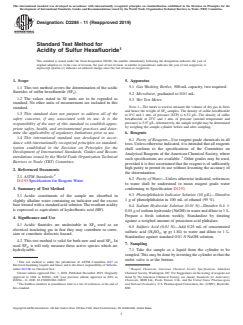
1.1 This test method covers the determination of the acidic fluorides of sulfur hexafluoride (SF6).
1.2 The values stated in SI units are to be regarded as standard. No other units of measurement are included in this standard.
1.3 This standard does not purport to address all of the safety concerns, if any, associated with its use. It is the responsibility of the user of this standard to establish appropriate safety, health, and environmental practices and determine the applicability of regulatory limitations prior to use.
1.4 This international standard was developed in accordance with internationally recognized principles on standardization established in the Decision on Principles for the Development of International Standards, Guides and Recommendations issued by the World Trade Organization Technical Barriers to Trade (TBT) Committee.
- Status
- Published
- Publication Date
- 30-Nov-2019
- Technical Committee
- D27 - Electrical Insulating Liquids and Gases
- Drafting Committee
- D27.06 - Chemical Test


Overview
ASTM D2284-11(2019) - Standard Test Method for Acidity of Sulfur Hexafluoride specifies procedures for determining the presence and quantity of acidic fluorides in sulfur hexafluoride (SF₆) gas. Primarily used in electrical insulating applications, SF₆ must meet high purity standards to ensure operational safety and equipment longevity. This standard outlines vital steps to detect acidity, which if present in excess, can contribute to corrosion and may pose risks in high-voltage environments. ASTM D2284 applies to both new and used SF₆, focusing on measuring hydrolyzable acidic substances.
Key Topics
- Significance of Acidic Fluorides: Acidic fluorides in SF₆ are undesirable as they can accelerate corrosion in electrical systems or represent dielectric hazards, potentially leading to equipment damage or failure.
- Test Method Applicability: The test method is valid for both new and reclaimed SF₆ gases. For used gas, it specifically measures active species that are hydrolyzable in water.
- Measurement Approach:
- Samples are bubbled through a slightly alkaline water solution with an indicator (phenolphthalein).
- The excess base is titrated with a standard acid, and the resulting acidity is calculated as equivalents of hydrofluoric acid (HF).
- Equipment Required: Gas washing bottles, microburet, wet test meter (or use of sample cylinder weighing for gas quantification).
- Reagent Requirements: High-purity chemicals and reagent-grade water are used to ensure accuracy.
- Precision: The standard details repeatability and detection limits, with a reliable detection threshold at 0.04 ppm acidity as HF.
Applications
- Electrical Insulating Gas Quality Control: Ensuring low acidity in SF₆ is critical for reliable performance of gas-insulated switchgear, transformers, and circuit breakers.
- Utility and High-Voltage Equipment Maintenance: Routine SF₆ testing helps prevent costly corrosion or insulation breakdown, prolonging equipment life and reducing maintenance costs.
- Regulatory Compliance: Adherence to ASTM D2284 can demonstrate compliance with safety and quality regulations for electrical utilities and gas suppliers.
- Gas Manufacturing and Recirculation: Gas producers and recyclers use this standard to verify the purity of their products before distribution or reuse in sensitive electrical environments.
Related Standards
- ASTM D1193 - Specification for Reagent Water: Outlines requirements for water purity used in chemical analyses, as referenced in the procedure.
- Other ASTM Insulating Gas Standards:
- Standards for handling, testing, and recycling SF₆ and other electrical insulating gases.
- International Guidelines:
- Developed following World Trade Organization’s principles to ensure international recognition and compatibility with global practices.
Keywords: ASTM D2284, acidity of sulfur hexafluoride, SF₆ purity testing, acidic fluorides, insulating gas quality, electrical equipment maintenance, gas analysis standard, SF₆ corrosion, dielectric hazard, reagent-grade chemicals.
By following ASTM D2284-11(2019), laboratories and industry professionals can reliably measure and control acidic impurities in SF₆, safeguarding the integrity and performance of high-voltage electrical equipment.
Relations
- Effective Date
- 01-Dec-2019
- Effective Date
- 01-Mar-2006
- Effective Date
- 10-Feb-1999
- Effective Date
- 10-Feb-1999
- Effective Date
- 01-Dec-2019
Get Certified
Connect with accredited certification bodies for this standard

ECOCERT
Organic and sustainability certification.

Eurofins Food Testing Global
Global leader in food, environment, and pharmaceutical product testing.

Intertek Bangladesh
Intertek certification and testing services in Bangladesh.
Sponsored listings
Frequently Asked Questions
ASTM D2284-11(2019) is a standard published by ASTM International. Its full title is "Standard Test Method for Acidity of Sulfur Hexafluoride". This standard covers: SIGNIFICANCE AND USE 4.1 Acidic fluorides are undesirable in SF6 used as an electrical insulating gas in that they may contribute to corrosion or constitute dielectric hazard. 4.2 This test method is valid for both new and used SF6. In used SF6, it will only measure those active species which are hydrolyzable. SCOPE 1.1 This test method covers the determination of the acidic fluorides of sulfur hexafluoride (SF6). 1.2 The values stated in SI units are to be regarded as standard. No other units of measurement are included in this standard. 1.3 This standard does not purport to address all of the safety concerns, if any, associated with its use. It is the responsibility of the user of this standard to establish appropriate safety, health, and environmental practices and determine the applicability of regulatory limitations prior to use. 1.4 This international standard was developed in accordance with internationally recognized principles on standardization established in the Decision on Principles for the Development of International Standards, Guides and Recommendations issued by the World Trade Organization Technical Barriers to Trade (TBT) Committee.
SIGNIFICANCE AND USE 4.1 Acidic fluorides are undesirable in SF6 used as an electrical insulating gas in that they may contribute to corrosion or constitute dielectric hazard. 4.2 This test method is valid for both new and used SF6. In used SF6, it will only measure those active species which are hydrolyzable. SCOPE 1.1 This test method covers the determination of the acidic fluorides of sulfur hexafluoride (SF6). 1.2 The values stated in SI units are to be regarded as standard. No other units of measurement are included in this standard. 1.3 This standard does not purport to address all of the safety concerns, if any, associated with its use. It is the responsibility of the user of this standard to establish appropriate safety, health, and environmental practices and determine the applicability of regulatory limitations prior to use. 1.4 This international standard was developed in accordance with internationally recognized principles on standardization established in the Decision on Principles for the Development of International Standards, Guides and Recommendations issued by the World Trade Organization Technical Barriers to Trade (TBT) Committee.
ASTM D2284-11(2019) is classified under the following ICS (International Classification for Standards) categories: 71.060.50 - Salts. The ICS classification helps identify the subject area and facilitates finding related standards.
ASTM D2284-11(2019) has the following relationships with other standards: It is inter standard links to ASTM D2284-11, ASTM D1193-06, ASTM D1193-99e1, ASTM D1193-99, ASTM D2472-15. Understanding these relationships helps ensure you are using the most current and applicable version of the standard.
ASTM D2284-11(2019) is available in PDF format for immediate download after purchase. The document can be added to your cart and obtained through the secure checkout process. Digital delivery ensures instant access to the complete standard document.
Standards Content (Sample)
This international standard was developed in accordance with internationally recognized principles on standardization established in the Decision on Principles for the
Development of International Standards, Guides and Recommendations issued by the World Trade Organization Technical Barriers to Trade (TBT) Committee.
Designation:D2284 −11 (Reapproved 2019)
Standard Test Method for
Acidity of Sulfur Hexafluoride
This standard is issued under the fixed designation D2284; the number immediately following the designation indicates the year of
original adoption or, in the case of revision, the year of last revision. A number in parentheses indicates the year of last reapproval. A
superscript epsilon (´) indicates an editorial change since the last revision or reapproval.
1. Scope 5. Apparatus
5.1 Gas Washing Bottles, 500-mL capacity, two required.
1.1 This test method covers the determination of the acidic
fluorides of sulfur hexafluoride (SF ).
5.2 Microburet, graduated to 0.01 mL.
1.2 The values stated in SI units are to be regarded as
5.3 Wet Test Meter.
standard. No other units of measurement are included in this
NOTE 1—The meter is used to measure the volume of dry gas in liters
standard.
and hence the weight of SF samples. The density of sulfur hexafluoride
1.3 This standard does not purport to address all of the
at 0°C and 1 atm. of pressure (STP) is 6.52 g/L. The density of sulfur
hexafluoride at 25°C and 1 atm. of pressure (normal temperature and
safety concerns, if any, associated with its use. It is the
pressure) is 5.97 g/L.Alternatively, the sample weight may be determined
responsibility of the user of this standard to establish appro-
by weighing the sample cylinder before and after sampling.
priate safety, health, and environmental practices and deter-
mine the applicability of regulatory limitations prior to use. 6. Reagents
1.4 This international standard was developed in accor-
6.1 Purity of Reagents—Use reagent grade chemicals in all
dance with internationally recognized principles on standard-
tests. Unless otherwise indicated, it is intended that all reagents
ization established in the Decision on Principles for the
shall conform to the specifications of the Committee on
Development of International Standards, Guides and Recom-
Analytical Reagents of theAmerican Chemical Society, where
mendations issued by the World Trade Organization Technical 3
such specifications are available. Other grades may be used,
Barriers to Trade (TBT) Committee.
provided it is first ascertained that the reagent is of sufficiently
high purity to permit its use without lessening the accuracy of
2. Referenced Documents
the determination.
2.1 ASTM Standards:
6.2 Purity of Water—Unless otherwise indicated, references
D1193 Specification for Reagent Water
to water shall be understood to mean reagent grade water
conforming to Specification D1193.
3. Summary of Test Method
6.3 Phenolphthalein Indicator Solution (10 g/L)—Dissolve
3.1 Acidic constituents of the sample are absorbed in
1 g of phenolphthalein in 100 mL of ethanol (95 %).
slightly alkaline water containing an indicator and the excess
base titrated with a standard acid solution.The resultant acidity
6.4 Sodium Hydroxide Solution (0.01 N)—Dissolve 0.4 6
is expressed as equivalents of hydrofluoric acid (HF).
0.01 g of sodium hydroxide (NaOH) in water and dilute to 1 L.
Prepare a fresh solution weekly. Standardize by titrating
4. Significance and Use
against a weighed amount of potassium acid phthalate.
4.1 Acidic fluorides are undesirable in SF used as an
6.5 Sulfuric Acid (0.01 N)—Add 0.25 mL of concentrated
electrical insulating gas in that they may contribute to corro-
sulfuric acid (H SO , sp gr 1.84) to water and dilute to 1 L.
2 4
sion or constitute dielectric hazard.
Standardize against standard 0.01 N NaOH solution.
4.2 This test method is valid for both new and used SF.In
7. Sampling
used SF , it will only measure those active species which are
7.1 Take the sample as a liquid from the cylinder to be
hydrolyzable.
sampled.Thismaybedonebyinvertingthecylindersothatthe
outlet valve is at the bottom.
This test method is under the jurisdiction of ASTM Committee D27 on
Electrical Insulating Liquids and Gases and is the direct responsibility of Subcom-
mittee D27.06 on Chemical Test. Reagent Chemicals, American Chemical Society Specifications, American
Current edition approved Dec. 1, 2019. Published December 2019. Originally Chemical Society, Washington, DC. For Suggestions on the testing of reagents not
approved in 1964 as D2284 – 64T. Last previous edition approved in 2011 as listed by the American Chemical Society, see Analar Standards for Laboratory
D2284 – 11. DOI: 10.1520/D2284-11R19. Chemicals, BDH Ltd., Poole, Dorset, U.K., and the United States Pharmacopeia
The boldface numbers in parentheses refer to a list of references at the end of and National Formulary, U.S. Pharmacopeial Convention, Inc. (USPC), Rockville,
this standard. MD.
Copyright © ASTM International, 100 Barr Harbor Drive, PO Box C700, West Conshohocken, PA 19428-2959. United States
...