


ASTM D7491-08(2015)
(Guide)Standard Guide for Management of Non-Conforming Coatings in Coating Service Level I Areas of Nuclear Power Plants
Standard Guide for Management of Non-Conforming Coatings in Coating Service Level I Areas of Nuclear Power Plants
SIGNIFICANCE AND USE
5.1 There are several methods for managing non-conforming coatings in an operating nuclear power plant. This guide outlines methods that have been determined to be acceptable to the nuclear industry.
5.2 Managing the amount of non-conforming coatings is key to ensuring the amount assumed, in the licensing bases is not exceeded.
5.3 EPRI Report 1003102 Revision 1 (formerly TR-109937) provides additional information on the selection, application, inspection and maintenance of nuclear plant safety-related protective coatings. This reference offers a detailed discussion of important considerations related to protective coatings and can be used to supplement this guide as deemed necessary.
SCOPE
1.1 This guide provides the user with guidance on developing a program for managing non-conforming coatings in Coating Service Level I areas of a nuclear power plant.
1.2 Non-conforming coatings include degraded previously DBA-qualified or acceptable coatings, unqualified coatings, unknown coatings, and unacceptable coatings.
1.3 This standard does not purport to address all of the safety concerns, if any, associated with its use. It is the responsibility of the user of this standard to establish appropriate safety and health practices and determine the applicability of regulatory limitations prior to use.
General Information
Buy Standard
Standards Content (Sample)
NOTICE: This standard has either been superseded and replaced by a new version or withdrawn.
Contact ASTM International (www.astm.org) for the latest information
Designation: D7491 − 08 (Reapproved 2015)
Standard Guide for
Management of Non-Conforming Coatings in Coating
Service Level I Areas of Nuclear Power Plants
This standard is issued under the fixed designation D7491; the number immediately following the designation indicates the year of
original adoption or, in the case of revision, the year of last revision. A number in parentheses indicates the year of last reapproval. A
superscript epsilon (´) indicates an editorial change since the last revision or reapproval.
1. Scope 3.2.1 non-conforming coatings, n—a coating or coating
system in a Coating Service Level I application that lacks or
1.1 This guide provides the user with guidance on develop-
has insufficient documentation to support or verify DBA
ing a program for managing non-conforming coatings in
qualification.
Coating Service Level I areas of a nuclear power plant.
3.2.1.1 Discussion—This would include coatings referred to
1.2 Non-conforming coatings include degraded previously
as unqualified, unacceptable, and degraded qualified coatings.
DBA-qualified or acceptable coatings, unqualified coatings,
3.2.2 unacceptable coating system, n—Asafetyrelatedcoat-
unknown coatings, and unacceptable coatings.
ing system for which no suitability for application review
1.3 This standard does not purport to address all of the
which meets the plant licensing requirements has been com-
safety concerns, if any, associated with its use. It is the
pleted.
responsibility of the user of this standard to establish appro-
3.2.2.1 Discussion—Therefore, no reasonable assurance ex-
priate safety and health practices and determine the applica-
ists that, when properly applied and maintained, the coating or
bility of regulatory limitations prior to use.
lining will not detach under normal or accident conditions.
This is applicable to “pre-ANSI” plants.
2. Referenced Documents
2.1 ASTM Standards:
4. Summary of Practice
D4538 Terminology Relating to Protective Coating and
4.1 The process and use of this guide is summarized in
Lining Work for Power Generation Facilities
Fig. 1.
2.2 Other Documents:
Regulatory Guide 1.54 Service Level I, II, and III protective
5. Significance and Use
Coatings Applied to Nuclear Power Plants
EPRI Report 1003102 Guideline on Nuclear Safety-Related
5.1 There are several methods for managing non-
Coatings, Revision 1 (formerly TR-109937)
conforming coatings in an operating nuclear power plant. This
guide outlines methods that have been determined to be
3. Terminology
acceptable to the nuclear industry.
3.1 Definitions—Definitions for use with this guide are
5.2 Managing the amount of non-conforming coatings is
shown in Terminology D4538 or other applicable standards.
key to ensuring the amount assumed, in the licensing bases is
3.2 Definitions of Terms Specific to This Standard:
not exceeded.
5.3 EPRI Report 1003102 Revision 1 (formerly TR-
109937) provides additional information on the selection,
This guide is under the jurisdiction of ASTM Committee D33 on Protective
application, inspection and maintenance of nuclear plant
Coating and Lining Work for Power Generation Facilities and is the direct
safety-related protective coatings. This reference offers a
responsibility of Subcommittee D33.10 on Protective Coatings Maintenance Work
for Power Generation Facilities.
detailed discussion of important considerations related to
Current edition approved Dec. 1, 2015. Published January 2016. Originally
protective coatings and can be used to supplement this guide as
approved in 2008. Last previous edition approved in 2008 as D7491 – 08. DOI:
deemed necessary.
10.1520/D7491-08R15.
For referenced ASTM standards, visit the ASTM website, www.astm.org, or
contact ASTM Customer Service at service@astm.org. For Annual Book of ASTM
6. Establishing the Design Limit of Non-Conforming
Standards volume information, refer to the standard’s Document Summary page on
Coatings
the ASTM website.
Available from U. S. Nuclear Regulatory Commission, Distribution Services
6.1 Determine what coatings do not meet the licensing basis
Section, Washington, DC 20555–0001, http://www.nrc.gov.
for the plant. For plants that have commitments to meet
Available from EPRI Customer Fulfillment, 1355 Willow Way, Suite 278,
Concord, CA 94520. Regulatory Guide 1.54 (applicable revision) and/or related
Copyright © ASTM International, 100 Barr Harbor Drive, PO Box C700, West Conshohocken, PA 19428-2959. United States
D7491 − 08 (2015)
FIG. 1 Managing Non-Conforming Coatings
D7491 − 08 (2015)
ANSI/ASTM standards typically require DBA testing of coat- 8. Guidance on Managing Non-Conforming Coatings
ings and extensive documentation associated with the applica-
8.1 Once an accounting of the amount of non-conforming
tion of the qualified coatings. This may be a more significant
coatings is determined, a decision will need to be made as to
requirement to satisfy than for an older plant which has not
how to manage the results. It is important to know the reason
made commitments to these requirements.
a particular area of coating is non-conforming.
6.2 The key to ensuring plant safety is to manage the
8.1.1 Conditions that may cause a coating to be non-
amount of non-conforming coatings so that it does not exceed
conforming:
the amount assumed in calculations that support plant
(1) Lack of or incomplete documentation for the applica-
operation, such as sump suction strainer head loss.
tion process.
(2) Lack of or incomplete documentation regarding appli-
6.3 Managing non-conforming coatings, must consider the
cator qualification.
capacity of the Emergency Core Cooling System (ECCS)
(3) Lack of or incomplete documentation regarding inspec-
suction strainer to accommodate debris expected to reach the
tor qualification.
ECCS suction strainer (including coating debris) without
(4) Lack of incomplete design change documentation for
reducing the overall ECCS pump net positive suction head
the use of alternate coatings.
(NPSH) margin below an acceptable value. Those plants with
(5) Improper or inadequate specification of technical and
significant operational NPSH margin for accommodating ad-
quality procurement requirements for services and materials.
ditionaldebrismayrequirelessprecisionwhendeterminingthe
(6) Improper dedication of commercial grade coatings.
amount of non-conforming coatings; simplified bounding tech-
(7) Incomplete documentation for the testing used to estab-
niques may be sufficient.
lish conformance with the design bases.
6.4 The non-conforming condition may also affect other
(8) Incomplete/inadequate specifications and procedures.
plant design and licensing limits, such as coating thickness
(9) Undefined or vague personnel qualification criteria.
affects on the accident heat transfer and peak temperature
(10) Degraded coatings, both qualified and unqualified.
calculations, and Fire Hazards Analysis.
(11) Misapplication of a DBA qualified coating system.
8.2 Remove, Repair, or Replace Non-Conforming Coatings:
7. Determining the Amount of Non-Conforming Coatings
8.2.1 If a condition assessment reveals that the coating has
7.1 Essentially every plant has some amount of non-
physically degraded in service, the degraded coating should be
conforming coatings inside of primary containment and this
removed or replaced in accordance with the coatings program
may be an acceptable condition. There are two considerations
as appropriate to restore that area to a qualified status.
when identifying non-conforming coatings.
8.2.2 Another option may be the replacement of a non-
7.1.1 Does the coating meet the licensing basis commit-
conforming coating with a qualified or an acceptable coating
ments?
system.
7.1.2 Is there reasonable assurance the coating will not
detach during normal operation or a Design Basis Accident
8.3 Mitigate the Consequences of Further Coating Degra-
(DBA)?
dation:
8.3.1 To preclude the removal, repair, or replacement of
7.2 The amount of coating that was applied inconsistent
with licensing commitments and design requirements needs to non-conforming coatings, techniques may be used to mitigate
the c
...
This document is not an ASTM standard and is intended only to provide the user of an ASTM standard an indication of what changes have been made to the previous version. Because
it may not be technically possible to adequately depict all changes accurately, ASTM recommends that users consult prior editions as appropriate. In all cases only the current version
of the standard as published by ASTM is to be considered the official document.
Designation: D7491 − 08 D7491 − 08 (Reapproved 2015)
Standard Guide for
Management of Non-Conforming Coatings in Coating
Service Level I Areas of Nuclear Power Plants
This standard is issued under the fixed designation D7491; the number immediately following the designation indicates the year of
original adoption or, in the case of revision, the year of last revision. A number in parentheses indicates the year of last reapproval. A
superscript epsilon (´) indicates an editorial change since the last revision or reapproval.
1. Scope
1.1 This guide provides the user with guidance on developing a program for managing non-conforming coatings in Coating
Service Level I areas of a nuclear power plant.
1.2 Non-conforming coatings include degraded previously DBA-qualified or acceptable coatings, unqualified coatings,
unknown coatings, and unacceptable coatings.
1.3 This standard does not purport to address all of the safety concerns, if any, associated with its use. It is the responsibility
of the user of this standard to establish appropriate safety and health practices and determine the applicability of regulatory
limitations prior to use.
2. Referenced Documents
2.1 ASTM Standards:
D4538 Terminology Relating to Protective Coating and Lining Work for Power Generation Facilities
2.2 Other Documents:
Regulatory Guide 1.54 Service Level I, II, and III protective Coatings Applied to Nuclear Power Plants
EPRI Report 1003102 Guideline on Nuclear Safety-Related Coatings, Revision 1 (formerly TR-109937)
3. Terminology
3.1 Definitions—Definitions for use with this guide are shown in Terminology D4538 or other applicable standards.
3.2 Definitions of Terms Specific to This Standard:
3.2.1 non-conforming coatings, n—a coating or coating system in a Coating Service Level I application that lacks or has
insufficient documentation to support or verify DBA qualification.
This guide is under the jurisdiction of ASTM Committee D33 on Protective Coating and Lining Work for Power Generation Facilities and is the direct responsibility
of Subcommittee D33.10 on Protective Coatings Maintenance Work for Power Generation Facilities.
Current edition approved Nov. 1, 2008Dec. 1, 2015. Published December 2008January 2016. Originally approved in 2008. Last previous edition approved in 2008 as
D7491 – 08. DOI: 10.1520/D7491-08.10.1520/D7491-08R15.
For referenced ASTM standards, visit the ASTM website, www.astm.org, or contact ASTM Customer Service at service@astm.org. For Annual Book of ASTM Standards
volume information, refer to the standard’sstandard’s Document Summary page on the ASTM website.
Available from U. S. Nuclear Regulatory Commission, Distribution Services Section, Washington, DC 20555–0001, http://www.nrc.gov.
Available from EPRI Customer Fulfillment, 1355 Willow Way, Suite 278, Concord, CA 94520.
3.2.1.1 Discussion—
This would include coatings referred to as unqualified, unacceptable, and degraded qualified coatings.
3.2.2 unacceptable coating system, n—A safety related coating system for which no suitability for application review which
meets the plant licensing requirements has been completed.
3.2.2.1 Discussion—
Therefore, no reasonable assurance exists that, when properly applied and maintained, the coating or lining will not detach under
normal or accident conditions. This is applicable to “pre-ANSI” plants.
Copyright © ASTM International, 100 Barr Harbor Drive, PO Box C700, West Conshohocken, PA 19428-2959. United States
D7491 − 08 (2015)
4. Summary of Practice
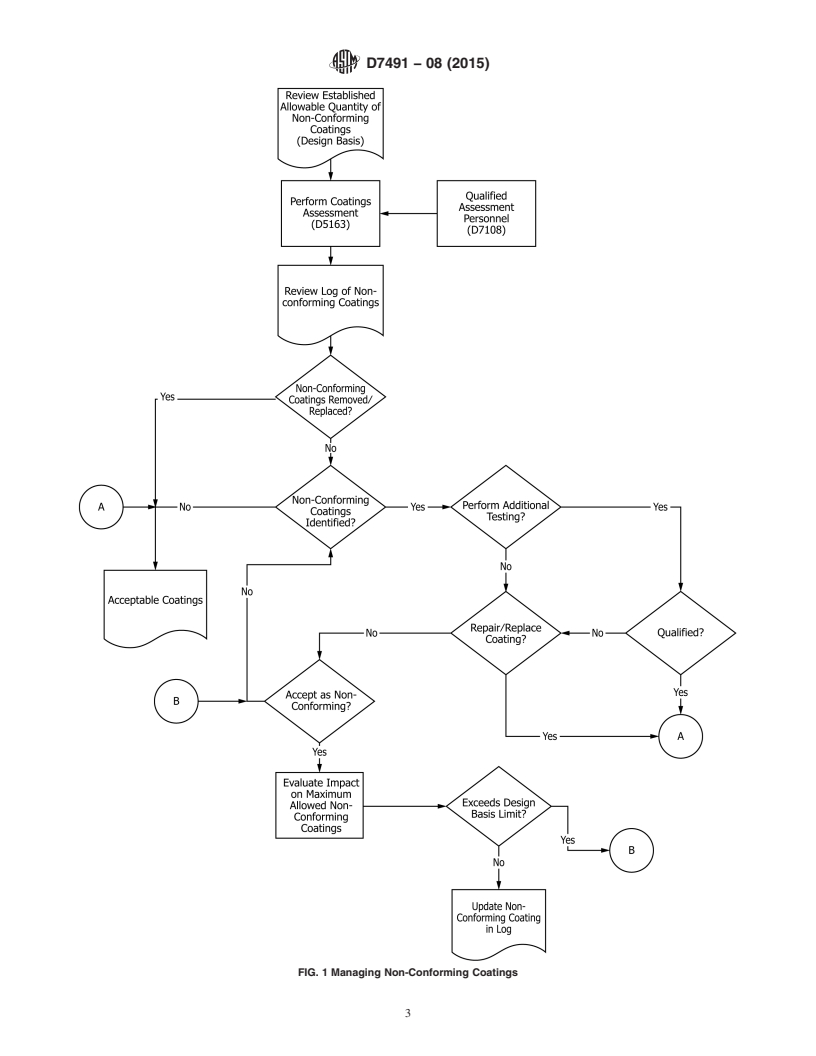
4.1 The process and use of this guide is summarized in
Fig. 1.
5. Significance and Use
5.1 There are several methods for managing non-conforming coatings in an operating nuclear power plant. This guide outlines
methods that have been determined to be acceptable to the nuclear industry.
5.2 Managing the amount of non-conforming coatings is key to ensuring the amount assumed, in the licensing bases is not
exceeded.
5.3 EPRI Report 1003102 Revision 1 (formerly TR-109937) provides additional information on the selection, application,
inspection and maintenance of nuclear plant safety-related protective coatings. This reference offers a detailed discrussiondiscus-
sion of inportantimportant considerations related to protective coatings and can be used to supplement this guide as deemed
necessary.
6. Establishing the Design Limit of Non-Conforming Coatings
6.1 Determine what coatings do not meet the licensing basis for the plant. For plants that have commitments to meet Regulatory
Guide 1.54 (applicable revision) and/or related ANSI/ASTM standards typically require DBA testing of coatings and extensive
documentation associated with the application of the qualified coatings. This may be a more significant requirement to satisfy than
for an older plant which has not made commitments to these requirements.
6.2 The key to ensuring plant safety is to manage the amount of non-conforming coatings so that it does not exceed the amount
assumed in calculations that support plant operation, such as sump suction strainer head loss.
6.3 Managing non-conforming coatings, must consider the capacity of the Emergency Core Cooling System (ECCS) suction
strainer to accommodate debris expected to reach the ECCS suction strainer (including coating debris) without reducing the overall
ECCS pump net positive suction head (NPSH) margin below an acceptable value. Those plants with significant operational NPSH
margin for accommodating additional debris may require less precision when determining the amount of non-conforming coatings;
simplified bounding techniques may be sufficient.
6.4 The non-conforming condition may also affect other plant design and licensing limits, such as coating thickness affects on
the accident heat transfer and peak temperature calculations, and Fire Hazards Analysis.
7. Determining the Amount of Non-Conforming Coatings
7.1 Essentially every plant has some amount of non-conforming coatings inside of primary containment and this may be an
acceptable condition. There are two considerations when identifying non-conforming coatings.
7.1.1 Does the coating meet the licensing basis commitments?
7.1.2 Is there reasonable assurance the coating will not detach during normal operation or a Design Basis Accident (DBA)?
7.2 The amount of coating that was applied inconsistent with licensing commitments and design requirements needs to be
identified.
7.3 It may also be appropriate to review procurement documents (including records of work performed ) for equipment installed
in containment to determine if coating applications performed off site conforms to licensing bases and design requirements.
7.4 If records cannot be found that identify the types and quantities of coatings (for example, weight or volume) installed in
containment, then some area, thickness, and density estimations need to be performed.
7.5 The results of the investigation should be tabulated according to the various containment surfaces, indicating the type,
quantity, location, and qualification classification of the coating applied. Photographic documentation is also helpful for reference
to the findings.
7.6 The tabulation should also consider identification of the complete coating system as applied.
7.7 Periodic reassessment or establishing a new baseline should be considered.
8. Guidance on Managing Non-Conforming Coatings
8.1 Once an accounting of the amount of non-conforming coatings is determined, a decision will need to be made as to how
to manage the results. It is important to know the reason a particular area of coating is non-conforming.
8.1.1 Conditions that may cause a coating to be non-conforming:
(1) Lack of or incomplete documentation for the application process.
(2) Lack of or incomplete documentation regarding applicator qualification.
(3) Lack of or incomplete documentation regarding inspector qualification.
(4) Lack of incomplete design change documentation for the use of alternate coatings.
D7491 − 08 (2015)
FIG. 1 Managing Non-Conforming Coatings
-------------
...
Questions, Comments and Discussion
Ask us and Technical Secretary will try to provide an answer. You can facilitate discussion about the standard in here.