


ASTM D1932-19
(Test Method)Standard Test Method for Thermal Endurance of Flexible Electrical Insulating Varnishes
Standard Test Method for Thermal Endurance of Flexible Electrical Insulating Varnishes
SIGNIFICANCE AND USE
5.1 A major factor affecting the long term performance of insulating materials is thermal degradation. It is possible that factors, such as moisture and vibration, will cause failures after the material has been weakened by thermal degradation.
5.2 An electrical insulating varnish is effective in protecting electrical equipment only as long as it retains its physical and electrical integrity.
5.3 The thermal degradation of the varnish results in weight loss, porosity, crazing, and generally a reduction in flexibility. Degradation of the varnish can be detected by a decrease in dielectric strength, which is therefore used as the failure criterion for this test method.
5.4 Electrical insulating varnishes undergo flexing in service due to vibration and thermal expansion. For this reason, this functional test includes flexing and elongation of the insulation. The electrodes used in this test method are designed to elongate the outer surface of the specimen 2 % with respect to the neutral axis of the base fiber while being tested for dielectric breakdown.
SCOPE
1.1 This test method covers the determination of the relative thermal endurance of flexible electrical insulating varnishes by determining the time necessary at elevated temperatures to decrease the dielectric breakdown of the varnish to an arbitrarily selected value when applied to a standard glass fiber fabric.
1.2 This test method does not apply to varnishes that lose a high percentage of their dielectric breakdown voltage when flexed before elevated temperature exposure as prescribed in the screening test (Section 9). Examples of such varnishes are those used for high speed armatures and laminated structures. Also, this test method is not applicable to varnishes which distort sufficiently during thermal elevated temperature exposure so that they cannot be tested using the curved electrode assembly.
1.3 Thermal endurance is expressed in terms of a temperature index.
1.4 The values stated in SI units are to be regarded as standard. No other units of measurement are included in this standard.
Note 1: There is no equivalent IEC or ISO standard.
1.5 This standard does not purport to address all of the safety concerns, if any, associated with its use. It is the responsibility of the user of this standard to establish appropriate safety, health, and environmental practices and determine the applicability of regulatory limitations prior to use. For specific hazard statements, see Section 7.
1.6 This international standard was developed in accordance with internationally recognized principles on standardization established in the Decision on Principles for the Development of International Standards, Guides and Recommendations issued by the World Trade Organization Technical Barriers to Trade (TBT) Committee.
General Information
- Status
- Published
- Publication Date
- 31-Oct-2019
- Technical Committee
- D09 - Electrical and Electronic Insulating Materials
- Drafting Committee
- D09.01 - Electrical Insulating Products
Relations
- Effective Date
- 01-Nov-2019
- Effective Date
- 01-Mar-2024
- Effective Date
- 01-Jan-2024
- Effective Date
- 01-Oct-2023
- Effective Date
- 01-Jan-2020
- Effective Date
- 01-Nov-2015
- Effective Date
- 01-Feb-2015
- Effective Date
- 01-Nov-2014
- Effective Date
- 01-May-2014
- Effective Date
- 01-Nov-2013
- Effective Date
- 01-Aug-2011
- Effective Date
- 01-Jun-2010
- Effective Date
- 01-Nov-2008
- Effective Date
- 01-May-2008
- Refers
ASTM D2307-07a - Standard Test Method for Thermal Endurance of Film-Insulated Round Magnet Wire - Effective Date
- 01-Oct-2007
Overview
ASTM D1932-19 is the internationally recognized standard test method for evaluating the thermal endurance of flexible electrical insulating varnishes. Established by ASTM International, this standard outlines procedures to determine how long an insulating varnish can maintain its physical and electrical properties when subjected to elevated temperatures. The core purpose is to assess the varnish's ability to resist thermal degradation, a key factor affecting the reliability and lifespan of electrical equipment.
Thermal endurance, as defined in this method, is measured by the time required for the insulating material’s dielectric breakdown voltage to decrease to a specified value. This test is critical for manufacturers and users of electrical insulating materials, as it helps ensure the long-term safety, performance, and integrity of electrical insulation systems.
Key Topics
- Thermal Degradation: Examines how flexible insulating varnishes deteriorate under heat, leading to loss of dielectric strength, flexibility, and physical integrity.
- Dielectric Breakdown Voltage: Uses reduction in dielectric strength as the failure criterion to determine the thermal endpoint for the varnish.
- Flexing and Elongation: Includes testing under mechanical stress (flexing and elongation) to replicate real-world service conditions.
- Temperature Index (TI): Provides a temperature rating based on extrapolated endurance data, allowing comparative evaluation of different varnishes.
- Applicability: Not suitable for varnishes used in high-speed armatures or those losing significant dielectric strength upon pre-test flexing.
- Standardized Test Methodology: Encompasses specimen preparation, exposure at multiple elevated temperatures, and precise measurement of electrical properties.
- Safety and Best Practices: Emphasizes proper laboratory procedures and regulatory compliance during testing.
Applications
ASTM D1932-19 is widely applied in the electrical and electronics industries, specifically for:
- Quality Assurance: Manufacturers use this test method to qualify flexible electrical insulating varnishes for motors, transformers, generators, and other electrical apparatus, ensuring materials meet specified endurance requirements.
- Material Comparison: Enables engineers and product developers to compare the thermal endurance of various insulating varnishes, supporting informed material selection for high-reliability applications.
- Product Certification: Used by third-party test labs and certification bodies as part of product compliance and safety verification processes.
- Research and Development: Supports R&D efforts to design advanced varnishes with improved thermal performance, flexibility, and dielectric properties.
- Preventive Maintenance: Helps predict insulation aging and schedule proactive maintenance or replacement in critical electrical infrastructure.
Related Standards
ASTM D1932-19 references several important standards and practices for its procedures and terminology:
- ASTM D149 - Test Method for Dielectric Breakdown Voltage and Dielectric Strength of Solid Electrical Insulating Materials.
- ASTM D374/D374M - Test Methods for Thickness of Solid Electrical Insulation.
- ASTM D580/D580M - Specification for Greige Woven Glass Tapes and Webbings.
- ASTM D618 - Practice for Conditioning Plastics for Testing.
- ASTM D2307 - Test Method for Thermal Endurance of Film-Insulated Round Magnet Wire.
- IEC 60216 - Guide for Determination of Thermal Endurance Properties of Electrical Insulating Materials (related guidance).
- ASTM D1711 - Terminology Relating to Electrical Insulation.
Keywords
ASTM D1932, thermal endurance, flexible electrical insulating varnishes, dielectric breakdown, electrical insulation, thermal degradation, temperature index, ASTM standards, reliability of insulating materials.
Adhering to ASTM D1932-19 ensures reliable assessment of the long-term thermal endurance of flexible electrical insulating varnishes, ultimately promoting the safety and durability of electrical equipment in demanding environments.
Buy Documents
ASTM D1932-19 - Standard Test Method for Thermal Endurance of Flexible Electrical Insulating Varnishes
REDLINE ASTM D1932-19 - Standard Test Method for Thermal Endurance of Flexible Electrical Insulating Varnishes
Get Certified
Connect with accredited certification bodies for this standard

Intertek Testing Services NA Inc.
Intertek certification services in North America.

UL Solutions
Global safety science company with testing, inspection and certification.

ANCE
Mexican certification and testing association.
Sponsored listings
Frequently Asked Questions
ASTM D1932-19 is a standard published by ASTM International. Its full title is "Standard Test Method for Thermal Endurance of Flexible Electrical Insulating Varnishes". This standard covers: SIGNIFICANCE AND USE 5.1 A major factor affecting the long term performance of insulating materials is thermal degradation. It is possible that factors, such as moisture and vibration, will cause failures after the material has been weakened by thermal degradation. 5.2 An electrical insulating varnish is effective in protecting electrical equipment only as long as it retains its physical and electrical integrity. 5.3 The thermal degradation of the varnish results in weight loss, porosity, crazing, and generally a reduction in flexibility. Degradation of the varnish can be detected by a decrease in dielectric strength, which is therefore used as the failure criterion for this test method. 5.4 Electrical insulating varnishes undergo flexing in service due to vibration and thermal expansion. For this reason, this functional test includes flexing and elongation of the insulation. The electrodes used in this test method are designed to elongate the outer surface of the specimen 2 % with respect to the neutral axis of the base fiber while being tested for dielectric breakdown. SCOPE 1.1 This test method covers the determination of the relative thermal endurance of flexible electrical insulating varnishes by determining the time necessary at elevated temperatures to decrease the dielectric breakdown of the varnish to an arbitrarily selected value when applied to a standard glass fiber fabric. 1.2 This test method does not apply to varnishes that lose a high percentage of their dielectric breakdown voltage when flexed before elevated temperature exposure as prescribed in the screening test (Section 9). Examples of such varnishes are those used for high speed armatures and laminated structures. Also, this test method is not applicable to varnishes which distort sufficiently during thermal elevated temperature exposure so that they cannot be tested using the curved electrode assembly. 1.3 Thermal endurance is expressed in terms of a temperature index. 1.4 The values stated in SI units are to be regarded as standard. No other units of measurement are included in this standard. Note 1: There is no equivalent IEC or ISO standard. 1.5 This standard does not purport to address all of the safety concerns, if any, associated with its use. It is the responsibility of the user of this standard to establish appropriate safety, health, and environmental practices and determine the applicability of regulatory limitations prior to use. For specific hazard statements, see Section 7. 1.6 This international standard was developed in accordance with internationally recognized principles on standardization established in the Decision on Principles for the Development of International Standards, Guides and Recommendations issued by the World Trade Organization Technical Barriers to Trade (TBT) Committee.
SIGNIFICANCE AND USE 5.1 A major factor affecting the long term performance of insulating materials is thermal degradation. It is possible that factors, such as moisture and vibration, will cause failures after the material has been weakened by thermal degradation. 5.2 An electrical insulating varnish is effective in protecting electrical equipment only as long as it retains its physical and electrical integrity. 5.3 The thermal degradation of the varnish results in weight loss, porosity, crazing, and generally a reduction in flexibility. Degradation of the varnish can be detected by a decrease in dielectric strength, which is therefore used as the failure criterion for this test method. 5.4 Electrical insulating varnishes undergo flexing in service due to vibration and thermal expansion. For this reason, this functional test includes flexing and elongation of the insulation. The electrodes used in this test method are designed to elongate the outer surface of the specimen 2 % with respect to the neutral axis of the base fiber while being tested for dielectric breakdown. SCOPE 1.1 This test method covers the determination of the relative thermal endurance of flexible electrical insulating varnishes by determining the time necessary at elevated temperatures to decrease the dielectric breakdown of the varnish to an arbitrarily selected value when applied to a standard glass fiber fabric. 1.2 This test method does not apply to varnishes that lose a high percentage of their dielectric breakdown voltage when flexed before elevated temperature exposure as prescribed in the screening test (Section 9). Examples of such varnishes are those used for high speed armatures and laminated structures. Also, this test method is not applicable to varnishes which distort sufficiently during thermal elevated temperature exposure so that they cannot be tested using the curved electrode assembly. 1.3 Thermal endurance is expressed in terms of a temperature index. 1.4 The values stated in SI units are to be regarded as standard. No other units of measurement are included in this standard. Note 1: There is no equivalent IEC or ISO standard. 1.5 This standard does not purport to address all of the safety concerns, if any, associated with its use. It is the responsibility of the user of this standard to establish appropriate safety, health, and environmental practices and determine the applicability of regulatory limitations prior to use. For specific hazard statements, see Section 7. 1.6 This international standard was developed in accordance with internationally recognized principles on standardization established in the Decision on Principles for the Development of International Standards, Guides and Recommendations issued by the World Trade Organization Technical Barriers to Trade (TBT) Committee.
ASTM D1932-19 is classified under the following ICS (International Classification for Standards) categories: 29.035.60 - Varnished fabrics. The ICS classification helps identify the subject area and facilitates finding related standards.
ASTM D1932-19 has the following relationships with other standards: It is inter standard links to ASTM D1932-18, ASTM D1711-24, ASTM D580/D580M-24, ASTM D374/D374M-23, ASTM D149-20, ASTM D1711-15, ASTM D580/D580M-15, ASTM D1711-14a, ASTM D1711-14, ASTM D1711-13, ASTM D1711-11a, ASTM D580/D580M-10, ASTM D618-08, ASTM D1711-08, ASTM D2307-07a. Understanding these relationships helps ensure you are using the most current and applicable version of the standard.
ASTM D1932-19 is available in PDF format for immediate download after purchase. The document can be added to your cart and obtained through the secure checkout process. Digital delivery ensures instant access to the complete standard document.
Standards Content (Sample)
This international standard was developed in accordance with internationally recognized principles on standardization established in the Decision on Principles for the
Development of International Standards, Guides and Recommendations issued by the World Trade Organization Technical Barriers to Trade (TBT) Committee.
Designation: D1932 − 19
Standard Test Method for
Thermal Endurance of Flexible Electrical Insulating
Varnishes
This standard is issued under the fixed designation D1932; the number immediately following the designation indicates the year of
original adoption or, in the case of revision, the year of last revision. A number in parentheses indicates the year of last reapproval. A
superscript epsilon (´) indicates an editorial change since the last revision or reapproval.
This standard has been approved for use by agencies of the U.S. Department of Defense.
1. Scope* mendations issued by the World Trade Organization Technical
Barriers to Trade (TBT) Committee.
1.1 Thistestmethodcoversthedeterminationoftherelative
thermal endurance of flexible electrical insulating varnishes by
2. Referenced Documents
determining the time necessary at elevated temperatures to
2.1 ASTM Standards:
decrease the dielectric breakdown of the varnish to an arbi-
D149 Test Method for Dielectric Breakdown Voltage and
trarily selected value when applied to a standard glass fiber
DielectricStrengthofSolidElectricalInsulatingMaterials
fabric.
at Commercial Power Frequencies
1.2 This test method does not apply to varnishes that lose a
D374/D374M Test Methods for Thickness of Solid Electri-
high percentage of their dielectric breakdown voltage when
cal Insulation
flexed before elevated temperature exposure as prescribed in
D580/D580M Specification for Greige Woven Glass Tapes
the screening test (Section 9). Examples of such varnishes are
and Webbings
those used for high speed armatures and laminated structures.
D618 Practice for Conditioning Plastics for Testing
Also, this test method is not applicable to varnishes which
D1346 Test Method for Testing Electrical Insulating Var-
distort sufficiently during thermal elevated temperature expo-
nishes for 180 C and Above (Withdrawn 1986)
sure so that they cannot be tested using the curved electrode
D1711 Terminology Relating to Electrical Insulation
assembly.
D2307 Test Method for Thermal Endurance of Film-
Insulated Round Magnet Wire
1.3 Thermal endurance is expressed in terms of a tempera-
D2518 Specification for Woven Glass Fabrics for Electrical
ture index.
Insulation (Withdrawn 2013)
1.4 The values stated in SI units are to be regarded as
D5423 Specification for Forced-Convection Laboratory Ov-
standard. No other units of measurement are included in this
ens for Evaluation of Electrical Insulation
standard.
2.2 IEC Publications:
NOTE 1—There is no equivalent IEC or ISO standard. IEC 60216 Guide for the Determination of Thermal Endur-
ance Properties of Electrical Insulating Materials (Part 1)
1.5 This standard does not purport to address all of the
safety concerns, if any, associated with its use. It is the
3. Terminology
responsibility of the user of this standard to establish appro-
3.1 Definitions:
priate safety, health, and environmental practices and deter-
3.1.1 For definitions of terms used in this test method refer
mine the applicability of regulatory limitations prior to use.
to Terminology D1711.
For specific hazard statements, see Section 7.
3.2 Definitions of Terms Specific to This Standard:
1.6 This international standard was developed in accor-
3.2.1 temperature index (TI), n—a number which permits
dance with internationally recognized principles on standard-
comparison of the temperature/time characteristics of an elec-
ization established in the Decision on Principles for the
trical insulating material, or a simple combination of materials,
Development of International Standards, Guides and Recom-
For referenced ASTM standards, visit the ASTM website, www.astm.org, or
contact ASTM Customer Service at service@astm.org. For Annual Book of ASTM
This test method is under the jurisdiction of ASTM Committee D09 on Standards volume information, refer to the standard’s Document Summary page on
Electrical and Electronic Insulating Materials and is the direct responsibility of theASTM website.
Subcommittee D09.01 on Electrical Insulating Products. The last approved version of this historical standard is referenced on
Current edition approved Nov. 1, 2019. Published November 2019. Originally www.astm.org.
approved in 1967. Last previous edition approved in 2018 as D1932 – 18. DOI: Available from American National Standards Institute, 25 West 43rd St., 4th
10.1520/D1932-19. Floor, New York, NY 10036.
*A Summary of Changes section appears at the end of this standard
Copyright © ASTM International, 100 Barr Harbor Drive, PO Box C700, West Conshohocken, PA 19428-2959. United States
D1932 − 19
based on the temperature in degrees Celsius which is obtained These values are used to construct a thermal endurance graph
by extrapolating the Arrhenius plot of endpoint time versus for use to estimate temperature indices.
temperature to a specified time, usually 20 000 h.
4.3 This test method is not applicable to materials having an
3.2.2 thermal endurance graph, n—an Arrhenius plot.
initial dielectric breakdown voltage of less than 12 kV/mm
(300 V/mil) of original thickness unless lower endpoint values
3.2.3 thermal endpoint time, n—the time necessary for a
are agreed upon or indicated in the applicable material speci-
specific property of a material, or a simple combination of
fications.
materials, to degrade to a defined end point when aged at a
specified temperature.
5. Significance and Use
3.2.4 thermal life endpoint time, n—a graphical representa-
5.1 A major factor affecting the long term performance of
tion of thermal endpoint time at a specified exposure tempera-
ture in which the value of a property of a material, or a simple insulating materials is thermal degradation. It is possible that
factors, such as moisture and vibration, will cause failures after
combination of materials, is measured at room temperature and
the material has been weakened by thermal degradation.
the values plotted as a function of time.
3.2.5 varnish, electrical insulating, n—a liquid resin system
5.2 An electrical insulating varnish is effective in protecting
that is applied to and cured on electrical components providing
electrical equipment only as long as it retains its physical and
electrical, mechanical, and environmental protection.
electrical integrity.
5.3 The thermal degradation of the varnish results in weight
3.2.5.1 Discussion—There are two types of electrical insu-
loss, porosity, crazing, and generally a reduction in flexibility.
latingvarnish:solvent-containingandsolventless.Thesolvent-
Degradation of the varnish can be detected by a decrease in
containing varnish is a solution, dispersion, or emulsion of a
dielectric strength, which is therefore used as the failure
polymer or mixture of polymers in a volatile, nonreactable
criterion for this test method.
liquid. The solventless type is a liquid resin system free of
volatile, nonreactable solvents.
5.4 Electrical insulating varnishes undergo flexing in ser-
vice due to vibration and thermal expansion. For this reason,
4. Summary of Test Method
this functional test includes flexing and elongation of the
insulation.The electrodes used in this test method are designed
4.1 Specimens are prepared using glass cloth coated with
to elongate the outer surface of the specimen 2 % with respect
the selected varnish to a specified build.
to the neutral axis of the base fiber while being tested for
4.2 Specimens are exposed in air at a minimum of three
dielectric breakdown.
temperatures above the expected use temperature of the mate-
rial. Dielectric breakdown voltage tests in air at room tempera-
6. Apparatus
ture are periodically made to determine the exposure time at
eachtesttemperaturerequiredtoreducethebreakdownvoltage 6.1 Electrode Test Fixture—The fixture shall be in accor-
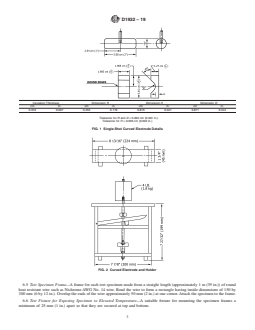
to a value of 12 kV/mm (300 V/mil) of original thickness. dance with the dimensions shown in Fig. 1 and Fig. 2.
Insulation Thickness Dimension R Dimension H Dimension D
cm in. cm in. cm in. cm in.
0.018 0.007 0.455 0.179 0.815 0.321 0.871 0.344
Tolerance for R and D = 0.003 cm (0.001 in.)
Tolerance for H = 0.005 cm (0.002 in.)
FIG. 1 Single-Shot Curved Electrode Details
D1932 − 19
7. Safety Precautions
7.1 It is unsafe to use varnish at temperatures above the
flash point without adequate ventilation, especially if the
possibility exists that flames or sparks are present. Store
varnish in sealed containers.
8. Test Specimens
8.1 Prepare glass cloth panels 150 by 300 mm (6 by 12 in.)
with the 300 mm (12 in.) dimension parallel to the warp
threads. Use fabric style No. 116 in accordance with Specifi-
cation D2518. Heat clean the specimens as specified in
Methods D1346 to arrive at a volatile content not to exceed
0.1 % in accordance with Specification D580/D580M.
8.2 Prepare the test specimen by dipping a glass cloth panel
described in 8.1 in the varnish at the standard laboratory
atmosphere described in Practice D618. Prior to dipping
panels, adjust the viscosity of the varnish to be tested by trial
so that two coats will give an over-all thickness of 0.178 6
0.0127 mm (0.007 6 0.0005 in.).
8.3 Immerse the panel in the varnish in the direction of the
300 mm (12 in.) length until bubbling stops, mechanically
withdraw at the rate of 90–110 mm (3.5–4.3 in.)/min, and then
allow to drain for ⁄2 h at the standard laboratory atmosphere.
8.4 Bake the specimen in the same vertical position as
dipped. Reverse the specimen, dip a second time, and drain as
above. Bake the specimen at such a temperature and for such
FIG. 2 Curved Electrode and Holder
a time as specified by the varnish manufacturer.
8.5 Prepare a set of twelve or more specimens for each
exposure temperature.
Electrodes shall be of polished brass, with the upper electrode
9. Screening Test
having a mass of 1.8 6 0.05 kg (4.0 6 0.1 lb).
9.1 Prepare one test specimen. Condition the specimen 48 h
6.2 Dielectric Breakdown Test Set—The set shall meet the
in the standard laboratory atmosphere. Cut five 25 by 300 mm
requirements of Test Method D149.
(1 by 12 in.) test strips from the center of the specimen,
6.3 Ovens—A forced draft constant-temperature oven con-
discardingthe12.5by300mm( ⁄2by12in.)portionfromeach
forming to Specification D5423, Type II.
side. Bend each of the five test strips once, 115 mm (4 ⁄2 in.)
6.4 Micrometer—Dead-weight type specified in Test Meth- from one end, 180° around a mandrel 3.175 mm (0.125 in.) in
odsD374/D374M,havingapresserfoot6.35 60.03mm(0.25 diameter.
6 0.001 in.) in diameter and an anvil of at least 50 mm (2 in.)
9.2 Measure the dielectric breakdown voltage on the bent
diameter and shall exert a pressure of 0.17 6 0.01 MPa (25 6
area of each five test strips. In like manner, make five
2 psi) on the pressure foot.
breakdown tests on th
...
This document is not an ASTM standard and is intended only to provide the user of an ASTM standard an indication of what changes have been made to the previous version. Because
it may not be technically possible to adequately depict all changes accurately, ASTM recommends that users consult prior editions as appropriate. In all cases only the current version
of the standard as published by ASTM is to be considered the official document.
Designation: D1932 − 18 D1932 − 19
Standard Test Method for
Thermal Endurance of Flexible Electrical Insulating
Varnishes
This standard is issued under the fixed designation D1932; the number immediately following the designation indicates the year of
original adoption or, in the case of revision, the year of last revision. A number in parentheses indicates the year of last reapproval. A
superscript epsilon (´) indicates an editorial change since the last revision or reapproval.
This standard has been approved for use by agencies of the U.S. Department of Defense.
1. Scope*
1.1 This test method covers the determination of the relative thermal endurance of flexible electrical insulating varnishes by
determining the time necessary at elevated temperatures to decrease the dielectric breakdown of the varnish to an arbitrarily
selected value when applied to a standard glass fiber fabric.
1.2 This test method does not apply to varnishes that lose a high percentage of their dielectric breakdown voltage when flexed
before elevated temperature exposure as prescribed in the screening test (Section 9). Examples of such varnishes are those used
for high speed armatures and laminated structures. Also, this test method is not applicable to varnishes which distort sufficiently
during thermal elevated temperature exposure so that they cannot be tested using the curved electrode assembly.
1.3 Thermal endurance is expressed in terms of a temperature index.
1.4 The values stated in SI units are to be regarded as standard. No other units of measurement are included in this standard.
NOTE 1—There is no equivalent IEC or ISO standard.
1.5 This standard does not purport to address all of the safety concerns, if any, associated with its use. It is the responsibility
of the user of this standard to establish appropriate safety, health, and environmental practices and determine the applicability of
regulatory limitations prior to use. For specific hazard statements, see Section 7.
1.6 This international standard was developed in accordance with internationally recognized principles on standardization
established in the Decision on Principles for the Development of International Standards, Guides and Recommendations issued
by the World Trade Organization Technical Barriers to Trade (TBT) Committee.
2. Referenced Documents
2.1 ASTM Standards:
D149 Test Method for Dielectric Breakdown Voltage and Dielectric Strength of Solid Electrical Insulating Materials at
Commercial Power Frequencies
D374/D374M Test Methods for Thickness of Solid Electrical Insulation
D580/D580M Specification for Greige Woven Glass Tapes and Webbings
D618 Practice for Conditioning Plastics for Testing
D1346 Test Method for Testing Electrical Insulating Varnishes for 180 C and Above (Withdrawn 1986)
D1711 Terminology Relating to Electrical Insulation
D2307 Test Method for Thermal Endurance of Film-Insulated Round Magnet Wire
D2518 Specification for Woven Glass Fabrics for Electrical Insulation (Withdrawn 2013)
D5423 Specification for Forced-Convection Laboratory Ovens for Evaluation of Electrical Insulation
2.2 IEC Publications:
IEC 60216 Guide for the Determination of Thermal Endurance Properties of Electrical Insulating Materials (Part 1)
This test method is under the jurisdiction of ASTM Committee D09 on Electrical and Electronic Insulating Materials and is the direct responsibility of Subcommittee
D09.01 on Electrical Insulating Products.
Current edition approved Nov. 1, 2018Nov. 1, 2019. Published November 2018November 2019. Originally approved in 1967. Last previous edition approved in 20132018
as D1932 – 13.D1932 – 18. DOI: 10.1520/D1932-18.10.1520/D1932-19.
For referenced ASTM standards, visit the ASTM website, www.astm.org, or contact ASTM Customer Service at service@astm.org. For Annual Book of ASTM Standards
volume information, refer to the standard’s Document Summary page on the ASTM website.
The last approved version of this historical standard is referenced on www.astm.org.
Available from American National Standards Institute, 25 West 43rd St., 4th Floor, New York, NY 10036.
*A Summary of Changes section appears at the end of this standard
Copyright © ASTM International, 100 Barr Harbor Drive, PO Box C700, West Conshohocken, PA 19428-2959. United States
D1932 − 19
3. Terminology
3.1 Definitions:
3.1.1 For definitions of terms used in this test method refer to Terminology D1711.
3.2 Definitions:Definitions of Terms Specific to This Standard:
3.2.1 temperature index (TI), n—a number which permits comparison of the temperature/time characteristics of an electrical
insulating material, or a simple combination of materials, based on the temperature in degrees Celsius which is obtained by
extrapolating the Arrhenius plot of endpoint time versus temperature to a specified time, usually 20 000 h.
3.2.2 thermal endurance graph, n—an Arrhenius plot.
3.2.3 thermal endpoint time, n—the time necessary for a specific property of a material, or a simple combination of materials,
to degrade to a defined end point when aged at a specified temperature.
3.2.4 thermal life endpoint time, n—a graphical representation of thermal endpoint time at a specified exposure temperature in
which the value of a property of a material, or a simple combination of materials, is measured at room temperature and the values
plotted as a function of time.
3.1.5 Refer to Terminology D1711 for definitions of other terms.
3.2.5 varnish, electrical insulating, n—a liquid resin system that is applied to and cured on electrical components providing
electrical, mechanical, and environmental protection.
3.2.5.1 Discussion—
There are two types of electrical insulating varnish: solvent-containing and solventless. The solvent-containing varnish is a
solution, dispersion, or emulsion of a polymer or mixture of polymers in a volatile, nonreactable liquid. The solventless type is
a liquid resin system free of volatile, nonreactable solvents.
4. Summary of Test Method
4.1 Specimens are prepared using glass cloth coated with the selected varnish to a specified build.
4.2 Specimens are exposed in air at a minimum of three temperatures above the expected use temperature of the material.
Dielectric breakdown voltage tests in air at room temperature are periodically made to determine the exposure time at each test
temperature required to reduce the breakdown voltage to a value of 12 kV/mm (300 V/mil) of original thickness. These values are
used to construct a thermal endurance graph for use to estimate temperature indices.
4.3 This test method is not applicable to materials having an initial dielectric breakdown voltage of less than 12 kV/mm (300
V/mil) of original thickness unless lower endpoint values are agreed upon or indicated in the applicable material specifications.
5. Significance and Use
5.1 A major factor affecting the long term performance of insulating materials is thermal degradation. It is possible that factors,
such as moisture and vibration, will cause failures after the material has been weakened by thermal degradation.
5.2 An electrical insulating varnish is effective in protecting electrical equipment only as long as it retains its physical and
electrical integrity.
5.3 The thermal degradation of the varnish results in weight loss, porosity, crazing, and generally a reduction in flexibility.
Degradation of the varnish can be detected by a decrease in dielectric strength, which is therefore used as the failure criterion for
this test method.
5.4 Electrical insulating varnishes undergo flexing in service due to vibration and thermal expansion. For this reason, this
functional test includes flexing and elongation of the insulation. The electrodes used in this test method are designed to elongate
the outer surface of the specimen 2 % with respect to the neutral axis of the base fiber while being tested for dielectric breakdown.
6. Apparatus
6.1 Electrode Test Fixture—The fixture shall be in accordance with the dimensions shown in Fig. 1 and Fig. 2. Electrodes shall
be of polished brass, with the upper electrode having a mass of 1.8 6 0.05 kg (4.0 6 0.1 lb).
6.2 Dielectric Breakdown Test Set—The set shall meet the requirements of Test Method D149.
6.3 Ovens—A forced draft constant-temperature oven conforming to Specification D5423, Type II.
6.4 Micrometer—Dead-weight type specified in Test Methods D374/D374M, having a presser foot 6.35 6 0.03 mm (0.25 6
0.001 in.) in diameter and an anvil of at least 50 mm (2 in.) diameter and shall exert a pressure of 0.17 6 0.01 MPa (25 6 2 psi)
on the pressure foot.
D1932 − 19
Insulation Thickness Dimension R Dimension H Dimension D
cm in. cm in. cm in. cm in.
0.018 0.007 0.455 0.179 0.815 0.321 0.871 0.344
Tolerance for R and D = 0.003 cm (0.001 in.)
Tolerance for H = 0.005 cm (0.002 in.)
FIG. 1 Single-Shot Curved Electrode Details
FIG. 2 Curved Electrode and Holder
6.5 Test Specimen Frame—A frame for each test specimen made from a straight length (approximately 1 m (39 in.)) of round
heat resistant wire such as Nichrome AWG No. 14 wire. Bend the wire to form a rectangle having inside dimensions of 150 by
300 mm (6 by 12 in.). Overlap the ends of the wire approximately 50 mm (2 in.) at one corner. Attach the specimen to the frame.
6.6 Test Fixture for Exposing Specimen to Elevated Temperature—A suitable fixture for mounting the specimen frames a
minimum of 25 mm (1 in.) apart so that they are secured at top and bottom.
D1932 − 19
6.7 Dipping Apparatus—An apparatus capable of removing the specimen from the varnish at the rate of 90–110 mm (3.5–4.3
in.)/min.
7. Safety Precautions
7.1 It is unsafe to use varnish at temperatures above the flash point without adequate ventilation, especially if the possibility
exists that flames or sparks are present. Store varnish in sealed containers.
8. Test Specimens
8.1 Prepare glass cloth panels 150 by 300 mm (6 by 12 in.) with the 300 mm (12 in.) dimension parallel to the warp threads.
Use fabric style No. 116 in accordance with Specification D2518. Heat clean the specimens as specified in Methods D1346 to
arrive at a volatile content not to exceed 0.1 % in accordance with Specification D580/D580M.
8.2 Prepare the test specimen by dipping a glass cloth panel described in 8.1 in the varnish at the standard laboratory atmosphere
described in Practice D618. Prior to dipping panels, adjust the viscosity of the varnish to be tested by trial so that two coats will
give an over-all thickness of 0.178 6 0.0127 mm (0.007 6 0.0005 in.).
8.3 Immerse the panel in the varnish in the direction of the 300 mm (12 in.) length until bubbling stops, mechanically withdraw
at the rate of 90–110 mm (3.5–4.3 in.)/min, and then allow to drain for ⁄2 h at the standard laboratory atmosphere.
8.4 Bake the specimen in the same vertical position as dipped. Reverse the specimen, dip a secon
...
Questions, Comments and Discussion
Ask us and Technical Secretary will try to provide an answer. You can facilitate discussion about the standard in here.
Loading comments...