

ASTM G67-24
(Test Method)Standard Test Method for Determining the Susceptibility to Intergranular Corrosion of 5XXX Series Aluminum Alloys by Mass Loss After Exposure to Nitric Acid (NAMLT Test)
General Information
- Abstract
SIGNIFICANCE AND USE
4.1 This test method provides a quantitative measure of the susceptibility to intergranular corrosion of Al-Mg and Al-Mg-Mn alloys. The nitric acid dissolves a second phase, an aluminum-magnesium intermetallic compound (βAl-Mg), in preference to the solid solution of magnesium in the aluminum matrix. When this compound is precipitated in a relatively continuous network along grain boundaries, the effect of the preferential attack is to corrode around the grains, causing them to fall away from the specimens. Such dropping out of the grains causes relatively large mass losses of the order of 25 mg/cm2 to 75 mg/cm2 (160 mg/in.2 to 480 mg/in.2), whereas, samples of intergranular-resistant materials lose only about 1 mg/cm2 to 15 mg/cm2 (10 mg/in.2 to 100 mg/in.2). When the βAl-Mg compound is randomly distributed, the preferential attack can result in intermediate mass losses. Metallographic examination is required in such cases to establish whether or not the loss in mass is the result of intergranular attack.
4.2 The precipitation of the second phase in the grain boundaries also gives rise to intergranular corrosion when the material is exposed to chloride-containing natural environments, such as seacoast atmospheres or sea water. The extent to which the alloy will be susceptible to intergranular corrosion depends upon the degree of precipitate continuity in the grain boundaries. Visible manifestations of the attack may be in various forms such as pitting, exfoliation, or stress-corrosion cracking, depending upon the morphology of the grain structure and the presence of sustained tensile stress.3
SCOPE
1.1 This test method, also known as the Nitric Acid Mass Loss Test (NAMLT), covers a procedure for constant immersion intergranular corrosion testing of 5XXX series aluminum alloys.
1.2 This test method is applicable only to wrought products.
1.3 This test method covers type of specimen, specimen preparation, test environment, and method of exposure.
1.4 The values stated in SI units are to be regarded as the standard. The values given in parentheses are for information only.
1.5 This standard does not purport to address all of the safety concerns, if any, associated with its use. It is the responsibility of the user of this standard to establish appropriate safety, health, and environmental practices and determine the applicability of regulatory limitations prior to use.
1.6 This international standard was developed in accordance with internationally recognized principles on standardization established in the Decision on Principles for the Development of International Standards, Guides and Recommendations issued by the World Trade Organization Technical Barriers to Trade (TBT) Committee.
- Status
- Published
- Publication Date
- 14-Jan-2024
- Technical Committee
- G01 - Corrosion of Metals
- Drafting Committee
- G01.05 - Laboratory Corrosion Tests
Buy Documents
ASTM G67-24 - Standard Test Method for Determining the Susceptibility to Intergranular Corrosion of 5XXX Series Aluminum Alloys by Mass Loss After Exposure to Nitric Acid (NAMLT Test)
REDLINE ASTM G67-24 - Standard Test Method for Determining the Susceptibility to Intergranular Corrosion of 5XXX Series Aluminum Alloys by Mass Loss After Exposure to Nitric Acid (NAMLT Test)
Overview
ASTM G67-24: Standard Test Method for Determining the Susceptibility to Intergranular Corrosion of 5XXX Series Aluminum Alloys by Mass Loss After Exposure to Nitric Acid (NAMLT Test) is a crucial international standard that provides a reliable laboratory procedure to quantitatively evaluate the intergranular corrosion susceptibility of 5XXX series aluminum alloys. Developed by ASTM International, this test, also known as the Nitric Acid Mass Loss Test (NAMLT), is primarily applied to wrought products and is recognized for its effectiveness in measuring corrosion resistance due to grain boundary sensitization.
The method involves continuously immersing prepared specimens in concentrated nitric acid at controlled temperatures, followed by measurement of mass loss, which serves as a direct indicator of susceptibility to intergranular corrosion.
Key Topics
- Intergranular Corrosion in 5XXX Series Aluminum Alloys: This test method targets grain boundary corrosion, particularly in Al-Mg and Al-Mg-Mn alloys. The presence and distribution of the βAl-Mg intermetallic compound at grain boundaries significantly influence corrosion behavior.
- Quantitative Evaluation: The NAMLT test provides a numerical value (mg/cm²) for mass loss, distinguishing materials with varying levels of resistance to intergranular corrosion.
- Sample Preparation and Testing: The standard specifies details about specimen type, preparation, immersion environment, and cleaning processes.
- Precision and Control: High sensitivity to parameters such as temperature necessitates stringent laboratory control and verification against standard reference materials.
- Reporting Requirements: The test mandates precise documentation of alloy identification, mass loss, sample dimensions, and test conditions for traceable, reproducible results.
Applications
ASTM G67-24 is commonly used in industries where aluminum corrosion resistance is critical, particularly in:
- Marine and Shipbuilding: 5XXX series aluminum alloys, known for their high magnesium content, are widely used in ship hulls and marine structures due to their strength-to-weight ratio and resistance to saltwater corrosion. This standard is vital for qualifying aluminum materials in marine environments, prone to chloride-induced intergranular corrosion.
- Automotive and Transportation: Lightweight aluminum components require validation of long-term durability and resistance to corrosion, especially under stress and environmental exposure.
- Aerospace: Aircraft parts made from 5XXX alloys are regularly tested to ensure reliability and safety, as intergranular corrosion can compromise mechanical performance.
- Material Development and Quality Assurance: Research and development teams use the NAMLT test to evaluate new alloys, heat treatments, or processing methods. Manufacturers apply this standard for batch certification and process control.
The practical value of ASTM G67-24 lies in its ability to differentiate between corrosion-resistant and susceptible materials, thus supporting material selection, certification, and failure analysis.
Related Standards
Several ASTM standards support or complement the application of ASTM G67-24:
- ASTM D1193: Specification for Reagent Water - outlines water purity requirements.
- ASTM E29: Guidance on significant digits and test data conformance.
- ASTM E691: Procedures for interlaboratory studies to determine test method precision.
- ASTM G1: Practices for preparing, cleaning, and evaluating corrosion test specimens.
- ASTM G16: Guide for applying statistics to corrosion data analysis.
Additionally, this standard aligns with internationally recognized principles for standardization developed by the World Trade Organization (WTO) Technical Barriers to Trade (TBT) Committee, ensuring global relevance and acceptance.
Keywords: ASTM G67-24, NAMLT test, intergranular corrosion, 5XXX series aluminum alloys, nitric acid mass loss test, aluminum corrosion resistance, grain boundary sensitization, ASTM International, material testing, marine aluminum alloys, corrosion testing standard.
Relations
- Effective Date
- 15-Jan-2024
- Effective Date
- 15-Jan-2024
- Effective Date
- 15-Jan-2024
- Effective Date
- 15-Jan-2024
Buy Documents
ASTM G67-24 - Standard Test Method for Determining the Susceptibility to Intergranular Corrosion of 5XXX Series Aluminum Alloys by Mass Loss After Exposure to Nitric Acid (NAMLT Test)
REDLINE ASTM G67-24 - Standard Test Method for Determining the Susceptibility to Intergranular Corrosion of 5XXX Series Aluminum Alloys by Mass Loss After Exposure to Nitric Acid (NAMLT Test)
Get Certified
Connect with accredited certification bodies for this standard

Element Materials Technology
Materials testing and product certification.

Inštitut za kovinske materiale in tehnologije
Institute of Metals and Technology. Materials testing, metallurgical analysis, NDT.
Sponsored listings
Frequently Asked Questions
ASTM G67-24 is a standard published by ASTM International. Its full title is "Standard Test Method for Determining the Susceptibility to Intergranular Corrosion of 5XXX Series Aluminum Alloys by Mass Loss After Exposure to Nitric Acid (NAMLT Test)". This standard covers: SIGNIFICANCE AND USE 4.1 This test method provides a quantitative measure of the susceptibility to intergranular corrosion of Al-Mg and Al-Mg-Mn alloys. The nitric acid dissolves a second phase, an aluminum-magnesium intermetallic compound (βAl-Mg), in preference to the solid solution of magnesium in the aluminum matrix. When this compound is precipitated in a relatively continuous network along grain boundaries, the effect of the preferential attack is to corrode around the grains, causing them to fall away from the specimens. Such dropping out of the grains causes relatively large mass losses of the order of 25 mg/cm2 to 75 mg/cm2 (160 mg/in.2 to 480 mg/in.2), whereas, samples of intergranular-resistant materials lose only about 1 mg/cm2 to 15 mg/cm2 (10 mg/in.2 to 100 mg/in.2). When the βAl-Mg compound is randomly distributed, the preferential attack can result in intermediate mass losses. Metallographic examination is required in such cases to establish whether or not the loss in mass is the result of intergranular attack. 4.2 The precipitation of the second phase in the grain boundaries also gives rise to intergranular corrosion when the material is exposed to chloride-containing natural environments, such as seacoast atmospheres or sea water. The extent to which the alloy will be susceptible to intergranular corrosion depends upon the degree of precipitate continuity in the grain boundaries. Visible manifestations of the attack may be in various forms such as pitting, exfoliation, or stress-corrosion cracking, depending upon the morphology of the grain structure and the presence of sustained tensile stress.3 SCOPE 1.1 This test method, also known as the Nitric Acid Mass Loss Test (NAMLT), covers a procedure for constant immersion intergranular corrosion testing of 5XXX series aluminum alloys. 1.2 This test method is applicable only to wrought products. 1.3 This test method covers type of specimen, specimen preparation, test environment, and method of exposure. 1.4 The values stated in SI units are to be regarded as the standard. The values given in parentheses are for information only. 1.5 This standard does not purport to address all of the safety concerns, if any, associated with its use. It is the responsibility of the user of this standard to establish appropriate safety, health, and environmental practices and determine the applicability of regulatory limitations prior to use. 1.6 This international standard was developed in accordance with internationally recognized principles on standardization established in the Decision on Principles for the Development of International Standards, Guides and Recommendations issued by the World Trade Organization Technical Barriers to Trade (TBT) Committee.
SIGNIFICANCE AND USE 4.1 This test method provides a quantitative measure of the susceptibility to intergranular corrosion of Al-Mg and Al-Mg-Mn alloys. The nitric acid dissolves a second phase, an aluminum-magnesium intermetallic compound (βAl-Mg), in preference to the solid solution of magnesium in the aluminum matrix. When this compound is precipitated in a relatively continuous network along grain boundaries, the effect of the preferential attack is to corrode around the grains, causing them to fall away from the specimens. Such dropping out of the grains causes relatively large mass losses of the order of 25 mg/cm2 to 75 mg/cm2 (160 mg/in.2 to 480 mg/in.2), whereas, samples of intergranular-resistant materials lose only about 1 mg/cm2 to 15 mg/cm2 (10 mg/in.2 to 100 mg/in.2). When the βAl-Mg compound is randomly distributed, the preferential attack can result in intermediate mass losses. Metallographic examination is required in such cases to establish whether or not the loss in mass is the result of intergranular attack. 4.2 The precipitation of the second phase in the grain boundaries also gives rise to intergranular corrosion when the material is exposed to chloride-containing natural environments, such as seacoast atmospheres or sea water. The extent to which the alloy will be susceptible to intergranular corrosion depends upon the degree of precipitate continuity in the grain boundaries. Visible manifestations of the attack may be in various forms such as pitting, exfoliation, or stress-corrosion cracking, depending upon the morphology of the grain structure and the presence of sustained tensile stress.3 SCOPE 1.1 This test method, also known as the Nitric Acid Mass Loss Test (NAMLT), covers a procedure for constant immersion intergranular corrosion testing of 5XXX series aluminum alloys. 1.2 This test method is applicable only to wrought products. 1.3 This test method covers type of specimen, specimen preparation, test environment, and method of exposure. 1.4 The values stated in SI units are to be regarded as the standard. The values given in parentheses are for information only. 1.5 This standard does not purport to address all of the safety concerns, if any, associated with its use. It is the responsibility of the user of this standard to establish appropriate safety, health, and environmental practices and determine the applicability of regulatory limitations prior to use. 1.6 This international standard was developed in accordance with internationally recognized principles on standardization established in the Decision on Principles for the Development of International Standards, Guides and Recommendations issued by the World Trade Organization Technical Barriers to Trade (TBT) Committee.
ASTM G67-24 is classified under the following ICS (International Classification for Standards) categories: 77.120.10 - Aluminium and aluminium alloys. The ICS classification helps identify the subject area and facilitates finding related standards.
ASTM G67-24 has the following relationships with other standards: It is inter standard links to ASTM G67-18, ASTM G110-92(2022)e2, ASTM G31-21, ASTM B928/B928M-15(2023)e1. Understanding these relationships helps ensure you are using the most current and applicable version of the standard.
ASTM G67-24 is available in PDF format for immediate download after purchase. The document can be added to your cart and obtained through the secure checkout process. Digital delivery ensures instant access to the complete standard document.
Standards Content (Sample)
This international standard was developed in accordance with internationally recognized principles on standardization established in the Decision on Principles for the
Development of International Standards, Guides and Recommendations issued by the World Trade Organization Technical Barriers to Trade (TBT) Committee.
Designation: G67 − 24
Standard Test Method for
Determining the Susceptibility to Intergranular Corrosion of
5XXX Series Aluminum Alloys by Mass Loss After Exposure
to Nitric Acid (NAMLT Test)
This standard is issued under the fixed designation G67; the number immediately following the designation indicates the year of original
adoption or, in the case of revision, the year of last revision. A number in parentheses indicates the year of last reapproval. A superscript
epsilon (´) indicates an editorial change since the last revision or reapproval.
1. Scope E691 Practice for Conducting an Interlaboratory Study to
Determine the Precision of a Test Method
1.1 This test method, also known as the Nitric Acid Mass
G1 Practice for Preparing, Cleaning, and Evaluating Corro-
Loss Test (NAMLT), covers a procedure for constant immer-
sion Test Specimens
sion intergranular corrosion testing of 5XXX series aluminum
G16 Guide for Applying Statistics to Analysis of Corrosion
alloys.
Data
1.2 This test method is applicable only to wrought products.
3. Summary of Test Method
1.3 This test method covers type of specimen, specimen
preparation, test environment, and method of exposure.
3.1 This test method consists of immersing test specimens
in concentrated nitric acid at 30 °C (86 °F) for 24 h and
1.4 The values stated in SI units are to be regarded as the
determining the mass loss per unit area as a measure of
standard. The values given in parentheses are for information
susceptibility to intergranular corrosion.
only.
1.5 This standard does not purport to address all of the
4. Significance and Use
safety concerns, if any, associated with its use. It is the
4.1 This test method provides a quantitative measure of the
responsibility of the user of this standard to establish appro-
susceptibility to intergranular corrosion of Al-Mg and Al-
priate safety, health, and environmental practices and deter-
Mg-Mn alloys. The nitric acid dissolves a second phase, an
mine the applicability of regulatory limitations prior to use.
aluminum-magnesium intermetallic compound (βAl-Mg), in
1.6 This international standard was developed in accor-
preference to the solid solution of magnesium in the aluminum
dance with internationally recognized principles on standard-
matrix. When this compound is precipitated in a relatively
ization established in the Decision on Principles for the
continuous network along grain boundaries, the effect of the
Development of International Standards, Guides and Recom-
preferential attack is to corrode around the grains, causing
mendations issued by the World Trade Organization Technical
them to fall away from the specimens. Such dropping out of the
Barriers to Trade (TBT) Committee.
grains causes relatively large mass losses of the order of
2 2 2
2. Referenced Documents
25 mg ⁄cm to 75 mg ⁄cm (160 mg ⁄in. to 480 mg ⁄in. ),
whereas, samples of intergranular-resistant materials lose only
2.1 ASTM Standards:
2 2 2 2
about 1 mg ⁄cm to 15 mg ⁄cm (10 mg ⁄in. to 100 mg/in. ).
D1193 Specification for Reagent Water
When the βAl-Mg compound is randomly distributed, the
E29 Practice for Using Significant Digits in Test Data to
preferential attack can result in intermediate mass losses.
Determine Conformance with Specifications
Metallographic examination is required in such cases to
establish whether or not the loss in mass is the result of
This test method is under the jurisdiction of ASTM Committee G01 on
intergranular attack.
Corrosion of Metals and is the direct responsibility of Subcommittee G01.05 on
Laboratory Corrosion Tests. This method was developed by a joint task group with
4.2 The precipitation of the second phase in the grain
The Aluminum Association, Inc.
boundaries also gives rise to intergranular corrosion when the
Current edition approved Jan. 15, 2024. Published January 2024. Originally
material is exposed to chloride-containing natural
approved in 1980. Last previous edition approved in 2018 as G67 – 18. DOI:
10.1520/G0067-24.
environments, such as seacoast atmospheres or sea water. The
For referenced ASTM standards, visit the ASTM website, www.astm.org, or
extent to which the alloy will be susceptible to intergranular
contact ASTM Customer Service at service@astm.org. For Annual Book of ASTM
corrosion depends upon the degree of precipitate continuity in
Standards volume information, refer to the standard’s Document Summary page on
the ASTM website. the grain boundaries. Visible manifestations of the attack may
Copyright © ASTM International, 100 Barr Harbor Drive, PO Box C700, West Conshohocken, PA 19428-2959. United States
G67 − 24
be in various forms such as pitting, exfoliation, or stress- 6.2 Laboratory-Grade Water Bath—This test method re-
corrosion cracking, depending upon the morphology of the quires precise temperature control (see 8.2 for tolerances on
grain structure and the presence of sustained tensile stress. test temperature). It is highly recommended that a laboratory-
grade water bath be used. An ideal configuration of specimens
5. Interferences
and water bath are shown in Figs. 1 and 2.
5.1 If all loose particles are not removed during cleaning
6.3 Temperature Measuring Device—Given the extreme
after exposure, the mass loss will be low relative to the amount
sensitivity to temperature fluctuations, it is recommended that
of corrosion that actually occurred.
the temperature be measured continuously with a recording
temperature measurement device.
6. Apparatus
6.4 Ultrasonic Bath—The corroded specimens will be
6.1 Nonmetallic Container—A suitable inert, nonmetallic
cleaned using an ultrasonic cleaning bath (see 11.7). Such
container should be used to contain the nitric acid and
ultrasonic cleaning baths are available from all of the common
specimens during the period of the test. The use of individual
laboratory supply companies and typically have an operating
beakers for each specimen is recommended; however, the
frequency of 40 kHz and 15 W ⁄L to 50 W ⁄L ultrasonic power.
immersion of multiple specimens in the same container is
acceptable.
7. Reagents
6.1.1 The specimens should be situated in the container so
7.1 Purity of Reagents—The nitric acid (HNO ) test solu-
that none of the major surfaces is in total contact with the walls
tion shall be reagent grade within the range of 69 w ⁄w % to 70
of the container. Also, specimens should be isolated electrically
w/w %. The sodium hydroxide (NaOH) solution used for
from one another. A recommended method of positioning the
etching and the HNO (67 w ⁄w % to 70 w ⁄w %) used for
specimens is to incline them so that the edges rest on the
desmutting shall also be reagent grade.
bottom and side wall of the container. See Figs. 1 and 2 for an
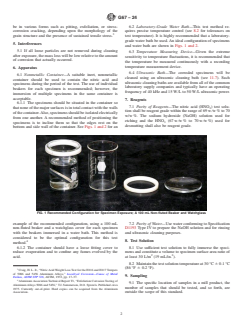
FIG. 1 Recommended Configuration for Specimen Exposure; A 100 mL Non-fluted Beaker and Watchglass
example of the recommended configuration, using a 100 mL 7.2 Purity of Water—Use water conforming to Specification
non-fluted beaker and a watchglass cover for each specimen D1193 Type IV to prepare the NaOH solution and for rinsing
with the beakers immersed in a water bath. This method is and ultrasonic cleaning purposes.
considered to be the optimal configuration for this test
8. Test Solution
method.
6.1.2 The container should have a loose fitting cover to
8.1 Use sufficient test solution to fully immerse the speci-
reduce evaporation and to confine any fumes evolved by the mens and constitute a volume to specimen surface area ratio of
2 2
acid. at least 30 L/m (19 mL/in. ).
8.2 Maintain the test solution temperature at 30 °C 6 0.1 °C
(86 °F 6 0.2 °F).
Craig, H. L. Jr., “Nitric Acid Weight Loss Test for the H116 and H117 Tempers
of 5086 and 5456 Aluminum Alloys,” Localized Corrosion—Cause of Metal
9. Sampling
Failure, ASTM STP 516, ASTM, 1972, pp. 17–37.
Aluminum Association Technical Report T1, “Exfoliation Corrosion Testing of
9.1 The specific location of samples in a mill product, the
Aluminum Alloys 5086 and 5456,” T.J. Summerson, D.O. Sprowls. Published circa
number of samples that should be tested, and so forth, are
1975. Currently out-of-print. Hard copies can be acquired from the Aluminum
Association. outside the scope of this standard.
G67 − 24
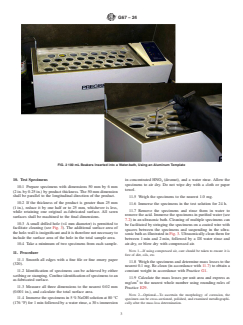
FIG. 2 100 mL Beakers Inserted into a Water-bath, Using an Aluminum Template
10. Test Specimens in concentrated HNO (desmut), and a water rinse. Allow the
specimens to air dry. Do not wipe dry with a cloth or paper
10.1 Prepare specimens with dimensions 50 mm by 6 mm
towel.
(2 in. by 0.25 in.) by product thickness. The 50 mm dimension
shall be parallel to the longitudinal direction of the product.
11.5 Weigh the specimens to the nearest 1.0 mg.
10.2 If the thickness of the product is greater than 25 mm
11.6 Immerse the specimens in the test solution for 24 h.
(1 in.),
...
This document is not an ASTM standard and is intended only to provide the user of an ASTM standard an indication of what changes have been made to the previous version. Because
it may not be technically possible to adequately depict all changes accurately, ASTM recommends that users consult prior editions as appropriate. In all cases only the current version
of the standard as published by ASTM is to be considered the official document.
Designation: G67 − 18 G67 − 24
Standard Test Method for
Determining the Susceptibility to Intergranular Corrosion of
5XXX Series Aluminum Alloys by Mass Loss After Exposure
to Nitric Acid (NAMLT Test)
This standard is issued under the fixed designation G67; the number immediately following the designation indicates the year of original
adoption or, in the case of revision, the year of last revision. A number in parentheses indicates the year of last reapproval. A superscript
epsilon (´) indicates an editorial change since the last revision or reapproval.
1. Scope
1.1 This test method, also known as the Nitric Acid Mass Loss Test (NAMLT) describes(NAMLT), covers a procedure for constant
immersion intergranular corrosion testing of 5XXX series aluminum alloys.
1.2 This test method is applicable only to wrought products.
1.3 This test method covers type of specimen, specimen preparation, test environment, and method of exposure.
1.4 The values stated in SI units are to be regarded as the standard. The values given in parentheses are for information only.
1.5 This standard does not purport to address all of the safety concerns, if any, associated with its use. It is the responsibility
of the user of this standard to establish appropriate safety, health, and environmental practices and determine the applicability of
regulatory limitations prior to use.
1.6 This international standard was developed in accordance with internationally recognized principles on standardization
established in the Decision on Principles for the Development of International Standards, Guides and Recommendations issued
by the World Trade Organization Technical Barriers to Trade (TBT) Committee.
2. Referenced Documents
2.1 ASTM Standards:
D1193 Specification for Reagent Water
E29 Practice for Using Significant Digits in Test Data to Determine Conformance with Specifications
E691 Practice for Conducting an Interlaboratory Study to Determine the Precision of a Test Method
G1 Practice for Preparing, Cleaning, and Evaluating Corrosion Test Specimens
G16 Guide for Applying Statistics to Analysis of Corrosion Data
3. Summary of Test Method
3.1 This test method consists of immersing test specimens in concentrated nitric acid at 30°C (86°F) for 24 h 30 °C (86 °F) for
24 h and determining the mass loss per unit area as a measure of susceptibility to intergranular corrosion.
This test method is under the jurisdiction of ASTM Committee G01 on Corrosion of Metals and is the direct responsibility of Subcommittee G01.05 on Laboratory
Corrosion Tests. This method was developed by a joint task group with The Aluminum Association, Inc.
Current edition approved Oct. 1, 2018Jan. 15, 2024. Published January 2019January 2024. Originally approved in 1980. Last previous edition approved in 20132018 as
G67 – 13.G67 – 18. DOI: 10.1520/G0067-18.10.1520/G0067-24.
For referenced ASTM standards, visit the ASTM website, www.astm.org, or contact ASTM Customer Service at service@astm.org. For Annual Book of ASTM Standards
volume information, refer to the standard’s Document Summary page on the ASTM website.
Copyright © ASTM International, 100 Barr Harbor Drive, PO Box C700, West Conshohocken, PA 19428-2959. United States
G67 − 24
4. Significance and Use
4.1 This test method provides a quantitative measure of the susceptibility to intergranular corrosion of Al-Mg and Al-Mg-Mn
alloys. The nitric acid dissolves a second phase, an aluminum-magnesium intermetallic compound (βAl-Mg), in preference to the
solid solution of magnesium in the aluminum matrix. When this compound is precipitated in a relatively continuous network along
grain boundaries, the effect of the preferential attack is to corrode around the grains, causing them to fall away from the specimens.
2 2
Such dropping out of the grains causes relatively large mass losses of the order of 2525 mg ⁄cm to 75 75 mg mg/cm⁄cm
2 2 2
(160(160 mg ⁄in. to 480 480 mg mg/in.⁄in. ), whereas, samples of intergranular-resistant materials lose only about 11 mg ⁄cm to
2 2 2
15 15 mg mg/cm⁄cm (10(10 mg ⁄in. to 100 mg/in. ). When the βAl-Mg compound is randomly distributed, the preferential attack
can result in intermediate mass losses. Metallographic examination is required in such cases to establish whether or not the loss
in mass is the result of intergranular attack.
4.2 The precipitation of the second phase in the grain boundaries also gives rise to intergranular corrosion when the material is
exposed to chloride-containing natural environments, such as seacoast atmospheres or sea water. The extent to which the alloy will
be susceptible to intergranular corrosion depends upon the degree of precipitate continuity in the grain boundaries. Visible
manifestations of the attack may be in various forms such as pitting, exfoliation, or stress-corrosion cracking, depending upon the
morphology of the grain structure and the presence of sustained tensile stress.
5. Interferences
5.1 If all loose particles are not removed during cleaning after exposure, the mass loss will be low relative to the amount of
corrosion that actually occurred.
6. Apparatus
6.1 Nonmetallic Container—A suitable inert, nonmetallic container should be used to contain the nitric acid and specimens during
the period of the test. The use of individual beakers for each specimen is recommended; however, the immersion of multiple
specimens in the same container is acceptable.
6.1.1 The specimens should be situated in the container so that none of the major surfaces is in total contact with the walls of the
container. Also, specimens should be isolated electrically from one another. A recommended method of positioning the specimens
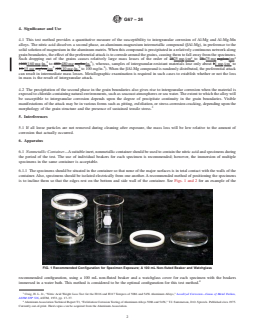
is to incline them so that the edges rest on the bottom and side wall of the container. See Figs. 1 and 2 for an example of the
FIG. 1 Recommended Configuration for Specimen Exposure; A 100 mL Non-fluted Beaker and Watchglass
recommended configuration, using a 100 mL non-fluted beaker and a watchglass cover for each specimen with the beakers
immersed in a water bath. This method is considered to be the optimal configuration for this test method.
Craig, H. L. Jr., “Nitric Acid Weight Loss Test for the H116 and H117 Tempers of 5086 and 5456 Aluminum Alloys,” Localized Corrosion—Cause of Metal Failure,
ASTM STP 516, ASTM, 1972, pp. 17–37.
Aluminum Association Technical Report T1, “Exfoliation Corrosion Testing of Aluminum Alloys 5086 and 5456,” T.J. Summerson, D.O. Sprowls. Published circa 1975.
Currently out-of-print. Hard copies can be acquired from the Aluminum Association.
G67 − 24
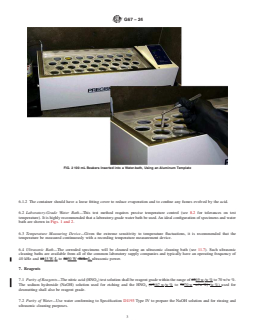
FIG. 2 100 mL Beakers Inserted into a Water-bath, Using an Aluminum Template
6.1.2 The container should have a loose fitting cover to reduce evaporation and to confine any fumes evolved by the acid.
6.2 Laboratory-Grade Water Bath—This test method requires precise temperature control (see 8.2 for tolerances on test
temperature). It is highly recommended that a laboratory-grade water bath be used. An ideal configuration of specimens and water
bath are shown in Figs. 1 and 2.
6.3 Temperature Measuring Device—Given the extreme sensitivity to temperature fluctuations, it is recommended that the
temperature be measured continuously with a recording temperature measurement device.
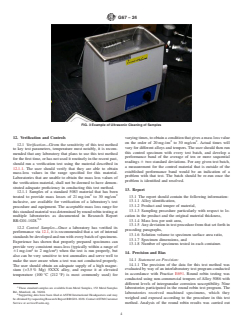
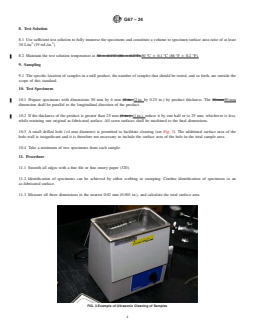
6.4 Ultrasonic Bath—The corroded specimens will be cleaned using an ultrasonic cleaning bath (see 11.7). Such ultrasonic
cleaning baths are available from all of the common laboratory supply companies and typically have an operating frequency of
40 kHz and 1515 W ⁄L to 5050 W W/L ⁄L ultrasonic power.
7. Reagents
7.1 Purity of Reagents—The nitric acid (HNO ) test solution shall be reagent grade within the range of 6769 w ⁄w % to 70 w/w %.
The sodium hydroxide (NaOH) solution used for etching and the HNO (67(67 w ⁄w % to 7070 w w/w %) ⁄w %) used for
desmutting shall also be reagent grade.
7.2 Purity of Water—Use water conforming to Specification D1193 Type IV to prepare the NaOH solution and for rinsing and
ultrasonic cleaning purposes.
G67 − 24
8. Test Solution
8.1 Use sufficient test solution to fully immerse the specimens and constitute a volume to specimen surface area ratio of at least
2 2
30 L/m (19 mL/in. ).
8.2 Maintain the test solution temperature at 30 6 0.1°C (86 6 0.2°F).30 °C 6 0.1 °C (86 °F 6 0.2 °F).
9. Sampling
9.1 The specific location of samples in a mill product, the number of samples that should be tested, and so forth, are outside the
scope of this standard.
10. Test Specimens
10.1 Prepare specimens with dimensions 50 mm by 6 mm (2 in. (2 in. by 0.25 in.) by product thickness. The 50-mm50 mm
dimension shall be parallel to the longitudinal direction of the product.
10.2 If the thickness of the product is greater than 25 mm (1 in.), (1 in.), reduce it by one half or to 25 mm, whichever is less,
while retaining one original as-fabricated surface. All sawn surfaces shall
...