

ASTM C476-23
(Specification)Standard Specification for Grout for Masonry
General Information
- Abstract
ABSTRACT
This specification covers two types of grout, fine and coarse grout, for use in the construction of masonry structures. Grout is specified by proportions or strength requirements. Materials used as ingredients in grout shall conform to the requirements specified such as: cementitious materials; blended cements; quicklime; hydrated lime; coal fly ash or raw calcine natural pozzolan; granulated blast furnace slag; air-entraining admixtures; aggregates; water; pumping aids; antifreeze compounds; and storage of materials. Fine grout shall be manufactured with fine aggregates. Coarse grout shall be manufactured with a combination of coarse and fine aggregates. Proportions of ingredients shall be determined by grout proportion requirements and by the specified compressive strength. Materials for grout shall be measured in such a way that the required proportions of the grout materials are controlled and accurately measured. Grout shall be produced using one of the following procedures: grout materials mixed with water at the job site and ready-mixed grout transported to the job site.
SCOPE
1.1 This specification covers two types of grout, fine and coarse grout, for use in the construction of masonry structures. Each type (fine and coarse) is further classified as conventional grout (requiring mechanical consolidation by puddling or vibration when placed) and self-consolidating grout (not requiring mechanical consolidation when placed). Conventional grout is specified by (1) proportions or (2) strength requirements. Self-consolidating grout is specified by strength requirements.
1.2 The text of this specification references notes and footnotes that provide explanatory material. These notes and footnotes (excluding those in tables and figures) shall not be considered as requirements of this specification.
1.3 The values stated in inch-pound units are to be regarded as standard. The values given in parentheses are mathematical conversions to SI units that are provided for information only and are not considered standard.
1.4 This international standard was developed in accordance with internationally recognized principles on standardization established in the Decision on Principles for the Development of International Standards, Guides and Recommendations issued by the World Trade Organization Technical Barriers to Trade (TBT) Committee.
- Status
- Published
- Publication Date
- 31-Jan-2023
- Technical Committee
- C12 - Mortars and Grouts for Unit Masonry
- Drafting Committee
- C12.05 - Grout & Grout Admixtures for Masonry

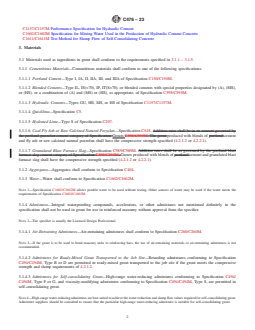
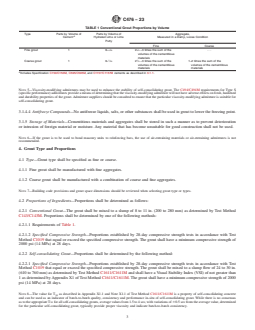
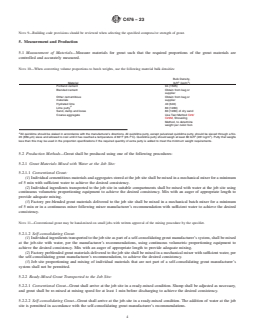
Overview
ASTM C476-23, published by ASTM International, is a comprehensive standard specification for grout used in masonry construction. This standard defines requirements for two primary types of grout: fine and coarse, both of which are used to ensure the structural integrity and durability of masonry structures. ASTM C476-23 addresses the specification by proportions or by strength, the acceptable materials and admixtures, and the procedures for manufacturing, mixing, and placing grout in masonry work. Adherence to this specification helps architects, engineers, and masonry contractors ensure consistent quality in masonry grout, supporting both conventional and self-consolidating grouts.
Key Topics
Types of Grout:
- Fine grout: Manufactured with fine aggregates.
- Coarse grout: Uses both fine and coarse aggregates.
- Each type can be classified as either conventional (requiring mechanical consolidation) or self-consolidating (not requiring mechanical consolidation).
Specification Methods:
- Conventional grout: Can be specified by mix proportions or by compressive strength.
- Self-consolidating grout: Specified by compressive strength only.
Material Requirements:
Ingredients must meet quality criteria in standards for:- Cementitious materials (various types of Portland and blended cements, quicklime, hydrated lime)
- Aggregates (per ASTM C404)
- Admixtures (such as air-entraining admixtures, high-range water-reducing admixtures)
- Water (per ASTM C1602/C1602M)
- Storage and handling to prevent contamination or deterioration.
Production and Mixing:
Grout can be prepared either by mixing materials with water at the job site or by using ready-mixed grout transported to the job site. Measurement and batching methods must ensure accurate proportions and consistency.
Applications
ASTM C476-23 is essential in the construction of load-bearing and non-load-bearing masonry walls, columns, and other structural elements. Typical applications include:
- Reinforced Masonry Construction: Grout fills the spaces between concrete masonry units, embedding reinforcement bars and enhancing load capacity.
- Structural and Architectural Masonry: Supports both structural stability and desired architectural finishes.
- Commercial and Residential Projects: Widely used in the construction industry, including schools, hospitals, housing, and commercial buildings.
- Compliance and Quality Assurance: Contractors and specifiers rely on ASTM C476-23 to meet code requirements and ensure the safety and longevity of masonry structures.
By standardizing the materials and methods for grout in masonry, ASTM C476-23 supports reliable construction outcomes and facilitates compliance with building codes.
Related Standards
Several ASTM standards provide additional or referenced requirements supporting ASTM C476-23, including:
- ASTM C150/C150M: Specification for Portland Cement
- ASTM C595/C595M: Specification for Blended Hydraulic Cements
- ASTM C207: Specification for Hydrated Lime for Masonry
- ASTM C404: Specification for Aggregates for Masonry Grout
- ASTM C1019: Test Method for Sampling and Testing Grout for Masonry
- ASTM C1602/C1602M: Specification for Mixing Water Used in the Production of Hydraulic Cement Concrete
- ASTM C260/C260M: Specification for Air-Entraining Admixtures for Concrete
- ASTM C494/C494M: Specification for Chemical Admixtures for Concrete
Using ASTM C476-23 alongside these related masonry standards helps project teams achieve consistent, code-compliant results and optimize the performance and durability of masonry structures.
Relations
- Effective Date
- 01-Feb-2024
- Effective Date
- 15-Jan-2024
- Refers
ASTM C29/C29M-23 - Standard Test Method for Bulk Density (“Unit Weight”) and Voids in Aggregate - Effective Date
- 01-Oct-2023
- Effective Date
- 01-Apr-2019
- Effective Date
- 01-Dec-2018
- Effective Date
- 01-Jan-2018
- Effective Date
- 15-Dec-2017
- Effective Date
- 01-Oct-2017
- Effective Date
- 01-Oct-2017
- Effective Date
- 15-Jun-2017
- Effective Date
- 01-Apr-2017
- Effective Date
- 01-Jan-2017
- Effective Date
- 15-Dec-2016
- Effective Date
- 01-Jul-2016
- Effective Date
- 15-Mar-2016
Get Certified
Connect with accredited certification bodies for this standard

DIBt (Deutsches Institut für Bautechnik)
German Institute for Building Technology.
DIN CERTCO
DIN Group product certification.

Aboma Certification B.V.
Specialized in construction, metal, and transport sectors.
Sponsored listings
Frequently Asked Questions
ASTM C476-23 is a technical specification published by ASTM International. Its full title is "Standard Specification for Grout for Masonry". This standard covers: ABSTRACT This specification covers two types of grout, fine and coarse grout, for use in the construction of masonry structures. Grout is specified by proportions or strength requirements. Materials used as ingredients in grout shall conform to the requirements specified such as: cementitious materials; blended cements; quicklime; hydrated lime; coal fly ash or raw calcine natural pozzolan; granulated blast furnace slag; air-entraining admixtures; aggregates; water; pumping aids; antifreeze compounds; and storage of materials. Fine grout shall be manufactured with fine aggregates. Coarse grout shall be manufactured with a combination of coarse and fine aggregates. Proportions of ingredients shall be determined by grout proportion requirements and by the specified compressive strength. Materials for grout shall be measured in such a way that the required proportions of the grout materials are controlled and accurately measured. Grout shall be produced using one of the following procedures: grout materials mixed with water at the job site and ready-mixed grout transported to the job site. SCOPE 1.1 This specification covers two types of grout, fine and coarse grout, for use in the construction of masonry structures. Each type (fine and coarse) is further classified as conventional grout (requiring mechanical consolidation by puddling or vibration when placed) and self-consolidating grout (not requiring mechanical consolidation when placed). Conventional grout is specified by (1) proportions or (2) strength requirements. Self-consolidating grout is specified by strength requirements. 1.2 The text of this specification references notes and footnotes that provide explanatory material. These notes and footnotes (excluding those in tables and figures) shall not be considered as requirements of this specification. 1.3 The values stated in inch-pound units are to be regarded as standard. The values given in parentheses are mathematical conversions to SI units that are provided for information only and are not considered standard. 1.4 This international standard was developed in accordance with internationally recognized principles on standardization established in the Decision on Principles for the Development of International Standards, Guides and Recommendations issued by the World Trade Organization Technical Barriers to Trade (TBT) Committee.
ABSTRACT This specification covers two types of grout, fine and coarse grout, for use in the construction of masonry structures. Grout is specified by proportions or strength requirements. Materials used as ingredients in grout shall conform to the requirements specified such as: cementitious materials; blended cements; quicklime; hydrated lime; coal fly ash or raw calcine natural pozzolan; granulated blast furnace slag; air-entraining admixtures; aggregates; water; pumping aids; antifreeze compounds; and storage of materials. Fine grout shall be manufactured with fine aggregates. Coarse grout shall be manufactured with a combination of coarse and fine aggregates. Proportions of ingredients shall be determined by grout proportion requirements and by the specified compressive strength. Materials for grout shall be measured in such a way that the required proportions of the grout materials are controlled and accurately measured. Grout shall be produced using one of the following procedures: grout materials mixed with water at the job site and ready-mixed grout transported to the job site. SCOPE 1.1 This specification covers two types of grout, fine and coarse grout, for use in the construction of masonry structures. Each type (fine and coarse) is further classified as conventional grout (requiring mechanical consolidation by puddling or vibration when placed) and self-consolidating grout (not requiring mechanical consolidation when placed). Conventional grout is specified by (1) proportions or (2) strength requirements. Self-consolidating grout is specified by strength requirements. 1.2 The text of this specification references notes and footnotes that provide explanatory material. These notes and footnotes (excluding those in tables and figures) shall not be considered as requirements of this specification. 1.3 The values stated in inch-pound units are to be regarded as standard. The values given in parentheses are mathematical conversions to SI units that are provided for information only and are not considered standard. 1.4 This international standard was developed in accordance with internationally recognized principles on standardization established in the Decision on Principles for the Development of International Standards, Guides and Recommendations issued by the World Trade Organization Technical Barriers to Trade (TBT) Committee.
ASTM C476-23 is classified under the following ICS (International Classification for Standards) categories: 91.100.10 - Cement. Gypsum. Lime. Mortar. The ICS classification helps identify the subject area and facilitates finding related standards.
ASTM C476-23 has the following relationships with other standards: It is inter standard links to ASTM C989/C989M-24, ASTM C404-24, ASTM C29/C29M-23, ASTM C150/C150M-19, ASTM C404-18, ASTM C1019-18, ASTM C404-11(2017), ASTM C989/C989M-17, ASTM C618-17, ASTM C1157/C1157M-17, ASTM C595/C595M-17, ASTM C29/C29M-17, ASTM C989/C989M-16e1, ASTM C494/C494M-16, ASTM C150/C150M-16. Understanding these relationships helps ensure you are using the most current and applicable version of the standard.
ASTM C476-23 is available in PDF format for immediate download after purchase. The document can be added to your cart and obtained through the secure checkout process. Digital delivery ensures instant access to the complete standard document.
Standards Content (Sample)
This international standard was developed in accordance with internationally recognized principles on standardization established in the Decision on Principles for the
Development of International Standards, Guides and Recommendations issued by the World Trade Organization Technical Barriers to Trade (TBT) Committee.
Designation: C476 − 23
Standard Specification for
Grout for Masonry
This standard is issued under the fixed designation C476; the number immediately following the designation indicates the year of
original adoption or, in the case of revision, the year of last revision. A number in parentheses indicates the year of last reapproval. A
superscript epsilon (´) indicates an editorial change since the last revision or reapproval.
This standard has been approved for use by agencies of the U.S. Department of Defense.
1. Scope* C150/C150M Specification for Portland Cement
C207 Specification for Hydrated Lime for Masonry Pur-
1.1 This specification covers two types of grout, fine and
poses
coarse grout, for use in the construction of masonry structures.
C260/C260M Specification for Air-Entraining Admixtures
Each type (fine and coarse) is further classified as conventional
for Concrete
grout (requiring mechanical consolidation by puddling or
C404 Specification for Aggregates for Masonry Grout
vibration when placed) and self-consolidating grout (not re-
C494/C494M Specification for Chemical Admixtures for
quiring mechanical consolidation when placed). Conventional
Concrete
grout is specified by (1) proportions or (2) strength require-
C595/C595M Specification for Blended Hydraulic Cements
ments. Self-consolidating grout is specified by strength re-
C618 Specification for Coal Fly Ash and Raw or Calcined
quirements.
Natural Pozzolan for Use in Concrete
1.2 The text of this specification references notes and
C989/C989M Specification for Slag Cement for Use in
footnotes that provide explanatory material. These notes and
Concrete and Mortars
footnotes (excluding those in tables and figures) shall not be
C1019 Test Method for Sampling and Testing Grout for
considered as requirements of this specification.
Masonry
C1157/C1157M Performance Specification for Hydraulic
1.3 The values stated in inch-pound units are to be regarded
as standard. The values given in parentheses are mathematical Cement
C1602/C1602M Specification for Mixing Water Used in the
conversions to SI units that are provided for information only
and are not considered standard. Production of Hydraulic Cement Concrete
C1611/C1611M Test Method for Slump Flow of Self-
1.4 This international standard was developed in accor-
Consolidating Concrete
dance with internationally recognized principles on standard-
ization established in the Decision on Principles for the
3. Materials
Development of International Standards, Guides and Recom-
3.1 Materials used as ingredients in grout shall conform to
mendations issued by the World Trade Organization Technical
the requirements specified in 3.1.1 – 3.1.5.
Barriers to Trade (TBT) Committee.
3.1.1 Cementitious Materials—Cementitious materials shall
2. Referenced Documents conform to one of the following specifications:
2 3.1.1.1 Portland Cement—Type I, IA, II, IIA, III, and IIIA
2.1 ASTM Standards:
of Specification C150/C150M.
C5 Specification for Quicklime for Structural Purposes
3.1.1.2 Blended Cements—Type IL, IS(<70), IP, IT(S<70),
C29/C29M Test Method for Bulk Density (“Unit Weight”)
or blended cements with special properties designated by (A),
and Voids in Aggregate
(MS), or (HS), or a combination of (A) and (MS) or (HS), as
C143/C143M Test Method for Slump of Hydraulic-Cement
appropriate, of Specification C595/C595M.
Concrete
3.1.1.3 Hydraulic Cements—Types GU, HE, MS, or HS of
Specification C1157/C1157M.
This specification is under the jurisdiction of ASTM Committee C12 on
3.1.1.4 Quicklime—Specification C5.
Mortars and Grouts for Unit Masonry and is the direct responsibility of Subcom-
3.1.1.5 Hydrated Lime—Type S of Specification C207.
mittee C12.05 on Grout & Grout Admixtures for Masonry.
3.1.1.6 Coal Fly Ash or Raw Calcined Natural Pozzolan—
Current edition approved Feb. 1, 2023. Published February 2023. Originally
Specification C618. Grouts produced with blends of cement
approved in 1961. Last previous edition approved in 2022 as C476 – 22. DOI:
10.1520/C0476-23.
and fly ash or raw calcined natural pozzolan shall have the
For referenced ASTM standards, visit the ASTM website, www.astm.org, or
compressive strength specified (4.2.1.2 or 4.2.2.1).
contact ASTM Customer Service at service@astm.org. For Annual Book of ASTM
3.1.1.7 Granulated Blast Furnace Slag—Specification
Standards volume information, refer to the standard’s Document Summary page on
the ASTM website. C989/C989M. Grouts produced with blends of cement and
*A Summary of Changes section appears at the end of this standard
Copyright © ASTM International, 100 Barr Harbor Drive, PO Box C700, West Conshohocken, PA 19428-2959. United States
C476 − 23
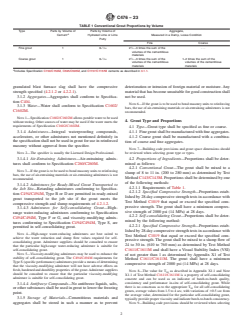
TABLE 1 Conventional Grout Proportions by Volume
Type Parts by Volume of Parts by Volume of Aggregate,
A
Cement Hydrated Lime or Lime Measured in a Damp, Loose Condition
Putty
Fine Coarse
1 1
Fine grout 1 0– ⁄10 2 ⁄4 –3 times the sum of the . . .
volumes of the cementitious
materials
1 1
Coarse grout 1 0– ⁄10 2 ⁄4 –3 times the sum of the 1–2 times the sum of the
volumes of the cementitious volumes of the cementitious
materials materials
A
Includes Specification C150/C150M, C595/C595M, and C1157/C1157M cements as described in 3.1.1.
granulated blast furnace slag shall have the compressive deterioration or intrusion of foreign material or moisture. Any
strength specified (4.2.1.2 or 4.2.2.1). material that has become unsuitable for good construction shall
3.1.2 Aggregates—Aggregates shall conform to Specifica- not be used.
tion C404.
NOTE 6—If the grout is to be used to bond masonry units to reinforcing
3.1.3 Water—Water shall conform to Specification C1602/
bars, the use of air-entraining materials or air-entraining admixtures is not
C1602M.
recommended.
NOTE 1—Specification C1602/C1602M allows potable water to be used
4. Grout Type and Proportions
without testing. Other sources of water may be used if the water meets the
requirements of Specification C1602/C1602M.
4.1 Type—Grout type shall be specified as fine or coarse.
3.1.4 Admixtures—Integral waterproofing compounds,
4.1.1 Fine grout shall be manufactured with fine aggregates.
accelerators, or other admixtures not mentioned definitely in
4.1.2 Coarse grout shall be manufactured with a combina-
the specification shall not be used in grout for use in reinforced
tion of coarse and fine aggregates.
masonry without approval from the specifier.
NOTE 7—Building code provisions and grout space dimensions should
be reviewed when selecting grout type or types.
NOTE 2—The specifier is usually the Licensed Design Professional.
3.1.4.1 Air-Entraining Admixtures—Air-entraining admix- 4.2 Proportions of Ingredients—Proportions shall be deter-
mined as follows:
tures shall conform to Specification C260/C260M.
4.2.1 Conventional Grout—The grout shall be mixed to a
NOTE 3—If the grout is to be used to bond masonry units to reinforcing
slump of 8 to 11 in. (200 to 280 mm) as determined by Test
bars, the use of air-entraining materials or air-entraining admixtures is not
Method C143/C143M. Proportions shall be determined by one
recommended.
of the following methods:
3.1.4.2 Admixtures for Ready-Mixed Grout Transported to
4.2.1.1 Requirements of Table 1.
the Job Site—Retarding admixtures conforming to Specifica-
4.2.1.2 Specified Compressive Strength—Proportions estab-
tion C494/C494M, Type B or D are permitted in ready-mixed
lished by 28-day compressive strength tests in accordance with
grout transported to the job site if the grout meets the
Test Method C1019 that equal or exceed the specified com-
compressive strength and slump requirements of 4.2.1.2.
pressive strength. The grout shall have a minimum compres-
3.1.4.3 Admixtures for Self-consolidating Grout—High-
sive strength of 2000 psi (14 MPa) at 28 days.
range water-reducing admixtures conforming to Specification
4.2.2 Self-consolidating Grout—Proportions shall be deter-
C494/C494M, Type F or G, and viscosity-modifying admix-
mi
...
This document is not an ASTM standard and is intended only to provide the user of an ASTM standard an indication of what changes have been made to the previous version. Because
it may not be technically possible to adequately depict all changes accurately, ASTM recommends that users consult prior editions as appropriate. In all cases only the current version
of the standard as published by ASTM is to be considered the official document.
Designation: C476 − 22 C476 − 23
Standard Specification for
Grout for Masonry
This standard is issued under the fixed designation C476; the number immediately following the designation indicates the year of
original adoption or, in the case of revision, the year of last revision. A number in parentheses indicates the year of last reapproval. A
superscript epsilon (´) indicates an editorial change since the last revision or reapproval.
This standard has been approved for use by agencies of the U.S. Department of Defense.
1. Scope*
1.1 This specification covers two types of grout, fine and coarse grout, for use in the construction of masonry structures. Each type
(fine and coarse) is further classified as conventional grout (requiring mechanical consolidation by puddling or vibration when
placed) and self-consolidating grout (not requiring mechanical consolidation when placed). Conventional grout is specified by (1)
proportions or (2) strength requirements. Self-consolidating grout is specified by strength requirements.
1.2 The text of this specification references notes and footnotes that provide explanatory material. These notes and footnotes
(excluding those in tables and figures) shall not be considered as requirements of this specification.
1.3 The values stated in inch-pound units are to be regarded as standard. The values given in parentheses are mathematical
conversions to SI units that are provided for information only and are not considered standard.
1.4 This international standard was developed in accordance with internationally recognized principles on standardization
established in the Decision on Principles for the Development of International Standards, Guides and Recommendations issued
by the World Trade Organization Technical Barriers to Trade (TBT) Committee.
2. Referenced Documents
2.1 ASTM Standards:
C5 Specification for Quicklime for Structural Purposes
C29/C29M Test Method for Bulk Density (“Unit Weight”) and Voids in Aggregate
C143/C143M Test Method for Slump of Hydraulic-Cement Concrete
C150/C150M Specification for Portland Cement
C207 Specification for Hydrated Lime for Masonry Purposes
C260/C260M Specification for Air-Entraining Admixtures for Concrete
C404 Specification for Aggregates for Masonry Grout
C494/C494M Specification for Chemical Admixtures for Concrete
C595/C595M Specification for Blended Hydraulic Cements
C618 Specification for Coal Fly Ash and Raw or Calcined Natural Pozzolan for Use in Concrete
C989/C989M Specification for Slag Cement for Use in Concrete and Mortars
C1019 Test Method for Sampling and Testing Grout for Masonry
This specification is under the jurisdiction of ASTM Committee C12 on Mortars and Grouts for Unit Masonry and is the direct responsibility of Subcommittee C12.05
on Grout & Grout Admixtures for Masonry.
Current edition approved Sept. 1, 2022Feb. 1, 2023. Published September 2022February 2023. Originally approved in 1961. Last previous edition approved in 20202022
as C476 – 20.C476 – 22. DOI: 10.1520/C0476-22.10.1520/C0476-23.
For referenced ASTM standards, visit the ASTM website, www.astm.org, or contact ASTM Customer Service at service@astm.org. For Annual Book of ASTM Standards
volume information, refer to the standard’s Document Summary page on the ASTM website.
*A Summary of Changes section appears at the end of this standard
Copyright © ASTM International, 100 Barr Harbor Drive, PO Box C700, West Conshohocken, PA 19428-2959. United States
C476 − 23
C1157/C1157M Performance Specification for Hydraulic Cement
C1602/C1602M Specification for Mixing Water Used in the Production of Hydraulic Cement Concrete
C1611/C1611M Test Method for Slump Flow of Self-Consolidating Concrete
3. Materials
3.1 Materials used as ingredients in grout shall conform to the requirements specified in 3.1.1 – 3.1.5.
3.1.1 Cementitious Materials—Cementitious materials shall conform to one of the following specifications:
3.1.1.1 Portland Cement—Type I, IA, II, IIA, III, and IIIA of Specification C150/C150M.
3.1.1.2 Blended Cements—Type IL, IS(<70), IP, IT(S<70), or blended cements with special properties designated by (A), (MS),
or (HS), or a combination of (A) and (MS) or (HS), as appropriate, of Specification C595/C595M.
3.1.1.3 Hydraulic Cements—Types GU, HE, MS, or HS of Specification C1157/C1157M.
3.1.1.4 Quicklime—Specification C5.
3.1.1.5 Hydrated Lime—Type S of Specification C207.
3.1.1.6 Coal Fly Ash or Raw Calcined Natural Pozzolan—Specification C618. Addition rates shall be in an amount governed by
the portland-pozzolan cement category of Specification Grouts C595/C595M. The grout produced with blends of portland cement
and fly ash or raw calcined natural pozzolan shall have the compressive strength specified (4.2.1.2 or 4.2.2.1).
3.1.1.7 Granulated Blast Furnace Slag—Specification C989/C989M. Addition rates shall be as governed by the portland blast
furnace slag cement category of Specification C595/C595M. Grouts produced with blends of portland cement and granulated blast
furnace slag shall have the compressive strength specified (4.2.1.2 or 4.2.2.1).
3.1.2 Aggregates—Aggregates shall conform to Specification C404.
3.1.3 Water—Water shall conform to Specification C1602/C1602M.
NOTE 1—Specification C1602/C1602M allows potable water to be used without testing. Other sources of water may be used if the water meets the
requirements of Specification C1602/C1602M.
3.1.4 Admixtures—Integral waterproofing compounds, accelerators, or other admixtures not mentioned definitely in the
specification shall not be used in grout for use in reinforced masonry without approval from the specifier.
NOTE 2—The specifier is usually the Licensed Design Professional.
3.1.4.1 Air-Entraining Admixtures—Air-entraining admixtures shall conform to Specification C260/C260M.
NOTE 3—If the grout is to be used to bond masonry units to reinforcing bars, the use of air-entraining materials or air-entraining admixtures is not
recommended.
3.1.4.2 Admixtures for Ready-Mixed Grout Transported to the Job Site—Retarding admixtures conforming to Specification
C494/C494M, Type B or D are permitted in ready-mixed grout transported to the job site if the grout meets the compressive
strength and slump requirements of 4.2.1.2.
3.1.4.3 Admixtures for Self-consolidating Grout—High-range water-reducing admixtures conforming to Specification C494/
C494M, Type F or G, and viscosity-modifying admixtures conforming to Specification C494/C494M, Type S, are permitted in
self-consolidating grout.
NOTE 4—High-range water-reducing admixtures are best suited to achieve the water reduction and slump flow values required for self-consolidating grout.
Admixture suppliers should be consulted to ensure that the particular high-range water-reducing admixture is suitable for self-consolidating grout.
C476 − 23
TABLE 1 Conventional Grout Proportions by Volume
Type Parts by Volume of Parts by Volume of Aggregate,
A
Cement Hydrated Lime or Lime Measured in a Damp, Loose Condition
Putty
Fine Coarse
1 1
Fine grout 1 0– ⁄10 2 ⁄4 –3 times the sum of the . . .
volumes of the cementitious
materials
1 1
Coarse grout 1 0– ⁄10 2 ⁄4 –3 times the sum of the 1–2 times the sum of the
volumes of the cementitious volumes of the cementitious
materials materials
A
Includes Specification C150/C150M, C595/C595M, and C1157/C1157M cements as described in 3.1.1.
NOTE 5—Viscosity-modifying admixtures may be used to enhance the stability of self-consolidating grout. The C494/C494M requirements for Type S
(specific performance) admixtures provide a means of determining that the viscosity-modifying admixture will not have adverse effects on fresh, hardened
and durability properties of the grout. Admixture suppliers should be consulted to ensure that the particular viscosity-modifying admixture is suitable for
self-consolidating grout.
3.1.4.4 Antifreeze Compounds—No antifreeze liquids, salts, or other substances shall be used in grout to lower the freezing point.
3.1.5 Storage of Materials—Cementitious materials and
...