

ASTM C1384-23
(Specification)Standard Specification for Admixtures for Masonry Mortars
General Information
- Abstract
ABSTRACT
This specification pertains to admixtures for masonry mortars. Admixtures are substances other than the prescribed materials of water, aggregate, and cementitious materials that are used to improve one or more of the recognized desirable properties of conventional masonry mortar. Admixtures are classified by their effect on the performance characteristics of conventional masonry mortars. Admixed mortars are classified by their modified properties, as compared to a reference mortar. The following classifications are recognized: bond enhancer, workability enhancer, set accelerator, set retarder, and water repellent. The materials to be used include Portland cement, hydraulic cement, blended hydraulic cement, masonry cement, mortar cement, lime, and sand. Different test methods shall be implemented in order to determine the following properties: soluble chloride content, compressive strength, water retention, air content of plastic mortar, board life, time of setting, flexural bond strength, and rate of water absorption.
SCOPE
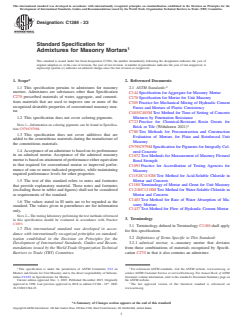
1.1 This specification pertains to admixtures for masonry mortars. Admixtures are substances other than Specification C270 prescribed materials of water, aggregate, and cementitious materials that are used to improve one or more of the recognized desirable properties of conventional masonry mortar.
1.2 This specification does not cover coloring pigments.
Note 1: Information on coloring pigments can be found in Specification C979/C979M.
1.3 This specification does not cover additives that are added to the cementitious materials during the manufacture of the cementitious materials.
1.4 Acceptance of an admixture is based on its performance in an admixed mortar. Acceptance of the admixed masonry mortar is based on attainment of performance either equivalent to that required for conventional mortar or improved performance of one or more indicated properties, while maintaining required performance levels for other properties.
1.5 The text of this standard refers to notes and footnotes that provide explanatory material. These notes and footnotes (excluding those in tables and figures) shall not be considered as requirements of the standard.
1.6 The values stated in SI units are to be regarded as the standard. The values given in parentheses are for information only.
Note 2: The testing laboratory performing the test methods referenced in this specification should be evaluated in accordance with Practice C1093.
1.7 This international standard was developed in accordance with internationally recognized principles on standardization established in the Decision on Principles for the Development of International Standards, Guides and Recommendations issued by the World Trade Organization Technical Barriers to Trade (TBT) Committee.
- Status
- Published
- Publication Date
- 30-Nov-2023
- Technical Committee
- C12 - Mortars and Grouts for Unit Masonry
- Drafting Committee
- C12.03 - Specifications for Mortars
Overview
ASTM C1384-23: Standard Specification for Admixtures for Masonry Mortars provides comprehensive requirements for admixtures intended for use in masonry mortars. Admixtures are substances added to masonry mortars, separate from the basic prescribed materials of water, aggregate, and cementitious components, to enhance critical mortar properties. ASTM C1384-23 classifies admixtures based on their performance effects, such as bond enhancement, workability improvement, setting control, or water repellency. This specification ensures consistent product performance, safety, and compatibility with materials recognized under ASTM C270.
Key Topics
Admixture Classifications
- Bond Enhancer: Improves the adhesion between mortar and masonry units.
- Workability Enhancer: Increases ease of mixing, placing, and spreading mortar.
- Set Accelerator: Shortens mortar setting time, beneficial in cold weather or accelerated construction schedules.
- Set Retarder: Extends setting time, allowing for longer workable periods, especially in hot conditions.
- Water Repellent: Reduces water absorption in hardened mortar for improved durability.
Material Requirements
- Admixtures are formulated to be compatible with Portland cement, hydraulic cement, blended hydraulic cement, masonry cement, mortar cement, lime, and sand.
- Sand and cementitious materials used must conform to relevant ASTM specifications (e.g., C270 and C144).
Testing and Performance Evaluation
- Admixtures must not introduce detrimental reactions and should not add excessive soluble or acid-soluble chlorides.
- Comprehensive laboratory testing determines:
- Soluble chloride content
- Compressive strength
- Water retention
- Air content in plastic mortar
- Board life (workability over time)
- Setting times
- Flexural bond strength
- Rate of water absorption
- All admixtures must enable the mortar to meet or exceed performance requirements relative to a reference mortar.
Product Marking and Labeling
- Packages must be clearly marked with admixture classification, manufacturer, and relevant details, especially regarding chloride content.
Applications
The ASTM C1384-23 standard is essential for:
- Manufacturers and Suppliers: Ensures that admixtures for masonry mortars provide measurable and reliable benefits without compromising safety or compatibility.
- Specifiers and Designers: Allows selection of admixtures for specific project needs, such as enhanced bond, improved workability, or moisture resistance in walls and structures.
- Quality Assurance and Testing Agencies: Mandates standardized testing protocols for verifying performance claims, supporting compliance, and ensuring product quality.
- Contractors and Masons: Provides confidence that mortar admixed as per ASTM C1384-23 will comply with applicable building codes and technically recognized practices.
Practical applications include new construction, restoration, and repair of unit masonry, where optimal mortar performance is crucial to durability, appearance, and structural integrity.
Related Standards
Referencing and compliance with other key ASTM standards is integral to using ASTM C1384-23:
- ASTM C270 - Specification for Mortar for Unit Masonry
The primary reference for mortar mixtures used in conjunction with admixtures. - ASTM C144 - Specification for Aggregate for Masonry Mortar
Defines sand quality requirements for mortar production. - ASTM C305 - Practice for Mechanical Mixing of Hydraulic Cement Pastes and Mortars
- ASTM C780 - Test Methods for Preconstruction and Construction Evaluation of Mortars
- ASTM C1072 - Test Methods for Measurement of Masonry Flexural Bond Strength
- ASTM C1403 - Test Method for Rate of Water Absorption of Masonry Mortars
- ASTM C1093 - Practice for Accreditation of Testing Agencies for Masonry
Using ASTM C1384-23 in conjunction with these standards supports the consistent production, specification, and testing of masonry mortar admixtures, fostering better construction practices and enhanced project outcomes.
Keywords: admixtures for masonry mortars, ASTM C1384, bond enhancer, workability enhancer, set accelerator, set retarder, water repellent, mortar admixture testing, masonry mortar specification.
Relations
- Effective Date
- 01-Dec-2023
- Effective Date
- 01-Jul-2023
- Effective Date
- 01-Dec-2018
- Effective Date
- 01-Dec-2023
- Effective Date
- 01-Dec-2023
- Effective Date
- 01-Dec-2023
- Effective Date
- 01-Dec-2023
- Referred By
ASTM C1780-23a - Standard Practice for Installation Methods for Cement-based Adhered Masonry Veneer - Effective Date
- 01-Dec-2023
- Effective Date
- 01-Dec-2023
- Effective Date
- 01-Dec-2023
- Referred By
ASTM C1714/C1714M-23 - Standard Specification for Preblended Dry Mortar Mix for Unit Masonry - Effective Date
- 01-Dec-2023
Get Certified
Connect with accredited certification bodies for this standard

DIBt (Deutsches Institut für Bautechnik)
German Institute for Building Technology.
DIN CERTCO
DIN Group product certification.

Aboma Certification B.V.
Specialized in construction, metal, and transport sectors.
Sponsored listings
Frequently Asked Questions
ASTM C1384-23 is a technical specification published by ASTM International. Its full title is "Standard Specification for Admixtures for Masonry Mortars". This standard covers: ABSTRACT This specification pertains to admixtures for masonry mortars. Admixtures are substances other than the prescribed materials of water, aggregate, and cementitious materials that are used to improve one or more of the recognized desirable properties of conventional masonry mortar. Admixtures are classified by their effect on the performance characteristics of conventional masonry mortars. Admixed mortars are classified by their modified properties, as compared to a reference mortar. The following classifications are recognized: bond enhancer, workability enhancer, set accelerator, set retarder, and water repellent. The materials to be used include Portland cement, hydraulic cement, blended hydraulic cement, masonry cement, mortar cement, lime, and sand. Different test methods shall be implemented in order to determine the following properties: soluble chloride content, compressive strength, water retention, air content of plastic mortar, board life, time of setting, flexural bond strength, and rate of water absorption. SCOPE 1.1 This specification pertains to admixtures for masonry mortars. Admixtures are substances other than Specification C270 prescribed materials of water, aggregate, and cementitious materials that are used to improve one or more of the recognized desirable properties of conventional masonry mortar. 1.2 This specification does not cover coloring pigments. Note 1: Information on coloring pigments can be found in Specification C979/C979M. 1.3 This specification does not cover additives that are added to the cementitious materials during the manufacture of the cementitious materials. 1.4 Acceptance of an admixture is based on its performance in an admixed mortar. Acceptance of the admixed masonry mortar is based on attainment of performance either equivalent to that required for conventional mortar or improved performance of one or more indicated properties, while maintaining required performance levels for other properties. 1.5 The text of this standard refers to notes and footnotes that provide explanatory material. These notes and footnotes (excluding those in tables and figures) shall not be considered as requirements of the standard. 1.6 The values stated in SI units are to be regarded as the standard. The values given in parentheses are for information only. Note 2: The testing laboratory performing the test methods referenced in this specification should be evaluated in accordance with Practice C1093. 1.7 This international standard was developed in accordance with internationally recognized principles on standardization established in the Decision on Principles for the Development of International Standards, Guides and Recommendations issued by the World Trade Organization Technical Barriers to Trade (TBT) Committee.
ABSTRACT This specification pertains to admixtures for masonry mortars. Admixtures are substances other than the prescribed materials of water, aggregate, and cementitious materials that are used to improve one or more of the recognized desirable properties of conventional masonry mortar. Admixtures are classified by their effect on the performance characteristics of conventional masonry mortars. Admixed mortars are classified by their modified properties, as compared to a reference mortar. The following classifications are recognized: bond enhancer, workability enhancer, set accelerator, set retarder, and water repellent. The materials to be used include Portland cement, hydraulic cement, blended hydraulic cement, masonry cement, mortar cement, lime, and sand. Different test methods shall be implemented in order to determine the following properties: soluble chloride content, compressive strength, water retention, air content of plastic mortar, board life, time of setting, flexural bond strength, and rate of water absorption. SCOPE 1.1 This specification pertains to admixtures for masonry mortars. Admixtures are substances other than Specification C270 prescribed materials of water, aggregate, and cementitious materials that are used to improve one or more of the recognized desirable properties of conventional masonry mortar. 1.2 This specification does not cover coloring pigments. Note 1: Information on coloring pigments can be found in Specification C979/C979M. 1.3 This specification does not cover additives that are added to the cementitious materials during the manufacture of the cementitious materials. 1.4 Acceptance of an admixture is based on its performance in an admixed mortar. Acceptance of the admixed masonry mortar is based on attainment of performance either equivalent to that required for conventional mortar or improved performance of one or more indicated properties, while maintaining required performance levels for other properties. 1.5 The text of this standard refers to notes and footnotes that provide explanatory material. These notes and footnotes (excluding those in tables and figures) shall not be considered as requirements of the standard. 1.6 The values stated in SI units are to be regarded as the standard. The values given in parentheses are for information only. Note 2: The testing laboratory performing the test methods referenced in this specification should be evaluated in accordance with Practice C1093. 1.7 This international standard was developed in accordance with internationally recognized principles on standardization established in the Decision on Principles for the Development of International Standards, Guides and Recommendations issued by the World Trade Organization Technical Barriers to Trade (TBT) Committee.
ASTM C1384-23 is classified under the following ICS (International Classification for Standards) categories: 91.100.10 - Cement. Gypsum. Lime. Mortar. The ICS classification helps identify the subject area and facilitates finding related standards.
ASTM C1384-23 has the following relationships with other standards: It is inter standard links to ASTM C1384-18e1, ASTM C780-23, ASTM C144-18, ASTM C1732-19, ASTM C1180-22, ASTM C1660-10(2018), ASTM C1713-23, ASTM C1780-23a, ASTM C1403-22a, ASTM C270-19ae1, ASTM C1714/C1714M-23. Understanding these relationships helps ensure you are using the most current and applicable version of the standard.
ASTM C1384-23 is available in PDF format for immediate download after purchase. The document can be added to your cart and obtained through the secure checkout process. Digital delivery ensures instant access to the complete standard document.
Standards Content (Sample)
This international standard was developed in accordance with internationally recognized principles on standardization established in the Decision on Principles for the
Development of International Standards, Guides and Recommendations issued by the World Trade Organization Technical Barriers to Trade (TBT) Committee.
Designation: C1384 − 23
Standard Specification for
Admixtures for Masonry Mortars
This standard is issued under the fixed designation C1384; the number immediately following the designation indicates the year of
original adoption or, in the case of revision, the year of last revision. A number in parentheses indicates the year of last reapproval. A
superscript epsilon (´) indicates an editorial change since the last revision or reapproval.
1. Scope* 2. Referenced Documents
1.1 This specification pertains to admixtures for masonry
2.1 ASTM Standards:
mortars. Admixtures are substances other than Specification
C144 Specification for Aggregate for Masonry Mortar
C270 prescribed materials of water, aggregate, and cementi-
C270 Specification for Mortar for Unit Masonry
tious materials that are used to improve one or more of the
C305 Practice for Mechanical Mixing of Hydraulic Cement
recognized desirable properties of conventional masonry mor-
Pastes and Mortars of Plastic Consistency
tar.
C403/C403M Test Method for Time of Setting of Concrete
1.2 This specification does not cover coloring pigments. Mixtures by Penetration Resistance
C723 Practice for Chemical-Resistant Resin Grouts for
NOTE 1—Information on coloring pigments can be found in Specifica-
Brick or Tile (Withdrawn 2021)
tion C979/C979M.
C780 Test Methods for Preconstruction and Construction
1.3 This specification does not cover additives that are
Evaluation of Mortars for Plain and Reinforced Unit
added to the cementitious materials during the manufacture of
Masonry
the cementitious materials.
C979/C979M Specification for Pigments for Integrally Col-
1.4 Acceptance of an admixture is based on its performance
ored Concrete
in an admixed mortar. Acceptance of the admixed masonry
C1072 Test Methods for Measurement of Masonry Flexural
mortar is based on attainment of performance either equivalent
Bond Strength
to that required for conventional mortar or improved perfor-
C1093 Practice for Accreditation of Testing Agencies for
mance of one or more indicated properties, while maintaining
Masonry
required performance levels for other properties.
C1152/C1152M Test Method for Acid-Soluble Chloride in
Mortar and Concrete
1.5 The text of this standard refers to notes and footnotes
that provide explanatory material. These notes and footnotes C1180 Terminology of Mortar and Grout for Unit Masonry
C1218/C1218M Test Method for Water-Soluble Chloride in
(excluding those in tables and figures) shall not be considered
as requirements of the standard. Mortar and Concrete
C1403 Test Method for Rate of Water Absorption of Ma-
1.6 The values stated in SI units are to be regarded as the
sonry Mortars
standard. The values given in parentheses are for information
C1437 Test Method for Flow of Hydraulic Cement Mortar
only.
NOTE 2—The testing laboratory performing the test methods referenced
3. Terminology
in this specification should be evaluated in accordance with Practice
C1093.
3.1 Terminology defined in Terminology C1180 shall apply
1.7 This international standard was developed in accor-
for this specification.
dance with internationally recognized principles on standard-
3.2 Definitions of Terms Specific to This Standard:
ization established in the Decision on Principles for the
Development of International Standards, Guides and Recom- 3.2.1 admixed mortar, n—masonry mortar that deviates
mendations issued by the World Trade Organization Technical from those combinations of materials recognized by Specifi-
Barriers to Trade (TBT) Committee. cation C270 in that it also contains an admixture.
1 2
This specification is under the jurisdiction of ASTM Committee C12 on For referenced ASTM standards, visit the ASTM website, www.astm.org, or
Mortars and Grouts for Unit Masonry and is the direct responsibility of Subcom- contact ASTM Customer Service at service@astm.org. For Annual Book of ASTM
mittee C12.03 on Specifications for Mortars. Standards volume information, refer to the standard’s Document Summary page on
Current edition approved Dec. 1, 2023. Published December 2023. Originally the ASTM website.
ɛ1 3
approved in 1998. Last previous approved in 2018 as edition C1384 – 18 . DOI: The last approved version of this historical standard is referenced on
10.1520/C1384-23. www.astm.org.
*A Summary of Changes section appears at the end of this standard
Copyright © ASTM International, 100 Barr Harbor Drive, PO Box C700, West Conshohocken, PA 19428-2959. United States
C1384 − 23
corrosion potential of masonry mortars toward embedded and attached
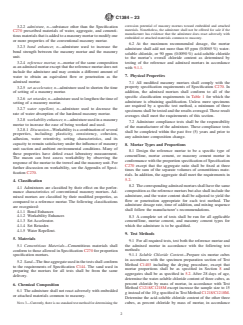
3.2.2 admixture, n—substance other than the Specification
materials. Nonetheless, the admixture shall not be offered for sale if the
C270 prescribed materials of water, aggregate, and cementi-
manufacturer has evidence that the admixture does react adversely with
tious materials that is added to a masonry mortar to modify one
embedded or attached materials common to masonry.
or more properties of the conventional masonry mortar.
6.2 At the maximum recommended dosage, the mortar
3.2.3 bond enhancer, n—admixture used to increase the
admixture shall add not more than 65 ppm (0.0065 %) water-
bond strength between the masonry mortar and the masonry
soluble chloride, or 90 ppm (0.0090 %) acid-soluble chloride
unit.
to the mortar’s overall chloride content as determined by
3.2.4 reference mortar, n—mortar of the same composition
testing of the reference and admixed mortars in accordance
as an admixed mortar except that the reference mortar does not
with 9.1.1.
include the admixture and may contain a different amount of
7. Physical Properties
water to obtain an equivalent flow or penetration as the
admixed mortar.
7.1 All modified masonry mortars shall comply with the
property specification requirements of Specification C270. In
3.2.5 set accelerator, n—admixture used to shorten the time
addition, the admixed mortars shall conform to all of the
of setting of a masonry mortar.
specific classification requirements in Table 1 for which the
3.2.6 set retarder, n—admixture used to lengthen the time of
admixture is obtaining qualification. Unless more specimens
setting of a masonry mortar.
are required by a specific test method, a minimum of three
3.2.7 water repellent, n—admixture used to decrease the
specimens shall be tested and the results averaged. These result
rate of water absorption of the hardened masonry mortar.
averages shall meet the requirements of this section.
3.2.8 workability enhancer, n—admixture used in a masonry
7.2 Admixture compliance tests shall be the responsibility
mortar to increase the ease of being worked and used.
of the manufacturer of the admixture. These compliance tests
3.2.8.1 Discussion—Workability is a combination of several
shall be completed within the past five (5) years and prior to
properties, including: plasticity, consistency, cohesion,
any admixture composition change.
adhesion, water retentivity, setting characteristics, and its
capacity to remain satisfactory under the influence of masonry
8. Mortar Types and Proportions
unit suction and ambient environmental conditions. Many of
8.1 Design the reference mortar to be a specific type of
these properties have defied exact laboratory measurement.
cement/lime, mortar cement, or masonry cement mortar in
The mason can best assess workability by observing the
conformance with the proportion specification of Specification
response of the mortar to the trowel and the masonry unit. For
C270 except that the aggregate ratio shall be fixed at three
further discussion on workability, see the Appendix of Speci-
times the sum of the separate volumes of cementitious mate-
fication C270.
rials. In addition, the aggregate shall meet the requirements in
5.2.
4. Classification
8.2 The corresponding admixed mortars shall have the same
4.1 Admixtures are classified by their effect on the perfor-
composition as the reference mortars but also shall include the
mance characteristics of conventional masonry mortars. Ad-
admixture, and the water content shall be adjusted to yield the
mixed mortars are classified by their modified properties, as
flow or penetration appropriate for each test method. The
compared to a reference mortar. The following classifications
admixture dosage rate, time of addition, and mixing sequence
are recognized:
shall follow the manufacturer’s recommendations.
4.1.1 Bond Enhancer.
4.1.2 Workability Enhancer.
8.3 A complete set of tests shall be run for all applicable
4.1.3 Set Accelerator. cement/lime, mortar cement, and masonry cement types for
4.1.4 Set Retarder.
which the admixture is to be qualified.
4.1.5 Water Repellent.
9. Test Methods
5. Materials
9.1 For all required tests, test both the reference mortar and
the admixed mortar in accordance with the following test
5.1 Cementitious Materials—Cementitious materials shall
conform to those allowed in Specification C270 for proportion methods:
9.1.1 Soluble Chloride Content—Prepare six mortar cubes
specification mortars.
in accordance with the specimen preparation section of Test
5.2 Sand—The fine aggregate used in the tests shall conform
Method C1403 including the drying procedure, except that
to the requirements of Specification C144. The sand used in
mortar proportions shall be as specified in Section 8 and
preparing the mortars for all tests shall be from the same
aggregates shall be as specified in 5.2. After 28 days of age,
delivery.
determine the water-soluble chloride content of three cubes, as
percent chloride by mass of mortar, in accordance with Test
6. Chemical Composition
Method C1218/C1218M except increase the sample size to 15
6.1 The admixture shall not react adversely with embedded
g instead of the 10 g specified in Test Method C1218/C1218M.
or attached materials common to masonry.
Determine the acid-soluble chloride content of the other three
NOTE 3—Currently, there is no standard test method for determining the cubes, as percent chloride by mass of mortar, in accordance
C1384 − 23
A
TABLE 1 Physical Requirements
Bond Enhanc
...
This document is not an ASTM standard and is intended only to provide the user of an ASTM standard an indication of what changes have been made to the previous version. Because
it may not be technically possible to adequately depict all changes accurately, ASTM recommends that users consult prior editions as appropriate. In all cases only the current version
of the standard as published by ASTM is to be considered the official document.
´1
Designation: C1384 − 18 C1384 − 23
Standard Specification for
Admixtures for Masonry Mortars
This standard is issued under the fixed designation C1384; the number immediately following the designation indicates the year of
original adoption or, in the case of revision, the year of last revision. A number in parentheses indicates the year of last reapproval. A
superscript epsilon (´) indicates an editorial change since the last revision or reapproval.
ε NOTE—Annex reference corrections for Test Method C780 were editorially made in December 2018.
1. Scope*
1.1 This specification pertains to admixtures for masonry mortars. Admixtures are substances other than Specification C270
prescribed materials of water, aggregate, and cementitious materials that are used to improve one or more of the recognized
desirable properties of conventional masonry mortar.
1.2 This specification does not cover coloring pigments.
NOTE 1—Information on coloring pigments can be found in Specification C979/C979M.
1.3 This specification does not cover additives that are added to the cementitious materials during the manufacture of the
cementitious materials.
1.4 Acceptance of an admixture is based on its performance in an admixed mortar. Acceptance of the admixed masonry mortar
is based on attainment of performance either equivalent to that required for conventional mortar or improved performance of one
or more indicated properties, while maintaining required performance levels for other properties.
1.5 The text of this standard refers to notes and footnotes that provide explanatory material. These notes and footnotes (excluding
those in tables and figures) shall not be considered as requirements of the standard.
1.6 The values stated in SI units are to be regarded as the standard. The values given in parentheses are for information only.
NOTE 2—The testing laboratory performing the test methods referenced in this specification should be evaluated in accordance with Practice C1093.
1.7 This international standard was developed in accordance with internationally recognized principles on standardization
established in the Decision on Principles for the Development of International Standards, Guides and Recommendations issued
by the World Trade Organization Technical Barriers to Trade (TBT) Committee.
2. Referenced Documents
2.1 ASTM Standards:
This specification is under the jurisdiction of ASTM Committee C12 on Mortars and Grouts for Unit Masonry and is the direct responsibility of Subcommittee C12.03
on Specifications for Mortars.
Current edition approved June 1, 2018Dec. 1, 2023. Published August 2018December 2023. Originally approved in 1998. Last previous approved in 20172018 as edition
ɛ1
C1384 – 17.C1384 – 18 . DOI: 10.1520/C1384-18E01.10.1520/C1384-23.
For referenced ASTM standards, visit the ASTM website, www.astm.org, or contact ASTM Customer Service at service@astm.org. For Annual Book of ASTM Standards
volume information, refer to the standard’s Document Summary page on the ASTM website.
*A Summary of Changes section appears at the end of this standard
Copyright © ASTM International, 100 Barr Harbor Drive, PO Box C700, West Conshohocken, PA 19428-2959. United States
C1384 − 23
C144 Specification for Aggregate for Masonry Mortar
C270 Specification for Mortar for Unit Masonry
C305 Practice for Mechanical Mixing of Hydraulic Cement Pastes and Mortars of Plastic Consistency
C403/C403M Test Method for Time of Setting of Concrete Mixtures by Penetration Resistance
C723 Practice for Chemical-Resistant Resin Grouts for Brick or Tile (Withdrawn 2021)
C780 Test Methods for Preconstruction and Construction Evaluation of Mortars for Plain and Reinforced Unit Masonry
C979/C979M Specification for Pigments for Integrally Colored Concrete
C1072 Test Methods for Measurement of Masonry Flexural Bond Strength
C1093 Practice for Accreditation of Testing Agencies for Masonry
C1152/C1152M Test Method for Acid-Soluble Chloride in Mortar and Concrete
C1180 Terminology of Mortar and Grout for Unit Masonry
C1218/C1218M Test Method for Water-Soluble Chloride in Mortar and Concrete
C1403 Test Method for Rate of Water Absorption of Masonry Mortars
C1437 Test Method for Flow of Hydraulic Cement Mortar
3. Terminology
3.1 Terminology defined in Terminology C1180 shall apply for this specification.
3.2 Definitions of Terms Specific to This Standard:
3.2.1 admixed mortar, n—masonry mortar that deviates from those combinations of materials recognized by Specification C270
in that it also contains an admixture.
3.2.2 admixture, n—substance other than the Specification C270 prescribed materials of water, aggregate, and cementitious
materials that is added to a masonry mortar to modify one or more properties of the conventional masonry mortar.
3.2.3 bond enhancer, n—admixture used to increase the bond strength between the masonry mortar and the masonry unit.
3.2.4 reference mortar, n—mortar of the same composition as an admixed mortar except that the reference mortar does not include
the admixture and may contain a different amount of water to obtain an equivalent flow or penetration as the admixed mortar.
3.2.5 set accelerator, n—admixture used to shorten the time of setting of a masonry mortar.
3.2.6 set retarder, n—admixture used to lengthen the time of setting of a masonry mortar.
3.2.7 water repellent, n—admixture used to decrease the rate of water absorption of the hardened masonry mortar.
3.2.8 workability enhancer, n—admixture used in a masonry mortar to increase the ease of being worked and used.
3.2.8.1 Discussion—
Workability is a combination of several properties, including: plasticity, consistency, cohesion, adhesion, water retentivity, setting
characteristics, and its capacity to remain satisfactory under the influence of masonry unit suction and ambient environmental
conditions. Many of these properties have defied exact laboratory measurement. The mason can best assess workability by
observing the response of the mortar to the trowel and the masonry unit. For further discussion on workability, see the Appendix
of Specification C270.
4. Classification
4.1 Admixtures are classified by their effect on the performance characteristics of conventional masonry mortars. Admixed
mortars are classified by their modified properties, as compared to a reference mortar. The following classifications are recognized:
4.1.1 Bond Enhancer.
4.1.2 Workability Enhancer.
The last approved version of this historical standard is referenced on www.astm.org.
C1384 − 23
4.1.3 Set Accelerator.
4.1.4 Set Retarder.
4.1.5 Water Repellent.
5. Materials
5.1 Cementitious Materials—Cementitious materials shall conform to those allowed in Specification C270 for proportion
specification mortars.
5.2 Sand—The fine aggregate used in the tests shall conform to the requirements of Specification C144. The sand used in preparing
the mortars for all tests shall be from the same delivery.
6. Chemical Composition
6.1 The admixture shall not react adversely with embedded or attached materials common to masonry.
NOTE 3—Currently, there is no standard test method for determining the corrosion potential of masonry mortars toward embedded and attached materials.
Nonetheless, the admixture shall not be offered for sale if the manufacturer has evidence that the admixture does react adversely with embedded or
attached materials common to masonry.
6.2 At the maximum recommended dosage, the mortar admixture shall add not more than 65 ppm (0.0065 %) water-soluble
chloride, or 90 ppm (0.0090 %) acid-soluble chloride to the mortar’s overall chloride content as determined by testing of the
reference and admixed mortars in accordance with 9.1.1.
7. Physical Properties
7.1 All modified masonry mortars shall comply with the property specification requirements of Specification C270. In addition,
the admixed mortars shall conform to all of the specific classification requirements in Table 1 for which the admixture is obtaining
qualification. Unless more specimens are required by a specific test method, a minimum of three specimens shall be tested and the
results averaged. These result averages shall meet the requirements of this section.
7.2 Admixture compliance tests shall be the responsibility of the manufacturer of the admixture. These compliance tests shall be
completed within the past five (5) years and prior to any admixture composition change.
8. Mortar Types and Proportions
8.1 Design the reference mortar to be a specific type of cement/lime, mortar cement, or masonry cement mortar in conformance
with the proportion specification of Specification C270 except that the aggregate ratio shall be fixed at three times the sum of the
separate volumes of cementitious materials. In addition, the aggregate shall meet the requirements in 5.2.
8.2 The corresponding admixed mortars shall have the same composition as the reference mortars but also shall include the
admixture, and the water content shall be adjusted to yield the flow or penetration appropriate for each test method. The admixture
dosage rate, time of addition, and mixing sequence shall follow the manufacturer’s recommendations.
8.3 A complete set of tests shall be run for all applicable cement/lime, mortar cement, and masonry cement types for which the
admixture is to be qualified.
9. Test Methods
9.1 For all required tests, test both the reference mortar and the admixed mortar in accordance with the following test methods:
9.1.1 Soluble Chloride Content—Prepare six mortar cubes in accordance with the specimen preparation section of Test Method
C1403 including the drying procedure, except that mortar proportions shall be as specified in Section 8 and aggregates shall be
as specified in 5.2. After 28 days of age, determine the water-soluble chloride content of three cubes, as percent chloride by mass
C1384 − 23
A
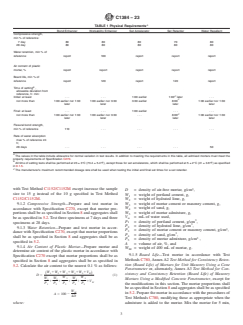
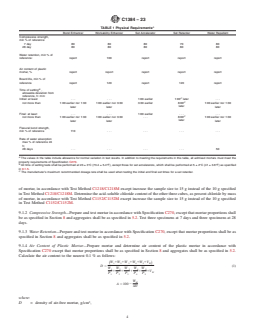
TABLE 1 Physical Requirements
Bond Enhancer Workability Enhancer Set Accelerator Set Retarder Water Repellent
Compressive strength,
min % of reference:
7 day 80 80 80 70 80
28 day 80 80 80 80 80
Water retention, min % of
reference: report 100 report report report
Air content of plastic
mortar, % report report report report report
Board life, min % of
reference report 120 report
...