

ASTM A342/A342M-21
(Test Method)Standard Test Methods for Permeability of Weakly Magnetic Materials
General Information
- Abstract
SIGNIFICANCE AND USE
3.1 This test method is suitable for specification acceptance, design purposes, service evaluation, regulatory statutes, manufacturing control, and research and development.
3.2 Because of the restrictions on the specimen shape and size, this test method is most often used to evaluate semifinished product before fabrication of parts.
SCOPE
1.1 These test methods cover four procedures for determination of the permeability [relative permeability]2 of materials having a relative permeability not exceeding 6.0.
1.2 The test methods covered are as follows:
1.2.1 Test Method 1—Fluxmetric Method is suitable for materials with relative permeabilities between 1.0 and 4.0. This method permits the user to select the magnetic field strength at which the permeability is to be measured.
1.2.2 Test Method 2—Permeability of Paramagnetic Materials has been eliminated as an acceptable method of test.
1.2.3 Test Method 3—Low Mu Permeability Indicator is suitable for measuring the permeability of a material as “less than” or “greater than” that of calibrated standard inserts with relative permeabilities between 1.01 and 6.0, as designated for use in a Low-Mu Permeability Indicator.3 In this method, a small volume of specimen is subjected to a local magnetic field that varies in magnitude and direction, so it is not possible to specify the magnetic field strength at which the measurement is made.
1.2.4 Test Method 4—Flux Distortion is suitable for materials with relative permeabilities between 1.0 and 2.0. In this method, a small volume of specimen is subjected to a local magnetic field that varies in magnitude and direction, so it is not possible to specify the magnetic field strength at which the measurement is made.4
1.2.5 Test Method 5—Vibrating Sample Magnetometry is suitable for materials with relative permeabilities between 1.0 and 4.0. This test method permits the user to select the magnetic field strength at which the permeability is to be measured.
1.3 Materials typically tested by these methods such as austenitic stainless steels may be weakly ferromagnetic. That is, the magnetic permeability is dependent on the magnetic field strength. As a consequence, the results obtained using the different methods may not closely agree with each other. When using Methods 1 and 5, it is imperative to specify the magnetic field strength or range of magnetic field strengths at which the permeabilities have been determined.
1.4 The values and equations stated in customary (cgs-emu and inch-pound) or SI units are to be regarded separately as standard. Within this standard, SI units are shown in brackets except for the sections concerning calculations where there are separate sections for the respective unit systems. The values stated in each system may not be exact equivalents; therefore, each system shall be used independently of the other. Combining values from the two systems may result in nonconformance with this standard.
1.5 This standard does not purport to address all of the safety concerns, if any, associated with its use. It is the responsibility of the user of this standard to establish appropriate safety, health, and environmental practices and determine the applicability of regulatory limitations prior to use.
1.6 This international standard was developed in accordance with internationally recognized principles on standardization established in the Decision on Principles for the Development of International Standards, Guides and Recommendations issued by the World Trade Organization Technical Barriers to Trade (TBT) Committee.
- Status
- Published
- Publication Date
- 31-Jan-2021
- Technical Committee
- A06 - Magnetic Properties
- Drafting Committee
- A06.01 - Test Methods
Overview
ASTM A342/A342M-21: Standard Test Methods for Permeability of Weakly Magnetic Materials defines procedures to determine the magnetic permeability-or relative permeability-of materials with relative permeability values up to 6.0. This standard supports specification acceptance, design, manufacturing control, service evaluation, regulatory compliance, and research activities for weakly magnetic materials, such as certain grades of austenitic stainless steels.
The standard describes four primary test methods, each tailored for specific material types and permeability ranges. By establishing recognized methodologies, ASTM A342/A342M-21 ensures consistent, reliable assessment of magnetic properties in weakly magnetic metals for diverse industrial applications.
Key Topics
- Test Methods Covered:
- Fluxmetric Method: Suitable for relative permeability between 1.0 and 4.0, allowing the user to select the test field strength.
- Low Mu Permeability Indicator: Utilizes calibrated inserts for assessing "less than" or "greater than" permeability between 1.01 and 6.0, ideal for shop or field use.
- Flux Distortion Method: Designed for permeability measurement in the 1.0 to 2.0 range, even on finished parts or small specimens.
- Vibrating Sample Magnetometry (VSM): Enables precise determination of permeability between 1.0 and 4.0 using small, well-prepared specimens.
- Material Suitability: Primarily used with semi-finished items, due to specimen shape/size requirements, but certain methods allow evaluation of parts in their finished state.
- Units of Measurement: Provides for both SI and customary (cgs-emu, inch-pound) units, but mixing systems is not permitted.
- Safety Considerations: Users must establish appropriate health, safety, and environmental practices.
Applications
ASTM A342/A342M-21 plays a crucial role in quality control and engineering specifications for industries where controlling magnetic signature and behavior is critical. Common applications include:
- Aerospace & Defense: Ensures that components like fasteners and structural elements in sensitive environments retain specified low magnetic permeability, reducing interference with electronic systems.
- Nuclear & Medical Equipment: Validation of materials for use in MRI machines, particle accelerators, and radiation shielding, where ferromagnetic behavior must be tightly controlled for functional and safety reasons.
- Industrial Manufacturing: Supports process control by evaluating stock material before fabrication of magnetically sensitive parts.
- Research & Development: Provides reliable data for the investigation of new alloys and treatments affecting magnetic properties.
- Service Evaluation & Regulatory Compliance: Assists in confirming ongoing conformance to permeability limits in mission-critical systems.
Related Standards
For a complete approach to magnetic property measurement of materials, consider the following ASTM standards:
- ASTM A34/A34M: Practice for Sampling and Procurement Testing of Magnetic Materials
- ASTM A341/A341M: Test Method for Direct Current Magnetic Properties of Soft Magnetic Materials Using D-C Permeameters
These standards complement ASTM A342/A342M-21 by providing guidance on sampling, preparation, and testing protocols for magnetic materials in a broader context.
Keywords: ASTM A342, magnetic permeability testing, weakly magnetic materials, relative permeability, austenitic stainless steel, low Mu indicator, fluxmetric method, vibrating sample magnetometer, nondestructive evaluation, magnetic property standards.
Relations
- Effective Date
- 01-Nov-2012
- Effective Date
- 01-Oct-2011
- Effective Date
- 01-Oct-2011
- Refers
ASTM A34/A34M-06 - Standard Practice for Sampling and Procurement Testing of Magnetic Materials - Effective Date
- 01-Nov-2006
- Effective Date
- 01-Nov-2005
- Effective Date
- 01-Nov-2005
- Refers
ASTM A34/A34M-01 - Standard Practice for Sampling and Procurement Testing of Magnetic Materials - Effective Date
- 10-Oct-2001
- Refers
ASTM A34/A34M-96 - Standard Practice for Sampling and Procurement Testing of Magnetic Materials - Effective Date
- 10-Oct-2001
Get Certified
Connect with accredited certification bodies for this standard

IMQ S.p.A. (Certification)
Italian electrical product certification.

SLG Prüf- und Zertifizierungs GmbH
German testing and certification body.

UL Solutions
Global safety science company with testing, inspection and certification.
Sponsored listings
Frequently Asked Questions
ASTM A342/A342M-21 is a standard published by ASTM International. Its full title is "Standard Test Methods for Permeability of Weakly Magnetic Materials". This standard covers: SIGNIFICANCE AND USE 3.1 This test method is suitable for specification acceptance, design purposes, service evaluation, regulatory statutes, manufacturing control, and research and development. 3.2 Because of the restrictions on the specimen shape and size, this test method is most often used to evaluate semifinished product before fabrication of parts. SCOPE 1.1 These test methods cover four procedures for determination of the permeability [relative permeability]2 of materials having a relative permeability not exceeding 6.0. 1.2 The test methods covered are as follows: 1.2.1 Test Method 1—Fluxmetric Method is suitable for materials with relative permeabilities between 1.0 and 4.0. This method permits the user to select the magnetic field strength at which the permeability is to be measured. 1.2.2 Test Method 2—Permeability of Paramagnetic Materials has been eliminated as an acceptable method of test. 1.2.3 Test Method 3—Low Mu Permeability Indicator is suitable for measuring the permeability of a material as “less than” or “greater than” that of calibrated standard inserts with relative permeabilities between 1.01 and 6.0, as designated for use in a Low-Mu Permeability Indicator.3 In this method, a small volume of specimen is subjected to a local magnetic field that varies in magnitude and direction, so it is not possible to specify the magnetic field strength at which the measurement is made. 1.2.4 Test Method 4—Flux Distortion is suitable for materials with relative permeabilities between 1.0 and 2.0. In this method, a small volume of specimen is subjected to a local magnetic field that varies in magnitude and direction, so it is not possible to specify the magnetic field strength at which the measurement is made.4 1.2.5 Test Method 5—Vibrating Sample Magnetometry is suitable for materials with relative permeabilities between 1.0 and 4.0. This test method permits the user to select the magnetic field strength at which the permeability is to be measured. 1.3 Materials typically tested by these methods such as austenitic stainless steels may be weakly ferromagnetic. That is, the magnetic permeability is dependent on the magnetic field strength. As a consequence, the results obtained using the different methods may not closely agree with each other. When using Methods 1 and 5, it is imperative to specify the magnetic field strength or range of magnetic field strengths at which the permeabilities have been determined. 1.4 The values and equations stated in customary (cgs-emu and inch-pound) or SI units are to be regarded separately as standard. Within this standard, SI units are shown in brackets except for the sections concerning calculations where there are separate sections for the respective unit systems. The values stated in each system may not be exact equivalents; therefore, each system shall be used independently of the other. Combining values from the two systems may result in nonconformance with this standard. 1.5 This standard does not purport to address all of the safety concerns, if any, associated with its use. It is the responsibility of the user of this standard to establish appropriate safety, health, and environmental practices and determine the applicability of regulatory limitations prior to use. 1.6 This international standard was developed in accordance with internationally recognized principles on standardization established in the Decision on Principles for the Development of International Standards, Guides and Recommendations issued by the World Trade Organization Technical Barriers to Trade (TBT) Committee.
SIGNIFICANCE AND USE 3.1 This test method is suitable for specification acceptance, design purposes, service evaluation, regulatory statutes, manufacturing control, and research and development. 3.2 Because of the restrictions on the specimen shape and size, this test method is most often used to evaluate semifinished product before fabrication of parts. SCOPE 1.1 These test methods cover four procedures for determination of the permeability [relative permeability]2 of materials having a relative permeability not exceeding 6.0. 1.2 The test methods covered are as follows: 1.2.1 Test Method 1—Fluxmetric Method is suitable for materials with relative permeabilities between 1.0 and 4.0. This method permits the user to select the magnetic field strength at which the permeability is to be measured. 1.2.2 Test Method 2—Permeability of Paramagnetic Materials has been eliminated as an acceptable method of test. 1.2.3 Test Method 3—Low Mu Permeability Indicator is suitable for measuring the permeability of a material as “less than” or “greater than” that of calibrated standard inserts with relative permeabilities between 1.01 and 6.0, as designated for use in a Low-Mu Permeability Indicator.3 In this method, a small volume of specimen is subjected to a local magnetic field that varies in magnitude and direction, so it is not possible to specify the magnetic field strength at which the measurement is made. 1.2.4 Test Method 4—Flux Distortion is suitable for materials with relative permeabilities between 1.0 and 2.0. In this method, a small volume of specimen is subjected to a local magnetic field that varies in magnitude and direction, so it is not possible to specify the magnetic field strength at which the measurement is made.4 1.2.5 Test Method 5—Vibrating Sample Magnetometry is suitable for materials with relative permeabilities between 1.0 and 4.0. This test method permits the user to select the magnetic field strength at which the permeability is to be measured. 1.3 Materials typically tested by these methods such as austenitic stainless steels may be weakly ferromagnetic. That is, the magnetic permeability is dependent on the magnetic field strength. As a consequence, the results obtained using the different methods may not closely agree with each other. When using Methods 1 and 5, it is imperative to specify the magnetic field strength or range of magnetic field strengths at which the permeabilities have been determined. 1.4 The values and equations stated in customary (cgs-emu and inch-pound) or SI units are to be regarded separately as standard. Within this standard, SI units are shown in brackets except for the sections concerning calculations where there are separate sections for the respective unit systems. The values stated in each system may not be exact equivalents; therefore, each system shall be used independently of the other. Combining values from the two systems may result in nonconformance with this standard. 1.5 This standard does not purport to address all of the safety concerns, if any, associated with its use. It is the responsibility of the user of this standard to establish appropriate safety, health, and environmental practices and determine the applicability of regulatory limitations prior to use. 1.6 This international standard was developed in accordance with internationally recognized principles on standardization established in the Decision on Principles for the Development of International Standards, Guides and Recommendations issued by the World Trade Organization Technical Barriers to Trade (TBT) Committee.
ASTM A342/A342M-21 is classified under the following ICS (International Classification for Standards) categories: 29.030 - Magnetic materials. The ICS classification helps identify the subject area and facilitates finding related standards.
ASTM A342/A342M-21 has the following relationships with other standards: It is inter standard links to ASTM A34/A34M-06(2012), ASTM A341/A341M-00(2011), ASTM A341/A341M-00(2011)e1, ASTM A34/A34M-06, ASTM A341/A341M-00(2005)e1, ASTM A341/A341M-00(2005), ASTM A34/A34M-01, ASTM A34/A34M-96. Understanding these relationships helps ensure you are using the most current and applicable version of the standard.
ASTM A342/A342M-21 is available in PDF format for immediate download after purchase. The document can be added to your cart and obtained through the secure checkout process. Digital delivery ensures instant access to the complete standard document.
Standards Content (Sample)
This international standard was developed in accordance with internationally recognized principles on standardization established in the Decision on Principles for the
Development of International Standards, Guides and Recommendations issued by the World Trade Organization Technical Barriers to Trade (TBT) Committee.
Designation: A342/A342M − 21
Standard Test Methods for
Permeability of Weakly Magnetic Materials
This standard is issued under the fixed designationA342/A342M; the number immediately following the designation indicates the year
of original adoption or, in the case of revision, the year of last revision.Anumber in parentheses indicates the year of last reapproval.
A superscript epsilon (´) indicates an editorial change since the last revision or reapproval.
This standard has been approved for use by agencies of the U.S. Department of Defense.
1. Scope not possible to specify the magnetic field strength at which the
measurement is made.
1.1 These test methods cover four procedures for determi-
2 1.2.5 Test Method 5—Vibrating Sample Magnetometry is
nation of the permeability [relative permeability] of materials
suitable for materials with relative permeabilities between 1.0
having a relative permeability not exceeding 6.0.
and 4.0. This test method permits the user to select the
1.2 The test methods covered are as follows:
magnetic field strength at which the permeability is to be
1.2.1 Test Method 1—Fluxmetric Method is suitable for
measured.
materialswithrelativepermeabilitiesbetween1.0and4.0.This
1.3 Materials typically tested by these methods such as
method permits the user to select the magnetic field strength at
austenitic stainless steels may be weakly ferromagnetic. That
which the permeability is to be measured.
is, the magnetic permeability is dependent on the magnetic
1.2.2 Test Method 2—Permeability of Paramagnetic Mate-
field strength.As a consequence, the results obtained using the
rials has been eliminated as an acceptable method of test.
differentmethodsmaynotcloselyagreewitheachother.When
1.2.3 Test Method 3—Low Mu Permeability Indicator is
usingMethods1and5,itisimperativetospecifythemagnetic
suitable for measuring the permeability of a material as “less
field strength or range of magnetic field strengths at which the
than” or “greater than” that of calibrated standard inserts with
permeabilities have been determined.
relative permeabilities between 1.01 and 6.0, as designated for
1.4 The values and equations stated in customary (cgs-emu
use in a Low-Mu Permeability Indicator. In this method, a
smallvolumeofspecimenissubjectedtoalocalmagneticfield and inch-pound) or SI units are to be regarded separately as
standard. Within this standard, SI units are shown in brackets
that varies in magnitude and direction, so it is not possible to
specifythemagneticfieldstrengthatwhichthemeasurementis exceptforthesectionsconcerningcalculationswherethereare
separate sections for the respective unit systems. The values
made.
stated in each system may not be exact equivalents; therefore,
1.2.4 Test Method 4—Flux Distortion is suitable for mate-
each system shall be used independently of the other. Combin-
rials with relative permeabilities between 1.0 and 2.0. In this
ingvaluesfromthetwosystemsmayresultinnonconformance
method, a small volume of specimen is subjected to a local
with this standard.
magnetic field that varies in magnitude and direction, so it is
1.5 This standard does not purport to address all of the
safety concerns, if any, associated with its use. It is the
1 responsibility of the user of this standard to establish appro-
These test methods are under the jurisdiction of ASTM Committee A06 on
Magnetic Properties and are the direct responsibility of Subcommittee A06.01 on priate safety, health, and environmental practices and deter-
Test Methods.
mine the applicability of regulatory limitations prior to use.
Current edition approved Feb. 1, 2021. Published February 2021. Originally
1.6 This international standard was developed in accor-
approved in 1949. Last previous edition approved in 2014 as A342/A342M–14.
dance with internationally recognized principles on standard-
DOI: 10.1520/A0342_A0342M-21.
Test Methods 1 and 5 actually measure magnetic susceptibility. The perme-
ization established in the Decision on Principles for the
ability (µ) [relative permeability (µ )] is related to the susceptibility (κ)bythe
r
Development of International Standards, Guides and Recom-
equations:
mendations issued by the World Trade Organization Technical
µ=1+4πκ (cgs-emu)
µ =1+κ (SI) Barriers to Trade (TBT) Committee.
r
The term permeability has been retained in these test methods because of its
widespread commercial and technological usage.
3 4
Thesolesourceofsupplyoftheapparatusknowntothecommitteeatthistime ThesolesourceofsupplyoftheapparatusknowntotheCommitteeatthistime
is Low-Mu Permeability Indicator, manufactured by Severn Engineering Co., Inc., is the Magnetoscop manufactured by INSTITUT DR. POERSTER GmbH & Co.
555 Stage Rd., Suite 1A, Auburn, AL 36830, http://www.severnengineering.com. KG. in Laisen 70, 72766, Reutlingen, Germany. (Probes can be returned for
(Indicatorscanbereturnedforrecalibration.)Iftheuserofthistestmethodisaware calibration.) If the user of this test method is aware of alternative suppliers, please
of alternative suppliers, please provide this information to ASTM International provide this information toASTM International Headquarters.Your comments will
Headquarters.Your comments will receive careful consideration at a meeting of the receive careful consideration at a meeting of the responsible technical committee,
responsible technical committee, which you may attend. which you may attend.
Copyright © ASTM International, 100 Barr Harbor Drive, PO Box C700, West Conshohocken, PA 19428-2959. United States
A342/A342M − 21
2. Referenced Documents wound and be capable of producing a uniform field of at least
5 300 Oe [24 kA/m] over the length of the test specimen for a
2.1 ASTM Standards:
short time (approximately 10 seconds) without overheating.
A34/A34MPractice for Sampling and Procurement Testing
4.2.2 Test Coil, B , used for measuring magnetic flux
of Magnetic Materials
density, shall have a cross-sectional area not greater than ten
A341/A341MTest Method for Direct Current Magnetic
times that of the test specimen. The test coil should have
Properties of Soft Magnetic Materials Using D-C Per-
sufficient turns (>1000) to provide adequate resolution and
meametersandthePointbyPoint(Ballistic)TestMethods
should be no longer than 20% of the test specimen length.
4.2.3 Compensating Coil, B' , of the same length, cross-
TEST METHOD 1, FLUXMETRIC METHOD
sectionalarea,andnumberofturnsascoil B andconnectedto
3. Significance and Use of Test Method 1
it in series opposition.
4.2.4 Air Flux Compensating Resistor, R' —This resistor is
3.1 Thistestmethodissuitableforspecificationacceptance,
B
used in conjunction with coil B' of Fig. 1 to adjust for exact
design purposes, service evaluation, regulatory statutes, manu- 1
compensation for the air flux enclosed by coil B in order that
facturing control, and research and development.
the intrinsic flux density may be measured directly.
3.2 Because of the restrictions on the specimen shape and
4.2.5 Electronic Fluxmeter, F—used to measure magnetic
size, this test method is most often used to evaluate semifin-
flux density. Alternatively, the magnetizing fixture may be
ished product before fabrication of parts.
connected to a dc hysteresigraph. The combined resistance of
the two test coils and the air flux compensating resistor form
4. Apparatus
partoftheinputresistanceofthefluxmeter.Thefluxmetershall
4.1 Power Supply—Asource of dc current for the electrical
be appropriately adjusted to compensate.
circuit shown in Fig. 1. Electronic power supplies are prefer-
able although the use of storage batteries is permitted.
5. Test Specimens
4.2 Test Fixture—Atest fixture consisting of a magnetizing
5.1 The test specimens shall consist of straight bars, rods,
solenoid with a pair of test coils, one for measuring B in the
wires,orstripsofuniformcrosssection.Multiplepiecesofthe
specimen and one for measuring air flux, plus a variable
same test lot may be used to increase the specimen cross-
resistorforpreciselycancelingtheairflux,andafluxmeterand
sectional area when needed. The cross-sectional area shall be
2 2
associated circuitry conforming to the following requirements:
not less than 0.2 cm [20 mm ]. The length shall be not less
4.2.1 Magnetizing Solenoid, C , having a minimum length
1 than 10 cm [100 mm] and the ratio of length to diameter or
of30cm[300mm]andaratiooflengthtoequivalentdiameter
equivalent diameter (that is, the diameter of a circle having an
of four or more. The magnetizing winding shall be uniformly
area equal to the cross-sectional area of the specimen) shall be
as follows:
Relative Permeability Dimensional Ratio
For referenced ASTM standards, visit the ASTM website, www.astm.org, or
Under 1.5 10 or greater
contact ASTM Customer Service at service@astm.org. For Annual Book of ASTM
1.5 to 2.0, incl. 15 or greater
Standards volume information, refer to the standard’s Document Summary page on
2.0 to 4.0 30 or greater
the ASTM website.
FIG. 1 Circuit Diagram for Method No. 1
A342/A342M − 21
5.2 This test method can be used with smaller dimension- 9. Precision and Bias of Test Method 1
ratio test specimens when used for comparing to similar
9.1 Theprecisionandbiasofthistestmethodhavenotbeen
specimens for quality control purposes.
established by interlaboratory study.
9.2 The measured permeability will be less than the true
6. Procedure
value due to the demagnetizing field, which depends on the
6.1 Measure the thickness and width or diameter of the test
specimen dimensional ratio. This leads not only to an overes-
specimens and calculate the cross-sectional area in square
timationofthemagneticfieldstrengthbutalsoreducestheflux
centimetres [square millimetres].
linkages in the B-coil. Provided the specimen and coil dimen-
6.2 Before inserting the test specimen in the solenoid,
sional ratios are as specified in 4.2.2 and 5.1, the largest
6,7
obtain an exact balance to nullify the effect of air flux in coil
negative error in µ − 1 as a result of demagnetizing effects
B by reversing the highest magnetizing current to be used in
will be−3% for µ − 1 < 0.5.
the test and adjusting the compensating resistor to obtain the
TEST METHOD 3, LOW-MU PERMEABILITY
minimum output from the flux sensing coils.
INDICATOR METHOD OF TEST
6.3 Place the test specimen in position in coil B , adjust the
magnetic field strength to the desired test value, then reverse
10. Significance and Use of Test Method 3
the magnetizing current (from +H to –H ) and record the
m m
10.1 The Low-Mu Permeability Indicator, schematically
fluxmeter reading. Optionally, the B versus H curve can be
shown in Fig. 2, is suitable for determining if the permeability
recorded on a hysteresigraph.
of low permeability materials (relative permeability of 6.0 or
less) is greater than or less than that of the standard insert
7. Calculation (Customary Units)
employed at the time of the test.
7.1 ConvertthefluxmeterreadingtointrinsicfluxdensityB
i
10.2 The instrument is portable and suitable for use in the
and calculate the permeability as follows:
shop, field, and laboratory.
B
i
µ 511 (1) 10.3 The instrument is suitable to test all forms and shapes
H
including parts, provided a suitable flat surface is available on
where:
the specimen. The material under test is that which is at the
surface and is against or is in immediate proximity to the
µ = permeability of the test specimen;
permanent bar magnet.
B = intrinsic flux density of the test specimen, G; and
i
H = magnetic field strength, Oe.
10.4 This test method provides test values (generally stated
as “permeability is less than”) suitable for specification pur-
8. Calculation (SI Units)
poses. It was originally created to comply with now obsolete
8.1 The output from the fluxmeter is the magnetic polariza-
Specification MIL – I – 17214B.
tion J. The relative permeability is calculated as follows:
11. Apparatus
J
µ 5 11 (2)
11.1 Permanent Bar Magnet—The center of the permanent
r
µ H
bar magnet is attached to one end of a movable arm having a
where:
µ = relative permeability of the test specimen;
Chen, D.-X., and Li, B.-Z., “On the Error of Measurement of Feebly Magnetic
r
Material in Regard to Demagnetizing Field,” Acta Metall. Sinica, Vol. 19, pp.
J = magnetic polarization, T;
−7
217–224, Oct. 1983 (in Chinese).
µ = magnetic constant = 4π×10 H/m; and
Chen, D.-X., Brug, J. A., and Goldfarb, R. B., “Demagnetizing Factors for
H = magnetic field strength, A/m.
Cylinders,” IEEE Trans. Magn., Vol. 27, 1991, pp. 3601–3619.
FIG. 2 Schematic Illustration of Low Permeability Indicator
A342/A342M − 21
fulcruminthecenterandacounterbalanceattheoppositeend, TEST METHOD 4, FLUX DISTORTION METHOD OF
thus permitting the permanent magnet to move in one plane in TEST
both directions.
15. Significance and Use of Test Method 4
11.2 Inserts—The standard inserts are weakly magnetic
materials of known permeability values as calibrated by the 15.1 The Flux Distortion Method of Test, schematically
manufacturer of the indicator against their established stan- showninFig.3,issuitablefordeterminingthepermeabilityof
dards. They are available with relative permeability ranging low permeability materials (relative permeability between 1.0
from 1.01 to 6.0. and 2.0) with resolution up to 0.00001. When the instrument
with probe is calibrated against standards with known perme-
11.3 Interferences—Bringing another magnet in contact
ability values as determined by the manufacturer of the
with the indicator permanent bar magnet will disturb the
indicator against their established standards or national
calibration of the indicator to such an extent that it must be
standards, the measured values of permeability can be made
returned to the manufacturer for recalibration. Avoid contact-
traceable to national standards.
ingtheindicatorwithstronglymagneticmaterialssuchassteel,
cast iron, ferritic, or martensitic stainless steels.
15.2 The commercially available electronic instruments for
performing this test are portable and suitable for use in the
12. Test Specimen
shop, field, and laboratory.
12.1 The test specimen or material to be tested is recom-
15.3 Thistestmethodissuitabletotestallformsandshapes
2 2
mended to have a minimum area of 1 cm [100 mm ] and a
including finished parts, provided a suitable flat or nearly flat
minimum thickness of 0.3 cm [3 mm] (the specimen may be
surface is available on the specimen.The material under test is
laminated). Test specimens having a volume in excess of the
that which is at the surface and is against, or is in immediate
minimum value implied above may be in any form, shape, or
proximity to, the probe.
condition (for example, castings, forgings, bars, weld beads,
15.4 This test method is suitable for specification
and so forth). The indicator may be placed on any location on
acceptance, design purposes, service evaluation, regulatory
the specimen to be tested provided that the surface is suitably
statutes,manufacturingcontrol,andresearchanddevelopment.
flat and in full contact with the permanent bar magnet. The
Relative test values allow for comparison of permeability
indicator is capable of detecting surface permeability
between parts of the same physical geometry.
differences, if present, of large objects.
16. Apparatus
13. Procedure
16.1 Electronic
...
This document is not an ASTM standard and is intended only to provide the user of an ASTM standard an indication of what changes have been made to the previous version. Because
it may not be technically possible to adequately depict all changes accurately, ASTM recommends that users consult prior editions as appropriate. In all cases only the current version
of the standard as published by ASTM is to be considered the official document.
Designation: A342/A342M − 14 A342/A342M − 21
Standard Test Methods for
Permeability of Weakly Magnetic Materials
This standard is issued under the fixed designation A342/A342M; the number immediately following the designation indicates the year
of original adoption or, in the case of revision, the year of last revision. A number in parentheses indicates the year of last reapproval.
A superscript epsilon (´) indicates an editorial change since the last revision or reapproval.
This standard has been approved for use by agencies of the U.S. Department of Defense.
1. Scope
1.1 These test methods cover four procedures for determination of the permeability [relative permeability] of materials having
a relative permeability not exceeding 6.0.
1.2 The test methods covered are as follows:
1.2.1 Test Method 1—Fluxmetric Method is suitable for materials with relative permeabilities between 1.0 and 4.0. This method
permits the user to select the magnetic field strength at which the permeability is to be measured.
1.2.2 Test Method 2—Permeability of Paramagnetic Materials has been eliminated as an acceptable method of test.
1.2.3 Test Method 3—Low Mu Permeability Indicator is suitable for measuring the permeability of a material as “less than” or
“greater than” that of calibrated standard inserts with permeability relative permeabilities between 1.01 and 6.0, as designated for
use in a Low-Mu Permeability Indicator. In this method, a small volume of specimen is subjected to a local magnetic field that
varies in magnitude and direction, so it is not possible to specify the magnetic field strength at which the measurement is made.
1.2.4 Test Method 4—Flux Distortion is suitable for materials with permeability relative permeabilities between 1.0 and 2.0. In
this method, a small volume of specimen is subjected to a local magnetic field that varies in magnitude and direction, so it is not
possible to specify the magnetic field strength at which the measurement is made.
1.2.5 Test Method 5—Vibrating Sample Magnetometry is suitable for materials with permeability relative permeabilities between
1.0 and 4.0. This test method permits the user to select the magnetic field strength at which the permeability is to be measured.
These test methods are under the jurisdiction of ASTM Committee A06 on Magnetic Properties and are the direct responsibility of Subcommittee A06.01 on Test
Methods.
Current edition approved May 1, 2014Feb. 1, 2021. Published May 2014February 2021. Originally approved in 1949. Last previous edition approved in 20122014 as
A342/A342MA342/A342M – 14.–04 (2012). DOI: 10.1520/A0342_A0342M-14.10.1520/A0342_A0342M-21.
Test Methods 1 and 5 actually measure magnetic susceptibility. The permeability (μ) [relative permeability (μ )] is related to the susceptibility (κ) by the equations:
r
μ = 1 + 4πκ (cgs-emu)
μ = 1 + κ (SI)
r
The term permeability has been retained in these test methods because of its widespread commercial and technological usage.
The sole source of supply of the apparatus known to the committee at this time is Low-Mu Permeability Indicator, manufactured by Severn Engineering Co., Inc., 555
Stage Rd., Suite 1A, Auburn, AL 36830, http://www.severnengineering.com. (Indicators can be returned for recalibration.) If you are the user of this test method is aware
of alternative suppliers, please provide this information to ASTM International Headquarters. Your comments will receive careful consideration at a meeting of the responsible
technical committee, which you may attend.
The sole source of supply of the apparatus known to the Committee at this time is the Magnetoscop manufactured by INSTITUT DR. POERSTER GmbH & Co. KG.
in Laisen 70, 72766, Reutlingen, Germany. (Probes can be returned for calibration.) If you are aware of alternatethe user of this test method is aware of alternative suppliers,
please provide this information to ASTM International Headquarters. Your comments will receive careful consideration at a meeting of the responsible technical committee,
which you may attend.
Copyright © ASTM International, 100 Barr Harbor Drive, PO Box C700, West Conshohocken, PA 19428-2959. United States
A342/A342M − 21
1.3 Materials typically tested by these methods such as austenitic stainless steels may be weakly ferromagnetic. That is, the
magnetic permeability is dependent on the magnetic field strength. As a consequence, the results obtained using the different
methods may not closely agree with each other. When using Methods 1 and 5, it is imperative to specify the magnetic field strength
or range of magnetic field strengths at which the permeabilities have been determined.
1.4 The values and equations stated in customary (cgs-emu and inch-pound) or SI units are to be regarded separately as standard.
Within this standard, SI units are shown in brackets except for the sections concerning calculations where there are separate
sections for the respective unit systems. The values stated in each system may not be exact equivalents; therefore, each system shall
be used independently of the other. Combining values from the two systems may result in nonconformance with this standard.
1.5 This standard does not purport to address all of the safety concerns, if any, associated with its use. It is the responsibility
of the user of this standard to establish appropriate safety safety, health, and healthenvironmental practices and determine the
applicability of regulatory limitations prior to use.
1.6 This international standard was developed in accordance with internationally recognized principles on standardization
established in the Decision on Principles for the Development of International Standards, Guides and Recommendations issued
by the World Trade Organization Technical Barriers to Trade (TBT) Committee.
2. Referenced Documents
2.1 ASTM Standards:
A34/A34M Practice for Sampling and Procurement Testing of Magnetic Materials
A341/A341M Test Method for Direct Current Magnetic Properties of Soft Magnetic Materials Using D-C Permeameters and the
Point by Point (Ballistic) Test Methods
TEST METHOD 1, FLUXMETRIC METHOD
3. Significance and Use of Test Method 1
3.1 This test method is suitable for specification acceptance, design purposes, service evaluation, regulatory statutes,
manufacturing control, and research and development.
3.2 Because of the restrictions on the specimen shape and size, this test method is most often used to evaluate semifinished product
before fabrication of parts.
4. Apparatus
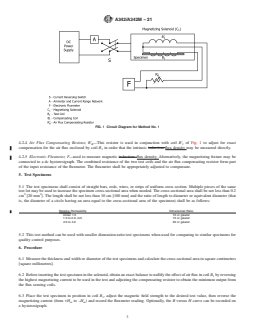
4.1 Power Supply—A source of dc current for the electrical circuit shown in Fig. 1. Electronic power supplies are preferable
although the use of storage batteries is permitted.
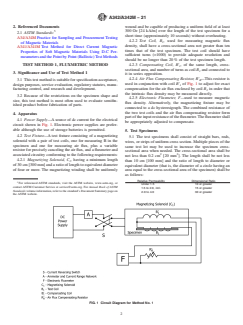
4.2 Test Fixture—A test fixture consisting of a magnetizing solenoid with a pair of test coils, one for measuring B in the specimen
and one for measuring air flux, plus a variable resistor for precisely canceling the air flux, and a fluxmeter and associated circuitry
conforming to the following requirements:
4.2.1 Magnetizing Solenoid, C , having a minimum length of 30 cm [300 mm] and a ratio of length to equivalent diameter of four
or more. The magnetizing winding shall be uniformly wound and be capable of producing a uniform field of at least 300 Oe [24
kA/m] over the length of the test specimen for a short time (approximately 10 seconds) without overheating.
4.2.2 Test Coil, B , used for measuring magnetic flux density, shall have a cross-sectional area not greater than ten times that of
the test specimen. The test coil should have sufficient turns (>1000) to provide adequate resolution and should be no longer than
20 % of the test specimen length.
4.2.3 Compensating Coil, B' , of the same length, cross-sectional area, and number of turns as coil B and connected to it in series
1 1
opposition.
For referenced ASTM standards, visit the ASTM website, www.astm.org, or contact ASTM Customer Service at service@astm.org. For Annual Book of ASTM Standards
volume information, refer to the standard’s Document Summary page on the ASTM website.
A342/A342M − 21
FIG. 1 Circuit Diagram for Method No. 1
4.2.4 Air Flux Compensating Resistor, R' —This resistor is used in conjunction with coil B' of Fig. 1 to adjust for exact
B 1
compensation for the air flux enclosed by coil B in order that the intrinsic induction flux density may be measured directly.
4.2.5 Electronic Fluxmeter, F—used to measure magnetic induction. flux density. Alternatively, the magnetizing fixture may be
connected to a dc hysteresigraph. The combined resistance of the two test coils and the air flux compensating resistor form part
of the input resistance of the fluxmeter. The fluxmeter shall be appropriately adjusted to compensate.
5. Test Specimens
5.1 The test specimens shall consist of straight bars, rods, wires, or strips of uniform cross section. Multiple pieces of the same
test lot may be used to increase the specimen cross-sectional area when needed. The cross-sectional area shall be not less than 0.2
2 2
cm [20 mm ]. The length shall be not less than 10 cm [100 mm] and the ratio of length to diameter or equivalent diameter (that
is, the diameter of a circle having an area equal to the cross-sectional area of the specimen) shall be as follows:
Relative Permeability Dimensional Ratio
Under 1.5 10 or greater
1.5 to 2.0, incl. 15 or greater
2.0 to 4.0 30 or greater
5.2 This test method can be used with smaller dimension-ratio test specimens when used for comparing to similar specimens for
quality control purposes.
6. Procedure
6.1 Measure the thickness and width or diameter of the test specimens and calculate the cross-sectional area in square centimetres
[square millimetres].
6.2 Before inserting the test specimen in the solenoid, obtain an exact balance to nullify the effect of air flux in coil B by reversing
the highest magnetizing current to be used in the test and adjusting the compensating resistor to obtain the minimum output from
the flux sensing coils.
6.3 Place the test specimen in position in coil B , adjust the magnetic field strength to the desired test value, then reverse the
magnetizing current (from +H to –H ) and record the fluxmeter reading. Optionally, the B versus H curve can be recorded on
m m
a hysteresigraph.
A342/A342M − 21
7. Calculation (Customary Units)
7.1 Convert the fluxmeter reading to intrinsic induction flux density B and calculate the permeability as follows:
i
B
i
μ 5 11 (1)
H
where:
where:
μ = permeability of the test specimen;
B = intrinsic induction of the test specimen, G; and
i
B = intrinsic flux density of the test specimen, G; and
i
H = magnetic field strength, Oe.
8. Calculation (SI Units)
8.1 The output from the fluxmeter is the magnetic polarization J. The relative permeability is calculated as follows:
J
μ 5 11 (2)
r
Γ H
m
J
μ 5 11 (2)
r
μ H
where:
where:
μ = relative permeability of the test specimen;
r
J = magnetic polarization, T;
−7
Γ = 4π × 10 H/m; and
m
−7
μ = magnetic constant = 4π × 10 H/m; and
H = magnetic field strength, A/m.
9. Precision and Bias of Test Method 1
9.1 The precision and bias of this test method have not been established by interlaboratory study.
9.2 The measured permeability will be less than the true value due to the demagnetizing field, which depends on the specimen
dimensional ratio. This leads not only to an overestimation of the magnetic field strength but also reduces the flux linkages in the
B-coil. Provided the specimen and coil dimensional ratios are as specified in 4.2.2 and 5.1, the largest negative error in μ − 1 as
6,7
a result of demagnetizing effects will be −3 % for μ − 1 < 0.5.
TEST METHOD 3, LOW-MU PERMEABILITY INDICATOR METHOD OF TEST
10. Significance and Use of Test Method 3
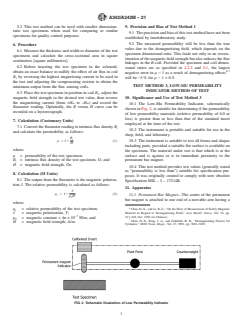
10.1 The Low-Mu Permeability Indicator, schematically shown in Fig. 2, is suitable for determining if the permeability of low
permeability materials (relative μpermeability of 6.0 or less) is greater than or less than that of the standard insert employed at the
time of the test.
10.2 The instrument is portable and suitable for use in the shop, field, and laboratory.
10.3 The instrument is suitable to test all forms and shapes including parts, provided a suitable flat surface is available on the
specimen. The material under test is that which is at the surface and is against or is in immediate proximity to the permanent bar
magnet.
Chen, D.-X., and Li, B.-Z., “On the Error of Measurement of Feebly Magnetic Material in Regard to Demagnetizing Field,” Acta Metall. Sinica, Vol. 19, pp. 217–224,
Oct. 1983 (in Chinese).
Chen, D.-X., Brug, J. A., and Goldfarb, R. B., “Demagnetizing Factors for Cylinders,” IEEE Trans. Magn., Vol. 27, 1991, pp. 3601–3619.
A342/A342M − 21
FIG. 2 Schematic Illustration of Low Permeability Indicator
10.4 This test method provides test values (generally stated as “permeability is less than”) suitable for specification purposes. It
was originally created to comply with now obsolete Specification MIL – I – 17214B.
11. Apparatus
11.1 Permanent Bar Magnet—The center of the permanent bar magnet is attached to one end of a movable arm having a fulcrum
in the center and a counterbalance at the opposite end, thus permitting the permanent magnet to move in one plane in both
directions.
11.2 Inserts—The standard inserts are weakly magnetic materials of known permeability values as calibrated by the manufacturer
of the indicator against their established standards. They are available with relative permeability ranging from 1.01 to 6.0.
11.3 Interferences—Bringing another magnet in contact with the indicator permanent bar magnet will disturb the calibration of the
indicator to such an extent that it must be returned to the manufacturer for recalibration. Avoid contacting the indicator with
strongly magnetic materials such as steel, cast iron, ferritic, or martensitic stainless steels.
12. Test Specimen
2 2
12.1 The test specimen or material to be tested is recommended to have a minimum area of 1 cm [100 mm ] and a minimum
thickness of 0.3 cm [3 mm] (the specimen may be laminated). Test specimens having a volume in excess of the minimum value
implied above may be in any form, shape, or condition (for example, castings, forgings, bars, weld beads, and so forth). The
indicator may be placed on any location on the specimen to be tested provided that the surface is suitably flat and in full contact
with the permanent bar magnet. The indicator is capable of detecting surface permeability differences, if present, of large objects.
13. Procedure
13.1 Screw into the top of the case a calibrated insert of known permeability. The permanent magnet is attached to the insert by
a force dependent upon the insert’s designated permeability value. Place the end of the permanent magnet projecting from the hole
in the bottom of the indicator in contact with the material being tested. Move the indicator away in a direction normal to the contact
surface. If the material being tested has a permeability higher than that of the insert, the permanent magnet will break contact first
with the insert as the indicator is moved away. However, if the permeability of the material being tested is lower than that of the
insert, the permanent magnet will break contact first with the test material as the indicator is moved away. By interchanging inserts,
it is possible to bracket the permeability of the material under test.
14. Precision and Bias of Test Method 3
14.1 The precision and bias of this test method have not been established by interlaboratory study.
14.2 The manufacturer of the Low-Mu Permeability Indicator determines the permeability of the calibrated inserts. The standards
...