

ASTM A958/A958M-24
(Specification)Standard Specification for Steel Castings, Carbon and Alloy, with Tensile Requirements, Chemical Requirements Similar to Standard Wrought Grades
General Information
- Abstract
ABSTRACT
This specification covers carbon and low-alloy steel castings. The steel specimens shall be heat treated and shall conform to the required values of austenitizing temperature and tempering temperature. The steel materials shall conform to the required chemical compositions of carbon, manganese, phosphorus, sulfur, silicon, nickel, chromium, and molybdenum. Tensile tests shall be performed and the steel specimens shall conform to the required values of tensile strength, yield strength, and elongation.
SCOPE
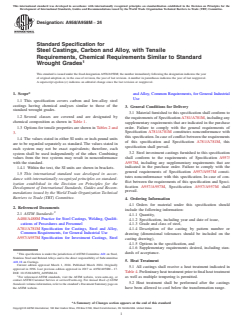
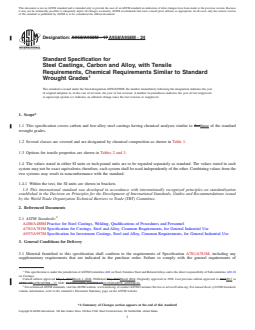
1.1 This specification covers carbon and low-alloy steel castings having chemical analyses similar to those of the standard wrought grades.
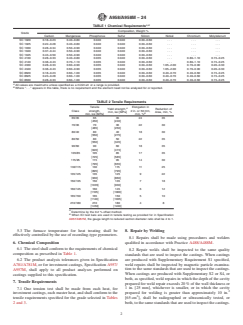
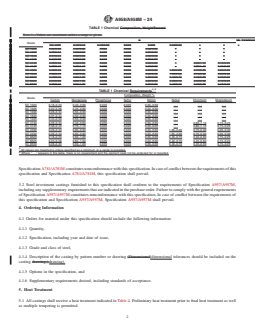
1.2 Several classes are covered and are designated by chemical composition as shown in Table 1.
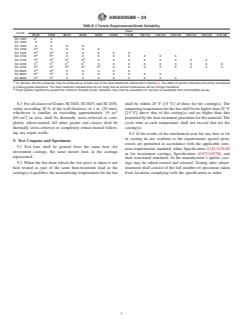
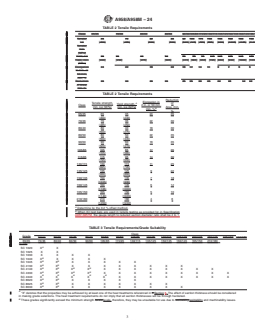
1.3 Options for tensile properties are shown in Tables 2 and 3.
1.4 The values stated in either SI units or inch-pound units are to be regarded separately as standard. The values stated in each system may not be exact equivalents; therefore, each system shall be used independently of the other. Combining values from the two systems may result in nonconformance with the standard.
1.4.1 Within the text, the SI units are shown in brackets.
1.5 This international standard was developed in accordance with internationally recognized principles on standardization established in the Decision on Principles for the Development of International Standards, Guides and Recommendations issued by the World Trade Organization Technical Barriers to Trade (TBT) Committee.
- Status
- Published
- Publication Date
- 29-Feb-2024
- Technical Committee
- A01 - Steel, Stainless Steel and Related Alloys
- Drafting Committee
- A01.18 - Castings
Buy Documents
ASTM A958/A958M-24 - Standard Specification for Steel Castings, Carbon and Alloy, with Tensile Requirements, Chemical Requirements Similar to Standard Wrought Grades
REDLINE ASTM A958/A958M-24 - Standard Specification for Steel Castings, Carbon and Alloy, with Tensile Requirements, Chemical Requirements Similar to Standard Wrought Grades
Overview
ASTM A958/A958M-24 is an international standard specification published by ASTM International, detailing requirements for carbon and low-alloy steel castings with chemical compositions similar to standard wrought grades. The standard defines both chemical and mechanical property requirements, including tensile strength, yield strength, and elongation. This ensures steel castings perform reliably in a wide range of structural and industrial applications. ASTM A958/A958M-24 references both SI and inch-pound units, but each unit system must be used independently to ensure compliance.
Key Topics
Steel Grades and Composition
The specification outlines several grades of carbon and low-alloy steel, such as SC 1020, SC 1045, SC 4140, and SC 4340. Each grade has tightly controlled ranges for elements including carbon, manganese, phosphorus, sulfur, silicon, nickel, chromium, and molybdenum. Chemical requirements closely mirror those of standard wrought steel grades.Mechanical Properties
Minimum tensile requirements for each grade and class are detailed, covering essential metrics:- Tensile strength
- Yield strength
- Elongation
- Reduction of area
Options for these properties allow for application flexibility.
Heat Treatment
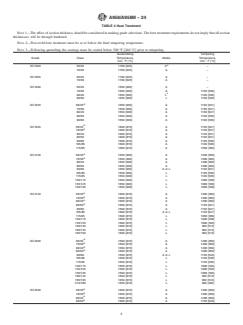
All castings must undergo heat treatment. The requirements specify:- Austenitizing and tempering temperatures
- Cooling media (air or liquid)
- Procedures for stress-relieving or reheat-treatment after welding
Quality Assurance
The standard requires:- Material traceability
- Test sampling for each heat or lot
- Options for supplementary requirements such as magnetic particle, radiographic, and ultrasonic examination
Welding and Repair
Weld repairs must be performed by qualified personnel following specific procedures and are subject to non-destructive testing, especially for critical applications.
Applications
ASTM A958/A958M-24 is used broadly wherever steel castings must meet rigorous mechanical and chemical standards similar to wrought products. Key sectors include:
Construction and Infrastructure
Steel castings for bridges, buildings, and structural supports benefit from the reliability and consistency required by this standard.Machinery and Industrial Equipment
Machine frames, gears, and heavy-wear components rely on steel castings with predictable mechanical properties.Automotive and Transportation
Parts such as housings, brackets, and suspension elements take advantage of grades offering high strength and ductility.Energy Sector
Power generation and oil and gas equipment utilize alloy steel castings meeting ASTM A958/A958M-24 for components subject to high stress and harsh environments.General Engineering
Any application where wrought-equivalent properties and verified performance are critical.
Related Standards
Users of ASTM A958/A958M-24 should be familiar with the following related ASTM standards:
- ASTM A781/A781M: General requirements for steel and alloy castings for industrial use.
- ASTM A957/A957M: Requirements for investment castings of steel and alloy.
- ASTM A488/A488M: Procedures and qualifications for welding steel castings.
These standards provide foundational requirements or specialized procedures referenced throughout ASTM A958/A958M-24.
Adhering to ASTM A958/A958M-24 ensures steel castings achieve consistent quality, mechanical performance, and reliability, making the standard vital for manufacturers, engineers, and quality professionals across demanding industries.
Relations
- Effective Date
- 01-Mar-2024
- Effective Date
- 01-Mar-2024
- Effective Date
- 01-Mar-2024
- Effective Date
- 01-Mar-2024
- Effective Date
- 01-Mar-2024
Buy Documents
ASTM A958/A958M-24 - Standard Specification for Steel Castings, Carbon and Alloy, with Tensile Requirements, Chemical Requirements Similar to Standard Wrought Grades
REDLINE ASTM A958/A958M-24 - Standard Specification for Steel Castings, Carbon and Alloy, with Tensile Requirements, Chemical Requirements Similar to Standard Wrought Grades
Get Certified
Connect with accredited certification bodies for this standard

Element Materials Technology
Materials testing and product certification.

Inštitut za kovinske materiale in tehnologije
Institute of Metals and Technology. Materials testing, metallurgical analysis, NDT.
Sponsored listings
Frequently Asked Questions
ASTM A958/A958M-24 is a technical specification published by ASTM International. Its full title is "Standard Specification for Steel Castings, Carbon and Alloy, with Tensile Requirements, Chemical Requirements Similar to Standard Wrought Grades". This standard covers: ABSTRACT This specification covers carbon and low-alloy steel castings. The steel specimens shall be heat treated and shall conform to the required values of austenitizing temperature and tempering temperature. The steel materials shall conform to the required chemical compositions of carbon, manganese, phosphorus, sulfur, silicon, nickel, chromium, and molybdenum. Tensile tests shall be performed and the steel specimens shall conform to the required values of tensile strength, yield strength, and elongation. SCOPE 1.1 This specification covers carbon and low-alloy steel castings having chemical analyses similar to those of the standard wrought grades. 1.2 Several classes are covered and are designated by chemical composition as shown in Table 1. 1.3 Options for tensile properties are shown in Tables 2 and 3. 1.4 The values stated in either SI units or inch-pound units are to be regarded separately as standard. The values stated in each system may not be exact equivalents; therefore, each system shall be used independently of the other. Combining values from the two systems may result in nonconformance with the standard. 1.4.1 Within the text, the SI units are shown in brackets. 1.5 This international standard was developed in accordance with internationally recognized principles on standardization established in the Decision on Principles for the Development of International Standards, Guides and Recommendations issued by the World Trade Organization Technical Barriers to Trade (TBT) Committee.
ABSTRACT This specification covers carbon and low-alloy steel castings. The steel specimens shall be heat treated and shall conform to the required values of austenitizing temperature and tempering temperature. The steel materials shall conform to the required chemical compositions of carbon, manganese, phosphorus, sulfur, silicon, nickel, chromium, and molybdenum. Tensile tests shall be performed and the steel specimens shall conform to the required values of tensile strength, yield strength, and elongation. SCOPE 1.1 This specification covers carbon and low-alloy steel castings having chemical analyses similar to those of the standard wrought grades. 1.2 Several classes are covered and are designated by chemical composition as shown in Table 1. 1.3 Options for tensile properties are shown in Tables 2 and 3. 1.4 The values stated in either SI units or inch-pound units are to be regarded separately as standard. The values stated in each system may not be exact equivalents; therefore, each system shall be used independently of the other. Combining values from the two systems may result in nonconformance with the standard. 1.4.1 Within the text, the SI units are shown in brackets. 1.5 This international standard was developed in accordance with internationally recognized principles on standardization established in the Decision on Principles for the Development of International Standards, Guides and Recommendations issued by the World Trade Organization Technical Barriers to Trade (TBT) Committee.
ASTM A958/A958M-24 is classified under the following ICS (International Classification for Standards) categories: 77.100 - Ferroalloys. The ICS classification helps identify the subject area and facilitates finding related standards.
ASTM A958/A958M-24 has the following relationships with other standards: It is inter standard links to ASTM A958/A958M-17, ASTM A488/A488M-24, ASTM A957/A957M-21, ASTM A781/A781M-21, ASTM A488/A488M-18e2. Understanding these relationships helps ensure you are using the most current and applicable version of the standard.
ASTM A958/A958M-24 is available in PDF format for immediate download after purchase. The document can be added to your cart and obtained through the secure checkout process. Digital delivery ensures instant access to the complete standard document.
Standards Content (Sample)
This international standard was developed in accordance with internationally recognized principles on standardization established in the Decision on Principles for the
Development of International Standards, Guides and Recommendations issued by the World Trade Organization Technical Barriers to Trade (TBT) Committee.
Designation: A958/A958M − 24
Standard Specification for
Steel Castings, Carbon and Alloy, with Tensile
Requirements, Chemical Requirements Similar to Standard
Wrought Grades
This standard is issued under the fixed designation A958/A958M; the number immediately following the designation indicates the year
of original adoption or, in the case of revision, the year of last revision. A number in parentheses indicates the year of last reapproval.
A superscript epsilon (´) indicates an editorial change since the last revision or reapproval.
1. Scope* and Alloy, Common Requirements, for General Industrial
Use
1.1 This specification covers carbon and low-alloy steel
castings having chemical analyses similar to those of the
3. General Conditions for Delivery
standard wrought grades.
3.1 Material furnished to this specification shall conform to
1.2 Several classes are covered and are designated by
the requirements of Specification A781/A781M, including any
chemical composition as shown in Table 1.
supplementary requirements that are indicated in the purchase
order. Failure to comply with the general requirements of
1.3 Options for tensile properties are shown in Tables 2 and
Specification A781/A781M constitutes nonconformance with
3.
this specification. In case of conflict between the requirements
1.4 The values stated in either SI units or inch-pound units
of this specification and Specification A781/A781M, this
are to be regarded separately as standard. The values stated in
specification shall prevail.
each system may not be exact equivalents; therefore, each
3.2 Steel investment castings furnished to this specification
system shall be used independently of the other. Combining
shall conform to the requirements of Specification A957/
values from the two systems may result in nonconformance
A957M, including any supplementary requirements that are
with the standard.
indicated in the purchase order. Failure to comply with the
1.4.1 Within the text, the SI units are shown in brackets.
general requirements of Specification A957/A957M consti-
1.5 This international standard was developed in accor-
tutes nonconformance with this specification. In case of con-
dance with internationally recognized principles on standard-
flict between the requirements of this specification and Speci-
ization established in the Decision on Principles for the
fication A957/A957M, Specification A957/A957M shall
Development of International Standards, Guides and Recom-
prevail.
mendations issued by the World Trade Organization Technical
Barriers to Trade (TBT) Committee.
4. Ordering Information
4.1 Orders for material under this specification should
2. Referenced Documents
include the following information:
2.1 ASTM Standards:
4.1.1 Quantity,
A488/A488M Practice for Steel Castings, Welding, Qualifi-
4.1.2 Specification, including year and date of issue,
cations of Procedures and Personnel
4.1.3 Grade and class of steel,
A781/A781M Specification for Castings, Steel and Alloy,
4.1.4 Description of the casting by pattern number or
Common Requirements, for General Industrial Use
drawing (dimensional tolerances should be included on the
A957/A957M Specification for Investment Castings, Steel
casting drawing),
4.1.5 Options in the specification, and
4.1.6 Supplementary requirements desired, including stan-
1 dards of acceptance.
This specification is under the jurisdiction of ASTM Committee A01 on Steel,
Stainless Steel and Related Alloys and is the direct responsibility of Subcommittee
5. Heat Treatment
A01.18 on Castings.
Current edition approved March 1, 2024. Published March 2024. Originally
5.1 All castings shall receive a heat treatment indicated in
approved in 1996. Last previous edition approved in 2017 as A958/A958M – 17.
Table 4. Preliminary heat treatment prior to final heat treatment
DOI: 10.1520/A0958_A0958M-24.
For referenced ASTM standards, visit the ASTM website, www.astm.org, or as well as multiple tempering is permitted.
contact ASTM Customer Service at service@astm.org. For Annual Book of ASTM
5.2 Heat treatment shall be performed after the castings
Standards volume information, refer to the standard’s Document Summary page on
the ASTM website. have been allowed to cool below the transformation range.
*A Summary of Changes section appears at the end of this standard
Copyright © ASTM International, 100 Barr Harbor Drive, PO Box C700, West Conshohocken, PA 19428-2959. United States
A958/A958M − 24
A,B
TABLE 1 Chemical Requirements
Composition, Weight %
Grade
Carbon Manganese Phosphorus Sulfur Silicon Nickel Chromium Molybdenum
SC 1020 0.18–0.23 0.40–0.80 0.040 0.040 0.30–0.60 . . . . . . . . .
SC 1025 0.22–0.28 0.40–0.80 0.040 0.040 0.30–0.60 . . . . . . . . .
SC 1030 0.28–0.34 0.50–0.90 0.040 0.040 0.30–0.60 . . . . . . . . .
SC 1040 0.37–0.44 0.50–0.90 0.040 0.040 0.30–0.60 . . . . . . . . .
SC 1045 0.43–0.50 0.50–0.90 0.040 0.040 0.30–0.60 . . . . . . . . .
SC 4130 0.28–0.33 0.40–0.80 0.035 0.040 0.30–0.60 . . . 0.80–1.10 0.15–0.25
SC 4140 0.38–0.43 0.70–1.10 0.035 0.040 0.30–0.60 . . . 0.80–1.10 0.15–0.25
SC 4330 0.28–0.33 0.60–0.90 0.035 0.040 0.30–0.60 1.65–2.00 0.70–0.90 0.20–0.30
SC 4340 0.38–0.43 0.60–0.90 0.035 0.040 0.30–0.60 1.65–2.00 0.70–0.90 0.20–0.30
SC 8620 0.18–0.23 0.60–1.00 0.035 0.040 0.30–0.60 0.40–0.70 0.40–0.60 0.15–0.25
SC 8625 0.23–0.28 0.60–1.00 0.035 0.040 0.30–0.60 0.40–0.70 0.40–0.60 0.15–0.25
SC 8630 0.28–0.33 0.60–1.00 0.035 0.040 0.30–0.60 0.40–0.70 0.40–0.60 0.15–0.25
A
All values are maximums unless specified as a minimum or a range is provided.
B
Where “. . .” appears in this table, there is no requirement and the element need not be analyzed for or reported.
TABLE 2 Tensile Requirements
Tensile Elongation in
A
Yield strength, Reduction of
Class strength, 2 in. or 50 mm,
min, ksi [MPa]
Area, min, %
B
min, ksi [MPa] min, %
65/35 65 35 24 35
[450] [240]
70/36 70 36 22 30
[485] [250]
80/40 80 40 18 30
[550] [275]
80/50 80 50 22 35
[550] [345]
90/60 90 60 18 35
[620] [415]
105/85 105 85 17 35
[725] [585]
115/95 115 95 14 30
[795] [655]
130/115 130 115 11 25
[895] [795]
135/125 135 125 9 22
[930] [860]
150/135 150 135 7 18
[1035] [930]
160/145 160 145 6 12
[1105] [1000]
165/150 165 150 5 10
[1140] [1035]
210/180 210 180 4 8
[1450] [1240]
A
Determine by the 0.2 % offset method.
B
When ICI test bars are used in tensile testing as provided for in Specification
A957/A957M, the gauge length to reduced section diameter ratio shall be 4 to 1.
5.3 The furnace temperature for heat treating shall be 8. Repair by Welding
effectively controlled by the use of recording-type pyrometers.
8.1 Repairs shall be made using procedures and welders
6. Chemical Composition qualified in accordance with Practice A488/A488M.
6.1 The steel shall conform to the requirements of chemical
8.2 Repair welds shall be inspected to the same quality
composition as prescribed in Table 1.
standards that are used to inspect the castings. When castings
are produced with Supplementary Requirement S1 specified,
6.2 The product analysis tolerances given in Specification
weld repairs shall be inspected by magnetic particle examina-
A781/A781M, or for investment castings, Specification A957/
tion to the same standards that are used to inspect the castings.
A957M, shall apply to all product analyses performed on
When castings are produced with Supplementary S2 or S4, or
castings supplied to this specification.
both, as specified, weld repairs in which the depth of the cavity
7. Tensile Requirements
prepared for weld repair exceeds 20 % of the wall thickness or
7.1 One tension test shall be made from each heat, for 1 in. [25 mm], whichever is smaller, or in which the cavity
investment castings, each master heat, and shall conform to the prepared for welding is greater than approximately 10 in.
tensile requirements specified for the grade selected in Tables [65 cm ], shall be radiographed or ultrasonically tested, or
2 and 3. both, to the same standards that are used to inspect the castings.
A958/A958M − 24
TABLE 3 Tensile Requirements/Grade Suitability
Class
Grade
65/35 70/36 80/40 80/50 90/60 105/85 115/95 130/115 135/125 150/135 160/145 165/150 210/180
A
SC 1020 X X
SC 1025 X X
SC 1030 X X X X
B
SC 1040 X X X X X
B B
SC 1045 X X X X X X X
B B
SC 4130 X X X X X X X X X X
B B B B
SC 4140 X X X X X X X X X X X X
B B B B
SC 4330 X X X X X X X X X X X X X
B B B B B
SC 4340 X X X X X X X X X X X X X
B B
SC 8620 X X X X X X X
B B
SC 8625 X X X X X X X X X
B B
SC 8630 X X X X X X X X X X
A
“X” denotes that the properties may be achieved by at least one of the heat treatments referenced in Section 5. The effect o
...
This document is not an ASTM standard and is intended only to provide the user of an ASTM standard an indication of what changes have been made to the previous version. Because
it may not be technically possible to adequately depict all changes accurately, ASTM recommends that users consult prior editions as appropriate. In all cases only the current version
of the standard as published by ASTM is to be considered the official document.
Designation: A958/A958M − 17 A958/A958M − 24
Standard Specification for
Steel Castings, Carbon and Alloy, with Tensile
Requirements, Chemical Requirements Similar to Standard
Wrought Grades
This standard is issued under the fixed designation A958/A958M; the number immediately following the designation indicates the year
of original adoption or, in the case of revision, the year of last revision. A number in parentheses indicates the year of last reapproval.
A superscript epsilon (´) indicates an editorial change since the last revision or reapproval.
1. Scope*
1.1 This specification covers carbon and low-alloy steel castings having chemical analyses similar to thatthose of the standard
wrought grades.
1.2 Several classes are covered and are designated by chemical composition as shown in Table 1.
1.3 Options for tensile properties are shown in Tables 2 and 3.
1.4 The values stated in either SI units or inch-pound units are to be regarded separately as standard. The values stated in each
system may not be exact equivalents; therefore, each system shall be used independently of the other. Combining values from the
two systems may result in nonconformance with the standard.
1.4.1 Within the text, the SI units are shown in brackets.
1.5 This international standard was developed in accordance with internationally recognized principles on standardization
established in the Decision on Principles for the Development of International Standards, Guides and Recommendations issued
by the World Trade Organization Technical Barriers to Trade (TBT) Committee.
2. Referenced Documents
2.1 ASTM Standards:
A488/A488M Practice for Steel Castings, Welding, Qualifications of Procedures and Personnel
A781/A781M Specification for Castings, Steel and Alloy, Common Requirements, for General Industrial Use
A957/A957M Specification for Investment Castings, Steel and Alloy, Common Requirements, for General Industrial Use
3. General Conditions for Delivery
3.1 Material furnished to this specification shall conform to the requirements of Specification A781/A781M, including any
supplementary requirements that are indicated in the purchase order. Failure to comply with the general requirements of
This specification is under the jurisdiction of ASTM Committee A01 on Steel, Stainless Steel and Related Alloys and is the direct responsibility of Subcommittee A01.18
on Castings.
Current edition approved May 1, 2017March 1, 2024. Published May 2017March 2024. Originally approved in 1996. Last previous edition approved in 20152017 as
A958 – 15.A958/A958M – 17. DOI: 10.1520/A0958_A0958M-17.10.1520/A0958_A0958M-24.
For referenced ASTM standards, visit the ASTM website, www.astm.org, or contact ASTM Customer Service at service@astm.org. For Annual Book of ASTM Standards
volume information, refer to the standard’s Document Summary page on the ASTM website.
*A Summary of Changes section appears at the end of this standard
Copyright © ASTM International, 100 Barr Harbor Drive, PO Box C700, West Conshohocken, PA 19428-2959. United States
A958/A958M − 24
TABLE 1 Chemical Composition, WeightPercent
NOTE 1—Values are maximum unless a range is given.
C Mn PSSiNiCrMo
Grade
SC 1020 0.18/0.23 0.40/0.80 0.040 0.040 0.30/0.60 - - -
SC 1025 0.22/0.28 0.40/0.80 0.040 0.040 0.30/0.60 - - -
SC 1030 0.28/0.34 0.50/0.90 0.040 0.040 0.30/0.60 - - -
SC 1040 0.37/0.44 0.50/0.90 0.040 0.040 0.30/0.60 - - -
SC 1045 0.43/0.50 0.50/0.90 0.040 0.040 0.30/0.60 - - -
SC 4130 0.28/0.33 0.40/0.80 0.035 0.040 0.30/0.60 - 0.80/1.10 0.15/0.25
SC 4140 0.38/0.43 0.70/1.10 0.035 0.040 0.30/0.60 - 0.80/1.10 0.15/0.25
SC 4330 0.28/0.33 0.60/0.90 0.035 0.040 0.30/0.60 1.65/2.00 0.70/0.90 0.20/0.30
SC 4340 0.38/0.43 0.60/0.90 0.035 0.040 0.30/0.60 1.65/2.00 0.70/0.90 0.20/0.30
SC 8620 0.18/0.23 0.60/1.00 0.035 0.040 0.30/0.60 0.40/0.70 0.40/0.60 0.15/0.25
SC 8625 0.23/0.28 0.60/1.00 0.035 0.040 0.30/0.60 0.40/0.70 0.40/0.60 0.15/0.25
SC 8630 0.28/0.33 0.60/1.00 0.035 0.040 0.30/0.60 0.40/0.70 0.40/0.60 0.15/0.25
A,B
TABLE 1 Chemical Requirements
Composition, Weight %
Grade
Carbon Manganese Phosphorus Sulfur Silicon Nickel Chromium Molybdenum
SC 1020 0.18–0.23 0.40–0.80 0.040 0.040 0.30–0.60 . . . . . . . . .
SC 1025 0.22–0.28 0.40–0.80 0.040 0.040 0.30–0.60 . . . . . . . . .
SC 1030 0.28–0.34 0.50–0.90 0.040 0.040 0.30–0.60 . . . . . . . . .
SC 1040 0.37–0.44 0.50–0.90 0.040 0.040 0.30–0.60 . . . . . . . . .
SC 1045 0.43–0.50 0.50–0.90 0.040 0.040 0.30–0.60 . . . . . . . . .
SC 4130 0.28–0.33 0.40–0.80 0.035 0.040 0.30–0.60 . . . 0.80–1.10 0.15–0.25
SC 4140 0.38–0.43 0.70–1.10 0.035 0.040 0.30–0.60 . . . 0.80–1.10 0.15–0.25
SC 4330 0.28–0.33 0.60–0.90 0.035 0.040 0.30–0.60 1.65–2.00 0.70–0.90 0.20–0.30
SC 4340 0.38–0.43 0.60–0.90 0.035 0.040 0.30–0.60 1.65–2.00 0.70–0.90 0.20–0.30
SC 8620 0.18–0.23 0.60–1.00 0.035 0.040 0.30–0.60 0.40–0.70 0.40–0.60 0.15–0.25
SC 8625 0.23–0.28 0.60–1.00 0.035 0.040 0.30–0.60 0.40–0.70 0.40–0.60 0.15–0.25
SC 8630 0.28–0.33 0.60–1.00 0.035 0.040 0.30–0.60 0.40–0.70 0.40–0.60 0.15–0.25
A
All values are maximums unless specified as a minimum or a range is provided.
B
Where “. . .” appears in this table, there is no requirement and the element need not be analyzed for or reported.
Specification A781/A781M constitutes nonconformance with this specification. In case of conflict between the requirements of this
specification and Specification A781/A781M, this specification shall prevail.
3.2 Steel investment castings furnished to this specification shall conform to the requirements of Specification A957/A957M,
including any supplementary requirements that are indicated in the purchase order. Failure to comply with the general requirements
of Specification A957/A957M constitutes nonconformance with this specification. In case of conflict between the requirements of
this specification and Specification A957/A957M, Specification A957/A957M shall prevail.
4. Ordering Information
4.1 Orders for material under this specification should include the following information:
4.1.1 Quantity,
4.1.2 Specification, including year and date of issue,
4.1.3 Grade and class of steel,
4.1.4 Description of the casting by pattern number or drawing (Dimensional(dimensional tolerances should be included on the
casting drawing.),drawing),
4.1.5 Options in the specification, and
4.1.6 Supplementary requirements desired, including standards of acceptance.
5. Heat Treatment
5.1 All castings shall receive a heat treatment indicated in Table 4. Preliminary heat treatment prior to final heat treatment as well
as multiple tempering is permitted.
A958/A958M − 24
TABLE 2 Tensile Requirements
Class 65/35 70/36 80/40 80/50 90/60105/85115/95130/115135/125150/135160/145165/150
Tensile, 65 70 80 80 90 105 115 130 135 150 160 165
ksi [450] [485] [550] [550] [620] [725] [795] [895] [930] [1035] [1105] [1140]
Tensile,
min.
(MPa)
Yield, ksi 35 36 40 50 60 85 95 115 125 135 145 150
Yield, min. [240] [250] [275] [345] [415] [585] [655] [795] [860] [930] [1000] [1035]
(MPa)
Elongation 24 22 18 22 18 17 14 11 9 7 6 5
in 2 in. or
50 mm,
min, %
Reduction 35 30 30 35 35 35 30 25 22 18 12 10
of Area,
min. %
TABLE 2 Tensile Requirements
Reduction
Elongation in
A
Tensile strength, of
Yield strength,
Class 2 in. or 50 mm,
min, ksi [MPa]
min, ksi [MPa] Area, min,
B
min, %
%
65/35 65 35 24 35
[450] [240]
70/36 70 36 22 30
[485] [250]
80/40 80 40 18 30
[550] [275]
80/50 80 50 22 35
[550] [345]
90/60 90 60 18 35
[620] [415]
105/85 105 85 17 35
[725] [585]
115/95 115 95 14 30
[795] [655]
130/115 130 115 11 25
[895] [795]
135/125 135 125 9 22
[930] [860]
150/135 150 135 7 18
[1035] [930]
160/145 160 145 6 12
[1105] [1000]
165/150 165 150 5 10
[1140] [1035]
210/180 210 180 4 8
[1450] [1240]
A
Determine by the 0.2 % offset method.
B
When ICI test bars are used in tensile testing as provided for in Specification
A957/A957M, the gauge length to reduced section diameter ratio shall be 4 to 1.
TABLE 3 Tensile Requirements/Grade Suitability
Class
Grade
Class 65/35 70/36 80/40 80/50 90/60 105/85 115/95 130/115 135/125 150/135 160/145 165/150 210/180
65/35 70/36 80/40 80/50 90/60 105/85 115/95 130/115 135/125 150/135 160/145 165/150 210/180
Grade
A
SC 1020 X X
SC 1025 X X
SC 1030 X X X X
B
SC 1040 X X X X X
B B
SC 1045 X X X X X X X
B B
SC 4130 X X X X X X X X X X
B B B B
SC 4140 X X X X X X X X X X X X
B B B B
SC 4330 X X X X X X X X X X X X X
B B B B B
SC 4340 X X X X X X X X X X X X X
B B
SC 8620 X X X X X X X
B B
SC 8625 X X X X X X X X X
B B
SC 8630 X X X X X X X X X X
A
“X” denotes that the properties may be achieved by at least one of the heat treatments referenced in 5.Section 5. The effect of section thickness should be considered
in making grade selections. The heat treatment requirements do not imply that all section thicknesses will be through hardened.
B
These grades significantly exceed the minimum strength levels;levels, therefore, they may be unsuitable for use due to weldability,weldability and machinability issues.
A958/A958M − 24
TABLE 4 Heat Treatment
NOTE 1—The effect of section thickness should be considered in making grade selections. The heat treatment requirements do not imply that all section
thicknesses will be through hardened.
NOTE 2—Post-weld heat treatment must be at or below the final tempering temperature.
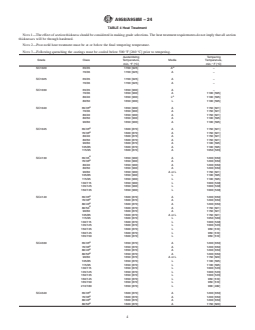
NOTE 3—Following quenching the castings must be cooled below 500 °F [260 °C] prior to tempering.
Austenitizing Tempering
Grade Class Temperature, Media Temperature,
min, °F [°C] min,° F [°C]
A
SC1020 65/35 1700 [925] A –
70/36 1700 [925] A –
SC1025 65/35 1700 [925] A –
70/36 1700 [925] A –
SC1030 65/35 1650 [900] A –
70/36 1650 [900] A 1100 [595]
A
80/40 1650 [900] L 1100 [595]
80/50 1650 [900] L 1100 [595]
B
SC1040 65/35 1650 [900] A 1150 [621]
70/36 1650 [900] A 1150 [621]
80/40 1650 [900] A 1150 [621]
80/50 1650 [900] A 1100 [595]
90/60 1650 [900] A 1100 [595]
B
SC1045 65/35 1600 [870] A 1150 [621]
B
70/36 1600 [870] A 1150 [621]
80/40 1600 [870] A 1150 [621]
80/50 1600 [870] A 1150 [621]
90/60 1600 [870] A 1100 [595]
105/85 1600 [870] A 1100 [595]
115/95 1600 [8
...