

ASTM F788/F788M-20e1
(Specification)Standard Specification for Surface Discontinuities of Bolts, Screws, Studs, and Rivets, Inch and Metric Series
General Information
- Abstract
ABSTRACT
This specification establishes allowable limits for the various types of surface discontinuities that may occur during the manufacture and processing of bolts, screws, and studs, including heat-treated machine screws, tapping screws, and sems. Types of surface discontinuities are: crack; burst; seam; fold; thread lap; void; tool marks; and gouge and nick. These surface discontinuities shall be inspected in accordance with the specified requirements.
SCOPE
1.1 This specification establishes allowable limits for the various types of surface discontinuities that may occur during the manufacture and processing of bolts, screws, studs, and rivets including heat-treated machine screws, tapping screws, and sems (the washers of screw-washer assemblies are excluded). This specification covers metric series products with nominal diameters of 4 mm and larger and with specified minimum tensile strengths of 420 MPa and higher; and inch series products with nominal diameters of No. 5 (0.1250 in.) and larger and with specified minimum tensile strengths of 60 000 psi and higher.
1.2 When the engineering requirements of the application necessitate control of surface discontinuities on bolts, screws, studs, or rivets, the purchaser shall specify conformance to ASTM Specification F788/F788M, in the original inquiry and purchase order.
1.2.1 When the engineering requirements of the application necessitate that surface discontinuities on bolts, screws, studs, and rivets be controlled within limits closer than those specified in this specification, the purchaser shall specify the applicable limits in the original inquiry and purchase order.
1.3 The allowable limits established in this specification for metric bolts, screws, and studs with nominal diameters from 4 to 24 mm inclusive, are essentially identical with requirements given in ISO 6157/I. There are no ISO standards for surface discontinuities on any inch-series products, or for rivets.
1.4 The values stated in either SI units or inch-pound units are to be regarded separately as standard. The values stated in each system may not be exact equivalents; therefore, each system shall be used independently of the other. Combining values from the two systems may result in non-conformance with the standard.
1.5 This international standard was developed in accordance with internationally recognized principles on standardization established in the Decision on Principles for the Development of International Standards, Guides and Recommendations issued by the World Trade Organization Technical Barriers to Trade (TBT) Committee.
- Status
- Published
- Publication Date
- 31-Mar-2020
- Technical Committee
- F16 - Fasteners
- Drafting Committee
- F16.93 - Quality Assurance Provisions for Fasteners
Overview
ASTM F788/F788M-20e1 is a standard specification developed by ASTM International that defines the allowable limits for surface discontinuities on bolts, screws, studs, and rivets from both inch and metric series. These fasteners, including heat-treated machine screws, tapping screws, and assemblies (sems), are commonly used across a wide range of industrial and structural applications. The specification enhances fastener quality by specifying permissible types and extents of surface imperfections such as cracks, seams, folds, voids, tool marks, and gouges, ensuring that finished products meet stringent mechanical and performance requirements.
Key Topics
- Scope of Coverage
- Sets limits for surface discontinuities on bolts, screws, studs, and rivets
- Applies to metric series (4 mm and larger, minimum tensile strength 420 MPa)
- Applies to inch series (No. 5/0.1250 in. and larger, minimum tensile strength 60,000 psi)
- Types of Surface Discontinuities
- Crack (quench and forging)
- Burst and shear burst
- Seam
- Fold
- Thread lap
- Void
- Tool marks
- Gouge and nick
- Inspection and Evaluation
- Visual inspection using specified sampling techniques
- Measurement and evaluation of detected discontinuities
- Use of GO ring gauges and torque testing for thread acceptability
- Purchasing Requirements
- Purchasers must specify conformance to ASTM F788/F788M during inquiry and ordering
- Stricter limits can be requested if required by application engineering
- International Alignment
- Metric limits align closely with ISO 6157/I
- No ISO equivalents for inch-series products or rivets
Applications
- Industrial and Structural Fastening
- Ensures reliable performance of fasteners in machinery, automotive, aerospace, and construction
- Prevents premature failure due to unacceptable surface irregularities
- Quality Control and Manufacturing
- Sets clear acceptance criteria for fastener producers and suppliers
- Defines standardized inspection and rejection processes for quality assurance
- Procurement and Engineering Design
- Provides a basis for engineers and procurement professionals to specify surface discontinuity requirements in technical specifications and purchase orders
- Allows tailoring of requirements for critical or high-stress applications by requesting closer control than the basic standard
- Regulatory and Contractual Compliance
- Used by suppliers and purchasers to satisfy international and defense-related fastener conformity standards
Related Standards
- ASTM E340 - Practice for Macroetching Metals and Alloys
- ASTM F1470 - Practice for Fastener Sampling for Specified Mechanical Properties and Performance Inspection
- ASTM F1789 - Terminology for F16 Mechanical Fasteners
- ISO 6157/I - Fasteners, Surface Discontinuities on Bolts, Screws and Studs (metric series only)
Keywords:
ASTM F788/F788M, fasteners, surface discontinuities, bolts, screws, studs, rivets, cracks, bursts, seams, folds, voids, tool marks, gouges, quality control, inch series, metric series, inspection, engineering standards, procurement, ISO 6157/I, industrial fasteners, mechanical properties
Note: This standard is updated regularly and used widely in industries where fastener reliability is critical. Conformance helps ensure safety, performance, and compatibility in both global and local supply chains.
Relations
- Effective Date
- 01-Jan-2024
- Effective Date
- 15-Nov-2023
- Effective Date
- 01-Nov-2023
- Effective Date
- 01-Feb-2018
- Effective Date
- 01-Jun-2017
- Effective Date
- 01-Aug-2016
- Effective Date
- 01-Mar-2015
- Effective Date
- 01-Feb-2015
- Effective Date
- 01-Sep-2014
- Effective Date
- 01-Feb-2014
- Effective Date
- 01-Dec-2012
- Effective Date
- 15-Nov-2012
- Effective Date
- 01-Jun-2012
- Effective Date
- 01-Nov-2011
- Effective Date
- 01-Nov-2011
Frequently Asked Questions
ASTM F788/F788M-20e1 is a technical specification published by ASTM International. Its full title is "Standard Specification for Surface Discontinuities of Bolts, Screws, Studs, and Rivets, Inch and Metric Series". This standard covers: ABSTRACT This specification establishes allowable limits for the various types of surface discontinuities that may occur during the manufacture and processing of bolts, screws, and studs, including heat-treated machine screws, tapping screws, and sems. Types of surface discontinuities are: crack; burst; seam; fold; thread lap; void; tool marks; and gouge and nick. These surface discontinuities shall be inspected in accordance with the specified requirements. SCOPE 1.1 This specification establishes allowable limits for the various types of surface discontinuities that may occur during the manufacture and processing of bolts, screws, studs, and rivets including heat-treated machine screws, tapping screws, and sems (the washers of screw-washer assemblies are excluded). This specification covers metric series products with nominal diameters of 4 mm and larger and with specified minimum tensile strengths of 420 MPa and higher; and inch series products with nominal diameters of No. 5 (0.1250 in.) and larger and with specified minimum tensile strengths of 60 000 psi and higher. 1.2 When the engineering requirements of the application necessitate control of surface discontinuities on bolts, screws, studs, or rivets, the purchaser shall specify conformance to ASTM Specification F788/F788M, in the original inquiry and purchase order. 1.2.1 When the engineering requirements of the application necessitate that surface discontinuities on bolts, screws, studs, and rivets be controlled within limits closer than those specified in this specification, the purchaser shall specify the applicable limits in the original inquiry and purchase order. 1.3 The allowable limits established in this specification for metric bolts, screws, and studs with nominal diameters from 4 to 24 mm inclusive, are essentially identical with requirements given in ISO 6157/I. There are no ISO standards for surface discontinuities on any inch-series products, or for rivets. 1.4 The values stated in either SI units or inch-pound units are to be regarded separately as standard. The values stated in each system may not be exact equivalents; therefore, each system shall be used independently of the other. Combining values from the two systems may result in non-conformance with the standard. 1.5 This international standard was developed in accordance with internationally recognized principles on standardization established in the Decision on Principles for the Development of International Standards, Guides and Recommendations issued by the World Trade Organization Technical Barriers to Trade (TBT) Committee.
ABSTRACT This specification establishes allowable limits for the various types of surface discontinuities that may occur during the manufacture and processing of bolts, screws, and studs, including heat-treated machine screws, tapping screws, and sems. Types of surface discontinuities are: crack; burst; seam; fold; thread lap; void; tool marks; and gouge and nick. These surface discontinuities shall be inspected in accordance with the specified requirements. SCOPE 1.1 This specification establishes allowable limits for the various types of surface discontinuities that may occur during the manufacture and processing of bolts, screws, studs, and rivets including heat-treated machine screws, tapping screws, and sems (the washers of screw-washer assemblies are excluded). This specification covers metric series products with nominal diameters of 4 mm and larger and with specified minimum tensile strengths of 420 MPa and higher; and inch series products with nominal diameters of No. 5 (0.1250 in.) and larger and with specified minimum tensile strengths of 60 000 psi and higher. 1.2 When the engineering requirements of the application necessitate control of surface discontinuities on bolts, screws, studs, or rivets, the purchaser shall specify conformance to ASTM Specification F788/F788M, in the original inquiry and purchase order. 1.2.1 When the engineering requirements of the application necessitate that surface discontinuities on bolts, screws, studs, and rivets be controlled within limits closer than those specified in this specification, the purchaser shall specify the applicable limits in the original inquiry and purchase order. 1.3 The allowable limits established in this specification for metric bolts, screws, and studs with nominal diameters from 4 to 24 mm inclusive, are essentially identical with requirements given in ISO 6157/I. There are no ISO standards for surface discontinuities on any inch-series products, or for rivets. 1.4 The values stated in either SI units or inch-pound units are to be regarded separately as standard. The values stated in each system may not be exact equivalents; therefore, each system shall be used independently of the other. Combining values from the two systems may result in non-conformance with the standard. 1.5 This international standard was developed in accordance with internationally recognized principles on standardization established in the Decision on Principles for the Development of International Standards, Guides and Recommendations issued by the World Trade Organization Technical Barriers to Trade (TBT) Committee.
ASTM F788/F788M-20e1 is classified under the following ICS (International Classification for Standards) categories: 21.060.10 - Bolts, screws, studs. The ICS classification helps identify the subject area and facilitates finding related standards.
ASTM F788/F788M-20e1 has the following relationships with other standards: It is inter standard links to ASTM F1470-24, ASTM E340-23, ASTM F1789-23, ASTM F1470-18, ASTM F1789-17, ASTM F1789-16, ASTM F1789-15a, ASTM F1789-15, ASTM F1789-14a, ASTM F1789-14, ASTM F1789-12a, ASTM F1470-12, ASTM F1789-12, ASTM F1789-11b, ASTM F1789-11a. Understanding these relationships helps ensure you are using the most current and applicable version of the standard.
ASTM F788/F788M-20e1 is available in PDF format for immediate download after purchase. The document can be added to your cart and obtained through the secure checkout process. Digital delivery ensures instant access to the complete standard document.
Standards Content (Sample)
This international standard was developed in accordance with internationally recognized principles on standardization established in the Decision on Principles for the
Development of International Standards, Guides and Recommendations issued by the World Trade Organization Technical Barriers to Trade (TBT) Committee.
´1
Designation: F788/F788M − 20
Standard Specification for
Surface Discontinuities of Bolts, Screws, Studs, and Rivets,
Inch and Metric Series
This standard is issued under the fixed designation F788/F788M; the number immediately following the designation indicates the year
of original adoption or, in the case of revision, the year of last revision. A number in parentheses indicates the year of last reapproval.
A superscript epsilon (´) indicates an editorial change since the last revision or reapproval.
ε NOTE—Editorially updated designation in September 2023.
This standard has been approved for use by agencies of the U.S. Department of Defense.
1. Scope* 1.5 This international standard was developed in accor-
dance with internationally recognized principles on standard-
1.1 This specification establishes allowable limits for the
ization established in the Decision on Principles for the
various types of surface discontinuities that may occur during
Development of International Standards, Guides and Recom-
the manufacture and processing of bolts, screws, studs, and
mendations issued by the World Trade Organization Technical
rivets including heat-treated machine screws, tapping screws,
Barriers to Trade (TBT) Committee.
and sems (the washers of screw-washer assemblies are ex-
cluded). This specification covers metric series products with
2. Referenced Documents
nominal diameters of 4 mm and larger and with specified
2.1 ASTM Standards:
minimum tensile strengths of 420 MPa and higher; and inch
E340 Practice for Macroetching Metals and Alloys
series products with nominal diameters of No. 5 (0.1250 in.)
F1470 Practice for Fastener Sampling for Specified Me-
and larger and with specified minimum tensile strengths of
chanical Properties and Performance Inspection
60 000 psi and higher.
F1789 Terminology for F16 Mechanical Fasteners
1.2 When the engineering requirements of the application
2.2 ISO Standard:
necessitate control of surface discontinuities on bolts, screws,
ISO 6157 ⁄I Fasteners, Surface Discontinuities on Bolts,
studs, or rivets, the purchaser shall specify conformance to
Screws and Studs
ASTM Specification F788/F788M, in the original inquiry and
purchase order.
3. Ordering Information
1.2.1 When the engineering requirements of the application
3.1 Orders for bolts, screws, studs, and rivets requiring
necessitate that surface discontinuities on bolts, screws, studs,
discontinuity control shall include the following:
and rivets be controlled within limits closer than those speci-
3.1.1 ASTM designation and date of issue of this specifica-
fied in this specification, the purchaser shall specify the
tion.
applicable limits in the original inquiry and purchase order.
3.1.2 Special requirements, for example, closer discontinu-
1.3 The allowable limits established in this specification for
ity limits (1.2.1) and inspection sampling plan (6.2).
metric bolts, screws, and studs with nominal diameters from 4
to 24 mm inclusive, are essentially identical with requirements
4. Types of Surface Discontinuities (see Terminology
given in ISO 6157 ⁄I. There are no ISO standards for surface
F1789 for definitions not provided)
discontinuities on any inch-series products, or for rivets.
4.1 Crack
1.4 The values stated in either SI units or inch-pound units
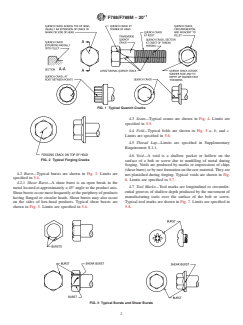
4.1.1 Quench Cracks—Typical quench cracks are shown in
are to be regarded separately as standard. The values stated in
Fig. 1. Limits are specified in 5.2.
each system may not be exact equivalents; therefore, each
4.1.2 Forging Cracks—Typical forging cracks are shown in
system shall be used independently of the other. Combining
Fig. 2. Limits are specified in 5.3.
values from the two systems may result in non-conformance
with the standard.
For referenced ASTM standards, visit the ASTM website, www.astm.org, or
This specification is under the jurisdiction of ASTM Committee F16 on contact ASTM Customer Service at service@astm.org. For Annual Book of ASTM
Fasteners and is the direct responsibility of Subcommittee F16.93 on Quality Standards volume information, refer to the standard’s Document Summary page on
Assurance Provisions for Fasteners. the ASTM website.
Current edition approved April 1, 2020. Published May 2020. Originally Available from International Organization for Standardization (ISO), ISO
approved in 1982. Last previous edition approved in 2018 as F788 – 13(2018). DOI: Central Secretariat, BIBC II, Chemin de Blandonnet 8, CP 401, 1214 Vernier,
10.1520/F0788_F0788M-20E01. Geneva, Switzerland, http://www.iso.org.
*A Summary of Changes section appears at the end of this standard
Copyright © ASTM International, 100 Barr Harbor Drive, PO Box C700, West Conshohocken, PA 19428-2959. United States
´1
F788/F788M − 20
FIG. 1 Typical Quench Cracks
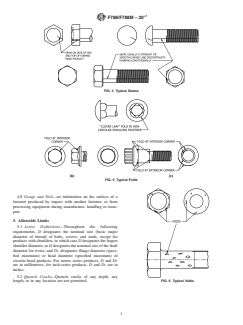
4.3 Seam—Typical seams are shown in Fig. 4. Limits are
specified in 5.5.
4.4 Fold—Typical folds are shown in Fig. 5 a, b, and c.
Limits are specified in 5.6.
4.5 Thread Lap—Limits are specified in Supplementary
Requirement S.1.1.
4.6 Void—A void is a shallow pocket or hollow on the
FIG. 2 Typical Forging Cracks
surface of a bolt or screw due to nonfilling of metal during
forging. Voids are produced by marks or impressions of chips
(shear burrs) or by rust formation on the raw material. They are
4.2 Burst—Typical bursts are shown in Fig. 3. Limits are
not planished during forging. Typical voids are shown in Fig.
specified in 5.4.
6. Limits are specified in 5.7.
4.2.1 Shear Burst—A shear burst is an open break in the
4.7 Tool Marks—Tool marks are longitudinal or circumfer-
metal located at approximately a 45° angle to the product axis.
Shear bursts occur most frequently at the periphery of products ential grooves of shallow depth produced by the movement of
manufacturing tools over the surface of the bolt or screw.
having flanged or circular heads. Shear bursts may also occur
on the sides of hex-head products. Typical shear bursts are Typical tool marks are shown in Fig. 7. Limits are specified in
shown in Fig. 3. Limits are specified in 5.4. 5.8.
FIG. 3 Typical Bursts and Shear Bursts
´1
F788/F788M − 20
FIG. 4 Typical Seams
FIG. 5 Typical Folds
4.8 Gouge and Nick—an indentation on the surface of a
fastener produced by impact with another fastener, or from
processing equipment during manufacture, handling or trans-
port.
5. Allowable Limits
5.1 Letter Definitions—Throughout the following
requirements, D designates the nominal size (basic major
diameter of thread) of bolts, screws, and studs, except for
products with shoulders, in which case D designates the largest
shoulder diameter, or D designates the nominal size of the shaft
diameter for rivets; and Dc designates flange diameter (speci-
fied maximum) or head diameter (specified maximum) of
circular head products. For metric series products, D and Dc
are in millimeters; for inch-series products, D and Dc are in
inches.
5.2 Quench Cracks—Quench cracks of any depth, any
FIG. 6 Typical Voids
length, or in any location are not permitted.
´1
F788/F788M − 20
hex head with the top of flange of flange bolts and screws, are
permitted (see Fig. 5 b).
5.6.3 Folds located at exterior corners are permitted (see
Fig. 5c).
5.7 Voids:
5.7.1 Voids on the surfaces of bolts, screws, studs, and rivets
are permitted, provided that: (1) depth of voids does not exceed
0.25 mm or 0.010 in. or 0.02 D, whichever is greater, and (2)
the combined area of all voids on the underhead bearing
surface of bolts, screws, and rivets does not exceed 10 % of the
FIG. 7 Typical Tool Marks
specified minimum bearing surface area.
5.7.2 The method for determining the area of voids on the
bearing surface shall be as agreed upon between the purchaser
5.3 Forging Cracks—Forging cracks on the top of the head
and the producer.
of bolts, screws, and rivets are permitted, provided that (a) no
5.8 Tool Marks:
crack shall have a length exceeding 1.0 D, and ( b) no crack
5.8.1 Tool marks on the underhead bearing surface are
shall have a width or depth exceeding 0.04 D. See Note 1.
permitted, provided the surface roughness measurement does
NOTE 1—Forging cracks within the limits of this specification may be
not exceed 3.2 μm or 125 μin., determined as the arithmetic
unsightly, but do not affect the mechanical properties or functional
average deviation from the mean surface.
requirements of the fastener.
5.8.2 Tool marks on other surfaces of the product are
5.4 Bursts and Shear Bursts (see Note 2):
permitted.
5.4.1 For hex-head bolts and screws, bursts and shear bursts
5.9 Nicks and Gouges—Nicks, gouges, dents, and scrapes
are permitted, provided that: (1) no burst or shear burst in the
are permitted, provided that the functionability of the product
flats extends into the crown (chamfer) circle on the to
...