

ASTM D1670/D1670M-11(2023)
(Test Method)Standard Test Method for Failure End Point in Accelerated and Outdoor Weathering of Bituminous Materials
General Information
- Abstract
SIGNIFICANCE AND USE
4.1 The extent of cracking or pitting of bituminous films is a measure of the extent of deterioration due to weathering. Failure due to cracking is more accurately determined electrically than visually.
4.2 Failure determined by this test method will depend not only on the characteristics of the bituminous material and the extent of weathering, but also on the film thickness, and the amount and type of mineral filler present.
4.3 Tests on a similar material of known weathering characteristics (a control) exposed at the same time as the test material is strongly recommended as a check on the validity of the test results.
SCOPE
1.1 This test method covers the use of a spark-generating apparatus for determination of failure due to cracking of bituminous materials undergoing accelerated or outdoor weathering on electrically conductive backings.
1.2 The values stated in either SI units or inch-pound units are to be regarded separately as standard. The values stated in each system may not be exact equivalents; therefore, each system shall be used independently of the other. Combining values from the two systems may result in nonconformance with the standard.
1.3 This standard does not purport to address all of the safety concerns, if any, associated with its use. It is the responsibility of the user of this standard to establish appropriate safety, health, and environmental practices and determine the applicability of regulatory limitations prior to use.
1.4 This international standard was developed in accordance with internationally recognized principles on standardization established in the Decision on Principles for the Development of International Standards, Guides and Recommendations issued by the World Trade Organization Technical Barriers to Trade (TBT) Committee.
- Status
- Published
- Publication Date
- 30-Jun-2023
- Technical Committee
- D08 - Roofing and Waterproofing
- Drafting Committee
- D08.02 - Steep Roofing Products and Assemblies

Overview
ASTM D1670/D1670M-11(2023) is an international standard developed by ASTM International, titled "Standard Test Method for Failure End Point in Accelerated and Outdoor Weathering of Bituminous Materials." This standard outlines a test method that utilizes a spark-generating apparatus to determine the point of failure, due to cracking, in bituminous materials exposed to both accelerated and natural outdoor weathering conditions. By offering a precise, electrical method to detect cracks compared to visual inspection, this standard provides enhanced reliability for assessing the weathering durability and longevity of bituminous films and coatings.
Key Topics
- Weathering and Deterioration: The method measures the deterioration of bituminous materials by identifying cracks or pitting, which indicate the extent of environmental damage over time.
- Electrical Detection: Unlike traditional visual assessments, this test method employs electrical means to more accurately register failure points through the use of a spark-generating device.
- Influencing Factors: The outcome relies not only on the material’s inherent properties and the degree of weathering but also on factors such as film thickness and the type and amount of mineral filler.
- Control Materials: Testing alongside a control sample with known weathering characteristics is recommended to validate results and enhance test credibility.
- Reporting and Precision: The standard prescribes detailed reporting requirements and criteria for accepting test repeatability between laboratories, ensuring consistency and accuracy.
Applications
The ASTM D1670/D1670M-11(2023) standard is essential for quality assurance and research activities involving bituminous materials, particularly in industries such as construction, roofing, waterproofing, and pavement engineering. Key applications include:
- Product Development: Manufacturers use this standard to analyze the durability of new bituminous coatings and formulations under accelerated or real-world weathering conditions.
- Quality Control: Production batches can be routinely tested for weathering resistance, ensuring consistent material performance before commercial release.
- Comparative Evaluation: Different formulations or production methods can be evaluated using parallel testing, including control samples, for objective performance comparisons.
- Regulatory and Compliance Testing: The method can help demonstrate compliance with international durability standards and specifications required in bidding for construction and infrastructure projects.
- Service Life Predictions: Data from these tests contribute valuable input for estimating the service life and maintenance schedules for bituminous-based infrastructure and products.
Related Standards
The test method references and complements other ASTM standards designed for the preparation and evaluation of bituminous materials:
- ASTM D1435: Practice for Outdoor Weathering of Plastics.
- ASTM D1669/D1669M: Practice for Preparation of Test Panels for Accelerated and Outdoor Weathering of Bituminous Coatings.
- ASTM D4798/D4798M: Practice for Accelerated Weathering Test Conditions and Procedures for Bituminous Materials (Xenon-Arc Method).
- ASTM D4799/D4799M: Practice for Accelerated Weathering Test Conditions and Procedures for Bituminous Materials (Fluorescent UV, Water Spray, and Condensation Method).
These related standards provide guidelines for specimen preparation, weathering exposure, and test conditions, ensuring comprehensive evaluation and comparability across various bituminous products and testing scenarios.
By applying ASTM D1670/D1670M-11(2023) in laboratory and field conditions, stakeholders ensure higher accuracy and repeatability in assessing the failure end point during weathering tests, thereby optimizing material selection and predicting lifespan for bituminous materials used in demanding outdoor environments.
Keywords: accelerated weathering, bituminous materials, failure end point, outdoor weathering, ASTM D1670, crack detection, material durability, electrical testing, quality assurance.
Relations
- Effective Date
- 01-May-2013
- Effective Date
- 01-Jan-2011
- Effective Date
- 01-Jul-2010
- Effective Date
- 01-Aug-2009
- Effective Date
- 01-Feb-2008
- Effective Date
- 01-Mar-2005
- Effective Date
- 10-Nov-1999
Get Certified
Connect with accredited certification bodies for this standard

DIBt (Deutsches Institut für Bautechnik)
German Institute for Building Technology.
DIN CERTCO
DIN Group product certification.

Aboma Certification B.V.
Specialized in construction, metal, and transport sectors.
Sponsored listings
Frequently Asked Questions
ASTM D1670/D1670M-11(2023) is a standard published by ASTM International. Its full title is "Standard Test Method for Failure End Point in Accelerated and Outdoor Weathering of Bituminous Materials". This standard covers: SIGNIFICANCE AND USE 4.1 The extent of cracking or pitting of bituminous films is a measure of the extent of deterioration due to weathering. Failure due to cracking is more accurately determined electrically than visually. 4.2 Failure determined by this test method will depend not only on the characteristics of the bituminous material and the extent of weathering, but also on the film thickness, and the amount and type of mineral filler present. 4.3 Tests on a similar material of known weathering characteristics (a control) exposed at the same time as the test material is strongly recommended as a check on the validity of the test results. SCOPE 1.1 This test method covers the use of a spark-generating apparatus for determination of failure due to cracking of bituminous materials undergoing accelerated or outdoor weathering on electrically conductive backings. 1.2 The values stated in either SI units or inch-pound units are to be regarded separately as standard. The values stated in each system may not be exact equivalents; therefore, each system shall be used independently of the other. Combining values from the two systems may result in nonconformance with the standard. 1.3 This standard does not purport to address all of the safety concerns, if any, associated with its use. It is the responsibility of the user of this standard to establish appropriate safety, health, and environmental practices and determine the applicability of regulatory limitations prior to use. 1.4 This international standard was developed in accordance with internationally recognized principles on standardization established in the Decision on Principles for the Development of International Standards, Guides and Recommendations issued by the World Trade Organization Technical Barriers to Trade (TBT) Committee.
SIGNIFICANCE AND USE 4.1 The extent of cracking or pitting of bituminous films is a measure of the extent of deterioration due to weathering. Failure due to cracking is more accurately determined electrically than visually. 4.2 Failure determined by this test method will depend not only on the characteristics of the bituminous material and the extent of weathering, but also on the film thickness, and the amount and type of mineral filler present. 4.3 Tests on a similar material of known weathering characteristics (a control) exposed at the same time as the test material is strongly recommended as a check on the validity of the test results. SCOPE 1.1 This test method covers the use of a spark-generating apparatus for determination of failure due to cracking of bituminous materials undergoing accelerated or outdoor weathering on electrically conductive backings. 1.2 The values stated in either SI units or inch-pound units are to be regarded separately as standard. The values stated in each system may not be exact equivalents; therefore, each system shall be used independently of the other. Combining values from the two systems may result in nonconformance with the standard. 1.3 This standard does not purport to address all of the safety concerns, if any, associated with its use. It is the responsibility of the user of this standard to establish appropriate safety, health, and environmental practices and determine the applicability of regulatory limitations prior to use. 1.4 This international standard was developed in accordance with internationally recognized principles on standardization established in the Decision on Principles for the Development of International Standards, Guides and Recommendations issued by the World Trade Organization Technical Barriers to Trade (TBT) Committee.
ASTM D1670/D1670M-11(2023) is classified under the following ICS (International Classification for Standards) categories: 91.100.50 - Binders. Sealing materials. The ICS classification helps identify the subject area and facilitates finding related standards.
ASTM D1670/D1670M-11(2023) has the following relationships with other standards: It is inter standard links to ASTM D1669/D1669M-07(2013)e1, ASTM D4798/D4798M-11, ASTM D4798/D4798M-10, ASTM D4798/D4798M-09, ASTM D4799/D4799M-08(2013)e1, ASTM D1435-05, ASTM D1435-99. Understanding these relationships helps ensure you are using the most current and applicable version of the standard.
ASTM D1670/D1670M-11(2023) is available in PDF format for immediate download after purchase. The document can be added to your cart and obtained through the secure checkout process. Digital delivery ensures instant access to the complete standard document.
Standards Content (Sample)
This international standard was developed in accordance with internationally recognized principles on standardization established in the Decision on Principles for the
Development of International Standards, Guides and Recommendations issued by the World Trade Organization Technical Barriers to Trade (TBT) Committee.
Designation: D1670/D1670M − 11 (Reapproved 2023)
Standard Test Method for
Failure End Point in Accelerated and Outdoor Weathering of
Bituminous Materials
This standard is issued under the fixed designation D1670/D1670M; the number immediately following the designation indicates the
year of original adoption or, in the case of revision, the year of last revision. A number in parentheses indicates the year of last
reapproval. A superscript epsilon (´) indicates an editorial change since the last revision or reapproval.
1. Scope D4799/D4799M Practice for Accelerated Weathering Test
Conditions and Procedures for Bituminous Materials
1.1 This test method covers the use of a spark-generating
(Fluorescent UV, Water Spray, and Condensation Method)
apparatus for determination of failure due to cracking of
bituminous materials undergoing accelerated or outdoor weath-
3. Summary of Test Method
ering on electrically conductive backings.
3.1 Dry, weathered, bituminous-coated test panels are
1.2 The values stated in either SI units or inch-pound units
grounded and a feeler electrode is passed over the back of a
are to be regarded separately as standard. The values stated in
linagraphic or ultra high sensitivity thermal fax paper placed on
each system may not be exact equivalents; therefore, each
the bituminous surface with the emulsion side down. Photo-
system shall be used independently of the other. Combining
copies are made of the front side of the paper on which the
values from the two systems may result in nonconformance
spots caused by the sparks appear. The photographs are
with the standard.
covered with an acrylic grid and the number of squares
1.3 This standard does not purport to address all of the
containing the spark records are counted and reported. Spark-
safety concerns, if any, associated with its use. It is the
ing in 26 or more grid squares is representative of failure.
responsibility of the user of this standard to establish appro-
priate safety, health, and environmental practices and deter-
4. Significance and Use
mine the applicability of regulatory limitations prior to use.
4.1 The extent of cracking or pitting of bituminous films is
1.4 This international standard was developed in accor-
a measure of the extent of deterioration due to weathering.
dance with internationally recognized principles on standard-
Failure due to cracking is more accurately determined electri-
ization established in the Decision on Principles for the
cally than visually.
Development of International Standards, Guides and Recom-
mendations issued by the World Trade Organization Technical
4.2 Failure determined by this test method will depend not
Barriers to Trade (TBT) Committee.
only on the characteristics of the bituminous material and the
extent of weathering, but also on the film thickness, and the
2. Referenced Documents
amount and type of mineral filler present.
2.1 ASTM Standards:
4.3 Tests on a similar material of known weathering char-
D1435 Practice for Outdoor Weathering of Plastics
acteristics (a control) exposed at the same time as the test
D1669/D1669M Practice for Preparation of Test Panels for
material is strongly recommended as a check on the validity of
Accelerated and Outdoor Weathering of Bituminous Coat-
the test results.
ings
D4798/D4798M Practice for Accelerated Weathering Test
5. Apparatus
Conditions and Procedures for Bituminous Materials
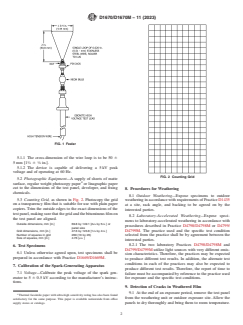
5.1 Any Spark-Generating Apparatus —Fig. 1 is an ex-
(Xenon-Arc Method)
ample of an acceptable configuration for the test feeler. Other
configurations are not prohibited, subject to the following
conditions:
This test method is under the jurisdiction of ASTM Committee D08 on Roofing
and Waterproofing and is the direct responsibility of Subcommittee D08.02 on Steep
Roofing Products and Assemblies.
Current edition approved July 1, 2023. Published July 2023. Originally approved
in 1959. Last previous edition approved in 2018 as D1670/D1670M – 11 (2018). The sole source of supply of the apparatus known to the committee at this time
DOI: 10.1520/D1670_D1670M-11R23. is Electrotechnic Model BD-40B Spark Generator, available from Electro-Technic
For referenced ASTM standards, visit the ASTM website, www.astm.org, or Products Co., 4642 N. Ravenswood Ave., Chicago, IL 60642. If you are aware of
contact ASTM Customer Service at service@astm.org. For Annual Book of ASTM alternative suppliers, please provide this information to ASTM Headquarters. Your
Standards volume information, refer to the standard’s Document Summary page on comments will receive careful consideration at a meeting of the responsible
the ASTM website. technical committee, which you may attend.
Copyright © ASTM International, 100 Barr Harbor Drive, PO Box C700, West Conshohocken, PA 19428-2959. United States
D1670/D1670M − 11 (2023)
FIG. 1 Feeler
5.1.1 The cross-dimension of the wire loop is to be 50 6
3 1
5 mm [1 ⁄4 6 ⁄8 in.].
5.1.2 The device is capable of delivering a 5 kV peak
voltage and of operating at 60 Hz.
FIG. 2 Counting Grid
5.2 Photographic Equipment—A supply of sheets of matte
surface, regular weight photocopy paper or linagraphic paper
cut to the dimensions of the test panel, developer, and fixing
8. Procedures for Weathering
chemicals.
8.1 Outdoor Weathering—Expose specimens to outdoor
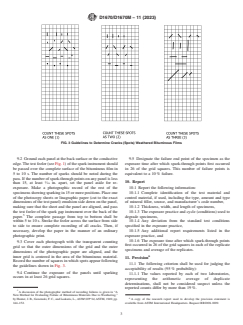
5.3 Counting Grid, as shown in Fig. 2. Photocopy the grid
weathering in accordance with requirements of Practice D1435
on a transparency film that is suitable for use with plain paper
at a site, rack angle, and backing to be agreed on by the
copiers. Trim the outside edges to the exact dimensions of the
interested parties.
test panel, making sure that the grid and the bituminous film on
8.2 Laboratory-Accelerated Weathering—Expose speci-
the test panel are aligned.
mens to laboratory-accelerated weathering in accordance with
3 7
Outside dimensions, mm [in.] 69.8 by 149.1 [2 ⁄4 by 5 ⁄8 ] or
procedures described in Practice D4798/D4798M or D4799/
panel size
7 7
D4799M. The practice used and the specific
...