


ASTM E2234-09(2018)
(Practice)Standard Practice for Sampling a Stream of Product by Attributes Indexed by AQL
Standard Practice for Sampling a Stream of Product by Attributes Indexed by AQL
ABSTRACT
This practice establishes lot or batch sampling plans and procedures for inspection by attributes using MIL-STD-105E as a basis for sampling a steady stream of lots indexed by acceptance quality limit (AQL). It provides the sampling plans of MIL-STD-105E in ASTM format for use by ASTM committees and others and recognizes the continuing usage of MIL-STD-105E in industries supported by ASTM. This practice also establishes lot or batch sampling plans and procedures for inspection by attributes.
The sampling plans described in this standard are applicable to AQL’s of 0.01% or higher and are therefore not suitable for applications where quality levels in the range of parts per million levels can be realized. Sampling plans designated in this practice are applicable, but not limited, to inspection of the end items, components and raw materials, operations or services, materials in process, supplies in storage, maintenance operations, data or records, and administrative procedures.
SIGNIFICANCE AND USE
4.1 Purpose—This publication establishes lot or batch sampling plans and procedures for inspection by attributes. This publication shall not be interpreted to supersede or conflict with any contractual requirements. The words “accept,” “acceptance,” “acceptable,” etc, refer only to the contractor’s use of the sampling plans contained in this standard and do not imply an agreement by the customer (formerly “Government” in original text) to accept any product. Determination of acceptability by the customer shall be as described in contractual documents. The sampling plans described in this standard are applicable to AQL’s of 0.01 % or higher and are therefore not suitable for applications where quality levels in the range of parts per million levels can be realized.
4.2 Application—Sampling plans designated in this publication are applicable, but not limited, to inspection of the following: (1) end items, (2) components and raw materials, (3) operations or services, (4) materials in process, (5) supplies in storage, (6) maintenance operations, (7) data or records, (8) administrative procedures. These plans are intended primarily to be used for a continuing series of lots or batches. The plans may also be used for the inspection of isolated lots or batches, but, in this latter case, the user is cautioned to consult the operating characteristic curves to find a plan which will yield the desired protection (see 6.11).
SCOPE
1.1 This practice establishes lot or batch sampling plans and procedures for inspection by attributes using MIL-STD-105E as a basis for sampling a steady stream of lots indexed by acceptance quality limit (AQL).
1.2 This practice provides the sampling plans of MIL-STD-105E in ASTM format for use by ASTM committees and others. It recognizes the continuing usage of MIL-STD-105E in industries supported by ASTM. Most of the original text in MIL-STD-105E is preserved in Sections 4 – 6 of this practice.
1.3 No system of units is specified in this standard.
1.4 This standard does not purport to address all of the safety concerns, if any, associated with its use. It is the responsibility of the user of this standard to establish appropriate safety, health, and environmental practices and determine the applicability of regulatory limitations prior to use.
1.5 This international standard was developed in accordance with internationally recognized principles on standardization established in the Decision on Principles for the Development of International Standards, Guides and Recommendations issued by the World Trade Organization Technical Barriers to Trade (TBT) Committee.
General Information
Buy Standard
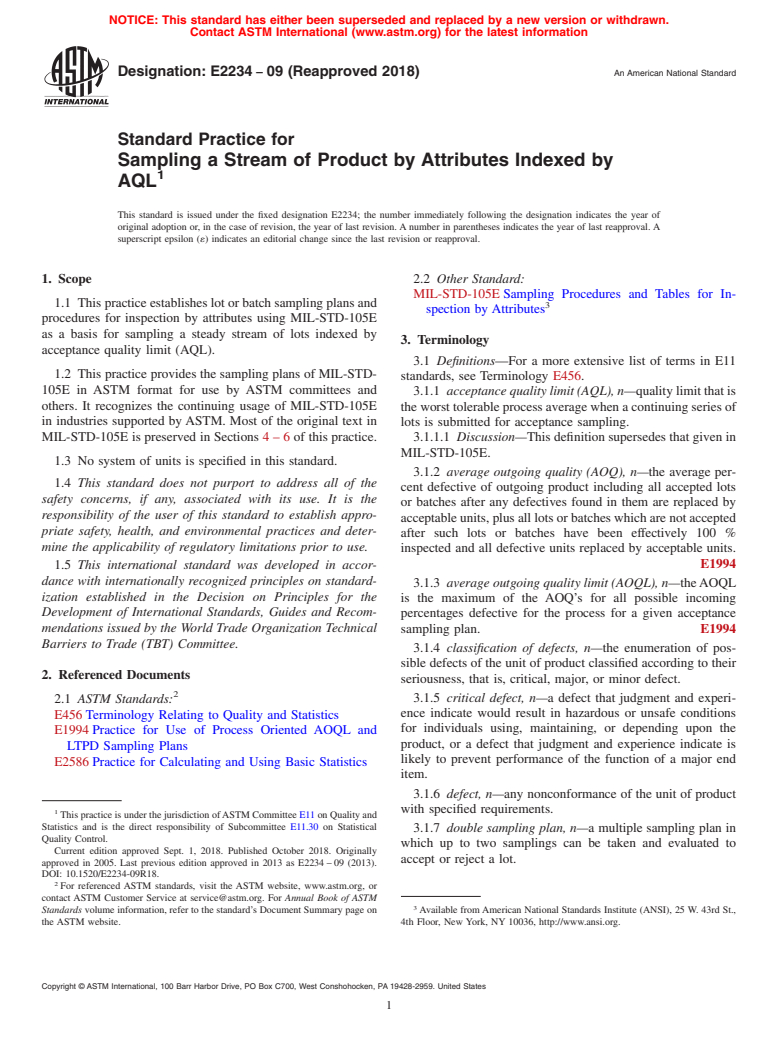
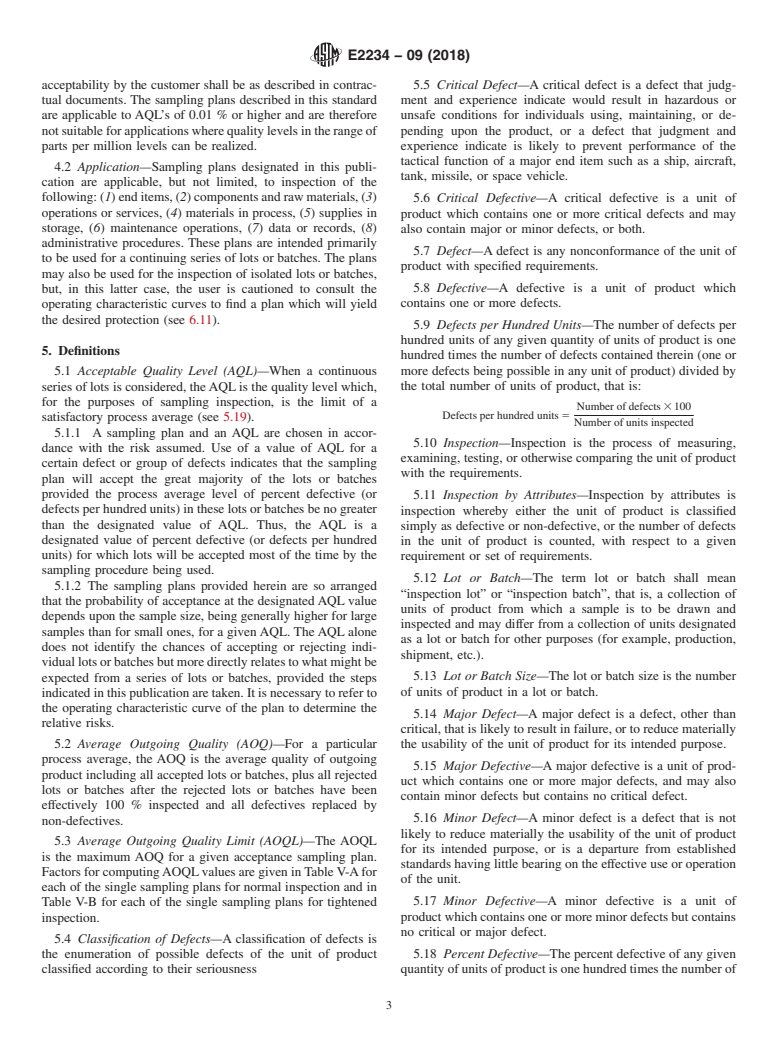
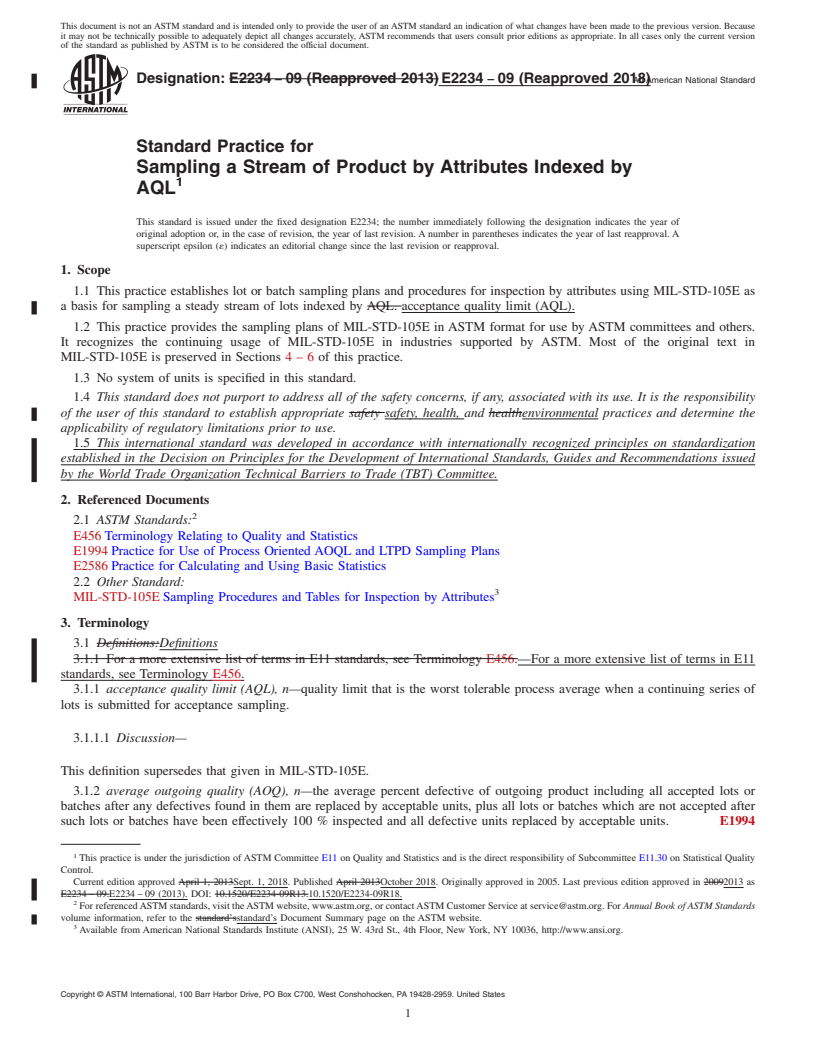
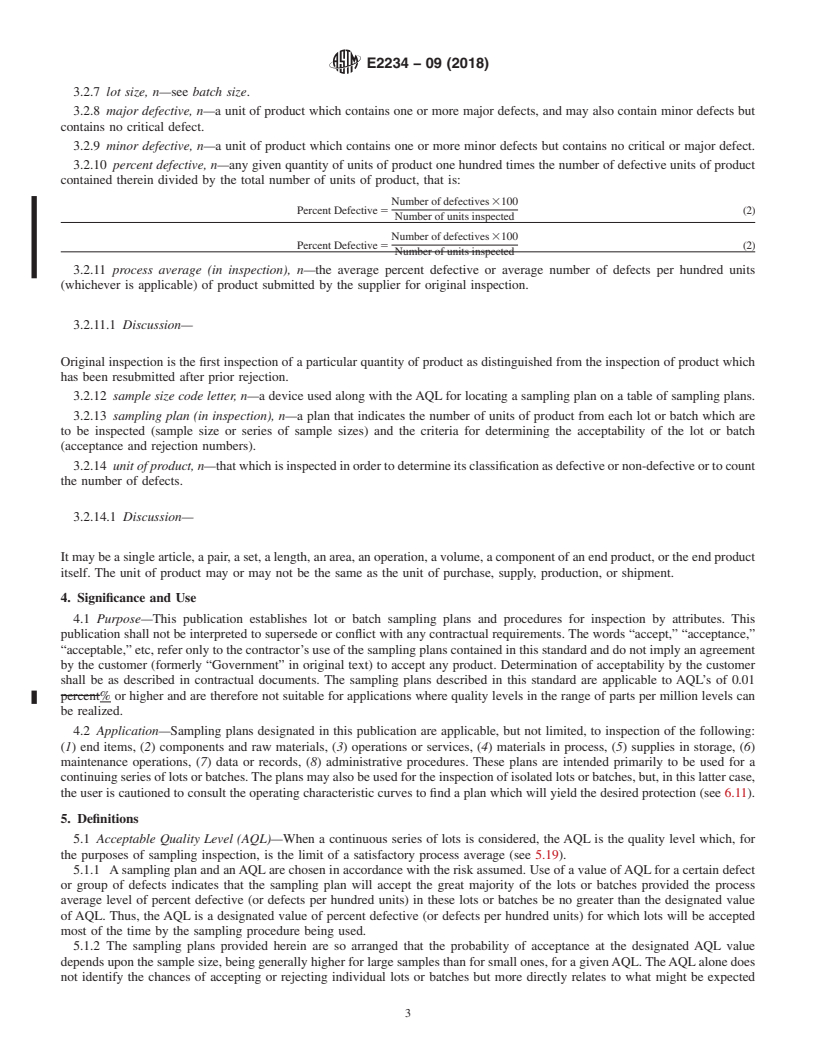
Standards Content (Sample)
NOTICE: This standard has either been superseded and replaced by a new version or withdrawn.
Contact ASTM International (www.astm.org) for the latest information
Designation: E2234 − 09 (Reapproved 2018) An American National Standard
Standard Practice for
Sampling a Stream of Product by Attributes Indexed by
AQL
This standard is issued under the fixed designation E2234; the number immediately following the designation indicates the year of
original adoption or, in the case of revision, the year of last revision. A number in parentheses indicates the year of last reapproval. A
superscript epsilon (´) indicates an editorial change since the last revision or reapproval.
1. Scope 2.2 Other Standard:
MIL-STD-105E Sampling Procedures and Tables for In-
1.1 This practice establishes lot or batch sampling plans and
spection by Attributes
procedures for inspection by attributes using MIL-STD-105E
as a basis for sampling a steady stream of lots indexed by
3. Terminology
acceptance quality limit (AQL).
3.1 Definitions—For a more extensive list of terms in E11
1.2 This practice provides the sampling plans of MIL-STD-
standards, see Terminology E456.
105E in ASTM format for use by ASTM committees and
3.1.1 acceptance quality limit (AQL), n—quality limit that is
others. It recognizes the continuing usage of MIL-STD-105E the worst tolerable process average when a continuing series of
in industries supported by ASTM. Most of the original text in
lots is submitted for acceptance sampling.
MIL-STD-105E is preserved in Sections 4 – 6 of this practice. 3.1.1.1 Discussion—This definition supersedes that given in
MIL-STD-105E.
1.3 No system of units is specified in this standard.
3.1.2 average outgoing quality (AOQ), n—the average per-
1.4 This standard does not purport to address all of the
cent defective of outgoing product including all accepted lots
safety concerns, if any, associated with its use. It is the
or batches after any defectives found in them are replaced by
responsibility of the user of this standard to establish appro-
acceptable units, plus all lots or batches which are not accepted
priate safety, health, and environmental practices and deter-
after such lots or batches have been effectively 100 %
mine the applicability of regulatory limitations prior to use.
inspected and all defective units replaced by acceptable units.
E1994
1.5 This international standard was developed in accor-
dance with internationally recognized principles on standard-
3.1.3 average outgoing quality limit (AOQL), n—the AOQL
ization established in the Decision on Principles for the
is the maximum of the AOQ’s for all possible incoming
Development of International Standards, Guides and Recom-
percentages defective for the process for a given acceptance
mendations issued by the World Trade Organization Technical sampling plan. E1994
Barriers to Trade (TBT) Committee.
3.1.4 classification of defects, n—the enumeration of pos-
sible defects of the unit of product classified according to their
2. Referenced Documents
seriousness, that is, critical, major, or minor defect.
3.1.5 critical defect, n—a defect that judgment and experi-
2.1 ASTM Standards:
ence indicate would result in hazardous or unsafe conditions
E456 Terminology Relating to Quality and Statistics
for individuals using, maintaining, or depending upon the
E1994 Practice for Use of Process Oriented AOQL and
product, or a defect that judgment and experience indicate is
LTPD Sampling Plans
likely to prevent performance of the function of a major end
E2586 Practice for Calculating and Using Basic Statistics
item.
3.1.6 defect, n—any nonconformance of the unit of product
with specified requirements.
This practice is under the jurisdiction of ASTM Committee E11 on Quality and
Statistics and is the direct responsibility of Subcommittee E11.30 on Statistical
3.1.7 double sampling plan, n—a multiple sampling plan in
Quality Control.
which up to two samplings can be taken and evaluated to
Current edition approved Sept. 1, 2018. Published October 2018. Originally
accept or reject a lot.
approved in 2005. Last previous edition approved in 2013 as E2234 – 09 (2013).
DOI: 10.1520/E2234-09R18.
For referenced ASTM standards, visit the ASTM website, www.astm.org, or
contact ASTM Customer Service at service@astm.org. For Annual Book of ASTM
Standards volume information, refer to the standard’s Document Summary page on Available from American National Standards Institute (ANSI), 25 W. 43rd St.,
the ASTM website. 4th Floor, New York, NY 10036, http://www.ansi.org.
Copyright © ASTM International, 100 Barr Harbor Drive, PO Box C700, West Conshohocken, PA 19428-2959. United States
E2234 − 09 (2018)
3.1.8 inspection, n—the process of measuring, examining, 3.2.5 defects per hundred units, n—any given quantity of
testing, or otherwise comparing the unit of product with the units of product is one hundred times the number of defects
requirements. contained therein (one or more defects being possible in any
unit of product) divided by the total number of units of product,
3.1.9 inspection by attributes, n—inspection whereby either
that is:
the unit of product is classified simply as defective or non-
defective, or the number of defects in the unit of product is Number of defects3 100
Defects per hundred units5 (1)
counted, with respect to a given requirement or set of require-
Number of units inspected
ments.
3.2.6 lot, n—see batch.
3.1.10 inspection lot, n—a collection of units of product
3.2.7 lot size, n—see batch size.
produced under conditions that are considered uniform and
3.2.8 major defective, n—a unit of product which contains
from which a sample is drawn and inspected.
one or more major defects, and may also contain minor defects
3.1.11 major defect, n—a defect, other than critical, that is
but contains no critical defect.
likely to result in failure, or to reduce materially the usability
3.2.9 minor defective, n—a unit of product which contains
of the unit of product for its intended purpose.
one or more minor defects but contains no critical or major
3.1.12 minor defect, n—a defect that is not likely to reduce
defect.
materially the usability of the unit of product for its intended
3.2.10 percent defective, n—any given quantity of units of
purpose, or is a departure from established standards having
product one hundred times the number of defective units of
little bearing on the effective use or operation of the unit.
product contained therein divided by the total number of units
3.1.13 multiple sampling plan, n—a sampling plan in which
of product, that is:
successive samples from a lot are drawn and after each sample
Number of defectives3 100
is inspected a decision is made to accept the lot, reject the lot,
Percent Defective5 (2)
Number of units inspected
or to take another sample, based on quality level of the
3.2.11 process average (in inspection), n—the average per-
combined samples.
cent defective or average number of defects per hundred units
3.1.13.1 Discussion—When the quality is much less or
(whichever is applicable) of product submitted by the supplier
much more than the AQL, the decision can be made on the first
for original inspection.
sample, which is smaller than that of a single sampling plan
3.2.11.1 Discussion—Original inspection is the first inspec-
with equivalent acceptance quality level. For samples that are
tion of a particular quantity of product as distinguished from
close to the AQL in quality, additional samples are required and
the inspection of product which has been resubmitted after
the total sample size will be larger than the corresponding
prior rejection.
single sampling plan.
3.2.12 sample size code letter, n—a device used along with
3.1.14 operating characteristic, n—probability of accep-
the AQL for locating a sampling plan on a table of sampling
tance using a specified acceptance sampling plan, as a function
plans.
of parameters describing quality of the lot.
3.2.13 sampling plan (in inspection), n—a plan that indi-
3.1.15 sample, n—a group of observations, test results,
cates the number of units of product from each lot or batch
taken from a large collection of observations, test results,
which are to be inspected (sample size or series of sample
which serves to provide information that may be used as a basis
sizes) and the criteria for determining the acceptability of the
for making a decision concerning the larger collection. E2586
lot or batch (acceptance and rejection numbers).
3.1.15.1 Discussion—A sample consists of one or more
3.2.14 unit of product, n—that which is inspected in order to
units of product drawn from an inspection lot, the units of the
sample being selected at random without regard to their determine its classification as defective or non-defective or to
count the number of defects.
quality. The number of units of product in the sample is the
sample size. 3.2.14.1 Discussion—It may be a single article, a pair, a set,
a length, an area, an operation, a volume, a component of an
3.2 Definitions of Terms Specific to This Standard:
end product, or the end product itself. The unit of product may
3.2.1 batch (in inspection), n—a collection of units of
or may not be the same as the unit of purchase, supply,
product produced under conditions that are considered uniform
production, or shipment.
and from which a sample is drawn and inspected, and may
differ from a collection of units designated as a batch for other
4. Significance and Use
purposes, for example, production, shipment, etc.
4.1 Purpose—This publication establishes lot or batch sam-
3.2.2 batch size, n—the number of units of product in a
pling plans and procedures for inspection by attributes. This
batch.
publication shall not be interpreted to supersede or conflict
3.2.3 critical defective, n—a unit of product which contains
with any contractual requirements. The words “accept,”
one or more critical defects and may also contain major or
“acceptance,” “acceptable,” etc, refer only to the contractor’s
minor defects, or both.
use of the sampling plans contained in this standard and do not
3.2.4 defective, n—a unit of product which contains one or imply an agreement by the customer (formerly “Government”
more defects. in original text) to accept any product. Determination of
E2234 − 09 (2018)
acceptability by the customer shall be as described in contrac- 5.5 Critical Defect—A critical defect is a defect that judg-
tual documents. The sampling plans described in this standard ment and experience indicate would result in hazardous or
are applicable to AQL’s of 0.01 % or higher and are therefore unsafe conditions for individuals using, maintaining, or de-
not suitable for applications where quality levels in the range of pending upon the product, or a defect that judgment and
parts per million levels can be realized. experience indicate is likely to prevent performance of the
tactical function of a major end item such as a ship, aircraft,
4.2 Application—Sampling plans designated in this publi-
tank, missile, or space vehicle.
cation are applicable, but not limited, to inspection of the
following: (1) end items, (2) components and raw materials, (3)
5.6 Critical Defective—A critical defective is a unit of
operations or services, (4) materials in process, (5) supplies in
product which contains one or more critical defects and may
storage, (6) maintenance operations, (7) data or records, (8)
also contain major or minor defects, or both.
administrative procedures. These plans are intended primarily
5.7 Defect—A defect is any nonconformance of the unit of
to be used for a continuing series of lots or batches. The plans
product with specified requirements.
may also be used for the inspection of isolated lots or batches,
5.8 Defective—A defective is a unit of product which
but, in this latter case, the user is cautioned to consult the
contains one or more defects.
operating characteristic curves to find a plan which will yield
the desired protection (see 6.11).
5.9 Defects per Hundred Units—The number of defects per
hundred units of any given quantity of units of product is one
5. Definitions
hundred times the number of defects contained therein (one or
more defects being possible in any unit of product) divided by
5.1 Acceptable Quality Level (AQL)—When a continuous
the total number of units of product, that is:
series of lots is considered, the AQL is the quality level which,
for the purposes of sampling inspection, is the limit of a
Number of defects3 100
Defects per hundred units5
satisfactory process average (see 5.19).
Number of units inspected
5.1.1 A sampling plan and an AQL are chosen in accor-
5.10 Inspection—Inspection is the process of measuring,
dance with the risk assumed. Use of a value of AQL for a
examining, testing, or otherwise comparing the unit of product
certain defect or group of defects indicates that the sampling
with the requirements.
plan will accept the great majority of the lots or batches
provided the process average level of percent defective (or
5.11 Inspection by Attributes—Inspection by attributes is
defects per hundred units) in these lots or batches be no greater
inspection whereby either the unit of product is classified
than the designated value of AQL. Thus, the AQL is a
simply as defective or non-defective, or the number of defects
designated value of percent defective (or defects per hundred
in the unit of product is counted, with respect to a given
units) for which lots will be accepted most of the time by the
requirement or set of requirements.
sampling procedure being used.
5.12 Lot or Batch—The term lot or batch shall mean
5.1.2 The sampling plans provided herein are so arranged
“inspection lot” or “inspection batch”, that is, a collection of
that the probability of acceptance at the designated AQL value
units of product from which a sample is to be drawn and
depends upon the sample size, being generally higher for large
inspected and may differ from a collection of units designated
samples than for small ones, for a given AQL. The AQL alone
as a lot or batch for other purposes (for example, production,
does not identify the chances of accepting or rejecting indi-
shipment, etc.).
vidual lots or batches but more directly relates to what might be
5.13 Lot or Batch Size—The lot or batch size is the number
expected from a series of lots or batches, provided the steps
of units of product in a lot or batch.
indicated in this publication are taken. It is necessary to refer to
the operating characteristic curve of the plan to determine the
5.14 Major Defect—A major defect is a defect, other than
relative risks.
critical, that is likely to result in failure, or to reduce materially
5.2 Average Outgoing Quality (AOQ)—For a particular the usability of the unit of product for its intended purpose.
process average, the AOQ is the ave
...
This document is not an ASTM standard and is intended only to provide the user of an ASTM standard an indication of what changes have been made to the previous version. Because
it may not be technically possible to adequately depict all changes accurately, ASTM recommends that users consult prior editions as appropriate. In all cases only the current version
of the standard as published by ASTM is to be considered the official document.
Designation: E2234 − 09 (Reapproved 2013) E2234 − 09 (Reapproved 2018)An American National Standard
Standard Practice for
Sampling a Stream of Product by Attributes Indexed by
AQL
This standard is issued under the fixed designation E2234; the number immediately following the designation indicates the year of
original adoption or, in the case of revision, the year of last revision. A number in parentheses indicates the year of last reapproval. A
superscript epsilon (´) indicates an editorial change since the last revision or reapproval.
1. Scope
1.1 This practice establishes lot or batch sampling plans and procedures for inspection by attributes using MIL-STD-105E as
a basis for sampling a steady stream of lots indexed by AQL. acceptance quality limit (AQL).
1.2 This practice provides the sampling plans of MIL-STD-105E in ASTM format for use by ASTM committees and others.
It recognizes the continuing usage of MIL-STD-105E in industries supported by ASTM. Most of the original text in
MIL-STD-105E is preserved in Sections 4 – 6 of this practice.
1.3 No system of units is specified in this standard.
1.4 This standard does not purport to address all of the safety concerns, if any, associated with its use. It is the responsibility
of the user of this standard to establish appropriate safety safety, health, and healthenvironmental practices and determine the
applicability of regulatory limitations prior to use.
1.5 This international standard was developed in accordance with internationally recognized principles on standardization
established in the Decision on Principles for the Development of International Standards, Guides and Recommendations issued
by the World Trade Organization Technical Barriers to Trade (TBT) Committee.
2. Referenced Documents
2.1 ASTM Standards:
E456 Terminology Relating to Quality and Statistics
E1994 Practice for Use of Process Oriented AOQL and LTPD Sampling Plans
E2586 Practice for Calculating and Using Basic Statistics
2.2 Other Standard:
MIL-STD-105E Sampling Procedures and Tables for Inspection by Attributes
3. Terminology
3.1 Definitions:Definitions
3.1.1 For a more extensive list of terms in E11 standards, see Terminology E456.—For a more extensive list of terms in E11
standards, see Terminology E456.
3.1.1 acceptance quality limit (AQL), n—quality limit that is the worst tolerable process average when a continuing series of
lots is submitted for acceptance sampling.
3.1.1.1 Discussion—
This definition supersedes that given in MIL-STD-105E.
3.1.2 average outgoing quality (AOQ), n—the average percent defective of outgoing product including all accepted lots or
batches after any defectives found in them are replaced by acceptable units, plus all lots or batches which are not accepted after
such lots or batches have been effectively 100 % inspected and all defective units replaced by acceptable units. E1994
This practice is under the jurisdiction of ASTM Committee E11 on Quality and Statistics and is the direct responsibility of Subcommittee E11.30 on Statistical Quality
Control.
Current edition approved April 1, 2013Sept. 1, 2018. Published April 2013October 2018. Originally approved in 2005. Last previous edition approved in 20092013 as
E2234 – 09.E2234 – 09 (2013). DOI: 10.1520/E2234-09R13.10.1520/E2234-09R18.
For referenced ASTM standards, visit the ASTM website, www.astm.org, or contact ASTM Customer Service at service@astm.org. For Annual Book of ASTM Standards
volume information, refer to the standard’sstandard’s Document Summary page on the ASTM website.
Available from American National Standards Institute (ANSI), 25 W. 43rd St., 4th Floor, New York, NY 10036, http://www.ansi.org.
Copyright © ASTM International, 100 Barr Harbor Drive, PO Box C700, West Conshohocken, PA 19428-2959. United States
E2234 − 09 (2018)
3.1.3 average outgoing quality limit (AOQL), n—the AOQL is the maximum of the AOQ’s for all possible incoming percentages
defective for the process for a given acceptance sampling plan. E1994
3.1.4 classification of defects, n—the enumeration of possible defects of the unit of product classified according to their
seriousness, that is, critical, major, or minor defect.
3.1.5 critical defect, n—a defect that judgment and experience indicate would result in hazardous or unsafe conditions for
individuals using, maintaining, or depending upon the product, or a defect that judgment and experience indicate is likely to
prevent performance of the function of a major end item.
3.1.6 defect, n—any nonconformance of the unit of product with specified requirements.
3.1.7 double sampling plan, n—a multiple sampling plan in which up to two samplings can be taken and evaluated to accept
or reject a lot.
3.1.8 inspection, n—the process of measuring, examining, testing, or otherwise comparing the unit of product with the
requirements.
3.1.9 inspection by attributes, n—inspection whereby either the unit of product is classified simply as defective or non-defective,
or the number of defects in the unit of product is counted, with respect to a given requirement or set of requirements.
3.1.10 inspection lot, n—a collection of units of product produced under conditions that are considered uniform and from which
a sample is drawn and inspected.
3.1.11 major defect, n—a defect, other than critical, that is likely to result in failure, or to reduce materially the usability of the
unit of product for its intended purpose.
3.1.12 minor defect, n—a defect that is not likely to reduce materially the usability of the unit of product for its intended
purpose, or is a departure from established standards having little bearing on the effective use or operation of the unit.
3.1.13 multiple sampling plan, n—a sampling plan in which successive samples from a lot are drawn and after each sample is
inspected a decision is made to accept the lot, reject the lot, or to take another sample, based on quality level of the combined
samples.
3.1.13.1 Discussion—
When the quality is much less or much more than the AQL, the decision can be made on the first sample, which is smaller than
that of a single sampling plan with equivalent acceptance quality level. For samples that are close to the AQL in quality, additional
samples are required and the total sample size will be larger than the corresponding single sampling plan.
3.1.14 operating characteristic, n—probability of acceptance using a specified acceptance sampling plan, as a function of
parameters describing quality of the lot.
3.1.15 sample, n—a group of observations, test results, taken from a large collection of observations, test results, which serves
to provide information that may be used as a basis for making a decision concerning the larger collection. E2586
3.1.15.1 Discussion—
A sample consists of one or more units of product drawn from an inspection lot, the units of the sample being selected at random
without regard to their quality. The number of units of product in the sample is the sample size.
3.2 Definitions of Terms Specific to This Standard:
3.2.1 batch (in inspection), n—a collection of units of product produced under conditions that are considered uniform and from
which a sample is drawn and inspected, and may differ from a collection of units designated as a batch for other purposes, for
example, production, shipment, etc.
3.2.2 batch size, n—the number of units of product in a batch.
3.2.3 critical defective, n—a unit of product which contains one or more critical defects and may also contain major and/or
minor defects.or minor defects, or both.
3.2.4 defective, n—a unit of product which contains one or more defects.
3.2.5 defects per hundred units, n—any given quantity of units of product is one hundred times the number of defects contained
therein (one or more defects being possible in any unit of product) divided by the total number of units of product, that is:
Number of defects 3100
Defects per hundred units 5 (1)
Number of units inspected
Number of defects 3100
Defects per hundred units 5 (1)
Number of units inspected
3.2.6 lot, n—see batch.
E2234 − 09 (2018)
3.2.7 lot size, n—see batch size.
3.2.8 major defective, n—a unit of product which contains one or more major defects, and may also contain minor defects but
contains no critical defect.
3.2.9 minor defective, n—a unit of product which contains one or more minor defects but contains no critical or major defect.
3.2.10 percent defective, n—any given quantity of units of product one hundred times the number of defective units of product
contained therein divided by the total number of units of product, that is:
Number of defectives 3100
Percent Defective 5 (2)
Number of units inspected
Number of defectives 3100
Percent Defective 5 (2)
Number of units inspected
3.2.11 process average (in inspection), n—the average percent defective or average number of defects per hundred units
(whichever is applicable) of product submitted by the supplier for original inspection.
3.2.11.1 Discussion—
Original inspection is the first inspection of a particular quantity of product as distinguished from the inspection of product which
has been resubmitted after prior rejection.
3.2.12 sample size code letter, n—a device used along with the AQL for locating a sampling plan on a table of sampling plans.
3.2.13 sampling plan (in inspection), n—a plan that indicates the number of units of product from each lot or batch which are
to be inspected (sample size or series of sample sizes) and the criteria for determining the acceptability of the lot or batch
(acceptance and rejection numbers).
3.2.14 unit of product, n—that which is inspected in order to determine its classification as defective or non-defective or to count
the number of defects.
3.2.14.1 Discussion—
It may be a single article, a pair, a set, a length, an area, an operation, a volume, a component of an end product, or the end product
itself. The unit of product may or may not be the same as the unit of purchase, supply, production, or shipment.
4. Significance and Use
4.1 Purpose—This publication establishes lot or batch sampling plans and procedures for inspection by attributes. This
publication shall not be interpreted to supersede or conflict with any contractual requirements. The words “accept,” “acceptance,”
“acceptable,” etc, refer only to the contractor’s use of the sampling plans contained in this standard and do not imply an agreement
by the customer (formerly “Government” in original text) to accept any product. Determination of acceptability by the customer
shall be as described in contractual documents. The sampling plans described in this standard are applicable to AQL’s of 0.01
percent% or higher and are therefore not suitable for applications where quality levels in the range of parts per million levels can
be realized.
4.2 Application—Sampling plans designated in this publication are applicable, but not limited, to inspection of the following:
(1) end items, (2) components and raw materials, (3) operations or services, (4) materials in process, (5) supplies in storage, (6)
maintenance operations, (7) data or records, (8) administrative procedures. These plans are intended primarily to be used for a
continuing series of lots or batches. The plans may also be used for the inspection of isolated lots or batches, but, in this latter case,
the user is cautioned to consult the operating characteristic curves to find a plan which will yield the desired protection (see 6.11).
5. Definitions
5.1 Acceptable Quality Level (AQL)—When a continuous series of lots is considered, the AQL is the quality level which, for
the purposes of sampling inspection, is the limit of a satisfactory process average (see 5.19).
5.1.1 A sampling plan and an AQL are chosen in accordance with the risk assumed. Use of a value of AQL for a certain defect
or group of defects indicates that the sampling plan will accept the great majority of the lots or batches provided the process
average level of percent defective (or defects per hundred units) in these lots or batches be no greater than the designated value
of AQL. Thus, the AQL is a designated value of percent defective (or defects per hundred units) for which lots will be accepted
most of the time by the sampling procedure being used.
5.1.2 The sampling plans provided herein are so arranged that the probability of acceptance at the designated AQL value
depends upon the sample size, being generally higher for large samples than for small ones, for a given AQL. The AQL alone does
not identify the chances of accepting or rejecting individual lots or batches but more directly relates to what might be expected
E2234 − 09 (2018)
from a series of lots or batches, provided the steps indicated in this publication are taken. It is necessary to refer to the operating
characteristic curve of the plan to determine the relative risks.
5.2 Average Outgoing Quality (AOQ)—For a particular process average, the AOQ is the average quality of outgoing product
including all accepted lots or batches, plus all rejected lots or batches after the rejected lots or batches have been effectively 100
percent% inspected and all defectives replaced by non-defectives.
5.3 Average Outgoing Quality Limit (AOQL)—The AOQL is the maximum AOQ for a given acceptance sampling plan. Factors
for computing AOQL values are given in Table V-A for each of the single sampling plans for normal inspection and in Table V-B
for each of the single sampling plans for tightened inspection.
5.4 Classification of Defects —Defects—A classification of defects is the enumeration of possible defects of the unit of product
classified according to their seriousness
5.5 Critical Defect—A critical defect is a defect that judgment and experience indicate would result in hazardous or unsafe
conditions for individuals using, maintaining, or depending upon the product, or a defect that judgment and experience indicate
is likely to prevent performance of the tactical function of a major end item such as a ship, aircraft, tank, missile, or space vehicle.
5.6 Critical Defective—A critical defective is a unit of product which contains one or more critical defects and may also contain
major and/or minor defects.or minor defects, or both.
5.7 Defect.—Defect—A defect is any nonconformance of the unit of product with specified requirements.
5.8 Defective—A defective is a unit of prod
...
Questions, Comments and Discussion
Ask us and Technical Secretary will try to provide an answer. You can facilitate discussion about the standard in here.