

ASTM F1468-04a(2018)
(Practice)Standard Practice for Evaluation of Metallic Weapons Detectors for Controlled Access Search and Screening
General Information
- Abstract
SIGNIFICANCE AND USE
4.1 The significant attributes of this practice are the methods for determining the detection capabilities of metal detectors, the methods for determining the effects of outside influences on detectors, and certain safety requirements for detectors.
4.2 While this practice was originated for walk-through metal weapons detectors, it is equally applicable to detectors of other metal objects. The innocent objects set (15.1.2) would require modification commensurate with the size of the other object to be tested; some tests may not be applicable and other specific and different tests may be necessary.
4.3 This practice includes testing site requirements (Section 6) to minimize data variations. These methods may be used at nonconforming sites if site-related disturbances are considered and accounted for.
4.4 This practice is not meant to constrain designs but it is applicable only to detectors which are designed for individual walk-through. The portal structure shall be deemed to meet this criterion if it provides a minimum vertical clearance of 1.96 m (77 in.) and a minimum horizontal width clearance of 0.66 m (26 in.).
4.5 This practice recognizes that the complex movements of a test object when carried by a person walking through a detector limits the precision and repeatability of the resultant observed signals. Averaged results from repeated tests under identical controlled conditions are recommended to obtain a better approximation of the underlying hypothetical true value for that set of conditions.
4.6 Where the term “significant” is used, it refers to phenomena which, in accordance with accepted engineering practices, exceed the normal variation of data.
SCOPE
1.1 This practice covers methods for the evaluation of walk-through metal weapons detectors and criteria for testing metal detection performance.
1.2 This practice specifies certain health, safety, and human factors criteria pertaining to the usage of the detection equipment.
1.3 This practice requires the use of non-standardized (user-supplied) test objects and test equipment. Evaluations made using the procedures outlined in this practice can be used for comparative evaluations only if the tests are made with the same equipment and test objects.
1.4 This practice is intended for use by manufacturers and evaluators of electromagnetic field devices used for screening persons entering into controlled access areas. It is not intended to set performance nor limit or constrain operating technologies, nor is it a document for use by individual operators or users of such equipment at specific access control points.
1.5 The values stated in SI units are to be regarded as the standard. Other units given in parentheses are for information only.
1.6 This standard does not purport to address all of the safety concerns, if any, associated with its use. It is the responsibility of the user of this standard to establish appropriate safety, health, and environmental practices and determine the applicability of regulatory limitations prior to use. For a specific hazards statement, see warning note in 12.2.5.
1.7 This international standard was developed in accordance with internationally recognized principles on standardization established in the Decision on Principles for the Development of International Standards, Guides and Recommendations issued by the World Trade Organization Technical Barriers to Trade (TBT) Committee.
- Status
- Published
- Publication Date
- 31-May-2018
- Technical Committee
- F12 - Security Systems and Equipment
- Drafting Committee
- F12.60 - Controlled Access Security, Search, and Screening Equipment
Overview
ASTM F1468-04a(2018) is the internationally recognized standard practice for the evaluation of metallic weapons detectors, particularly those designed for walk-through screening at controlled access points. Developed by ASTM International, this standard outlines comprehensive test methods for assessing the detection capabilities of metal detectors, measuring the effects of environmental and external influences, and stipulating essential safety and human factors criteria for such equipment.
The standard is widely applied by manufacturers and evaluators of electromagnetic field-based metal detectors used to screen individuals entering secure or restricted areas. While initially focused on walk-through weapons detectors, its methods are adaptable to other metal object detection applications, provided modifications are made to accommodate different test objects.
Key Topics
- Detection Capability Assessment: Clear guidelines for determining the sensitivity, critical test points, and object orientations to evaluate the effectiveness of metal detectors in identifying concealed weapons or metallic objects.
- Testing Site Requirements: Recommendations for minimizing data variation due to environmental influences by specifying optimal physical site characteristics, including distance from metal-containing structures and absence of electrical interference.
- Outside Influence Evaluation: Procedures for examining the impact of mechanical and electrical disturbances-like moving metal objects or power line noise-on detector performance.
- Safety and Human Factors: Safety requirements addressing potential personal injuries, electrical hazards, and device tip-over risks, ensuring both users and operators are protected. The evaluation also considers ergonomic aspects such as walk-through clearances and operational procedures.
- Comparative Performance Evaluation: Stipulates that non-standardized test objects and equipment are used, making the outcomes suitable for comparative evaluation only if identical conditions are maintained.
- Adaptability: Notes that while the standard was originated for walk-through types, it can be tailored to other detector types with adjustments to accommodate object size and test scenarios.
- Data Reproducibility: Recognizes the inherent variability caused by human testers and prescribes repeated tests and averaged results for improved reliability.
Applications
The principal applications of ASTM F1468-04a(2018) include:
- Security Screening: Used in airports, correctional facilities, courthouses, and other high-security locations to ensure metal detectors reliably detect weapons while minimizing false alarms from innocent personal effects.
- Manufacturing and Quality Assurance: Provides a benchmark against which developers and manufacturers of walk-through metal detectors can evaluate their products before deployment in controlled access environments.
- Comparative Evaluations: Enables consistent, repeatable test results for comparing different makes or models of metal detectors when evaluating procurement options.
- Safety Compliance and Auditing: Offers a framework for safety officers and security auditors to check compliance with industry best practices during installation and use.
- Custom Detection Solutions: Facilitates tailoring testing procedures to specialized detection scenarios, such as detecting small metallic objects, by adjusting the set of test objects.
Related Standards
Organizations involved in the assessment and deployment of metallic weapons detectors often consult these related standards:
- IEEE C62.41 - Guide for Surge Voltages in Low Voltage AC Power Circuits: referenced for evaluating electromagnetic compatibility and resilience against power disturbances.
- ASTM E1969 - Standard Guide for the Use of Metal Detectors for the Detection of Buried Utilities: provides guidance for different detection scenarios.
- IEC 61000 Series - Electromagnetic compatibility (EMC) standards: relevant for assessing electrical and electromagnetic influences.
By following ASTM F1468-04a(2018), stakeholders ensure their security screening processes meet recognized best practices in metal detector evaluation, site preparation, safety, and data reliability, supporting effective controlled access search and screening operations worldwide.
Relations
- Effective Date
- 01-Jun-2018
- Effective Date
- 01-Jun-2018
Frequently Asked Questions
ASTM F1468-04a(2018) is a standard published by ASTM International. Its full title is "Standard Practice for Evaluation of Metallic Weapons Detectors for Controlled Access Search and Screening". This standard covers: SIGNIFICANCE AND USE 4.1 The significant attributes of this practice are the methods for determining the detection capabilities of metal detectors, the methods for determining the effects of outside influences on detectors, and certain safety requirements for detectors. 4.2 While this practice was originated for walk-through metal weapons detectors, it is equally applicable to detectors of other metal objects. The innocent objects set (15.1.2) would require modification commensurate with the size of the other object to be tested; some tests may not be applicable and other specific and different tests may be necessary. 4.3 This practice includes testing site requirements (Section 6) to minimize data variations. These methods may be used at nonconforming sites if site-related disturbances are considered and accounted for. 4.4 This practice is not meant to constrain designs but it is applicable only to detectors which are designed for individual walk-through. The portal structure shall be deemed to meet this criterion if it provides a minimum vertical clearance of 1.96 m (77 in.) and a minimum horizontal width clearance of 0.66 m (26 in.). 4.5 This practice recognizes that the complex movements of a test object when carried by a person walking through a detector limits the precision and repeatability of the resultant observed signals. Averaged results from repeated tests under identical controlled conditions are recommended to obtain a better approximation of the underlying hypothetical true value for that set of conditions. 4.6 Where the term “significant” is used, it refers to phenomena which, in accordance with accepted engineering practices, exceed the normal variation of data. SCOPE 1.1 This practice covers methods for the evaluation of walk-through metal weapons detectors and criteria for testing metal detection performance. 1.2 This practice specifies certain health, safety, and human factors criteria pertaining to the usage of the detection equipment. 1.3 This practice requires the use of non-standardized (user-supplied) test objects and test equipment. Evaluations made using the procedures outlined in this practice can be used for comparative evaluations only if the tests are made with the same equipment and test objects. 1.4 This practice is intended for use by manufacturers and evaluators of electromagnetic field devices used for screening persons entering into controlled access areas. It is not intended to set performance nor limit or constrain operating technologies, nor is it a document for use by individual operators or users of such equipment at specific access control points. 1.5 The values stated in SI units are to be regarded as the standard. Other units given in parentheses are for information only. 1.6 This standard does not purport to address all of the safety concerns, if any, associated with its use. It is the responsibility of the user of this standard to establish appropriate safety, health, and environmental practices and determine the applicability of regulatory limitations prior to use. For a specific hazards statement, see warning note in 12.2.5. 1.7 This international standard was developed in accordance with internationally recognized principles on standardization established in the Decision on Principles for the Development of International Standards, Guides and Recommendations issued by the World Trade Organization Technical Barriers to Trade (TBT) Committee.
SIGNIFICANCE AND USE 4.1 The significant attributes of this practice are the methods for determining the detection capabilities of metal detectors, the methods for determining the effects of outside influences on detectors, and certain safety requirements for detectors. 4.2 While this practice was originated for walk-through metal weapons detectors, it is equally applicable to detectors of other metal objects. The innocent objects set (15.1.2) would require modification commensurate with the size of the other object to be tested; some tests may not be applicable and other specific and different tests may be necessary. 4.3 This practice includes testing site requirements (Section 6) to minimize data variations. These methods may be used at nonconforming sites if site-related disturbances are considered and accounted for. 4.4 This practice is not meant to constrain designs but it is applicable only to detectors which are designed for individual walk-through. The portal structure shall be deemed to meet this criterion if it provides a minimum vertical clearance of 1.96 m (77 in.) and a minimum horizontal width clearance of 0.66 m (26 in.). 4.5 This practice recognizes that the complex movements of a test object when carried by a person walking through a detector limits the precision and repeatability of the resultant observed signals. Averaged results from repeated tests under identical controlled conditions are recommended to obtain a better approximation of the underlying hypothetical true value for that set of conditions. 4.6 Where the term “significant” is used, it refers to phenomena which, in accordance with accepted engineering practices, exceed the normal variation of data. SCOPE 1.1 This practice covers methods for the evaluation of walk-through metal weapons detectors and criteria for testing metal detection performance. 1.2 This practice specifies certain health, safety, and human factors criteria pertaining to the usage of the detection equipment. 1.3 This practice requires the use of non-standardized (user-supplied) test objects and test equipment. Evaluations made using the procedures outlined in this practice can be used for comparative evaluations only if the tests are made with the same equipment and test objects. 1.4 This practice is intended for use by manufacturers and evaluators of electromagnetic field devices used for screening persons entering into controlled access areas. It is not intended to set performance nor limit or constrain operating technologies, nor is it a document for use by individual operators or users of such equipment at specific access control points. 1.5 The values stated in SI units are to be regarded as the standard. Other units given in parentheses are for information only. 1.6 This standard does not purport to address all of the safety concerns, if any, associated with its use. It is the responsibility of the user of this standard to establish appropriate safety, health, and environmental practices and determine the applicability of regulatory limitations prior to use. For a specific hazards statement, see warning note in 12.2.5. 1.7 This international standard was developed in accordance with internationally recognized principles on standardization established in the Decision on Principles for the Development of International Standards, Guides and Recommendations issued by the World Trade Organization Technical Barriers to Trade (TBT) Committee.
ASTM F1468-04a(2018) is classified under the following ICS (International Classification for Standards) categories: 95.060 - Weapons. The ICS classification helps identify the subject area and facilitates finding related standards.
ASTM F1468-04a(2018) has the following relationships with other standards: It is inter standard links to ASTM F1468-04a(2010), ASTM C1270-97(2021). Understanding these relationships helps ensure you are using the most current and applicable version of the standard.
ASTM F1468-04a(2018) is available in PDF format for immediate download after purchase. The document can be added to your cart and obtained through the secure checkout process. Digital delivery ensures instant access to the complete standard document.
Standards Content (Sample)
This international standard was developed in accordance with internationally recognized principles on standardization established in the Decision on Principles for the
Development of International Standards, Guides and Recommendations issued by the World Trade Organization Technical Barriers to Trade (TBT) Committee.
Designation: F1468 − 04a (Reapproved 2018)
Standard Practice for
Evaluation of Metallic Weapons Detectors for Controlled
Access Search and Screening
This standard is issued under the fixed designation F1468; the number immediately following the designation indicates the year of
original adoption or, in the case of revision, the year of last revision.Anumber in parentheses indicates the year of last reapproval.A
superscript epsilon (´) indicates an editorial change since the last revision or reapproval.
1. Scope 2. Referenced Documents
2.1 ANSI/IEEE Standard:
1.1 This practice covers methods for the evaluation of
C62.41 IEEE Guide for Surge Voltages in Low VoltageAC
walk-through metal weapons detectors and criteria for testing
Power Circuits
metal detection performance.
1.2 This practice specifies certain health, safety, and human
3. Terminology
factors criteria pertaining to the usage of the detection equip-
3.1 Definitions of Terms Specific to This Standard:
ment.
3.1.1 clean tester—person who does not carry any objects
1.3 Thispracticerequirestheuseofnon-standardized(user-
which would significantly alter the signal produced when the
supplied) test objects and test equipment. Evaluations made
person carries a test object; smaller test objects require more
using the procedures outlined in this practice can be used for
complete elimination of metallic objects. By example but not
comparative evaluations only if the tests are made with the
limitation, such significant objects may include: metallic belt
same equipment and test objects.
buckles,metalbuttons,cardiacpacemakers,coins,metal-frame
eye glasses, hearing aids, jewelry, keys, mechanical pens and
1.4 This practice is intended for use by manufacturers and
pencils, shoes with metal shanks or arch supports, metallic
evaluators of electromagnetic field devices used for screening
surgical implants, undergarment support metal, and metal
persons entering into controlled access areas. It is not intended
zippers. A clean tester passing through a metal detector shall
to set performance nor limit or constrain operating
not cause a disturbance signal greater than 10% of that
technologies, nor is it a document for use by individual
produced when carrying the critical test object through the
operators or users of such equipment at specific access control
detector. The tester shall have a mass between 50 and 100 kg
points.
(110and220lb)andaheightbetween1.50and1.90m(59and
1.5 The values stated in SI units are to be regarded as the
75 in.). If the detector is designed to be sensitive to body size
standard. Other units given in parentheses are for information
because of design or desired sensitivity, the physical size of
only.
testers should be smaller and within a narrower range.
1.6 This standard does not purport to address all of the
3.1.2 critical orientation—orientation of a test object which
safety concerns, if any, associated with its use. It is the
produces the smallest detection signal or weakest detection.
responsibility of the user of this standard to establish appro-
3.1.3 critical sensitivity setting—sensitivity setting of a
priate safety, health, and environmental practices and deter-
detector at which the critical test object in its critical orienta-
mine the applicability of regulatory limitations prior to use.
tion is detected at a 90% or greater rate at the weakest or
For a specific hazards statement, see warning note in 12.2.5.
critical test point for the detector.
1.7 This international standard was developed in accor-
3.1.4 critical test object—test object out of a given group of
dance with internationally recognized principles on standard-
objectswhich,initsworst-caseorcriticalorientation,produces
ization established in the Decision on Principles for the
the worst-case or critical sensitivity setting for a specific
Development of International Standards, Guides and Recom-
detector. The group shall comprise one or more objects which
mendations issued by the World Trade Organization Technical
are to be detected under the same detector settings.
Barriers to Trade (TBT) Committee.
3.1.5 critical test point—location within the passage open-
ing of a detector portal which produces the weakest signal
This practice is under the jurisdiction of ASTM Committee F12 on Security
response(thecriticalsensitivity)forthecriticaltestobjectatits
Systems and Equipmentand is the direct responsibility of Subcommittee F12.60 on
critical orientation.
Controlled Access Security, Search, and Screening Equipment.
CurrenteditionapprovedJune1,2018.PublishedJuly2018.Originallyapproved
in 1993. Last previous edition approved in 2010 as F1468 – 04a (2010). DOI: Available from Institute of Electrical and Electronics Engineers, Inc. (IEEE),
10.1520/F1468-04AR18. 445 Hoes Ln., P.O. Box 1331, Piscataway, NJ 08854-1331, http://www.ieee.org.
Copyright © ASTM International, 100 Barr Harbor Drive, PO Box C700, West Conshohocken, PA 19428-2959. United States
F1468 − 04a (2018)
3.1.6 detector—synonym (used in this practice for brevity) 4.5 Thispracticerecognizesthatthecomplexmovementsof
for a walk-through device for detecting weapons such as a test object when carried by a person walking through a
defined in 3.1.14. detector limits the precision and repeatability of the resultant
observed signals. Averaged results from repeated tests under
3.1.7 discrimination ratio—expression of a detector’s abil-
identical controlled conditions are recommended to obtain a
ity to discriminate between a weapon and innocent personal
better approximation of the underlying hypothetical true value
possessions; it is the ratio of the signal generated by a critical
for that set of conditions.
testobjecttothesignalgeneratedbyanassortmentofinnocent
personal possessions (see Section 8). 4.6 Where the term “significant” is used, it refers to phe-
nomena which, in accordance with accepted engineering
3.1.8 electrical influence test probe—air-core coil for creat-
practices, exceed the normal variation of data.
ing electromagnetic fields that could influence detector capa-
bility (see 15.3).
5. Safety Requirements
3.1.9 induced electromagnetic field test probe—air-core coil
5.1 Personal Health and Safety—The health and safety of
for measuring the strength of the electromagnetic fields gen-
searchees, operators, and other persons using or coming in
erated by a detector (see 15.2).
contact with the equipment shall have been considered in the
3.1.10 outside influence—site-related situation or occur-
equipment design. In addition to the tip-over tests in 5.4 and
rence of a mechanical or electrical nature which alters the
5.5, any hazards concerning factors in 5.2 and 5.3 shall be
normal operation of the detector.
included in the evaluation report.
3.1.11 test object—any metallic object used to evaluate the
5.2 Mechanical—The equipment shall be free of sharp
detection capability of a detector. See 7.2 for specific require-
corners of protrusions that can puncture the skin or clothing or
ments.
injure persons moving normally within the immediate area.
Any potential tripping hazards, such as wires, cables, anti-tilt
3.1.12 test probe—testing devices as specified in 15.2 –
devices, ramps, etc. shall also be noted on the report.
15.4, utilized in the simulation of outside influences.
5.3 Electrical—The detector shall be free of potential elec-
3.1.13 testing laboratory site—area suitable for proper test-
trical shock hazards during operation.
ing and evaluation of detectors (see Section 6).
5.4 Portal Tip-Over—With a stop at the base of the detector
3.1.14 walk-through weapons detection device (detector)—
to prevent sliding, a force shall be applied at or near the top of
freestanding screening device, utilizing an electromagnetic
thedetectorinthedirectionofsearchpassageuntilthedetector
field within its portal structure, for detecting metallic weapons
starts to tip. The tipping moment, calculated as the height
concealed on persons walking through the structure.
above the floor times the maximum force required, shall be
3.1.15 weapon—device intended to do damage to personnel
recorded in the evaluation report. If anti-tilt fixtures or acces-
or equipment without intentionally harming the attacker, but
sories are provided or recommended by the detector
requiring the attacker to physically activate the device. Ex-
manufacturer, tests shall be conducted with and without such
amples include guns, knives, and hand grenades.
devices and recorded in the report.
5.5 Accessory Table or Pedestal Tip-Over—Test as in 5.4
4. Significance and Use
except apply the force at the point and in the direction for
4.1 Thesignificantattributesofthispracticearethemethods
easiest tipping. Record the resultant moment.
for determining the detection capabilities of metal detectors,
5.6 Tip-over testing is not required if a detector must be
themethodsfordeterminingtheeffectsofoutsideinfluenceson
anchored for proper operation.
detectors, and certain safety requirements for detectors.
4.2 While this practice was originated for walk-through
6. Testing Laboratory Site and General Requirements
metalweaponsdetectors,itisequallyapplicabletodetectorsof
6.1 Distancing Requirements—Sites in which detectors are
other metal objects. The innocent objects set (15.1.2) would
tested and evaluated shall be free of significant extraneous
require modification commensurate with the size of the other
influences.
object to be tested; some tests may not be applicable and other
6.1.1 Walls,furniture,lighting,electricalpowerlines,etc.of
specific and different tests may be necessary.
metalliccontentorofelectricallyinfluencingnature(exceptfor
4.3 This practice includes testing site requirements (Section
lines supplying power to the detector and interconnecting its
6) to minimize data variations. These methods may be used at
components) shall be at least 3 m (10 ft) distant.
nonconforming sites if site-related disturbances are considered
6.1.2 Overheadstructures,suchasceilingsorlights,shallbe
and accounted for.
at least 1 m (40 in.) distant from the nearest surface of the
detector and free of electrical lines within 3 m (10 ft).
4.4 This practice is not meant to constrain designs but it is
applicable only to detectors which are designed for individual 6.2 Floor Requirements—The floor shall be solid and not
walk-through.Theportalstructureshallbedeemedtomeetthis capable of transferring vibration or shake to the detector of an
criterion if it provides a minimum vertical clearance of 1.96 m amplitude discernible in the detector signal output when a
(77 in.) and a minimum horizontal width clearance of 0.66 m clean tester walks through. It shall be free of steel except for
(26 in.). nails or reinforcing bars. No electrical lines shall run in or
F1468 − 04a (2018)
under the floor closer than 2 m (6.5 ft) to any portion of the 7.4.1 A walk-through is necessary to determine the actual
detector.Ifthemanufacturerrecommendsshielding,suchasan critical sensitivity. In the absence of a conflicting requirement,
aluminum floor liner or elevated platform, it shall be in place walk-throughs shall be at an approximate velocity of 1 m/s (3
before testing. ft/s).
7.5 If a mechanized carrier is not available, the same tests
6.3 The working area shall include sufficient space for the
can be performed by a person carrying the test object. Several
detector and instrumentation equipment, and for personnel to
operate it conveniently. The number of instrumentation stands identical passes are necessary to obtain adequate consistency.
or carts shall be minimized.They shall have low metal content
7.6 Test Object Orientation:
and be located so that they do not influence test results.
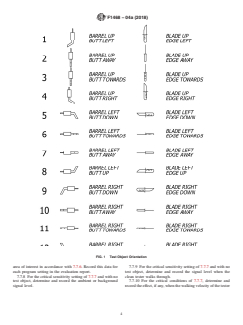
7.6.1 The nomenclature and positions given in Fig. 1 refer
6.4 Determine by appropriate engineering techniques that to the orientation of weapons (guns or other weapons) with
respect to the metal detectors.
the testing site is free and remains free of all electrical
influences which might affect the tests. This includes verifica-
7.7 The comprehensive test for determining detector sensi-
tion of the quality of the detector power source. Record in the
tivity requires passing all test objects in a group in all
evaluation report any deviations from 6.1 – 6.4.
orientations through all points of a selected grid pattern within
the portal opening. This must be repeated for all combinations
6.5 The detector shall be in a totally operational condition,
of optional operating modes, multiple channels, and alternate
complete with such items as floor or wall shieldings, electron-
configurations.Theamountoftestingrequiredmaybereduced
ics pedestals, etc., in their normal operational position.
by the following procedures.
6.6 Many of the following sections require quantitative
7.7.1 In the absence of other criteria, start sensitivity mea-
measurements of signal magnitude. Manufacturers who do not
surements at a grid location point at the horizontal center
provide quantitative measurements of signal magnitude shall
between the side panels and vertically equidistant from both
specify alternative procedures which will provide equivalent
top and bottom ends of all panel coils; a vertical height from
evaluation capability.
the floor of 0.8 to 1.0 m (30 to 40 in.) is usable.
7.7.2 Begin with the vertical object orientation 3 as indi-
7. Procedure for Testing Detection Performance
cated in Fig. 1. Pass all objects in the test object group to be
7.1 The purpose of this procedure is to establish the sensi-
evaluated through the detector. Remove test objects which
tivity setting which is required for the detection of the
produce a signal twice as large as the smallest signal for the
worst-case test object in its worst orientation at the least-
group.
sensitive location within the portal opening.This is the critical
7.7.3 Test the remaining objects in the other two mutually
sensitivity for detection of the critical test object in its critical
orthogonal orientations (across and in-out). Remove objects in
orientation at the critical test point.
orientations that produce signals 50% larger than the smallest
signal.
7.2 For the evaluation of detectors under this practice, the
7.7.4 Using only the objects and orientations not eliminated
test object or objects shall be actual (not simulated) objects
in 7.7.2 and 7.7.3, determine the signals produced at intervals
which,individuallyorcollectively,representthecharacteristics
alongaverticalaxiscenteredbetweenthepanels.Ifthesignals
oftheweaponsorothercontrabandobjectswhichitisdesigned
are relatively constant, grid intervals of 0.2 m (8 in.) are
to detect.
adequate.Nearthetopandbottomandnearanyareaproducing
7.3 As an otherwise clean tester walks through a detector
abrupt changes in sensitivity, intervals of 0.1 m or 0.05 m may
carrying a test object, the path taken by the object can be
benecessary.Thecriticalobjectandorientationwillusuallybe
approximated by a straight line through a horizontally and
the combination giving the weakest response.
vertically located point within the portal opening.This ignores
7.7.4.1 The critical test object can vary as a result of
the side-to-side rocking, vertical bouncing, body rotation, and
program selection. Repeat 7.7.2 – 7.7.4 for all program
velocity surging which the walking motion exhibits. These
versions to be evaluated.
secondary motions alter the signal generated by a test object
7.7.5 Determine the signals at intervals across the portal
whenitiscarriedbyanotherwisecleantester,comparedtothe
opening for the critical object and orientation of 7.7.4. This
signalfromthesametestobjectwhencarriedbyahypothetical
shall be at a vertical height in accordance with 7.7.1, which
mechanized straight-line carrier apparatus.
accordingto7.7.4,indicatesdoesnothaveanabruptchangein
7.3.1 To better simulate expected actual usage, a walk-
sensitivity. Intervals of 100 mm (4 in.) are normally adequate
throughofacleantestercarryingatestobjectmustberepeated
unless an abrupt change is discerned. If this does occur, repeat
sufficienttimesforstatisticalaccuracytoproducethedefinitive
testsacrosstheopeningatotherverticalpositionstolocateand
critical sensitivity data.
pinpoint the area of the critical test point.
7.7.6 For any given usage of a metal detector, it is the
7.4 A mechanized carrier produces more consistent data.
responsibility of the evaluator to decide on the exact area
When such equipment is available, its use is recommended for
within the portal opening from which the critical detection
determining the intrinsic sensitivity topography of a detector.
point will be determined.
Normally,thecriticaltestobject,itscriticalorientation,andthe
critical grid location point can be determined, along with an 7.7.7 From the data obtained in 7.7, select the critical test
approximate critical sensitivity. object, orientation, location, and sensitivity setting within the
F1468 − 04a (2018)
FIG. 1 Test Object Orientation
area of interest in accordance with 7.7.6. Record this data for 7.7.9 For the critical sensitivity setting of 7.7.7 and with no
each program setting in the evaluation report. test object, determine and record the signal level when the
7.7.8 For the critical sensitivity setting of 7.7.7 and with no clean tester walks through.
test object, determine and record the ambient or background 7.7.10 For the critical conditions of 7.7.7, determine and
signal level. recordtheeffect,ifany,whenthewalkingvelocityofthetester
F1468 − 04a (2018)
FIG. 2 Test Object Orientation
isreducedfromthenormal1to0.5m/s(3.0to1.5ft/s)andalso
when it is increased to 1.3 m/s (4.2 ft/s).
F1468 − 04a (2018)
8. Procedure for Measuring Metallic Discrimination 9.4 The detector shall have an alarm to alert the operator in
case a component or other failure accidentally produce elec-
8.1 The primary purpose of this procedure is to determine a
tromagnetic fields below the level of the detector function.
detector’s ability to discriminate between innocent personal
possessions and the objects to be detected.
10. Conditions Applicable to Outside Influence Tests
8.2 With the detector operating under the same conditions
10.1 Tests in 11.2, 12.1, and 12.2 require measurement of
andsensitivityasusedfor7.7.7,determinethesignalgenerated
detector sensitivity. For the other tests, the detector shall be in
by a clean tester carrying the critical test object at its critical
its “actively detecting” mode and operating at the critical
orientation and location.
sensitivity setting in 7.7.7.
8.3 With the detector operating under the same conditions
10.2 Except for 12.1 (power supply variation), conduct all
andsensitivityasusedfor7.7.7,determinethesignalgenerated
tests at the manufacturer’s nominal nameplate power supply
by a clean tester carrying only the array of personal possession
potential.
objects at their given locations in accordance with 15.1.
10.3 Somedetectorshavepassiveprovisionsforcombatting
8.4 Divide the critical test object signal by the possessions outside influences, such as shields or shielded portals. When
the shielding is removable, make measurements with and
signaltoobtainthediscriminationratio.Recordthisratiointhe
evaluation report. without shield and record two sets of data to show the effects
of these provisions.
8.5 The entire set of possessions in 15.1.2 is suitable for
10.4 For detectors that are not symmetrical from side to
testingmanyweaponsdetectors.Whereadetectoristobeused
side, record data for each side.
for small objects, larger items in the set shall be deleted until
the signal from the possessions array is smaller than the signal
10.5 For detectors with more than one channel generating a
from the smallest test object (see 15.1.2).
detection signal, recorded results shall reflect the most adverse
findings with respect to outside influences.
9. Procedure for Determining the Peak-Induced
10.6 For detectors with optional operating modes, record
Electromagnetic Field
additional sets of data to show the effects of the different
9.1 With the detector
...