


ASTM C1349-17(2024)
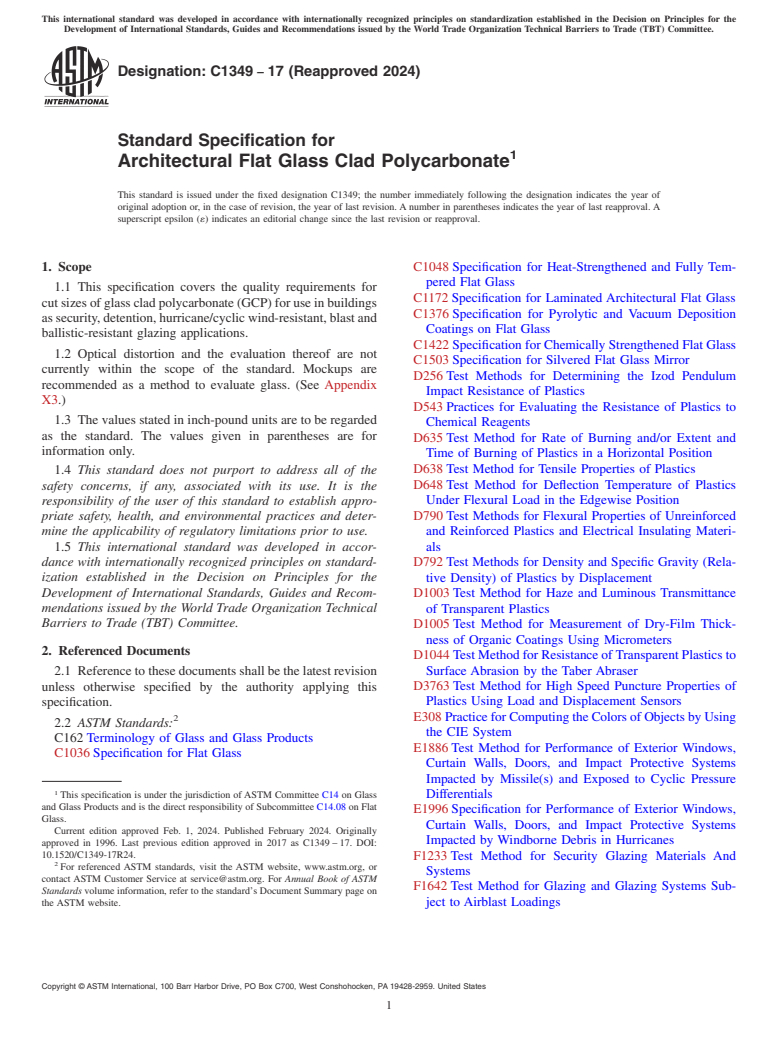
(Specification)Standard Specification for Architectural Flat Glass Clad Polycarbonate
Standard Specification for Architectural Flat Glass Clad Polycarbonate
ABSTRACT
This specification covers the quality requirements for cut sizes of architectural flat glass clad polycarbonate (GCP) for use in buildings as security, detention, hurricane/cyclic wind-resistant, and blast and ballistic-resistant glazing applications. Architectural polycarbonates furnished under this specification shall be of the following kinds: Kind GCP, single core (SC); Kind GCP, multiple core (MC); and Kind GCP, others (O). The polycarbonates shall be examined by means of the following: security test; impact test for safety glazing; missile impact and cyclic pressure test; security glazing test; airblast loading test; detention glazing test; bullet resisting glazing test; burglary resisting test; visual inspection; and transmittance test. The materials shall also adhere to specified size and dimensional requirements, and maximum allowable blemishes in form of bubbles, edge boil blow-ins, fuses, single strand lint hairs, inside dirt spots, areas of concentrated lint, delamination and discoloration, short interlayer and unlaminated area chips, streaks and scuffs, white scratches, carbon specks, and crizzles.
SCOPE
1.1 This specification covers the quality requirements for cut sizes of glass clad polycarbonate (GCP) for use in buildings as security, detention, hurricane/cyclic wind-resistant, blast and ballistic-resistant glazing applications.
1.2 Optical distortion and the evaluation thereof are not currently within the scope of the standard. Mockups are recommended as a method to evaluate glass. (See Appendix X3.)
1.3 The values stated in inch-pound units are to be regarded as the standard. The values given in parentheses are for information only.
1.4 This standard does not purport to address all of the safety concerns, if any, associated with its use. It is the responsibility of the user of this standard to establish appropriate safety, health, and environmental practices and determine the applicability of regulatory limitations prior to use.
1.5 This international standard was developed in accordance with internationally recognized principles on standardization established in the Decision on Principles for the Development of International Standards, Guides and Recommendations issued by the World Trade Organization Technical Barriers to Trade (TBT) Committee.
General Information
Relations
Standards Content (Sample)
This international standard was developed in accordance with internationally recognized principles on standardization established in the Decision on Principles for the
Development of International Standards, Guides and Recommendations issued by the World Trade Organization Technical Barriers to Trade (TBT) Committee.
Designation: C1349 − 17 (Reapproved 2024)
Standard Specification for
1
Architectural Flat Glass Clad Polycarbonate
This standard is issued under the fixed designation C1349; the number immediately following the designation indicates the year of
original adoption or, in the case of revision, the year of last revision. A number in parentheses indicates the year of last reapproval. A
superscript epsilon (´) indicates an editorial change since the last revision or reapproval.
1. Scope C1048 Specification for Heat-Strengthened and Fully Tem-
pered Flat Glass
1.1 This specification covers the quality requirements for
C1172 Specification for Laminated Architectural Flat Glass
cut sizes of glass clad polycarbonate (GCP) for use in buildings
C1376 Specification for Pyrolytic and Vacuum Deposition
as security, detention, hurricane/cyclic wind-resistant, blast and
Coatings on Flat Glass
ballistic-resistant glazing applications.
C1422 Specification for Chemically Strengthened Flat Glass
1.2 Optical distortion and the evaluation thereof are not
C1503 Specification for Silvered Flat Glass Mirror
currently within the scope of the standard. Mockups are
D256 Test Methods for Determining the Izod Pendulum
recommended as a method to evaluate glass. (See Appendix
Impact Resistance of Plastics
X3.)
D543 Practices for Evaluating the Resistance of Plastics to
1.3 The values stated in inch-pound units are to be regarded
Chemical Reagents
as the standard. The values given in parentheses are for
D635 Test Method for Rate of Burning and/or Extent and
information only.
Time of Burning of Plastics in a Horizontal Position
D638 Test Method for Tensile Properties of Plastics
1.4 This standard does not purport to address all of the
D648 Test Method for Deflection Temperature of Plastics
safety concerns, if any, associated with its use. It is the
Under Flexural Load in the Edgewise Position
responsibility of the user of this standard to establish appro-
priate safety, health, and environmental practices and deter- D790 Test Methods for Flexural Properties of Unreinforced
and Reinforced Plastics and Electrical Insulating Materi-
mine the applicability of regulatory limitations prior to use.
1.5 This international standard was developed in accor- als
dance with internationally recognized principles on standard- D792 Test Methods for Density and Specific Gravity (Rela-
ization established in the Decision on Principles for the tive Density) of Plastics by Displacement
Development of International Standards, Guides and Recom-
D1003 Test Method for Haze and Luminous Transmittance
mendations issued by the World Trade Organization Technical
of Transparent Plastics
Barriers to Trade (TBT) Committee.
D1005 Test Method for Measurement of Dry-Film Thick-
ness of Organic Coatings Using Micrometers
2. Referenced Documents
D1044 Test Method for Resistance of Transparent Plastics to
Surface Abrasion by the Taber Abraser
2.1 Reference to these documents shall be the latest revision
unless otherwise specified by the authority applying this D3763 Test Method for High Speed Puncture Properties of
Plastics Using Load and Displacement Sensors
specification.
2 E308 Practice for Computing the Colors of Objects by Using
2.2 ASTM Standards:
the CIE System
C162 Terminology of Glass and Glass Products
E1886 Test Method for Performance of Exterior Windows,
C1036 Specification for Flat Glass
Curtain Walls, Doors, and Impact Protective Systems
Impacted by Missile(s) and Exposed to Cyclic Pressure
1
This specification is under the jurisdiction of ASTM Committee C14 on Glass Differentials
and Glass Products and is the direct responsibility of Subcommittee C14.08 on Flat
E1996 Specification for Performance of Exterior Windows,
Glass.
Curtain Walls, Doors, and Impact Protective Systems
Current edition approved Feb. 1, 2024. Published February 2024. Originally
Impacted by Windborne Debris in Hurricanes
approved in 1996. Last previous edition approved in 2017 as C1349 – 17. DOI:
10.1520/C1349-17R24.
F1233 Test Method for Security Glazing Materials And
2
For referenced ASTM standards, visit the ASTM website, www.astm.org, or
Systems
contact ASTM Customer Service at service@astm.org. For Annual Book of ASTM
F1642 Test Method for Glazing and Glazing Systems Sub-
Standards volume information, refer to the standard’s Document Summary page on
the ASTM website. ject to Airblast Loadings
Copyright © ASTM International, 100 Barr Harbor Drive, PO Box C700, West Conshohocken, PA 19428-2959. United States
1
---------------------- Page: 1 ----------------------
C1349 − 17 (2024)
F1915 Test Methods for Glazing for Detention Facilities 3.2.16 flammability rating—the rate of burn; a CC-1 r
...
Questions, Comments and Discussion
Ask us and Technical Secretary will try to provide an answer. You can facilitate discussion about the standard in here.