

ASTM A579/A579M-20
(Specification)Standard Specification for Superstrength Alloy Steel Forgings
General Information
- Abstract
ABSTRACT
This specification deals with the standard requirements for superstrength alloy steel forgings for highly stressed structural members. Covered here are eight types (twenty-seven grades) of alloy steels, namely: quenched and tempered steels (Grades 11, 12, 12a, 13, 21, 22, 23, 31, 32, and 33); air hardened steel (Grade 41); martensitic stainless steels (Grades 51, 52, and 53); No. 1 precipitation hardened stainless steel (Grade 61); No. 2 precipitation hardened stainless steel (Grade 64); No. 3 precipitation hardened stainless steels (Grades 62 and 63); maraging steels (Grades 71, 72, 73, 74, and 75); and miscellaneous steels (Grades 81, 82, 83, and 84). The steels shall be manufactured by melting process and shall be finished by hot-worked forging. Forgings may be furnished in one of the following conditions: stress relieving; annealing; solution treatment; solution treatment and ageing; normalizing; normalizing and tempering; or quenching and tempering. Heat and product analyses shall be employed to assess the conformance of steels with required chemical compositions. Forgings shall examined by tension and Charpy impact tests and conform to required mechanical properties such as yield strength, tensile strength, elongation, reduction of area, minimum room-temperature Charpy V-notch energy absorption, maximum annealed hardness, and section size capability. Nondestructive tests, such as magnetic particle, liquid penetrant, and ultrasonic inspection procedures, shall also be performed.
SCOPE
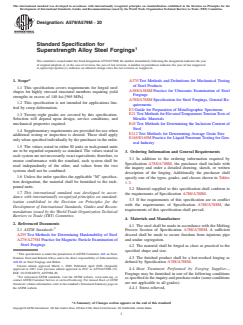
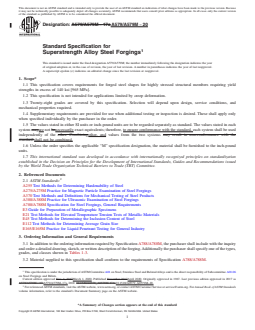
1.1 This specification covers requirements for forged steel shapes for highly stressed structural members requiring yield strengths in excess of 140 ksi [965 MPa].
1.2 This specification is not intended for applications limited by creep deformation.
1.3 Twenty-eight grades are covered by this specification. Selection will depend upon design, service conditions, and mechanical properties required.
1.4 Supplementary requirements are provided for use when additional testing or inspection is desired. These shall apply only when specified individually by the purchaser in the order.
1.5 The values stated in either SI units or inch-pound units are to be regarded separately as standard. The values stated in each system are not necessarily exact equivalents; therefore, to ensure conformance with the standard, each system shall be used independently of the other, and values from the two systems shall not be combined.
1.6 Unless the order specifies the applicable “M” specification designation, the material shall be furnished to the inch-pound units.
1.7 This international standard was developed in accordance with internationally recognized principles on standardization established in the Decision on Principles for the Development of International Standards, Guides and Recommendations issued by the World Trade Organization Technical Barriers to Trade (TBT) Committee.
- Status
- Published
- Publication Date
- 29-Feb-2020
- Technical Committee
- A01 - Steel, Stainless Steel and Related Alloys
- Drafting Committee
- A01.06 - Steel Forgings and Billets
Buy Documents
ASTM A579/A579M-20 - Standard Specification for Superstrength Alloy Steel Forgings
REDLINE ASTM A579/A579M-20 - Standard Specification for Superstrength Alloy Steel Forgings
Overview
ASTM A579/A579M-20 is the standard specification developed by ASTM International governing the requirements for superstrength alloy steel forgings. These forgings are designed for use in highly stressed structural members which require exceptional yield strength-specifically, yield strengths in excess of 140 ksi [965 MPa]. This specification includes a broad range of steel grades and types, such as quenched and tempered alloys, air-hardened steels, martensitic stainless steels, several classes of precipitation-hardened stainless steels, maraging steels, and other specialty alloy steels. The standard ensures that these forgings meet stringent chemical, mechanical, and nondestructive testing requirements for demanding industrial and structural applications.
Key Topics
- Scope and Grades
- Covers twenty-eight grades across eight types of high-strength alloy steels.
- Selection of type and grade depends on required design, service environment, and mechanical properties.
- Manufacturing and Processing
- Finished by hot-worked forging according to specified melting processes.
- Can be provided in stress relieved, annealed, solution treated, solution treated and aged, normalized, normalized and tempered, or quenched and tempered conditions.
- Mechanical Property Testing
- Forgings must undergo tension and Charpy V-notch impact testing to verify properties such as:
- Yield strength (minimum 140 ksi / 965 MPa)
- Tensile strength
- Elongation
- Reduction of area
- Impact energy absorption at room temperature
- Section size capability and maximum annealed hardness are specified for different grades and applications.
- Forgings must undergo tension and Charpy V-notch impact testing to verify properties such as:
- Nondestructive Examination
- Includes magnetic particle, liquid penetrant, and ultrasonic testing to ensure integrity and absence of defects.
- Supplementary Requirements
- Additional testing or inspection (e.g., macroetch, grain size, hardenability, fracture toughness) can be specified by the purchaser to support specialized needs.
- Units of Measure
- The standard can be used with either SI or inch-pound units; mixing unit systems is not permitted to ensure compliance.
Applications
ASTM A579/A579M-20 superstrength alloy steel forgings are critical for industries where structural reliability and performance are paramount. Key application areas include:
- Aerospace - Structural and load-bearing components in aircraft and spacecraft that demand high strength-to-weight ratios.
- Defense and Military - Armored vehicles, weapons systems, and critical assemblies where failure is not tolerated.
- Power Generation - Turbine shafts, blades, and other highly stressed parts in thermal, hydro, or nuclear facilities.
- Heavy Machinery - Construction equipment, mining machinery, and industrial presses subjected to extreme forces and cycles.
- Oil & Gas and Petrochemical - Drilling and processing equipment exposed to harsh environments and mechanical stress.
Related Standards
- ASTM A788/A788M - General requirements for steel forgings
- ASTM A370 - Mechanical testing of steel products
- ASTM A388/A388M - Ultrasonic examination of steel forgings
- ASTM A255 - Hardenability of steel
- ASTM A275/A275M - Magnetic particle examination
- ASTM E21 - Tension testing at elevated temperatures
- ASTM E45 - Determining inclusion content of steel
- ASTM E112 - Grain size determination
- ASTM E165/E165M - Liquid penetrant testing
Practical Value
Adhering to ASTM A579/A579M-20 ensures that superstrength alloy steel forgings deliver consistent performance, safety, and durability under extreme conditions. The standard provides manufacturers, engineers, and end-users with clear requirements for chemical composition, heat treatment, mechanical properties, and quality assurance. Utilizing forgings that meet this specification helps mitigate risk and extend service life for critical infrastructure and equipment in demanding environments.
Keywords: superstrength alloy steel forgings, high-strength steel, ASTM A579/A579M, mechanical properties, structural components, nondestructive testing, aerospace steel, power generation forgings, military grade steel, industrial forgings.
Relations
- Effective Date
- 01-Mar-2020
- Effective Date
- 01-Mar-2024
- Effective Date
- 01-Nov-2023
- Effective Date
- 01-Nov-2023
- Effective Date
- 01-Nov-2023
- Effective Date
- 01-Jul-2019
- Effective Date
- 01-May-2019
- Effective Date
- 01-Nov-2018
- Effective Date
- 01-Sep-2018
- Effective Date
- 01-Sep-2018
- Effective Date
- 01-Mar-2018
- Refers
ASTM A370-17a - Standard Test Methods and Definitions for Mechanical Testing of Steel Products - Effective Date
- 15-Nov-2017
- Effective Date
- 01-Nov-2017
- Effective Date
- 01-May-2017
- Effective Date
- 01-Jan-2017
Buy Documents
ASTM A579/A579M-20 - Standard Specification for Superstrength Alloy Steel Forgings
REDLINE ASTM A579/A579M-20 - Standard Specification for Superstrength Alloy Steel Forgings
Get Certified
Connect with accredited certification bodies for this standard

Element Materials Technology
Materials testing and product certification.

Inštitut za kovinske materiale in tehnologije
Institute of Metals and Technology. Materials testing, metallurgical analysis, NDT.
Sponsored listings
Frequently Asked Questions
ASTM A579/A579M-20 is a technical specification published by ASTM International. Its full title is "Standard Specification for Superstrength Alloy Steel Forgings". This standard covers: ABSTRACT This specification deals with the standard requirements for superstrength alloy steel forgings for highly stressed structural members. Covered here are eight types (twenty-seven grades) of alloy steels, namely: quenched and tempered steels (Grades 11, 12, 12a, 13, 21, 22, 23, 31, 32, and 33); air hardened steel (Grade 41); martensitic stainless steels (Grades 51, 52, and 53); No. 1 precipitation hardened stainless steel (Grade 61); No. 2 precipitation hardened stainless steel (Grade 64); No. 3 precipitation hardened stainless steels (Grades 62 and 63); maraging steels (Grades 71, 72, 73, 74, and 75); and miscellaneous steels (Grades 81, 82, 83, and 84). The steels shall be manufactured by melting process and shall be finished by hot-worked forging. Forgings may be furnished in one of the following conditions: stress relieving; annealing; solution treatment; solution treatment and ageing; normalizing; normalizing and tempering; or quenching and tempering. Heat and product analyses shall be employed to assess the conformance of steels with required chemical compositions. Forgings shall examined by tension and Charpy impact tests and conform to required mechanical properties such as yield strength, tensile strength, elongation, reduction of area, minimum room-temperature Charpy V-notch energy absorption, maximum annealed hardness, and section size capability. Nondestructive tests, such as magnetic particle, liquid penetrant, and ultrasonic inspection procedures, shall also be performed. SCOPE 1.1 This specification covers requirements for forged steel shapes for highly stressed structural members requiring yield strengths in excess of 140 ksi [965 MPa]. 1.2 This specification is not intended for applications limited by creep deformation. 1.3 Twenty-eight grades are covered by this specification. Selection will depend upon design, service conditions, and mechanical properties required. 1.4 Supplementary requirements are provided for use when additional testing or inspection is desired. These shall apply only when specified individually by the purchaser in the order. 1.5 The values stated in either SI units or inch-pound units are to be regarded separately as standard. The values stated in each system are not necessarily exact equivalents; therefore, to ensure conformance with the standard, each system shall be used independently of the other, and values from the two systems shall not be combined. 1.6 Unless the order specifies the applicable “M” specification designation, the material shall be furnished to the inch-pound units. 1.7 This international standard was developed in accordance with internationally recognized principles on standardization established in the Decision on Principles for the Development of International Standards, Guides and Recommendations issued by the World Trade Organization Technical Barriers to Trade (TBT) Committee.
ABSTRACT This specification deals with the standard requirements for superstrength alloy steel forgings for highly stressed structural members. Covered here are eight types (twenty-seven grades) of alloy steels, namely: quenched and tempered steels (Grades 11, 12, 12a, 13, 21, 22, 23, 31, 32, and 33); air hardened steel (Grade 41); martensitic stainless steels (Grades 51, 52, and 53); No. 1 precipitation hardened stainless steel (Grade 61); No. 2 precipitation hardened stainless steel (Grade 64); No. 3 precipitation hardened stainless steels (Grades 62 and 63); maraging steels (Grades 71, 72, 73, 74, and 75); and miscellaneous steels (Grades 81, 82, 83, and 84). The steels shall be manufactured by melting process and shall be finished by hot-worked forging. Forgings may be furnished in one of the following conditions: stress relieving; annealing; solution treatment; solution treatment and ageing; normalizing; normalizing and tempering; or quenching and tempering. Heat and product analyses shall be employed to assess the conformance of steels with required chemical compositions. Forgings shall examined by tension and Charpy impact tests and conform to required mechanical properties such as yield strength, tensile strength, elongation, reduction of area, minimum room-temperature Charpy V-notch energy absorption, maximum annealed hardness, and section size capability. Nondestructive tests, such as magnetic particle, liquid penetrant, and ultrasonic inspection procedures, shall also be performed. SCOPE 1.1 This specification covers requirements for forged steel shapes for highly stressed structural members requiring yield strengths in excess of 140 ksi [965 MPa]. 1.2 This specification is not intended for applications limited by creep deformation. 1.3 Twenty-eight grades are covered by this specification. Selection will depend upon design, service conditions, and mechanical properties required. 1.4 Supplementary requirements are provided for use when additional testing or inspection is desired. These shall apply only when specified individually by the purchaser in the order. 1.5 The values stated in either SI units or inch-pound units are to be regarded separately as standard. The values stated in each system are not necessarily exact equivalents; therefore, to ensure conformance with the standard, each system shall be used independently of the other, and values from the two systems shall not be combined. 1.6 Unless the order specifies the applicable “M” specification designation, the material shall be furnished to the inch-pound units. 1.7 This international standard was developed in accordance with internationally recognized principles on standardization established in the Decision on Principles for the Development of International Standards, Guides and Recommendations issued by the World Trade Organization Technical Barriers to Trade (TBT) Committee.
ASTM A579/A579M-20 is classified under the following ICS (International Classification for Standards) categories: 77.140.85 - Iron and steel forgings. The ICS classification helps identify the subject area and facilitates finding related standards.
ASTM A579/A579M-20 has the following relationships with other standards: It is inter standard links to ASTM A579/A579M-17a, ASTM A370-24, ASTM E45-18a(2023), ASTM A275/A275M-23, ASTM A388/A388M-23, ASTM A370-19, ASTM A788/A788M-19, ASTM A788/A788M-18b, ASTM A255-10(2018), ASTM A788/A788M-18a, ASTM A788/A788M-18, ASTM A370-17a, ASTM A788/A788M-17a, ASTM A788/A788M-17, ASTM A370-17. Understanding these relationships helps ensure you are using the most current and applicable version of the standard.
ASTM A579/A579M-20 is available in PDF format for immediate download after purchase. The document can be added to your cart and obtained through the secure checkout process. Digital delivery ensures instant access to the complete standard document.
Standards Content (Sample)
This international standard was developed in accordance with internationally recognized principles on standardization established in the Decision on Principles for the
Development of International Standards, Guides and Recommendations issued by the World Trade Organization Technical Barriers to Trade (TBT) Committee.
Designation: A579/A579M −20
Standard Specification for
Superstrength Alloy Steel Forgings
This standard is issued under the fixed designationA579/A579M; the number immediately following the designation indicates the year
of original adoption or, in the case of revision, the year of last revision. A number in parentheses indicates the year of last reapproval.
A superscript epsilon (´) indicates an editorial change since the last revision or reapproval.
1. Scope* A370 Test Methods and Definitions for Mechanical Testing
of Steel Products
1.1 This specification covers requirements for forged steel
A388/A388M Practice for Ultrasonic Examination of Steel
shapes for highly stressed structural members requiring yield
Forgings
strengths in excess of 140 ksi [965 MPa].
A788/A788M Specification for Steel Forgings, General Re-
1.2 This specification is not intended for applications lim-
quirements
ited by creep deformation.
E3 Guide for Preparation of Metallographic Specimens
E21 TestMethodsforElevatedTemperatureTensionTestsof
1.3 Twenty-eight grades are covered by this specification.
Selection will depend upon design, service conditions, and Metallic Materials
E45 Test Methods for Determining the Inclusion Content of
mechanical properties required.
Steel
1.4 Supplementary requirements are provided for use when
E112 Test Methods for Determining Average Grain Size
additional testing or inspection is desired. These shall apply
E165/E165M Practice for Liquid Penetrant Testing for Gen-
only when specified individually by the purchaser in the order.
eral Industry
1.5 The values stated in either SI units or inch-pound units
are to be regarded separately as standard. The values stated in
3. Ordering Information and General Requirements
each system are not necessarily exact equivalents; therefore, to
3.1 In addition to the ordering information required by
ensure conformance with the standard, each system shall be
Specification A788/A788M, the purchaser shall include with
used independently of the other, and values from the two
the inquiry and order a detailed drawing, sketch, or written
systems shall not be combined.
description of the forging. Additionally the purchaser shall
1.6 Unless the order specifies the applicable “M” specifica-
specify one of the types, grades, and classes shown in Tables
tion designation, the material shall be furnished to the inch-
1-3.
pound units.
3.2 Material supplied to this specification shall conform to
1.7 This international standard was developed in accor-
the requirements of Specification A788/A788M.
dance with internationally recognized principles on standard-
3.3 If the requirements of this specification are in conflict
ization established in the Decision on Principles for the
with the requirements of Specification A788/A788M, the
Development of International Standards, Guides and Recom-
requirements of this specification shall prevail.
mendations issued by the World Trade Organization Technical
Barriers to Trade (TBT) Committee.
4. Materials and Manufacture
2. Referenced Documents
4.1 The steel shall be made in accordance with the Melting
2.1 ASTM Standards: Process Section of Specification A788/A788M. A sufficient
A255 Test Methods for Determining Hardenability of Steel discard shall be made to secure freedom from injurious pipe
A275/A275M Practice for Magnetic Particle Examination of and undue segregation.
Steel Forgings
4.2 The material shall be forged as close as practical to the
specified shape and size.
This specification is under the jurisdiction of ASTM Committee A01 on Steel,
4.3 The finished product shall be a hot-worked forging as
Stainless Steel and Related Alloys and is the direct responsibility of Subcommittee
A01.06 on Steel Forgings and Billets.
defined by Specification A788/A788M.
Current edition approved March 1, 2020. Published April 2020. Originally
4.4 Heat Treatment Performed by Forging Supplier—
approved in 1967. Last previous edition approved in 2017 as A579/A579M–17a.
DOI: 10.1520/A0579_A0579M–20.
Forgings may be furnished in one of the following conditions
For referenced ASTM standards, visit the ASTM website, www.astm.org, or
as specified in the inquiry and purchase order (some conditions
contact ASTM Customer Service at service@astm.org. For Annual Book of ASTM
are not applicable to all grades):
Standards volume information, refer to the standard’s Document Summary page on
the ASTM website. 4.4.1 Stress relieved,
*A Summary of Changes section appears at the end of this standard
Copyright © ASTM International, 100 Barr Harbor Drive, PO Box C700, West Conshohocken, PA 19428-2959. United States
A579/A579M − 20
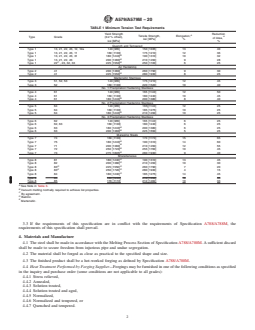
TABLE 1 Minimum Tension Test Requirements
Yield Strength
Reduction
A
Tensile Strength,
Elongation,
A
Type Grade (0.2 % offset),
of Area,
%
ksi [MPa]
%
ksi [MPa]
Quench and Tempered
Type 1 13, 21, 22, 23, 12, 12a 140 [965] 150 [1035] 13 40
Type 1 13, 21, 22, 23, 11 160 [1100] 175 [1210] 12 36
B
Type 1 13, 21, 22, 23, 31 180 [1240] 190 [1310] 10 32
B
Type 1 13, 21, 22, 23 200 [1380] 210 [1450] 9 28
C B
Type 1 22 , 23, 32, 33 225 [1550] 250 [1720] 6 25
Air Hardening
B
Type 2 41 200 [1380] 260 [1790] 9 30
B
Type 2 41 225 [1550] 280 [1930] 8 25
Martensitic Stainless
Type 3 51, 52, 53 140 [965] 175 [1210] 12 45
Type 3 52 160 [1100] 220 [1520] 10 40
No. 1 Precipitation Hardening Stainless
Type 4 61 140 [965] 165 [1140] 12 50
Type 4 61 160 [1100] 180 [1240] 10 45
B
Type 4 61 180 [1240] 200 [1380] 8 40
No. 2 Precipitation Hardening Stainless
Type 5 64 140 [965] 165[(1140] 12 25
Type 5 64 160 [1100] 185 [1275] 10 25
B
Type 5 64 180 [1240] 210 [1450] 10 25
No. 3 Precipitation Hardening Stainless
Type 6 62 140 [965] 165 [1140] 6 25
Type 6 62, 63 160 [1100] 180 [1240] 6 25
B
Type 6 63 180 [1240] 200 [1380] 6 25
B
Type 6 63 200 [1380] 225 [1550] 5 25
Maraging Steels
Type 7 74 160 [1100] 170 [1170] 15 65
B
Type 7 75 180 [1240] 190 [1310] 14 60
B
Type 7 71 200 [1380] 210 [1450] 12 55
B
Type 7 72 250 [1720] 255 [1760] 10 45
B
Type 7 73 275 [1895] 280 [1930] 9 40
Miscellaneous
D
Type 8 81 180 [1240] 190 [1310] 13 45
D
Type 8 82 200 [1380] 210 [1450] 10 30
D D
Type 8 83 225 [1550] 260 [1790] 7 20
E D
Type 8 83 250 [1720] 280 [1930] 4 15
D
Type 8 84 180 [1240] 185 [1275] 14 45
Type 8 85 170 [1172] 212 [1462] 10 33
A
See Note in Table 3.
B
Vacuum melting normally required to achieve list properties.
C
By agreement.
D
Bainitic.
E
Martensitic.
4.4.2 Annealed, 5.2 Product Analysis—The product analysis provisions of
4.4.3 Solution treated, Specification A788/A788M may be used by the purchaser.
4.4.4 Solution treated and aged,
4.4.5 Normalized,
6. Mechanical Properties
4.4.6 Normalized and tempered, or
6.1 The material shall conform to the mechanical properties
4.4.7 Quenched and tempered.
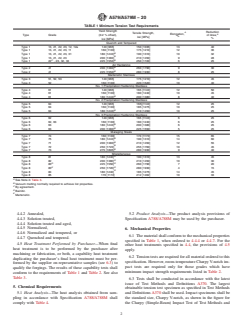
specified in Table 1, when ordered to 4.4.4 or 4.4.7. For the
4.5 Heat Treatment Performed by Purchaser—When final
other heat treatments specified in 4.4, the provisions of 4.5
heat treatment is to be performed by the purchaser after
apply.
machining or fabrication, or both, a capability heat treatment
6.2 Tension tests are required for all material ordered to this
duplicating the purchaser’s final heat treatment must be per-
specification. However, room-temperature Charpy V-notch im-
formed by the supplier on representative samples (see 6.3)to
pact tests are required only for those grades which have
qualify the forgings. The results of these capability tests shall
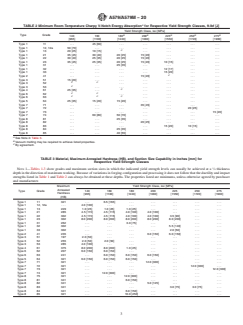
minimum impact strength requirements listed in Table 2.
conform to the requirements of Table 1 and Table 2. See also
Table 3.
6.3 Tests shall be conducted in accordance with the latest
issue of Test Methods and Definitions A370. The largest
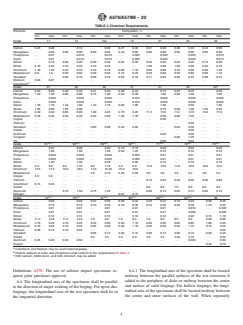
5. Chemical Requirements
obtainable tension test specimen as specified in Test Methods
5.1 Heat Analysis—The heat analysis obtained from sam- and Definitions A370 shall be used. Impact specimens shall be
pling in accordance with Specification A788/A788M shall the standard size, Charpy V-notch, as shown in the figure for
comply with Table 4. the Charpy (Simple-Beam) Impact Test of Test Methods and
A579/A579M − 20
A
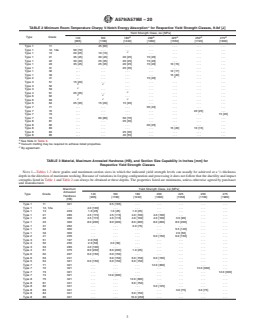
TABLE 2 Minimum Room-Temperature Charpy V-Notch Energy Absorption for Respective Yield Strength Classes, ft·lbf [J]
Yield Strength Class, ksi [MPa]
B B B B B
Type Grade
140 160 180 200 225 250 275
[1240] [1380] [1550] [1720] [1900]
[965] [1100]
Type1 11 . 45[60] . . . . .
Type1 12,12a 50[70] . . . . . .
C
Type 1 13 20 [25] 10 [15] . . . .
Type 1 21 35 [45] 30 [40] 20 [25] 15 [20] . . . . . . . . .
Type 1 22 30 [40] 25 [35] 20 [25] 15 [20] . . . . . . . . .
Type 1 23 35 [45] 25 [35] 20 [25] 15 [20] 10 [15] . . . . . .
Type1 31 . . 25[35] . . . .
Type1 32 . . . . 12[17] . .
Type1 33 . . . . 15[20] . .
C
Type2 41 . . . 15[20] . .
Type3 51 15[20] . . . . . .
CC
Type 3 52 . . . . .
C
Type 3 53 . . . . . .
C
Type 4 61 25 [35] . . . . . . .
CC
Type 6 62 . . . . .
CC C
Type 6 63 . . . .
Type 5 64 25 [35] 15 [20] 15 [20] . . . . . . . . . . . .
Type7 71 . . . 35[45] . . .
Type7 72 . . . . . 20[25] .
Type7 73 . . . . . . 15[20]
Type7 74 . 60[80] 50[70] . . . .
Type8 81 . . 25[35] . . . .
Type8 82 . . . 20[25] . . .
Type8 83 . . . . 15[20] 10[15] .
Type8 84 . . 25[35] . . . .
Type8 85 . . 40[55] . . . .
A
See Note in Table 3.
B
Vacuum melting may be required to achieve listed properties.
C
By agreement.
TABLE 3 Material, Maximum Annealed Hardness (HB), and Section Size Capability in Inches [mm] for
Respective Yield Strength Classes
NOTE 1—Tables 1-3 show grades and maximum section sizes in which the indicated yield strength levels can usually be achieved at a ⁄4 thickness
depth in the direction of maximum working. Because of variations in forging configuration and processing it does not follow that the ductility and impact
strengths listed in Table 1 and Table 2 can always be obtained at these depths. The properties listed are minimums, unless otherwise agreed by purchaser
and manufacturer.
Maximum Yield Strength Class, ksi [MPa]
Annealed
140 160 180 200 225 250 275
Type Grade
Hardness
[965] [1100] [1240] [1380] [1550] [1720] [1900]
(HB)
Type 1 11 321 . . . 6.5 [165] . . . . . . . . . . . . . . .
Type 1 12, 12a . . . 4.0 [100] . . . . . . . . . . . . . . . . . .
Type 1 13 229 1.0 [25] 1.0 [25] 1.0 [25] . . . . . . . . . . . .
Type 1 21 285 4.5 [115] 4.5 [115] 4.0 [100] 4.0 [100] . . . . . . . . .
Type 1 22 302 4.5 [115] 4.5 [115] 4.0 [100] 4.0 [100] 3.5 [90] . . . . . .
Type 1 23 302 8.0 [200] 8.0 [200] 8.0 [200] 8.0 [200] 8.0 [200] . . . . . .
Type1 31 262 . . 3.0[75] . . . .
Type 1 32 302 . . . . . . . . . . . . 5.5 [140] . . . . . .
Type1 33 302 . . . . 2.0[50] . .
Type 2 41 235 . . . . . . . . . 6.0 [150] 6.0 [150] . . . . . .
Type3 51 197 2.0[50] . . . . . .
Type 3 52 255 2.0 [50] 2.0 [50] . . . . . . . . . . . . . . .
Type 3 53 285 4.0 [100] . . . . . . . . . . . . . . . . . .
Type 4 61 375 8.0 [200] 8.0 [200] 1.0 [25] . . . . . . . . . . . .
Type 6 62 207 6.0 [150] 6.0 [150] . . . . . . . . . . . . . . .
Type 6 63 241 . . . 6.0 [150] 6.0 [150] 6.0 [150] . . . . . . . . .
Type 5 64 321 6.0 [150] 6.0 [150] 6.0 [150] . . . . . . . . . . . .
Type 7 71 321 . . . . . . . . . 12.0 [300] . . . . . . . . .
Type 7 72 321 . . . . . . . . . . . . . . . 12.0 [300] . . .
Type 7 73 321 . . . . . . . . . . . . . . . . . . 12.0 [300]
Type 7 74 321 . . . 12.0 [300] . . . . . . . . . . . . . . .
Type 8 75 321 . . . . . . 12.0 [300] . . . . . . . . . . . .
Type 8 81 341 . . . . . . 6.0 [150] . . . . . . . . . . . .
Type 8 82 341 . . . . . . . . . 5.0 [125] . . . . . . . . .
Type 8 83 341 . . . . . . . . . . . . 3.0 [75] 3.0 [75] . . .
Type 8 84 341 . . . . . . 6.0 [150] . . . . . . . . . . . .
Type 8 85 321 . . . . . . 10.0 [250] . . . . . . . . . . . .
A579/A579M − 20
TABLE 4 Chemical Requirements
Elements Composition, %
min max min max min max min max min max min max min max
Grade 11 12 12a 13 21 22 23
Carbon 0.23 0.28 . . . 0.12 . . . 0.20 0.27 0.33 0.31 0.38 0.38 0.43 0.45 0.50
Manganese . . . 0.20 0.60 0.90 0.60 0.90 0.40 0.60 0.60 0.90 0.60 0.90 0.60 0.90
Phosphorus . . . 0.01 . . . 0.010 . . . 0.015 . . . 0.025 . . . 0.025 . . . 0.025 . . . 0.015
Sulfur . . . 0.01 . . . 0.010 . . . 0.015 . . . 0.025 . . . 0.025 . . . 0.025 . . . 0.015
Silicon . . . 0.10 0.20 0.35 0.20 0.35 0.20 0.35 0.20 0.35 0.20 0.35 0.15 0.30
Nickel 2.75 3.25 4.75 5.25 4.75 5.25 . . . . . . 1.65 2.00 1.65 2.00 0.40 0.70
Chromium 1.40 1.65 0.40 0.70 0.40 0.70 0.80 1.10 0.65 0.90 0.70 0.90 0.90 1.20
Molybdenum 0.8 1.0 0.30 0.65 0.30 0.65 0.15 0.25 0.30 0.60 0.30 0.60 0.90 1.10
Vanadium . . . . . . 0.05 0.10 0.05 0.10 0.05 0.10 0.17 0.23 0.05 0.10 0.08 0.15
Niobium/ 0.03 0.07 . . . . . . . . . . . .
A
Columbium
B
Grade 31 32 33 41 51 52 53
Carbon 0.23 0.28 0.40 0.45 0.41 0.46 0.38 0.43 . . . 0.15 0.20 0.25 . . . 0.20
Manganese 1.20 1.50 0.65 0.90 0.75 1.00 0.20 0.40 . . . 1.00 0.50 1.00 . . . 1.00
Phosphorus . . . 0.025 . . . 0.025 . . . 0.025 . . . 0.015 . . . 0.025 . . . 0.025 . . . 0.025
Sulfur . . . 0.025 . . . 0.025 . . . 0.025 . . . 0.015 . . . 0.025 . . . 0.025 . . . 0.025
Silicon 1.30 1.70 1.45 1.80 1.40 1.75 0.80 1.00 . . . 1.00 . . . 0.50 . . . 1.00
Nickel 1.65 2.00 1.65 2.00 . . . . . . . . . . . . . . . 0.75 0.50 1.00 1.25 2.50
Chromium 0.20 0.40 0.65 0.90 1.90 2.25 4.75 5.25 11.5 13.5 11.0 12.5 15.0 17.0
Molybdenum 0.35 0.45 0.30 0.45 0.45 0.60 1.20 1.40 . . . 0.50 0.90 1.25 . . . . . .
Copper . . . . . . . . . . . . . . . . . . . . . . . . . . . 0.50 . . . . . . . . . . . .
Titanium . . . . . . . . . . . 0.05 . .
Vanadium . . . . . . . . . . . . 0.03 0.08 0.40 0.60 . . . . . . 0.20 0.30 . . . . . .
Cobalt . . . . . . . . . . . . . . . . . . . . . . . . . . . . . . . . . 0.25 . . . . . .
Aluminum . . . . . .
...
This document is not an ASTM standard and is intended only to provide the user of an ASTM standard an indication of what changes have been made to the previous version. Because
it may not be technically possible to adequately depict all changes accurately, ASTM recommends that users consult prior editions as appropriate. In all cases only the current version
of the standard as published by ASTM is to be considered the official document.
Designation: A579/A579M − 17a A579/A579M − 20
Standard Specification for
Superstrength Alloy Steel Forgings
This standard is issued under the fixed designation A579/A579M; the number immediately following the designation indicates the year
of original adoption or, in the case of revision, the year of last revision. A number in parentheses indicates the year of last reapproval.
A superscript epsilon (´) indicates an editorial change since the last revision or reapproval.
1. Scope*
1.1 This specification covers requirements for forged steel shapes for highly stressed structural members requiring yield
strengths in excess of 140 ksi [965 MPa].
1.2 This specification is not intended for applications limited by creep deformation.
1.3 Twenty-eight grades are covered by this specification. Selection will depend upon design, service conditions, and
mechanical properties required.
1.4 Supplementary requirements are provided for use when additional testing or inspection is desired. These shall apply only
when specified individually by the purchaser in the order.
1.5 The values stated in either SI units or inch-pound units are to be regarded separately as standard. The values stated in each
system mayare not benecessarily exact equivalents; therefore, to ensure conformance with the standard, each system shall be used
independently of the other. Combiningother, and values from the two systems may result in non-conformance with the
standard.shall not be combined.
1.6 Unless the order specifies the applicable “M” specification designation, the material shall be furnished to the inch-pound
units.
1.7 This international standard was developed in accordance with internationally recognized principles on standardization
established in the Decision on Principles for the Development of International Standards, Guides and Recommendations issued
by the World Trade Organization Technical Barriers to Trade (TBT) Committee.
2. Referenced Documents
2.1 ASTM Standards:
A255 Test Methods for Determining Hardenability of Steel
A275/A275M Practice for Magnetic Particle Examination of Steel Forgings
A370 Test Methods and Definitions for Mechanical Testing of Steel Products
A388/A388M Practice for Ultrasonic Examination of Steel Forgings
A788/A788M Specification for Steel Forgings, General Requirements
E3 Guide for Preparation of Metallographic Specimens
E21 Test Methods for Elevated Temperature Tension Tests of Metallic Materials
E45 Test Methods for Determining the Inclusion Content of Steel
E112 Test Methods for Determining Average Grain Size
E165/E165M Practice for Liquid Penetrant Testing for General Industry
3. Ordering Information and General Requirements
3.1 In addition to the ordering information required by Specification A788/A788M, the purchaser shall include with the inquiry
and order a detailed drawing, sketch, or written description of the forging. Additionally the purchaser shall specify one of the types,
grades, and classes shown in Tables 1-3.
3.2 Material supplied to this specification shall conform to the requirements of Specification A788/A788M.
This specification is under the jurisdiction of ASTM Committee A01 on Steel, Stainless Steel and Related Alloys and is the direct responsibility of Subcommittee A01.06
on Steel Forgings and Billets.
Current edition approved Nov. 1, 2017March 1, 2020. Published November 2017April 2020. Originally approved in 1967. Last previous edition approved in 2017 as
A579/A579M – 17.A579/A579M–17a. DOI: 10.1520/A0579_A0579M-17A.10.1520/A0579_A0579M–20.
For referenced ASTM standards, visit the ASTM website, www.astm.org, or contact ASTM Customer Service at service@astm.org. For Annual Book of ASTM Standards
volume information, refer to the standard’s Document Summary page on the ASTM website.
*A Summary of Changes section appears at the end of this standard
Copyright © ASTM International, 100 Barr Harbor Drive, PO Box C700, West Conshohocken, PA 19428-2959. United States
A579/A579M − 20
TABLE 1 Minimum Tension Test Requirements
Yield Strength
Reduction
A
Tensile Strength,
Elongation,
A
Type Grade (0.2 % offset),
of Area,
%
ksi [MPa]
%
ksi [MPa]
Quench and Tempered
Type 1 13, 21, 22, 23, 12, 12a 140 [965] 150 [1035] 13 40
Type 1 13, 21, 22, 23, 11 160 [1100] 175 [1210] 12 36
B
Type 1 13, 21, 22, 23, 31 180 [1240] 190 [1310] 10 32
B
Type 1 13, 21, 22, 23 200 [1380] 210 [1450] 9 28
C B
Type 1 22 , 23, 32, 33 225 [1550] 250 [1720] 6 25
Air Hardening
B
Type 2 41 200 [1380] 260 [1790] 9 30
B
Type 2 41 225 [1550] 280 [1930] 8 25
Martensitic Stainless
Type 3 51, 52, 53 140 [965] 175 [1210] 12 45
Type 3 52 160 [1100] 220 [1520] 10 40
No. 1 Precipitation Hardening Stainless
Type 4 61 140 [965] 165 [1140] 12 50
Type 4 61 160 [1100] 180 [1240] 10 45
B
Type 4 61 180 [1240] 200 [1380] 8 40
No. 2 Precipitation Hardening Stainless
Type 5 64 140 [965] 165[(1140] 12 25
Type 5 64 160 [1100] 185 [1275] 10 25
B
Type 5 64 180 [1240] 210 [1450] 10 25
No. 3 Precipitation Hardening Stainless
Type 6 62 140 [965] 165 [1140] 6 25
Type 6 62, 63 160 [1100] 180 [1240] 6 25
B
Type 6 63 180 [1240] 200 [1380] 6 25
B
Type 6 63 200 [1380] 225 [1550] 5 25
Maraging Steels
Type 7 74 160 [1100] 170 [1170] 15 65
B
Type 7 75 180 [1240] 190 [1310] 14 60
B
Type 7 71 200 [1380] 210 [1450] 12 55
B
Type 7 72 250 [1720] 255 [1760] 10 45
B
Type 7 73 275 [1895] 280 [1930] 9 40
Miscellaneous
D
Type 8 81 180 [1240] 190 [1310] 13 45
D
Type 8 82 200 [1380] 210 [1450] 10 30
D D
Type 8 83 225 [1550] 260 [1790] 7 20
E D
Type 8 83 250 [1720] 280 [1930] 4 15
D
Type 8 84 180 [1240] 185 [1275] 14 45
Type 8 85 180 [1240] 210 [1450] 10 35
Type 8 85 170 [1172] 212 [1462] 10 33
A
See Note in Table 3.
B
Vacuum melting normally required to achieve list properties.
C
By agreement.
D
Bainitic.
E
Martensitic.
3.3 If the requirements of this specification are in conflict with the requirements of Specification A788/A788M, the
requirements of this specification shall prevail.
4. Materials and Manufacture
4.1 The steel shall be made in accordance with the Melting Process Section of Specification A788/A788M. A sufficient discard
shall be made to secure freedom from injurious pipe and undue segregation.
4.2 The material shall be forged as close as practical to the specified shape and size.
4.3 The finished product shall be a hot-worked forging as defined by Specification A788/A788M.
4.4 Heat Treatment Performed by Forging Supplier—Forgings may be furnished in one of the following conditions as specified
in the inquiry and purchase order (some conditions are not applicable to all grades):
4.4.1 Stress relieved,
4.4.2 Annealed,
4.4.3 Solution treated,
4.4.4 Solution treated and aged,
4.4.5 Normalized,
4.4.6 Normalized and tempered, or
4.4.7 Quenched and tempered.
A579/A579M − 20
A
TABLE 2 Minimum Room-Temperature Charpy V-Notch Energy Absorption for Respective Yield Strength Classes, ft·lbf [J]
Yield Strength Class, ksi [MPa]
B B B B B
Type Grade
140 160 180 200 225 250 275
[1240] [1380] [1550] [1720] [1900]
[965] [1100]
Type 1 11 . . . 45 [60] . . . . . . . . . . . . . . .
Type 1 12, 12a 50 [70] . . . . . . . . . . . . . . . . . .
C
Type 1 13 20 [25] 10 [15] . . . . . . . . . . . .
Type 1 21 35 [45] 30 [40] 20 [25] 15 [20] . . . . . . . . .
Type 1 22 30 [40] 25 [35] 20 [25] 15 [20] . . . . . . . . .
Type 1 23 35 [45] 25 [35] 20 [25] 15 [20] 10 [15] . . . . . .
Type 1 31 . . . . . . 25 [35] . . . . . . . . . . . .
Type 1 32 . . . . . . . . . . . . 12 [17] . . . . . .
Type 1 33 . . . . . . . . . . . . 15 [20] . . . . . .
C
Type 2 41 . . . . . . . . . 15 [20] . . . . . .
Type 3 51 15 [20] . . . . . . . . . . . . . . . . . .
C C
Type 3 52 . . . . . . . . . . . . . . .
C
Type 3 53 . . . . . . . . . . . . . . . . . .
C
Type 4 61 25 [35] . . . . . . . . . . . . . . .
C C
Type 6 62 . . . . . . . . . . . . . . .
C C C
Type 6 63 . . . . . . . . . . . .
Type 5 64 25 [35] 15 [20] 15 [20] . . . . . . . . . . . .
Type 7 71 . . . . . . . . . 35 [45] . . . . . . . . .
Type 7 72 . . . . . . . . . . . . . . . 20 [25] . . .
Type 7 73 . . . . . . . . . . . . . . . . . . 15 [20]
Type 7 74 . . . 60 [80] 50 [70] . . . . . . . . . . . .
Type 8 81 . . . . . . 25 [35] . . . . . . . . . . . .
Type 8 82 . . . . . . . . . 20 [25] . . . . . . . . .
Type 8 83 . . . . . . . . . . . . 15 [20] 10 [15] . . .
Type 8 84 . . . . . . 25 [35] . . . . . . . . . . . .
Type 8 85 . . . . . . 40 [55] . . . . . . . . . . . .
A
See Note in Table 3.
B
Vacuum melting may be required to achieve listed properties.
C
By agreement.
TABLE 3 Material, Maximum Annealed Hardness (HB), and Section Size Capability in Inches [mm] for
Respective Yield Strength Classes
NOTE 1—Tables 1-3 show grades and maximum section sizes in which the indicated yield strength levels can usually be achieved at a ⁄4 thickness
depth in the direction of maximum working. Because of variations in forging configuration and processing it does not follow that the ductility and impact
strengths listed in Table 1 and Table 2 can always be obtained at these depths. The properties listed are minimums, unless otherwise agreed by purchaser
and manufacturer.
Maximum Yield Strength Class, ksi [MPa]
Annealed
140 160 180 200 225 250 275
Type Grade
Hardness
[965] [1100] [1240] [1380] [1550] [1720] [1900]
(HB)
Type 1 11 321 . . . 6.5 [165] . . . . . . . . . . . . . . .
Type 1 12, 12a . . . 4.0 [100] . . . . . . . . . . . . . . . . . .
Type 1 13 229 1.0 [25] 1.0 [25] 1.0 [25] . . . . . . . . . . . .
Type 1 21 285 4.5 [115] 4.5 [115] 4.0 [100] 4.0 [100] . . . . . . . . .
Type 1 22 302 4.5 [115] 4.5 [115] 4.0 [100] 4.0 [100] 3.5 [90] . . . . . .
Type 1 23 302 8.0 [200] 8.0 [200] 8.0 [200] 8.0 [200] 8.0 [200] . . . . . .
Type 1 31 262 . . . . . . 3.0 [75] . . . . . . . . . . . .
Type 1 32 302 . . . . . . . . . . . . 5.5 [140] . . . . . .
Type 1 33 302 . . . . . . . . . . . . 2.0 [50] . . . . . .
Type 2 41 235 . . . . . . . . . 6.0 [150] 6.0 [150] . . . . . .
Type 3 51 197 2.0 [50] . . . . . . . . . . . . . . . . . .
Type 3 52 255 2.0 [50] 2.0 [50] . . . . . . . . . . . . . . .
Type 3 53 285 4.0 [100] . . . . . . . . . . . . . . . . . .
Type 4 61 375 8.0 [200] 8.0 [200] 1.0 [25] . . . . . . . . . . . .
Type 6 62 207 6.0 [150] 6.0 [150] . . . . . . . . . . . . . . .
Type 6 63 241 . . . 6.0 [150] 6.0 [150] 6.0 [150] . . . . . . . . .
Type 5 64 321 6.0 [150] 6.0 [150] 6.0 [150] . . . . . . . . . . . .
Type 7 71 321 . . . . . . . . . 12.0 [300] . . . . . . . . .
Type 7 72 321 . . . . . . . . . . . . . . . 12.0 [300] . . .
Type 7 73 321 . . . . . . . . . . . . . . . . . . 12.0 [300]
Type 7 74 321 . . . 12.0 [300] . . . . . . . . . . . . . . .
Type 8 75 321 . . . . . . 12.0 [300] . . . . . . . . . . . .
Type 8 81 341 . . . . . . 6.0 [150] . . . . . . . . . . . .
Type 8 82 341 . . . . . . . . . 5.0 [125] . . . . . . . . .
Type 8 83 341 . . . . . . . . . . . . 3.0 [75] 3.0 [75] . . .
Type 8 84 341 . . . . . . 6.0 [150] . . . . . . . . . . . .
Type 8 85 321 . . . . . . 10.0 [250] . . . . . . . . . . . .
A579/A579M − 20
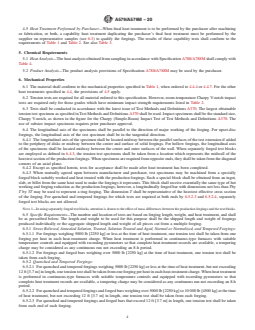
4.5 Heat Treatment Performed by Purchaser—When final heat treatment is to be performed by the purchaser after machining
or fabrication, or both, a capability heat treatment duplicating the purchaser’s final heat treatment must be performed by the
supplier on representative samples (see 6.3) to qualify the forgings. The results of these capability tests shall conform to the
requirements of Table 1 and Table 2. See also Table 3.
5. Chemical Requirements
5.1 Heat Analysis—The heat analysis obtained from sampling in accordance with Specification A788/A788M shall comply with
Table 4.
5.2 Product Analysis—The product analysis provisions of Specification A788/A788M may be used by the purchaser.
6. Mechanical Properties
6.1 The material shall conform to the mechanical properties specified in Table 1, when ordered to 4.4.4 or 4.4.7. For the other
heat treatments specified in 4.4, the provisions of 4.5 apply.
6.2 Tension tests are required for all material ordered to this specification. However, room-temperature Charpy V-notch impact
tests are required only for those grades which have minimum impact strength requirements listed in Table 2.
6.3 Tests shall be conducted in accordance with the latest issue of Test Methods and Definitions A370. The largest obtainable
tension test specimen as specified in Test Methods and Definitions A370 shall be used. Impact specimens shall be the standard size,
Charpy V-notch, as shown in the figure for the Charpy (Simple-Beam) Impact Test of Test Methods and Definitions A370. The
use of subsize impact specimens requires prior purchaser approval.
6.4 The longitudinal axis of the specimens shall be parallel to the direction of major working of the forging. For upset-disc
forgings, the longitudinal axis of the test specimen shall be in the tangential direction.
6.4.1 The longitudinal axis of the specimen shall be located midway between the parallel surfaces of the test extension if added
to the periphery of disks or midway between the center and surface of solid forgings. For hollow forgings, the longitudinal axis
of the specimens shall be located midway between the center and outer surfaces of the wall. When separately forged test blocks
are employed as defined in 6.4.3, the tension test specimens shall be taken from a location which represents the midwall of the
heaviest section of the production forgings. When specimens are required from opposite ends, they shall be taken from the diagonal
corners of an axial plane.
6.4.2 Except as specified herein, tests for acceptance shall be made after heat treatment has been completed.
6.4.3 When mutually agreed upon between manufacturer and purchaser, test specimens may be machined from a specially
forged block suitably worked and heat treated with the production forgings. Such a special block shall be obtained from an ingot,
slab, or billet from the same heat used to make the forgings it represents. This block shall receive essentially the same type of hot
working and forging reduction as the production forgings; however, a longitudinally forged bar with dimensions not less than Tby
T by 3T may be used to represent a ring forging. The dimension T shall be representative of the heaviest effective cross section
of the forging. For quenched and tempered forgings for which tests are required at both ends by 6.5.2.3 and 6.5.2.4, separately
forged test blocks are not allowed.
NOTE 1—In using separately forged test blocks, attention is drawn to the effect of mass differences between the production forgings and the test blocks.
6.5 Specific Requirements—The number and location of tests are based on forging length, weight, and heat treatment, and shall
be
...